‘Sending Flowers’ by Hannah Stephenson

On this Friday of Valentines weekend, a poem that celebrates the work of the florist, in a creative presentment of the vendor/customer relationship. The Friday Poem this week is ‘Sending Flowers’ by Hannah Stephenson.

Sending Flowers

The florist reads faces, reaches into the mouths of customers.
Turns curled tongues into rose petals,

teeth clinking against one another into baby’s breath.
She selects a cut bloom, a bit of leaf,

lays stem alongside of stem, as if building a wrist
from the inside. She binds them

when the message is right, and sighs at the pleasure
of her profession. Her trade:

to wrangle intensity, to gather blooms and say, here,
these do not grow together

but in this new arrangement is language. The florist
hands you a bouquet

yanked from your head, the things you could not say
with your ordinary voice.

Hannah Stephenson

The week@work – Super Bowl@50, Facebook@12 and unemployment@4.9%

This week@work the center of the media universe shifted from Iowa to New Hampshire, and Silicon Valley where, separated by about 12 miles on Highway 101, Levi Stadium in Santa Clara will host the 50th Super Bowl game, and Facebook celebrated it’s twelfth birthday at corporate HQ in Menlo Park. And, in the U.S. the unemployment rate dropped to 4.9%, the lowest since 2008.

In the lead up to the big game there were hundreds of stories about those who choose football as a career, from the high school senior announcing a college choice to the veteran player rewarded with membership in the Football Hall of Fame.

The typical NFL player takes their first step in their career at the annual February ritual, ‘National Signing Day’. It’s the day high school football players sign a ‘Letter of Intent’ to accept an offer of admission and commit to play football at the collegiate level. This year, Tom Brady and Derek Jeter were on hand in Ann Arbor, Michigan to participate in ‘The Signing of the Stars’ “a flamboyant national signing day pep rally streamed live on Wednesday by The Players’ Tribune — the website founded by Jeter, a Michigan native — and intended to build the hype around this year’s class of prospective Wolverines football players.”

Time will tell if the top college recruit, Rashan Gary, from Paramus Catholic High School in New Jersey will advance beyond his playing days at Michigan.

On the other end of the football career spectrum is recognition as an inductee into the NFL Hall of Fame. The class of 2016 includes former Oakland Raiders quarterback, Ken Stabler who let his team to their first Super Bowl victory after the 1976 season.

“While generally a cause for celebration, Saturday’s announcement of the class of 2016 for the Pro Football Hall of Fame carried a somber tone as Ken Stabler, a Super Bowl-winning quarterback for the Oakland Raiders, was elected days after it was publicly revealed that he had had Stage 3 chronic traumatic encephalopathy, or C.T.E., a degenerative brain disease, before his death in July.

Stabler, known as the Snake, who won a Most Valuable Player Award for the 1974 season and led the Raiders to the team’s first Super Bowl victory after the 1976 season, was previously a finalist for election three times, but this year, as a senior candidate, he was elected alongside Dick Stanfel, a star offensive lineman in the 1950s. The modern-era electees were Brett Favre, Marvin Harrison, Kevin Greene, Orlando Pace and Tony Dungy, as well as Edward J. DeBartolo Jr., who owned the San Francisco 49ers for all five of their Super Bowl wins and was elected as a contributor.”

On Wednesday, journalist, John Branch’s profile of Stabler, and his life after football with chronic traumatic encephalopathy (C.T.E.) was published in The New York Times.

“After retiring from football, Stabler worked as a broadcast analyst for the N.F.L. and for the University of Alabama, where he had played quarterback under Coach Bear Bryant. His damaged knees became such a problem in the past 10 years that he rarely ventured out.

“His vision of what a leader is, what a strong person is, is someone who did not show signs of weakness,” said Alexa Stabler, 29, the second of Stabler’s three grown daughters. “Because it would affect the people he relied on and the people he cared about, whether that was his family or his teammates.”

When Stabler was 31, a 1977 Sports Illustrated feature story detailed his penchant for honky-tonks and marinas, usually with a drink in one hand and a pretty woman in the other…He pondered what he might do after football.

“My lifestyle is too rough — too much booze and babes and cigarettes — to be a high school coach,” Stabler said. “I’d hardly be a shining example to the young athletes of the future.”

His family hopes that the most powerful lesson he provides is the one delivered after he was gone.

In between signing day and induction into the Football Hall of Fame, if you’re impossibly lucky, is a chance to compete in the national championship of professional football, the Super Bowl.

The annual spectacle, held this year in the vortex of Silicon Valley has exposed the growing economic divide, “gentrification, sky-high housing prices and the technology industry’s influence on local government, even the nation’s biggest party has become a battleground.”

“The cost of hosting the Super Bowl — estimated at about $5 million for the city — has unleashed a storm of anger among residents already resentful of the influx of expensive restaurants, high-end stores and rich, young tech workers who have snapped up apartments in historically low-income neighborhoods. To tidy up for the tourists, the city’s large homeless population has been swept out of view, which some people here see as evidence that this city, long a seat of leftist activism, has sold itself to corporate interests.

“In San Francisco, we’re supposed to be the bastion of crazy liberals,” Ms. Leitner said. “Instead of raising wages for teachers so they can afford to live here, why are we spending money on a party for people who work for the N.F.L.?”

Fast Company writer, Michael Grothaus marked the birthday celebration on Thursday at Facebook.

“It’s a bit crazy when you think about it, but Facebook is 12 years old today. On February 4, 2004, Mark Zuckerberg launched his fledgling social media site at Harvard. And the rest, as they say, is history. Twelve years on, Facebook has become the largest social media company ever. It influences myriad aspects of our lives and recently passed a billion active users each day.

It’s also kind of doing what candy makers and online retailers have tried to do in the past by deeming February 4th as an unofficial holiday that it hopes catches on: Friend’s Day.”

A look back to the 2004 Harvard Crimson article about ‘thefacebook.com’ may be the best  argument for why venture capitalists should be reading their alma mater’s student newspaper.

“Thousands of students across the country use it. Major corporations are falling over themselves to buy it.

But nearly a semester after creating thefacebook.com, a social networking website launched on Feb. 4, Mark E. Zuckerberg ’06 doesn’t seem to have let things go to his head.

Wearing a yellow t-shirt, blue jeans, and open-toe Adidas sandals, Zuckerberg sits on a ragged couch in the middle of a messy Kirkland House common room, surrounded by strewn clothes and half-closed boxes.

Amidst this squalor, he smiles.

“I’m just like a little kid. I get bored easily and computers excite me. Those are the two driving factors here.”

Thefacebook.com allows university students to create personal profiles listing their interests, contact info, relationship status, classes and more.

It started locally at Harvard. It now has almost 160,000 members from across the country.”

Twelve years later, Thomas Friedman considers the question, ‘Social Media: Destroyer or Creator?’

“Over the last few years we’ve been treated to a number of “Facebook revolutions,” from the Arab Spring to Occupy Wall Street to the squares of Istanbul, Kiev and Hong Kong, all fueled by social media. But once the smoke cleared, most of these revolutions failed to build any sustainable new political order, in part because as so many voices got amplified, consensus-building became impossible.

Question: Does it turn out that social media is better at breaking things than at making things?

Recently, an important voice answered this question with a big “ yes.” That voice was Wael Ghonim, the Egyptian Google employee whose anonymous Facebook page helped to launch the Tahrir Square revolution in early 2011 that toppled President Hosni Mubarak — but then failed to give birth to a true democratic alternative.

“Five years ago,” concluded Ghonim, “I said, ‘If you want to liberate society, all you need is the Internet.’ Today I believe if we want to liberate society, we first need to liberate the Internet.”

Beyond the Super Bowl and Facebook, the economy continues to improve. The jobless rate is under 5% and wages are rising.

“It’s not that the new data blew the lid off expectations or pointed to some radical acceleration in job growth in the opening weeks of 2016. Quite the contrary. The nation added 151,000 jobs in January, which was below analysts’ expectations and well below the revised 262,000 jobs added in December. That looks an awful lot like “reversion to the mean,” and it wouldn’t be surprising if final revisions show a slower pace of job growth across the two months.

But while economists and financial markets have traditionally placed the greatest weight on that payroll number as the key indicator of whether economic growth is speeding up or slowing down, we’re entering a phase where some other components of the jobs report are more important.”

Two additional articles of interest this week profile the executive who created the culture at Netflix and a BBC photo essay on the career dreams of the children who have fled Syria.

‘The Woman Who Created Netflix’s Enviable Company Culture’  Vivian Giang for Fast Company – “The woman behind “Netflix Culture: Freedom & Responsibility” was the company’s chief talent officer at the time, Patty McCord…Instead of listing the company’s core values like every other company was doing, McCord decide to write down the things the company valued, what mattered to them, what they expected in their people.”

‘When I grow up I want to be…’ (BBC) “Despite their current predicament, children who have fled the conflict in Syria and are now living in neighbouring countries dream of what the future holds for them, and the International Rescue Committee (IRC) sent photographer Meredith Hutchison to find out.”

To end this week@work, let me introduce you to Rama, age 13, and her dream of becoming a doctor, as a reminder to honor your dreams.
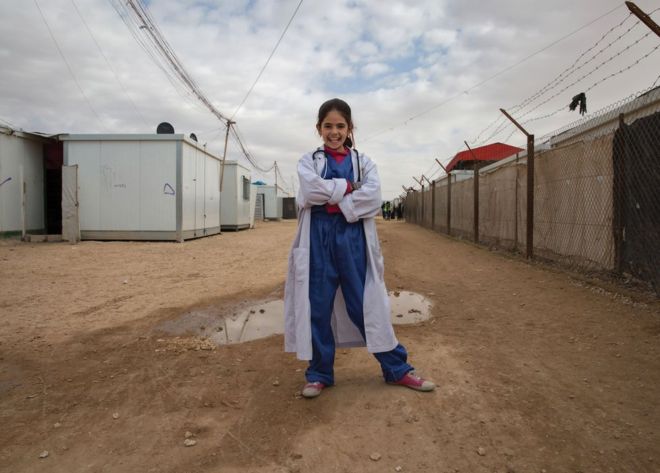
_88034777_a80f7902-6be1-4991-913e-aed456838390.jpg“Walking down the street as a young girl in Syria or Jordan, I encountered many people suffering – sick or injured – and I always wanted to have the power and skills to help them.
“Now, as a great physician in my community, I have that ability. Easing someone’s pain in the most rewarding aspect of my job. To be able to give them relief is the most rewarding aspect of my job. To be able to give them relief and make them smile – this is what I love most.”


 

‘Into the Lincoln Tunnel’ a poem by Deborah Garrison

The Friday Poem this week is for all the commuters who leave New Jersey every day and enter Manhattan via the Lincoln Tunnel. The poet, Deborah Garrison gives voice to the thoughts we sometimes entertain as passengers on a bus, in uncertain times, inhaling the fumes, the indigenous scent of New York Hudson crossings. “…please smile upon these good people who want to enter the city and work. Because work is good…”

Into the Lincoln Tunnel

The bus rolled into the Lincoln Tunnel,
and I was whispering a prayer
that it not be today, not today, please
no shenanigans, no blasts, no terrors,
just please the rocking, slightly nauseating
gray ride, stop and start, chug-a
in the dim fellowship of smaller cars,
bumper lights flickering hello and warning.
Yes, please smile upon these good
people who want to enter the city and work.
Because work is good, actually, and life is good,
despite everything, and I don’t mean to sound
spoiled, but please don’t think I don’t know
how grateful I should be
for what I do have —

I wonder whom I’m praying to.
Maybe Honest Abe himself,
craggy and splendid in his tall chair,
better than God to a kid;
Lincoln whose birthday I shared,
in whom I took secret pride: born, thus I was,
to be truthful, and love freedom.

Now with a silent collective sigh
steaming out into the broken winter sun,
up the ramp to greet buildings, blue brick
and brown stone and steel, candy-corn pylons
and curving guardrails massively bolted and men
in hard hats leaning on resting machines
with paper cups of coffee —

a cup of coffee, a modest thing to ask
Abe for,
dark, bitter, fresh
as an ordinary morning.

Deborah Garrison   ‘The Second Child’   Random House, 2008

workthoughts@one

Happy Groundhog Day! A day immortalized in the 1993 Bill Murray movie, as our national holiday of second chances.

I launched ‘workthoughts’ a year ago, on Groundhog Day, because I believed a blog about work should consider career evolution, lifelong learning and several second chances. It was never meant to be a place to find a job, rather a place to consider choices, share ideas and reconnect with dreams.

‘Workthoughts’ had its origin in a Tuesday afternoon course I taught for college students who were employed as interns for the semester. Most arrived thinking it was a waste of time, an added commitment to an already crowded schedule of classes, commuting and work.

As the semester progressed we dealt with the situations that develop in any workplace: disconnect in expectations, dysfunctional communications, poor leadership, lack of meaningful assignments, and recognition. We also talked about the bigger picture: global trends, leadership, teamwork, generations in the workplace, diversity and gender issues, work/life balance. It was about the humanities and social sciences, and building relationships with mentors, colleagues and clients.

“What would you do if you were stuck in one place and everything was exactly the same and nothing that you did mattered?” (Bill Murray, Groundhog Day)

Success@work begins with a clear understanding of self and a broad knowledge of the world@work. How can you connect the dots if you’re stuck in one place, everything is exactly the same and nothing you do matters?

‘Workthoughts’ provides weekly supplements in the humanities with the ‘Friday Poem’, sampling a variety of lyrical interpretations of work, and ‘The Saturday Read’, a book or long form article recommendation to illuminate the work experience and offer alternate views to problem solving. The ‘week@work’ summarizes selected stories from a variety of journalists and experts. And in-between are the conversations about fun, joy, success, and failure @work.

Work is about relationships. We build them, not on the technical aspects of the work to be accomplished, but on the human connections that grow beyond, in shared interests and experience.

Thank you to all who have connected and shared your ‘workthoughts’ this year. And thank you to all the alumni of MDA 250 – who stay connected, continue to inspire, and know the value of second chances.


The week@work – It’s still 3 minutes to midnight, an engineer’s regret, a world run by millennials and the myth of the ‘best jobs’ lists

This week@work began with the announcement that the ‘Doomsday Clock’ has remained at 3 minutes to midnight, and ended with a remembrance day for NASA astronauts lost. Millennials will soon assume a larger role in global leadership and may move the hands of that clock backward, and ‘astronaut’ does not appear on either list released last week, ranking top jobs for 2016.

“Martyl Langsdorf’s “Doomsday Clock,” which first graced the cover of the Bulletin’s print edition in 1947, has served for 69 years to focus the world’s attention on the most pressing global threats. The time on the Clock reflects whether we are more or less safe than last year, and compares the current situation to years further in the past; the decision on where to set the Clock’s hands is an attempt to reconcile the achievements and breakdowns in security efforts, broadly defined, that occur each and every year.

Last year, the Science and Security Board moved the Doomsday Clock forward to three minutes to midnight, noting: ‘The probability of global catastrophe is very high, and the actions needed to reduce the risks of disaster must be taken very soon.’ That probability has not been reduced. The Clock ticks. Global danger looms. Wise leaders should act—immediately.” Bulletin of the Atomic Scientists, 2016

While many hold personal memories of where we were on January 28, 1986, those closest to the program provide a cautionary tale on leadership, communication and the value of trusting the voice of your employees.

As NASA observed a ‘Day of Remembrance’, NPR correspondent, Howard Berkes, returned to Bringham City, Utah to interview Bob Ebling, ’30 Years After Explosion, Challenger Engineer Still Blames Himself’.

“Thirty years ago, as the nation mourned the loss of seven astronauts on the space shuttle Challenger, Bob Ebeling was steeped in his own deep grief.

The night before the launch, Ebeling and four other engineers at NASA contractor Morton Thiokol had tried to stop the launch. Their managers and NASA overruled them.

That night, he told his wife, Darlene, “It’s going to blow up.”

When Challenger exploded 73 seconds after liftoff, Ebeling and his colleagues sat stunned in a conference room at Thiokol’s headquarters outside Brigham City, Utah. They watched the spacecraft explode on a giant television screen and they knew exactly what had happened.”

The Economist contemplated a new global order when the millennials take charge, ‘When the young get older: their time will come’.

“Where some see a generation in crisis, others think the young are adapting quite well to the challenges of a changing world. They flit from job to job not because they are fickle but because job security is a thing of the past. They demand flexible hours and work-life balance because they know they don’t have to be in the office to be productive. They spend six hours a day online because that is how they work, and also how they relax. Their enthusiasm for new ideas (and lack of spare cash) has kickstarted money-saving technologies from Uber to WhatsApp. They take longer to settle down and have children, but so what? They will also be working far later in life than their parents did.

In every generation, the young are the first to take to the streets to demand reform. Sometimes their fury leads nowhere, but autocrats still fear it. That is why China’s government rolled tanks over the Tiananmen Square protesters, and why it censors social media today. Young Africans, for their part, may not put up indefinitely with gerontocrats such as 91-year-old Robert Mugabe of Zimbabwe and 82-year-old Paul Biya of Cameroon.

In democracies, young people will some day realise that signing online petitions is no substitute for voting (just as their elders started voting when they acquired grey hairs and mortgages and sent their children to government schools). When the young show up at polling stations, democratic governments will heed their views. And when the millennials start calling the shots more widely in society, they will do so for a long time. For thanks to steady advances in medical technology, they will remain healthy and able to work for longer than any previous generation. Indeed, if scientists’ efforts to crack the “ageing code” in human genes bear fruit, many of them will live past 120.”

Where are the jobs? That’s the question the experts try to answer each year, identifying the best jobs and best places to work.

U.S. News and World Report announced their 2016 Best Jobs Rankings and glassdoor.com ranked the 25 Best Jobs in America. Orthodontist, dentist, computer systems analyst, nurse anesthetist and physician assistant led the U.S. News Top 100. The glassdooor.com list’s top five included data scientist, tax manager, solutions architect, engagement manager and mobile developer.

It’s always good to have a snapshot of market driven job titles, but it doesn’t help if your ‘dream job’ doesn’t make the list, or even exist. The myth of these lists lie in the impermanence of work. The top jobs this year may vanish from the list next year. It’s about the work you want to do, and the job title you imagine or may create.

Three additional stories this week were reported by journalists at The New York Times: an analysis of the success of Iowa’s economic development, commentary on the career of a veteran NFL quarterback who found joy in his sport but will now have the long off season to consider lessons from a loss, and advice on how to raise a creative child.

‘In Iowa, Jobs Are Plentiful but Workers Are Not’ Patricia Cohen

“At 3.4 percent, Iowa’s unemployment rate is among the lowest in the country. With major metropolitan areas — crowded with hard-hat construction sites — painting an alluring picture of steady economic progress, business leaders here retain a sunny optimism that is rarely heard from the presidential candidates.

But now that Iowa has achieved a tightening labor market that is the envy of most other states, many companies are confronted with a different set of challenges pushing them to rethink everything from recruiting to economic development.”

‘Carson Palmer’s Memorable Season Ends With a Forgettable Night’  William C. Rhoden

“I’ll look back at this season at some point, but not tonight,” Palmer said. “This is the only game that’s on my mind, not the other 16, 17.”

Despite Sunday’s disaster, this was a season in which Palmer reclaimed some of the joy that the business of football and the grind of the sport had taken away.”

‘How to Raise a Creative Child. Step One: Back Off’  Adam Grant

“Child prodigies rarely become adult geniuses who change the world…What holds them back is that they don’t learn to be original. They strive to earn the approval of their parents and the admiration of their teachers. But as they perform in Carnegie Hall and become chess champions, something unexpected happens: Practice makes perfect, but it doesn’t make new.”