Who will you become? That’s the question we should ask when we consider a new job, but often the promise of a new opportunity obscures the answer until we find ourselves caught in the rip tide of the unconsidered.
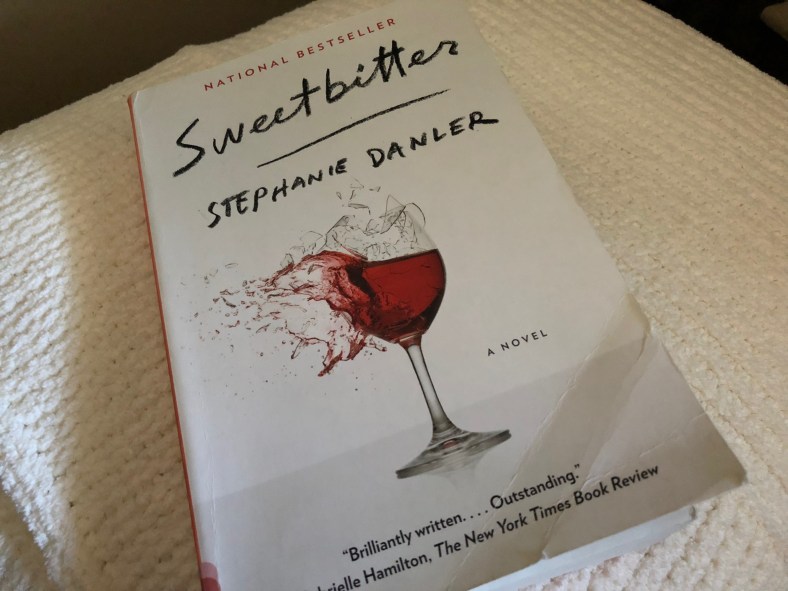
The Saturday Read this week is ‘Sweetbitter’, a novel by Stephanie Danler perfectly captures what it’s like to be 22, taking your first job in New York City.
“Let’s say I was born in late June of 2006 when I came over the George Washington Bridge at seven a.m. with the sun circulating and dawning, the sky full of sharp corners of light, before the exhaust rose, before the heat gridlocked in, windows unrolled, radio turned up to some impossibly hopeful pop song, open, open, open.”
There it is. That moment when we shed one identity and begin to sculpt the new. This is the magic of the author’s prose; transforming the familiar.
Set to debut as a six-part STARZ series on May 6, I encourage you to snag a copy and read this book while imagination is still your own and small screen images can’t get in the way of literary transport.
“…nobody remembers what it feels like to be so recklessly absorbent.
When you can’t see in front of you life is nothing but surprises. Looking back, there were truly so few of them.”
I’m not sure why we rely on non-fiction to inform our knowledge of life@work. Best seller lists are full of management philosophy exuding from ivy covered walls and concrete corporate towers. But it’s the fiction writers who add a touch of imagination and humanity to the workplace, who are the true management gurus.
“I don’t know what it is exactly, being a server. It’s a job, certainly, but not exclusively. There’s a transparency to it, an occupation stripped of the usual ambitions. One doesn’t move up or down. One waits. You are a waiter.”
‘Sweetbitter’ is a book about work and the communities we build around us to manage the connection between self and the enormity of place, in this case, New York City. It’s about expectations colliding with reality in a spot where following your dream invites on-going comparison to an alternate career path.
“We called them the Nine-to-Fivers. They lived in accordance with nature, waking and sleeping with the cycle of the sun. Mealtimes, business hours, the world conformed to their schedule. They were dining, shopping, consuming, unwinding, expanding while we were working, diminishing, being absorbed into their scenery.”
On the last night of her paperback book tour last June, the author read from the novel and shared her own career narrative with a group of readers at independent bookstore, Pages in Manhattan Beach, California.
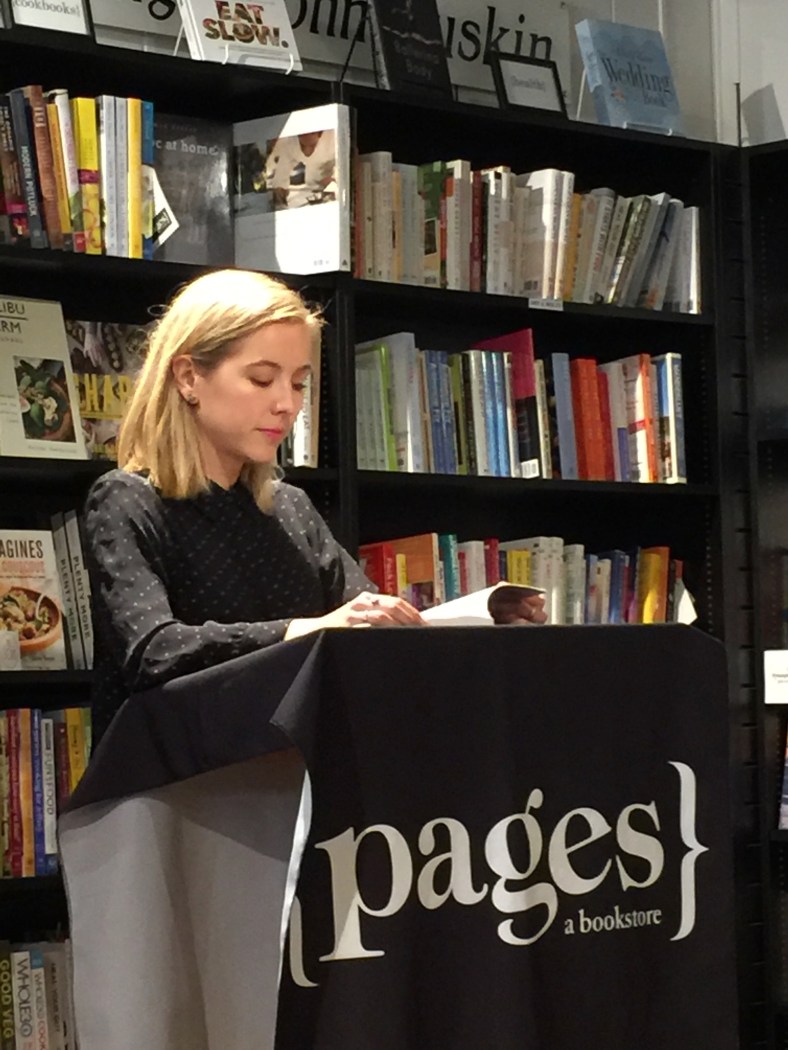
She alluded to similarities with her main character, Tess, and her early career working as a waitress in Seal Beach and later in NY at the Union Square Cafe. “At age 22 you are in the stream of experience, nothing is premeditated; autonomy without consequences. After six months at the Union Square Cafe I was no longer a writer.”
She pursued a successful path in the restaurant industry until she was confronted with “a hinge moment – the crushing feeling in your chest” when you realize your current commitment @work is delaying your dream job.
She applied to graduate school, went back to serving tables, took notes and spent 12 hours on Tuesdays creating a manuscript – ‘Sweetbitter’.
“That is the story of how I stopped waiting tables.”
One more thing, Stephanie Danler is obsessive about poetry. And that’s the strongest argument to read the novel before viewing the series. The book is beautifully written, in one instance transforming the cacophony of random dinner conversation into a poem.
If you’ve ever been a server, this book may stir a memory or two. A restaurant is where many of us started out, absorbing and ignoring life lessons on the fly. It was our workplace and Ms. Danler was one of us.


 “It is hard to evaluate the extent of the problem of the unpaid or badly paid work of these women religious which is in any case barely recognized…Yet it is not only a question of money. The matter of financial compensation constitutes rather the trees which hide the forest of a far greater problem: recognition of how matters stand. So many women religious have the feeling that much is being done to give new value to male vocations but that very little is being done to do the same for female vocations. “Unfortunately behind all this lies the idea that women are worth less than men and, especially, that the priest is all whereas the sister is nothing in the Church.”
 “There’s a movie coming out this month that I’ve been waiting all my life to see: A Wrinkle in Time, based on Madeleine L’Engle’s fantasy novel, which was published in 1962 but is only now receiving its first big-screen adaptation. There was almost no novel to adapt. Twenty-six publishers rejected L’Engle’s manuscript before John Farrar, of Farrar, Straus and Giroux, took it on. You can imagine how A Wrinkle in Time may have perplexed publishers. The plot hinges on shortcuts through the space-time continuum; it leavens its central fight against evil with amusing scenes involving midnight liverwurst sandwiches. But at its core L’Engle’s tale tackles a problem most people have to cope with sooner or later: how to be yourself in a world that prefers conformity.



 workthoughts