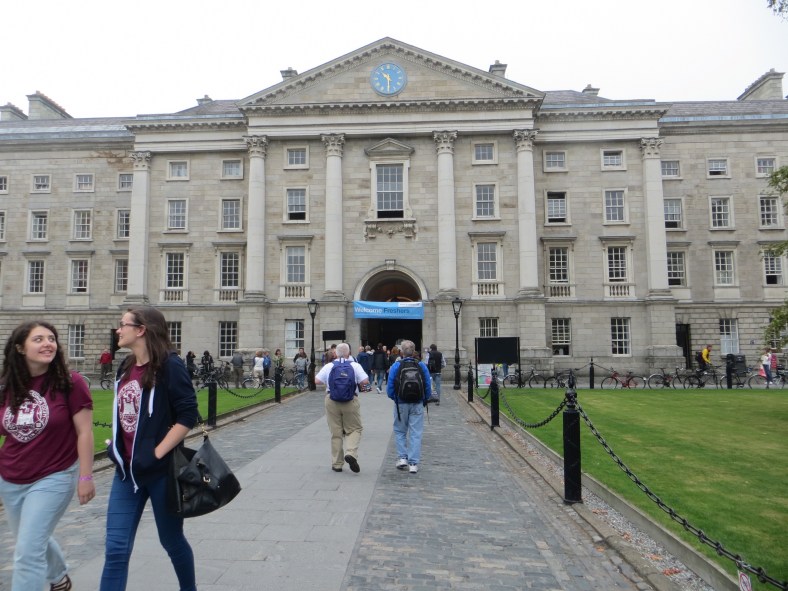
Do business majors have an advantage?

Does a particular major give you an advantage in today’s job market? If you were to look to the enrollments in professional school programs around the country you might come to the conclusion that there is a benefit to these ‘vocational’ programs.

Do you want to be an accountant or an engineer? Do you need an undergraduate business degree to find a job in business? If you want to be a filmmaker and didn’t get into a film program is your career over?

If you’re not planning to be an accountant or an engineer, it really doesn’t matter what you choose as an undergraduate major. What is important is that you choose a major that you enjoy. If you are actively engaged in your studies, you will do well and it will be reflected in your GPA. You should seek out internships that will give you an opportunity to demonstrate the practical application of your education.

David Brooks writing in The New York Times imagined an alternative universe to today’s trend to vocationalize higher education.

“Just once I’d like to have a college student come up to me and say, “I really wanted to major in accounting, but my parents forced me to major in medieval art.”

As I write this I know there are many of you who are doubters. But let’s look at your competition. With the exception of the University of Pennsylvania, none of the Ivy League schools have an undergraduate business major. Employers hiring at those schools are looking at traditional liberal arts majors.

Check out the bios of the folks who are leaders in your particular field. You may be surprised to see how many theater, philosophy and history majors are leading Fortune 500 organizations. And those filmmakers? How many of them have succeeded because they know how to tell a story and select a score to create the perfect visual image without knowing all the technical aspects of film?

The message here is to look at your undergraduate education as a time for intellectual exploration. There are so many career options, even in an economic downturn. It just does not make sense to narrow your choices prematurely. Take electives, get out of your comfort zone. Don’t go for the easy classes, take the ones that challenge you to think and stretch your capabilities. This is what will prepare you for the workplace after graduation.

The Saturday Read – ‘The Martian’ by Andy Weir

Did you want to be an astronaut when you grew up? Maybe you thought about signing up for the one way ticket to inhabit Mars?

The ‘Saturday Read’ this week, ‘The Martian’ by Andy Weir, is another ‘suggested read before you see the movie‘. The novel was described by Joel Achenbach in the Washington Post as the book that may have saved NASA and the entire space program.

There are two career narratives here. The first is the author’s story and the path to publication. The second is the fictional story of Mark Watney, his fellow astronauts and the folks at Mission Control.

On the first page we are introduced to astronaut Watney, on Mars.

“Six days into what should be the greatest month of my life, and it’s turned into a nightmare.” 

Our narrator is a member of the third crew NASA sent to Mars.

“Ares 3. Well, that was my mission. Okay, not mine per se. Commander Lewis was in charge. I was just one of her crew. I would only be ‘in command’ of the mission if I were the only remaining person.

What do you know? I’m in command.”

Have you ever taken part in one of those team building sessions where you are lost at sea with only ten salvaged items? You have to rank order them and imagine how each will improve your chances for survival. ‘The Martian’ is a natural for a new version of imaginary survival training.

“It was a ridiculous sequence of events that led me to almost dying, and an even more ridiculous sequence that led me to surviving.” 

I should mention that these are excerpts from Watney’s log of his time on Mars. For the major portion of the book we follow him as he connects an amazing array of dots to stay alive. This is a book about problem solving and this astronaut makes MacGyver look like an amateur.

For the first 50 pages we are alone with our inventive astronaut as he creates a habitat on an uninhabitable environment.

“So that’s the situation. I’m stranded on Mars. I have no way to communicate with Hermes or Earth. Everyone thinks I’m dead…”

Not so fast…enter Mindy Park at SatCon, NASA.

“Masters degree in mechanical engineering…and I’m working in an all night photo booth.”

Mindy finds signs of life in satellite images and soon the world knows Mark Watney has survived. Here’s the problem. He has to endure 1,412 more days before any possible rescue.

This is also a book about leadership, taking risks, personal sacrifice and exhausting all possible resources to accomplish a goal. It has all the elements of a Harvard business case study, but with a sense of humor.

The ‘other’ career story, of author Andy Weir, was reported by Kelly Dickerson for Business Insider.

“His earlier attempts at writing pretty much flopped, but “The Martian” took off, partly because it captures Weir’s enthusiasm for science and space exploration.

In 2009, Weir started posting the story chapter by chapter on his personal blog where anyone could read it for free. The early version of his self-published book attracted a lot of science-minded readers, and they offered feedback.

Word of the book spread, and readers started asking for an e-reader copy. So Weir made all the individual chapters available in one file. Some had trouble downloading it though, so Weir put it on Amazon via Kindle Direct Publishing.

That’s when the floodgates opened. More people downloaded the 99-cent Amazon version than had ever downloaded the free version, Weir said, and readers started leaving positive reviews on Amazon. In just a few months it skyrocketed to the top of Amazon’s best-selling science fiction list.

So a book agent got in touch with Weir. Shortly after that, the publishing company Random House called — it wanted to publish a hardcover.

Four days later, Hollywood called for the movie rights…”

Bring-Him-Home-The-Martian

And in case you thought it was just a novel or a movie… Entrepreneur Elon Musk posted a photo on Twitter this week of his Dragon Spacecraft landing on the red planet. Enjoy the ‘Saturday Read’ – ‘The Martian’.

elonmusk dragon

‘A Man May Change’ a poem by Marvin Bell

Every four years we discover Iowa through the lens of the presidential primary. This week’s Friday Poem comes from Iowa’s first poet laureate, Marvin Bell. He was on the faculty of the University of Iowa until 2005 and toured with the garage band of authors, ‘The Rock Bottom Remainders’.

In a world of work where change is a constant, we may miss the slow erosion of self@work. “…it sometimes happens that a man has changed so slowly that he slips away before anyone notices and lives and dies before anyone can find out.”

A Man May Change

As simply as a self-effacing bar of soap
escaping by indiscernible degrees in the wash water
is how a man may change
and still hour by hour continue in his job.
There in the mirror he appears to be on fire
but here at the office he is dust.
So long as there remains a little moisture in the stains,
he stands easily on the pavement
and moves fluidly through the corridors. If only one
cloud can be seen, it is enough to know of others,
and life stands on the brink. It rains
or it doesn’t, or it rains and it rains again.
But let it go on raining for forty days and nights
or let the sun bake the ground for as long,
and it isn’t life, just life, anymore, it’s living.
In the meantime, in the regular weather of ordinary days,
it sometimes happens that a man has changed
so slowly that he slips away
before anyone notices
and lives and dies before anyone can find out.

Marvin Bell  Nightworks: Poems 1962-2000