Can the ‘talking cure’ reconnect ‘a band of tweeters’?

It’s one thing for us to tolerate distraction in the workplace as devices buzz and chime through meetings, but it’s a bit more unnerving to consider the scenario described by a U.S. Army major as soldiers returning from a combat mission opt out of conversation and sit “silently in front of computer screens, posting about their day on Facebook”.

John Spencer is the Army major expressing concern over how “global connectedness has altered almost every facet of a soldier’s daily life”.

“The term “band of brothers” has become almost a cliché to describe how the close personal bonds formed between soldiers translate into combat effectiveness. Yet my combat experience in Iraq suggests that the kind of unit cohesion we saw in past wars may be coming undone because of a new type of technological cohesion: social media, and too much connectivity.”

It’s one more example to support the 30 years of research conducted by MIT professor, Sherry Turkle.

“We’ve gotten used to being connected all the time, but we have found ways around conversation — at least from conversation that is open-ended and spontaneous, in which we play with ideas and allow ourselves to be fully present and vulnerable. But it is in this type of conversation — where we learn to make eye contact, to become aware of another person’s posture and tone, to comfort one another and respectfully challenge one another — that empathy and intimacy flourish. In these conversations, we learn who we are.”

Professor Turkle cites the research of Howard Gardner and Katie Davis on what they call the “app generation,” which grew up with phones in hand and apps at the ready. It tends toward impatience, expecting the world to respond like an app, quickly and efficiently. The app way of thinking starts with the idea that actions in the world will work like algorithms: Certain actions will lead to predictable results.”

Which brings us back to 2008 and Major Spencer’s observations of his ‘band of tweeters’.

“In 2008, I saw the soldiers’ individuality in battle. I saw them arguing about what decisions to make. I often observed much more transactional communications where there would have been friendly banter in the past. Groups seemed unable to learn from their daily challenges or direct any intergroup policing of individual actions. I saw these things especially in the younger soldiers.”

He goes on to emphasize the importance of motivation and social cohesion for any large organization, but identifies the need for conversation as critical in the military workplace.

“What all of the research highlights is the importance of conversation during noncombat time — the hours of nothingness, the shared boredom — where bonds of trust, friendships and group identity are built.”

Most of us go to work in a place where guns and ammo are not part of our daily existence. But the risks to our health and well-being might be in equal jeopardy when we multi-task, “always available elsewhere”.

At the end of his essay, Major Spencer suggests “developing structures to organize the social interactions and conversations that used to occur spontaneously. This would include requiring soldiers to hold post-patrol gatherings on top of their usual mission reviews. This debriefing concept is very effective within other organizations. I would also shift the trend from small two- to four-man living spaces and increase them to four to six, both in stateside bases and especially in combat.”

And leave the devices in another room. Disconnected, we can reestablish conversation.

Professor Turkle cites psychologist Yalda T. Uhls’ research with children at a ‘device free’ camp, demonstrating our capacity for resilience when we untether for a period of time.

“After five days without phones or tablets, these campers were able to read facial emotions and correctly identify the emotions of actors in videotaped scenes significantly better than a control group. What fostered these new empathic responses? They talked to one another. In conversation, things go best if you pay close attention and learn how to put yourself in someone else’s shoes. This is easier to do without your phone in hand. Conversation is the most human and humanizing thing that we do.”

“Conversation is the antidote to the algorithmic way of looking at life because it teaches you about fluidity, contingency and personality.”

Our technology alerts us to ‘recalculate’ when we choose to diverge from the programmed path. It’s another ownership issue of our humanity, to take back control of conversation in a ‘tech free’ space.

“This is our moment to acknowledge the unintended consequences of the technologies to which we are vulnerable, but also to respect the resilience that has always been ours. We have time to make corrections and remember who we are — creatures of history, of deep psychology, of complex relationships, of conversations, artless, risky and face to face.”

And for our ‘band of brothers’ (and sisters) –

“… the benefits of hyper-connectivity for individual soldiers shouldn’t outweigh the collective costs of social cohesion…”

The Saturday Read – ‘Dear Committee Members’ by Julie Schumacher

Have you ever considered a life as a university professor? For those outside the ivory tower, it seems an idyllic career: contemplating great thoughts, teaching a few classes, and travelling the world on sabbatical.

This week’s ‘Saturday Read’ is required reading for anyone planning to spend an extended period of time on a college campus. University of Minnesota professor Julie Schumacher has written a valuable and humorous addition to the canon of university life with ‘Dear Committee Members’.

If your workplace is academia, you are familiar with letters of reference. In this novel of university life, creative writing and literature professor Jason Fitger narrates a year in his life via a variety of LORs, written to advance his personal agenda and the careers of colleagues and students.

Brock Clarke’s review of the book cited the author’s choice of structure as one of its strengths.

“…Schumacher also brilliantly uses the epistolary form to show Jay’s desperation in the face of his crumbling university, career, life. In all this, her scabrous book reminds me of Sam Lipsyte’s “Home Land,” Richard Russo’s “Straight Man” and Jincy Willett’s “Winner of the National Book Award.” If you didn’t find those books funny, well, that means you’re a corpse. But you’re also, apparently, a corpse who reads, so there’s hope for you yet. You should read “Dear Committee Members”; maybe it will bring you back to life.”

The story tracks with the academic calendar and begins with our fearless professor writing a letter of recommendation for a grad student, followed by another providing an assessment of the current state of affairs to the department chair.

“…more that a third of our faculty now consists of temporary (adjunct) instructors who creep into the building under cover of darkness to teach graveyard shifts of freshman comp; they are not eligible to vote or serve…the remaining two-thirds of the faculty, bearing the scars of disenfranchisement and long-term abuse, are busy tending to personal grudges like scraps of carrion on which they gnaw in the gloom of their offices…after subtracting the names of those who are on leave or close to retirement, and those already serving in the killing fields of administration…”

Only an insider could provide this accurate summation of the state of the university today. This is not breaking news to those inside the ivy walls, but serves as a reality check to those aspiring to an academic career.

The author provides one of the most compelling arguments for the liberal arts in Jason’s letter of recommendation to fictional Bridget Maslow at Addistar Network, Inc. And gives any of you english majors out there the perfect words for your cover letter.

“Belatedly it occurs to me that some members of your HR committee, a few skeptical souls, may be clutching a double strand of worry beads and wondering aloud about the practicality or usefulness of a degree in English rather than, let’s say, computers. Be reassured: the literature students has learned to inquire, to question, to interpret, to critique, to compare, to research, to argue, to sift to analyze, to shape, to express. His intellect can be put to broad use. The computer major, by contrast is a technician – a plumber clutching a single, abeit shining, box of tools.”

‘Dear Committee Members’ is a story of one man’s career/life choices. At the end, you just may want to consider a university as your workplace. Where else can you work where one quarter of the population are newbies and you have the opportunity to start over every autumn?

“There is nothing more promising or hopeful than the start of the academic cycle: another chance for self-improvement, for putting into practice what one learned – or failed to learn – during the previous year.”

Restarting the global conversation about women

Sixty-two million girls across the globe are not attending school today. Sixty-two million dreams will never be realized. Those who advocate for access to schooling do so at a significant risk to themselves and their families. It’s not just about education, but values, attitudes and beliefs.

Last weekend the movie ‘Suffragette’ was released in theaters in the U.S. It’s a fictionalized story of the fight for women’s right to vote in Great Britain in the years between 1911 and 1913.

In a ‘CBS This Morning’ interview, actress Carey Mulligan discussed her role and how little she knew of the historical facts, prior to filming, with co-anchor Nora O’Donnell.

“I knew a sort of really basic school version which is a little paragraph in our history book saying, you know, ‘Women got the vote eventually,”‘ Mulligan said, laughing. “Somehow. It was a couple of lines and, you know, lots of images of women with flowers looking very peaceful.”

“I left school and I voted because my parents voted. But I didn’t really understand the weight of what I had with my vote,” she said.

This past Tuesday was election day and I was tempted to opt out, thinking there were no major initiatives on the ballot. But then I remembered the Carey Mulligan interview and the history of women who sacrificed so much so that I could have the opportunity to vote.

Along with suffrage, women have a right to education. The absence of one or both, excludes women from the global conversation.

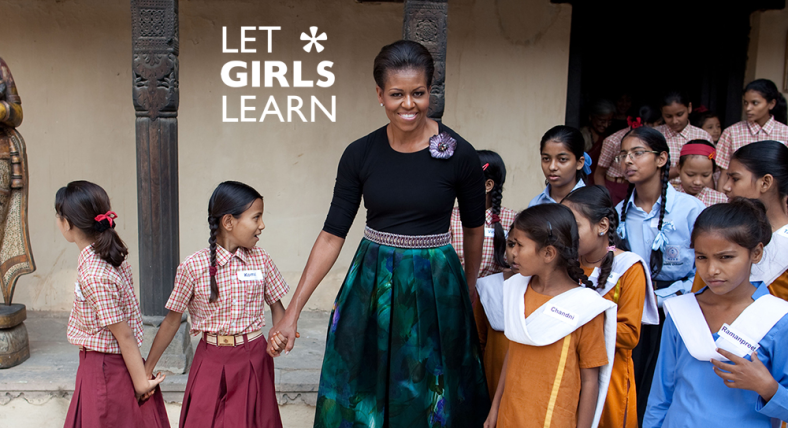
On Wednesday First Lady Michele Obama addressed the World Innovation Summit for Education in Doha, Qatar and introduced her initiative, ‘Let Girls Learn’.

“If we truly want to get girls into our classrooms, then we need to have an honest conversation about how we view and treat women in our societies,” she told an international education conference. “And this conversation needs to happen in every country on this planet, including my own.”

“I don’t think it’s an accident” that girls who want to attend secondary school are threatened. When girls are young, she said, “they are often seen simply as children. But when they hit adolescence and they start to develop into women and are suddenly subject to all of their society’s biases around gender, that is precisely when they start to fall behind in their education.”

“It’s about whether parents think their daughters are as worthy of an education as their sons. It’s about whether our societies cling to outdated laws and traditions that oppress and exclude women, or whether their views of women are as full citizens entitled to equal rights.”

I live in a country that failed to pass an equal rights amendment for women in the seventies. The amendment was written in 1923 by Alice Paul, a suffragist leader, after U.S. women won the right to vote in 1920.

“The ERA was introduced into every Congress between 1923 and 1972, when it was passed and sent to the states for ratification. The original seven-year time limit in the ERA’s proposing clause was extended by Congress to June 30, 1982, but at that deadline, the ERA had been ratified by 35 states, three states short of the 38 required to put it into the Constitution.”

It’s time to restart the global conversation about women. Let’s begin at home and honor the suffragettes of the early 20th century, and the global heroines of the 21st.

It’s not just millennials – we all want to learn and grow @work

“How Do Employers Retain Job-Hopping Millennial Employees?” That was the question posed on Quora.com earlier this week. After reading the response from millennial entrepreneur, Elijah Medge, posted on Slate.com, I realized that what we want from work is not a generational issue, we all have similar expectations @work: to learn, grow and be challenged in an “awesome work environment”.

The American worker is tired of hearing about the ‘outrageous expectations’ of the millennial generation.

Instead, let’s step back and thank the millennials for their workplace vision that demands a voice in decision making, requires meaning @work, invites a diverse set of views and creates a bit of fun on the way to productivity.

There will always be a clash between employer and employee expectations when the process lacks honesty. Employers are scrambling to create ‘band aids’ to attract new hires. Job candidates, anxious to please a potential employer, play the game to get the offer, only to depart in a few months when promise and reality don’t match.

Media reports are full of stories of companies trying a variety of experiments to entice millennials to sign on the dotted line. There is no considered approach, just a bunch of ideas being thrown at the wall to see if any stick. The most recently publicized, ‘unlimited vacation time’.

Mr. Medge’s suggestions remind us that a fundamental tenet of management is ‘keep it simple’:

“Facilitate team bonding outside of the office.”

“Mix it up and have a little fun.”

“Take the time to coach, train, and develop successful mentalities.”

“Offer awesome incentives.”

“Encourage learning and mistakes.”

“Don’t micromanage.”

“Consistently recognize top performers.”

“Talk to your people about their goals.”

Do you see anything here that’s generation specific?

When corporate contracts with workers began to disintegrate in the late ’70s, members of the greatest generation and baby boomers were forced to rethink their relationship with the workplace. The disruption of downsizing signaled the end of ‘job stability’.

The level of workplace disruption came as a shock. Those generations were new at this and slow to respond. They had families and mortgages and the risks were too high to challenge the status quo, even thought the status quo had been shattered. The economy was changing and maintaining a standard of living required two incomes.

In contrast, today’s new workers, although saddled with debt, have few other ties. They are the ‘free agents’ of the contemporary workplace and they have watched previous generations, their parents and grandparents, and concluded there is a better way to work.

Let’s engage all workers in conversation about work culture that incorporates Mr. Medge’s common sense components.

The question of employee retention crosses all generations @work: the leaders, the mentors and the newbies. Calibrate the expectations of all members of the workplace community, align with the organization’s culture and restore credibility into the recruitment and retention process.

The ‘gig economy’ and ‘the new romantics’

The ground is shifting the foundations of our world@work. New economic models are emerging of mosaic careers where freelancing is the predominant driver of income. In order to flourish workers will have to reimagine their life@work and add skills previously delivered through full time employers. This is the conversation that should be taking place in corporate boardrooms, university classrooms, state legislatures and presidential debates.

Don’t believe me? How did you get to work? Uber? Where did you stay on vacation? Airbnb?

The initial repercussions of the new world@work are being felt in the halls of justice as folks try to fit old definitions of work and workers into new, entrepreneurial business models.

Sarah Kessler writing for Fast Company summarized the dilemma.

“What’s at stake with these lawsuits and protests? The very definition of “employee” in a tech-enabled, service-driven 21st century American economy. Gig economy companies do not own cars, hotels, or even their workers’ cleaning supplies. What they own is a marketplace with two sides. On one side are people who need a job done—a ride to the airport, a clean house, a lunchtime delivery. On the other are people who are willing to do that job. If Uber and other companies are going to be as big as some claim, a new deal has to be brokered, one that squares the legal rules governing work with new products and services. What benefits can you expect from a quasi-employer? What does it mean to be both independent and tethered to an app-based company? The social contract between gig economy workers and employers is broken. Who will fix it, and how, will determine the fate of thousands of workers and hundreds of millions of dollars.”

James Surowiecki writing in The New Yorker described just how difficult it is to define the difference between an employee and an independent contractor.

“We hear a lot these days about the gig economy, but the issue of whether a worker is an employee or an independent contractor has been the subject of intense legal battles for decades. The distinction can be surprisingly hard to make. The I.R.S. has a list of twenty factors that it takes into account, but other federal agencies have different criteria, as do most states. The fundamental issue is usually whether an employer has “control” over the work being done, but defining control isn’t always easy.”

This is where it begins in the U.S., in the court system. Meanwhile, entrepreneurs will continue to connect clients with products and hire workers who will supplement their income performing a variety of part-time professional services. Eventually the laws will catch up with the workplace reality. But in the interim, universities have to decipher the emerging skill set and prepare the next generation of workers for success.

Joseph Aoun, President of Northeastern University in Boston conducted an informal survey of the university community, tweeting the question, “What skills will graduates need for success in the gig economy?”

“…we can see five skills that will be invaluable for thriving in the gig economy:

Generativity: How to create something unique, be it a product, a service, or an idea. E.g., coming up with the idea for a widget.

Entrepreneurship: How to spot an opportunity and act on it effectively. Discovering a market for widgets.

Originality: How to view an existing subject through an unexpected lens. Realizing that the widget can be made more sustainably from recycled water bottles.

Interdisciplinary thought: How to bridge concepts from different fields to form new ideas. Combining engineering and design so that the widget is not only functional, but beautiful.

Dealing with ambiguity: How to confidently address a problem with no clear solution, often by using a blend of experience, intuition, and grasp of human nature. Faced with plunging stock prices, reinventing the company as a widget-sharing app.”

The ‘new gig workers’ will also need a basic understanding of business law and finance. Arun Sundararajan writing in The Guardian assesses the micro and macro implications of the new model.

“There’s certainly something empowering about being your own boss. With the right mindset, you can achieve a better work-life balance. But there’s also something empowering about a steady pay cheque, fixed work hours and company-provided benefits. It’s harder to plan your life longer term when you don’t know how much money you’re going to be making next year.”

In many countries, key slices of the social safety net are tied to full-time employment with a company or the government. Although the broader socioeconomic effects of the gig economy are as yet unclear, it is clear we must rethink the provision of our safety net, decoupling it from salaried jobs and making it more readily available to independent workers.”

Fundamentally, the new ‘gig worker’ will focus on human interaction vs. transactional activities. We are back to the core curriculum of a liberal arts education. The lawyers, politicians and business folk will figure out the structure and protections. The humanists will find job security in the ‘gig economy’.

David Brooks writing in The New York Times imagines the new world@work.

“What are the activities that we humans, driven by our deepest nature or by the realities of daily life, will simply insist be performed by other humans?”

“Secure workers will combine technical knowledge with social awareness — the sort of thing you get from your genes, from growing up in a certain sort of family and by widening your repertoire of emotions through reflection, literature and a capacity for intimacy.”

“I could imagine a time when young thinkers discard the strictures of the academic professionalism and try to revive the model of the intellectual as secular sage. I could see other young people tiring of résumé-building do-goodism and trying to live more radically for the poor. The romantic tries as much as possible to ground his or her life in purer love that transforms — making him or her more inspired, creative and dedicated, and therefore better able to live as a modern instantiation of some ideal.”

Gig learning is lifelong learning. We will need leaders in both education and business who will welcome the feedback of their constituencies and be nimble in their response to a world@work that is driven by human interaction in the relational and supported by technology in the transactional.

Do business majors have an advantage?

Does a particular major give you an advantage in today’s job market? If you were to look to the enrollments in professional school programs around the country you might come to the conclusion that there is a benefit to these ‘vocational’ programs.

Do you want to be an accountant or an engineer? Do you need an undergraduate business degree to find a job in business? If you want to be a filmmaker and didn’t get into a film program is your career over?

If you’re not planning to be an accountant or an engineer, it really doesn’t matter what you choose as an undergraduate major. What is important is that you choose a major that you enjoy. If you are actively engaged in your studies, you will do well and it will be reflected in your GPA. You should seek out internships that will give you an opportunity to demonstrate the practical application of your education.

David Brooks writing in The New York Times imagined an alternative universe to today’s trend to vocationalize higher education.

“Just once I’d like to have a college student come up to me and say, “I really wanted to major in accounting, but my parents forced me to major in medieval art.”

As I write this I know there are many of you who are doubters. But let’s look at your competition. With the exception of the University of Pennsylvania, none of the Ivy League schools have an undergraduate business major. Employers hiring at those schools are looking at traditional liberal arts majors.

Check out the bios of the folks who are leaders in your particular field. You may be surprised to see how many theater, philosophy and history majors are leading Fortune 500 organizations. And those filmmakers? How many of them have succeeded because they know how to tell a story and select a score to create the perfect visual image without knowing all the technical aspects of film?

The message here is to look at your undergraduate education as a time for intellectual exploration. There are so many career options, even in an economic downturn. It just does not make sense to narrow your choices prematurely. Take electives, get out of your comfort zone. Don’t go for the easy classes, take the ones that challenge you to think and stretch your capabilities. This is what will prepare you for the workplace after graduation.

The week@work – College choice & future earnings, friends@work, ‘ambition’ and a networking mindset

This week@work we learned that future earnings @work is affected by where you attended college. In the workplace, it’s not so easy to make friends@work, ‘ambition’ can be an insult and a networking mindset is about authenticity and generosity.

The New York Times contributor Kevin Carey reported on ‘Gaps in Earnings Stand Out in Release of College Data’. Analyzing the data from the federal government’s ‘College Scorecard’ he found not only a disparity in earnings between elite college grads and second tier universities, but also a gender gap in earnings among alumni of those elite colleges.

“The data reveals how much money students are borrowing in exchange for earnings after graduation. While U.C.L.A. and Penn State are both prestigious public research universities, recent U.C.L.A. grads leave with about 30 percent less debt, even as their predecessors are earning about 30 percent more money than counterparts at Penn State. Harvard students borrow barely a quarter of what Brandeis students take on, and earn nearly twice as much.

The return is unequal in other ways. There is an earnings gender gap at every top university. The size of the difference varies a great deal. At Duke, for example, women earned $93,100 per year on average, compared with $123,000 for men, a difference of $29,900. At Princeton, men earned more and women earned less, for a difference of $47,700. Women who enrolled at Cornell earned more than women who enrolled at Yale.”

Let’s imagine you have landed a great job, what are your expectations of the workplace? Do you want to socialize with colleagues?

University of Pennsylvania professor Adam Grant asked the question, ‘can work colleagues be friends?’

“Once, work was a major source of friendships. We took our families to company picnics and invited our colleagues over for dinner. Now, work is a more transactional place. We go to the office to be efficient, not to form bonds. We have plenty of productive conversations but fewer meaningful relationships. 

It’s not that Americans are less concerned with relationships overall. We’re social creatures outside work, yet the office interaction norm tends to be polite but impersonal. Some people think pleasantries have no place in professional meetings.

Why are Americans so determined to get down to business?

The economic explanation is that long-term employment has essentially vanished: Instead of spending our careers at one organization, we expect to jump ship every few years. Since we don’t plan to stick around, we don’t invest in the same way. We view co-workers as transitory ties, greeting them with arms-length civility while reserving real camaraderie for outside work.

Some observers blame the rise of flextime and virtual work. When more people are working remotely, we have fewer chances for the face-to-face encounters that are so critical to companionship. But a comprehensive analysis of 46 studies of over 12,000 employees demonstrated that as long as people were in the office for at least two and a half days per week, “telecommuting had no generally detrimental effects on the quality of workplace relationships.”

If you don’t build relationships @work, how will you navigate the corporate culture? How will you understand how to motivate a diverse workforce? How will you learn that the word ‘ambition’ is one of those code words with different meaning for men and women?

Kristin van Ogtrop, editor of Real Simple magazine reported on the results of a poll conducted by Real Simple and Time magazine exploring how men and women define success and ambition.

“When it comes to success in corporate America, context trumps competence. Lisa Shalett, now the chief marketing officer of The Odyssey, a social content platform, recently concluded a 20-year career at Goldman Sachs with both a highly sought-after partner title and the wisdom of experience regarding what women must do to thrive in a male environment. “Ambition,” says Shalett, “needs care and feeding, having the kind of informal relationships where you understand ‘How do I navigate this path, what do I need to know, how can I get there?’ Men tend to be ambitious for things, for positions, for titles, for results. Women tend to be ambitious to be recognized for performance, to be valued, to be included, and maybe expect that good things will come from that.”

“Barnard president Debora Spar believes entrepreneurial has replaced ambitious for a new generation. “I don’t think anyone has ever come in my office and said, ‘I’m ambitious.’ Everyone I know is ‘entrepreneurial.’” And now a number of ambitious women are simply channeling their dissatisfaction with traditional corporate life into fast-growing new businesses.”

The key to building and sustaining relationships in the workplace is networking. Our attempts to reach out may fail and it may be because we are a bit too focused on our side of the equation.

CEO and co-founder of Alumnify, AJ Agrawal shared his thoughts on ‘How to Develop a Networking Mindset’.

“Over and over again, we hear about the importance of having connections to get ahead in business and in life. “It’s not what you know, it’s who know” as the famous saying goes. While people repeat this all the time, it questions the meaning behind relationships. Do we make connections because we like the person’s work and ideals, or because we think they can help us?

To build a strong network, as (Sar) Haribhakti puts it, your mindset should be focused on initiating relationships with authenticity and generosity. People always tend to capitalize on what they think the other person might be offer them for achieving their personal goals, growing their businesses, or get an introduction to an influential person. He thinks what most people fail to realize is that every human has an innate desire of being appreciated and valued.”

One additional article of interest on the topic of professional development:

‘Teaching Tech Skills to Millions, And Fast’ – on-line degree provider,Udacity partnered with technology companies to create online courses geared toward teaching a set of discrete, highly prized technical skills — including mobile programming, data analysis and web development. Students who complete these courses are awarded the nanodegree, a credential that Udacity has worked with Google, AT&T and other companies to turn into a new form of workplace certification.”

The week@work – The time we spend @work, unpaid interns@the UN, no union for college football and the value of one good friend

Sarah Boseley reported on Wednesday on the health risks of working long hours for The Guardian newspaper in the UK.

“The largest study conducted on the issue, carried out in three continents and led by scientists at University College London, found that those who work more than 55 hours a week have a 33% increased risk of stroke compared with those who work a 35- to 40-hour week. They also have a 13% increased risk of coronary heart disease.

The findings will confirm the assumptions of many that a long-hours culture, in which people work from early in the morning until well into the evening, with work also intruding into weekends, is potentially harmful to health.”

During a discussion of these findings on CBS This Morning, co-anchor Charlie Rose turned the conversation to a discussion of how we define work.

“For some people reading a lot is play and pleasure. For others it’s work. It’s part of what they do and how they spend their time. It’s one thing to be on an assembly line, I think, and another thing to be reading a novel in preparation to interview someone. 

Where do we draw the line? Is there a line? That is the topic of the next article this week@work.

The New Yorker writer, Tim Wu thinks ‘You Really Don’t Need To Work So Much’. He questions why we have allowed ourselves to become players in “a football game where the whistle is never blown”. His solution, work should fulfill society’s needs with minimal effort. Let the workaholics have their fun, but not at the expense of the rest of us.

“The past fifty years have seen massive gains in productivity, the invention of countless labor-saving devices, and the mass entry of women into the formal workforce. If we assume that there is, to a certain degree, a fixed amount of work necessary for society to function, how can we at once be more productive, have more workers, and yet still be working more hours? Something else must be going on.”

“…in white-collar jobs, the amount of work can expand infinitely through the generation of false necessities—that is, reasons for driving people as hard as possible that have nothing to do with real social or economic needs.”

“The antidote is simple to prescribe but hard to achieve: it is a return to the goal of efficiency in work—fulfilling whatever needs we have, as a society, with the minimal effort required, while leaving the option of more work as a hobby for those who happen to love it.”

Does society need more unpaid interns? Apparently the United Nations thinks so and has grown their ‘volunteer workforce’ from 131 in 1996 to over 4,000 worldwide this year. ‘The Economist Explains why the UN doesn’t pay it’s interns’.

“The story of an unpaid intern living in a tent in Geneva did not make the United Nations look good. David Hyde, a fresh-faced 22-year-old from New Zealand, said he set up camp on the banks of Lake Geneva because he could not afford the Swiss city’s exorbitant rents while working for free. The news stirred up public outrage as well as sympathy from Mr Hyde’s colleagues: scores of UN interns in Geneva walked off the job on August 14th to protest against his plight. That same day a cluster of “interns’ rights” groups penned an open letter to the UN’s secretary-general, Ban Ki-moon, pointing out that the practice of not paying interns sits awkwardly with Article 23 of the organisation’s own Universal Declaration of Human Rights (“Everyone who works has the right to just and favourable remuneration ensuring for himself and his family an existence worthy of human dignity”). So why doesn’t the UN pay its interns?”

“They fear that paid internships may become a back door for recruitment and increase competition for coveted low-level “professional” positions.”

Excuse me, isn’t that why you do an internship? Isn’t this the apprenticeship that may one day lead to a full time job?

And while we are on the subject, let’s turn our attention to another group of unpaid collegians in the news this week, college football players. On Monday the U.S. National Labor Relations Board dismissed a petition from Northwestern University football players to form a union.

Ben Strauss reported on the board’s rationale in The New York Times:

“The board did not rule directly on the central question in the case — whether the players, who spend long hours on football and help generate millions of dollars for Northwestern, are university employees. Instead, it found that the novelty of the petition and its potentially wide-ranging impacts on college sports would not have promoted “stability in labor relations.”

Citing competitive balance and the potential impact on N.C.A.A. rules, the board made it clear that it harbored many reservations about the ramifications of granting college athletes, much less a single team, collective bargaining rights.”

For some college football players, their teammates are their best friends. And it may explain why many are so resilient.

Melissa Dahl described recent research in the UK for New York Magazine, ‘Having Just One Good Friend Strengthens Kids’ Resilience’.

“Let’s take a moment to praise the wonders of the true-blue best friendship, an especially powerful thing during the teenage years. A new study, published earlier this summer in the British Journal of Psychology, looked at this idea specifically among kids from low-income neighborhoods, and found that kids with just one solid, supportive friendship also tended to show signs of greater resilience when facing adversity than the kids with lower-quality friendships.

In their analysis, the researchers found an association between higher-quality friendships and greater resilience, likely, they theorize, because of the emotional support and the sounding board a real best friend provides.”

Here are a few more articles from the week@work that you may have missed.

The Future of Work and Workers – The Pacific Standard began a series this week exploring “What worries you most—and/or excites you most—about the future of work and workers? Put another way: What will be the most consequential changes in the world of work and workers, and what anxieties and possibilities will they produce?”

What the First Female Rangers ProveElizabeth Samet for Bloomberg View “Access to Ranger School, and combat units, is really about access to leadership opportunities. Of the 12 four-star Army generals currently on active duty, all are men. Eleven began their careers in the infantry or armor branch. Ten wear the Ranger tab. In other words, if you want a chance of running the Army, you would do well to go to Ranger School.”

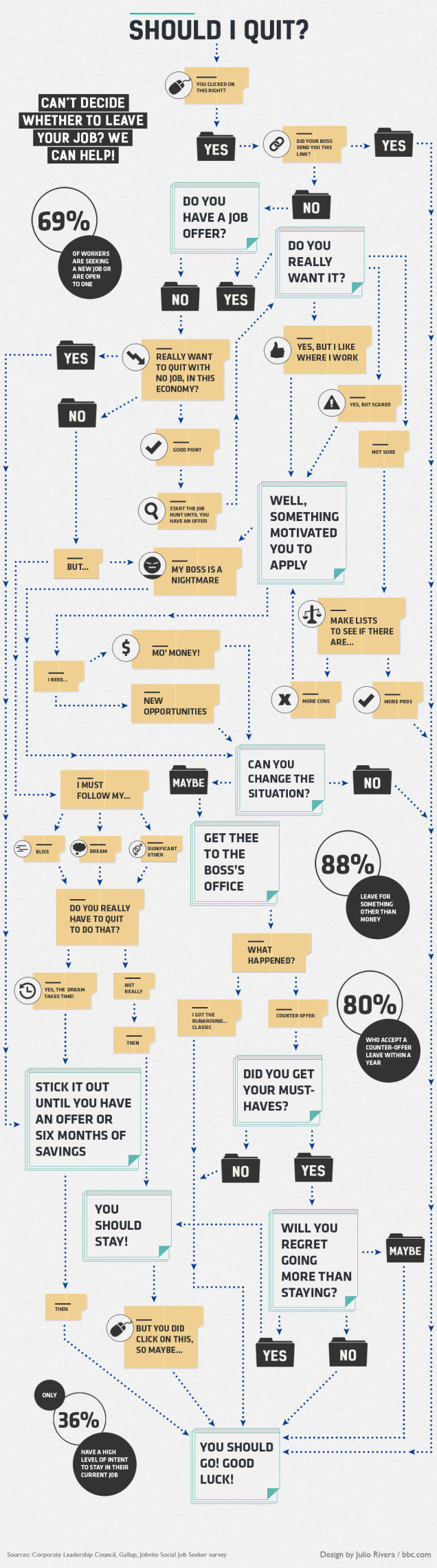
To Quit Or Not To Quit? This Flowchart Tells If It’s Time George Mortimer for Lifehack “Changing jobs or careers is something many people think about, but never seriously consider until it’s too late to change. The use of this flowchart makes it easier for you to determine if your current job satisfies your lifestyle. In basic terms, if your job isn’t making your life better you’re probably better off finding a new one.”

1372360723813364326

‘To David, About His Education’ a poem by Howard Nemerov

As students return to school, the conversation once again turns to the value of education. Sitting at your desk you may look back and wonder why you had to take courses that seemed to have no relevance to your current position. Or you may have figured out that all disciplines are linked, even if those connections lie just beneath the surface.

This week’s ‘Friday Poem’ comes from Harvard alum, poet laureate, and photographer, Diane Arbus‘ big brother, Howard Nemerov. It answers the question, what will you have to learn to become one of the grownups?

To David, About His Education

The world is full of mostly invisible things,
And there is no way but putting the mind’s eye,
Or its nose, in a book, to find them out,
Things like the square root of Everest
Or how many times Byron goes into Texas,
Or whether the law of the excluded middle
Applies west of the Rockies. For these
And the like reasons, you have to go to school
And study books and listen to what you are told,
And sometimes try to remember. Though I don’t know
What you will do with the mean annual rainfall
On Plato’s Republic, or the calorie content
Of the Diet of Worms, such things are said to be
Good for you, and you will have to learn them
In order to become one of the grown-ups
Who sees invisible things neither steadily nor whole,
But keeps gravely the grand confusion of the world
Under his hat, which is where it belongs,
And teaches small children to do this in their turn.

Howard Nemerov, “To David, About His Education” from ‘War Stories: Poems About Long Ago and Now’.

The week@work – How to live wisely, raise strong women, the value of a liberal arts education and more

It’s that time of year, ‘back to school’. It doesn’t matter if you are preschool or college, your local retail outlet is ready to meet every consumer need to outfit you or your dorm room. It’s also ‘back to work’ for those returning from vacation ( if you are one of the six in ten who took some leave this summer). There was a lot going on this week@work. Here are a few stories to get your Monday morning office conversations going.

Harvard professor Richard J. Light, the author of a 2001 book, ‘How to Make the Most of College’ asked New York Times readers to imagine they were dean for a day in a new article, ‘How to Live Wisely’. Before you skip to the next paragraph, stay with me. His questions have relevance for all leaders.

“Imagine you are Dean for a Day. What is one actionable change you would implement to enhance the college experience on campus?

I have asked students this question for years. The answers can be eye-opening. A few years ago, the responses began to move away from “tweak the history course” or “change the ways labs are structured.” A different commentary, about learning to live wisely, has emerged.

What does it mean to live a good life? What about a productive life? How about a happy life? How might I think about these ideas if the answers conflict with one another? And how do I use my time here at college to build on the answers to these tough questions?”

Once we leave college and begin to move ahead in our careers these questions become even more critical in our quest of life long learning.

Professor Light offers “five exercises that tackle the big questions”. Number three:

“I call this the Broad vs. Deep Exercise. If you could become extraordinarily good at one thing versus being pretty good at many things, which approach would you choose? We invite students to think about how to organize their college life to follow their chosen path in a purposeful way.”

Rephrase this one in respect to your career preparation. Have you organized your life around your choice to develop an expertise or be more of a generalist?

The next story may be too late for some struggling small colleges, but Forbes magazine reported ‘That ‘Useless’ Liberal Arts Degree Has Become Tech’s Hottest Ticket’. ( Full disclosure here, I have one of those ‘useless’ degrees and have found it extremely complementary to my career choices.)

“Engineers may still command the biggest salaries, but at disruptive juggernauts such as Facebook and Uber, the war for talent has moved to nontechnical jobs, particularly sales and marketing. The more that audacious coders dream of changing the world, the more they need to fill their companies with social alchemists who can connect with customers–and make progress seem pleasant.”

Liberal Arts = Social Alchemy? Has a six figure ring to it.

On the millennial front this week there were two stories in The New York Times. The first reported on a new Pew Research Study which found that millenials are less likely to leave the nest.

“In 2010, according to the study, 69 percent of 18- to 34-year-olds lived independently. During the first four months of this year, just 67 percent of that same age group was living independently. From 2010 to April 2015, the share of young adults living in their parents’ homes has increased to 26 percent from 24 percent, the study said.”

For those who have left the nest to build their own, another Times report found ‘Millennial Men Aren’t the Dads They Thought They’d Be’.

“Young men today have aspirations of being hands-on fathers as well as breadwinners — supportive husbands who also do dishes.

But as they enter that more responsibility-filled stage of life, something changes: Their roles often become much more traditional.

Millennial men — ages 18 to early 30s — have much more egalitarian attitudes about family, career and gender roles inside marriage than generations before them, according to a variety of research by social scientists. Yet they struggle to achieve their goals once they start families, researchers say. Some researchers think that’s because workplace policies have not caught up to changing expectations at home.”

This research and story is one to follow as this generation now makes up the largest % of the workforce. As they progress in their careers it will be interesting to see if attitudes begin to align with work/life policies.

Amy Joyce reporting in the Washington Post poses the question: ‘Are you holding your own daughter back? Here are 5 ways to raise girls to be leaders.’ This is another must read article with research backed practical suggestions for parents to avoid gender bias.

“Think you’re raising your daughter to be a strong leader? Look more closely: You, and the people around her, may unwittingly be doing just the opposite.

Teen boys, teen girls, and, yes, even parents have biases against girls and women as leaders, new research from the Harvard Graduate School of Education and its Making Caring Common project found.

Richard Weissbourd, a Harvard psychologist who runs the Making Caring Common project, said he was “surprised by the extent of it … how gendered both the boys’ and the girls’ responses were.”

Weissbourd decided to look at bias as part of the larger goal of helping children learn to be kind. “We were concerned that biases get in the way of people caring about and respecting other people, so our initial study was just looking at biases,” he said. “And one of the striking findings that emerged was gender bias.”

And the last story is related to the photo in the header. Erica Murphy, editorial assistant at Levo shared ‘7 Things I Learned About Life From Completely Unplugging’. (This one’s for you – the 4 in 10 who have not taken vacation this summer) My two favorites (you can read the rest) – “No one cares & a tech free world does exist”.

“When you live in a big city like New York, you forget that people out there do lead simple lives. And honestly? It’s not so bad. I don’t think I could deal with no running water all the time, but it’s nice to be out in the country sometimes and just relax. Maybe Potter County isn’t on your radar, but it’s the same idea as finding a nearby park and leaving your phone at home. Or maybe you go hiking for the day and really connect with nature. With our lives getting more hectic every day, it’s important to find that time for yourself to decompress.”

Hoping you find time to unplug this week@work.