The week@work: three questions, a tree, a word, a phrase (and a rabbit)

It’s almost over. A year of continual brain-numbing ‘breaking news’ and distraction. This week@work the focus is on communication and understanding. A teacher posed three important questions to her students, two journalists tracked the odyssey of a balsam fir tree, Merriam-Webster and Oxford dictionaries selected the word of the year and we found the origin of  the phrase ‘glass ceiling’. (And there’s a rabbit.)

The New York Times investigative journalist and author Jodi Kantor‘s work breaking the Harvey Weinstein story demonstrated the value of solid reporting in a time of fake news. But it was her tweet last week that caught my attention.

These are “excellent questions” to ask when evaluating a news story. They can also be added or modified to our repertoire@work. Questions@work are essential, as Academy Award winning producer Brian Grazer noted in his 2015 book, ‘A Curious Mind: The Secret to a Bigger Life’.

“If you’re the boss, and you manage by asking questions, you’re laying the foundation for the culture of your company or group. 

You’re letting people know that the boss is willing to listen. This isn’t about being “warm” or “friendly”. It’s about understanding how complicated the modern business world is, how indispensable diversity of perspective is, and how hard creative work is.”

And now, a holiday story: the modern tale of a tree, a farmer, a trucker, a lot owner and a customer.

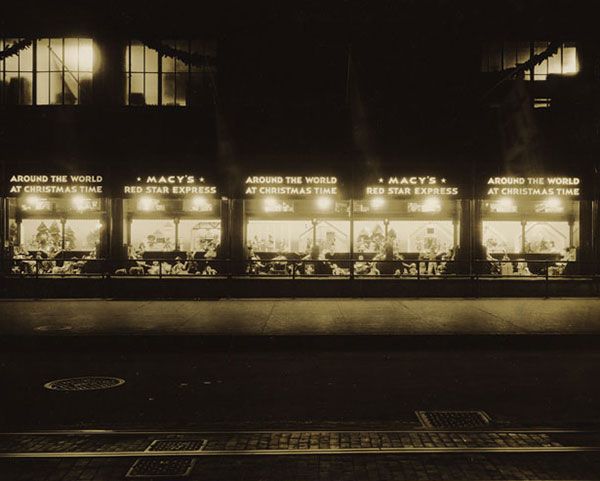
The American Christmas Tree Association reported “More that 94 million American households, or 79 percent of all households, will display a Christmas tree in their home this holiday season…This represents a slight increase overall in the number of households displaying a Christmas tree this year compared to last year. Of those trees, 80 percent will be artificial trees and 20 percent will be real.”

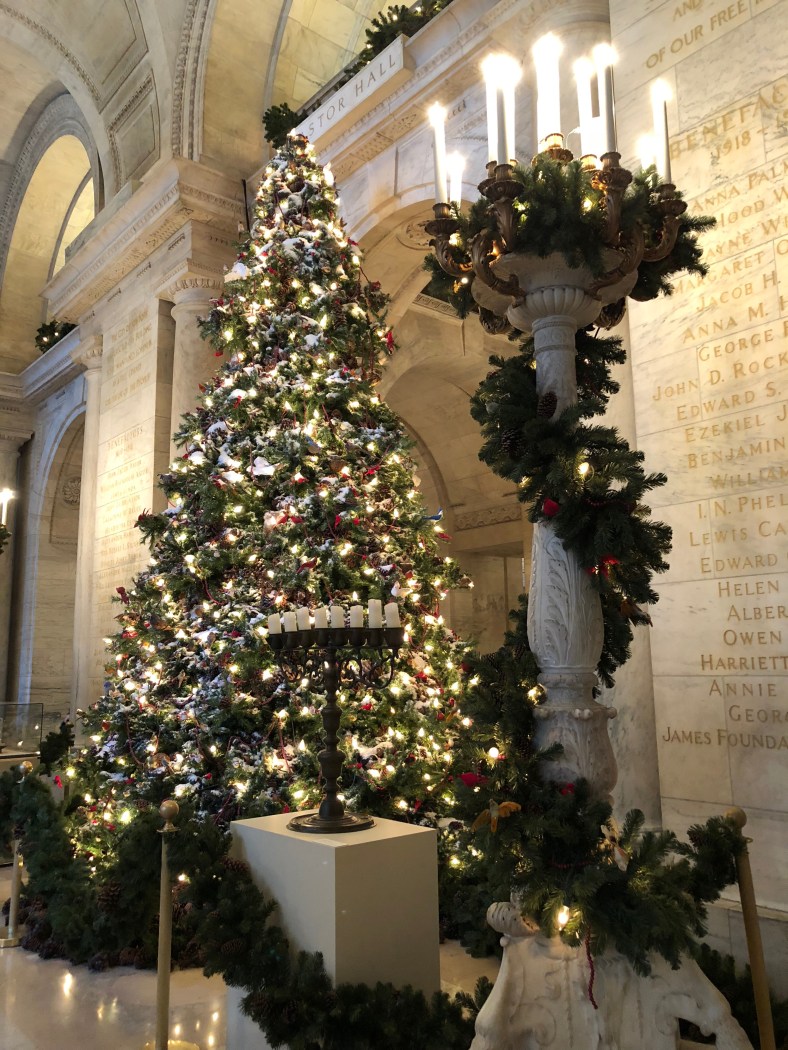
nypl tree.jpg

In ‘1,000 miles. Five Days. Four Familes. One Tree.’, journalists Tiffany Hsu and Roger Kisby followed the supply chain of a single ‘real’ balsam fir from a Nova Scotia farm to a living room in Queens.

“In Lunenburg County, a chunk of Nova Scotia pockmarked by lakes and patches of balsam firs, Silver’s Farm hugs a hill with 45 acres of farmland splayed out in front and 150 acres of Christmas trees behind, all growing naturally and tightly “like the hairs on a dog’s back,” said Wayne Silver.

His operation is small, felling just 3,000 trees a season. Some Nova Scotia farms cut down tens of thousands of trees annually and even ship some overseas.

Mr. Silver took over the farm in 1991 from his father, who took it over from his father, who began cutting Christmas trees in the 1930s. Trees “are in my blood,” he said.

Help is scarce. In a tight labor market with low unemployment, many other tree farmers are hiring migrants from Mexico and Jamaica. Mr. Silver will likely follow suit next year.

“I just work too many long hours,” he said.”

This ‘must read’ multi-media gem captures the changing world of work in North America for farmers, truckers, small business owners and customers.

WOTY-youthquake-banner-760x220.jpg

It’s that time of year when those @work in the cataloging of words announce their ‘word of the year’. The Oxford Dictionaries chose “the noun, youthquake, defined as ‘a significant cultural, political, or social change arising from the actions or influence of young people’.”

IMG_8130

“Merriam-Webster’s Word of the Year for 2017 is feminism. The word was a top lookup throughout the year, with several spikes that corresponded to various news reports and events. The general rise in lookups tells us that many people are interested in this word; specific spikes give us insight into some of the reasons why.”

And while we’re on the topic, did you ever wonder where the phrase ‘glass ceiling’ originated? This past week, the BBC interviewed management consultant Marilyn Loden who coined the phrase almost 40 years ago.

“I first used the phrase “glass ceiling” in 1978 during a panel discussion about women’s aspirations. As I listened, I noted how the (female) panellists focused on the deficiencies in women’s socialisation, the self-deprecating ways in which women behaved, and the poor self-image that many women allegedly carried.

It was a struggle to sit quietly and listen to the criticisms.

True, women did seem unable to climb the career ladder beyond the lowest rung of middle management, but I argued that the “invisible glass ceiling” – the barriers to advancement that were cultural not personal – was doing the bulk of the damage to women’s career aspirations and opportunities.

javits-center.jpg

On 24 May 2018, the “glass ceiling” will be 40 years old.

What has changed for working women in that time? The sheer number of female managers has increased dramatically across most industries and yet the metaphor continues to symbolise an enduring barrier to gender equality – one that has been normalised in many organisations where there is now a sense of complacency about the lack of women at the top.”

One last story this week@work: ‘Harvey Is A Great Holiday Movie’ by Jennifer Finney Boylan
“…if the holiday season means anything at all, it’s about believing in things that we cannot actually see. That virtues as shopworn as faith, hope and love can abide, even if others think you’re a crazy person for believing in them. That those we have lost — parents, friends, even our own younger selves — can live on, in us. That there really are spirits that can make us more than ourselves, that can turn our perilous, fallen lives into something sacred.”


IMG_7796.jpg


The Friday Poem ‘The Question’ by Karla Kuskin

Before poetry was printed on the back of NYC Metro Cards, there was ‘Poetry in Motion’, a joint effort of the MTA and the Poetry Society of America. Between October, 1992 and August, 1997 commuters, families and tourists could sample poems, reading from the placards displayed in subway cars and buses.

Poetry in Motion® places poetry in the transit systems of cities throughout the country, helping to create a national readership for both emerging and established poets.”

The Friday Poem this week was one of those selected for the inaugural NYC program: ‘The Question’ by Karla Kuskin. In this holiday season, revisit career choice through the eyes of your younger self.

The Question

People always say to me
“What do you think you’d like to be
When you grow up?”
And I say, “Why,
I think I’d like to be the sky
Or be a plane or train or mouse
Or maybe a haunted house
Or something furry, rough and wild…
Or maybe I will stay a child.”

Karla Kuskin   ‘Poetry in Motion: 100 Poems From the Subways and Buses’ 1996

The week@work: Person of the Year, Pantone color of the year, unemployment and Colin Kaepernick

This week@work Time Magazine announced their Person of the Year for 2017 and Pantone launched the annual color for 2018. The unemployment rate remained at 4.1% and Colin Kaepernick received Sports Illustrated’s Muhammad Ali Legacy Award.

On Wednesday morning Time Magazine announced the 2017 Person of the Year: ‘The Silence Breakers’. Chosen from a group of ten finalists, the magazine recognized a group of people who came forward to unmask workplace harassment.

person-of-year-2017-time-magazine-cover1

“This reckoning appears to have sprung up overnight. But it has actually been simmering for years, decades, centuries. Women have had it with bosses and co-workers who not only cross boundaries but don’t even seem to know that boundaries exist. They’ve had it with the fear of retaliation, of being blackballed, of being fired from a job they can’t afford to lose. They’ve had it with the code of going along to get along. They’ve had it with men who use their power to take what they want from women. These silence breakers have started a revolution of refusal, gathering strength by the day, and in the past two months alone, their collective anger has spurred immediate and shocking results: nearly every day, CEOs have been fired, moguls toppled, icons disgraced. In some cases, criminal charges have been brought.”

“The women and men who have broken their silence span all races, all income classes, all occupations and virtually all corners of the globe. They might labor in California fields, or behind the front desk at New York City’s regal Plaza Hotel, or in the European Parliament. They’re part of a movement that has no formal name. But now they have a voice.”

In the workplace, everyone loses  when women are devalued. Sallie Krawcheck tallied the cost in one of the most widely read articles last week.

“What we are only beginning to recognize is that demeaning and devaluing women is an insidious, expensive problem. It’s not just the eye-popping settlements in some cases, like the $32 million paid by Bill O’Reilly to settle a harassment claim. Nor is it just the high salaries network stars have been making while allegedly assaulting subordinates, like the $20 million, or more, for Matt Lauer. It only starts there.

The bigger cost derives from how women’s ideas are discounted and their talent ignored. I have seen it up close in the two worlds I know best: Wall Street, where I was chief executive of Smith Barney and of Merrill Lynch Wealth Management, and in Silicon Valley, where I’ve raised money to run my start-up, Ellevest. These places are perhaps the purest microcosms of capitalism, and their lessons are instructive for all of us.”

While we’re on the topic, Katie Rogers explored the bias ‘When Our Trusted Storytellers Are Also the Abusers’.

“For decades, the journalists Matt Lauer, Charlie Rose, Bill O’Reilly and Mark Halperin appeared in front of cameras and tried to help Americans understand the country and one another. Now that they’ve lost their jobs after multiple accusations of sexual abuse, we are left wondering what they taught us.

How much did the abuse of women — often younger, subordinate or not famous — by powerful male journalists factor into the stories they told us? What did we learn about power, politics, accountability, elections — or even about Hillary Clinton, the first female presidential candidate from a major party?”

On a lighter, more regal note, Pantone has announced its color choice for 2018, moving away from 2017’s ‘Greenery’ to ‘Ultra Violet’, just in time for holiday shopping.

pantone-color-of-the-year-2018-ultra-violet-banner.jpg

Camila Domonoske reported on the shift. “Each color of the year encompasses something about fashion, decorating and design trends while also reflecting “what’s needed in our world today,” the Pantone Color Institute’s vice president, Laurie Pressman asserted in a statement.

So. What does purple have to say about our planet in 2018?

It’s “a dramatically provocative and thoughtful purple shade,” Pantone says, one that “communicates originality, ingenuity, and visionary thinking that points us towards the future.”

Purple is often associated with royalty, nobility, luxury, power, and ambition. Which now may be attainable with a simple wardrobe update. Or, hard work; which more of us are doing as the Labor Department released the new unemployment report showing an unexpected addition of 228,000 jobs in November. “Economists expect that in time, wages will post a sustained pickup, which has remained elusive in this expansion even though labor-market slack is steadily disappearing.”

One of the finalists for Time’s Person of the Year, former San Francisco 49ers quarterback, Colin Kaepernick, received the Muhammad Ali Legacy Award from Sports Illustrated on Tuesday night.

Colin-Kaepernick-Man-of-the-Year-1217-GQ-FECK02-01.jpg

“Kaepernick began kneeling during the national anthem last season to protest racial inequality and police brutality. The demonstration sparked a wave of protests by NFL players during the anthem that repeatedly have been denounced by President Donald Trump.

He spoke Tuesday about continuing Ali’s legacy of fighting social injustice, saying the boxing great “mentored me without ever meeting me.”

Kaepernick has not had a contract since leaving the 49ers in March and recently filed a grievance vs. the NFL. Ken Belson provided an update, ‘Explaining the Grievance Case That Kaepernick Filed Against the NFL’.

“You may not have heard much about it lately because it is transpiring behind closed doors. And it is unlike any legal proceeding you might have seen before, not really a trial but with elements of one.

The rules on how the investigation is conducted and by whom — and all the quirks of what evidence is allowed — are detailed in the byzantine labor agreement between the league and players.

It was designed with due process in mind, but as often happens with cases involving the N.F.L., the decisions are appealed and end up in federal court.”

If he is successful, “Kaepernick would receive twice what he might have earned if he was playing. However, “The league cannot force a team to assess or sign Kaepernick.”

To all the ‘silence breakers’, this was your week@work.


The Friday Poem ‘Superior’ by Deborah Garrison

Nineteen years after her first book of poetry was published, Deborah Garrison remains the voice of women@work. I’m waiting for her to find the words to capture this moment in the workplace, but until then, the Friday Poem is ‘Superior’.

Superior

She came to dread the way he would wander
into her office, his eyes flicking over the papers
on her desk as though it offended him
to have to interrupt tasks that were being done
for him, as though the details she was mistress of
would needlessly clutter his manager’s mind.
As he talked of the Big Picture, of who was soon
to die and who to win a prize, the pencil
she held poised a few inches above the text
she’d been correcting when he breezed in
was her only protest. Did it irk him –
the way she kept her shoulders slightly rounded
over the page, the way the graphite stub in her smudged
fingers accused him?

Probably not, as he warmed to his speech;
he was a thinker-aloud, couldn’t have a thought
unless he spoke it out before an obedient listener.
She saw the air thronged with his conceptual
offspring; if she didn’t keep her slack mouth shut
(now he paused, mid-phrase, touching the air
with an index figure just where he saw
his point appear), she might actually swallow
one of his soap bubbles, like a cartoon character
sucking her whole 2-D world
back down. He talked on.

She agreed, she agreed, she seconded his thesis,
and with each murmured yes her certainty mounted:
she would never be one of them – A Director, a Manager,
an Executive Thingy. She didn’t have the ambition.
She was simply a pencil, scratching, pausing,
picking her way down an obscure page.
She liked her fate.
But would she be left alone to enjoy it?
He hovered there – couldn’t bear to release her –
now about to turn and go – but no.
He was settling in her single chair and leaning near
to confide more fully in her.

Deborah Garrison
‘A Working Girl Can’t Win’ Random House, NY 1998

Martha Stewart’s Thanksgiving/Job Search Advice

With Thanksgiving only a few days away, it’s the season to consult Martha Stewart for job search advice.

In a book published in 2005 entitled ‘The Martha Rules’, Ms. Stewart defined ten essentials for achieving business success. Let’s focus on #8 – “The pie isn’t perfect? Cut it into wedges – When faced with a business challenge, evaluate or assess the situation, gather the good things in sight, abandon the bad, clear your mind and move on.”

How do you apply this to your job search? Maybe the thought of competing in this economy is just overwhelming. Or, you’ve been going through a series of first round interviews and none have materialized into a full time offer. You have a business challenge. Time to assess you progress. What have you learned from the process so far? Are you focused on the rejections or the possibilities?

The job search is difficult. It requires a lot of hard work. You may be discouraged by rejection. Rather than focusing on the negative, use this holiday break as a point to leave the bad behind and as Martha says, clear your mind and move on.

To be successful in a job search today you need to honestly evaluate your strengths. What’s your area of expertise? Which employers can best use your skill set? Don’t waste time on job listings that don’t match your talents. If you find a perfect match, but the employer decides you’re not qualified, move on to the next one on your list.

Which brings me to Martha rule #6: ”Quality every day – Strive for quality in every decision, every day.” There are no short cuts. Approach each new opportunity with the energy of your first choice.

The Friday Poem ‘Thanksgiving’ by Linda McCarriston

This year poetry has regained its’ place in our culture. One poem, meant to be read as a whole, can express our peculiar moment in time with a single line. “Any deliberate leap into chaos, small or large, with an intent to make order, matters.” Written in 1984, the Friday poem is ‘Thanksgiving’ by Linda McCarriston.

Thanksgiving

Every year we call it down upon ourselves,
the chaos of the day before the occasion,
the morning before the meal. Outdoors,
the men cut wood, fueling appetite
in the gray air, as Nana, Arlene, Mary,
Robin—whatever women we amount to—
turn loose from their wrappers the raw,
unmade ingredients. A flour sack leaks,
potatoes wobble down counter tops
tracking dirt like kids, blue hubbard erupts
into shards and sticky pulp when it’s whacked
with the big knife, cranberries leap away
rather than be halved. And the bird, poor
blue thing—only we see it in its dead skin—
gives up for good the long, obscene neck, the gizzard,
the liver quivering in my hand, the heart.

So what? What of it? Besides the laughter,
I mean, or the steam that shades the windows
so that the youngest sons must come inside
to see how the smells look. Besides
the piled wood closing over the porch windows,
the pipes the men fill, the beers
they crack, waiting in front of the game.

Any deliberate leap into chaos, small or large,
with an intent to make order, matters. That’s what.
A whole day has passed between the first apple
cored for pie, and the last glass polished
and set down. This is a feast we know how to make,
a Day of Feast, a day of thanksgiving
for all we have and all we are and whatever
we’ve learned to do with it: Dear God, we thank you
for your gifts in this kitchen, the fire,
the food, the wine. That we are together here.
Bless the world that swirls outside these windows—
a room full of gifts seeming raw and disordered,
a great room in which the stoves are cold,
the food scattered, the children locked forever
outside dark windows. Dear God, grant
to the makers and keepers power to save it all.

from ‘Talking Soft Dutch’   Texas Tech Press   1984

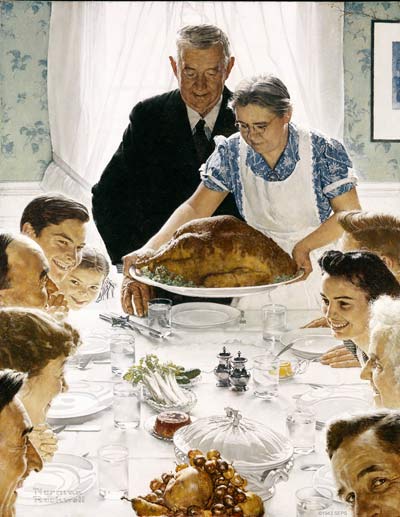
Photo credit: ‘Freedom from Want’ Norman Rockwell for The Saturday Evening Post March 13,1943

The Friday Poem – The Purpose of Poetry

On October 26, 1963, less than a month before his death, U.S. President John F. Kennedy visited Amherst College to deliver a speech at the groundbreaking for the Robert Frost Library.

“In publishing the remarks after Kennedy’s murder, The Atlantic noted that he“identified himself, as no president before him has done so poignantly, with ‘books and men and learning.’ ”

Today, 54 years later, rather than a Friday Poem, the text of the address delivered that day by the 35th President of the United States, in recognition of the contribution of Robert Frost and the place of poetry in our national value set. This is what American leadership looks like.

Our national strength matters, but the spirit which informs and controls our strength matters just as much. This was the special significance of Robert Frost. He brought an unsparing instinct for reality to bear on the platitudes and pieties of society. His sense of the human tragedy fortified him against self-deception and easy consolation. “I have been” he wrote, “one acquainted with the night.” And because he knew the midnight as well as the high noon, because he understood the ordeal as well as the triumph of the human spirit, he gave his age strength with which to overcome despair. At bottom, he held a deep faith in the spirit of man, and it is hardly an accident that Robert Frost coupled poetry and power, for he saw poetry as the means of saving power from itself. When power leads men towards arrogance, poetry reminds him of his limitations. When power narrows the areas of man’s concern, poetry reminds him of the richness and diversity of his existence. When power corrupts, poetry cleanses. For art establishes the basic human truth which must serve as the touchstone of our judgment.

The artist, however faithful to his personal vision of reality, becomes the last champion of the individual mind and sensibility against an intrusive society and an officious state. The great artist is thus a solitary figure. He has, as Frost said, a lover’s quarrel with the world. In pursuing his perceptions of reality, he must often sail against the currents of his time. This is not a popular role. If Robert Frost was much honored in his lifetime, it was because a good many preferred to ignore his darker truths. Yet in retrospect, we see how the artist’s fidelity has strengthened the fibre of our national life.

If sometimes our great artists have been the most critical of our society, it is because their sensitivity and their concern for justice, which must motivate any true artist, makes him aware that our Nation falls short of its highest potential. I see little of more importance to the future of our country and our civilization than full recognition of the place of the artist.

If art is to nourish the roots of our culture, society must set the artist free to follow his vision wherever it takes him. We must never forget that art is not a form of propaganda; it is a form of truth. And as Mr. MacLeish once remarked of poets, there is nothing worse for our trade than to be in style. In free society art is not a weapon and it does not belong to the spheres of polemic and ideology. Artists are not engineers of the soul. It may be different elsewhere. But democratic society–in it, the highest duty of the writer, the composer, the artist is to remain true to himself and to let the chips fall where they may. In serving his vision of the truth, the artist best serves his nation. And the nation which disdains the mission of art invites the fate of Robert Frost’s hired man, the fate of having “nothing to look backward to with pride, and nothing to look forward to with hope.”

I look forward to a great future for America, a future in which our country will match its military strength with our moral restraint, its wealth with our wisdom, its power with our purpose. I look forward to an America which will not be afraid of grace and beauty, which will protect the beauty of our natural environment, which will preserve the great old American houses and squares and parks of our national past, and which will build handsome and balanced cities for our future.

I look forward to an America which will reward achievement in the arts as we reward achievement in business or statecraft. I look forward to an America which will steadily raise the standards of artistic accomplishment and which will steadily enlarge cultural opportunities for all of our citizens. And I look forward to an America which commands respect throughout the world not only for its strength but for its civilization as well. And I look forward to a world which will be safe not only for democracy and diversity but also for personal distinction.

Robert Frost was often skeptical about projects for human improvement, yet I do not think he would disdain this hope. As he wrote during the uncertain days of the Second War:

Take human nature altogether since time began . . .
And it must be a little more in favor of man,
Say a fraction of one percent at the very least . . .
Our hold on this planet wouldn’t have so increased.

Because of Mr. Frost’s life and work, because of the life and work of this college, our hold on this planet has increased.”

Listen to speech

Text and recording courtesy of the John F. Kennedy Library and the U.S. National Archives.


The week@work: the crisis of civic education, karoshi, unemployment & the future of office attire

This week@work stories examine the role of education in creating civil discourse, the consequences of karoshi, the impact of weather on unemployment and the future of office attire.

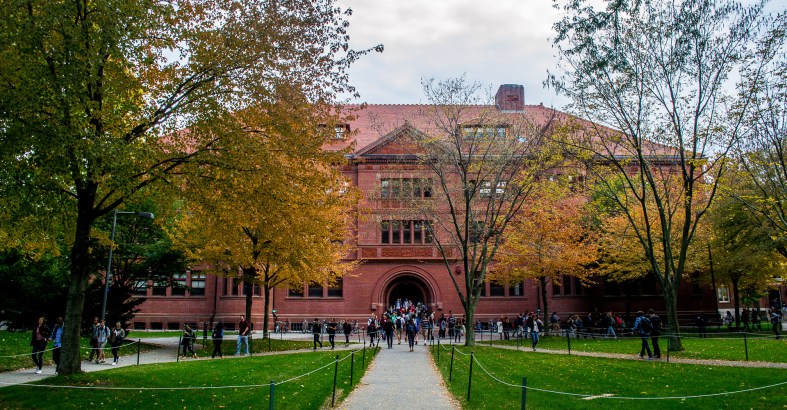
While walking through the U.S.Capitol Visitor Center last week I encountered a group of junior high school students who were shrieking at each other as they reported a sighting of House Speaker Paul Ryan as if he were a chart topping rock star. What if the majority of junior high and high school students had the opportunity to walk the halls of Congress and observe the process of governing?

Harvard president emeritus, Derek Bok examines ‘The Crisis of Civic Education’.

“Schools have long been the primary source of civic education in America. As an early champion of public education, Horace Mann, pointed out more than 150 years ago: “One of the highest and most valuable objects to which the influences of a school can be made conducive consists in training our children to self-government. Yet schools cannot accomplish this task by themselves. Many studies have pointed to the difficulties that hamper their efforts, including inadequate funding and pressures on teachers from school boards, parents, politicians, and textbook publishers. In view of those problems, it is not surprising that the National Assessment of Educational Progress, which periodically evaluates the knowledge of America’s schoolchildren, concluded in 2010 that more than two-thirds of high-school seniors scored below “proficient” in their knowledge of civics and government.”

Once the American high school senior transitions to college, there is no imperative to incorporate “essential courses to equip them to perform their civic functions more effectively” into their curriculum.

HCF_desktop.jpg

“While many colleges claim to be preparing citizens…and although they offer many classes and activities that can contribute to this end, few provide any required courses aimed at achieving that result. Instead, learning to become an active and informed citizen is simply treated as an option — much like preparing to be a doctor or a lawyer or a business executive — even though becoming a citizen is not a choice but a status acquired automatically by the vast majority of undergraduates.”

Bok suggests a number of approaches: linking community involvement experience with academic coursework; connecting the dots between the activity and public policy, engagement with student government and establishing multi-cultural residence halls.

Colleges have a responsibility to lead on this issue. Colleges own this one. If not here, where?

“In today’s diverse and highly partisan society, it is particularly important to teach undergraduates to take account of contrary opinions and arguments and to discuss such differences respectfully. Most campuses are well positioned to encourage these habits…The recent election underscores the importance of extending such efforts to encourage interaction among classmates with different political ideologies and socioeconomic backgrounds.”

Walter Sim reported on ‘Death by overwork: Will Japan finally face up to ‘karoshi’?

“With her mobile phone in hand as if waiting for her next assignment, a 31-year-old political reporter with broadcaster NHK died of heart failure in her sleep in July 2013 after clocking nearly 160 hours of overtime the month before.

Two years later, on Christmas Day, a rookie at advertising giant Dentsu leapt to her death after being subjected to a gruelling schedule and harassment at her workplace.

Osaka Sphere Building

The statistics nationwide are quite startling. Japan’s second annual karoshi White Paper, released last Friday, said there were 191 work-related deaths and attempted suicides in the fiscal year ending March 2017. This was two more than the previous year. In the same fiscal year, 498 cases of mental illness, such as depression, were deemed work-related.

And from January 2010 to March 2015, 368 suicides – 352 men and 16 women – were deemed as karoshi.”

Patricia Cohen reported ‘U.S. Lost 33,000 Jobs in September; Unemployment Rate Dips to 4.2%’.

“Staggering from the impact of hurricanes that walloped Texas, Florida and neighboring states, the economy lost 33,000 jobs in September, the first monthly decline in employment in seven years, the government reported on Friday.

But economists discounted the discouraging report, describing it as a blip in a job market that was fundamentally strong.”

Wondering what to wear this week@work? Jessica Holland asks ‘Are tracksuits and trainers the future of office attire?’

sykes london.jpeg

“They were all wearing trainers and layers of black,” says Evelyn Cotter, a career coach based in London. She’s describing a recent public speaking conference she attended, where the crowd of ambitious young professionals were dressed in a uniform way.

“Everyone had come straight from work, they were wearing black jeans and smart sneakers, but it definitely felt professional,” adds Cotter. “It’s a conscious style choice. It’s not just what you throw on to play with your dog in the garden.”

“The industry of ‘athleisure’ – sporty clothes and shoes that people don’t necessarily wear to play sport – grew by a staggering 42% between 2008 and 2015, according to Morgan Stanley research. More recently, its influence has begun to creep into offices, where workers’ clothing is becoming increasingly relaxed and designed for comfort. The Society for Human Resource Management, an international organisation, tracks how many employers allow workers to dress casually every day, and that figure rose from 32% in 2014 to 44% in 2016.”

Before you head out to your favorite ‘athleisure’ retailer, check the culture and style of your employer. On days when you are meeting with clients, it’s always a good idea to mirror the style of your customer. (or their expectations)

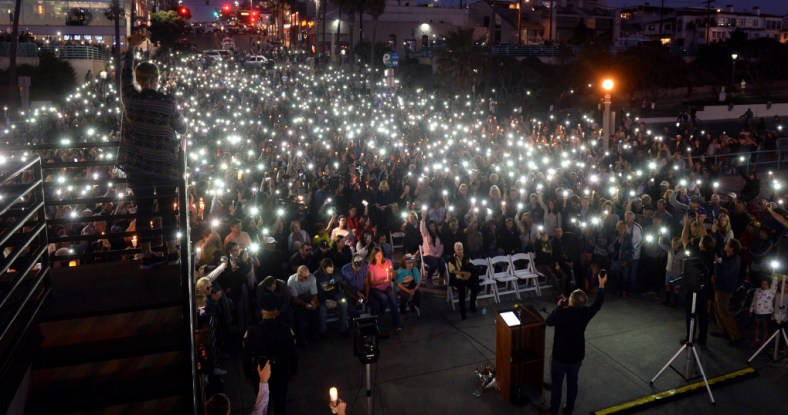
The last story this week@work, was the first story breaking on Monday morning. Folks taking a break from work at a music festival on a Sunday evening in Las Vegas became targets of a mass shooting. In twelve minutes 58 people between the ages of 20 and 67 were murdered; 489 were injured. On Wednesday, the citizens of Manhattan Beach, California gathered on a pier overlooking the Pacific to mourn two of the victims: Sandy Casey, 35, a special education teacher at Manhattan Beach Middle School and Rachael Parker, 33, a records technician with the Manhattan Beach Police Department.

1005_nws_tdb-l-mbvigil-carr01-1.jpgThis week@work consider how you might do more than send thoughts and prayers.
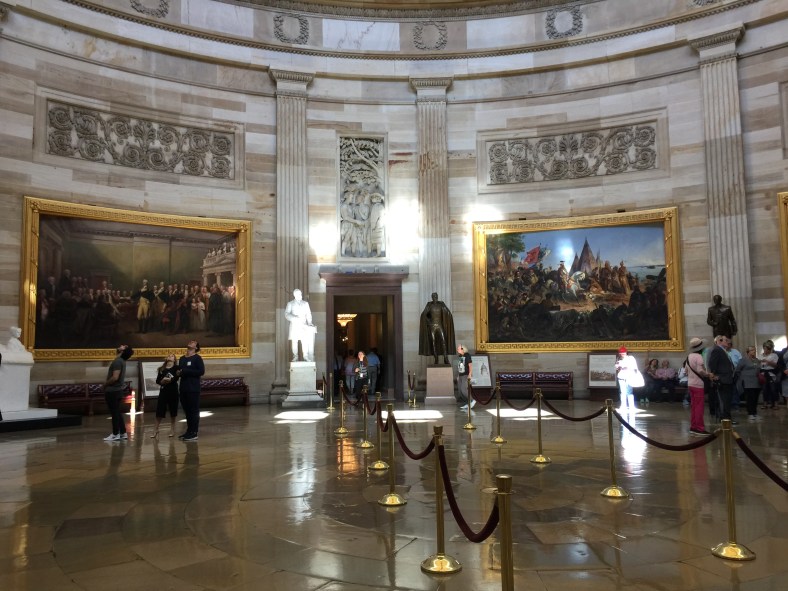
 

Photo credit: Manhattan Beach vigil, Steve Carr for the Daily Breeze/ Office Attire, Sykes London for British Vogue

Visiting Washington, D.C.

We spent most of the past week visiting our nation’s capital, Washington, D.C.. Congress was in session, although from a brief time spent in the Senate Chamber, it didn’t seem much was getting done.

In the gallery we were told to be quiet and observe. A senator from Hawaii was speaking, but no one was listening. A group of pages alternated places, delivering notes, glasses of water, and portable podia in a well choreographed exchange within a mostly vacant chamber. (Think Wimbledon with only ball boys/girls, no players.)

Once outside, you may encounter the random legislator passing through with a posse of aides. In the capitol rotunda velvet ropes form a temporary corridor for members of congress to navigate through constituents without pause to connect. These are very busy people doing something very important @work.

rotunda.jpg

The folks we elect to congress are protected by multiple layers of security. I’m not sure how many times I passed through security screenings or how many x-rays my body absorbed in the course of six hours, but it’s clear that we are paying a price for our democracy.

Our elected officials don’t talk to those they represent, because their workplace provides a cocoon from reality. And @work they don’t listen to one another. They don’t even show up to demonstrate professional courtesy when a colleague is speaking.

There are hundreds of twenty-somethings waiting in the wings of congressional office buildings with a vision for the future of our democracy. They hold a glimmer of promise for the future. But the prevailing impression is that no one is home.

capitol2.jpgThis was the week of the Las Vegas horror. If there was a time for leadership and visibility, this would be the moment. But as I walked the grounds on Capitol Hill, all was quiet.
I think, as Americans, we visit D.C. in search of inspiration from the past. Our history is neatly laid out in the geometry of Pierre L’Enfant’s urban design. We remember our fallen in war, recognize our culture in museum exhibits, and honor the leaders whose vision has maintained our democracy.

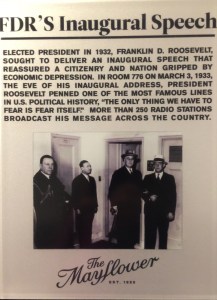
We stayed at the Mayflower Hotel, just down the hall from where soon to be president, Franklin Delano Roosevelt wrote his first inaugural address on the eve of his swearing in on March 4, 1933.

IMG_9378

As I took off my bracelet, opened my bag, checked my FitBit, and listened to an usher instruct me to keep my views to myself as I entered the Senate Chamber, I realized this is what worried Franklin Delano Roosevelt 84 years ago.

“This is preeminently the time to speak the truth, the whole truth, frankly and boldly. Nor need we shrink from honestly facing conditions in our country today. This great Nation will endure as it has endured, will revive and will prosper. So, first of all, let me assert my firm belief that the only thing we have to fear is fear itself—nameless, unreasoning, unjustified terror which paralyzes needed efforts to convert retreat into advance. In every dark hour of our national life a leadership of frankness and vigor has met with that understanding and support of the people themselves which is essential to victory.”

To those of you who go to work every day as an elected official, this is your job description: leadership of frankness and vigor – don’t shrink from honestly facing conditions in our country today.  (and maybe get rid of the velvet ropes in the rotunda)


The mysteries of networking #6

Does networking really take place in a galaxy far, far away? I think that’s the way some of us approach it – a great excuse for not engaging in the process. And then, there’s the whole ‘mentoring thing’ – Do I need one? How do I find one? Then what do I do?

It’s pretty simple. It’s hard work. Actually, once you start the work doesn’t end. You just need to recalculate the equation. It’s not a chore, it’s an amazing, fun exploration. And you can start today, with the folks in a college classroom, colleagues at work, members of your book club or athletic training group.

“There’s a Chinese saying: “Explore what’s best in the others and follow.” Among my friends, I always learn the best from them.”  Lee Shau Kee

Think about that. “Explore the best in others and follow.” Who are the ‘best’ in your world or the one you want to join? What are the qualities/values that align to win your vote as best@what they do? If you could have a few minutes with them, what would you ask?

The ‘networking’ thing is the exploration. Think about how you might go about planning for a hike, or travel. Why are you going? What do you hope to find? What research have you conducted to prepare? And, you’re planning to have fun, right?

Apply the same process to networking. “Explore the best in others…”

“…and follow.” Once you have started a conversation, it’s time to examine the next layer of career success. What has been the path to success? What were the failures, trade-offs, and recovery? How many detours came along the way? What do they look for in folks they hire?

Ask questions unique to your career aspirations. Your goal is to spark a longer conversation, one that may lead to a continuing professional relationship – a mentor.

“Among my friends, I always learn the best from them.”