What question would you ask? Interviewing for POTUS

Not all of us have the opportunity to interview candidates in our workplace, but when we do, we want to get it right. We want pose the question that elicits a response providing a hint to how this individual will perform if selected.

Tonight, in California, the  candidates seeking the Republican nomination for president will participate in a debate. In reality, they will be answering interview questions posed by journalists. What question would you ask?

If you don’t know where to begin, Adam Bryant’s weekly executive interviews column in The New York Times is a good place to start. In an interview last month, Greg Schott of software company, MuleSoft shared his hiring philosophy.

“First off, we’re looking for someone who’s a good human. That is defined by high integrity, being a great team player, and they want to win as a company first, team second, individually third. The next thing we look for is people who are whip-smart. The third thing we look for is a clear track record of achievement.

And I also work hard to understand the decisions they’ve made along the way, like why they left a certain job to take the next one. You learn all kinds of things from why they made those job transitions. I’ll also ask what they’ve done that changed things for their organization as opposed to just doing the job that they were asked to do. What did they do that nobody asked them to do?”

We definitely want someone who’s a good human to be president. I would like to know why they left their current job to take the next one. Why have some not left their current job yet? What have they done above and beyond the job description? Integrity, smarts, record of achievement all good.

Maybe I’d add a question about flexibility, dealing with ambiguity. Describe a belief you held for a long time that with some education and experience you changed? Being president requires leading the folks you don’t agree with along with those who voted for you.

Starbucks CEO Howard Schultz shared his opinion on the election process and the responsibility of those elected to represent us to act differently, and posed his questions for the candidates.

“Every one of the candidates offers grand promises about new leadership and new solutions. But where do they stand on working with their rivals? Regardless of who wins the presidency, the odds of the same party controlling a filibuster-proof Senate are slim. If we want to turn the nation around, we have to act differently. Save for the most rabid partisans, most people don’t want one-party rule. They want Democrats and Republicans to work together.

Americans who are tired of politics as usual should demand a clear answer to a simple question from every candidate: What will you do to unite all of us?”

Stewart Butterfield of communications service company Slack discussed his interview process with Adam Bryant.

“I used to always ask three short questions — one math, one geography and one history. I didn’t expect people to get the answers right, but I just want them to be curious about the world. The first is what’s three times seventeen. Then name three countries in Africa. You’d be astonished by the number of people who can’t do that. And what century was the French Revolution in, give or take 200 years.

I don’t do that anymore, but I do ask everyone what they want to be when they grow up. Good answers are usually about areas in which they want to grow, things they want to learn, things that they feel like they haven’t had a chance to accomplish yet but want to accomplish.”

This is what I want to know. What did these folks on the stage at the Reagan Library want to be when they grew up? Ok, they wanted to be president. But it’s not enough to want. What do they still wish to learn, to accomplish? What does their world look like at the end of a successful presidency? The answers will give me the information I need to make a decision.

And, I would like them to name three countries in Africa.

Can ‘YouTube’ be a mentor?

If YouTube videos can teach us how to wire a smoke detector, can they also teach us how to lead? That may seem like a ridiculous question, but in our evolving ‘conversation adverse’ culture, are we turning to videos to provide guidance in the workplace?

Think about your first job, your first day at work. Aside from the anticipation, you might as well have been visiting another planet. Perceptions collided with reality as you navigated your way through the first days; an amateur anthropologist alert to  any clue to success in this new society you had joined. Who could you trust to advise you on your journey?

That is the question we all ask at some point in our first weeks at work. All is new and colleagues seem equal. Then the sorting begins as you filter conversations and observe interactions among colleagues and the leadership team. A picture begins to emerge of the culture, the influencers and the business problems to be solved. For most of us, we wing it. We take our experience, as limited as it may be, and experiment. We offer solutions. Find they are not well constructed. Go back and revise and then venture back with the edited proposal. It’s a process of trial and error as we independently craft an answer.

We find ourselves at a turning point. We need help. Where do we go to find it?

There are thousands of articles that define the role of mentors, how to find one, how to manage the relationship, but it was the first paragraph of an article I read a few weeks ago that introduced a significant hybrid approach to how we learn to work.

In early August, Starbucks CEO Howard Schultz wrote an opinion piece in The New York Times on the topic of servant leadership, putting others first and leading from the heart.

“From the earliest days of Starbucks, I’ve been captivated by the art of leadership. I was mentored over three decades by Warren G. Bennis, the eminent professor and scholar on leadership. I’ve gathered insights from peers, and I’ve drawn inspiration from our 300,000 employees. But nothing I’ve read or heard in the past few years has rivaled the power of the image I viewed on my cellphone a few years ago: Pope Francis, shortly after his election, kneeling and washing the feet of a dozen prisoners in Rome, one of them a young Muslim woman, in a pre-Easter ritual.”

In one short paragraph, the CEO describes a combination of activities that build upon each other to form his leadership style. He relies on a mentor from outside his business, gathers insights from peers and employees and in the end it’s an image from the internet that provides the inspiration for his leadership view.

Can YouTube be a mentor? There is no substitute for human interaction and advice. Learning to work is a lifetime quest and hard work. But the ability to access online courses, TED Talks and podcasts provide an essential element in our professional development.

The week@work – Why everyone should take a geography class, Angela Merkel’s humanity, and the legacy of Oliver Sachs

The week@work was one of stories that urge us to open our minds and hearts to what we may not at first understand.

If you don’t understand geography you won’t comprehend the on-going global political struggles. If you live in Europe, you are overwhelmed imagining the impact of the vast number of immigrants arriving daily. German Chancellor Angela Merkel has taken on the role of champion for the dignity of common humanity and is guiding the discussion of the consequences if Europe fails on the question of refugees. Closer to home, Dr. Oliver Sachs has left us a legacy of writings and research that helps us understand ourselves, our brains, and appreciate the interconnectedness of life.

Joshua Keating writing for Slate, asks ‘Where In The World?’ While enrollment in university geography classes is increasing, many departments have been eliminated and courses are no longer available. Digital literacy without geographical literacy is not a good thing.

“Geographical literacy remains vital—particularly for those of us who live in (for the time being at least) the world’s preeminent military and economic superpower. Geography is necessary for understanding why the overthrow of a government in Libya contributed to an unprecedented surge of migrants into Europe, why Ukraine has been split between East and West amid its conflict with Russia, and why China’s neighbors are alarmed at the new islands under construction in the South China Sea. And as we learned during last year’s Ebola panic, an understanding of African geography could have helped explain why an outbreak in West Africa should not lead to the quarantining of people from Kenya or Tanzania. In the years to come, as the effects of climate change on everything from sea level rise to deforestation to drought quite literally reshape the world we live in, an understanding of geography will be necessary for mitigating and adapting to the consequences.”

If you have been wondering when the U.S. media would begin leading the news with the story of the immigrant crisis in Europe, this was the week and the focus was on the Keleti train station in Budapest, Hungary. As the route of immigrants shift toward the Balkans anti-immigrant sentiment is growing. Germany expects to receive 800,000 refugees and asylum seekers this year.

In an editorial on Tuesday, ‘The Guardian view on Europe’s refugee crisis: a little leadership, at last’, the staff praised the courage of the German Chancellor.

“There can be no tolerance of those who question the dignity of other people,” she said, standing in front of placards accusing her of being the people’s traitor. “There is no tolerance of those who are not ready to help, where, for legal and humanitarian reasons, help is due.”

Confronted by forces that would overwhelm British leaders, the woman the Greek left (and many on the British left who should know better) mistakenly accuse of being the leading advocate of conservative neoliberalism has stood up to be counted. Being the country to which so many want to migrate should be a source of pride, she says. She wants to keep Germany and Europe open, to welcome legitimate asylum seekers in common humanity, while doing her very best to stop abuse and keep the movement to manageable proportions. Which demands a European-wide response. So far, her electorate and her press back her.”

Dr. Oliver Sachs died this week. There have been countless obituaries and remembrances, but my favorite is from The New York Times’ Michiko Kakutani, the Pulitzer Prize winning book critic.

“It’s no coincidence that so many of the qualities that made Oliver Sacks such a brilliant writer are the same qualities that made him an ideal doctor: keen powers of observation and a devotion to detail, deep reservoirs of sympathy, and an intuitive understanding of the fathomless mysteries of the human brain and the intricate connections between the body and the mind.

Dr. Sacks, who died on Sunday at 82, was a polymath and an ardent humanist, and whether he was writing about his patients, or his love of chemistry or the power of music, he leapfrogged among disciplines, shedding light on the strange and wonderful interconnectedness of life — the connections between science and art, physiology and psychology, the beauty and economy of the natural world and the magic of the human imagination.”

Other articles of interest this week@work offered advice on choice of college major, how to eliminate interruptions in the office and quitting your job before you have another.

‘Major Choice Shouldn’t Define a Career’ Jordan Holman – Sage advice from a senior writing in the student newspaper of the University of Southern California. “In this job economy it matters more about how you can apply the skills you acquired from the classes taken and lessons learned than just the titles on your resumé. It’s about taking that difficult class that you’re frightened of, but which could also serve as the perfect anecdote during an interview.”

‘5 Strategies to Eliminate Constant Interruptions’ Lisa Evans – “Did you know that the average manager gets interrupted approximately once every eight minutes? That’s about seven interruptions each hour. What’s worse, after every interruption, it takes an average of 25 minutes to fully regain cognitive focus. No wonder at the end of an eight-hour day, you still feel like you haven’t accomplished anything.”

Should You Quit Your Job Before You Have Another One? –  Stephanie Vozza – Multiple news outlets covered the release of ‘Leap: Leaving a Job With No Plan B to Find the Career and Life You Really Want’ by former Public Radio Marketplace reporter Tess Vigeland“When I left, one of the biggest questions I got was, ‘What the hell are you doing?’ and there are plenty of times I miss it,” she admits. “I miss being in a newsroom. I miss the microphone and the audience. Those are the times when I beat myself about the head, but they’re becoming rarer and rarer. You have to go through the process. I feel it was absolutely the right thing to do. I used to spend a chunk of day miserable. If it’s Sunday and you never look forward to Monday, you need to make a change. Life is too short to live for Friday afternoon.”

And one more time, The New York Times reported on the continuing trend of wage and salary lag as corporate profits continue to surge.

Workthoughts from outside the margins

Was anyone working yesterday? As social media and cable news forecast the financial apocalypse, I escaped to my ‘go to’ twitter account of Tony winning composer, lyricist and actor, Lin-Manuel Miranda. (For those of you who have been living under a rock for the past year, he is the leader of the merry band of actors who have been recreating the life of Alexander Hamilton on Broadway in nine performances per week this summer.)

And for those of you who think Twitter is an intellectual wasteland, time to get on board. You are missing out on at least one connection with an innovator who is truly transforming the American musical.

Innovation is one of our most overused words, but John Kander, composer of ‘Cabaret’ and ‘Chicago’ used that exact word to describe Mr. Miranda earlier this month in a New York Times profile.

“Innovators are usually synthesizers — they synthesize everything they know and add their own personal talents, and out comes something new,” Mr. Kander said. “What Lin is is a refreshing and healthy contemporary synthesist of everything he’s known before.”

But I digress. Back to Monday and Twitter and @Lin_Manuel. Let’s just say he has a high level of interaction with his followers. And one of those followers, @jjaxtweets, posted ‘My annual back to school post’, which #YayHamlet retweeted. And here is the message.

“Keep an eye out for that kid in the back of your classroom, scribbling in the margins. He or she is dreaming of worlds we haven’t yet imagined, scribbling toward a place we haven’t yet seen. Engage those kids, get them out of the margins, and there’s no telling where they may lead you.”

This is where a career begins. A parent, a teacher taking time to engage the child scribbling in the margins.

How do you get to Broadway or whatever your dream might be? You really, really need to love what you are doing. Check out the YouTube videos of the Ham4Ham performances between shows for those in the ticket lottery line and you get the idea.

Infuse your dream with the essence of those first scribbles, and the relationships you build over time.

Connect the dots and synthesize everything you know. Constantly nurture your talent. Lifelong learning has no expiration date.

Work really, really hard and have fun.

I think the ‘kid in the back of the classroom’ was Lin-Manuel Miranda. Or was it you?

The week@work – The time we spend @work, unpaid interns@the UN, no union for college football and the value of one good friend

Sarah Boseley reported on Wednesday on the health risks of working long hours for The Guardian newspaper in the UK.

“The largest study conducted on the issue, carried out in three continents and led by scientists at University College London, found that those who work more than 55 hours a week have a 33% increased risk of stroke compared with those who work a 35- to 40-hour week. They also have a 13% increased risk of coronary heart disease.

The findings will confirm the assumptions of many that a long-hours culture, in which people work from early in the morning until well into the evening, with work also intruding into weekends, is potentially harmful to health.”

During a discussion of these findings on CBS This Morning, co-anchor Charlie Rose turned the conversation to a discussion of how we define work.

“For some people reading a lot is play and pleasure. For others it’s work. It’s part of what they do and how they spend their time. It’s one thing to be on an assembly line, I think, and another thing to be reading a novel in preparation to interview someone. 

Where do we draw the line? Is there a line? That is the topic of the next article this week@work.

The New Yorker writer, Tim Wu thinks ‘You Really Don’t Need To Work So Much’. He questions why we have allowed ourselves to become players in “a football game where the whistle is never blown”. His solution, work should fulfill society’s needs with minimal effort. Let the workaholics have their fun, but not at the expense of the rest of us.

“The past fifty years have seen massive gains in productivity, the invention of countless labor-saving devices, and the mass entry of women into the formal workforce. If we assume that there is, to a certain degree, a fixed amount of work necessary for society to function, how can we at once be more productive, have more workers, and yet still be working more hours? Something else must be going on.”

“…in white-collar jobs, the amount of work can expand infinitely through the generation of false necessities—that is, reasons for driving people as hard as possible that have nothing to do with real social or economic needs.”

“The antidote is simple to prescribe but hard to achieve: it is a return to the goal of efficiency in work—fulfilling whatever needs we have, as a society, with the minimal effort required, while leaving the option of more work as a hobby for those who happen to love it.”

Does society need more unpaid interns? Apparently the United Nations thinks so and has grown their ‘volunteer workforce’ from 131 in 1996 to over 4,000 worldwide this year. ‘The Economist Explains why the UN doesn’t pay it’s interns’.

“The story of an unpaid intern living in a tent in Geneva did not make the United Nations look good. David Hyde, a fresh-faced 22-year-old from New Zealand, said he set up camp on the banks of Lake Geneva because he could not afford the Swiss city’s exorbitant rents while working for free. The news stirred up public outrage as well as sympathy from Mr Hyde’s colleagues: scores of UN interns in Geneva walked off the job on August 14th to protest against his plight. That same day a cluster of “interns’ rights” groups penned an open letter to the UN’s secretary-general, Ban Ki-moon, pointing out that the practice of not paying interns sits awkwardly with Article 23 of the organisation’s own Universal Declaration of Human Rights (“Everyone who works has the right to just and favourable remuneration ensuring for himself and his family an existence worthy of human dignity”). So why doesn’t the UN pay its interns?”

“They fear that paid internships may become a back door for recruitment and increase competition for coveted low-level “professional” positions.”

Excuse me, isn’t that why you do an internship? Isn’t this the apprenticeship that may one day lead to a full time job?

And while we are on the subject, let’s turn our attention to another group of unpaid collegians in the news this week, college football players. On Monday the U.S. National Labor Relations Board dismissed a petition from Northwestern University football players to form a union.

Ben Strauss reported on the board’s rationale in The New York Times:

“The board did not rule directly on the central question in the case — whether the players, who spend long hours on football and help generate millions of dollars for Northwestern, are university employees. Instead, it found that the novelty of the petition and its potentially wide-ranging impacts on college sports would not have promoted “stability in labor relations.”

Citing competitive balance and the potential impact on N.C.A.A. rules, the board made it clear that it harbored many reservations about the ramifications of granting college athletes, much less a single team, collective bargaining rights.”

For some college football players, their teammates are their best friends. And it may explain why many are so resilient.

Melissa Dahl described recent research in the UK for New York Magazine, ‘Having Just One Good Friend Strengthens Kids’ Resilience’.

“Let’s take a moment to praise the wonders of the true-blue best friendship, an especially powerful thing during the teenage years. A new study, published earlier this summer in the British Journal of Psychology, looked at this idea specifically among kids from low-income neighborhoods, and found that kids with just one solid, supportive friendship also tended to show signs of greater resilience when facing adversity than the kids with lower-quality friendships.

In their analysis, the researchers found an association between higher-quality friendships and greater resilience, likely, they theorize, because of the emotional support and the sounding board a real best friend provides.”

Here are a few more articles from the week@work that you may have missed.

The Future of Work and Workers – The Pacific Standard began a series this week exploring “What worries you most—and/or excites you most—about the future of work and workers? Put another way: What will be the most consequential changes in the world of work and workers, and what anxieties and possibilities will they produce?”

What the First Female Rangers ProveElizabeth Samet for Bloomberg View “Access to Ranger School, and combat units, is really about access to leadership opportunities. Of the 12 four-star Army generals currently on active duty, all are men. Eleven began their careers in the infantry or armor branch. Ten wear the Ranger tab. In other words, if you want a chance of running the Army, you would do well to go to Ranger School.”

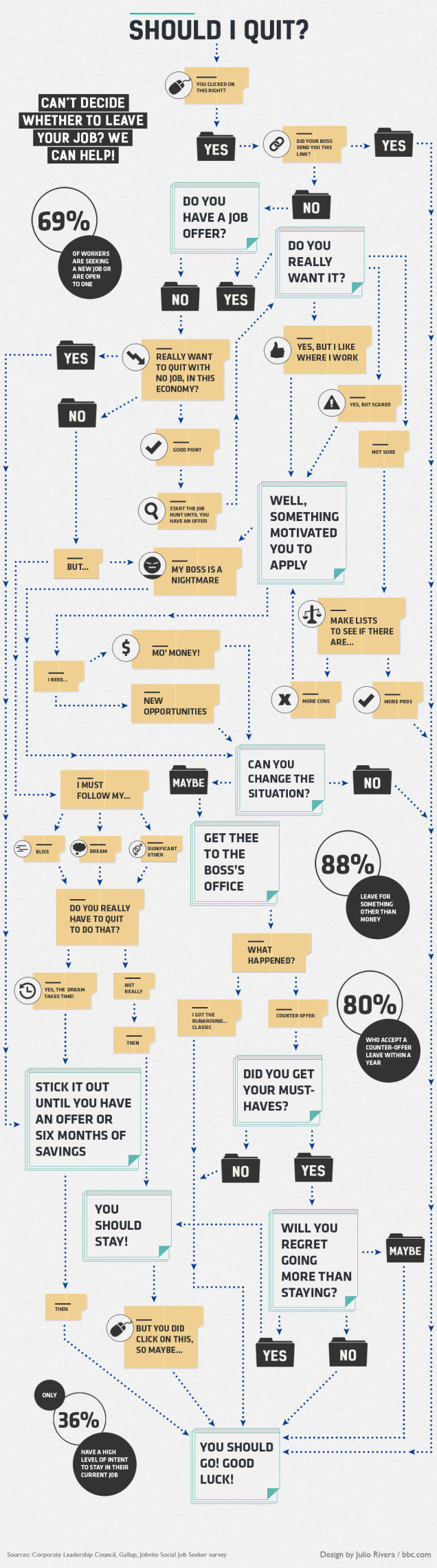
To Quit Or Not To Quit? This Flowchart Tells If It’s Time George Mortimer for Lifehack “Changing jobs or careers is something many people think about, but never seriously consider until it’s too late to change. The use of this flowchart makes it easier for you to determine if your current job satisfies your lifestyle. In basic terms, if your job isn’t making your life better you’re probably better off finding a new one.”

1372360723813364326

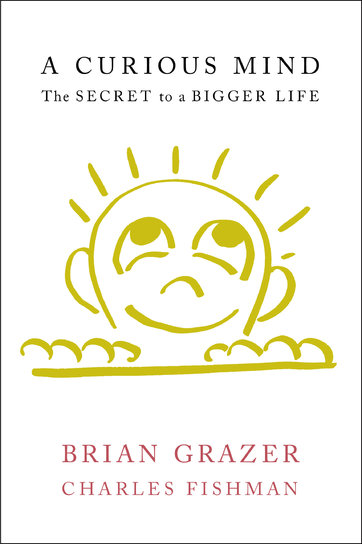
The Saturday Read – Brian Grazer and Charles Fishman ‘A Curious Mind: The Secret to a Bigger Life’

Are you curious about the people who work for you? Academy award winning producer Brian Grazer thinks you should be. He manages his organization with curiosity, by asking questions. His book, ‘A Curious Mind: The Secret to a Bigger Life’ was released earlier this year and is a memoir of his success and it’s source, listening to the answers.

“If you’re the boss, and you manage by asking questions, you’re laying the foundation for the culture of your company or group. 

You’re letting people know that the boss is willing to listen. This isn’t about being “warm” or “friendly”. It’s about understanding how complicated the modern business world is, how indispensable diversity of perspective is, and how hard creative work is.”

The initial reviews of the book focused on the ‘curiosity conversations’ Grazer has utilized throughout his career to network with a variety of folks in his unique quest for lifelong learning. But in the acknowledgements at the end of the book he addresses the reader directly on his purpose in writing ‘A Curious Mind’.

“a book not about my curiosity, but about what curiosity has enabled me to do, about what curiosity can enable anyone to do…”

“I didn’t want to write a book about all the people I’d had conversations with – I wanted to write about the impulse to have those conversations. I wanted to use the conversations to tell a story: the story of my steady discovery of the power of curiosity in my own life.”

For Grazer, it’s not just a hobby, but a commitment to intentionally integrate questioning into both his work and life outside of work.

“For it to be effective, curiosity has to be harnessed to at least two other key traits. First, the ability to pay attention to the answers to your questions – you have to actually absorb whatever it is you’re being curious about…The second trait is the willingness to act.”

In the early chapters he describes the power of curiosity to motivate, spark creativity, and build confidence. He is the ‘bard of curiosity’ sharing his career story intertwined with his capacity for discovery. But it’s in chapter five where the storytelling turns to management advice. “…the human connection that is created by curiosity…Human connection requires sincerity. It requires compassion. It requires trust.”

“Can you really have sincerity, or compassion, or trust, without curiosity?

“I don’t think so. I think when you stop to consider it – when you look at your own experiences at work and at home – what’s so clear is that authentic human connection requires curiosity.”

Here is the ‘gem’ of the book.

“To be a good boss, you have to be curious about the people who work for you.”

How many of you have a BA in business, an MBA or certificate from a prestigious executive management program? Has anyone ever suggested management by curiosity? We have all been taught to listen. And we don’t. But no one ever explained in this way, how critical the right questions are to getting to the fundamentals when decisions are being made.

“I use curiosity every day to help manage people at work…as a tool to build trust and cooperation and engagement.”

“And curiosity is the key to connecting and staying connected.”

Reading ‘A Curious Mind’ reminded me of a quote buried in dialog in the 2012 novel by Mark Helprin, ‘In Sunlight and in Shadow’:

“It’s a defining difference, curiosity. I’ve never known a stupid person who was curious, or a curious person who was stupid.”

‘To David, About His Education’ a poem by Howard Nemerov

As students return to school, the conversation once again turns to the value of education. Sitting at your desk you may look back and wonder why you had to take courses that seemed to have no relevance to your current position. Or you may have figured out that all disciplines are linked, even if those connections lie just beneath the surface.

This week’s ‘Friday Poem’ comes from Harvard alum, poet laureate, and photographer, Diane Arbus‘ big brother, Howard Nemerov. It answers the question, what will you have to learn to become one of the grownups?

To David, About His Education

The world is full of mostly invisible things,
And there is no way but putting the mind’s eye,
Or its nose, in a book, to find them out,
Things like the square root of Everest
Or how many times Byron goes into Texas,
Or whether the law of the excluded middle
Applies west of the Rockies. For these
And the like reasons, you have to go to school
And study books and listen to what you are told,
And sometimes try to remember. Though I don’t know
What you will do with the mean annual rainfall
On Plato’s Republic, or the calorie content
Of the Diet of Worms, such things are said to be
Good for you, and you will have to learn them
In order to become one of the grown-ups
Who sees invisible things neither steadily nor whole,
But keeps gravely the grand confusion of the world
Under his hat, which is where it belongs,
And teaches small children to do this in their turn.

Howard Nemerov, “To David, About His Education” from ‘War Stories: Poems About Long Ago and Now’.

The one thing you should bring to college

Are you getting that ‘back to school’ feeling yet? You know, the urge to go out and purchase new pens, notebooks, trapper keepers? For most of us ‘going back to school’ is another day at the office. For the Class of 2019 it’s the beginning of the college experience and they are ready with carloads of clothing, supplies, electronics, bedding and food.

There is one item missing from the checklists, and it’s an essential for the college freshman – a journal.

For six years I taught a freshman seminar at the University of Southern California. My gift to each student was a simple Moleskine classic lined notebook. There was no requirement to fill in the blanks and turn it in at the end of the semester. It was my way of suggesting that recording one’s thoughts and experiences would provide an outlet from the stress of freshman year.

The benefits of a journal extend far beyond the daily scribbles of events. As you write, your communication skills improve as you create a narrative of your days. The practice of collecting your thoughts creates structure and discipline at a time when the transition to life at college offers multiple distractions.

You are capturing memories crafted in words. What makes you unique? Who are you meeting and what are you learning as you engage with your new community?

Social networking sites provide a way to catalog your contacts, photos and portfolio. Everything you post will follow you through life in a parallel virtual universe. How do you capture the feeling of transformation as you grow at college and in your career? Online you are the public relations version of yourself. On paper, your journal is your record-keeping of reality: failure, rejection, obstacles presented and obstacles overcome.

“One advantage in keeping a diary is that you become aware with reassuring clarity of the changes which you constantly suffer and which in a general way are naturally believed, surmised, and admitted by you, but which you’ll unconsciously deny when it comes to the point of gaining hope or peace from such an admission. In the diary you find proof that in situations which today would seem unbearable, you lived, looked around and wrote down observations, that this right hand moved then as it does today, when we may be wiser because we are able to look back upon our former condition, and for that very reason have got to admit the courage of our earlier striving in which we persisted even in sheer ignorance.”  Franz Kafka ‘Diaries, 1910 – 1923’

You are writing your story in real time. Don’t edit, but do read what you write and be amazed, looking back at what you have accomplished.

Journals are not just for college. They are our personal reference library of life experience.

The week@work – Unemployment, economic mobility, parental leave, a tribute to #55 and anticipating Rio

The week@work included the first debate of the 2016 election season, the release of economic indicators and two American corporations announcing generous parental leave policies. This week also marks one year until those who work in sports will demonstrate their skills at the Summer Olympics in Brazil. And the NFL, in its wisdom, denied a Hall of Fame inductee’s daughter the opportunity to fulfill a father’s wish.

Once again, the week@work was about values: those we hold as a society and those organizations demonstrate not just in policies, but in action.

The June jobs numbers were released by the Labor Department on Thursday. Ben Casselman reported on the numbers behind the numbers in his article for ‘FiveThirtyEight’, ‘Don’t Forget The Workers The Recovery Is Leaving Behind’.

“U.S. employers added 215,000 jobs in July, the Bureau of Labor Statistics said in its monthly jobs report on Friday. It was the third straight month of job growth above 200,000, and the 10th in the past year. Revisions to prior months’ data added another 14,000 jobs, and the unemployment rate held steady at 5.3 percent, the lowest it’s been since before the recession.

Although the progress has been impressive, it has not been absolute. The headline unemployment rate is nearing a level most economists consider healthy — policymakers at the Federal Reserve consider a rate of between 5 percent and 5.2 percent “normal” over the long term — but the government’s official definition of unemployment leaves out people who have stopped looking for work or are stuck in part-time jobs. A broader underemployment rate, which includes both groups, stood at 10.4 percent in July, still well above its prerecession level.

It’s worth paying particular attention to a handful of groups that were hard-hit by the recession and continue to struggle in the recovery: African-Americans, young people, the less-educated and the long-term unemployed. The good news: All four groups are seeing some improvement, in some cases rapid improvement. But all of them have a long way to go before their employment could be considered healthy.”

In a related opinion piece, Nicholas Kristof posed the question, ‘U.S.A., Land of Limitations?

“Researchers have repeatedly found that in the United States, there is now less economic mobility than in Canada or much of Europe. A child born in the bottom quintile of incomes in the United States has only a 4 percent chance of rising to the top quintile, according to a Pew study.

…more children in America live in poverty now (22 percent at last count) than at the start of the financial crisis in 2008 (18 percent). They grow up not in a “land of opportunity,” but in the kind of socially rigid hierarchies that our ancestors fled, the kind of society in which your outcome is largely determined by your beginning.”

The week@work story with the most press was the decision by Netflix, soon followed by an announcement from Microsoft, to offer extended parental leave.

Vauhini Vara writing in The New Yorker reports on ‘Why Parental Leave Remains a Privilege’.

“There are other reasons for policies like Netflix’s, besides the fight over talented workers. Gerry Ledford, a senior research scientist at the University of Southern California’s Center for Effective Organizations, pointed out that the companies that offer costly benefits, like long paid parental leaves, tend to be financially successful, with money available to spend on H.R. perks. Google and Facebook are highly profitable, and while Netflix is only barely profitable, investors don’t seem to mind; the company’s share price set a new record on the day that Netflix announced its updated parental-leave policy. A third factor—and perhaps the least known—has to do with Silicon Valley’s location in California, where all workers have access to some amount of paid leave for the first six weeks after the birth or adoption of a child; it’s easier for a company to justify generous parental leave when many of their employees were already taking time off anyway.”

This time next year we will all be cheering our respective nations as athletes compete at the Summer Olympics in Brazil. As NBC rolled out their initial commercials in anticipation of hours of broadcast time, two stories offered a preview of the competition.

The first was part of a series of videos produced by GoPro. Beach volleyball competitor and Olympic silver medalist April Ross narrates a four minute video describing her ‘life @work’ on the beach. For young women who aspire to elite competition, April’s perspective is a window on the dedication required to succeed. She shares her pride at winning silver but is motivated to take that “one step up on the podium” in Rio. Her best advice, “Don’t get caught up in other people’s expectations”.

And then there is the young woman who goes to work every day in the water. Katie Ledecky startled all in London in 2012, when she earned gold in the 800 meter freestyle. This week she won five gold medals at the World Championships. The New York Times reported on her achievement, becoming “the first to win the 200, 400, 800 and 1,500-meter freestyles in a major competition.”

“Ledecky capped off a history-making week on Saturday at Kazan Arena with another milestone. In the 800-meter freestyle, the event that launched Ledecky into the international spotlight at the 2012 London Olympics, she set her 10th world record of the past 24 months with a clocking of 8 minutes 7.39 seconds. The time was 3.61 seconds better than her 13-month-old mark.

Ledecky, 18, slapped the water three times — once for each individual world record she set at these world championships.”

Junior Seau was a football player. On Saturday he was inducted along with seven others into the Football Hall of Fame in Canton, Ohio. The New York Times covered the ceremony and the story behind the story.

“In his 20-year N.F.L. career, Junior Seau established himself as one of the game’s greatest linebackers. He committed suicide in 2012 at age 43 and was subsequently found to have had a degenerative brain condition linked to repeated hits to the head. Before his death, Seau told his daughter Sydney that she should speak on his behalf if he made it into the Pro Football Hall of Fame. But the Hall, citing a five-year-old policy of not letting others give full speeches for deceased inductees, did not allow Sydney to deliver her speech.”

Today, The New York Times printed Sydney’s complete remarks as the full page lead story of the sports section. Her words reflect the sincere love and respect of a daughter for a father and a desire to fulfill his wish. One wonders, one more time, about the disconnect at the NFL between stated and demonstrated values.

“The two words that exemplify my dad the most are “passion” and “love.” Everything he achieved, accomplished or set his mind to was done with both qualities. In every situation — whether it be practice, a game, a family barbecue, an impromptu ukulele song or just a run on the Oceanside Strand — he always gave you all of himself because to him, there was never any other option.”

“Being the first Polynesian and Samoan to make it into the Hall of Fame is such an accomplishment. He is proof that even a young boy from Oceanside can make his dreams a reality. All his success is a direct reflection of the Oceanside community and family that raised him and molded him into the man he became. Although he is the first Polynesian to make it into the Hall, I know he will not be the last.”

The Saturday Read – Ed Catmull with Amy Wallace ‘Creativity, Inc.’

If you can’t find a business book that meets your needs, write one. Last year Pixar’s Ed Catmull decided to do just that with ‘Creativity, Inc.’ In the introduction, he tells the reader the book “is about the ongoing work of paying attention – of leading by being self-aware, as managers and as companies. It is an expression of the ideas that I believe make the best in us possible.”

The Saturday Read this week is ‘Creativity, Inc: Overcoming The Unseen Forces That Stand In The Way Of True Inspiration’.

What differentiates this ‘management bible’ from the others is how well it integrates Catmull’s personal story into the evolution of his management values. We learn how our first interactions with the workplace can influence how we expect all our work places to be structured.

The author changed his undergraduate major from art to physics. In graduate school at the University of Utah he was encouraged by a professor, Ivan Sutherland to study computer graphics “in essence, the making of digital pictures out of numbers, or data that can be manipulated by a machine”. 

It was in this collegial environment that he first experienced “This tension between the individual’s personal creative contribution and the leverage of the group is a dynamic that exists in all creative environments…we had the genius who seemed to do amazing work on his or her own; on the other end, we had the group that excelled precisely because of its multiplicity of views.”

His experiential memory of the environment needed to create the impossible informed his management approach as his career unfolded.

“I would devote myself to learning how to build not just a successful company but a sustainable creative culture.”

His guiding principles remain consistent. In a 2008 Harvard Business Review article, ‘How Pixar Fosters Collective Creativity’ he outlined his management philosophy.

“Empower your creatives. Create a peer culture. Free up communication. Craft a learning environment. Get more out of post-mortems.”

‘Creativity, Inc.’ expands on these principles with experiential lessons in failure and success. It’s about values.

“My belief is that good leadership can help creative people stay on the path to excellence no matter what business they’re in.”

“We start from the presumption that our people are talented and want to contribute. We accept that, without meaning to, our company is stifling that talent in myriad unseen ways. Finally, we try to identify those impediments and fix them.”

“What makes Pixar special is that we acknowledge we will always have problems, many of them hidden from our view; that we work hard to uncover these problems, even if doing so means making ourselves uncomfortable; and that, when we come across a problem, we marshal all of our energies to solve it.”

Throughout the book we are learning about his leadership approach. It’s one that is not exclusive to the head of a major entertainment enterprise, but relevant to all managers from start ups to the Fortune 100.

“The way I see it, my job as manager is to create a fertile environment, keep it healthy, and watch for the things that undermine it. I believe, to my core, that everybody has the potential to be creative – whatever form that creativity takes – and that to encourage such development is a noble thing.”