The Saturday Read – The National Book Award ‘Long List’

This past week The National Book Foundation announced the ‘long list’ of nominees for The National Book Award to be announced on November 16. The books nominated fall into four categories: Fiction, Non-Fiction, Poetry, and Young People’s Literature.

A quick review of the titles provides a cultural snapshot of the issues we face as individuals and society as a whole. ‘The Saturday Read’ this week offers a list those nominated in the  fiction and non-fiction categories.

The fiction nominees includes an Oprah Book Club pick, my favorite of the past year, and an anticipated new novel to be released in October.

In non-fiction, racism is a common topic; echoing the theme of last year’s ‘required reading’, 2016 award winner, Ta-Nehisi Coates’ ‘Between the World and Me’. The nominees in this category remind us why we read non-fiction: to listen, to understand the world in all its complexity, and to make thoughtful decisions about our future.

Fiction

Chris Bachelder, The Throwback Special (W. W. Norton & Company)

Garth Greenwell, What Belongs to You (Farrar, Straus and Giroux/Macmillan)

Adam Haslett, Imagine Me Gone (Little, Brown and Company/Hachette Book Group)

Paulette Jiles, News of the World (William Morrow/HarperCollinsPublishers)

Karan Mahajan, The Association of Small Bombs (Viking Books/Penguin Random House)

Elizabeth McKenzie, The Portable Veblen (Penguin Press/Penguin Random House)

Lydia Millet, Sweet Lamb of Heaven (W. W. Norton & Company)

Brad Watson, Miss Jane (W. W. Norton & Company)

Colson Whitehead, The Underground Railroad (Doubleday/Penguin Random House)

Jacqueline Woodson, Another Brooklyn (Amistad/HarperCollinsPublishers)

Non-Fiction

Andrew J. Bacevich, America’s War for the Greater Middle East: A Military History
(Random House/Penguin Random House)

Patricia Bell-Scott, The Firebrand and the First Lady: Portrait of a Friendship: Pauli Murray, Eleanor Roosevelt, and the Struggle for Social Justice (Alfred A. Knopf /Penguin Random House)

Adam Cohen, Imbeciles: The Supreme Court, American Eugenics, and the Sterilization of Carrie Buck (Penguin Press/Penguin Random House)

Arlie Russell Hochschild, Strangers in Their Own Land: Anger and Mourning on the American Right (The New Press)

Ibram X. Kendi, Stamped from the Beginning: The Definitive History of Racist Ideas in America (Nation Books)

Viet Thanh Nguyen, Nothing Ever Dies: Vietnam and the Memory of War
(Harvard University Press)

Cathy O’Neil, Weapons of Math Destruction: How Big Data Increases Inequality and Threatens Democracy (Crown Publishing Group/Penguin Random House)

Andrés Reséndez, The Other Slavery: The Uncovered Story of Indian Enslavement in America (Houghton Mifflin Harcourt)

Manisha Sinha, The Slave’s Cause: A History of Abolition (Yale University Press)

Heather Ann Thompson, Blood in the Water: The Attica Prison Uprising of 1971 and Its Legacy (Pantheon Books/Penguin Random House)


The Friday Poem ‘Fall Song’ by Mary Oliver

On Thursday those of us living in the Northern Hemisphere transitioned into fall. At the moment the sun was directly over the equator, the seasons changed. In celebration of change, the Friday Poem this week is Mary Oliver’s ‘Fall Song’.

Fall Song

Another year gone, leaving everywhere
its rich spiced residues: vines, leaves,

the uneaten fruits crumbling damply
in the shadows, unmattering back

from the particular island
of this summer, this NOW, that now is nowhere

except underfoot, moldering
in that black subterranean castle

of unobservable mysteries – roots and sealed seeds
and the wanderings of water. This

I try to remember when time’s measure
painfully chafes, for instance when autumn

flares out at the last, boisterous and like us longing
to stay – how everything lives, shifting

from one bright vision to another, forever
in these momentary pastures.

Mary Oliver, winner of the Pulitzer Prize and author, most recently of ‘Felicity’, a collection of poems

The mysteries of networking #5: Try it in reverse

Folks entering the job market for the first time are often hesitant to reach out to potential networking contacts. What do I have to give in return? is a common question. The answer may be to ‘network in reverse’.

Traditional networking is a commitment of mutual support over time. The majority of established professionals hold no expectation of immediate reciprocity when advising newbies to the job market.

Turns out, their expectations need revision; there’s quite a bit of knowledge to be shared by the most recent additions to the workplace. Just don’t be surprised when you get the call from someone twice your age asking, Will you mentor me?

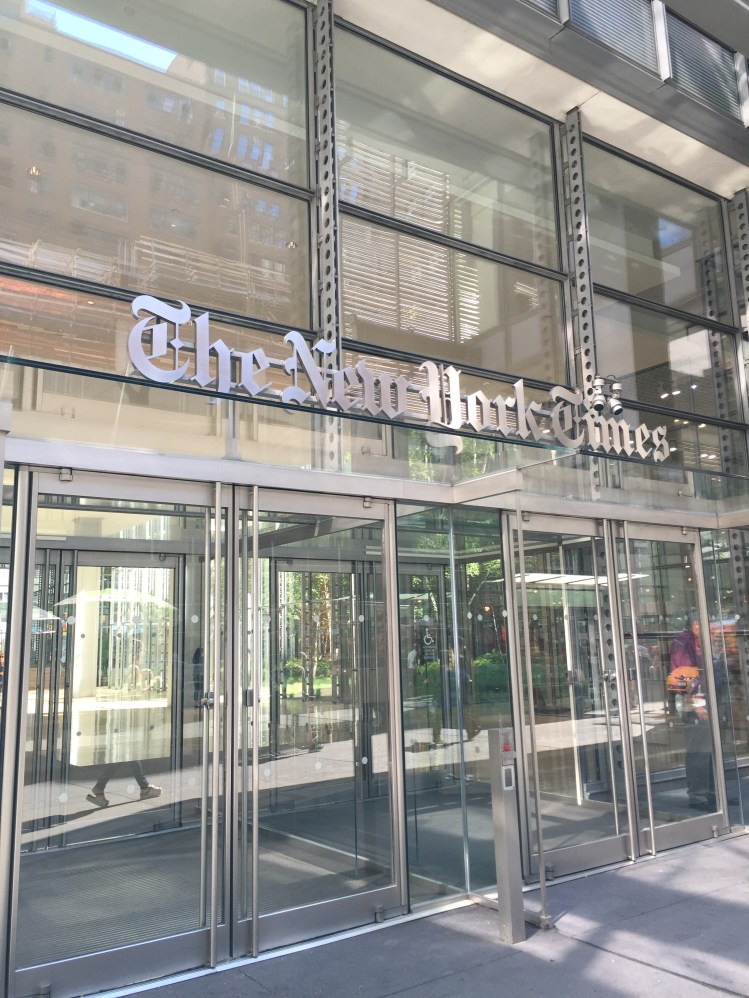
That’s exactly what happened when The New York Times assignment editor, Phyllis Korkki approached social editor, Talya Minsberg.

Let’s start with a quick inventory of your skill set. What is the skill that has been burning a hole on your ‘to do’ list for the last six months? You know, that one thing you are a bit afraid of, but would catapult your career if you just spent some time learning?

Who do you know who can serve as a bridge to knowledge or provide a bit of training and support?

That’s basically the story of Phyllis and Talya, a ‘reverse mentorship’ initiated around the joys of technology, specifically Snapchat.

Phyllis shared her story, ‘Schooled by a Mentor Half My Age’.

“How on earth did I become an “older worker?”

It was only a few years ago, it seems, that I set out to climb the ladder in my chosen field. That field happens to be journalism, but it shares many attributes with countless other workplaces. For instance, back when I was one of the youngest people in the room, I was helped by experienced elders who taught me the ropes.

Now, shockingly, I’m one of the elders. And I’ve watched my industry undergo significant change. That’s why I recently went searching for a young mentor — yes, a younger colleague to mentor me.”

She found that ‘reverse mentor’ in Talya who was ‘Seeing Age With a New Lens’.

 “A few months ago, Phyllis Korkki, an assignment editor at The New York Times who sits a few cubicles away, approached me with a question that gave me pause. “Will you mentor me?” she asked.

I gave her what I imagine was a blank stare, and responded, “Wait, what?”

Phyllis is a longtime Times employee, an accomplished journalist and an author. So the fact that she was approaching me for mentorship was unexpected.

She wanted to do what she was calling a reverse mentorship. She wanted to challenge herself and learn something new, something outside her comfort zone, she said. She wanted to learn how to use Snapchat.

Snapchat is a popular social mobile app that features, among other things, stories that live for just a day. And she came to me because a large part of my role has been guiding editorial strategy in the brave new world of stories that disappear in 24 hours.

So of course I was happy to meet with Phyllis one on one.

But a mentorship? I was honored, albeit a bit perplexed.”

It was at this nexus of generational knowledge transfer, that the two connected in an informal ‘reverse networking’ relationship that has benefited both, and serves as a model for an ‘older brain’/ ‘younger brain’ mind meld.

Phyllis realized the benefit of utilizing a new application @work, as well as the learning experience itself.

“It was exhilarating to see my progress — and embarrassing to witness my missteps, like putting my finger over the camera at the close of the cat cafe video. (But have you ever tried to record yourself while trying to keep a cat on your shoulder?)”

Talya, the mentor, observed Phyllis’ first venture into Snapchat’s geofilters and emoji.

“Eventually, Phyllis took to the official New York Times Snapchat account to broadcast three stories. And three times I waited with bated breath to watch those stories, feeling like a teacher in the back of a classroom waiting for a student to give a big presentation. Each time, she got better — and I was eager to tell her about it in person.

When I gave Phyllis a glowing review, she kept saying, “Really? You like it?” I think we both recognized the moment as a milestone in the reverse mentorship. We both felt success.”

And  that’s the ultimate benefit of a mentoring relationship: both participants experience success.

Your assignment, this week@work, should you choose to accept it: go find your Phyllis or Talya and engage in the career energizing process of a ‘reverse mentorship.”

The week@work – the value of cross-functional experience, empowering introverts, economic recovery, and a new leader @librarycongress

It turns out that the path to leadership is paved not just by elite MBA degrees, but also with experience across a range of business functions. Once you arrive in the ‘C Suite’ it’s to your advantage to pay attention to the introverts in the room.

In other stories this week@work, evidence shows an increase in middle class incomes, there’s a new Librarian of Congress, and can you remember Oprah’s first book club pick 20 years ago?

Generalize or specialize? That is the question Neil Irwin answers in ‘A Winding Path to the Top’ for The New York Times.

“How does a person get to be the boss? What does it take for an ambitious young person starting a career to reach upper rungs of the corporate world — the C.E.O.’s office, or other jobs that come with words like “chief” or “vice president” on the office door?

The answer has always included hard work, brains, leadership ability and luck. But in the 21st century, another, less understood attribute seems to be particularly important.

To get a job as a top executive, new evidence shows, it helps greatly to have experience in as many of a business’s functional areas as possible. A person who burrows down for years in, say, the finance department stands less of a chance of reaching a top executive job than a corporate finance specialist who has also spent time in, say, marketing. Or engineering. Or both of those, plus others.”

Many corporations, in the past, had institutionalized ‘rotational assignments’ in a variety of business functions under the aegis of ‘leadership development programs’. When ‘shareowner’ value became the primary measure for CEOs, these internal employee development initiatives were shut down. But the need for cross-functional expertise never went away.

“To be a C.E.O. or other top executive, said Guy Berger, an economist at LinkedIn, “you need to understand how the different parts of a company work and how they interact with each other and understand how other people do their job, even if it’s something you don’t know well enough to do yourself.”

Developing multiple areas of expertise provide a pragmatic workplace foundation for the aspiring entrepreneur, the Fortune 500 CEO, and the variety of public and private leadership opportunities in between.

You learn the language, make life-long career connections, and maintain contact with your customer.

grand central ny.jpg

Location seems to influence opportunities as well. Take note, all you folks who hesitate to relocate.

“Beyond the results on job functions, the data from LinkedIn shows some trends for which the explanations aren’t completely obvious. For example, former consultants who lived in New York or Los Angeles had higher odds of ending up with a top job than people in other large cities like Washington or Houston. A former management consultant with 15 years of work experience in six different functions and an M.B.A. from a top school had a 66 percent chance of becoming a top executive if he lived in New York compared with a 38 percent chance in Washington.”

Bottom line, moving out of you career comfort zone, whether that means function or city, holds long-term implications for career success.

The second story this week@work comes from the print edition of The Economist, ‘Shhhh! Companies would benefit from helping introverts to thrive’.

Most companies worry about discriminating against their employees on the basis of race, gender or sexual preference. But they give little thought to their shabby treatment of introverts.

The recent fashion for hyper-connectedness also reinforces an ancient prejudice against introverts when it comes to promotion. Many companies unconsciously identify leadership skills with extroversion—that is, a willingness to project the ego, press the flesh and prattle on in public.

What can companies do to make life better for introverts? At the very least, managers should provide private office space and quiet areas where they can recharge. Firms need to recognise that introverts bring distinctive skills to their jobs. They may talk less in meetings, but they tend to put more thought into what they say. Leaders should look at their organisations through the introverts’ eyes. Does the company hold large meetings where the loudest voices prevail? That means that it is marginalising introverts. Does it select recruits mainly on the basis of how they acquit themselves in interviews? That could be blinding it to people who dislike performing in public.”

Jim Tankersley reported for The Washington Post Wonkblog, ‘Middle class incomes had their fastest growth on record last year’.

ny-corner

“Middle-class Americans and the poor enjoyed their best year of economic improvement in decades in 2015, the Census Bureau reported Tuesday, a spike that broke a years-long streak of disappointment for American workers but did not fully repair the damage inflicted by the Great Recession.

Real median household income was $56,500 in 2015, the bureau reported, up from $53,700 in 2014. That 5.2 percent increase was the largest, in percentage terms, recorded by the bureau since it began tracking median income statistics in the 1960s.

In addition, the poverty rate fell by 1.2 percentage points, the steepest decline since 1968. There were 43.1 million Americans in poverty on the year, 3.5 million fewer than in 2014. The share of Americans who lack health insurance continued a years-long decline, falling 1.3 percentage points, to 9.1 percent.

“The highest income growth was in the bottom fifth” of workers, “which is very welcome news,” said Lawrence Mishel, president of the liberal Economic Policy Institute think tank. Furman, of the White House, credited wage-boosting policy initiatives for some of that increase: “The fact that millions of workers have gotten a raise, as states have raised minimum wages, has definitely had an effect there,” he said.

All told, the gains brought median incomes nearly back to their levels before the recession, after adjusting for inflation, though they remain below 1999 levels. Bureau officials said the 5.2 percent growth rate was not statistically distinguishable from five other previous increases in the data, most recently the 3.7 percent jump from 1997 to 1998.”

On Wednesday, Carla Hayden was sworn in as the 14th Librarian of Congress“Hayden, the first woman and the first African American to lead the national library, was nominated to the position by President Barack Obama on February 24, 2016, and her nomination was confirmed by the U.S. Senate on July 13.”4532.jpg

Baynard Woods covered the appointment for The Guardian, ‘Carla Hayden: new librarian of Congress makes history, with an eye on the future’.“Even though librarianship is one of the four what they call feminized professions – social work, education nursing, and librarianship – where 85% of the workforce is female, there haven’t been an equal amount of women in the leadership positions,” Hayden said in an interview.

Hayden is also only the third Librarian of Congress to actually have training as a librarian.

“There have been lawyers and politicians, historians, scholars, librarians, and I think at this time it’s not a detriment to have a librarian be librarian of Congress,” she said.

The librarian of Congress oversees the world’s largest library system. As the name indicates, one of the main roles of the library is to assist Congress in the research it needs in order to pass bills. It also oversees the US copyright system, names the poet laureate, and preserves historical documents and books.

Hayden first came to national prominence in 2003 when she spoke out against certain elements of the Patriot Act as the head of the American Library Association. Attorney general John Ashcroft attacked Hayden for sowing “hysteria” about the provision of the act that would allow the government to search library and bookstore records.

Hayden shot back.

“We are deeply concerned that the attorney general should be so openly contemptuous of those who seek to defend our Constitution,” she said. “Rather than ask the nation’s librarians and Americans nationwide to ‘just trust him,’ Ashcroft could allay concerns by releasing aggregate information about the number of libraries visited using the expanded powers created by the USA Patriot Act.”

At the time, there was political risk in such statements, but Hayden said she never considered that.”

In history@work this week, September 17 marked the 20th anniversary of Oprah Winfrey’s Book Club. Do you remember the first pick? Jacquelyn Mitchard‘s ‘Deep End of the Ocean’.201603-ep521-own-watn-9-949x534.jpgOprah’s Book Club quickly became a hugely influential force in the publishing world, with the popular TV host’s endorsement capable of catapulting a previously little-known book onto best-seller lists.

When Oprah’s Book Club first launched, some in the publishing world were skeptical about its chances for success. As The New York Times noted: “Winfrey’s project—recommending books, even challenging literary novels, for viewers to read in advance of discussions on her talk show—initially provoked considerable skepticism in the literary world, where many associated daytime television with lowbrow entertainments like soap operas and game shows.” However, the club proved to be a hit with Winfrey’s legions of fans, and many of her picks sold over 1 million copies. (She earned no money from book sales.) Winfrey’s ability to turn not just books but almost any product or person she recommended into a phenomenon came to be known as the “Oprah Effect.”

Celebrate this week@work with a selection from Oprah’s long list of book recommendations.


Photo credit: Carla Hayden by Pablo Martinez Monsivais/AP

The week@work – end of summer, Wells Fargo issues an apology to artists, start-ups adapt, cycling is the new networking, and the August jobs report

In news this week@work: Wells Fargo placed advertising in advance of ‘Teen Financial Education Day’ implying the worth of career aspirations in the sciences rank above those in the arts, Silicon Valley start-ups are adapting  to anticipate a market downturn, networking has moved from the bar to the bike (that’s a good thing), and the U.S. unemployment rate remained unchanged at 4.9%.

Late Saturday morning I checked my Twitter feed and found this from novelist Caroline Leavitt. Forget post-tropical cyclone Hermine, this was the Labor Day weekend’s perfect storm.

According to Forbes contributing writer, Emily Willingham,“Wells Fargo rolled out an ad campaign this week that it almost immediately withdrew following on Internet outrage from a lot of angry artists and humanities professors. That may not sound that scary, but these folks know how to use words and emote.

The ads, using images depicting teens engaging in sciencey things, urge us to “get them ready for tomorrow” by ensuring that the aspiring ballerinas and actors of today become engineers and botanists of the future…

The message here is, of course, that the future is science. That becoming a ballerina or an actor is a dreamscape fairytale that has no place in a real world of cold hard cash and sciencey-sounding things like botany. Imagine if some parents buy into that ad’s message and try to push their budding ballerina into botany instead. The world loses an artist and gains a mediocre, uninterested botanist who’s given up her life’s dream? Lose–lose.”

This was not just a ‘business section’ story. Olivia Clement reported on Broadway’s reaction on Playbill.com.

“A new advertising campaign from Wells Fargo, an American banking and financial services company, has prompted outrage from the theatre community. The ads imply that it is more valuable for young people to pursue a career in the sciences rather than the arts.

A Wells Fargo brochure depicts a young man in a science lab. “An actor yesterday. A botanist today. Let’s get them ready for tomorrow,” reads the accompanying text. Another, depicting a young woman in a lab, reads: “A ballerina yesterday. An engineer today.”

Among those to express their disappointment and frustration at the campaign on September 3 were Alex Brightman, Ann Harada, Cynthia Erivo, Heather Headley and Benj Pasek—who took to Twitter to call out the company directly. “Apparently @WellsFargo doesn’t think that an actor or ballerina require any work at all. Shame!” read Erivo’s tweet.”

Wells Fargo apologized via Twitter late Saturday.

Anticipating the end of the boom, Katie Benner delivered a tech industry status report, ‘Warned of a Crash, Start-Ups in Silicon Valley Narrow Their Focus’.

“Last year, many tech executives, venture capitalists and entrepreneurs were convinced that a multiyear boom that had propelled young companies to great heights could no longer sustain itself.

The worst fallout may yet come, but many of the start-ups have hung on. Across Silicon Valley, engineers are still commanding annual salaries that average $136,000, according to Hired, a recruiting firm. Demand is brisk for $4 buttered toast, and office space rents remain near record highs. The biggest start-ups, like Uber and Airbnb, continue to land billions of dollars in funding. And investors are shoveling money into venture capital funds, which raised so much cash in the first half of this year that it rivaled the amount raised in all of 2015.

For all of the hand-wringing, “there just hasn’t been much of a downturn,” said Paul Buchheit, a managing partner at Y Combinator, a prominent start-up incubator that nurtured companies including Dropbox and Airbnb. “I don’t even see many companies going out of business.”

Wondering where you might meet one of those tech execs or VCs? This past week Sarah Max covered a story that has been growing globally over the past year, ‘Cycling Matches the Pace and Pitches of Tech’. In other words, cycling is the new networking.

20160511__12DCBBIKw~1.jpg

“Thinking he needed to take up a “California sport,” Greg Gretsch started cycling in 1988, when he moved to the Bay Area to work in marketing at Apple after graduating from the University of Georgia. He bought a 10-speed road bike and joined a group of other Apple employees for a standing noon ride.

Today, Mr. Gretsch, 49, is a founding partner with San Francisco-based Jackson Square Ventures, which makes early-stage investments in fledgling companies, including a social network and performance-tracking app for athletes call Strava. He rides an average of five days a week on paved roads in the Bay Area and on trails near his second home near Lake Tahoe. Cycling is primarily for exercise and escape, he said, but it has also been good for his career.

“Connecting with people is important to what I do, and you can learn a lot about a person, and from a person, on the bike,” said Mr. Gretsch, who founded three companies before going into venture capital in 2000 at a firm called Sigma Partners.”

On Friday, the U.S. Labor Department released the August jobs report. Camila Domonoske summarized the data for NPR.

“The U.S. added 151,000 new jobs in August and the unemployment rate held steady at 4.9 percent, according to the monthly jobs report from the Bureau of Labor Statistics.

Both those metrics fell short of expectations: Economists were expecting about 180,000 new jobs, and a slight dip in the unemployment rate, to 4.8 percent…”

Finally, this week@work, we celebrated the last weekend of summer.

IMG_5468.jpg


Photo credit: Boulder cyclists, Cliff Grassmick, Daily Camera


It’s Labor Day #LetsTalkAboutWork!

It’s Labor Day – the last barbecue of summer, the ‘final’ summer sale on everything, and the traditional late evening travel crush. What if we reimagined this holiday as a day of national conversation on work and workers? #LetsTalkAboutWork!

You need not look further than the USA TODAY headline: “Labor Day by the Numbers: Americans Can’t Stop, Won’t Stop Working” to realize we are spending more time @work and less time considering why. Here’s just a sampling of stats journalist Ashley May reported: 41% of workers did not take a single vacation day in 2015, 55% ended the year with unused vacation days, and 41% of employers require staff to work today, Labor Day.

Out of necessity we maintain a laser focus on our own career goals, spending most of the 365 days a year securing our future as best we can in an ever changing workplace. What if we just took one of those days to consider the workplace issues we face as part of a larger context?

The Labor Day holiday was originally conceived as “…a creation of the labor movement and is dedicated to the social and economic achievements of American workers. It constitutes a yearly national tribute to the contributions workers have made to the strength, prosperity, and well-being of our country.”

What better way to offer a tribute to the American worker than to engage in a national discussion that restores respect and considers the reality of today’s workplace?

Politicians will parade and hold forth at Labor Day gatherings, but will not solicit ideas, or listen to the voices of workers who don’t share their agenda.

Access to education and a right to work are fundamental American values. It’s how we define ourselves when asked ‘what do you do?’. Imagine the despair for those with no answer.

It’s time to reestablish the voice of the American worker and address both the barriers to workplace entry, and the challenges @work once you arrive.

Share your ideas @workthoughts.com #LetsTalkAboutWork!


What are you going to do with those energy reserves you stored this summer?

As the sun sets on summer 2016, use the upcoming Labor Day weekend as a catalyst to recalibrate you career trajectory.

Why Labor Day? Timing is everything. This weekend marks a transition between seasons and a sense of ‘starting over’ as a new school year begins.

When you arrive @work on Tuesday morning your plans will collide with the competing interests of colleagues returning to work, equally energized and motivated. If you have a plan, and a schedule of activities already on your calendar you will be in a position to maintain the momentum, moving you closer to your ‘dream’.

Start with two questions:

What do I still want to accomplish?

What is one thing I can do move forward?

Your answer to the first question asserts your priorities, and the second sets the first item on your agenda.

When thinking about priorities, consider feedback you have received from managers, colleagues, mentors and friends. What skills need fine tuning? Is there additional expertise you need to acquire to advance in your current position or transition to a new workplace? Who can help you achieve your goals? Is it time for additional training or an advanced degree?

The ‘still want to accomplish’ question hits at the fundamental essence of who you are, who you want to become, and the legacy you want to leave behind. It has a workplace component, but also addresses work/life balance, and your role as a contributing member of your community.

The next step is to schedule a meeting to set your priorities in motion: coffee with a mentor to review your career direction, an information interview to establish a new professional connection, a visit to a local non-profit, or a meeting with an academic advisor to explore educational options.

Your priorities dictate your agenda.

Before the weekend comes to an end, take a few minutes to review your calendar and block out time for ‘summer energy reserves expenditures’. Send at least one email requesting a meeting and try to find time each week to sit down with folks who can expand your career horizons.

Effectively managing your work/life is an ongoing energy expense. It will keep you moving forward, recalibrating as needed.


The one thing every Olympian should do before they leave Rio 2016

The one thing every Olympian should do before they leave Rio is update their social media identity across all platforms.

For a brief moment in time Olympic athletes capture the global stage and water cooler conversations. It’s not only those who make the podium, but those we discover in the diverse narratives of their journeys to Rio. The majority will return to their home countries as national heroes, contributing to society, away from the media spotlight. A few may return as coaches or commentators in four years. Most will miss the opportunity to capture the Olympic experience as a bridge to the next phase of their career.

In the past I have worked with returning  Olympians who hesitate to include their achievements in sport on their resume. The most competitive athletes are the most reticent to record their accomplishments.

They just don’t think it’s relevant. It is.

In the global workplace, it’s not just the resume; social media communicates talent instantaneously to potential employers. Your professional image is transmitted through your social media identity.

On Saturday, American Virginia Thrasher won the first gold medal awarded at the games in the women’s the 10-meter air rifle. Within a few hours she was taking her first TV interview on NBC, describing her hectic schedule of additional events and starting her sophomore year at West Virginia University.

In describing her life over the next couple of weeks, Thrasher gave voice to the stress that accompanies the life of every student athlete, combining sport with academics. Often lost, is time for reflection on how these experiences transform the athlete into a professional @work.

How do you build the bridge from sport to work on social media?

Take a look at your social media presence across all platforms: Facebook, Instagram, Snapchat, LinkedIn, Twitter…

Do all the pieces fit into a unifying narrative? If not, it’s time to edit. As an Olympian, expectations have been raised and your online image should reflect your aspirations vs. social missteps.

Have you created links to videos and press coverage of your accomplishments?

Do you post videos and press coverage on your Twitter account?

Have you checked with third party sites to ensure your profile information is up to date?

Do you have an account on LinkedIn? (If you’re making the transition from sport to your next career, this component of your professional online identity is critical as you build your ‘next career’ network.)

There are many athletes who hesitate to be defined by their sport, but the skills developed in pursuit of Olympic gold closely match those sought by potential employers: teamwork, goal orientation, communications, problem-solving, and resilience.

Whether you are a summer Olympian, or a star on your own professional stage, it’s time to seize the moment and refresh you social media identity.


Photo credit: US Women’s Rugby Seven – Geoff Burke for USA TODAY Sports


The week@work – Olympic stories, author salaries, “what a feminist looks like” & the July jobs report

This week@work the athletes who go to work every day to pursue an Olympic dream are in Rio, Forbes announced their list of top earning authors, President Obama penned an essay on “what a feminist looks like”, and the U.S. labor market grew by 255,000 positions.

The major story of the next two weeks will take place in Brazil as the athletes of the world gather to compete in the XXXI Olympics. Journalists covered two athletes who have travelled diverse paths to reach Rio 2016.

 Kianoosh Hashemzadeh introduced us to equestrian, Lauren Kieffer, ‘An American Rider Trying to Beat the Boys in Rio’, for The New Yorker

“There are two Olympic-level athletic endeavors in which men and women square off head to head: sailing and equestrian sports. Eventing, an equestrian sport in which horse and rider compete in three phases—dressage, cross-country, and stadium jumping—has been called the most dangerous competition in the Olympics. That danger has never deterred female riders: they have competed alongside men since the field became open to them, at the 1964 Games, in Tokyo. Women do well in the sport, but they have struggled to reach its uppermost echelon: the current top-ten list of the Fédération Équestre Internationale, the sport’s governing body, is made up of eight men and two women. There are, however, six women in the following ten spots—and sitting at No. 12, eager to crash the old guard, is the top female eventing athlete in the United States, twenty-nine-year-old Lauren Kieffer.”

lauren kieffer.jpg“No woman has ever won an individual gold medal in the sport, and, while Kieffer’s focus is to bring home a team medal, an individual victory would be particularly sweet. Women are contenders in eventing, but few have made it to the very top. As Kieffer told me, “Someone has to beat the boys.”

If you’ve seen the Visa commercial that has been running during the NBC Olympic coverage, you may recognize the name Yusra Mardini, a member of the refugee team competing at the Olympics.

mardini.JPG

Charly Wilder profiled her heroic story from her training facility in Berlin for The New York Times, ‘She Swam to Escape Syria. Now She’ll Swim in Rio’.

“Yusra Mardini, an Olympic swimmer, was an hour and a half into her first training session of the day, butterfly-kicking down the length of a pool with a yellow rubber duck balanced on her head.

Last August, Mardini and her sister Sarah fled war-torn Syria and embarked on a harrowing, monthlong journey through Lebanon, Turkey and Greece, up through the Balkans and Central Europe, to Germany, narrowly dodging capture and death. When their crammed dinghy broke down between Turkey and Greece, she and her sister, also a swimmer, jumped into the water and helped guide the boat to safety.

Mardini’s story came to public attention in March when she was identified by the International Olympic Committee as a candidate to compete on a new team of refugees, made up of athletes who are stateless or would otherwise be excluded from the Games. She was thrust into the spotlight, celebrated by the news media as a fresh-faced example of Germany’s so-called welcome culture — a story of uplift at the center of the global refugee crisis.”

Robert Kitson updated the story from Rio after the first day of Olympic competition, ‘Yusra Mardini delights with butterfly heat win for Refugee Olympic Team’

“For those minded to complain about minor irritations in Rio such as humidity in the aquatics centre or a few nibbling insects, the 18-year-old’s story should serve as a timely reminder of life’s more pressing issues.

The venue may have been far from full and her heat loaded with competitors entertaining nil hope of reaching the final but Mardini was the most popular of winners in a time of 1min 9.21sec, just over a second faster than her nearest heat rival. Afterwards she could scarcely contain her joy: “Everything was amazing. It was the only thing I ever wanted was to compete in the Olympics. I had a good feeling in the water. Competing with all these great champions is exciting. I’ve only been back swimming for two years so we’re only now getting back to my levels of before.”

The next story this week@work is for all of you commuting to work, considering a career change. Forbes announced their annual ranking of the world’s highest paid authors this week and new to the top ten was commuter, former journalist and ‘near broke’ novelist, Paula Hawkins.

Natalie Robehmed reported on ‘The World’s Highest-Paid Authors 2016: James Patterson, Jeff Kinney and J.K. Rowling Top Ranking’.

“These well-heeled wordsmiths earned a combined $269 million over the last 12 months, proving that the written word isn’t dead–although television and movie adaptations often help drive sales.

Patterson topped our list for the third straight year, earning $95 million pretax, while children’s author Jeff Kinney placed a distant second, earning $19.5 million.”

hawkins.jpgThe only newcomer to the ranking: Paula Hawkins. After “The Girl with the Dragon Tattoo” and “Gone Girl,” her novel “The Girl on the Train” is the latest literary phenomenon with a calculating female character to hit the bestseller list. It sold 11 million copies worldwide; a movie version hits theaters in October.”

President Barak Obama wrote an essay linking his upbringing by strong women, his role as a father of two girls, and the nomination of Hillary Clinton, to describe “This Is What a Feminist Looks Like” for Glamour magazine.

“In my lifetime we’ve gone from a job market that basically confined women to a handful of often poorly paid positions to a moment when women not only make up roughly half the workforce but are leading in every sector, from sports to space, from Hollywood to the Supreme Court. I’ve witnessed how women have won the freedom to make your own choices about how you’ll live your lives—about your bodies, your educations, your careers, your finances. Gone are the days when you needed a husband to get a credit card. In fact, more women than ever, married or single, are financially independent.

malia-sasha-obama.jpg…the most important people in my life have always been women. I was raised by a single mom, who spent much of her career working to empower women in developing countries. I watched as my grandmother, who helped raise me, worked her way up at a bank only to hit a glass ceiling.

So I’d like to think that I’ve been pretty aware of the unique challenges women face—it’s what has shaped my own feminism. But I also have to admit that when you’re the father of two daughters, you become even more aware of how gender stereotypes pervade our society. You see the subtle and not-so-subtle social cues transmitted through culture. You feel the enormous pressure girls are under to look and behave and even think a certain way.

…we need to break through these limitations.” 

Finally, this week@work, the U.S. Labor Department released the July 2016 jobs report. Jeff Cox covered the news for CNBC.

“Job creation crushed estimates in July as the economy added 255,000 positions, according to the Labor Department.

The headline unemployment rate held steady at 4.9 percent, though a more encompassing measure that includes those not actively looking for work and those working part-time for economic reasons moved up a notch to 9.7 percent. Though still mired near generational lows, the labor force participation rate ticked up one-tenth to 62.8 percent as those counted as not in the labor force decreased 184,000 to 94.3 million.

Hourly wages also moved higher, increasing by 8 cents or an annualized pace of 2.6 percent, while the average work week edged up to 34.5 hours.”

Photo credits: Lauren Kieffer – Toni L. Sandys/The Washington Post, Yusra Mardini – Michael Sohn/AP, Paula Hawkins – The Daily Beast, President Obama – The Daily Mail


What I did this summer…

What happened to summer? Is it me, or does time go by more quickly after July 4? Before your experiences of the past few months are lost in the excitement of fall work assignments, take some time to reflect on what you learned.

Did you travel, study, volunteer or all of the above? Did your curiosity lead you to interviews with folks outside your career field? What did you learn about yourself?

Catalog your experience including the skills you acquired or any challenges you overcame. Some of these will fall naturally into a resume, but others will provide the content for future professional conversations.

How did you grow as an individual or as a professional? Can you identify ways to link your summer experience to your current work?

Sanity and survival compel us to try to separate work from the rest of our lives. But when we return to work after vacation, maintaining the separation can be a barrier to creativity.

Refreshing the view allows us to be open to new opportunities.

Develop a narrative that tells your story of the summer – a story that incorporates all the elements of the ‘new and improved’ you. Keep it simple. Focus on experience that adds value to your ‘brand @work’.

A conversation poolside that sparked an idea for a new product. An article/book that offered an alternative approach to problem-solving. A civic engagement project that spurred ideas to motivate your team. A faculty member or classmate who provided a connection to a potential new client.

Or, did the chance to step away and just daydream provide new insight into your next career?