Workthoughts from outside the margins

Was anyone working yesterday? As social media and cable news forecast the financial apocalypse, I escaped to my ‘go to’ twitter account of Tony winning composer, lyricist and actor, Lin-Manuel Miranda. (For those of you who have been living under a rock for the past year, he is the leader of the merry band of actors who have been recreating the life of Alexander Hamilton on Broadway in nine performances per week this summer.)

And for those of you who think Twitter is an intellectual wasteland, time to get on board. You are missing out on at least one connection with an innovator who is truly transforming the American musical.

Innovation is one of our most overused words, but John Kander, composer of ‘Cabaret’ and ‘Chicago’ used that exact word to describe Mr. Miranda earlier this month in a New York Times profile.

“Innovators are usually synthesizers — they synthesize everything they know and add their own personal talents, and out comes something new,” Mr. Kander said. “What Lin is is a refreshing and healthy contemporary synthesist of everything he’s known before.”

But I digress. Back to Monday and Twitter and @Lin_Manuel. Let’s just say he has a high level of interaction with his followers. And one of those followers, @jjaxtweets, posted ‘My annual back to school post’, which #YayHamlet retweeted. And here is the message.

“Keep an eye out for that kid in the back of your classroom, scribbling in the margins. He or she is dreaming of worlds we haven’t yet imagined, scribbling toward a place we haven’t yet seen. Engage those kids, get them out of the margins, and there’s no telling where they may lead you.”

This is where a career begins. A parent, a teacher taking time to engage the child scribbling in the margins.

How do you get to Broadway or whatever your dream might be? You really, really need to love what you are doing. Check out the YouTube videos of the Ham4Ham performances between shows for those in the ticket lottery line and you get the idea.

Infuse your dream with the essence of those first scribbles, and the relationships you build over time.

Connect the dots and synthesize everything you know. Constantly nurture your talent. Lifelong learning has no expiration date.

Work really, really hard and have fun.

I think the ‘kid in the back of the classroom’ was Lin-Manuel Miranda. Or was it you?

The Saturday Read – Brian Grazer and Charles Fishman ‘A Curious Mind: The Secret to a Bigger Life’

Are you curious about the people who work for you? Academy award winning producer Brian Grazer thinks you should be. He manages his organization with curiosity, by asking questions. His book, ‘A Curious Mind: The Secret to a Bigger Life’ was released earlier this year and is a memoir of his success and it’s source, listening to the answers.

“If you’re the boss, and you manage by asking questions, you’re laying the foundation for the culture of your company or group. 

You’re letting people know that the boss is willing to listen. This isn’t about being “warm” or “friendly”. It’s about understanding how complicated the modern business world is, how indispensable diversity of perspective is, and how hard creative work is.”

The initial reviews of the book focused on the ‘curiosity conversations’ Grazer has utilized throughout his career to network with a variety of folks in his unique quest for lifelong learning. But in the acknowledgements at the end of the book he addresses the reader directly on his purpose in writing ‘A Curious Mind’.

“a book not about my curiosity, but about what curiosity has enabled me to do, about what curiosity can enable anyone to do…”

“I didn’t want to write a book about all the people I’d had conversations with – I wanted to write about the impulse to have those conversations. I wanted to use the conversations to tell a story: the story of my steady discovery of the power of curiosity in my own life.”

For Grazer, it’s not just a hobby, but a commitment to intentionally integrate questioning into both his work and life outside of work.

“For it to be effective, curiosity has to be harnessed to at least two other key traits. First, the ability to pay attention to the answers to your questions – you have to actually absorb whatever it is you’re being curious about…The second trait is the willingness to act.”

In the early chapters he describes the power of curiosity to motivate, spark creativity, and build confidence. He is the ‘bard of curiosity’ sharing his career story intertwined with his capacity for discovery. But it’s in chapter five where the storytelling turns to management advice. “…the human connection that is created by curiosity…Human connection requires sincerity. It requires compassion. It requires trust.”

“Can you really have sincerity, or compassion, or trust, without curiosity?

“I don’t think so. I think when you stop to consider it – when you look at your own experiences at work and at home – what’s so clear is that authentic human connection requires curiosity.”

Here is the ‘gem’ of the book.

“To be a good boss, you have to be curious about the people who work for you.”

How many of you have a BA in business, an MBA or certificate from a prestigious executive management program? Has anyone ever suggested management by curiosity? We have all been taught to listen. And we don’t. But no one ever explained in this way, how critical the right questions are to getting to the fundamentals when decisions are being made.

“I use curiosity every day to help manage people at work…as a tool to build trust and cooperation and engagement.”

“And curiosity is the key to connecting and staying connected.”

Reading ‘A Curious Mind’ reminded me of a quote buried in dialog in the 2012 novel by Mark Helprin, ‘In Sunlight and in Shadow’:

“It’s a defining difference, curiosity. I’ve never known a stupid person who was curious, or a curious person who was stupid.”

The Saturday Read – Ed Catmull with Amy Wallace ‘Creativity, Inc.’

If you can’t find a business book that meets your needs, write one. Last year Pixar’s Ed Catmull decided to do just that with ‘Creativity, Inc.’ In the introduction, he tells the reader the book “is about the ongoing work of paying attention – of leading by being self-aware, as managers and as companies. It is an expression of the ideas that I believe make the best in us possible.”

The Saturday Read this week is ‘Creativity, Inc: Overcoming The Unseen Forces That Stand In The Way Of True Inspiration’.

What differentiates this ‘management bible’ from the others is how well it integrates Catmull’s personal story into the evolution of his management values. We learn how our first interactions with the workplace can influence how we expect all our work places to be structured.

The author changed his undergraduate major from art to physics. In graduate school at the University of Utah he was encouraged by a professor, Ivan Sutherland to study computer graphics “in essence, the making of digital pictures out of numbers, or data that can be manipulated by a machine”. 

It was in this collegial environment that he first experienced “This tension between the individual’s personal creative contribution and the leverage of the group is a dynamic that exists in all creative environments…we had the genius who seemed to do amazing work on his or her own; on the other end, we had the group that excelled precisely because of its multiplicity of views.”

His experiential memory of the environment needed to create the impossible informed his management approach as his career unfolded.

“I would devote myself to learning how to build not just a successful company but a sustainable creative culture.”

His guiding principles remain consistent. In a 2008 Harvard Business Review article, ‘How Pixar Fosters Collective Creativity’ he outlined his management philosophy.

“Empower your creatives. Create a peer culture. Free up communication. Craft a learning environment. Get more out of post-mortems.”

‘Creativity, Inc.’ expands on these principles with experiential lessons in failure and success. It’s about values.

“My belief is that good leadership can help creative people stay on the path to excellence no matter what business they’re in.”

“We start from the presumption that our people are talented and want to contribute. We accept that, without meaning to, our company is stifling that talent in myriad unseen ways. Finally, we try to identify those impediments and fix them.”

“What makes Pixar special is that we acknowledge we will always have problems, many of them hidden from our view; that we work hard to uncover these problems, even if doing so means making ourselves uncomfortable; and that, when we come across a problem, we marshal all of our energies to solve it.”

Throughout the book we are learning about his leadership approach. It’s one that is not exclusive to the head of a major entertainment enterprise, but relevant to all managers from start ups to the Fortune 100.

“The way I see it, my job as manager is to create a fertile environment, keep it healthy, and watch for the things that undermine it. I believe, to my core, that everybody has the potential to be creative – whatever form that creativity takes – and that to encourage such development is a noble thing.”

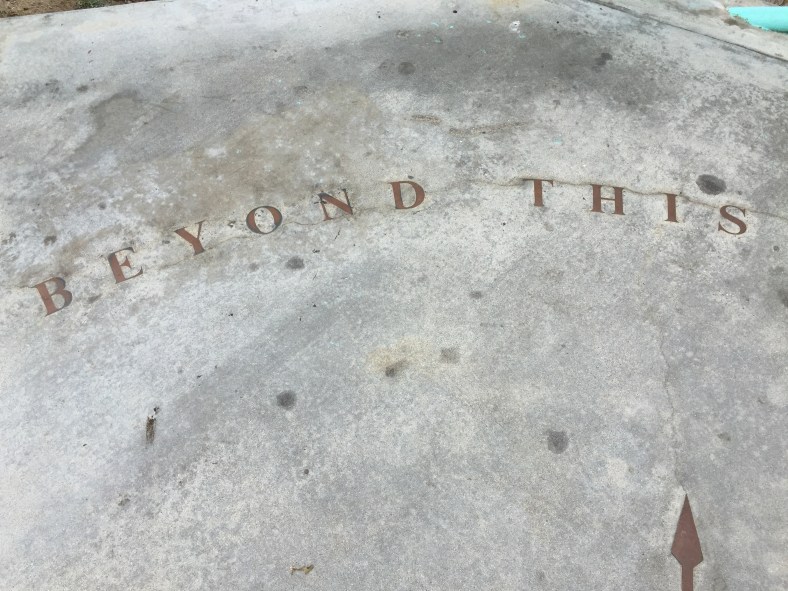
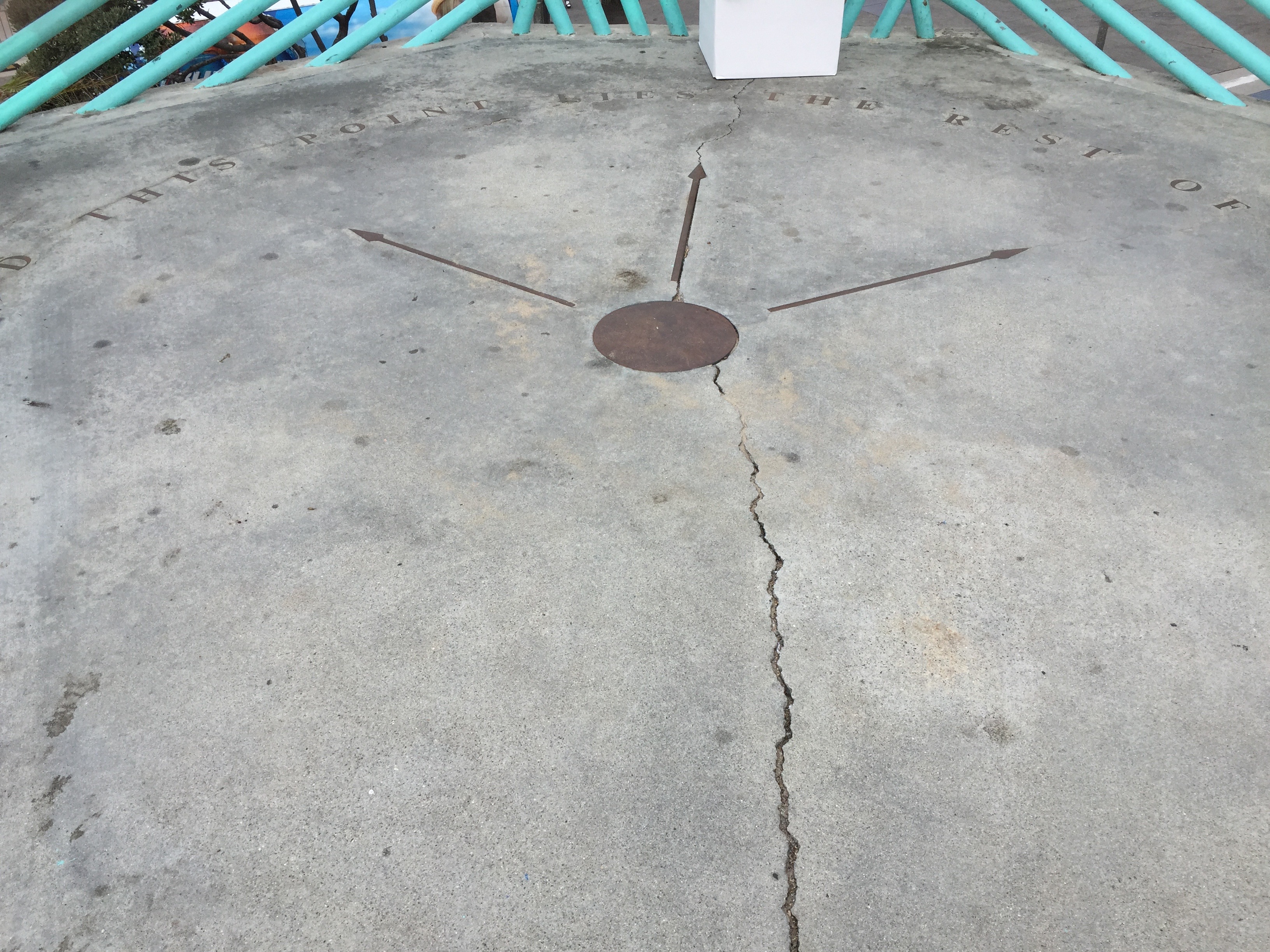
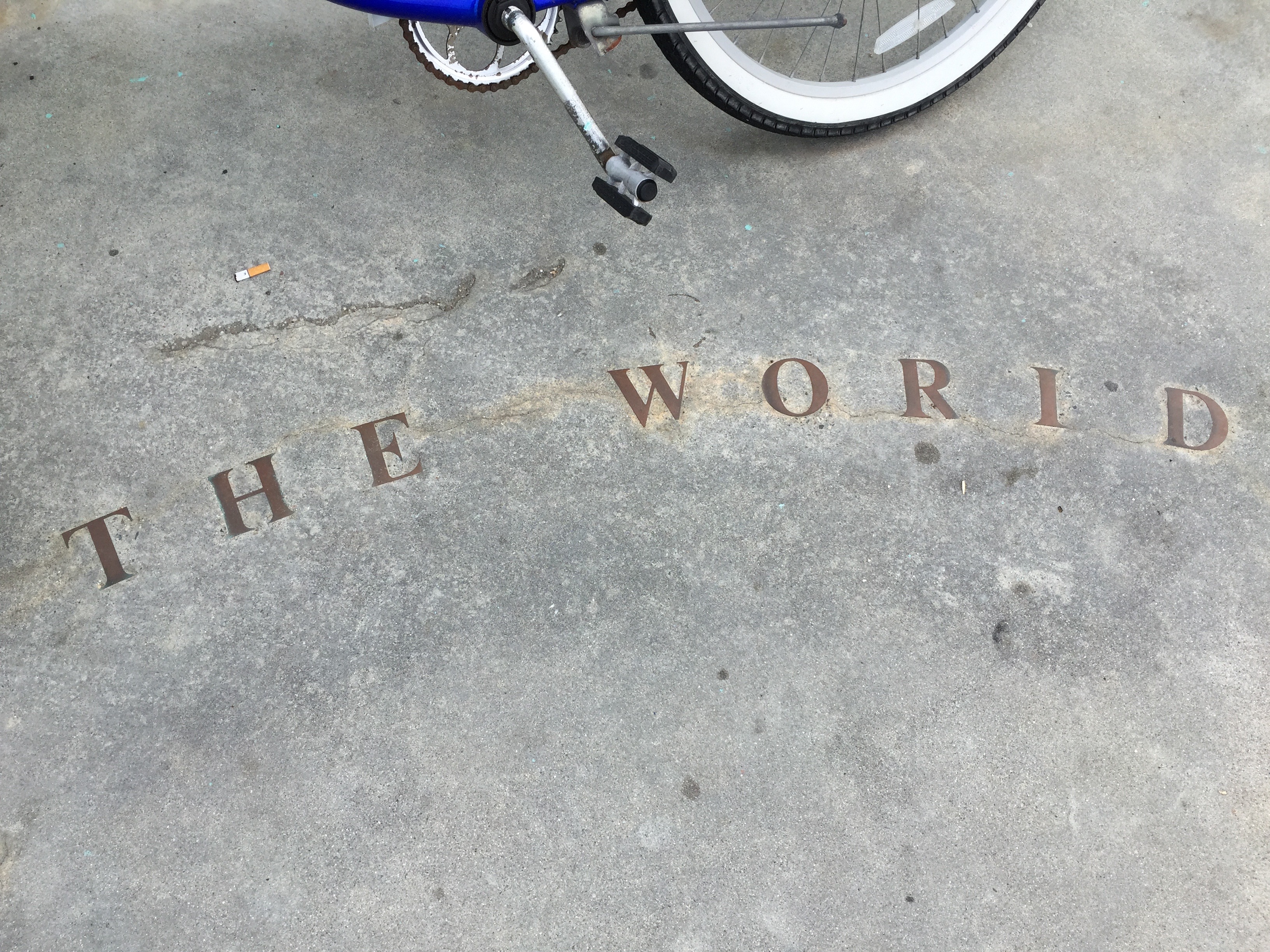
“Beyond this point lies the rest of the world”

I went for a walk this morning along the beach. It was cloudy, unusual for a summer day in California. I stopped in a parking lot to take a photo of the town’s iconic pier. I looked down for a minute and that’s when I spotted it. Embedded in the cement, facing the ocean are three directional arrows. In a semi-circle surrounding the arrows are the words “Beyond this point lies the rest of the world’.

There they were, nine simple words, welcoming visitors to imagine life beyond this point.

IMG_2554

In writing this blog I have often emphasized the importance of curiosity and creativity, urging readers to step away from what is familiar and risk failure to experience success. Here it is, a perfect invitation to imagination and exploration.

IMG_2560

You don’t have to travel to California and gaze at the Pacific. Just stop what you are doing, look up and remind yourself that that there is something bigger beyond where you sit.

IMG_2561

Why we do science and the triumph of NASA’s ‘New Horizons’ team

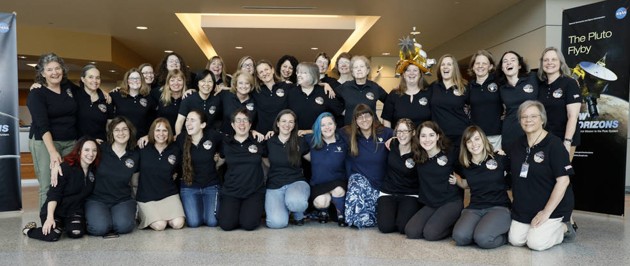
Last week we celebrated the team play of the US Women’s National Team, this week we honor NASA’s ‘New Horizons’ team for piloting a spacecraft the size of a small piano through space for 3,463 days and three billion miles.

Remember Pluto? You know, the ninth planet in order from the sun. Is there anyone who did not do a science project on the planets? Very few of us can trace our choice of career back to the grade school science fair, but some folks used those dioramas as a foundation to build a career in space exploration.

Think about what you were doing at work nine years ago. Now imagine you were part of a team that started a journey toward that ninth planet in 2006. And then your planet was demoted to dwarf status. Can you imagine sustaining a team for almost a decade?

Daniel Terdiman examined the success factors in a post for Fast Company.

“Not everyone on the original team stayed on board throughout the 14 years between proposal and today, but many have. Besides Hersman and principal investigator Stern, others who are still deeply involved include Alice Bowman, the New Horizons mission operations manager, Glen Fountain, the New Horizons project manager, Mark Holdridge, the Pluto encounter mission manager, and many other team leads and sub-leads who worked on everything from propulsion to communications.

That’s impressive stability. Of course, all these people have other tasks beyond the New Horizons project, but everyone knew it was about to be show time. “People ramped down so they weren’t working much on the project,” Hersman said, “but when the time comes to fly past Pluto, a lot of other stuff gets put on hold, or they find time.”

Terdiman found that a ‘longevity document’ provided the blueprint for the mission including requirements and contact information for every team member. “One other essential element of preparing for the nine-year mission was compiling a spreadsheet of contingencies for when things went wrong. This was useful when ground control temporarily lost communications with the New Horizons probe on July 4 of this year.” And finally, “When it’s all over, look back.”

If the shear wonder of the team’s achievement was not enough, Adrienne Lafrance, writing for the Atlantic, identified another major milestone for the ‘New Horizons’ team:

“For all the firsts coming out of the New Horizons mission—color footage of Pluto, photos of all five of its moons, and flowing datastreams about Pluto’s composition and atmosphere—there’s one milestone worth noting on Earth: This may be the mission with the most women in NASA history.”

“The New Horizons team includes about 200 people today, but there have been thousands of scientists and engineers who have contributed to the mission since it began more than a decade ago. Women make up about one-quarter of the flyby team, those responsible for the high-stakes mission taking place this month, according to NASA.”

And now, for you skeptics who either believe all of this is happening on a sound stage in Burbank or just don’t get why we do science and stretch the limits of our knowledge, I turn to Neil deGrasse Tyson.

In an interview with Lester Holt for NBC Nightly News on Tuesday, the American astrophysicist and director of New York’s Hayden Planetarium answered the question of why we do science.

“One of the greatest aspects of what it is to do science is to reach a new vista and then discover that you can now ask questions undreamt of before you got there.”

Tonight, go outside and look up. What do you see? What questions do you have? Imagine being part of a team working to find the answers to those ‘undreamt of’ questions from our new vantage point.

Are you suffering from ‘work martyr complex’? You may need a vacation.

This one’s for all of you who believe you are truly indispensable at work. It’s also for your employees who are really annoyed that you don’t trust them to carry on in your absence. Breaking news – the world will not end if you take a vacation. If it does, I think welcoming the apocalypse on a beach with a Kaluha Colada is preferable to being crushed in a stampede of office workers headed to the one working elevator in the building.

The syndrome, ‘work martyr complex’, has been recently identified among workers in the U.S.. Entrepreneurs are particularly susceptible.  It’s highly communicable and may result in personal burnout. Long term effects include loss of perspective, sense of humor and anyone who has ever worked for you.

It’s one thing to leave paid vacation time on the table, but it’s taking it to the next level when it’s treated as a badge of honor within organizations. Executives encourage employees to take time off, but many leave a portion of their own vacation time unused. These same executives expect folks to be available even when thousands of miles and multiple time zones separate you.

Good news, the effects of ‘work martyr complex’ are reversible. All it requires is that you remove the Joan of Arc costume and be yourself – you know, yourself – the creative, curious colleague who used to interact with co-workers and leave the office for lunch or a walk around the parking lot.

By the way, your competitors are poaching your best people. How? By offering extended vacation time and gaining the benefit of increased productivity from a refreshed workforce.

Journalist Jack Dickey reported for Time Magazine on this new trend in the retail sector:

“On May 14, billboards went up around Houston and Philadelphia, with H&M advertising careers…and extolling one benefit in particular. Five weeks vacation is possible, the signs read.

H&M’s recruiting campaign says a lot about anxieties in the American workforce. The retailer is trying to crack an unexpectedly hard nut: getting American workers to take more time off.”

Beyond the direct competitor benefit consideration, the research is solid. Stepping away invigorates employee contribution.

Entrepreneur Magazine uncovered ‘The Secret to Increased Productivity: Taking Time Off’.

“There is a lot of research that says we have a limited pool of cognitive resources,” says Allison Gabriel, an assistant professor of management at Virginia Commonwealth University who studies job demands and employee motivation. “When you are constantly draining your resources, you are not being as productive as you can be. If you get depleted, we see performance decline. You’re able to persist less and have trouble solving tasks.”

That’s counterintuitive in a culture programmed to believe that it takes near-nonstop work to get the sale, beat the competitor or do whatever is needed to succeed. For most entrepreneurs, rest is considered the province of lesser mortals, put off for a future that never arrives. It’s as if each day is an Ironman triathlon that requires one to crawl across the finish line on all fours.

Vacations have been shown to lead to significantly higher performance upon return to the job. The energizing ingredients are time away from stressors (you need two weeks to get the recuperative benefits from burnout) and mastery and social experiences while on vacation that build competence and social connection.”

If you don’t give your employees time to think and play, you’re not going to have the creativity you need to succeed,” says Vincent Berk, CEO of FlowTraq.”

Time to redefine vacation as an organizational value, not a benefit.

The Art of the Interview

Most of us approach a job interview as an interrogation instead of a conversation. What if the interview was a bit more like those conducted in front of an audience by James Lipton or a podcast by Debbie Millman?

I’ve been thinking a lot about how we select employees for our organizations. Today, in our age of analytics, large corporations believe they can select a candidate using an algorithm to build a scaffolding of interview questions. The process of determining ‘cultural fit’ has morphed into finding folks you would like to hang out with vs. ones who have the skills to do the job.

Both approaches seem to miss something. On one hand, science excludes humanity and on the other, the modern version of the ‘old boy’ network finds its’ candidates at the familiar fraternity mixer. Neither path leads to a diverse organization. Maybe it’s time to look outside current human resources thinking and learn from the ‘masters’ of the interview.

I have this one touchstone article that continues to resonate on a variety of levels. It’s a Harvard Business Review article published in December 2009, ‘The Innovator’s DNA’. In it, the authors (Jeffrey H. Dyer, Hal B. Gregersen and Clayton M. Christensen) posed the question, “What makes innovators different?”

The first skill:

“Associating, or the ability to successfully connect seemingly unrelated questions, problems, or ideas from different fields, is central to the innovator’s DNA.”

 The second, questioning:

“innovators constantly ask questions that challenge common wisdom”. 

Networking, the third skill:

“Devoting time and energy to finding and testing ideas through a network of diverse individuals gives innovators a radically different perspective. Unlike most executives—who network to access resources, to sell themselves or their companies, or to boost their careers— innovative entrepreneurs go out of their way to meet people with different kinds of ideas and perspectives to extend their own knowledge domains.”

With this framework in mind, I was reading Debbie Millman’s 2010 ‘How to Think Like a Great Graphic Designer’ last night, and it all came together. In his foreward, Steven Heller, describes the role of an interviewer:

“Interviews must be tackled with zeal, and the interviewer must control the discussion while waiting for that unexpected revelation to leak out. A skilled host must therefore prepare exhaustively: Take James Lipton of ‘inside the Actors Studio’, with his famously large stack of blue index cards, each containing a pointed question neatly integrated into a systematic progression; while he theatrically examines the narratives of his subjects’ careers, he is always flexible enough to flow with the unforeseen currents of conversation…”

Interviewing requires considerable acumen to enable both the expressive and, especially, the reticent guest to open up. 

Debbie Millman, who has hosted the Internet radio program, ‘Design Matters’ since 2005, always does her homework – and then some…she plies each of her visitors with questions to evoke the unexpected response. At the same time, she inspires their confidence, owing to her sincere interest in the life and work she’s exploring.”

We ask candidates to prepare, but often the distractions of the other things we do, besides recruiting, interfere to a point where we ‘wing it’ as interviewers and rely on the algorithm generated questions. We end up with plain vanilla data to compare with other plain vanilla data and add a dash of our subjective judgment.  The lead candidate we hoped to recruit was probably not too impressed with the experience, knowing he or she was just another cog in the assembly line of interviews of the day.

This may not be a new idea, actually it’s quite fundamental. But imagine the success of an interview when both parties are prepared for the conversation, the interviewer inspires confidence in the candidate to present their authentic self and both can demonstrate a sincere interest in the life and work of the organization.

Entrepreneur’s Notebook – The Cambridge Satchel Company

Why do folks decide to start their own business? Entrepreneur magazine offers a laundry list of possible motivations that include financial independence, tax benefits, ‘a story to tell’ and reinvention. For Cambridge Satchel Company founder, Julie Deane, her motivation was to fund a private education for her daughter and remove her from a school where she was bullied. Her ‘story to tell’ is one of reinventing the traditional school satchel.

A Daily Mail article summarized her journey from kitchen table to fashionista:

“When Julie Deane discovered her daughter was being bullied, she vowed to move her to the £12,000-a-year school down the road.

But unable to afford the fees, the housewife sat down at her kitchen table and wrote a list of ten ways to raise money.

Halfway down the list she wrote ‘selling traditional leather satchels’. It was a business venture which, just four years later, would generate an annual turnover of more than £12million.”

And this is why you should listen to your family (and your potential customer) :

“Emily and her younger brother Max, now 11, were reading Harry Potter at the time and had asked their mother for leather satchels similar to those worn by the book’s characters. Starting small, she found a leather supplier in Hull and asked him to make her eight chestnut brown satchels.

She said: ‘I chose satchels because I had always loved mine as a child. It lasted me all the way through school, whereas my children’s rucksacks became tatty and dirty within a few months.’

The Cambridge University graduate had been enjoying life as a full-time mother while her husband, a partner at an engineering consultancy firm, was the breadwinner. But she immersed herself in books on how to run a business and quickly found herself working all hours of the day from the kitchen of the family home near Cambridge to keep up with demand.”

The bags caught on as a fashion accessory worn by celebrities. Her satchels are sold in the U.S. at Bloomingdales and Saks Fifth Avenue.

Growing her business from a website, she obtained $21m in investments earlier this year, from U.S. backers, Index Ventures. Her plan, after an international trade visit with the Prime Minister, is to break into China and “train up the next generation” of British craftsmen. All the bags are handcrafted in the UK.

Why do some ventures succeed while others do not? Ms. Deane knew her product, had strong motivation for success and worked hard to translate her vision into a reality. The result? She has created jobs, preserved a vocation for leather craftsman and offered a quality product.

In an interview with the Huff Post Third Metric she was asked:

“Did you ever dream – a few years ago, that you would own such a successful company?”

“I didn’t think about it, I have always worked hard at following up every opportunity and building the brand. Trying to exceed expectations of customers (individuals and trade) and not compromising ethics or quality.”

Asked what advice she would share with aspiring entrepreneurs:

“Give it a go, it’s never been a better time to reach a global market. Don’t risk what you can’t afford to lose, that way you will remain optimistic, creative and happy.”

That’s my red satchel in the photo. I bought it online four years ago after returning from a trip to the UK. I had seen the competition in a variety of retail outlets, but her story and the quality of the product closed the sale.

If you have an idea and are committed to hard work, then ‘give it a go!’

It’s only a play? Lessons learned on the stage

The lights dim, the music rises from an orchestra pit hidden from view and a tiny light begins to fly across the curtain. It’s that magical moment of anticipation in a darkened theater on a spring night in New York. It could be any play, but for me, on Tuesday it was ‘Finding Neverland’, the new Broadway musical about the life of JM Barrie, the playwright and creator of Peter Pan.

Being cast in the lead of a Broadway play has about the same odds as being signed to an NFL contract. Only the lucky, talented few survive the uncompromising selection process beginning with high school and college productions, local theater companies, summer stages and hours of auditions to reach the pinnacle of success for a stage actor.

A Yahoo finance article in 2013 listed drama and theater arts among ‘The 10 Worst Majors for Finding a Good Job’. And yet, sitting in a theater, removed from electronic contact with the outside world, it’s easy to understand why so many aspire to a career on the stage.

The lead role of JM Barrie in ‘Finding Neverland’ is acted by Matthew Morrison. His journey to the Lunt Fontanne Theater in NY started at the Orange County School of the Arts in California and progressed to NYU, TV roles, supporting roles on Broadway, his first lead in ‘The Light on the Piazza’, and in 2009, ‘Glee’ where his audience came to know him as ‘Will Schuester’. Although not as popular with critics as theater goers, this musical based on a 2004 movie plays to a full house at every performance.

And every night, each member of the audience receives the gift of watching a cast of actors pursuing their dream. And the actors include children, dogs and actors playing dogs.

Lesson #1 – There they are, on stage, demonstrating in an incredibly competitive business, that you can achieve your dream.

Lesson #2  – Act Two – The former actors who have achieved success beyond the footlights.

Clarence Otis, Jr. who stepped down as Chairman and CEO of Darden Restaurants late last year, credited his success in team building to his experience in theater.

“The thing that prepared me the most — where the team was front and center — was theater, which I did a lot of growing up, in high school, during college, law school and even for a couple of years after law school. I would say that probably is the starkest lesson in how reliant you are on others, because you’re there in front of an audience. It’s all live, and everybody’s got to know their lines and know their cues and know their movement, and so you’re totally dependent on people doing that.”

Tom Vander Well, business consultant, writes on his Wayfarer blog ’10 Ways Being a Theatre Major Prepared Me for Success’.

“When I chose my major, I had no pipe dreams about becoming a professional actor. I did it because more than one wise adult had advised me that my actual major in college would have less impact on my eventual job search than having the actual degree. “Study what you love” I was told, “not what you think will get you a job.” I listened for once and chose theatre because I’d done it all through my secondary education, I had relative success doing it, and because I simply loved being a part of it. Fortunately, my parents gave me absolutely no grief about my choice (unlike most of my fellow majors. Thanks mom & dad!)”

The list of skills he acquired includes: “improvisation, project management, working with a limited budget, hard work, presentation skills and making difficult choices.”

I would add that you learn to accept feedback as an actor. And you eventually realize it’s about the performance, not personal. If you listen you will get better. Maybe that’s the most important lesson we can take from those who make a living on the stage – listen and you will get better.

The Saturday Read – Pico Iyer ‘The Art of Stillness’

This weekend’s ‘Saturday Read’ encourages us to “live outside conventional ideas”, as designer Philippe Starck describes how he maintains his innovative perspective. “I live alone mostly, in the middle of nowhere.”  ‘The Art of Stillness, Adventures in Going Nowhere’ is author Pico Iyer’s continued exploration of ‘staying put’ that began with his 2011 article, ‘The Joy of Quiet’.

“In barely one generation we’ve moved from exulting in the time-saving devices that have so expanded our lives to trying to get away from them — often in order to make more time. The more ways we have to connect, the more many of us seem desperate to unplug. Like teenagers, we appear to have gone from knowing nothing about the world to knowing too much all but overnight.”

In ‘Art of Stillness’, Iyer describes himself “As one who’d been crossing continents alone since the age of nine, I’d always found my delight in movement; I’d even become a travel writer so that my business and my pleasure could become one.”

He describes his book as “simply about how one person tries to take care of his loved ones, do his job, and hold on to some direction in a madly accelerating world.”

He tells the story of his visit to the Mt. Baldy Zen Center outside Los Angeles to interview singer-songwriter Leonard Cohen. It’s the encounter and result that give the book it’s center. Leaving the retreat he reflects:

“…not many years ago, it was access to information and movement that seemed our greatest luxury; nowadays, it’s often freedom from information, the chance to sit still, that feels like the ultimate prize. Stillness is not just an indulgence for those with enough resources – it’s a necessity for anyone who wishes to gather less visible resources.”

He shares his journey in both written and photographic narrative. His images invite the reader to his ‘Nowhere’. Near the end of the book he shares his conclusion:

“It’s only by taking myself away from clutter and distraction that I can begin to hear something out of earshot and recall that listening is much more invigorating than giving voice to all the thoughts and prejudices that anyway keep me company twenty-four hours a day. And it’s only by going nowhere – by sitting still or letting my mind relax – that I find the thoughts that come to me unbidden are far fresher and more imaginative than the ones I consciously seek out.”

“Nowhere has to become somewhere we visit in the corner of our lives…”

Find a corner in your life and enjoy “The Art of Stillness”.