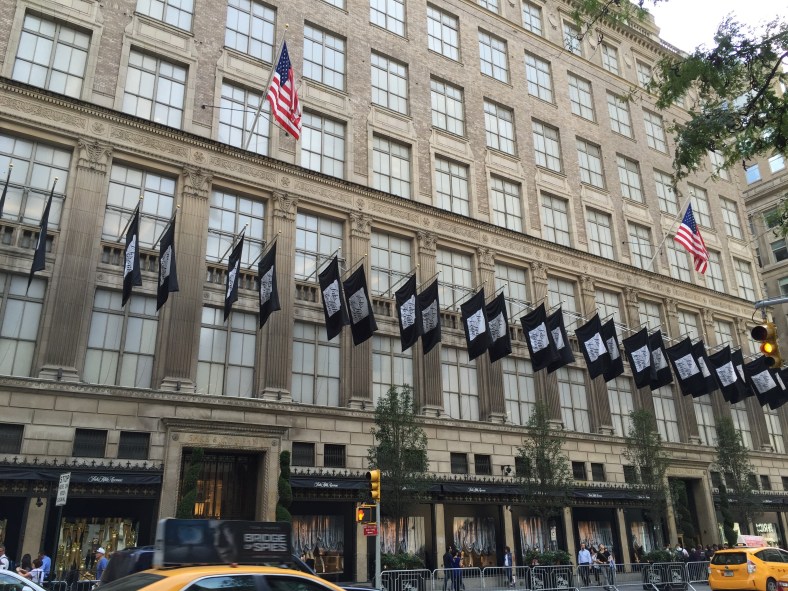
The Saturday Read ‘Wild Man: Patagonia’s conflicted philosopher-king’ by Nick Paumgarten

The Saturday Read this week is journalist Nick Paumgarten‘s profile of the “tiny terror”, Yvon Chouinard, founder of the outdoor clothing and gear company, Patagonia.

If you are not familiar with Patagonia, “Our Reason for Being” provides a concise tutorial.

“Patagonia grew out of a small company that made tools for climbers. Alpinism remains at the heart of a worldwide business that still makes clothes for climbing – as well as for skiing, snowboarding, surfing, fly fishing, paddling and trail running. These are all silent sports. None require a motor; none deliver the cheers of a crowd. In each sport, reward comes in the form of hard-won grace and moments of connection between us and nature.

Our values reflect those of a business started by a band of climbers and surfers, and the minimalist style they promoted. The approach we take towards product design demonstrates a bias for simplicity and utility.

For us at Patagonia, a love of wild and beautiful places demands participation in the fight to save them, and to help reverse the steep decline in the overall environmental health of our planet. We donate our time, services and at least 1% of our sales to hundreds of grassroots environmental groups all over the world who work to help reverse the tide.”

“Wild Man” is the story of how Chouinard’s career evolved over time, rooted in love and respect for nature. It’s an entrepreneur’s journey, with cameo appearances by familiar names: journalist Tom Brokaw, The North Face founder, Doug Tompkins, Royal Robbins and Tom Frost.

Nick Paumgarten’s first connection to Patagonia came in 1992 when he “had a job answering phones at Patagonia’s mail-order office, in Bozeman, Montana…As far as qualifications, I was another city kid, but I’d been out in nature a bit and was, in descending order of aptitude, a skier, whitewater kayaker, backpacker, mountain biker, and fly-rod flailer. I had come of age poring over the Patagonia catalogue, with its action shots and exotic locales, and I already had Yvon Chouinard right up there with Jack Kerouac and Jimi Hendrix on my list of great Americans. Plus, I liked the idea of getting good gear at a discount.”

When Paumgarten decides to leave the job early, he gets his first inkling of Patagonia’s corporate culture.

“I quit the job before I was supposed to, in order to go on a ski trip. Of the two women who’d hired me, one was angry and the other understanding. Their reaction embodied an intrinsic schizophrenia at Patagonia. Chouinard had always encouraged his employees to cut work and go surfing when the swell came in. But it was also a company trying to claw its way out of a hole.”

Patagonia survived the economic challenges of the early nineties with layoffs and loans “from a friend and from some Argentines who wanted to get their money out of the country.”

“It was hard,” Chouinard said. “I realized we were just growing for the sake of growing, which is bullshit.”

“The company, he worried, was straying from its hard-core origins. “I was faced with the prospect of owning a billion-dollar company, with thousands of employees making ‘outdoorlike’ clothing for posers,” he said early in 1991, in a speech to the employees, in which he outlined his misgivings and his new resolutions. These subsequently appeared in the Patagonia catalogue, as a manifesto, under the heading “The Next Hundred Years.”

This ‘long read’ is a primer for the aspiring entrepreneur. It’s a vivid narrative of the progression of one man’s career from childhood dreams of being a fur trapper, to climber, private detective, surfer and blacksmith; proving there are no straight career paths. Its also a lesson in failure, resilience and a realization over time that success can be a double- edged sword.

“Eco-conscious fun-hoggery, as an ethos, a culture, a life style, and an industry, spans the world, and even rules some corners of it. Chouinard is its best-known avatar and entrepreneur, its principal originator and philosopher-king, and is as responsible as anyone for guiding it from the primitive tin-can and hobnail aesthetic of the mid-twentieth century to the slackline and dome-tent attitude of today. He has made it more comfortable, and more glamorous, to be outside, in harsh conditions. His influence is way out of proportion to his revenue footprint. He has mixed feelings about all this—some apprehension about the world he has made. He celebrates the spread of an ecological consciousness but laments the disappearance of danger and novelty, and the way that the wilderness has become a hobby, or even a vocation. He disdains ski areas (“They’re golf courses”), the idea of professional climbing (“I just don’t like the whole paid-climber thing”), and the proliferation of extreme sports as programming and marketing (“Red Bull’s in the snuff-film business”).”

Malinda Chouinard, Yvon’s wife and business partner, was a pioneer in ‘on-site daycare’ and in 2012 her efforts resulted in Patagonia becoming “the first California business to become a B Corp.”

“Malinda is principally responsible for making the company a notably humane place to work. Many there cite the advantage of having day care on site. In 1985, Malinda created (and has since put aside a vast patchwork of space for) what became known as the Great Pacific Child Development Center, to which I didn’t give much consideration, until I got a tour. A staff of twenty-eight oversees some eighty kids, on sprawling grounds of more than twelve thousand square feet, roughly half of it outdoors, among the fruit trees. A recent baby boom had led to another expansion, which displaced the H.R. department to a trailer. “We’ve raised fifteen hundred kids so far,” Chouinard told me. “None of them have been in prison—that I know of, anyway.”

Chouinard’s management style?

“I’m just the owner.” He called his executive style “management by absence.” He used to read business books and study various executive styles and corporate structures, here and abroad, but he prefers to take his lessons from nature—from ant colonies, for example. “There’s no management,” he said. “Every ant just does his job. They communicate and figure it out. It’s like a Navy seal team. The whole team has to agree on what the mission is.” It’s also true, however, that Chouinard’s occasionally whimsical notions send the ants scurrying. Absent or not, he’s still the big ant.”

There are multiple gems of wisdom interspersed throughout the profile. When asked “if the prospect of death bothered him”, he shared his secret to a good life.

“Nah, I’ve always considered death to be a part of life,” he said. “Tell you the secret to a good life: always be the oldest one in the room.”


Photo credit: Patagonia annual report

The Friday Poem ‘The Land of Counterpane’ by Robert Louis Stevenson

There has been quite a bit of ‘health@work’ news this week as one of the major candidates for U.S. President took a couple of sick days away from her campaign.

In the spirit of taking a respite to heal, enter the imagination of writer and poet Robert Louis Stevenson.

The Land of Counterpane

When I was sick and lay a-bed,
I had two pillows at my head,
And all my toys beside me lay
To keep me happy all the day.

And sometimes for an hour or so
I watched my leaden soldiers go,
With different uniforms and drills,
Among the bed-clothes, through the hills;

And sometimes sent my ships in fleets
All up and down among the sheets;
Or brought my trees and houses out,
And planted cities all about.

I was the giant great and still
That sits upon the pillow-hill,
And sees before him, dale and plain,
The pleasant land of counterpane.

Robert Louis Stevenson  from ‘A Child’s Garden of Verses’ 1913

img_5559

The Saturday Read ‘New York Fashion Week: An Oral History’

‘The Saturday Read’ this week is an online interactive feature from the September 8, 2016 New York Times ‘Thursday Styles’ section, capturing a multi-media moment in fashion history as the baton is being passed to the next generation of designers. Ruth La Ferla brings us ‘Our Stories’, an oral history from fashion icons Ralph Lauren, Donna Karan, Calvin Klein, Carolina Herrera, Michael Kors, Issac Mizrahi and Alexander Wang.

This one is for all of you who are first to the newsstand for the September issues of Vogue and Harpers Bazaar, hoping to find a few classical wardrobe elements to update your look for fall. Designer outlets may be the closest most of us get to the runway, but many aspire to a career in one of the global capitals of fashion.

“As New York Fashion Week approaches its 75th year (the first official shows, massed under the heading of Press Week, were held in 1943), with 151 shows spread over nine days, many designers are questioning the future of this semiannual gathering. “We are facing the end of an era,” the designer Diane von Furstenberg said in a recent interview. “But there is nothing nostalgic about that. The future will be more exciting.”

The future may well be exciting, but for many in the industry, the past is one to savor and celebrate. Here, a crowd of fashion notables reflect on their experiences: the good, the bad, the awkward and the forever memorable.”

From their “first shows”, through the “unforgettable moments”, “growing pains”, “the glamour girls” and the “dark days” as AIDS devastated the industry, the top designers, models and fashion commentators share their success, and the mistakes along the way to being installed as icons. If you believe we learn from the wisdom of others, this interactive experience is required reading/viewing.

Here’s a sample.

ZAC POSEN

“In February 2002, when I showed my first collection, I did the setup preshow in my parents’ living room. I had done the collection with small seed money that was generally lent by friends, family and with my savings from the lemonade stand that I had started as a kid on Spring Street.”

ALEXANDER WANG

“Our first fashion week show, for fall 2007, was in a Chelsea warehouse. It was hectic backstage. I remember our casting director freaking out because all the models and dressers (who also happened to be my best friends) were eating greasy pizza, and the director was like, “Where’s Alex?” I was right there eating pizza, too. I guess I didn’t know any better.”

DONNA KARAN

“The turning point came in 1985 when I left Anne Klein. At the time I said to my bosses, “I have this vision for a little company.” Women in those years were wearing shirts and little ties to the office. I asked myself: “Where is the sexuality? Where is the comfort? Where are the clothes that go from day into night? How do you travel with your wardrobe in one bag?” And that’s how the Seven Easy Pieces came about.”

ALEK WEK
Model in the 1990s

“When I started modeling, people kept saying, “Oh, she’s so different, she’s bizarre,” like I wasn’t quite normal. Of course there was a racist element to those conversations. People were beating around the bush. But if I focused on that, I don’t think I would have stayed in fashion. Being viewed as different only gave me more incentive. I wanted people to know that your features or your color don’t make you less beautiful. My motivation was deeper than me just putting on makeup and clothes and doing shows.”

SIMON DOONAN

“All those people perished, and now many young people maybe don’t even know that Perry Ellis was an actual person. Many young African-American designers would be inspired to know how many great African-Americans had careers at the time.

These people didn’t all just get on a bus and drive off somewhere. They died excruciating deaths, some in the hallways of hospitals without help or support. In many instances, their families rejected them. I distinctly remember people who didn’t have a funeral or memorial. I had a friend who was buried in an unmarked grave.

It’s always troubled me that these supertalented original thinkers weren’t adequately memorialized.

They were Patrick Kelly, Angel Estrada, Isaia, Clovis Ruffin, Halston, Antonio Lopez and Juan Ramos, Tina Chow, Tim Hawkins, Robert Hayes and Laughlin Barker. And the photographers: David Seidner, Barry McKinley, Herb Ritts, Bill King and so many more. They were window-dresser friends: Bob Currie, Michael Cipriano, Bob Benzio, Stephen Di Petrie. The list goes on.”


The week@work – end of summer, Wells Fargo issues an apology to artists, start-ups adapt, cycling is the new networking, and the August jobs report

In news this week@work: Wells Fargo placed advertising in advance of ‘Teen Financial Education Day’ implying the worth of career aspirations in the sciences rank above those in the arts, Silicon Valley start-ups are adapting  to anticipate a market downturn, networking has moved from the bar to the bike (that’s a good thing), and the U.S. unemployment rate remained unchanged at 4.9%.

Late Saturday morning I checked my Twitter feed and found this from novelist Caroline Leavitt. Forget post-tropical cyclone Hermine, this was the Labor Day weekend’s perfect storm.

According to Forbes contributing writer, Emily Willingham,“Wells Fargo rolled out an ad campaign this week that it almost immediately withdrew following on Internet outrage from a lot of angry artists and humanities professors. That may not sound that scary, but these folks know how to use words and emote.

The ads, using images depicting teens engaging in sciencey things, urge us to “get them ready for tomorrow” by ensuring that the aspiring ballerinas and actors of today become engineers and botanists of the future…

The message here is, of course, that the future is science. That becoming a ballerina or an actor is a dreamscape fairytale that has no place in a real world of cold hard cash and sciencey-sounding things like botany. Imagine if some parents buy into that ad’s message and try to push their budding ballerina into botany instead. The world loses an artist and gains a mediocre, uninterested botanist who’s given up her life’s dream? Lose–lose.”

This was not just a ‘business section’ story. Olivia Clement reported on Broadway’s reaction on Playbill.com.

“A new advertising campaign from Wells Fargo, an American banking and financial services company, has prompted outrage from the theatre community. The ads imply that it is more valuable for young people to pursue a career in the sciences rather than the arts.

A Wells Fargo brochure depicts a young man in a science lab. “An actor yesterday. A botanist today. Let’s get them ready for tomorrow,” reads the accompanying text. Another, depicting a young woman in a lab, reads: “A ballerina yesterday. An engineer today.”

Among those to express their disappointment and frustration at the campaign on September 3 were Alex Brightman, Ann Harada, Cynthia Erivo, Heather Headley and Benj Pasek—who took to Twitter to call out the company directly. “Apparently @WellsFargo doesn’t think that an actor or ballerina require any work at all. Shame!” read Erivo’s tweet.”

Wells Fargo apologized via Twitter late Saturday.

Anticipating the end of the boom, Katie Benner delivered a tech industry status report, ‘Warned of a Crash, Start-Ups in Silicon Valley Narrow Their Focus’.

“Last year, many tech executives, venture capitalists and entrepreneurs were convinced that a multiyear boom that had propelled young companies to great heights could no longer sustain itself.

The worst fallout may yet come, but many of the start-ups have hung on. Across Silicon Valley, engineers are still commanding annual salaries that average $136,000, according to Hired, a recruiting firm. Demand is brisk for $4 buttered toast, and office space rents remain near record highs. The biggest start-ups, like Uber and Airbnb, continue to land billions of dollars in funding. And investors are shoveling money into venture capital funds, which raised so much cash in the first half of this year that it rivaled the amount raised in all of 2015.

For all of the hand-wringing, “there just hasn’t been much of a downturn,” said Paul Buchheit, a managing partner at Y Combinator, a prominent start-up incubator that nurtured companies including Dropbox and Airbnb. “I don’t even see many companies going out of business.”

Wondering where you might meet one of those tech execs or VCs? This past week Sarah Max covered a story that has been growing globally over the past year, ‘Cycling Matches the Pace and Pitches of Tech’. In other words, cycling is the new networking.

20160511__12DCBBIKw~1.jpg

“Thinking he needed to take up a “California sport,” Greg Gretsch started cycling in 1988, when he moved to the Bay Area to work in marketing at Apple after graduating from the University of Georgia. He bought a 10-speed road bike and joined a group of other Apple employees for a standing noon ride.

Today, Mr. Gretsch, 49, is a founding partner with San Francisco-based Jackson Square Ventures, which makes early-stage investments in fledgling companies, including a social network and performance-tracking app for athletes call Strava. He rides an average of five days a week on paved roads in the Bay Area and on trails near his second home near Lake Tahoe. Cycling is primarily for exercise and escape, he said, but it has also been good for his career.

“Connecting with people is important to what I do, and you can learn a lot about a person, and from a person, on the bike,” said Mr. Gretsch, who founded three companies before going into venture capital in 2000 at a firm called Sigma Partners.”

On Friday, the U.S. Labor Department released the August jobs report. Camila Domonoske summarized the data for NPR.

“The U.S. added 151,000 new jobs in August and the unemployment rate held steady at 4.9 percent, according to the monthly jobs report from the Bureau of Labor Statistics.

Both those metrics fell short of expectations: Economists were expecting about 180,000 new jobs, and a slight dip in the unemployment rate, to 4.8 percent…”

Finally, this week@work, we celebrated the last weekend of summer.

IMG_5468.jpg


Photo credit: Boulder cyclists, Cliff Grassmick, Daily Camera


The week@work or on vacation-what leadership looks like, what leadership reads & ‘wasting time’ on the Internet

This week@work, desks and cubicles are vacant as colleagues are catching a few last days of escape away from work. Among those still @work: a journalist shared a relic of presidential transition to remind us what leadership looks like, the White House tweeted the President’s vacation reading choices, Olympians continue to compete in Rio, and we may not be wasting time on the internet.

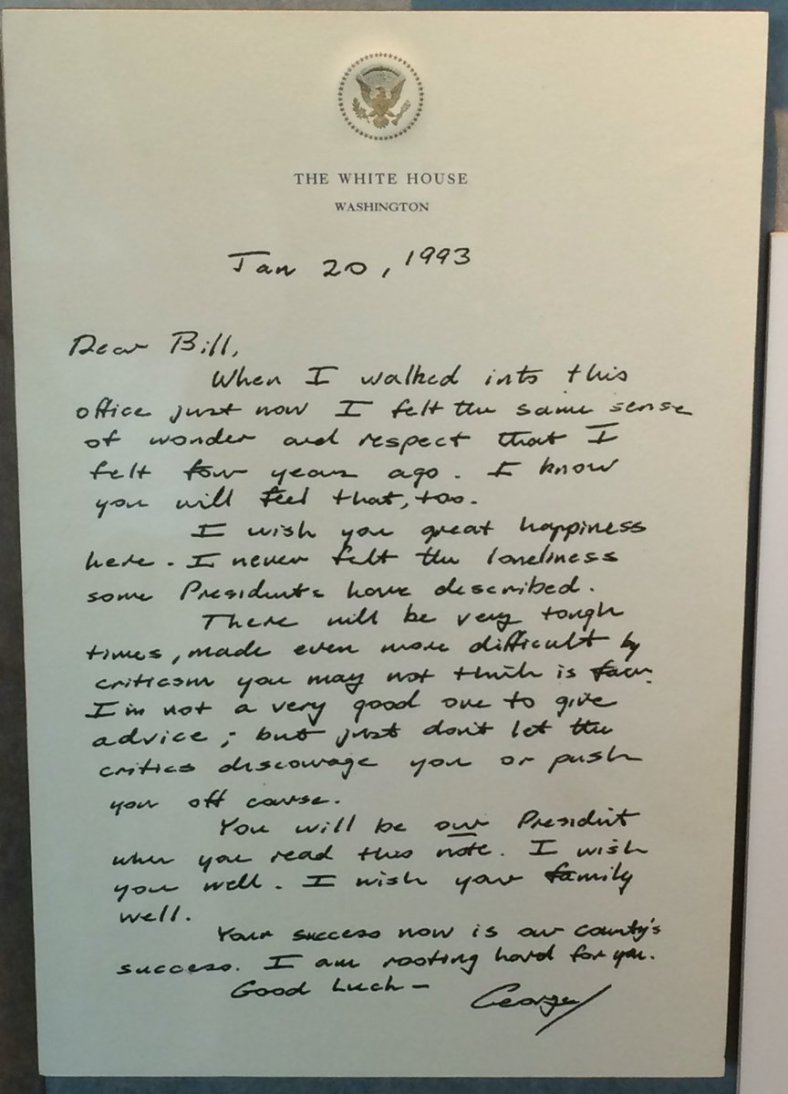
There’s been a copy of a letter circulating recently on the Internet. It arrived in my Twitter account this week via journalist Joyce Karam. It’s a handwritten note written on Inauguration Day, 1993 by departing President George H.W. Bush to his successor, President Bill Clinton.

bush to clinton.jpg

Imagine arriving at your new job on Monday morning and finding a handwritten note from your predecessor, wishing you great happiness @work. “Your success is now our success”.

What if you wrote a letter to the person taking over your desk on Monday morning? Could you convey a “sense of wonder and respect” for your workplace and your work?

Think about it. This is what leadership looks like.

While we are on the topic of U.S. Presidents, current President Obama is on vacation with family, friends and five ‘summer reads’ including Oprah’s recent Book Club selection and one of Bill Gates’ favorites.

readinglist2016_1200.jpeg

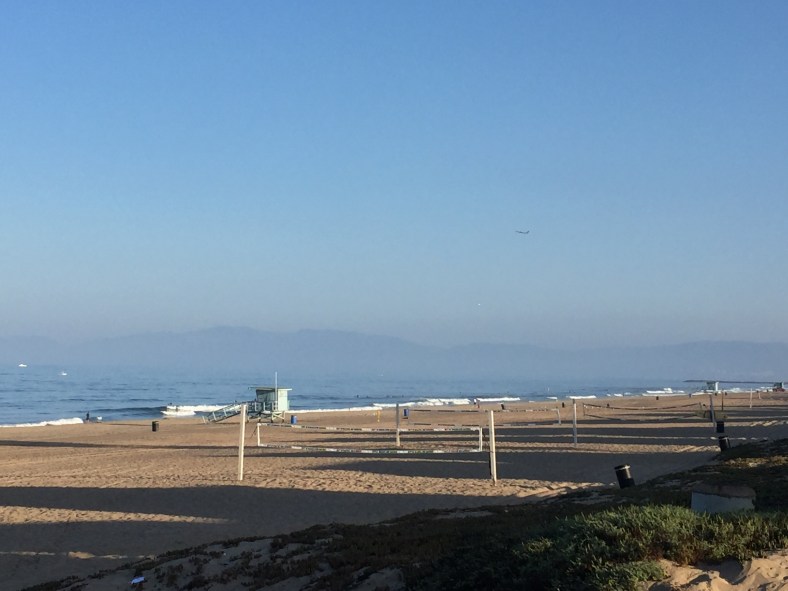
(A quick aside here on the Olympics. The photo at the top of the page captures the vacant volleyball nets this morning in Manhattan Beach, California. It’s the place where two U.S. Olympians, Kerry Walsh Jennings and April Ross went to work to get ready for Rio.)

Back to work, and reading, and surfing the Internet.

Kenneth Goldsmith, artist, professor and first poet laureate of the Museum of Modern Art, urged LA Times readers to ‘Go ahead: Waste time on the Internet’ with his OpEd this weekend.

“The notion that the Internet is bad for you seems premised on the idea that the Internet is one thing — a monolith. In reality it’s a befuddling mix of the stupid and the sublime, a shattered, contradictory, and fragmented medium. Internet detractors seem to miss this simple fact, which is why so many of their criticisms disintegrate under observation.”

He recently discussed his University of Pennsylvania course and new book ‘Wasting Time on the Internet’ with Quentin Hardy of The New York Times. Drawing on his personal observations of students and family, he imagined what an educated person will look like in the 21st century.

We still read great books, and there is a place for great universities. But an educated person in the future will be a curious person who collects better artifacts. The ability to call up and use facts is the new education. How to tap them, how to use them.

I’ve got a 10-year-old and 17-year-old. They’re thinking differently from me. They stay connected all the time, and they’re smart, they play baseball, they read, they spend time online. They’re not robots. Basic human qualities haven’t changed. I can find Plato in online life. When I read Samuel Pepys’s diary I see Facebook posts. We just find new ways to express things.

Go ahead, take a break this week@work. Stream the last week of the Olympics, read a great book, and follow the tangents of Internet exploration.

‘Summer Olympics Look’ a poem by J. Allyn Rosser

From the origin of the Olympic games in ancient Greece, to the modern games of the twentieth century, poets played a central role along with sport. Each generation added their point of view.

Author Tony Perrottet wrote of ‘Poetry’s Relationship With the Olympics’.

“In ancient Greece, literary events were an indispensable part of athletic festivals, where fully clothed writers could be as popular with the crowd as the buff athletes who strutted about in the nude, gleaming with olive oil. Spectators packing the sanctuary of Zeus sought perfection in both body and mind. Champion athletes commissioned great poets like Pindar to compose their victory odes, which were sung at lavish banquets by choruses of boys. (The refined cultural ambience could put contemporary opening ceremonies, with their parade of pop stars, to shame.) Philosophers and historians introduced cutting-edge work, while lesser-known poets set up stalls or orated from soapboxes.”

In 1912, a poem ‘Ode to Sport’ won the first gold literature medal of the modern games. But as Boston Globe reporter Amanda Katz discovered, a bit of intrigue accompanied the entry.

“Presented in full in both French and German versions, attributed to the duo of Georges Hohrod and Martin Eschbach, it was called “Ode to Sport”—a rhapsodic, nine-verse prose poem praising athletics as a model of “Joy,” “Audacity,” “Justice,” and other virtues. The judges went wild. As they wrote in their published review of the poem, “It is of the exact type that we sought for the competitions….It praises sport in a form that to the ear is very literary and very sporting.” So taken were the judges with this Olympic gold poem that they refused to award either the silver or the bronze.

Weeks later, however, according to Stanton, the judges were still trying to get a solid address where they could send Hohrod and Eschbach’s medal and certificate. Only sometime after that did the truth emerge: There was no Hohrod or Eschbach, and the perfect fit of the poem with the initial impulse behind the arts events was no accident. Worried that there wouldn’t be enough entries in his beloved arts competitions, the baron had written the poem himself.”

In London, four years ago, British poet laureate Carol Ann Duffy‘s poem ‘Eton Manor’ traced the 100 year history of the venue chosen for the Paralympics.

The Friday Poem this week is ‘Summer Olympics Look’ American poet J. Allyn Rosser‘s observation of how we view the Olympics @home.

Summer Olympics Look

Only five of us were arguing about the score
of a forward one-and-a-half triple twist
with absolutely rip entry, executed
by an unpronounceable stiff-stepping Russian,
because the sixth was busy in the kitchen.
I couldn’t help noticing how Jane had made
every surface sparkle, clutter-free, neat tray
of snacks, napkins fanned on the coffee table,
fresh daisies on the mantel and by the door.
The Russian’s entry was smooth, minimal splash,
but his come out had been a tiny bit clumsy.
So Jane’s future ex-husband said, anyway,
and when he called out that he wouldn’t mind
another beer as long as she was up,
and she called back that she’d just brought him one,
he had to say something. Because there it stood,
still frosty, darkening the coaster at his elbow.
He said now that’s the sign of a good wife,
like a good waitress, you’re hardly even aware
when she’s there. By now Jane had entered,
her arms crossed in a kind of tuck position.
Her approach was understated but forceful,
and the deftness of the look she sent him
when he finally looked up at her
was so pure and deep and swift, it left
hardly a ripple there in the room among us.

J. Allyn Rosser   The Smithsonian Magazine, July 2012


What I did this summer…

What happened to summer? Is it me, or does time go by more quickly after July 4? Before your experiences of the past few months are lost in the excitement of fall work assignments, take some time to reflect on what you learned.

Did you travel, study, volunteer or all of the above? Did your curiosity lead you to interviews with folks outside your career field? What did you learn about yourself?

Catalog your experience including the skills you acquired or any challenges you overcame. Some of these will fall naturally into a resume, but others will provide the content for future professional conversations.

How did you grow as an individual or as a professional? Can you identify ways to link your summer experience to your current work?

Sanity and survival compel us to try to separate work from the rest of our lives. But when we return to work after vacation, maintaining the separation can be a barrier to creativity.

Refreshing the view allows us to be open to new opportunities.

Develop a narrative that tells your story of the summer – a story that incorporates all the elements of the ‘new and improved’ you. Keep it simple. Focus on experience that adds value to your ‘brand @work’.

A conversation poolside that sparked an idea for a new product. An article/book that offered an alternative approach to problem-solving. A civic engagement project that spurred ideas to motivate your team. A faculty member or classmate who provided a connection to a potential new client.

Or, did the chance to step away and just daydream provide new insight into your next career?


‘The little blue dress’ – Christian Siriano finds success in ‘designing’ a career of inclusion

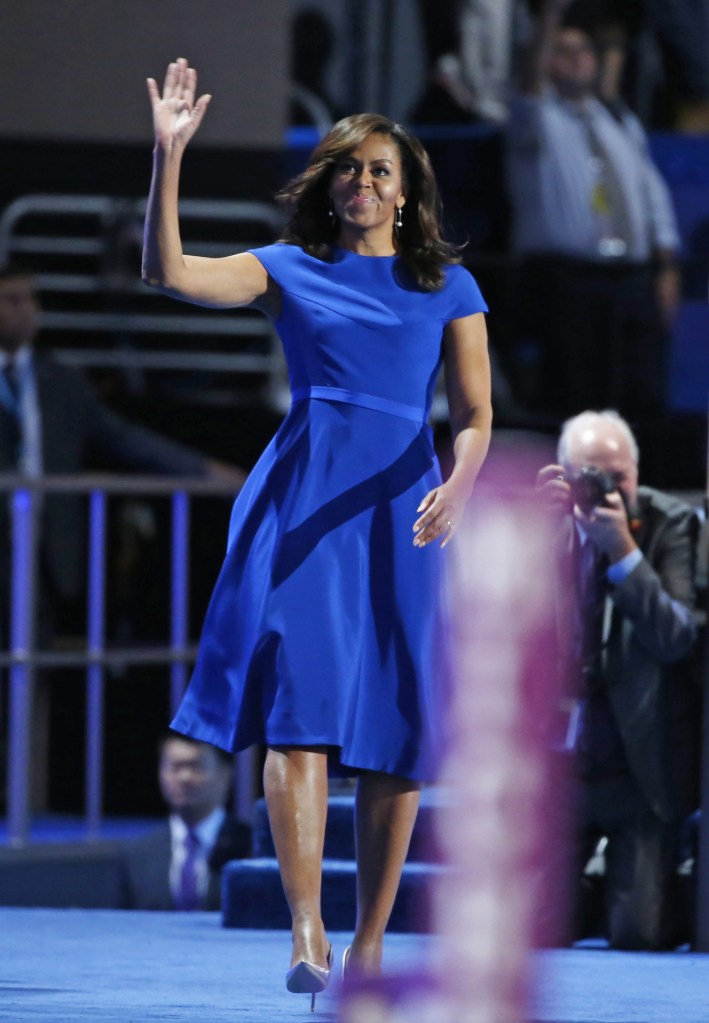
Clothes make the woman. Forget the ‘little black dress’. Last night at the Democratic National Convention, designer Christian Siriano created a new fashion statement in his dress for First Lady Michelle Obama – the ‘little blue dress’.

Mr. Siriano, winner of season four of Project Runway, has become the ‘go to’ wizard of real women’s clothing design.

On June 28  ‘Ghostbusters’ actress and Saturday Night Live cast member, Leslie Jones tweeted“It’s so funny how there are no designers wanting to help me with a premiere dress for movie. Hmmm that will change and I remember everything.”

Mr. Soriano responded within an hour “@Lesdoggg ✋🏼👋🏼”

In a follow-up tweet he expressed his long held work values.

“It shouldn’t be exceptional to work with brilliant people just because they’re not sample size. Congrats aren’t in order, a change is.”

One could guess it’s this attitude of inclusion that put him on the First Lady’s radar.

The New York Times ‘On the Runway’ columnist, Vanessa Friedman noted the link.

“Lest you think Mrs. Obama’s wardrobe choice was just happenstance, however, know that the convention appearance was only the second time she has worn Mr. Siriano; the first time was this month, at the funeral for the police officers killed in Dallas.

Throughout her time in the White House, the first lady has made something of a secondary cause out of supporting new, independent American designers, and choosing her clothes not only because she likes them but because their back story has a certain resonance that goes beyond the aesthetic. Monday night was no different. Fashion is not known for its embrace of togetherness (more for its exclusion). But Mr. Siriano is.

Think that’s just a coincidence?”

michele obama

We make an impression with how we dress. For those in the public eye, where you are one wardrobe malfunction away from a twitter storm, what you wear communicates who you are.

For the rest of us, not a size 2, figuring out what to wear to work is more than dress selection, it’s choosing the ‘costume of the day’ that will enhance our confidence and  communicate our individuality and work ethic.

You never know who may be paying attention.

I look forward to following Mr. Soriano’s career and hope others will follow his leadership to create contemporary fashion for today’s diverse workplace reality.


Photo credit: Mrs. Obama – Reuters


The Saturday Read -‘How to Be an Explorer of the World: Portable Life Museum’ by Keri Smith

This is the first ‘Saturday Read’ that comes with a warning.

“! Warning to whomever has just picked up this book. If you find you are unable to use your imagination, you should put this book back immediately. It is not for you. In this book you will be repeatedly asked to…suspend your disbelief, complete tasks that make you feel a bit strange, look at the world in ways that make you think differently, conduct experiments on a regular basis, and see inanimate objects as alive.” 

If you need to improve your CQ (curiosity quotient), this week’s selection from author, illustrator and guerrilla artist, Keri Smith‘How to Be an Explorer of the World: Portable Life Museum’ is for you.

Author Smith invites the reader on a journey of discovery, loosely following a 13 point guide, which includes a “fieldwork section in the back of the book to record and discover findings.”

“You might want to think of this book as you metaphorical suitcase. A place to collect and document your findings. How do you see? It is also a museum. Your very own museum that will contain your unique vision of the world.”

After a couple of incredibly depressing weeks of global events, I was browsing the selection at Main Street Books in ‘downtown’ Davidson, North Carolina last weekend, when this book cover demanded I stop, open, and return to the wonder of our world; starting right where we sit. I was ready to pack my “metaphorical suitcase” and explore an alternate reality.

Here’s the other warning that should come with this book. ‘May be habit-forming.’

On page 13 ‘your mission’, if you choose to accept, is explained.

“The following pages include a variety of prompts and assignments that will help you on your travels. There is also a section on tools and techniques that will help you with documenting methods. You may use the worksheets included or create your own. Remember, all of your most important tools exist in your body! Use them. Collect as much data as you can – it may come in handing later on. Good luck on your journey.”

How to be an explorer? “Always be looking. Everything is interesting. Notice patterns, make connections. Use all of the senses in your investigations.” (and more)

Here’s an example, from the page I opened to first. “Exploration#7 World of Color”

“Collect paint chips from a paint or hardware store. Find colors you respond to in the world. Attempt to match them using the chips. ( You can also match the colors using a portable paint set.) Make notes of where you saw the colors. (Example: color #573 four leaf clover – My scarf, color #308 golden vista – Sunset 01/09/08)

Alternate: document colors from your favorite books, your dreams, your memories.”

There are 59 explorations that tease your inner Picasso or Shackleton, the last being “How to Wander Aimlessly”. This is a book for those of you on vacation, who missed the point of your break :“freedom or release from duty, business, or activity.”

How do you wander aimlessly? “Pay attention to the details. Lose all sense of time and place.” Reinhabit you inner four year old.

This book will plaster a smile on the crankiest visage.

In a month when the release of Pokemon Go has launched thousands of new adventures, ‘How to Be an Explorer of the World’ will reconnect you with a simpler time when all you needed for entertainment was a big box and an imagination to occupy yourself for hours.


“Dignify the outsider” & other lessons from Carolyn See

When we talk about mentors, we often confine ourselves within the walls of our chosen profession. Carolyn See, professor and writer, was also a ‘world class’ mentor to those who were ‘outsiders’ to the world of New York publishing, the purveyors of taste in American storytelling.

I met Carolyn after a panel at the 2003 Los Angeles Times Festival of Books, when she was signing copies of ‘Making a Literary Life: Advice for Writers and Other Dreamers’. We had a brief conversation and I followed up with an email a few days later to thank her for taking the time to chat. Her response was immediate, gracious and filled with humor.

At the time I was not a writer, but a ‘dreamer’, considering a literary life, while pursuing a passion working with college students. Carolyn encouraged me to explore the writing life, and taught me what it truly means to be a mentor.

Carolyn died last week in Santa Monica, California. Many of her students and friends have shared their memories in published obituaries and tweets. In all there is the common thread of the ‘insider’ welcoming the ‘outsider’.

“…I believe, with a patriotic sincerity that would make a Legionnaire blush, that American literature is owned by everybody in America and that world lit is owned by everyone in the world and that we all get to have a say in it, not just a comparatively few men and women in the Northeast, no matter how decent and talented they may be.”

LA Times columnist, former book critic and writer, David Ulin described his relationship with Carolyn in 2014.

“Carolyn taught me how to be a writer in California. For her, that meant a three-dimensional literary life: writing, teaching and reviewing, all of them inextricable from the whole. As a critic, I have tried to follow her model that reviews should be part of an ongoing conversation with one’s readers, and should explicate something essential — not only whether or not we like a book, but also how it connects to, or reflects, our aesthetics, our world view. Carolyn has always regarded reading as an act of engagement . . . and reviewing, too.”

What is a mentor? What can we learn from the life of a writer if we have followed a completely different career path?

A mentor teaches you to be the three-dimensional human in your workplace vision of success.

In ‘Making a Literary Life, Carolyn offers two menu items: ‘Carolyn’s 18 Minute Chili’ and ‘Carolyn’s 18 Hour Chili’.  For the writer, the two step (18 minute) is “a thousand words a day or two hours of revision” and “a charming note to a writer, editor or agent you admire – five days a week for the rest of your life”.

This is what a mentor does, unselfishly shares their recipe for success with measurable, accountable advice. And the part about ‘charming notes’? It’s universal in its application. This is not about ‘sucking up’, but genuinely expressing gratitude or professional admiration, tied to a specific circumstance.

The ’18 hour chili alternative’ includes suggestions to “take an outside excursion once a week”, “pretend- in your mind – to be…”, and “make a list of what a … like you might want”.

We need to get outside our ‘comfort zone’ to stay creative. It’s essential to visualize what you would be like in your dream job, and equally important, to hold an image of what success looks like to you.

“You can go a surprisingly long time without figuring out the kind of person you are and in what direction your life is taking you.”

It’s why I will always be grateful for my encounter with Carolyn See, and why we all, outsiders included, need a mentor who keeps us honest and on track toward success.