The Saturday Read – The National Book Award ‘Long List’

This past week The National Book Foundation announced the ‘long list’ of nominees for The National Book Award to be announced on November 16. The books nominated fall into four categories: Fiction, Non-Fiction, Poetry, and Young People’s Literature.

A quick review of the titles provides a cultural snapshot of the issues we face as individuals and society as a whole. ‘The Saturday Read’ this week offers a list those nominated in the  fiction and non-fiction categories.

The fiction nominees includes an Oprah Book Club pick, my favorite of the past year, and an anticipated new novel to be released in October.

In non-fiction, racism is a common topic; echoing the theme of last year’s ‘required reading’, 2016 award winner, Ta-Nehisi Coates’ ‘Between the World and Me’. The nominees in this category remind us why we read non-fiction: to listen, to understand the world in all its complexity, and to make thoughtful decisions about our future.

Fiction

Chris Bachelder, The Throwback Special (W. W. Norton & Company)

Garth Greenwell, What Belongs to You (Farrar, Straus and Giroux/Macmillan)

Adam Haslett, Imagine Me Gone (Little, Brown and Company/Hachette Book Group)

Paulette Jiles, News of the World (William Morrow/HarperCollinsPublishers)

Karan Mahajan, The Association of Small Bombs (Viking Books/Penguin Random House)

Elizabeth McKenzie, The Portable Veblen (Penguin Press/Penguin Random House)

Lydia Millet, Sweet Lamb of Heaven (W. W. Norton & Company)

Brad Watson, Miss Jane (W. W. Norton & Company)

Colson Whitehead, The Underground Railroad (Doubleday/Penguin Random House)

Jacqueline Woodson, Another Brooklyn (Amistad/HarperCollinsPublishers)

Non-Fiction

Andrew J. Bacevich, America’s War for the Greater Middle East: A Military History
(Random House/Penguin Random House)

Patricia Bell-Scott, The Firebrand and the First Lady: Portrait of a Friendship: Pauli Murray, Eleanor Roosevelt, and the Struggle for Social Justice (Alfred A. Knopf /Penguin Random House)

Adam Cohen, Imbeciles: The Supreme Court, American Eugenics, and the Sterilization of Carrie Buck (Penguin Press/Penguin Random House)

Arlie Russell Hochschild, Strangers in Their Own Land: Anger and Mourning on the American Right (The New Press)

Ibram X. Kendi, Stamped from the Beginning: The Definitive History of Racist Ideas in America (Nation Books)

Viet Thanh Nguyen, Nothing Ever Dies: Vietnam and the Memory of War
(Harvard University Press)

Cathy O’Neil, Weapons of Math Destruction: How Big Data Increases Inequality and Threatens Democracy (Crown Publishing Group/Penguin Random House)

Andrés Reséndez, The Other Slavery: The Uncovered Story of Indian Enslavement in America (Houghton Mifflin Harcourt)

Manisha Sinha, The Slave’s Cause: A History of Abolition (Yale University Press)

Heather Ann Thompson, Blood in the Water: The Attica Prison Uprising of 1971 and Its Legacy (Pantheon Books/Penguin Random House)


The mysteries of networking #5: Try it in reverse

Folks entering the job market for the first time are often hesitant to reach out to potential networking contacts. What do I have to give in return? is a common question. The answer may be to ‘network in reverse’.

Traditional networking is a commitment of mutual support over time. The majority of established professionals hold no expectation of immediate reciprocity when advising newbies to the job market.

Turns out, their expectations need revision; there’s quite a bit of knowledge to be shared by the most recent additions to the workplace. Just don’t be surprised when you get the call from someone twice your age asking, Will you mentor me?

That’s exactly what happened when The New York Times assignment editor, Phyllis Korkki approached social editor, Talya Minsberg.

Let’s start with a quick inventory of your skill set. What is the skill that has been burning a hole on your ‘to do’ list for the last six months? You know, that one thing you are a bit afraid of, but would catapult your career if you just spent some time learning?

Who do you know who can serve as a bridge to knowledge or provide a bit of training and support?

That’s basically the story of Phyllis and Talya, a ‘reverse mentorship’ initiated around the joys of technology, specifically Snapchat.

Phyllis shared her story, ‘Schooled by a Mentor Half My Age’.

“How on earth did I become an “older worker?”

It was only a few years ago, it seems, that I set out to climb the ladder in my chosen field. That field happens to be journalism, but it shares many attributes with countless other workplaces. For instance, back when I was one of the youngest people in the room, I was helped by experienced elders who taught me the ropes.

Now, shockingly, I’m one of the elders. And I’ve watched my industry undergo significant change. That’s why I recently went searching for a young mentor — yes, a younger colleague to mentor me.”

She found that ‘reverse mentor’ in Talya who was ‘Seeing Age With a New Lens’.

 “A few months ago, Phyllis Korkki, an assignment editor at The New York Times who sits a few cubicles away, approached me with a question that gave me pause. “Will you mentor me?” she asked.

I gave her what I imagine was a blank stare, and responded, “Wait, what?”

Phyllis is a longtime Times employee, an accomplished journalist and an author. So the fact that she was approaching me for mentorship was unexpected.

She wanted to do what she was calling a reverse mentorship. She wanted to challenge herself and learn something new, something outside her comfort zone, she said. She wanted to learn how to use Snapchat.

Snapchat is a popular social mobile app that features, among other things, stories that live for just a day. And she came to me because a large part of my role has been guiding editorial strategy in the brave new world of stories that disappear in 24 hours.

So of course I was happy to meet with Phyllis one on one.

But a mentorship? I was honored, albeit a bit perplexed.”

It was at this nexus of generational knowledge transfer, that the two connected in an informal ‘reverse networking’ relationship that has benefited both, and serves as a model for an ‘older brain’/ ‘younger brain’ mind meld.

Phyllis realized the benefit of utilizing a new application @work, as well as the learning experience itself.

“It was exhilarating to see my progress — and embarrassing to witness my missteps, like putting my finger over the camera at the close of the cat cafe video. (But have you ever tried to record yourself while trying to keep a cat on your shoulder?)”

Talya, the mentor, observed Phyllis’ first venture into Snapchat’s geofilters and emoji.

“Eventually, Phyllis took to the official New York Times Snapchat account to broadcast three stories. And three times I waited with bated breath to watch those stories, feeling like a teacher in the back of a classroom waiting for a student to give a big presentation. Each time, she got better — and I was eager to tell her about it in person.

When I gave Phyllis a glowing review, she kept saying, “Really? You like it?” I think we both recognized the moment as a milestone in the reverse mentorship. We both felt success.”

And  that’s the ultimate benefit of a mentoring relationship: both participants experience success.

Your assignment, this week@work, should you choose to accept it: go find your Phyllis or Talya and engage in the career energizing process of a ‘reverse mentorship.”

The Saturday Read ‘Wild Man: Patagonia’s conflicted philosopher-king’ by Nick Paumgarten

The Saturday Read this week is journalist Nick Paumgarten‘s profile of the “tiny terror”, Yvon Chouinard, founder of the outdoor clothing and gear company, Patagonia.

If you are not familiar with Patagonia, “Our Reason for Being” provides a concise tutorial.

“Patagonia grew out of a small company that made tools for climbers. Alpinism remains at the heart of a worldwide business that still makes clothes for climbing – as well as for skiing, snowboarding, surfing, fly fishing, paddling and trail running. These are all silent sports. None require a motor; none deliver the cheers of a crowd. In each sport, reward comes in the form of hard-won grace and moments of connection between us and nature.

Our values reflect those of a business started by a band of climbers and surfers, and the minimalist style they promoted. The approach we take towards product design demonstrates a bias for simplicity and utility.

For us at Patagonia, a love of wild and beautiful places demands participation in the fight to save them, and to help reverse the steep decline in the overall environmental health of our planet. We donate our time, services and at least 1% of our sales to hundreds of grassroots environmental groups all over the world who work to help reverse the tide.”

“Wild Man” is the story of how Chouinard’s career evolved over time, rooted in love and respect for nature. It’s an entrepreneur’s journey, with cameo appearances by familiar names: journalist Tom Brokaw, The North Face founder, Doug Tompkins, Royal Robbins and Tom Frost.

Nick Paumgarten’s first connection to Patagonia came in 1992 when he “had a job answering phones at Patagonia’s mail-order office, in Bozeman, Montana…As far as qualifications, I was another city kid, but I’d been out in nature a bit and was, in descending order of aptitude, a skier, whitewater kayaker, backpacker, mountain biker, and fly-rod flailer. I had come of age poring over the Patagonia catalogue, with its action shots and exotic locales, and I already had Yvon Chouinard right up there with Jack Kerouac and Jimi Hendrix on my list of great Americans. Plus, I liked the idea of getting good gear at a discount.”

When Paumgarten decides to leave the job early, he gets his first inkling of Patagonia’s corporate culture.

“I quit the job before I was supposed to, in order to go on a ski trip. Of the two women who’d hired me, one was angry and the other understanding. Their reaction embodied an intrinsic schizophrenia at Patagonia. Chouinard had always encouraged his employees to cut work and go surfing when the swell came in. But it was also a company trying to claw its way out of a hole.”

Patagonia survived the economic challenges of the early nineties with layoffs and loans “from a friend and from some Argentines who wanted to get their money out of the country.”

“It was hard,” Chouinard said. “I realized we were just growing for the sake of growing, which is bullshit.”

“The company, he worried, was straying from its hard-core origins. “I was faced with the prospect of owning a billion-dollar company, with thousands of employees making ‘outdoorlike’ clothing for posers,” he said early in 1991, in a speech to the employees, in which he outlined his misgivings and his new resolutions. These subsequently appeared in the Patagonia catalogue, as a manifesto, under the heading “The Next Hundred Years.”

This ‘long read’ is a primer for the aspiring entrepreneur. It’s a vivid narrative of the progression of one man’s career from childhood dreams of being a fur trapper, to climber, private detective, surfer and blacksmith; proving there are no straight career paths. Its also a lesson in failure, resilience and a realization over time that success can be a double- edged sword.

“Eco-conscious fun-hoggery, as an ethos, a culture, a life style, and an industry, spans the world, and even rules some corners of it. Chouinard is its best-known avatar and entrepreneur, its principal originator and philosopher-king, and is as responsible as anyone for guiding it from the primitive tin-can and hobnail aesthetic of the mid-twentieth century to the slackline and dome-tent attitude of today. He has made it more comfortable, and more glamorous, to be outside, in harsh conditions. His influence is way out of proportion to his revenue footprint. He has mixed feelings about all this—some apprehension about the world he has made. He celebrates the spread of an ecological consciousness but laments the disappearance of danger and novelty, and the way that the wilderness has become a hobby, or even a vocation. He disdains ski areas (“They’re golf courses”), the idea of professional climbing (“I just don’t like the whole paid-climber thing”), and the proliferation of extreme sports as programming and marketing (“Red Bull’s in the snuff-film business”).”

Malinda Chouinard, Yvon’s wife and business partner, was a pioneer in ‘on-site daycare’ and in 2012 her efforts resulted in Patagonia becoming “the first California business to become a B Corp.”

“Malinda is principally responsible for making the company a notably humane place to work. Many there cite the advantage of having day care on site. In 1985, Malinda created (and has since put aside a vast patchwork of space for) what became known as the Great Pacific Child Development Center, to which I didn’t give much consideration, until I got a tour. A staff of twenty-eight oversees some eighty kids, on sprawling grounds of more than twelve thousand square feet, roughly half of it outdoors, among the fruit trees. A recent baby boom had led to another expansion, which displaced the H.R. department to a trailer. “We’ve raised fifteen hundred kids so far,” Chouinard told me. “None of them have been in prison—that I know of, anyway.”

Chouinard’s management style?

“I’m just the owner.” He called his executive style “management by absence.” He used to read business books and study various executive styles and corporate structures, here and abroad, but he prefers to take his lessons from nature—from ant colonies, for example. “There’s no management,” he said. “Every ant just does his job. They communicate and figure it out. It’s like a Navy seal team. The whole team has to agree on what the mission is.” It’s also true, however, that Chouinard’s occasionally whimsical notions send the ants scurrying. Absent or not, he’s still the big ant.”

There are multiple gems of wisdom interspersed throughout the profile. When asked “if the prospect of death bothered him”, he shared his secret to a good life.

“Nah, I’ve always considered death to be a part of life,” he said. “Tell you the secret to a good life: always be the oldest one in the room.”


Photo credit: Patagonia annual report

The Friday Poem ‘The Land of Counterpane’ by Robert Louis Stevenson

There has been quite a bit of ‘health@work’ news this week as one of the major candidates for U.S. President took a couple of sick days away from her campaign.

In the spirit of taking a respite to heal, enter the imagination of writer and poet Robert Louis Stevenson.

The Land of Counterpane

When I was sick and lay a-bed,
I had two pillows at my head,
And all my toys beside me lay
To keep me happy all the day.

And sometimes for an hour or so
I watched my leaden soldiers go,
With different uniforms and drills,
Among the bed-clothes, through the hills;

And sometimes sent my ships in fleets
All up and down among the sheets;
Or brought my trees and houses out,
And planted cities all about.

I was the giant great and still
That sits upon the pillow-hill,
And sees before him, dale and plain,
The pleasant land of counterpane.

Robert Louis Stevenson  from ‘A Child’s Garden of Verses’ 1913

img_5559

Your first day @work is not that different from your first day @college

Late last month, The New York Times shared advice for incoming college freshman from 25 upperclassmen and recent grads. As I read the article, I noted a parallel in the seven topics offered for new students, and folks in their first months @work – from the first internship through every career transition.

“Freshman year is a chance to redefine yourself, to challenge assumptions, to lay the foundation for the rest of your life.”

The first day of work is also a chance to redefine yourself, challenge assumptions and begin to lay the foundation of your career.

Let’s examine the list of seven, and test their application to the workplace.

“Extend yourself”  You are the ‘newbie’ @work. You’re not expected to have all the answers on day one. Ask questions.  Explore the world beyond your cubicle. Find ‘community spaces’ where folks gather, and mingle.

“Do the work”  In college, this is basically showing up for class, @work it’s consistently engaging in projects. Don’t wait to be asked. Offer to participate in assignments that will stretch your talents.

“Understand the system and work it”  Every workplace has its unique culture, values and traditions. If you did your research before you started your new job, you should have an inkling of what to expect. Once you are on payroll, take some time to observe how folks communicate, how priorities are set, where the budget dollars are allocated, and who is making the decisions. Align yourself with the energized vs. the disgruntled.

“Be yourself”  Hopefully you selected a workplace that is a ‘fit’ with your values and talents. If the recruitment process was straightforward, being the ‘authentic’ you will contribute to your success.

You will change as part of a new work community, just as you evolved throughout your college years in an environment that fostered success, creativity, and diversity.  Check in periodically with friends outside your workplace to ensure you’re growing vs. losing your essential essence.

“Tend to yourself”, “Your grade in one class does not define you”  These tidbits of advice applied to work fall into the categories of work/life balance and recovering from failure. It’s very easy to be consumed by the work in the beginning. You’re learning new concepts, meeting new people, struggling to make deadlines, and communicating in a new workplace language. If you’re not spending time outside of work socializing, contributing to your community or maintaining a fitness routine; your work will eventually suffer.

When you do make a mistake, your career isn’t over. The upper strata of success is populated with folks who have recovered from both minor and major workplace calamity.

“Develop people skills”  Without solid communication skills, every day at work will be a challenge. Our work culture has traditionally rewarded the extrovert, but new research has shown the introvert is an equal partner in the success of any organization.

In college you may have been able to get an ‘A’ as an individual, rarely leaving your room, thinking great thoughts and rarely interacting with the campus community. @work you have to deal with people. You may be the most brilliant innovator, but at some point you have to explain your product to a client.

All of us can improve our communication skills and it’s to an organization’s advantage to support you in this effort. Find out if there are skill development programs available through your employer or professional association. Be proactive on this one.

 “Don’t get stuck” Life doesn’t always go according to plan. Entering college you may have thought you would be the next Bill Gates, when a Freshman Seminar introduced you to the wonderful world of philosophy. Tangents open up @work as well. Entering an organization for the first time, you cannot imagine the variety of opportunities that are available. You may be in a meeting with a client and realize the work his/her organization is doing is a better fit for you skills. Be open when an alternative is presented. There is no perfect career path, just one that is unique to you.

One more – always share what you learn with colleagues. Knowledge is power. Shared information can be transformative.

The week@work or on vacation-what leadership looks like, what leadership reads & ‘wasting time’ on the Internet

This week@work, desks and cubicles are vacant as colleagues are catching a few last days of escape away from work. Among those still @work: a journalist shared a relic of presidential transition to remind us what leadership looks like, the White House tweeted the President’s vacation reading choices, Olympians continue to compete in Rio, and we may not be wasting time on the internet.

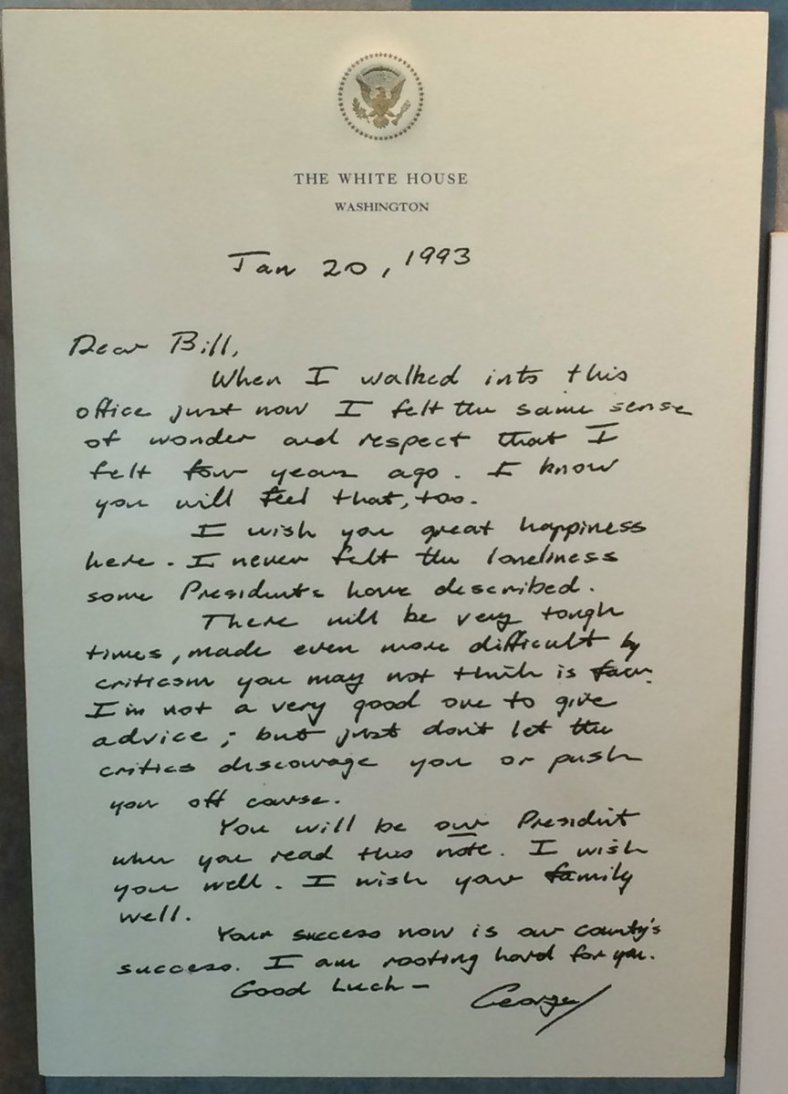
There’s been a copy of a letter circulating recently on the Internet. It arrived in my Twitter account this week via journalist Joyce Karam. It’s a handwritten note written on Inauguration Day, 1993 by departing President George H.W. Bush to his successor, President Bill Clinton.

bush to clinton.jpg

Imagine arriving at your new job on Monday morning and finding a handwritten note from your predecessor, wishing you great happiness @work. “Your success is now our success”.

What if you wrote a letter to the person taking over your desk on Monday morning? Could you convey a “sense of wonder and respect” for your workplace and your work?

Think about it. This is what leadership looks like.

While we are on the topic of U.S. Presidents, current President Obama is on vacation with family, friends and five ‘summer reads’ including Oprah’s recent Book Club selection and one of Bill Gates’ favorites.

readinglist2016_1200.jpeg

(A quick aside here on the Olympics. The photo at the top of the page captures the vacant volleyball nets this morning in Manhattan Beach, California. It’s the place where two U.S. Olympians, Kerry Walsh Jennings and April Ross went to work to get ready for Rio.)

Back to work, and reading, and surfing the Internet.

Kenneth Goldsmith, artist, professor and first poet laureate of the Museum of Modern Art, urged LA Times readers to ‘Go ahead: Waste time on the Internet’ with his OpEd this weekend.

“The notion that the Internet is bad for you seems premised on the idea that the Internet is one thing — a monolith. In reality it’s a befuddling mix of the stupid and the sublime, a shattered, contradictory, and fragmented medium. Internet detractors seem to miss this simple fact, which is why so many of their criticisms disintegrate under observation.”

He recently discussed his University of Pennsylvania course and new book ‘Wasting Time on the Internet’ with Quentin Hardy of The New York Times. Drawing on his personal observations of students and family, he imagined what an educated person will look like in the 21st century.

We still read great books, and there is a place for great universities. But an educated person in the future will be a curious person who collects better artifacts. The ability to call up and use facts is the new education. How to tap them, how to use them.

I’ve got a 10-year-old and 17-year-old. They’re thinking differently from me. They stay connected all the time, and they’re smart, they play baseball, they read, they spend time online. They’re not robots. Basic human qualities haven’t changed. I can find Plato in online life. When I read Samuel Pepys’s diary I see Facebook posts. We just find new ways to express things.

Go ahead, take a break this week@work. Stream the last week of the Olympics, read a great book, and follow the tangents of Internet exploration.

What I did this summer…

What happened to summer? Is it me, or does time go by more quickly after July 4? Before your experiences of the past few months are lost in the excitement of fall work assignments, take some time to reflect on what you learned.

Did you travel, study, volunteer or all of the above? Did your curiosity lead you to interviews with folks outside your career field? What did you learn about yourself?

Catalog your experience including the skills you acquired or any challenges you overcame. Some of these will fall naturally into a resume, but others will provide the content for future professional conversations.

How did you grow as an individual or as a professional? Can you identify ways to link your summer experience to your current work?

Sanity and survival compel us to try to separate work from the rest of our lives. But when we return to work after vacation, maintaining the separation can be a barrier to creativity.

Refreshing the view allows us to be open to new opportunities.

Develop a narrative that tells your story of the summer – a story that incorporates all the elements of the ‘new and improved’ you. Keep it simple. Focus on experience that adds value to your ‘brand @work’.

A conversation poolside that sparked an idea for a new product. An article/book that offered an alternative approach to problem-solving. A civic engagement project that spurred ideas to motivate your team. A faculty member or classmate who provided a connection to a potential new client.

Or, did the chance to step away and just daydream provide new insight into your next career?


The Saturday Read -‘How to Be an Explorer of the World: Portable Life Museum’ by Keri Smith

This is the first ‘Saturday Read’ that comes with a warning.

“! Warning to whomever has just picked up this book. If you find you are unable to use your imagination, you should put this book back immediately. It is not for you. In this book you will be repeatedly asked to…suspend your disbelief, complete tasks that make you feel a bit strange, look at the world in ways that make you think differently, conduct experiments on a regular basis, and see inanimate objects as alive.” 

If you need to improve your CQ (curiosity quotient), this week’s selection from author, illustrator and guerrilla artist, Keri Smith‘How to Be an Explorer of the World: Portable Life Museum’ is for you.

Author Smith invites the reader on a journey of discovery, loosely following a 13 point guide, which includes a “fieldwork section in the back of the book to record and discover findings.”

“You might want to think of this book as you metaphorical suitcase. A place to collect and document your findings. How do you see? It is also a museum. Your very own museum that will contain your unique vision of the world.”

After a couple of incredibly depressing weeks of global events, I was browsing the selection at Main Street Books in ‘downtown’ Davidson, North Carolina last weekend, when this book cover demanded I stop, open, and return to the wonder of our world; starting right where we sit. I was ready to pack my “metaphorical suitcase” and explore an alternate reality.

Here’s the other warning that should come with this book. ‘May be habit-forming.’

On page 13 ‘your mission’, if you choose to accept, is explained.

“The following pages include a variety of prompts and assignments that will help you on your travels. There is also a section on tools and techniques that will help you with documenting methods. You may use the worksheets included or create your own. Remember, all of your most important tools exist in your body! Use them. Collect as much data as you can – it may come in handing later on. Good luck on your journey.”

How to be an explorer? “Always be looking. Everything is interesting. Notice patterns, make connections. Use all of the senses in your investigations.” (and more)

Here’s an example, from the page I opened to first. “Exploration#7 World of Color”

“Collect paint chips from a paint or hardware store. Find colors you respond to in the world. Attempt to match them using the chips. ( You can also match the colors using a portable paint set.) Make notes of where you saw the colors. (Example: color #573 four leaf clover – My scarf, color #308 golden vista – Sunset 01/09/08)

Alternate: document colors from your favorite books, your dreams, your memories.”

There are 59 explorations that tease your inner Picasso or Shackleton, the last being “How to Wander Aimlessly”. This is a book for those of you on vacation, who missed the point of your break :“freedom or release from duty, business, or activity.”

How do you wander aimlessly? “Pay attention to the details. Lose all sense of time and place.” Reinhabit you inner four year old.

This book will plaster a smile on the crankiest visage.

In a month when the release of Pokemon Go has launched thousands of new adventures, ‘How to Be an Explorer of the World’ will reconnect you with a simpler time when all you needed for entertainment was a big box and an imagination to occupy yourself for hours.


‘In the Planetarium’ a poem by James Doyle

In the past couple of days we marked two events in the history of U.S. space exploration: man’s first walk on the moon and the end of the space shuttle program.

Pulitzer Prize winning journalist John Noble Wilford recalled his coverage of the moon landing for the New York Times from NASA’s Johnson Space Center.

“July 20,1969 — a date that lives in my memory as the great divide, the B.C. to A.D., in my journalism career. It was the day of the first walk on the moon by humans, Neil Armstrong and Buzz Aldrin, and I covered the event for The Times from mission control in Houston.

I began my front-page article with a sentence as simple as it was astonishing:

Men have landed and walked on the moon.

Two Americans, astronauts of Apollo 11, steered their fragile four-legged lunar module safely and smoothly to the historic landing yesterday at 4:17:40 P.M., Eastern daylight time.

Neil A. Armstrong, the 38-year-old civilian commander, radioed to earth and the mission control room here:

“Houston, Tranquility Base here. The Eagle has landed.”

On July 21, 2011 the space shuttle Atlantis landed on runway 15 at the Kennedy Space Center in Florida ending the 135th mission and 30 years of the U.S. Space Shuttle program. Today visitors can tour an exhibit at the site in Florida “displayed as only spacewalking astronauts have seen her before — rotated 43.21 degrees with payload doors open and its Canadarm (robotic arm) extended, as it has just undocked from the International Space Station.” 

Astronauts still travel into space. As I write this, the 60th woman to fly in space, Kate Rubins, orbits among the stars above us.

I wonder if this Friday’s poem was written for her by a friend who accompanied her on a school field trip to the Planetarium.

In the Planetarium

I read the palms of the other
kids on the field trip to see
which ones would grow up

to be astronauts. The lifeline
on Betty Lou’s beautiful hand
ended the day after tomorrow,

so I told her how the rest
of our lives is vastly over-rated,
even in neighboring galaxies.

When she asked me how I knew
so much, I said I watched
War of the Worlds six times

and, if she went with me to
the double-feature tomorrow,
I’d finish explaining the universe.

I smiled winningly. The Halley’s Comet
lecture by our teacher whooshed in
my one ear and out the other.

James Doyle   ‘The Long View Just Keeps Treading Water’, Accents Publishing, 2012

(Photo Scott Kelly #YearInSpace “Looking out to the Milky Way”)

“Dignify the outsider” & other lessons from Carolyn See

When we talk about mentors, we often confine ourselves within the walls of our chosen profession. Carolyn See, professor and writer, was also a ‘world class’ mentor to those who were ‘outsiders’ to the world of New York publishing, the purveyors of taste in American storytelling.

I met Carolyn after a panel at the 2003 Los Angeles Times Festival of Books, when she was signing copies of ‘Making a Literary Life: Advice for Writers and Other Dreamers’. We had a brief conversation and I followed up with an email a few days later to thank her for taking the time to chat. Her response was immediate, gracious and filled with humor.

At the time I was not a writer, but a ‘dreamer’, considering a literary life, while pursuing a passion working with college students. Carolyn encouraged me to explore the writing life, and taught me what it truly means to be a mentor.

Carolyn died last week in Santa Monica, California. Many of her students and friends have shared their memories in published obituaries and tweets. In all there is the common thread of the ‘insider’ welcoming the ‘outsider’.

“…I believe, with a patriotic sincerity that would make a Legionnaire blush, that American literature is owned by everybody in America and that world lit is owned by everyone in the world and that we all get to have a say in it, not just a comparatively few men and women in the Northeast, no matter how decent and talented they may be.”

LA Times columnist, former book critic and writer, David Ulin described his relationship with Carolyn in 2014.

“Carolyn taught me how to be a writer in California. For her, that meant a three-dimensional literary life: writing, teaching and reviewing, all of them inextricable from the whole. As a critic, I have tried to follow her model that reviews should be part of an ongoing conversation with one’s readers, and should explicate something essential — not only whether or not we like a book, but also how it connects to, or reflects, our aesthetics, our world view. Carolyn has always regarded reading as an act of engagement . . . and reviewing, too.”

What is a mentor? What can we learn from the life of a writer if we have followed a completely different career path?

A mentor teaches you to be the three-dimensional human in your workplace vision of success.

In ‘Making a Literary Life, Carolyn offers two menu items: ‘Carolyn’s 18 Minute Chili’ and ‘Carolyn’s 18 Hour Chili’.  For the writer, the two step (18 minute) is “a thousand words a day or two hours of revision” and “a charming note to a writer, editor or agent you admire – five days a week for the rest of your life”.

This is what a mentor does, unselfishly shares their recipe for success with measurable, accountable advice. And the part about ‘charming notes’? It’s universal in its application. This is not about ‘sucking up’, but genuinely expressing gratitude or professional admiration, tied to a specific circumstance.

The ’18 hour chili alternative’ includes suggestions to “take an outside excursion once a week”, “pretend- in your mind – to be…”, and “make a list of what a … like you might want”.

We need to get outside our ‘comfort zone’ to stay creative. It’s essential to visualize what you would be like in your dream job, and equally important, to hold an image of what success looks like to you.

“You can go a surprisingly long time without figuring out the kind of person you are and in what direction your life is taking you.”

It’s why I will always be grateful for my encounter with Carolyn See, and why we all, outsiders included, need a mentor who keeps us honest and on track toward success.