#TheGreatListen 2015

What if you could capture a generation of American lives and experiences in one holiday weekend? That’s the vision of StoryCorps founder, Dave Isay, and he plans to fulfill his mission this Thanksgiving weekend through a combination of an app and an educators toolkit to enable DIY interviews to gather the wisdom of others. It’s the #GreatThanksgivingListen and you are invited to attend.

StoryCorps recently celebrated twelve years of conducting and recording oral history interviews, beginning with a booth in New York’s Grand Central Station and later taking the booth on the road to all 50 states creating the largest single collection of human voices ever gathered. The next step is to grow the archive of 100,000 to tens of thousands.

Dave Isay and his organization are the recipients of the 2015 TED Prize, and it was in his presentation to the annual conference in April that he outlined his proposal for a “national homework assignment”.

Here’s the plan. Download the app, select ‘helpful hints’ for a short tutorial. Select ‘browse’ to view previous StoryCorps recordings. Go to ‘my interviews’ to outline and record your interview. You can choose  from a list of sample questions by categories. Next step –  record!

“Who are they? What did they learn in life? How would they like to be remembered?”

And here’s the magical part. You can keep your recording for yourself or opt to upload it to the StoryCorps archive at the American Folklife Center at the Library of Congress. Imagine the story of your family intertwined with other American voices building upon a historical record of their time.

In his April TED talk, Isay described the power of “…everyday people talking about lives lived with kindness, courage, decency and dignity…it sometimes feels like you are walking on holy ground…”

If you believe that you learn from the wisdom of others, this holiday offers an opportunity to join “…a global movement to record and preserve meaningful conversations with one another that results in an ever growing digital archive of the collective wisdom of humanity.”


The week@work – A school for watchmakers, innovations in teaching, #OptOutside and other leadership stories

The theme of the past week@work was innovation: creating a school for those who work with their hands, teaching history through theater on Broadway, using video games to modernize MBA education and opting out to #OptOutside.

CBS News produced a segment on luxury brand watchmaker, Patek Philippe and the creation of a school for watchmakers in New York to meet a growing customer demand for craftsmanship in a digital age. “…the 175-year-old company decided to open its own watch school at its New York City offices.

Around 300 people applied; six were chosen. for their temperament as much as for their technical aptitude. So what personal characteristics does Patek Philippe look for in order to select students?

“We need people who are committed, so commitment is a big quality,” replied master watchmaker Laurent Junod, who heads the school. Plus, “Patience, of course.”

“We do a training program here that is two years long. But the learning is not finished. You have to learn all your life.”

Unknown-1

The program provides an alternative career for those who seek to work with their hands. “The school is free. Students are paid a small stipend to cover expenses.

Gaman Kwok had been tutoring elementary school kids. “If somebody told me that I will be training to be a watchmaker a year ago, I would, look at them like, ‘What? Really?'”

Juan Alonzo was working at a men’s clothing store. “I want to be as good as Laurent!” he said of his ambition.

At the end of the course — if they pass their exams — Patek Philippe will hire them. They’ll move on to a lifetime of silence, and precision, and learning.”

Do you think they get an employee discount?

IMG_2516

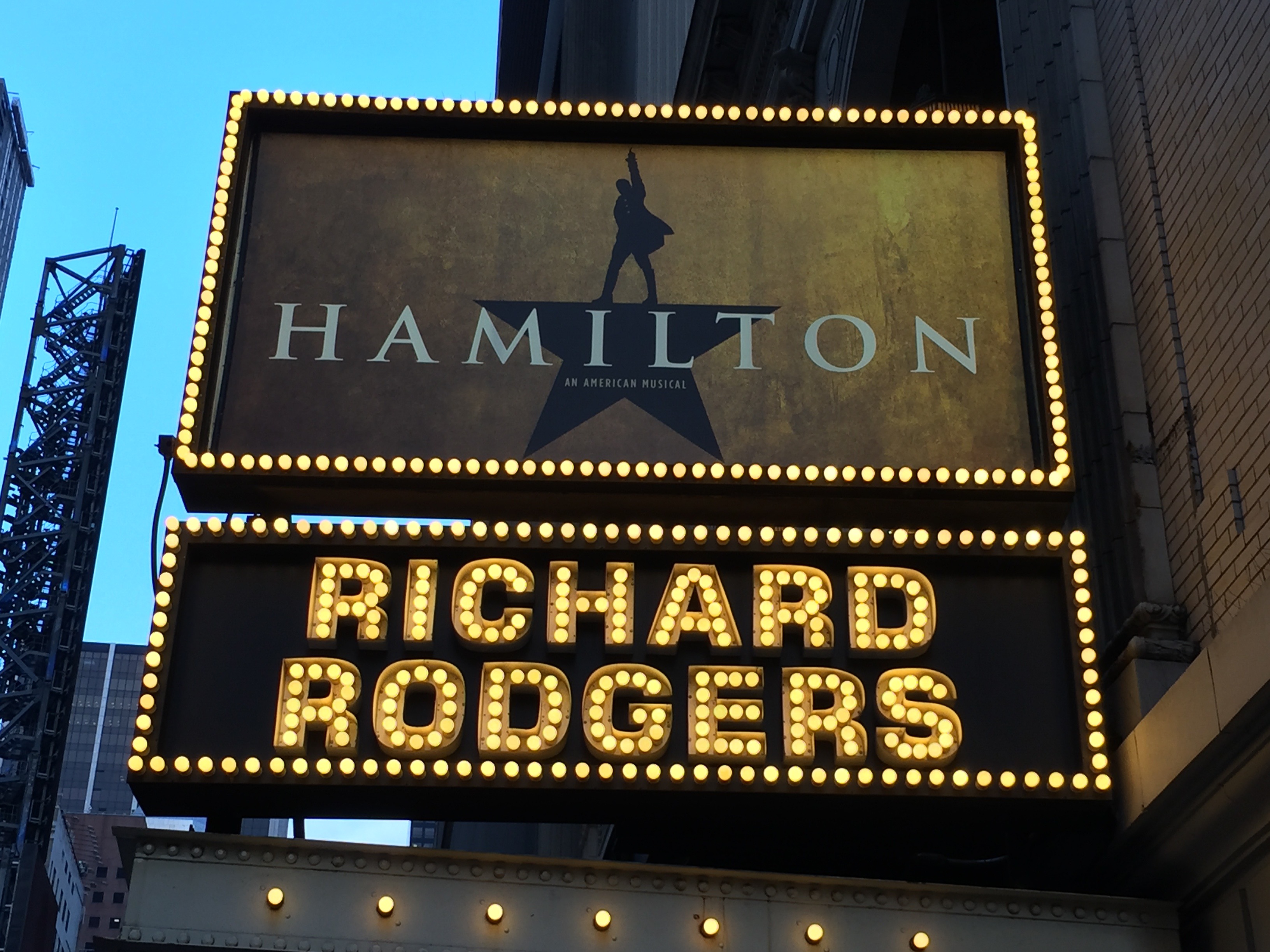
There is a play on Broadway about our founding fathers, one in particular, Alexander Hamilton. ‘Hamilton’ is a hip hop musical retelling of the story of an immigrant who rose to become a force in the building of a new nation. It is based on Ron Chernow’s 818 page biography published in 2004. How many eleventh graders do you think would read an 818 page biography? How many teachers could find the time to read the same?

Sounds like an opportunity to innovate. This week the producers and the Rockefeller Foundation announced a partnership to provide 20,000 New York City eleventh graders with a chance to attend a performance and continue the learning.“The curriculum will be put together by the nonprofit Gilder Lehrman Institute of American History, which plans to create a website with copies of the primary documents that undergird the book and lyrics, and teaching materials about Hamilton and the founding fathers. Students will be invited to create and share their own artistic responses to Hamilton’s life.”

Think about this – 20,000 students who probably have never had access to the lights of Broadway will now be sitting in orchestra seats for one of the most important and creative plays staged in recent memory. And, it’s about history.

“Lin-Manuel Miranda, the creator and star of “Hamilton,” said that he was frequently asked at the stage door how the show, which is both costly to attend and often sold out, could be made more accessible to young people, and he said finding a way to do that has been a priority for him. Mr. Miranda, 35, is a graduate of the Hunter College elementary and high schools for gifted students in New York City.

“If we can excite curiosity in students, there’s no telling what can happen next,” he said. “Not to say we’re going to make 1,300 history majors or 1,300 musical theater writers every time we do the show, but hopefully they will take away how much Hamilton did with his life in the time that he had.”

No telling what can happen next..

Shane Ferro, business journalist for the Huffington Post reported on a new video game, ‘One Day’, being developed for MBA students at the Hult International Business School.

“While it is now fairly common for video games to teach elementary concepts — spelling, basic math, typing — higher education has more or less resisted encroaching technology up to this point. Until recently, higher-level concepts have been harder to program because there may be more than one right answer. “One Day,” which its creators say is the first game of its kind, poses some fairly new questions about learning in the digital age and the role of the professor in a modern classroom.

“I’ve been a business school professor for 30 years,” said John Beck, whose educational consulting company, North Star Leadership Group, developed “One Day.” He lamented that most MBA programs rely on teaching methods honed decades before the personal computing revolution. “For 30 years I’ve been thinking the system is so broken. The case studies model dates from the 1920s, and the lecture model from the 1850s.”

Unknown

The day after Thanksgiving, previously known as ‘Black Friday’, now carries a new hashtag courtesy of the leadership team at retailer REI. #OptOutside is a campaign to encourage folks to leave the shopping behind, enjoy the outdoors and share their experience on social media.

“REI is hoping to convince consumers to start a new Black Friday tradition, one that doesn’t involve buying anything. It has built a dedicated #OptOutside website with resources on local hiking trails. REI’s campaign was built with its employees and customers in mind — the company operates as a co-op, with roughly 5.5 million members who pay a one-time fee for a share of the business. Members contribute to at least 80% of REI’s sales.

The decision to close on Black Friday is bold in an industry that has practically made the day a mandatory part of business, not only because customers demand it, but because the bottom line often does, too. The holiday shopping season is the biggest, and most competitive, time of year for retailers, with Black Friday at the center of the hoopla.”

And while we are on the subject of leadership, here are two articles you might find interesting:

‘Giving More Corporate Chiefs the Steve Jobs Treatment’ Nitin Nohira “I worry that we’re too quick to forget the accomplishments of great business leaders, and that if the people leading companies felt some solace that their long-term legacies might warrant a more careful evaluation, as is now occurring around Steve Jobs, they might make very different decisions.”

‘How Not to Flunk at Failure’ John Danner & Mark Coopersmith “Failure is a strategic resource. Like the people you employ, the money you spend or the facilities and technologies you use, it has unique intrinsic value if you’re open and wise enough to manage it as such. Treat it like unrefined ore that needs to be processed and examined to reveal its riches. Failure is reality’s way of showing you what you don’t yet know, but need to learn. It contains the seeds of precisely the insight you’ve been looking for, if you have the honesty and humility to explore those secrets.”

The Saturday Read – ‘Humans of New York:Stories’ by Brandon Stanton

We learn from the wisdom of others. In Brandon Stanton’s new book we learn from the wisdom of strangers. The ‘Saturday Read’ this week is ‘Humans of New York: Stories’.

“The simplest way to describe the development of HONY over the past five years is this: it’s evolved from a photography blog to a storytelling blog…after cataloging thousands of people, I stumbled upon the idea of including quotes from my subjects alongside their photographs. The quotes grew longer and longer, until eventually I was spending fifteen to twenty minutes interviewing each person I photographed. These interviews, and the stories that resulted from them, became the new purpose of Humans of New York. The blog became dedicated to telling the stories of strangers on the street.”

The first career story is the author’s own. He graduated from college, took a job in Chicago as a bond trader, lost his job, moved to New York and started taking pictures of folks on the street. His work evolved into a blog with 15.6 million followers. His first book of photography, Humans of New York, landed at the top of The New York Times Bestseller List in the fall of 2013 and the new book will debut at the top of the November 1, 2015 list.

Why the response? Because the Mr. Stanton’s stories, told in words and images are about us. The scope of his project embraces NYC folks encountered on the street, reflecting on their past and future. We don’t know names. We don’t know ages. We can only guess in connecting the photo to the quote. At times the words seem at odds with the picture.

Here is one example from a young man, perhaps in his early teens.

“I’ve sort of had an arrogant demeanor my entire life, and I’m learning that I’m going to have to change that if I want to succeed. I realized that it doesn’t matter how clever you are if nobody wants to work with you.”

Another from a young woman seated on a suitcase, in the middle of a train station.

“I wish I’d partied a little less. People always say: ‘Be true to yourself.’. But that’s misleading because there are two selves. There’s your short-term self, and there’s your long-term self. And if you’re only true to your short-term self, your long-term self slowly decays.”

And a man at mid-life in what appears to be a cold corporate lobby, sitting on a stone bench, framed by a stone wall.

“When you’re twenty-five, you feel like you’re riding a wave. You feel like opportunities are just going to keep coming at you, and you think it’s never going to end. But then it ends.”

“When does it end?”

“When you turn forty, and they start looking for someone younger.”

The reader gets a sense they are looking in the mirror, but they’re not. The photo doesn’t match the selfie, but the sentiment fits.

Heather Long, writing for CNN Money, interviewed Stanton and attended his reading at a NY Barnes and Noble. What has he learned in the process of photographing and interviewing 10,000 people? “Americans should reconsider how much they work.”

“He often asks: What is your biggest struggle? And what do you regret most in life?
“Balancing my life is an answer I hear a lot,” he said. “Balancing work and family.”
People go on to tell him how they wish they had skipped that marketing conference and attended their daughter’s 8th grade dance instead.”

One of my favorite ‘inteviews’ appears early in the book (page 5). The narrative comes from a third grader (?).

“I want to build a bridge”

“How do you build a bridge?”

“If you want to build a bridge, it’s going to take a long time and it might be hard because your employees might not be as interested in building a bridge as you are. You have to think about what type of bridge you want to make…” 

He could be talking about life and career.

HONY: Stories invites us on a road trip through the streets of New York, opting for the detours that welcome conversation. This is a book to read slowly, observing the detail in the photos and the humanity in the words. It’s a compendium of other’s lifelong learning, generously shared.

“I want to be an artist.” “What kind of art do you want to make?” “I want to make different versions of myself.”

‘A Consumer’s Report’ a poem by Peter Porter

Imagine you work for Consumer Reports, the U.S. product review and ratings service, and you are on deadline to submit an evaluation of a new product. In this week’s Friday Poem, ‘A Consumer’s Report’ from Australian born poet, Peter Porter, life is the product under review.

Porter moved to London in the early 1950s and took a job with an advertising agency publishing his first collection of poetry in 1961. Have you ever noticed how many ‘Mad Men’ moonlight as poets?

Kate Middleton, the 2012 Sydney City Poet, described the poem in her Tumblr post.

“In “A Consumer’s Report” Porter reminds us that even language that seems to have been repurposed by the corporate world can in fact be reclaimed and renewed. Often this reclamation can happen simply through the application of a set of familiar terms to a surprising new context: this is exactly what Porter does in his poem here, taking the language of marketing, and billing life itself as a commodity to be test-driven as you would a new car or skincare product. In so doing Porter wittily leads the reader both to examine the nature of the titular consumer’s report, but also prods his reader to a serious consideration of life itself.”

A Consumer’s Report

The name of the product I tested is Life,
I have completed the form you sent me
and understand that my answers are confidential.

I had it as a gift,
I didn’t feel much while using it,
in fact I think I’d have liked to be more excited.
It seemed gentle on the hands
but left an embarrassing deposit behind.
It was not economical
and I have used much more than I thought
(I suppose I have about half left
but it’s difficult to tell)—
although the instructions are fairly large
there are so many of them
I don’t know which to follow, especially
as they seem to contradict each other.
I’m not sure such a thing
should be put in the way of children—
It’s difficult to think of a purpose
for it. One of my friends says
it’s just to keep its maker in a job.
Also the price is much too high.
Things are piling up so fast,
after all, the world got by
for thousand million years
without this, do we need it now?
(Incidentally, please ask your man
to stop calling me ‘the respondent’,
I don’t like the sound of it.)
There seems to be a lot of different labels,
sizes and colours should be uniform,
the shape is awkward, it’s waterproof
but not heat resistant, it doesn’t keep
yet it’s very difficult to get rid of:
whenever they make it cheaper they tend
to put less in—if you say you don’t
want it, then it’s delivered anyway.
I’d agree it’s a popular product,
it’s got into the language; people
even say they’re on the side of it.
Personally I think it’s overdone,
a small thing people are ready
to behave badly about. I think
we should take it for granted. If its
experts are called philosophers or market
researchers or historians, we shouldn’t
care. We are the consumers and the last
law makers. So finally, I’d buy it.
But the question of a ‘best buy’
I’d like to leave until I get
the competitive product you said you’d send.

Peter Porter from ‘The Poetry of Business Life: An Anthology’ Ralph Windle 1994

The Saturday Read – ‘The Invention of Nature: Alexander von Humboldt’s New World’ by Andrea Wulf

This weekend we celebrate exploration and discovery in recognition of the arrival of Christopher Columbus in the Americas. What motivates those who choose a life of adventure and exploration? The ‘Saturday Read’ is the career story of an intrepid pioneer whose curiosity drove him to become one of the most famous of his age.

The ‘Saturday Read’ this week is ‘The Invention of Nature: Alexander von Humboldt’s New World’ by Andrea Wulf.

I first encountered von Humboldt when reading ‘The Art of Travel’ by Alain de Botton. At the end of a chapter ‘On Curiosity’, de Botton shares a quote attributed to von Humboldt near the end of his life:

“People often say that I’m curious about too many things at once: botany, astronomy, comparative anatomy. But can you really forbid a man from harboring a desire to know and embrace everything that surrounds him?”

Alexander von Humboldt was the master of connecting the dots and lived at a point in time when the multidisciplinary approach fueled exploration and discovery.

“Alexander von Humboldt has been largely forgotten in the English-speaking world. He was one of the last polymaths, and died at a time when scientific disciplines were hardening into tightly fenced and more specialized fields. Consequently his more holistic approach – a scientific method that included art, history, poetry and politics alongside hard data – has fallen out of favour. By the beginning of the twentieth century, there was little room for a man whose knowledge had bridged a vast range of subjects. As scientists crawled into their narrow areas of expertise dividing and further subdividing, they lost Humboldt’s interdisciplinary methods and his concept of nature as a global force. 

One of Humboldt’s greatest achievements had been to make science accessible and popular. Everybody learned from him: farmers and craftsmen, schoolboys and teachers, artists and musicians, scientists and politicians…Unlike Christopher Columbus or Issac Newton, Humboldt did not discover a continent or a new law of physics. Humboldt was not known for a single fact or discovery but for his worldview. His vision of nature has passed into our consciousness as if by osmosis. It is almost as though his ideas have become so manifest that the man behind them has disappeared.”

Today universities scramble to attract students with multidisciplinary offerings, but the silos of academia continue to resist cross-pollinization of knowledge. This is why we need to remove the invisibility cloak from von Humboldt and revisit his curiosity and travel the roads that led to his discoveries.

Author Andrea Wulf wrote an opinion piece for the Los Angeles Times, ‘Alexander von Humboldt: The man who made nature modern’, linking his conclusions to the environmental challenges we face today.

“At a time when scientists were classifying the world into ever smaller taxonomic units, Humboldt regarded Earth as one great living organism in which everything was connected. It was a radically new approach, and it makes him a naturalist hero for the 21st century.”

“With California in the fourth year of serious drought, with forest fires burning, oceans rising and extreme weather spreading havoc, Humboldt deserves to be rediscovered. His interdisciplinary methods and his concept of nature as one of global patterns should underpin our policymaking.

As scientists try to understand and predict the consequences of climate change, Humboldt’s belief in the free exchange of information and in fostering communication across disciplines is vitally important. His insights that social, economic and political issues are closely connected to environmental problems remain resoundingly topical. “Mankind’s mischief …disturbs nature’s order,” he warned, in words as relevant today as they were two centuries ago.”

Alexander von Humboldt’s legacy echoes in the works of John Muir and George Perkins Marsh and in the wild gardens of California where the native ‘Humboldt Lily’ thrives in a dry climate. And now it’s preserved in the words of Andrea Wulf. Enjoy the ‘Saturday Read’ and encourage your children to grow up to be polymaths.

humboldt lily

What if we approached job search as an adventure?

Take a minute to search the online dictionaries for a definition of the word ‘adventure’. All will include a version of “an ​unusual, ​exciting, and ​possibly ​dangerous ​activity, ​trip, or ​experience, or the ​excitement ​produced by such ​activities”. What if we approached our job search as an adventure?

There are bookcases full of career exploration guides and a plethora of simulation exercises marketed as navigational tools for the job seeker. The industry of career consulting has depreciated the complexity of vocational discovery and led folks to believe that career mysteries can be decoded with minimal effort.

It’s a cookie cutter approach assuming that we know what jobs are out there and know the skill set required for each. What we also know is that the world @work is volatile and many job titles have been retired along with their occupants and many more have evolved with the emergence of new employers.

If you frame your job search as an adventure, your expectations adjust to prepare for the unexpected. Your time frames align with reality. The anticipation of meeting new folks, cataloging what you still need to learn and testing your ambitions @work will catapult you out of bed each morning.

Where do you start? Select an individual who is known for their sense of adventure. Focus on the excitement vs. the danger. Why are they successful?

“To me, adventure has always been the connections and bonds you create with people when you’re there. And you can have that anywhere.” Bear Grylls

Start making the connections – scheduling conversations.The adventure is in the discovery of what you don’t know about work. It’s asking questions, listening and connecting the dots. As you accumulate knowledge, various scenarios begin to emerge in the experience of others.

It’s a lifetime commitment once you open the door to adventure.

Remember what Bilbo used to say: ‘It’s a dangerous business, Frodo, going out your door. You step onto the road, and if you don’t keep your feet, there’s no knowing where you might be swept off to.”” — J.R.R. Tolkien

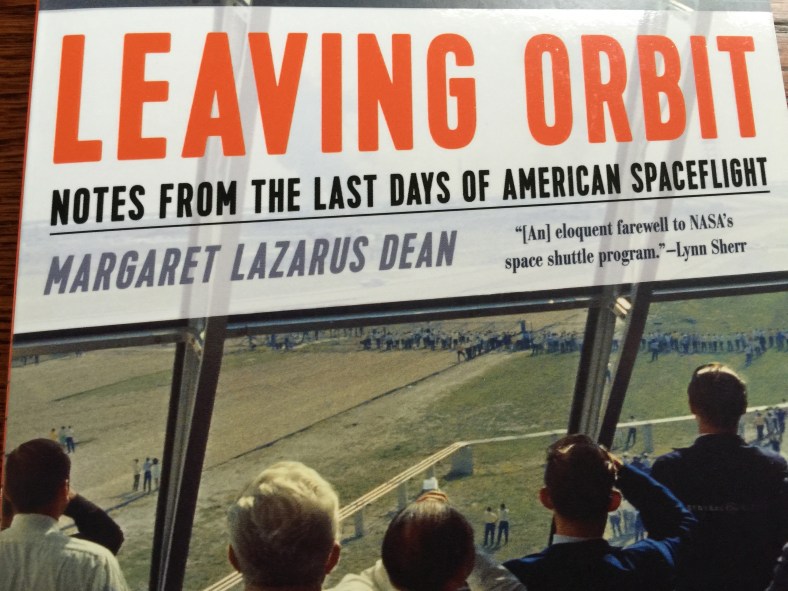
The Saturday Read – ‘Leaving Orbit: Notes from the Last Days of American Spaceflight’ by Margaret Lazarus Dean

“Even before the last launches, NASA had announced the final destinations for each of the orbiters – Endeavor to the California Science Center in Los Angeles…”

On Friday, September 21 at 11:59 AM, the Space Shuttle Endeavor flew over Los Angeles and the campus of the University of Southern California. It was completing it’s 26th mission atop a Boeing 747 with a flyover of locations where workers had designed the spacecraft,  built and assembled parts, and tracked it’s 25 earth orbit missions. On that morning, in LA, Endeavor was the Hollywood star as thousands stood on rooftops to catch a glimpse of the final flight.IMG_0534

Today visitors can view the Endeavor in a temporary pavilion. It’s in a museum, a relic of a dream to build spacecraft in low earth orbit that would transport humans to Mars. The story of how we journeyed from the ‘heroic era’ of space travel to the last shuttle flight is told by Margaret Lazarus Dean in this week’s Saturday Read – ‘Leaving Orbit: Notes from the Last Days of American Spaceflight’. It’s a narrative constructed to introduce us to the workers who enabled the success of NASA, while at the same time recognizing the courage of the astronauts,

On Wednesday the U.S. National Archives tweeted a copy of President John F. Kennedy’s confidential spaceflight schedule.CQAQyZ8UAAA725tOnce we had arrived at the moon, the plan was to begin construction of a vehicle to travel to Mars by 1975. What happened?

“When we think about the Apollo project now, we think of it as being a time when all Americans were united behind a project they could take pride in. The fact is that Americans were slowly falling out of love with Apollo right from the beginning. Even before Neil, Buzz and Mike made it to the moon, only about a third of Americans thought the moon project was worth the cost. At the same time, a clear majority of Americans throughout the sixties said that they approved of Apollo; in other words, uneasiness about the cost of spaceflight has always been paired with widespread positive feelings about spaceflight. This contradiction has made NASA the site of one of the deeper ambiguities of American culture: spaceflight is an achievement we take great pride in, paid for with our own money, over our objections.”

The author’s story is shared through the lens of a family of workers at the Kennedy Space Center in Florida. It’s a connection that began with an email about her first novel, continued on Facebook and provided access to facilities and events at the center. As the shuttle program is coming to an end, these employees retain their optimism, as colleagues are being laid off. With the end of the shuttle program NASA has disconnected from its institutional memory, the bridge to transfer knowledge to the next generation of space architects and engineers.

Ms. Dean is an associate professor at the University of Tennessee in Knoxville. One of the more interesting sections of the book chronicles her interactions with her students about the history of spaceflight and her adventures to view the last three shuttle launches. These conversations reveal another disconnect; a loss of our historical memory of spaceflight.

She was a teenager when the Challenger exploded, and missed the early years of the space program and competition with the USSR to be the first to the moon. But she fills the gap with the words of writers who witnessed the historic events.

“The books that mean the most to me are the firsthand accounts, the people who grapple with what they have seen and experienced, and by doing so take on the emotional meaning of spaceflight…Tom Wolfe undertook to grasp the courage of the astronauts and uncovered a brotherhood that is both unprecedented and ageless. Oriana Fallaci was an Italian journalist who traveled to Houston, Huntsville, and the Cape at the height of the excitement for Apollo but before the success of the moon landing…(and) Norman Mailer’s book about witnessing the launch of Apollo 11…”

In recent weeks there seems to be an uptick in the discussion of space travel. The movie ‘The Martian’ has reignited a conversation about travel to Mars. The filmmakers worked closely with NASA to ensure credibility in the storytelling.

Jeff Bezos is moving his space exploration company, Blue Origin, to Florida where he will operate manufacturing and testing centers as well as launch rockets from Cape Canaveral’s Complex 36. Elon Musk’s SpaceX continues to design, manufacture and launch advanced rockets and spacecraft with a goal to send people to other planets.

“The story of American spaceflight is a story with many endings.”

The workplace of space is evolving. ‘Leaving Orbit’ is required reading to reclaim our history and institutional memory.

Workthoughts from outside the margins

Was anyone working yesterday? As social media and cable news forecast the financial apocalypse, I escaped to my ‘go to’ twitter account of Tony winning composer, lyricist and actor, Lin-Manuel Miranda. (For those of you who have been living under a rock for the past year, he is the leader of the merry band of actors who have been recreating the life of Alexander Hamilton on Broadway in nine performances per week this summer.)

And for those of you who think Twitter is an intellectual wasteland, time to get on board. You are missing out on at least one connection with an innovator who is truly transforming the American musical.

Innovation is one of our most overused words, but John Kander, composer of ‘Cabaret’ and ‘Chicago’ used that exact word to describe Mr. Miranda earlier this month in a New York Times profile.

“Innovators are usually synthesizers — they synthesize everything they know and add their own personal talents, and out comes something new,” Mr. Kander said. “What Lin is is a refreshing and healthy contemporary synthesist of everything he’s known before.”

But I digress. Back to Monday and Twitter and @Lin_Manuel. Let’s just say he has a high level of interaction with his followers. And one of those followers, @jjaxtweets, posted ‘My annual back to school post’, which #YayHamlet retweeted. And here is the message.

“Keep an eye out for that kid in the back of your classroom, scribbling in the margins. He or she is dreaming of worlds we haven’t yet imagined, scribbling toward a place we haven’t yet seen. Engage those kids, get them out of the margins, and there’s no telling where they may lead you.”

This is where a career begins. A parent, a teacher taking time to engage the child scribbling in the margins.

How do you get to Broadway or whatever your dream might be? You really, really need to love what you are doing. Check out the YouTube videos of the Ham4Ham performances between shows for those in the ticket lottery line and you get the idea.

Infuse your dream with the essence of those first scribbles, and the relationships you build over time.

Connect the dots and synthesize everything you know. Constantly nurture your talent. Lifelong learning has no expiration date.

Work really, really hard and have fun.

I think the ‘kid in the back of the classroom’ was Lin-Manuel Miranda. Or was it you?

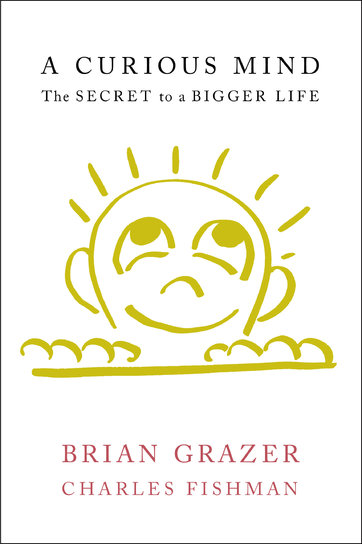
The Saturday Read – Brian Grazer and Charles Fishman ‘A Curious Mind: The Secret to a Bigger Life’

Are you curious about the people who work for you? Academy award winning producer Brian Grazer thinks you should be. He manages his organization with curiosity, by asking questions. His book, ‘A Curious Mind: The Secret to a Bigger Life’ was released earlier this year and is a memoir of his success and it’s source, listening to the answers.

“If you’re the boss, and you manage by asking questions, you’re laying the foundation for the culture of your company or group. 

You’re letting people know that the boss is willing to listen. This isn’t about being “warm” or “friendly”. It’s about understanding how complicated the modern business world is, how indispensable diversity of perspective is, and how hard creative work is.”

The initial reviews of the book focused on the ‘curiosity conversations’ Grazer has utilized throughout his career to network with a variety of folks in his unique quest for lifelong learning. But in the acknowledgements at the end of the book he addresses the reader directly on his purpose in writing ‘A Curious Mind’.

“a book not about my curiosity, but about what curiosity has enabled me to do, about what curiosity can enable anyone to do…”

“I didn’t want to write a book about all the people I’d had conversations with – I wanted to write about the impulse to have those conversations. I wanted to use the conversations to tell a story: the story of my steady discovery of the power of curiosity in my own life.”

For Grazer, it’s not just a hobby, but a commitment to intentionally integrate questioning into both his work and life outside of work.

“For it to be effective, curiosity has to be harnessed to at least two other key traits. First, the ability to pay attention to the answers to your questions – you have to actually absorb whatever it is you’re being curious about…The second trait is the willingness to act.”

In the early chapters he describes the power of curiosity to motivate, spark creativity, and build confidence. He is the ‘bard of curiosity’ sharing his career story intertwined with his capacity for discovery. But it’s in chapter five where the storytelling turns to management advice. “…the human connection that is created by curiosity…Human connection requires sincerity. It requires compassion. It requires trust.”

“Can you really have sincerity, or compassion, or trust, without curiosity?

“I don’t think so. I think when you stop to consider it – when you look at your own experiences at work and at home – what’s so clear is that authentic human connection requires curiosity.”

Here is the ‘gem’ of the book.

“To be a good boss, you have to be curious about the people who work for you.”

How many of you have a BA in business, an MBA or certificate from a prestigious executive management program? Has anyone ever suggested management by curiosity? We have all been taught to listen. And we don’t. But no one ever explained in this way, how critical the right questions are to getting to the fundamentals when decisions are being made.

“I use curiosity every day to help manage people at work…as a tool to build trust and cooperation and engagement.”

“And curiosity is the key to connecting and staying connected.”

Reading ‘A Curious Mind’ reminded me of a quote buried in dialog in the 2012 novel by Mark Helprin, ‘In Sunlight and in Shadow’:

“It’s a defining difference, curiosity. I’ve never known a stupid person who was curious, or a curious person who was stupid.”

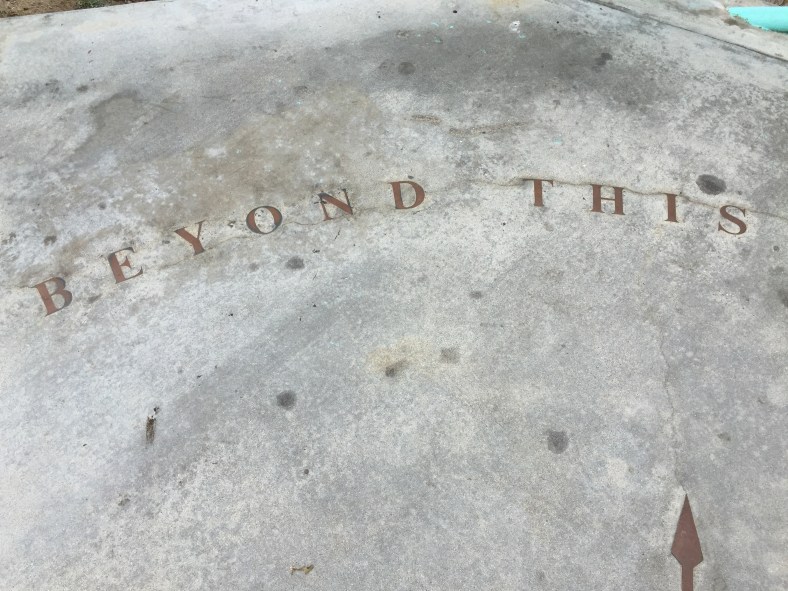
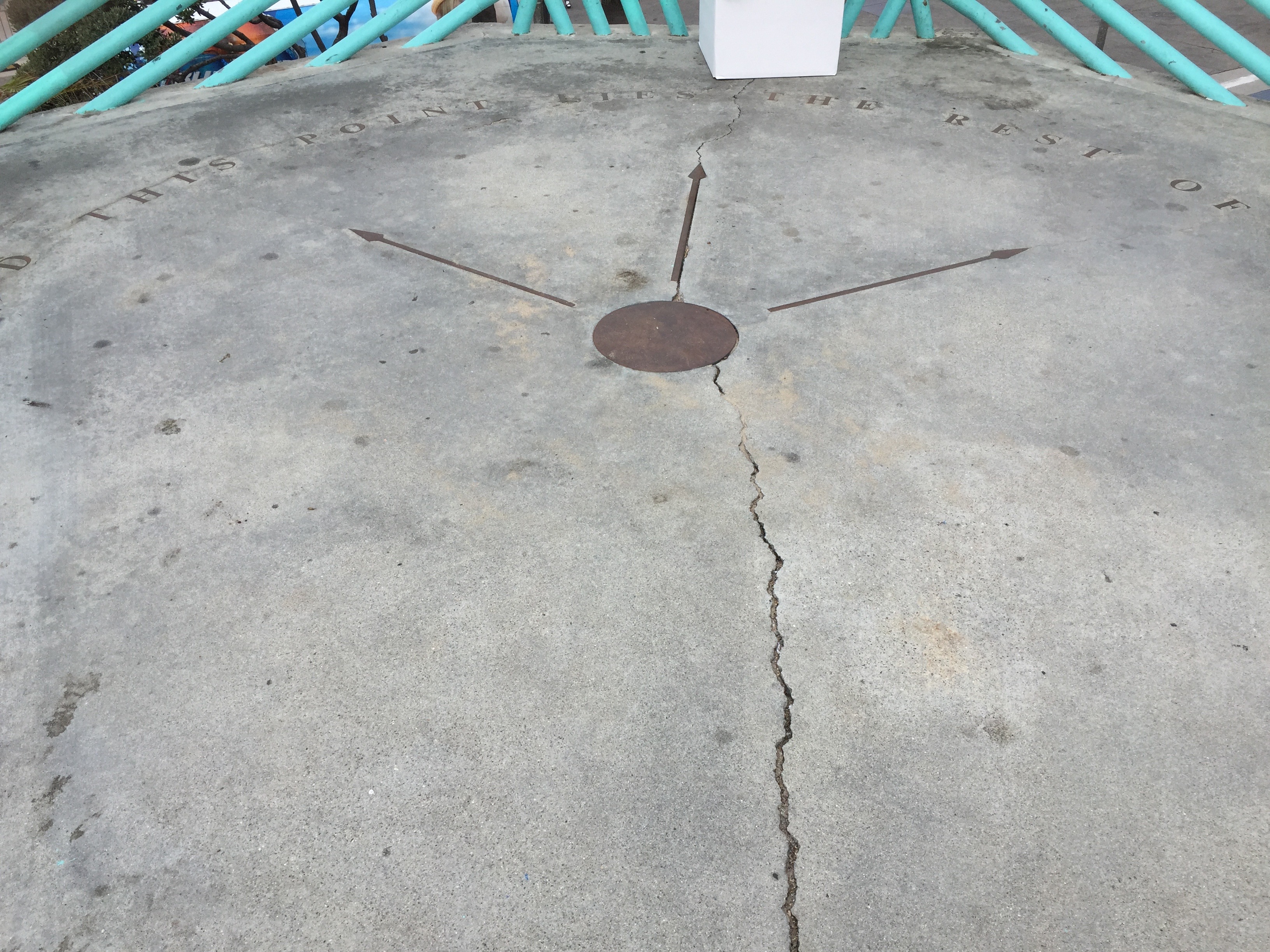
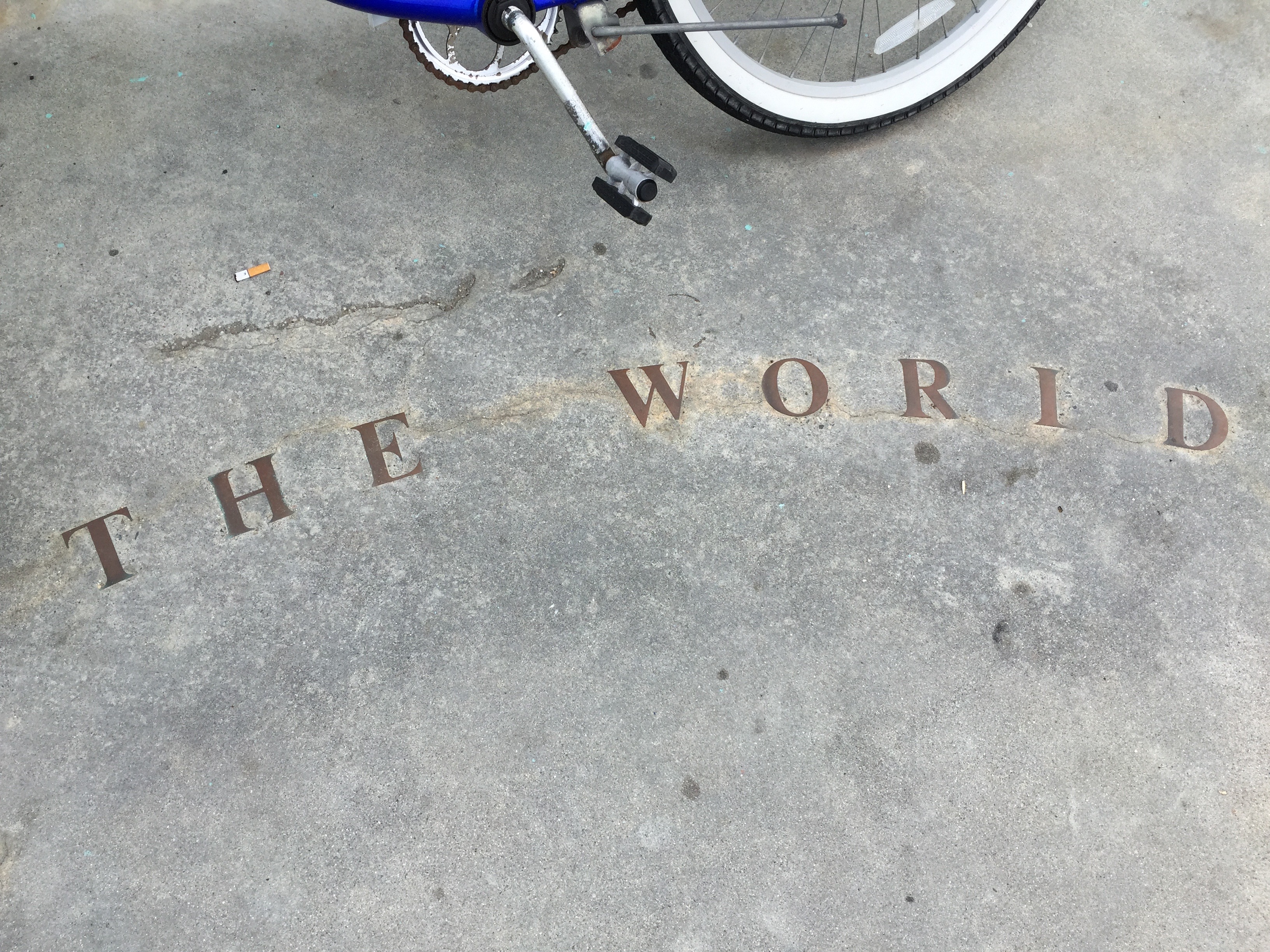
“Beyond this point lies the rest of the world”

I went for a walk this morning along the beach. It was cloudy, unusual for a summer day in California. I stopped in a parking lot to take a photo of the town’s iconic pier. I looked down for a minute and that’s when I spotted it. Embedded in the cement, facing the ocean are three directional arrows. In a semi-circle surrounding the arrows are the words “Beyond this point lies the rest of the world’.

There they were, nine simple words, welcoming visitors to imagine life beyond this point.

IMG_2554

In writing this blog I have often emphasized the importance of curiosity and creativity, urging readers to step away from what is familiar and risk failure to experience success. Here it is, a perfect invitation to imagination and exploration.

IMG_2560

You don’t have to travel to California and gaze at the Pacific. Just stop what you are doing, look up and remind yourself that that there is something bigger beyond where you sit.

IMG_2561