The mysteries of networking – part three

Everyone tells you to ‘network’ to find a job. And yet the majority of us freeze at the thought of connecting with strangers to obtain information about careers. And it’s not just being shy. Most professionals who have made connections to establish business relationships find it difficult to translate those same skills to find a job.

Summer gives us an opportunity to ease into the process. We tend to think of networking as a formal meeting that involves lots of preparation in advance. There’s another approach that involves the chance encounter and spontaneous conversation away from the workplace. Vacation travel can offer unique alternatives to test your informal networking skills.

Last week while I was waiting for my delayed flight at Newark Liberty I observed a conversation between a pilot and a passenger in the boarding area. At first there was the normal exchange, sharing travel disruptions past, but that was followed with introductions, exchange of business cards and a more in depth conversation about work and life. Amid the chaos of summer travel two professional were networking.

It starts with curiosity and a desire to be continually learning.

While you are traveling, relaxing on a beach or hiking in the mountains be receptive to an opportunity for unexpected connection. Take a few minutes and disconnect from your electronics and observe your surroundings and fellow travelers. Test your ‘talking with strangers’ skills by noting something about an individual and initiate a conversation. It could be as simple as a comment to someone wearing clothing with a logo of your alma mater or favorite sports team.

These random conversations may not result in information directly related to your career advancement. But if you believe we learn from the wisdom of others, the conversations will yield valuable clues to experience, failure and success.

Nurture these informal connections along with those directly affiliated with your career field. Keep in touch via social networking. Never underestimate the value of your informal network to inform and influence your career choices.

Why we do science and the triumph of NASA’s ‘New Horizons’ team

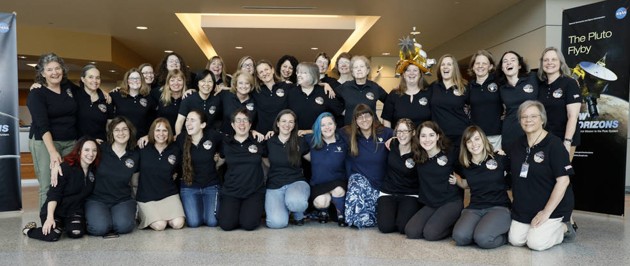
Last week we celebrated the team play of the US Women’s National Team, this week we honor NASA’s ‘New Horizons’ team for piloting a spacecraft the size of a small piano through space for 3,463 days and three billion miles.

Remember Pluto? You know, the ninth planet in order from the sun. Is there anyone who did not do a science project on the planets? Very few of us can trace our choice of career back to the grade school science fair, but some folks used those dioramas as a foundation to build a career in space exploration.

Think about what you were doing at work nine years ago. Now imagine you were part of a team that started a journey toward that ninth planet in 2006. And then your planet was demoted to dwarf status. Can you imagine sustaining a team for almost a decade?

Daniel Terdiman examined the success factors in a post for Fast Company.

“Not everyone on the original team stayed on board throughout the 14 years between proposal and today, but many have. Besides Hersman and principal investigator Stern, others who are still deeply involved include Alice Bowman, the New Horizons mission operations manager, Glen Fountain, the New Horizons project manager, Mark Holdridge, the Pluto encounter mission manager, and many other team leads and sub-leads who worked on everything from propulsion to communications.

That’s impressive stability. Of course, all these people have other tasks beyond the New Horizons project, but everyone knew it was about to be show time. “People ramped down so they weren’t working much on the project,” Hersman said, “but when the time comes to fly past Pluto, a lot of other stuff gets put on hold, or they find time.”

Terdiman found that a ‘longevity document’ provided the blueprint for the mission including requirements and contact information for every team member. “One other essential element of preparing for the nine-year mission was compiling a spreadsheet of contingencies for when things went wrong. This was useful when ground control temporarily lost communications with the New Horizons probe on July 4 of this year.” And finally, “When it’s all over, look back.”

If the shear wonder of the team’s achievement was not enough, Adrienne Lafrance, writing for the Atlantic, identified another major milestone for the ‘New Horizons’ team:

“For all the firsts coming out of the New Horizons mission—color footage of Pluto, photos of all five of its moons, and flowing datastreams about Pluto’s composition and atmosphere—there’s one milestone worth noting on Earth: This may be the mission with the most women in NASA history.”

“The New Horizons team includes about 200 people today, but there have been thousands of scientists and engineers who have contributed to the mission since it began more than a decade ago. Women make up about one-quarter of the flyby team, those responsible for the high-stakes mission taking place this month, according to NASA.”

And now, for you skeptics who either believe all of this is happening on a sound stage in Burbank or just don’t get why we do science and stretch the limits of our knowledge, I turn to Neil deGrasse Tyson.

In an interview with Lester Holt for NBC Nightly News on Tuesday, the American astrophysicist and director of New York’s Hayden Planetarium answered the question of why we do science.

“One of the greatest aspects of what it is to do science is to reach a new vista and then discover that you can now ask questions undreamt of before you got there.”

Tonight, go outside and look up. What do you see? What questions do you have? Imagine being part of a team working to find the answers to those ‘undreamt of’ questions from our new vantage point.

The Saturday Read -Mark Vanhoenacker ‘Skyfaring’

This week’s ‘Saturday Read’ is for all of you who keep your window sashes up on transcontinental flights. And for those of you who don’t, author and pilot, Mark Vanhoenacker has a link on his website to share a glimpse of what you have been missing. And it’s not the grainy black and white video from the camera mounted underneath those Swiss Air flights.

The ‘Saturday Read’ is ‘Skyfaring: A Journey With A Pilot’.

What do we know of the work lives of pilots? These are the folks we trust to transport us across oceans, continents, cities and deserts. Our only contact through hours of flight is a welcome message, flight status update or a ‘thank you for choosing our airline’.

Turns out, pilots can be very interesting people. And, like many of us, they arrive at their ‘dream job’ after trying out other options. Mark Vanhoenacker’s career began in academia and management consulting. He started his flight training in 2001 after realizing all those plane flights were constant reminders of what he really wanted to do with his life.

Geoff Dyer reviewed the book for The Guardian newspaper:

“There is always something uplifting about people in love with their work, and on becoming an airline pilot Vanhoenacker (now a senior first officer with British Airways) seems to have attained a state of enviable grace. He loves everything about the job: the machinery, the language, the physics, the maps, the weather (always sunny up there above the lid of cloud), his colleagues, the rituals in which multiple layers of safety are embedded and encoded.”

Dwight Gardner‘s review in The New York Times cited “the intellectual and emotional delights of flying…

Mr. Vanhoenacker speaks often in “Skyfaring” about poetry and art and music. In Paris, he heads for the Musée Rodin. He has a well-stocked mind. Cumulus clouds remind him of the ceilings in the New York Public Library or Versailles; the earth’s rotation summons for him a passage from Marilynne Robinson’s novel “Gilead.” He mentions pilots who go to cooking schools or visit botanical gardens wherever they go.

Thus one of the vivid things about this book is that is makes you imagine the men and women who pilot the machines that fly over our heads as a merry band of scholars and aesthetes, rather than glorified bus drivers. It’s as if they’re racing up there to pluck the world’s best cultural fruit, fruit we are too hidebound to seek except rarely.”

And when Mr. Vanhoenacker is not flying the plane:

“One of my favorite things to do as a passenger is put music on and look out at the world. I think airplanes are one of the few places you can zone out. When you fly as a passenger you definitely have this meditative space. I never use Wi-Fi as a passenger.”  

In the first few pages of ‘Lift’, the first section of the book, the author shares three questions people ask when they learn he is a pilot:

“Is flying something I have always wanted to do? Have I ever seen anything “up there” that I cannot explain? And do I remember my first flight? I like these questions. They seem to have arrived, entirely intact, from a time before flying became ordinary and routine. They suggest that even now, when many of us so regularly leave one place on the earth and cross the high blue to another, we are not nearly as accustomed to flying as we think. These questions remind me that while airplanes have overturned many of our older sensibilities, a deeper part of our imagination lingers and still sparks in  the former realm, among ancient, even atavistic, ideas of distance and place, migrations and the sky.”

If this book doesn’t rekindle the wonder of air flight, check to see if you can still fog up a mirror. For those of you still breathing, invest some time this weekend to take flight with Mark Vanhoenacker as your pilot and rediscover the joy of getting lost in the clouds.

The Saturday Read – Summer Books

We have summer in our sights, anticipating travel, adventure, rest and relaxation. Harbingers of the coming season are the summer reading lists from the traditional print book review sources, the icons of Silicon Valley and the titans of Wall Street.

The act of picking up a book, unrelated to work or school, has moved away from the center and occurs only on the periphery of our lives. We seem to have relegated reading to the category of indulgence vs. necessity. We give ourselves permission to read in summer, during an interval when we step away from work.

Writing in The Irish Times, Isabelle Cartwright considered the question of why we read.

“…the simple answer is for pleasure. But what exactly is the nature of that pleasure? Reading removes us from the structure of our lives, from the routine, the sequential habits of our day-to-day living. We enter instead another time zone. The plot, characters and setting occupy us, and while we read we inhabit the others’ reality. The pleasure therefore is derived from escaping our own small, limited and often repetitive lives and entering an exotic elsewhere.

But perhaps there is also the attraction of reserving something private for ourselves, something outside of the public world of relationship, family, work and occupation; something that is not encumbered by the stricture of time and self.”

For those of you who need a utilitarian rationale to set aside time to read, there is research to show we are morally and socially better as a result of our efforts:

Raymond Mar, a psychologist at York University in Canada, and Keith Oatley, a professor emeritus of cognitive psychology at the University of Toronto, reported in studies published in 2006 and 2009 that individuals who often read fiction appear to be better able to understand other people, empathize with them and view the world from their perspective. This link persisted even after the researchers factored in the possibility that more empathetic individuals might choose to read more novels. A 2010 study by Mar found a similar result in young children: the more stories they had read to them, the keener their “theory of mind,” or mental model of other people’s intentions.”

We become more emotionally intelligent as we read.

If that doesn’t convince you, the ‘Lifehack blog’ lists ’10 Benefits of Reading: Why You Should Read Every Day’ (not just in summer): “Mental stimulation, stress reduction, knowledge, vocabulary expansion, memory improvement, stronger analytical skills, improved focus and concentration, better writing skills, tranquility and free entertainment.”

I think they’re on to something here, for all you skeptics. A few of these skills match exactly to what employers look for in potential candidates: communications and problem solving. Maybe reading is a necessity and not an indulgence.

Here is a menu of links to the popular reading lists this summer:

The Los Angeles Times – Summer reading guide: The 136 books you’ll want to read

The New York Times – When the Water’s Too Cold, Something Else to Dive Into, A Critic’s Survey of Summer Books

USA Today – 25 Hot Books for Summer

The Washington Post – A great leadership reading list — without any business books on it

Bloomberg – Books Worth Reading This Summer

NPR – Four Books That Deliver Unexpected And Delightful Surprises This Summer

A Year of Books, Mark Zuckerberg

Beach Reading (and More), Bill Gates

10 Beach Books from J.P. Morgan’s Summer Reading List

Happy sand in your toes, head in the clouds, sea spray on your face reading!

The Mysteries of Networking – Part Two

Are you curious about why some people succeed and others do not? If you had the opportunity, who would you like to interview about their success? What would you ask? Identifying folks you would like to meet and crafting questions for a conversation is the foundation for a lifetime of networking.

Start by making a list of who you want to meet. Since we are talking about careers, let’s focus on professional connections. Once you have your list, google these folks for background, then email or call to schedule an appointment.  Anticipate rejection, but don’t give up. Request a minimal length of time (15 – 20 minutes), offer a wide range of dates (next 3 weeks) and be charming and humble (even if arrogance if viewed as an asset in the industry).

Brian Grazer calls his approach to networking ‘curiosity conversations’. He found, early in his career:

“First, people – even famous and powerful people – are happy to talk, especially about themselves and their work; and second, it helps to have even a small pretext to talk to them.”

“I developed a brief introduction for the secretaries and assistants who answered the phone: “Hi, my name is Brian Grazer. I work for Warner Bros. Business Affairs. This is not associated with studio business, and I do not want a job., but I would like to meet Mr. So-and-so for five minutes to talk to him…” And I always offered a specific reason I wanted to talk to everyone.

My message was clear: I worked at a real place, I only wanted five minutes on the schedule, I did not want a job. And I was polite.”

Minimize rejection by having your script ready with your specific reason for the meeting request.

Once you have your meeting, develop a set of questions. Keep it short and to the point. What is it that you want to know about this individual that will help guide you in your career decision? Here are a few suggestions:

Why do you think you have been successful in this field?

What experiences served as building blocks to your success?

Did you experience failure? How did you recover and move forward?

How do you balance work and family? Have there been tradeoffs?

What do you look for when selecting a new employee?

What does it take to be a success in this field?

Try to meet with folks at their workplace. It is one thing to hear people talk about their work, it is another to experience the work environment and observe them in it. Remember, you are trying to absorb as much information as you can in a short time to help you in your career decision. Think Dian Fossey among the gorillas of Rwanda. Observe the culture, the behaviors and the office decor.

How many people should you meet? It’s not about quantity. It may be that your first contact answers your questions and you are on a track to follow your dream. Or, your first information interview only leads to more questions. Before you leave, ask for an additional contact; someone who may be able to answer these additional questions.

Networking is about building relationships. The quality of the effort depends on your ability to listen and act on the information you receive. It’s a practice, not a 911 call when your job is threatened.

Adapt your style for lifelong learning and networking to incorporate elements of Brian Grazer’s ‘curiosity conversations’:

“For thirty-five years, I’ve been tracking down people about whom I was curious and asking if I could sit down with them for an hour. I’ve had as few as a dozen curiosity conversations in a year, but sometimes I’ve done them as often as once a week. My goal was always at least one every two weeks.”


The other Stanford Commencement Speech – Dana Gioia

Even if you had not attended the commencement of the Class of 2012 at Stanford, you probably have a faint memory of the speech Steve Jobs delivered, as it played in unending loops on social media.

Why did his words resonate? Because he shared what he believed to be the fundamentals of his success though a multi-disciplinary, non-traditional approach to education.

“… you have to trust that the dots will somehow connect in your future. You have to trust in something – your gut, destiny, life, karma, whatever. This approach has never let me down, and it has made all the difference in my life.”

Steve Jobs in 2012 was a celebrity. The speaker in 2007 was not, and that caused a stir on ‘The Farm’. A self described working class kid – half Italian, half Mexican from Hawthorne, California, Dana Gioia was serving as the head of the National Endowment for the Arts when he was invited to speak.

In a culture where ‘connecting the dots’, creativity, innovation and curiosity are the current corporate buzz words, we seem to devalue the artists who live these words every day.

Gioia acknowledged the disagreement over his choice and used it to challenge the graduate’s definition of celebrity in his address.

“I know that there was a bit of controversy when my name was announced as the graduation speaker. A few students were especially concerned that I lacked celebrity status. It seemed I wasn’t famous enough. I couldn’t agree more. As I have often told my wife and children, “I’m simply not famous enough.”

And that—in a more general and less personal sense—is the subject I want to address today, the fact that we live in a culture that barely acknowledges and rarely celebrates the arts or artists.”

He then illustrated his point sharing his story:

“I grew up mostly among immigrants, many of whom never learned to speak English. But at night watching TV variety programs like the Ed Sullivan Show or the Perry Como Music Hall, I saw—along with comedians, popular singers, and movie stars—classical musicians like Jascha Heifetz and Arthur Rubinstein, opera singers like Robert Merrill and Anna Moffo, and jazz greats like Duke Ellington and Louis Armstrong captivate an audience of millions with their art.

The same was even true of literature. I first encountered Robert Frost, John Steinbeck, Lillian Hellman, and James Baldwin on general interest TV shows. All of these people were famous to the average American—because the culture considered them important.

Today no working-class or immigrant kid would encounter that range of arts and ideas in the popular culture. Almost everything in our national culture, even the news, has been reduced to entertainment, or altogether eliminated.”

Dana Gioia’s work today is poet and university lecturer. But he started his career in the same place, at Stanford. He earned both B.A. and M.B.A. degrees from his alma mater and pursued a business career, eventually serving as a Vice President of General Foods. In between he earned an MA in Comparative Literature from Harvard and in 1992 left the corporate world to be a full time writer.

On that day, at Stanford he was speaking to himself, challenging those who would go off to investment banks and Fortune 500 companies to consider their responsibility to American culture and the arts.

“To compete successfully, this country needs continued creativity, ingenuity, and innovation.

Art is an irreplaceable way of understanding and expressing the world—equal to but distinct from scientific and conceptual methods. Art addresses us in the fullness of our being—simultaneously speaking to our intellect, emotions, intuition, imagination, memory, and physical senses. There are some truths about life that can be expressed only as stories, or songs, or images.

Art delights, instructs, consoles. It educates our emotions. And it remembers. As Robert Frost once said about poetry, “It is a way of remembering that which it would impoverish us to forget.” Art awakens, enlarges, refines, and restores our humanity. You don’t outgrow art. The same work can mean something different at each stage of your life. A good book changes as you change.”

Steve Jobs and Dana Gioia gave the same speech five years apart. It’s about curiosity, creativity and innovation. How can we connect the dots if our world view has only one?

The Saturday Read – Biography

If we read biographies will be be better leaders?

A quick review of President Obama’s reading list includes the life stories of former presidents: Adams, Lincoln and FDR. The number two book this week on The New York Times Business Best Seller list is the new bio, ‘Becoming Steve Jobs’. Last week the Wall Street Journal reviewed ‘Hannibal: A Hellenistic Life’.

“It is not histories I am writing, but lives; the most glorious deeds do not always indicate virtue or vice, but a small thing like a phrase or a jest often reveals more of a character than the bloodiest battles.”  Plutarch, ‘Parallel Lives’

We read biographies to extract the wisdom of others. Biographies offer a portal into understanding the larger world where these lives were lived. Read closely they offer proof that history repeats itself.

“We live – at least in the Western world – in a golden age for biography. The depiction of real lives in every medium from print to film, from radio to television and the Internet is more popular than ever…Biography, today, remains as it has always been, the record and interpretation of real lives – the lives of others and ourselves.”  Nigel Hamilton, ‘How To Do Biography’

The ‘Saturday Read’ this week is not a recommendation of a single title, but a suggestion of a genre.

Despite a well publicized ‘biography kerfuffle’ over a new, ‘unauthorized’ biography of Steve Jobs written by Fast Company reporters, Brent Schlender and Rick Tetzeli, it has been the ‘year of biography’, offering a variety of choices, spanning centuries.

The 2015 Pulitzer Prize for Biography was awarded to ‘The Pope and Mussolini: The Secret History of Pius XI and the Rise of Fascism in Europe’ by David I. Kertzer. Also nominated as finalists in this category were: ‘Louis Armstrong: Master of Modernism’ by Thomas Brothers and ‘Stalin: Volume I: Paradoxes of Power, 1878-1928’ by Stephen Kotkin.

The LA Times Book Prizes includes a standalone category for biography. This year Andrew Roberts‘Napoleon: A Life’ received the award in a roster of respected nominees including Pulitzer finalist Steve Kotkin along with:

Adam Begley, ‘Updike’

Robert M. Dowling, ‘Eugene O’Neill: A Life in Four Acts’

Kirstin Downey, ‘Isabella: The Warrior Queen’

On the Saturday morning of the LA Times Festival of Books I attended a panel moderated by Eisenhower biographer, Jim Newton. Biographers Downey and Kotkin revealed their subjects were very unlikely historical figures. Looking back at their early years, Isabella of Spain and Stalin showed little promise for the lives they would eventually lead. Yet all of these writers crafted stories of actors who emerged onto the global stage amid success, controversy and failure.  A. Scott Berg who published a hefty bio of Woodrow Wilson last year closed the discussion describing the role of biography as “a way to illuminate the times”.

This weekend, select a book from those suggested here or find one about someone you admire and perhaps would like to emulate. Discover a mentor in the pages of biography.

The week@work April 13 – 19 Apollo 13, Brian Grazer & Adderall in the workplace

The week@work celebrated authors and their books at the LA Times Festival of Books in Los Angeles, commemorated the courage of the astronauts on Apollo 13 and explored the growing abuse of attention deficit disorder drugs in the workplace.

It’s interesting how the dots connect. Yesterday I was sitting in a large auditorium at the University of Southern California listening to an interview with Brian Grazer, producer and now writer, describe a self-improvement process he has utilized since graduating from college. Each week he identifies at least one person, a stranger, he would like to meet and have a ‘curiosity conversation’. It’s a practice he continues to energize and expand his capabilities. Speaking earlier this year at SXSW he emphasized “Curiosity is the source of all my success.”

In 1995 he produced the film Apollo 13, recounting the story of the astronaut’s survival. The key word is survival. His process in selecting this project connected back to a woman, Veronica Denegra, who had been tortured for 18 months in Chile for her opposition to the government. It wasn’t his interest in space, but his memory of Ms. Denegra’s story of survival that connected him to Apollo 13.

“You can never know how the dots will connect; how opportunities will come alive when you never knew they existed.”

The talented professionals at NASA who brainstormed their way through to a successful conclusion of the Apollo 13 mission were honored this week at the San Diego Air and Space Museum on the 45th anniversary of the mission. The story of the ‘real life’ events led by mission commander Jim Lovell and flight director Gene Kranz remains a model case study of problem solving, teamwork and creativity in an extremely high risk work environment.

In the December, 2009 issue of the Harvard Business Review three authors described their findings on how CEO’s innovate. In ‘The Innovator’s DNA’ Jeffrey H. Dyer, Hal Gregersen and Clayton M. Christensen identified “five “discovery skills” that distinguish the most creative executives: associating, questioning, observing, experimenting, and networking. We found that innovative entrepreneurs (who are also CEOs) spend 50% more time on these discovery activities than do CEOs with no track record for innovation. Together, these skills make up what we call the innovator’s DNA. And the good news is, if you’re not born with it, you can cultivate it.”

Here we have Brian Grazer, producer, who appears to be the poster boy for the innovator’s DNA, telling the story of another illustration of innovation, in the story of the Apollo13 crew and the folks on the ground at NASA who brought them home, 45 years ago this week.

“The conversations are the artistic fertilizer of what comes up on the screen. It enriches everything that lives in your mind in terms of exploring possibilities.”

The third story this week appears on the front page of the Sunday New York Times, ‘Abuse of Attention Deficit Pills Graduates Into the Workplace’. A generation that employed attention disorder drugs to stay up late to study for a final or complete a paper has now continued the practice, ordering ‘pills on demand’ to complete work assignments.

“Doctors and medical ethicists expressed concern for misusers’ health, as stimulants can cause anxiety, addiction and hallucinations when taken in high doses. But they also worried about added pressure in the workplace — where the use by some pressures more to join the trend.”

Young professionals believe they need these drugs to get hired. And once hired, believe they need chemical support to sustain their productivity, to be competitive.

We are only at the beginning of this story, but leaders should be paying attention and consider the effects of an organizational culture that facilitates this behavior. A dose of management emotional intelligence and creativity might go a long way to building an alternative workplace, a place where productivity is fueled by ‘curiosity conversations’, not drugs.

Mr. Grazer believes “Curiosity is the solution to every problem that you’ve got.” And he may be right.