The week@work Leadership lessons from Pope Francis, John Boehner and Martin Winterkorn

During this week@work three leaders representing the religious, legislative and corporate sectors, demonstrated their leadership strengths and weaknesses on the global stage.

Pope Francis on a visit to the United States, challenged national and world leaders to take the lead on major global issues. One of those leaders, John Boehner, internalized the advice and resigned his position as Speaker of the House and Member of Congress the following day. At the same time as the Pope was demanding action on the environment, Martin Winterkorn, the CEO of Volkswagen resigned as his company became the latest example of corporate fraud at the expense of ‘our home’.

On Friday, Pope Francis addressed the General Assembly of the United Nations urging world leaders to provide the essential minimum: lodging, labor and land as well as education, religious freedom and civil rights. It was his use of a quote from the poem, ‘El Gaucho Martin Fierro’ which could be easily applied to the competitive atmosphere of corporate life.

“…government leaders must do everything possible to ensure that all can have the minimum spiritual and material means needed to live in dignity and to create and support a family, which is the primary cell of any social development. In practical terms, this absolute minimum has three names: lodging, labor, and land; and one spiritual name: spiritual freedom, which includes religious freedom, the right to education and other civil rights.”

“War is the negation of all rights and a dramatic assault on the environment. If we want true integral human development for all, we must work tirelessly to avoid war between nations and between peoples.”

El Gaucho Martín Fierro, a classic of literature in my native land, says: “Brothers should stand by each other, because this is the first law; keep a true bond between you always, at every time – because if you fight among yourselves, you’ll be devoured by those outside”.

The Pope once again communicated the urgency to protect the environment. “Any harm done to the environment, therefore, is harm done to humanity.” Simultaneously, the global story of Volkswagen violating emission standards by using sophisticated software in diesel models to ‘trick’ environmental testing was made public.

“In 2012, a group of researchers at West Virginia University won a $50,000 grant from the International Council on Clean Transportation to do performance testing on clean diesel cars. Arvind Thiruvengadam, a research assistant professor in mechanical and aerospace engineering, told NPR this week that the team was merely excited do the research—which involved driving the clean diesel cars outside the lab—and write a journal paper based on the data. They never expected that they would discover one of the biggest frauds in automotive history.

When Thiruvengadam and his colleagues tested Volkswagen’s clean diesel cars, they found discrepancies up to 35 times the expected emissions levels. The researchers suspected cheating, but couldn’t be sure. David Carder, another researcher on the West Virginia University team, told Reuters that the fallout at hand is surprising because this data was made public over a year and a half ago.”

Are you following this? In 2012 – that’s three years ago – academics accidentally discovered one of the biggest frauds in automotive history. And yet, in those three years, the CEO of Volkswagen, Martin Winterkorn maintains he didn’t have a clue.

“I am shocked by the events of the past few days. Above all, I am stunned that misconduct on such a scale was possible in the Volkswagen Group.

As CEO I accept responsibility for the irregularities that have been found in diesel engines and have therefore requested the Supervisory Board to agree on terminating my function as CEO of the Volkswagen Group. I am doing this in the interests of the company even though I am not aware of any wrong doing on my part.

Volkswagen needs a fresh start – also in terms of personnel. I am clearing the way for this fresh start with my resignation. I have always been driven by my desire to serve this company, especially our customers and employees. Volkswagen has been, is and will always be my life.”

Leading by resignation. Nice try. It’s the culture that defines behavior and that’s set at the top. Whatever the vision Mr. Winterkorn communicated to shareholders, the means to the end derailed the company and the reputation of a respected brand. His accountability ended with an exit. Not the best lesson in corporate governance.

On Friday morning, as the Pope was about to address the United Nations, word leaked that the Republican Speaker of the House of Representative, John Boehner was resigning.

“My first job as speaker is to protect the institution,” Mr. Boehner said. “It had become clear to me that this prolonged leadership turmoil would do irreparable harm to the institution.”

Here is the perfect example of ‘fighting among yourselves to the advantage of your outside adversaries’. Apparently moderate, constructive, cooperation is not valued in the legislative branch of the U.S. government. When the folks at the extremes have the ability to create distraction and avoid the real work in their job description, is it the role of a leader to step aside to protect the institution?

What are the leadership lessons of this week@work? If you follow the lead of Pope Francis and are a bit more humble, listen to your constituency and lead by example you get it. If you are not paying attention, you will end up with a legacy of scandal. In the end, no matter how hard you try to lead, when values disconnect, it’s time to go.

The topic of leadership was also in the air with the publication of the Inc. magazine annual survey of executives in the fastest growing private companies, ‘Inc. 500 CEOs are more concerned with managing growth than with politics

“Which attribute is most accurate in describing your success? See opportunities – 40%, Persistence – 38%, Leadership ability – 10%, Salesmanship – 4% and Understand basic business principles – 8%.”

Seventy percent are in favor of raising the minimum wage.”

These CEOs are almost unanimous in their positive view of economic opportunity, but still struggle with leadership skills. Among the shortcomings: patience, the ability to communicate consistently, and manage well.

I think it’s safe to say that we will not be Pope. And most of us will not sit in the C Suite or behind the President during the State of the Union Address. But in our corner of influence, we can demonstrate the traits of a strong leader: humility, empathy, confidence, consistent communication, integrity, and fairness. And bonus points if you are a leader who can employ a quote from 19th century literature to make your point.

The ‘gig economy’ and ‘the new romantics’

The ground is shifting the foundations of our world@work. New economic models are emerging of mosaic careers where freelancing is the predominant driver of income. In order to flourish workers will have to reimagine their life@work and add skills previously delivered through full time employers. This is the conversation that should be taking place in corporate boardrooms, university classrooms, state legislatures and presidential debates.

Don’t believe me? How did you get to work? Uber? Where did you stay on vacation? Airbnb?

The initial repercussions of the new world@work are being felt in the halls of justice as folks try to fit old definitions of work and workers into new, entrepreneurial business models.

Sarah Kessler writing for Fast Company summarized the dilemma.

“What’s at stake with these lawsuits and protests? The very definition of “employee” in a tech-enabled, service-driven 21st century American economy. Gig economy companies do not own cars, hotels, or even their workers’ cleaning supplies. What they own is a marketplace with two sides. On one side are people who need a job done—a ride to the airport, a clean house, a lunchtime delivery. On the other are people who are willing to do that job. If Uber and other companies are going to be as big as some claim, a new deal has to be brokered, one that squares the legal rules governing work with new products and services. What benefits can you expect from a quasi-employer? What does it mean to be both independent and tethered to an app-based company? The social contract between gig economy workers and employers is broken. Who will fix it, and how, will determine the fate of thousands of workers and hundreds of millions of dollars.”

James Surowiecki writing in The New Yorker described just how difficult it is to define the difference between an employee and an independent contractor.

“We hear a lot these days about the gig economy, but the issue of whether a worker is an employee or an independent contractor has been the subject of intense legal battles for decades. The distinction can be surprisingly hard to make. The I.R.S. has a list of twenty factors that it takes into account, but other federal agencies have different criteria, as do most states. The fundamental issue is usually whether an employer has “control” over the work being done, but defining control isn’t always easy.”

This is where it begins in the U.S., in the court system. Meanwhile, entrepreneurs will continue to connect clients with products and hire workers who will supplement their income performing a variety of part-time professional services. Eventually the laws will catch up with the workplace reality. But in the interim, universities have to decipher the emerging skill set and prepare the next generation of workers for success.

Joseph Aoun, President of Northeastern University in Boston conducted an informal survey of the university community, tweeting the question, “What skills will graduates need for success in the gig economy?”

“…we can see five skills that will be invaluable for thriving in the gig economy:

Generativity: How to create something unique, be it a product, a service, or an idea. E.g., coming up with the idea for a widget.

Entrepreneurship: How to spot an opportunity and act on it effectively. Discovering a market for widgets.

Originality: How to view an existing subject through an unexpected lens. Realizing that the widget can be made more sustainably from recycled water bottles.

Interdisciplinary thought: How to bridge concepts from different fields to form new ideas. Combining engineering and design so that the widget is not only functional, but beautiful.

Dealing with ambiguity: How to confidently address a problem with no clear solution, often by using a blend of experience, intuition, and grasp of human nature. Faced with plunging stock prices, reinventing the company as a widget-sharing app.”

The ‘new gig workers’ will also need a basic understanding of business law and finance. Arun Sundararajan writing in The Guardian assesses the micro and macro implications of the new model.

“There’s certainly something empowering about being your own boss. With the right mindset, you can achieve a better work-life balance. But there’s also something empowering about a steady pay cheque, fixed work hours and company-provided benefits. It’s harder to plan your life longer term when you don’t know how much money you’re going to be making next year.”

In many countries, key slices of the social safety net are tied to full-time employment with a company or the government. Although the broader socioeconomic effects of the gig economy are as yet unclear, it is clear we must rethink the provision of our safety net, decoupling it from salaried jobs and making it more readily available to independent workers.”

Fundamentally, the new ‘gig worker’ will focus on human interaction vs. transactional activities. We are back to the core curriculum of a liberal arts education. The lawyers, politicians and business folk will figure out the structure and protections. The humanists will find job security in the ‘gig economy’.

David Brooks writing in The New York Times imagines the new world@work.

“What are the activities that we humans, driven by our deepest nature or by the realities of daily life, will simply insist be performed by other humans?”

“Secure workers will combine technical knowledge with social awareness — the sort of thing you get from your genes, from growing up in a certain sort of family and by widening your repertoire of emotions through reflection, literature and a capacity for intimacy.”

“I could imagine a time when young thinkers discard the strictures of the academic professionalism and try to revive the model of the intellectual as secular sage. I could see other young people tiring of résumé-building do-goodism and trying to live more radically for the poor. The romantic tries as much as possible to ground his or her life in purer love that transforms — making him or her more inspired, creative and dedicated, and therefore better able to live as a modern instantiation of some ideal.”

Gig learning is lifelong learning. We will need leaders in both education and business who will welcome the feedback of their constituencies and be nimble in their response to a world@work that is driven by human interaction in the relational and supported by technology in the transactional.

Do business majors have an advantage?

Does a particular major give you an advantage in today’s job market? If you were to look to the enrollments in professional school programs around the country you might come to the conclusion that there is a benefit to these ‘vocational’ programs.

Do you want to be an accountant or an engineer? Do you need an undergraduate business degree to find a job in business? If you want to be a filmmaker and didn’t get into a film program is your career over?

If you’re not planning to be an accountant or an engineer, it really doesn’t matter what you choose as an undergraduate major. What is important is that you choose a major that you enjoy. If you are actively engaged in your studies, you will do well and it will be reflected in your GPA. You should seek out internships that will give you an opportunity to demonstrate the practical application of your education.

David Brooks writing in The New York Times imagined an alternative universe to today’s trend to vocationalize higher education.

“Just once I’d like to have a college student come up to me and say, “I really wanted to major in accounting, but my parents forced me to major in medieval art.”

As I write this I know there are many of you who are doubters. But let’s look at your competition. With the exception of the University of Pennsylvania, none of the Ivy League schools have an undergraduate business major. Employers hiring at those schools are looking at traditional liberal arts majors.

Check out the bios of the folks who are leaders in your particular field. You may be surprised to see how many theater, philosophy and history majors are leading Fortune 500 organizations. And those filmmakers? How many of them have succeeded because they know how to tell a story and select a score to create the perfect visual image without knowing all the technical aspects of film?

The message here is to look at your undergraduate education as a time for intellectual exploration. There are so many career options, even in an economic downturn. It just does not make sense to narrow your choices prematurely. Take electives, get out of your comfort zone. Don’t go for the easy classes, take the ones that challenge you to think and stretch your capabilities. This is what will prepare you for the workplace after graduation.

What question would you ask? Interviewing for POTUS

Not all of us have the opportunity to interview candidates in our workplace, but when we do, we want to get it right. We want pose the question that elicits a response providing a hint to how this individual will perform if selected.

Tonight, in California, the  candidates seeking the Republican nomination for president will participate in a debate. In reality, they will be answering interview questions posed by journalists. What question would you ask?

If you don’t know where to begin, Adam Bryant’s weekly executive interviews column in The New York Times is a good place to start. In an interview last month, Greg Schott of software company, MuleSoft shared his hiring philosophy.

“First off, we’re looking for someone who’s a good human. That is defined by high integrity, being a great team player, and they want to win as a company first, team second, individually third. The next thing we look for is people who are whip-smart. The third thing we look for is a clear track record of achievement.

And I also work hard to understand the decisions they’ve made along the way, like why they left a certain job to take the next one. You learn all kinds of things from why they made those job transitions. I’ll also ask what they’ve done that changed things for their organization as opposed to just doing the job that they were asked to do. What did they do that nobody asked them to do?”

We definitely want someone who’s a good human to be president. I would like to know why they left their current job to take the next one. Why have some not left their current job yet? What have they done above and beyond the job description? Integrity, smarts, record of achievement all good.

Maybe I’d add a question about flexibility, dealing with ambiguity. Describe a belief you held for a long time that with some education and experience you changed? Being president requires leading the folks you don’t agree with along with those who voted for you.

Starbucks CEO Howard Schultz shared his opinion on the election process and the responsibility of those elected to represent us to act differently, and posed his questions for the candidates.

“Every one of the candidates offers grand promises about new leadership and new solutions. But where do they stand on working with their rivals? Regardless of who wins the presidency, the odds of the same party controlling a filibuster-proof Senate are slim. If we want to turn the nation around, we have to act differently. Save for the most rabid partisans, most people don’t want one-party rule. They want Democrats and Republicans to work together.

Americans who are tired of politics as usual should demand a clear answer to a simple question from every candidate: What will you do to unite all of us?”

Stewart Butterfield of communications service company Slack discussed his interview process with Adam Bryant.

“I used to always ask three short questions — one math, one geography and one history. I didn’t expect people to get the answers right, but I just want them to be curious about the world. The first is what’s three times seventeen. Then name three countries in Africa. You’d be astonished by the number of people who can’t do that. And what century was the French Revolution in, give or take 200 years.

I don’t do that anymore, but I do ask everyone what they want to be when they grow up. Good answers are usually about areas in which they want to grow, things they want to learn, things that they feel like they haven’t had a chance to accomplish yet but want to accomplish.”

This is what I want to know. What did these folks on the stage at the Reagan Library want to be when they grew up? Ok, they wanted to be president. But it’s not enough to want. What do they still wish to learn, to accomplish? What does their world look like at the end of a successful presidency? The answers will give me the information I need to make a decision.

And, I would like them to name three countries in Africa.

The Saturday Read ‘A Hologram for the King’ by Dave Eggers

Before you see the movie, take a trip with author Dave Eggers to King Abdullah Economic City in Saudia Arabia and meet American salesman, Alan Clay in this week’s Saturday Read, ‘A Hologram for the King’.

Have you ever had a job in sales? If yes, you know the feeling of dependence on the whim of a sometimes enigmatic client. You have developed a second sense for the competitive pitch of your business rivals. And you have learned to rely on the support of your tech team to execute a demo, make you look good, and help you close the deal. You also know what it’s like to lose, maintain your confidence and uncover the next potential opportunity in the loss.

This 2012 novel is the story of one man’s American Dream on the edge as he pursues his last chance at success in the bewildering global marketplace. If you have not worked in sales, the book cracks open a window into the world of waiting for a face to face meeting with a prospect, in this case, the king.

Alan has the attitude, extremes of confidence and self-doubt, the bi-polar disposition required of all successful sales folk.

“…He was more than that. Some days he was more than that. Some days he could encompass the world. Some days he could see for miles. Some days he climbed over the foothills of indifference to see the landscape of his life and future for what it was: mappable, traversable, achievable. Everything he wanted to do had been done before, so why couldn’t he do it? He could. If only he could engage on a continual basis. If only he could draw up a plan and execute it. He could! He had to believe he could. Of course he did.”

In her June, 2012 review of the book, Michiko Kakutani reflected on the larger themes of the narrative.

“In Mr. Eggers’s telling, the 54-year-old Alan is not just another hapless loser undergoing a midlife crisis. Rather, his sad-funny-dreamlike story unfolds to become an allegory about the frustrations of middle-class America, about the woes unemployed workers and sidelined entrepreneurs have experienced in a newly globalized world in which jobs are being outsourced abroad.”

‘…he has achieved something that is more modest and equally satisfying: the writing of a comic but deeply affecting tale about one man’s travails that also provides a bright, digital snapshot of our times.”

In an interview with Cressida Leyshon, author Eggers described how the story evolved to blend the themes of globalization and the American economy.

“Before I heard about K.A.E.C., I had been kicking around ideas about a character who had been in manufacturing. The idea of Alan having been in bicycle manufacturing arrived next, and was personal to me, given I grew up about twenty miles from the Schwinn factory, which was building great bikes until the eighties on the west side of Chicago. I wanted to explore how an essentially good man like Alan participated in the process of manufacturing moving offshore in the eighties and nineties, slowly making the factories, workers, supply chain, and eventually, himself, unnecessary.”

Tom Hanks is cast as Alan in the movie. The promo photo released early this year captures our hero in the desert, clad in the costume of the everyman salesman, coat and tie, regardless of the environment.

Unknown

Near the end of the book, Alan utters the mantra of sales.

“…he had to presume goodwill. He had to hope for amnesia.”

The week@work – Why everyone should take a geography class, Angela Merkel’s humanity, and the legacy of Oliver Sachs

The week@work was one of stories that urge us to open our minds and hearts to what we may not at first understand.

If you don’t understand geography you won’t comprehend the on-going global political struggles. If you live in Europe, you are overwhelmed imagining the impact of the vast number of immigrants arriving daily. German Chancellor Angela Merkel has taken on the role of champion for the dignity of common humanity and is guiding the discussion of the consequences if Europe fails on the question of refugees. Closer to home, Dr. Oliver Sachs has left us a legacy of writings and research that helps us understand ourselves, our brains, and appreciate the interconnectedness of life.

Joshua Keating writing for Slate, asks ‘Where In The World?’ While enrollment in university geography classes is increasing, many departments have been eliminated and courses are no longer available. Digital literacy without geographical literacy is not a good thing.

“Geographical literacy remains vital—particularly for those of us who live in (for the time being at least) the world’s preeminent military and economic superpower. Geography is necessary for understanding why the overthrow of a government in Libya contributed to an unprecedented surge of migrants into Europe, why Ukraine has been split between East and West amid its conflict with Russia, and why China’s neighbors are alarmed at the new islands under construction in the South China Sea. And as we learned during last year’s Ebola panic, an understanding of African geography could have helped explain why an outbreak in West Africa should not lead to the quarantining of people from Kenya or Tanzania. In the years to come, as the effects of climate change on everything from sea level rise to deforestation to drought quite literally reshape the world we live in, an understanding of geography will be necessary for mitigating and adapting to the consequences.”

If you have been wondering when the U.S. media would begin leading the news with the story of the immigrant crisis in Europe, this was the week and the focus was on the Keleti train station in Budapest, Hungary. As the route of immigrants shift toward the Balkans anti-immigrant sentiment is growing. Germany expects to receive 800,000 refugees and asylum seekers this year.

In an editorial on Tuesday, ‘The Guardian view on Europe’s refugee crisis: a little leadership, at last’, the staff praised the courage of the German Chancellor.

“There can be no tolerance of those who question the dignity of other people,” she said, standing in front of placards accusing her of being the people’s traitor. “There is no tolerance of those who are not ready to help, where, for legal and humanitarian reasons, help is due.”

Confronted by forces that would overwhelm British leaders, the woman the Greek left (and many on the British left who should know better) mistakenly accuse of being the leading advocate of conservative neoliberalism has stood up to be counted. Being the country to which so many want to migrate should be a source of pride, she says. She wants to keep Germany and Europe open, to welcome legitimate asylum seekers in common humanity, while doing her very best to stop abuse and keep the movement to manageable proportions. Which demands a European-wide response. So far, her electorate and her press back her.”

Dr. Oliver Sachs died this week. There have been countless obituaries and remembrances, but my favorite is from The New York Times’ Michiko Kakutani, the Pulitzer Prize winning book critic.

“It’s no coincidence that so many of the qualities that made Oliver Sacks such a brilliant writer are the same qualities that made him an ideal doctor: keen powers of observation and a devotion to detail, deep reservoirs of sympathy, and an intuitive understanding of the fathomless mysteries of the human brain and the intricate connections between the body and the mind.

Dr. Sacks, who died on Sunday at 82, was a polymath and an ardent humanist, and whether he was writing about his patients, or his love of chemistry or the power of music, he leapfrogged among disciplines, shedding light on the strange and wonderful interconnectedness of life — the connections between science and art, physiology and psychology, the beauty and economy of the natural world and the magic of the human imagination.”

Other articles of interest this week@work offered advice on choice of college major, how to eliminate interruptions in the office and quitting your job before you have another.

‘Major Choice Shouldn’t Define a Career’ Jordan Holman – Sage advice from a senior writing in the student newspaper of the University of Southern California. “In this job economy it matters more about how you can apply the skills you acquired from the classes taken and lessons learned than just the titles on your resumé. It’s about taking that difficult class that you’re frightened of, but which could also serve as the perfect anecdote during an interview.”

‘5 Strategies to Eliminate Constant Interruptions’ Lisa Evans – “Did you know that the average manager gets interrupted approximately once every eight minutes? That’s about seven interruptions each hour. What’s worse, after every interruption, it takes an average of 25 minutes to fully regain cognitive focus. No wonder at the end of an eight-hour day, you still feel like you haven’t accomplished anything.”

Should You Quit Your Job Before You Have Another One? –  Stephanie Vozza – Multiple news outlets covered the release of ‘Leap: Leaving a Job With No Plan B to Find the Career and Life You Really Want’ by former Public Radio Marketplace reporter Tess Vigeland“When I left, one of the biggest questions I got was, ‘What the hell are you doing?’ and there are plenty of times I miss it,” she admits. “I miss being in a newsroom. I miss the microphone and the audience. Those are the times when I beat myself about the head, but they’re becoming rarer and rarer. You have to go through the process. I feel it was absolutely the right thing to do. I used to spend a chunk of day miserable. If it’s Sunday and you never look forward to Monday, you need to make a change. Life is too short to live for Friday afternoon.”

And one more time, The New York Times reported on the continuing trend of wage and salary lag as corporate profits continue to surge.

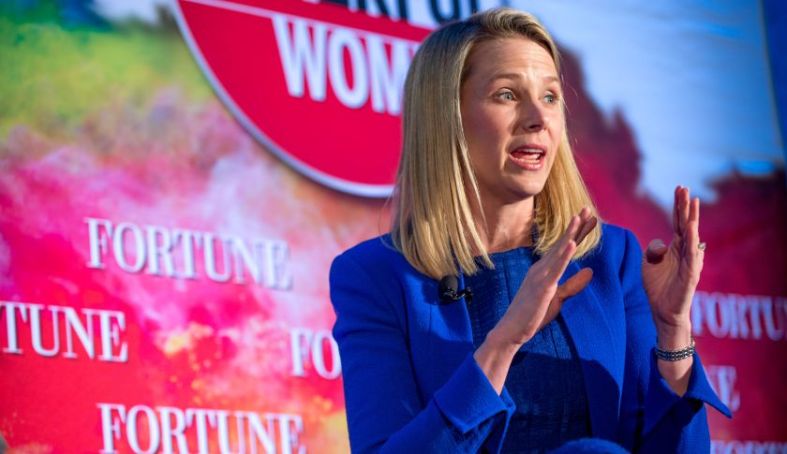
Marissa Mayer – Tag Team Parent?

On Tuesday, Yahoo CEO Marissa Mayer announced via Tumblr that she is expecting twin girls. On the same day New York Magazine writer, Oz Spies described her life, as a mother of three, as a ‘tag-team parent’. These two distinct narratives provide a vivid illustration of how folks cope with balancing work and life in a world of income inequality.

Ms. Mayer became one of the highest profile working mothers three years ago, not long after her appointment as head of the global internet service. A 2013 profile in Vogue described her strategy to balance work and child care.

“She set up a nursery next to her office, and for several months after Macallister was born, he and his nanny came to work with her.”

In her announcement this week, she implied she would utilize a similar approach with the birth of the twins.

“Since my pregnancy has been healthy and uncomplicated and since this is a unique time in Yahoo’s transformation, I plan to approach the pregnancy and delivery as I did with my son three years ago, taking limited time away and working throughout. I’ve shared the news and my plans with Yahoo’s Board of Directors and my executive team, and they are incredibly supportive and happy for me. I want to thank them for all of their encouragement as well as their offers of help and continued support.”

What is the message to the employees at Yahoo who might be planning family leave when the CEO opts out?

Writers Claire Cain Miller and David Streitfeld explored the issue in their NYT article, ‘Big Leaps for Parental Leave, if Workers Actually Take It’.

“Such contradictory signaling from Yahoo, which lengthened its parental leave in 2013, is typical and ambiguous, said Joan Williams, director of the Center for WorkLife Law at the University of California, Hastings. “The underlying work culture sends the message that if you’re really committed, you’re here all the time,” she said.”

On the other side of the spectrum, meet a Colorado couple, parents of three. One is a firefighter and the other a writer and consultant in the non-profit sector.

“We’re tag-team parents. It’s a term coined by the Center for Economic and Policy Research for parents who work alternating schedules, taking turns at both paid employment and child care, and it’s a work-parenting setup that’s on the rise. More than one-fourth of two-income couples include an adult working a nonstandard schedule (other than nine to five with evening or weekend hours).

Shift work is nothing new, but traditionally, many men who worked overnight, including firefighters, had wives who were stay-at-home moms. Now, more of these couples trade off work and kid duties. On my husband’s crew (all married fathers), the wives are all in the workforce, most of us fitting that work in around our husbands’ 48-hour shift blocks and our children’s school schedules. As a nonprofit consultant and writer, my job often gets done from a computer in our basement late at night, and I fit in the rest on the days when my husband is home with the kids. It’s yet another way that families today don’t look like the breadwinner father and stay-at-home mother ones of the past.”

While the media focuses on the birth announcements of business rockstars, it ignores the larger issue facing middle class families today. The average parent cannot bring their child and nanny to work. The cost of child care for two or more children exceeds the additional revenue of most second incomes. In the majority of families there is only one solution, alternating schedules with frequent handoffs of toddlers in parking lots when the best plans fail and shifts overlap.

This is our new American dream.

“Single parents, deployed parents, grandparents who are raising the children of their children — there are all kinds of complexities with which to wrestle. We figure it out as we go and we keep going.”

For the majority, including Oz Spies and her family this is the new normal.

“For us, tag-team parenting is the best way to see the kids we adore, do work we love, and still pay the bills. We’ll never have a standing Friday date night or every weekend together, but all this tag-team parenting has made us appreciate that we’re a team.”

Maybe Marissa Mayer’s strategy for blending family and work is a version of ‘tag team parenting’. It’s just hard to visualize a pre-dawn Silicon Valley McDonalds parking lot where a CEO and venture capitalist husband exchange toddlers, diaper bags and car seats.

The week@work – The time we spend @work, unpaid interns@the UN, no union for college football and the value of one good friend

Sarah Boseley reported on Wednesday on the health risks of working long hours for The Guardian newspaper in the UK.

“The largest study conducted on the issue, carried out in three continents and led by scientists at University College London, found that those who work more than 55 hours a week have a 33% increased risk of stroke compared with those who work a 35- to 40-hour week. They also have a 13% increased risk of coronary heart disease.

The findings will confirm the assumptions of many that a long-hours culture, in which people work from early in the morning until well into the evening, with work also intruding into weekends, is potentially harmful to health.”

During a discussion of these findings on CBS This Morning, co-anchor Charlie Rose turned the conversation to a discussion of how we define work.

“For some people reading a lot is play and pleasure. For others it’s work. It’s part of what they do and how they spend their time. It’s one thing to be on an assembly line, I think, and another thing to be reading a novel in preparation to interview someone. 

Where do we draw the line? Is there a line? That is the topic of the next article this week@work.

The New Yorker writer, Tim Wu thinks ‘You Really Don’t Need To Work So Much’. He questions why we have allowed ourselves to become players in “a football game where the whistle is never blown”. His solution, work should fulfill society’s needs with minimal effort. Let the workaholics have their fun, but not at the expense of the rest of us.

“The past fifty years have seen massive gains in productivity, the invention of countless labor-saving devices, and the mass entry of women into the formal workforce. If we assume that there is, to a certain degree, a fixed amount of work necessary for society to function, how can we at once be more productive, have more workers, and yet still be working more hours? Something else must be going on.”

“…in white-collar jobs, the amount of work can expand infinitely through the generation of false necessities—that is, reasons for driving people as hard as possible that have nothing to do with real social or economic needs.”

“The antidote is simple to prescribe but hard to achieve: it is a return to the goal of efficiency in work—fulfilling whatever needs we have, as a society, with the minimal effort required, while leaving the option of more work as a hobby for those who happen to love it.”

Does society need more unpaid interns? Apparently the United Nations thinks so and has grown their ‘volunteer workforce’ from 131 in 1996 to over 4,000 worldwide this year. ‘The Economist Explains why the UN doesn’t pay it’s interns’.

“The story of an unpaid intern living in a tent in Geneva did not make the United Nations look good. David Hyde, a fresh-faced 22-year-old from New Zealand, said he set up camp on the banks of Lake Geneva because he could not afford the Swiss city’s exorbitant rents while working for free. The news stirred up public outrage as well as sympathy from Mr Hyde’s colleagues: scores of UN interns in Geneva walked off the job on August 14th to protest against his plight. That same day a cluster of “interns’ rights” groups penned an open letter to the UN’s secretary-general, Ban Ki-moon, pointing out that the practice of not paying interns sits awkwardly with Article 23 of the organisation’s own Universal Declaration of Human Rights (“Everyone who works has the right to just and favourable remuneration ensuring for himself and his family an existence worthy of human dignity”). So why doesn’t the UN pay its interns?”

“They fear that paid internships may become a back door for recruitment and increase competition for coveted low-level “professional” positions.”

Excuse me, isn’t that why you do an internship? Isn’t this the apprenticeship that may one day lead to a full time job?

And while we are on the subject, let’s turn our attention to another group of unpaid collegians in the news this week, college football players. On Monday the U.S. National Labor Relations Board dismissed a petition from Northwestern University football players to form a union.

Ben Strauss reported on the board’s rationale in The New York Times:

“The board did not rule directly on the central question in the case — whether the players, who spend long hours on football and help generate millions of dollars for Northwestern, are university employees. Instead, it found that the novelty of the petition and its potentially wide-ranging impacts on college sports would not have promoted “stability in labor relations.”

Citing competitive balance and the potential impact on N.C.A.A. rules, the board made it clear that it harbored many reservations about the ramifications of granting college athletes, much less a single team, collective bargaining rights.”

For some college football players, their teammates are their best friends. And it may explain why many are so resilient.

Melissa Dahl described recent research in the UK for New York Magazine, ‘Having Just One Good Friend Strengthens Kids’ Resilience’.

“Let’s take a moment to praise the wonders of the true-blue best friendship, an especially powerful thing during the teenage years. A new study, published earlier this summer in the British Journal of Psychology, looked at this idea specifically among kids from low-income neighborhoods, and found that kids with just one solid, supportive friendship also tended to show signs of greater resilience when facing adversity than the kids with lower-quality friendships.

In their analysis, the researchers found an association between higher-quality friendships and greater resilience, likely, they theorize, because of the emotional support and the sounding board a real best friend provides.”

Here are a few more articles from the week@work that you may have missed.

The Future of Work and Workers – The Pacific Standard began a series this week exploring “What worries you most—and/or excites you most—about the future of work and workers? Put another way: What will be the most consequential changes in the world of work and workers, and what anxieties and possibilities will they produce?”

What the First Female Rangers ProveElizabeth Samet for Bloomberg View “Access to Ranger School, and combat units, is really about access to leadership opportunities. Of the 12 four-star Army generals currently on active duty, all are men. Eleven began their careers in the infantry or armor branch. Ten wear the Ranger tab. In other words, if you want a chance of running the Army, you would do well to go to Ranger School.”

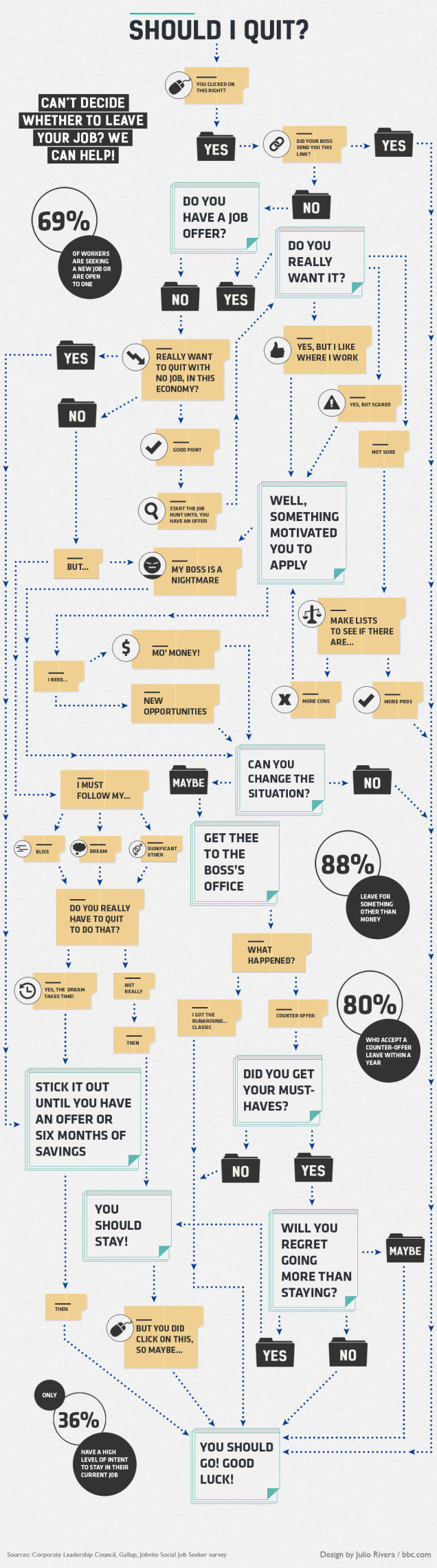
To Quit Or Not To Quit? This Flowchart Tells If It’s Time George Mortimer for Lifehack “Changing jobs or careers is something many people think about, but never seriously consider until it’s too late to change. The use of this flowchart makes it easier for you to determine if your current job satisfies your lifestyle. In basic terms, if your job isn’t making your life better you’re probably better off finding a new one.”

1372360723813364326

The week@work – Unemployment, economic mobility, parental leave, a tribute to #55 and anticipating Rio

The week@work included the first debate of the 2016 election season, the release of economic indicators and two American corporations announcing generous parental leave policies. This week also marks one year until those who work in sports will demonstrate their skills at the Summer Olympics in Brazil. And the NFL, in its wisdom, denied a Hall of Fame inductee’s daughter the opportunity to fulfill a father’s wish.

Once again, the week@work was about values: those we hold as a society and those organizations demonstrate not just in policies, but in action.

The June jobs numbers were released by the Labor Department on Thursday. Ben Casselman reported on the numbers behind the numbers in his article for ‘FiveThirtyEight’, ‘Don’t Forget The Workers The Recovery Is Leaving Behind’.

“U.S. employers added 215,000 jobs in July, the Bureau of Labor Statistics said in its monthly jobs report on Friday. It was the third straight month of job growth above 200,000, and the 10th in the past year. Revisions to prior months’ data added another 14,000 jobs, and the unemployment rate held steady at 5.3 percent, the lowest it’s been since before the recession.

Although the progress has been impressive, it has not been absolute. The headline unemployment rate is nearing a level most economists consider healthy — policymakers at the Federal Reserve consider a rate of between 5 percent and 5.2 percent “normal” over the long term — but the government’s official definition of unemployment leaves out people who have stopped looking for work or are stuck in part-time jobs. A broader underemployment rate, which includes both groups, stood at 10.4 percent in July, still well above its prerecession level.

It’s worth paying particular attention to a handful of groups that were hard-hit by the recession and continue to struggle in the recovery: African-Americans, young people, the less-educated and the long-term unemployed. The good news: All four groups are seeing some improvement, in some cases rapid improvement. But all of them have a long way to go before their employment could be considered healthy.”

In a related opinion piece, Nicholas Kristof posed the question, ‘U.S.A., Land of Limitations?

“Researchers have repeatedly found that in the United States, there is now less economic mobility than in Canada or much of Europe. A child born in the bottom quintile of incomes in the United States has only a 4 percent chance of rising to the top quintile, according to a Pew study.

…more children in America live in poverty now (22 percent at last count) than at the start of the financial crisis in 2008 (18 percent). They grow up not in a “land of opportunity,” but in the kind of socially rigid hierarchies that our ancestors fled, the kind of society in which your outcome is largely determined by your beginning.”

The week@work story with the most press was the decision by Netflix, soon followed by an announcement from Microsoft, to offer extended parental leave.

Vauhini Vara writing in The New Yorker reports on ‘Why Parental Leave Remains a Privilege’.

“There are other reasons for policies like Netflix’s, besides the fight over talented workers. Gerry Ledford, a senior research scientist at the University of Southern California’s Center for Effective Organizations, pointed out that the companies that offer costly benefits, like long paid parental leaves, tend to be financially successful, with money available to spend on H.R. perks. Google and Facebook are highly profitable, and while Netflix is only barely profitable, investors don’t seem to mind; the company’s share price set a new record on the day that Netflix announced its updated parental-leave policy. A third factor—and perhaps the least known—has to do with Silicon Valley’s location in California, where all workers have access to some amount of paid leave for the first six weeks after the birth or adoption of a child; it’s easier for a company to justify generous parental leave when many of their employees were already taking time off anyway.”

This time next year we will all be cheering our respective nations as athletes compete at the Summer Olympics in Brazil. As NBC rolled out their initial commercials in anticipation of hours of broadcast time, two stories offered a preview of the competition.

The first was part of a series of videos produced by GoPro. Beach volleyball competitor and Olympic silver medalist April Ross narrates a four minute video describing her ‘life @work’ on the beach. For young women who aspire to elite competition, April’s perspective is a window on the dedication required to succeed. She shares her pride at winning silver but is motivated to take that “one step up on the podium” in Rio. Her best advice, “Don’t get caught up in other people’s expectations”.

And then there is the young woman who goes to work every day in the water. Katie Ledecky startled all in London in 2012, when she earned gold in the 800 meter freestyle. This week she won five gold medals at the World Championships. The New York Times reported on her achievement, becoming “the first to win the 200, 400, 800 and 1,500-meter freestyles in a major competition.”

“Ledecky capped off a history-making week on Saturday at Kazan Arena with another milestone. In the 800-meter freestyle, the event that launched Ledecky into the international spotlight at the 2012 London Olympics, she set her 10th world record of the past 24 months with a clocking of 8 minutes 7.39 seconds. The time was 3.61 seconds better than her 13-month-old mark.

Ledecky, 18, slapped the water three times — once for each individual world record she set at these world championships.”

Junior Seau was a football player. On Saturday he was inducted along with seven others into the Football Hall of Fame in Canton, Ohio. The New York Times covered the ceremony and the story behind the story.

“In his 20-year N.F.L. career, Junior Seau established himself as one of the game’s greatest linebackers. He committed suicide in 2012 at age 43 and was subsequently found to have had a degenerative brain condition linked to repeated hits to the head. Before his death, Seau told his daughter Sydney that she should speak on his behalf if he made it into the Pro Football Hall of Fame. But the Hall, citing a five-year-old policy of not letting others give full speeches for deceased inductees, did not allow Sydney to deliver her speech.”

Today, The New York Times printed Sydney’s complete remarks as the full page lead story of the sports section. Her words reflect the sincere love and respect of a daughter for a father and a desire to fulfill his wish. One wonders, one more time, about the disconnect at the NFL between stated and demonstrated values.

“The two words that exemplify my dad the most are “passion” and “love.” Everything he achieved, accomplished or set his mind to was done with both qualities. In every situation — whether it be practice, a game, a family barbecue, an impromptu ukulele song or just a run on the Oceanside Strand — he always gave you all of himself because to him, there was never any other option.”

“Being the first Polynesian and Samoan to make it into the Hall of Fame is such an accomplishment. He is proof that even a young boy from Oceanside can make his dreams a reality. All his success is a direct reflection of the Oceanside community and family that raised him and molded him into the man he became. Although he is the first Polynesian to make it into the Hall, I know he will not be the last.”

The week@work – The odds of being poor@some point, how walking in nature changes the brain, young women envision pauses in their career and advice to working mothers

One story stood out from the rest this week@work. Washington Post journalists Emily Badger and Christopher Ingraham reported on the findings of sociologist Mark Rand at Washington University. The title alone was attention grabbing: ‘The remarkably high odds you’ll be poor at some point in your life’.

“The poor in America are not a permanent class of people. Who’s poor in any given year is different from who’s poor a few years later.

By the time they’re 60 years old, Rank has found, nearly four in five people experience some kind of economic hardship: They’ve gone through a spell of unemployment, or spent time relying on a government program for the poor like food stamps, or lived at least one year in poverty or very close to it.

By age 60, nearly 80 percent of us will have gone through a rough stretch.

“Rather than an uncommon event,” Rank says, “poverty was much more common than many people had assumed once you looked over a long period of time.”

The age of job stability is over, if anyone was still hanging on to an ideal of job security. Financial planning is a critical component of long term career planning. The reality of the research is that there will be periods of economic challenge alternating with periods of affluence. The ‘poor’ are not some abstract population. They are your neighbors, family and friends.

A story in The New York Times offered an example of how attitudes toward work and career might alter a family’s income. Journalist Claire Cain Miller writing for the Upshot found that the most recent entrants to the workplace envision planned pauses in their careers.

“The youngest generation of women in the work force — the millennials, age 18 to early 30s — is defining career success differently and less linearly than previous generations of women. A variety of survey data shows that educated, working young women are more likely than those before them to expect their career and family priorities to shift over time.

The surveys highlighted that two generations after women entered the business world in large numbers, it can still be hard for women to work. Even those with the highest career ambitions are more likely than their predecessors to plan to scale back at work at certain times or to seek out flexible jobs.

You might call them the planning generation: Their approach is less all or nothing — climb the career ladder or stay home with children — and more give and take.”

Recalling the career of journalist Marlene Sanders who died last week, Katherine Rosman shared the story of a member of the generation who achieved professional distinction while being among the first to ‘work outside the home’.

“In 2000, Cynthia McFadden, the senior legal and investigative correspondent for NBC News, attended a party given by her friend Jeffrey Toobin, a staff writer for The New Yorker and legal analyst for CNN. There, Ms. McFadden was catching up with Mr. Toobin’s mother, Marlene Sanders, the pioneering television reporter. She asked for her advice on managing motherhood and a career.

Ms. Sanders put both hands on Ms. McFadden’s shoulders and peered into her eyes. “Never apologize for working,” the older woman said. “You love what you do, and loving what you do is a great gift to give your child.”

Over the years, Ms. McFadden said, Mr. Toobin told her he loved having a mother who worked outside the home, even in an era when it was not that common. It was a sentiment he reiterated in an interview on Wednesday. “I found her career exciting,” he said. “I loved to watch her on TV. Guilt was never part of the equation. And given her temperament, if she had been home all the time, it would have been a close contest to determine whether she or I went insane first.”

The last story of the week shares research that should encourage you to take a walk in the park. Reporting on a study at Stanford University, Gretchen Reynolds found:

A walk in the park may soothe the mind and, in the process, change the workings of our brains in ways that improve our mental health, according to an interesting new study of the physical effects on the brain of visiting nature.

But just how a visit to a park or other green space might alter mood has been unclear. Does experiencing nature actually change our brains in some way that affects our emotional health?

That possibility intrigued Gregory Bratman, a graduate student at the Emmett Interdisciplinary Program in Environment and Resources at Stanford University, who has been studying the psychological effects of urban living. In an earlier study published last month, he and his colleagues found that volunteers who walked briefly through a lush, green portion of the Stanford campus were more attentive and happier afterward than volunteers who strolled for the same amount of time near heavy traffic.”

In summary this week@work – take a walk in the park and consider your career path. Lose the guilt if you are a working mother, and plan for both the expected as well as the unexpected shifts in work/life balance.