What being a ‘team player’ really means – #AmyRodriguez8

How many times have we heard about being a ‘good team player’? Our ability to ‘play well with others’ may influence a hiring decision or career advancement. In reality, the world of the corporate team player is a bit more ambiguous. Not so in sports. On Sunday, a record television audience watched the US Women’s National Team win the World Cup. There were leaders, the visible few with corporate sponsorships, but the road to the final was won by the ‘team players’.

Why do some teams excel while others fail?

Often folks with competing agendas are brought together to solve a problem or complete a project. Each member contributes based on their skill set, but the process is derailed when goal definition and respect for colleagues is lacking. If a feedback loop has not been included in the planning, dysfunction can continue unchecked.

Which brings me back to the US Women’s National Team and one member, Amy Rodriguez.

You can google Amy and find pages of material documenting her career in soccer. She led her team at USC to a National Championship. She has earned two Olympic Gold Medals. And she is a ‘team player’ who contributed to the success in this year’s world cup.

I met Amy when she was a freshman at the University of Southern California. She was a student in a seminar I taught in the spring of 2006. Over her time at USC we would occasionally stop for a brief conversation in the middle of campus, but for the most part, I have followed her career as most of her fans, from a distance.

But it’s at a distance that you observe the consistency of Amy’s personality, values, dedication and collegiality. Yesterday she had a moment in the spotlight as she led the crowd welcoming the team back to LA in celebration.

There have been many books written about the distinctions between successful teams and those that fail.

In the end, it’s a mutual trust and respect for others that underscores the values of a team player.

Tomorrow the team will receive New York’s highest honor with a ticker tape parade in lower Manhattan. Take a minute to cheer on those who scored the goals and their supporting players.

Congratulations Amy!

The week@work – The Pope on climate change and more, Disney reverses a decision and the importance of staring out the window

This week@work has been spent planning a European adventure. For the next two weeks I will be taking leave of our conversation on work and career. I will continue to share thoughts and articles on Twitter. Please follow @Eileen Kohan or @workthoughts.

Before I go, let’s take a look at the week@work. This week included the major story of Pope Francis’ encyclical, Disney ABC Television reversing a decision on layoffs and the insights we gain from staring out the window.

Elizabeth Kolbert commented on the content of the encyclical in The New Yorker “A Papal Message That Spares No One”:

“…though its focus is on man’s relationship to nature, it also has much to say about man’s relationship to his fellow man and to himself—little of it laudatory. The vision that Pope Francis offers in his encyclical is of a world spiralling toward disaster, in which people are too busy shopping and checking their cell phones to do, or even care, much about it.

“The pace of consumption, waste and environmental change has so stretched the planet’s capacity that our contemporary lifestyle, unsustainable as it is, can only precipitate catastrophes,” the Pope writes. At another point, he says, “Many people will deny doing anything wrong because distractions constantly dull our consciousness of just how limited and finite our world really is.”

According to Francis, the problems of environmental degradation and global poverty are intimately related. Both can be traced to a way of thinking that regards the world as a means, rather than an end. This way of thinking rules the marketplace—“Finance overwhelms the real economy”—and dominates our data-driven culture: “Technology tends to absorb everything into its ironclad logic.”

The Guardian noted: “He says iPhones and all our other gadgets are getting in the way of our relationship with nature.”

“Real relationships with others, with all the challenges they entail, now tend to be replaced by a type of internet communication which enables us to choose or eliminate relationships at whim, thus giving rise to a new type of contrived emotion which has more to do with devices and displays than with other people and with nature.”

And finally, the pope’s tweet: “The earth, our home, is beginning to look more and more like an immense pile of filth.” Proving you can distill 180 pages into 140 characters.

Variety reported on the decision by Disney executives to keep 35 tech employees who not only been notified that their jobs were being eliminated, but they were expected to train their replacements.

“The Disney ABC Television Group has reversed course on cutting jobs for up to 35 application developers, two weeks after informing the employees that they were being laid off.

But the Disney ABC TV Media Technology and Strategy development team subsequently decided to rescind the layoffs. First reported by Computerworld, Disney ABC spokesman Kevin Brockman confirmed the plans on Wednesday.

When the layoffs were rescinded, some of the affected employees had already started training their Cognizant Technology replacements in what’s dubbed the “knowledge transfer” process.”

For more detail on this story, check the NPR interview with Computerworld senior editor,  Patrick Thibodeau.

The last story this week is from The School of Life on ‘The importance of staring out the window’.

“The point of staring out of a window is, paradoxically, not to find out what is going on outside. It is, rather, an exercise in discovering the contents of our own minds. It’s easy to imagine we know what we think, what we feel and what’s going on in our heads. But we rarely do entirely. There’s a huge amount of what makes us who we are that circulates unexplored and unused. Its potential lies untapped. It is shy and doesn’t emerge under the pressure of direct questioning. If we do it right, staring out the window offers a way for us to listen out for the quieter suggestions and perspectives of our deeper selves.”

“…some of our greatest insights come when we stop trying to be purposeful and instead respect the creative potential of reverie. Window daydreaming is a strategic rebellion against the excessive demands of immediate (but ultimately insignificant) pressures – in favour of the diffuse, but very serious, search for the wisdom of the unexplored deep self.”

The lessons of the week@work – Looking from space we share the same ‘home’ and the responsibility to care for that common home. How? Taking time off, paying attention to nature, disconnecting from technology and reclaiming our humanity.

Why has it been so hard to shatter the glass ceiling?

Forbes Magazine’s most powerful woman, German Chancellor Angela Merkel was caught in conversation with President Obama yesterday at the G7 Summit. She was not, as the media suggested, auditioning for the lead role in the Sound of Music.

The G7 leaders are dealing with serious economic and political issues that will eventually trickle down to effect us all. But the media focus was on a photograph and a caricature that diminished the accomplishments of the German leader.

The Washington Post headlined “A remarkable photo of President Obama and Angela Merkel” and continued:

“The backdrop to the 41st G7 Summit held in Germany is breathtaking, with its green trees and towering mountains. It makes for great image of German Chancellor Angela Merkel talking and gesturing with a seated President Obama.

It’s made all the better with Merkel’s shruggie pose ¯\_(ツ)_/¯, which also just so happens to look like that one scene from “The Sound of Music.”

Really? Is this journalism? Here is a woman whose leadership skills have kept the European Union together, maintained a dialog with the Russian president in a difficult political climate and has transformed her country since her election in 2005.

And, American journalists covering the summit have likened the German Chancellor to a singing nun.

Bryce Covert, writing in The New York Times on Friday, chronicled “our problem with powerful women”. She described Hillary Clinton being “optimistic about the path of progress toward gender equality. She called the presidency the “highest, hardest glass ceiling.” But she also said that it had “about 18 million cracks in it, and the light is shining through like never before, filling us all with the hope and the sure knowledge that the path will be a little easier next time.”

In reality, Ms. Covert’s research shows, “Too few women make it into corporate leadership.”

“Progress is not inevitable, though, nor is it fixed. The country has a complicated relationship with powerful women: They have to keep proving themselves over and over again, being twice as good, and dragging one woman through the process doesn’t make it easier for those who follow.

Individual women might hope that their struggles blaze trails for everyone else. Mrs. Clinton must feel optimistic about her chances to win the presidency a second time around. But the reality is that the country hasn’t gotten used to women in charge. A crack in the glass ceiling in one place could very well just reinforce it for everyone else.”

Maybe it was Angela Merkel’s crack in the glass ceiling that has made it so hard for Mrs. Clinton. I might also suggest to the female journalists who enthusiastically broadcast ‘the sound of music photo’ on air last night, you’re not helping. You’re like the Safelight Auto Glass repair guy, making sure you seal up all those cracks and fortify glass ceiling.

Take another look at the photo. I think Chancellor Merkel is asking President Obama, “What’s wrong with you people? What is your problem with powerful women leaders?”

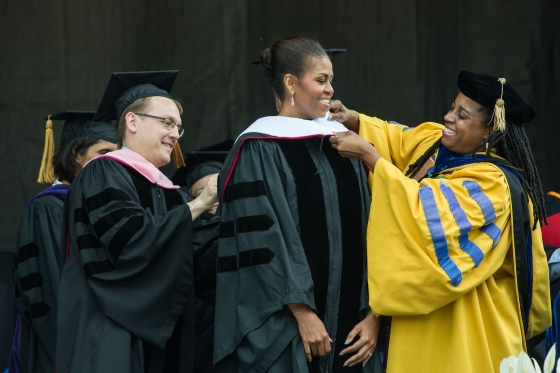
First Lady Michelle Obama @ Oberlin College & Tuskegee University – “Rise above the noise”

First Lady Michelle Obama delivered two commencement addresses this spring. The first, in early May at Tuskegee University and the second over the weekend at Oberlin College. Respect and civility were on her mind and the narrative of her experience gave credence to the challenge she posed to graduates at both institutions: “stay true to who you are and where you come from” and “rise above the noise and shape the revolutions of your time”.

The position of First Lady of the United States is a career choice. The interview process is tangential to the candidate for president, but the spouse’s background is equally examined under the microscope of the 24×7 news cycle. In her speech to the Tuskegee graduating class, Mrs. Obama was candid in her reflections on the impact of the campaign and shared a leadership lesson in her resolve to not let others define her.

“Back when my husband first started campaigning for President, folks had all sorts of questions of me: What kind of First Lady would I be? What kinds of issues would I take on? Would I be more like Laura Bush, or Hillary Clinton, or Nancy Reagan? And the truth is, those same questions would have been posed to any candidate’s spouse. That’s just the way the process works. But, as potentially the first African American First Lady, I was also the focus of another set of questions and speculations; conversations sometimes rooted in the fears and misperceptions of others. Was I too loud, or too angry, or too emasculating?  Or was I too soft, too much of a mom, not enough of a career woman?

But eventually, I realized that if I wanted to keep my sanity and not let others define me, there was only one thing I could do, and that was to have faith in God’s plan for me. I had to ignore all of the noise and be true to myself — and the rest would work itself out. 

So throughout this journey, I have learned to block everything out and focus on my truth. I had to answer some basic questions for myself: Who am I? No, really, who am I? What do I care about?”

The most respected of the management gurus are adamant that before you can lead, you have to know who you are, your values and what you care about. This is your anchor throughout your career.

“And at the end of the day, by staying true to the me I’ve always known, I found that this journey has been incredibly freeing. Because no matter what happened, I had the peace of mind of knowing that all of the chatter, the name calling, the doubting — all of it was just noise. It did not define me. It didn’t change who I was. And most importantly, it couldn’t hold me back. I have learned that as long as I hold fast to my beliefs and values — and follow my own moral compass — then the only expectations I need to live up to are my own.”

At Oberlin College, Mrs. Obama acknowledged the campus culture of service and social justice and encouraged graduates to take a leadership role “to actively seek out the most contentious, polarized, gridlocked places you can find. Because so often, throughout our history, those have been the places where progress really happens –- the places where minds are changed, lives transformed, where our great American story unfolds.”  

“And the truth is, graduates, after four years of thoughtful, respectful discussion and debate here at Oberlin -– those seminars where you explored new ideas together, those late-night conversations where you challenged each other and learned from each other — after all of that, you might find yourself a little dismayed by the clamor outside these walls — the name-calling, the negative ads, the folks yelling at each other on TV. After being surrounded by people who are so dedicated to serving others and making the world a better place, you might feel a little discouraged by the polarization and gridlock that too often characterize our politics and civic life.

Her address continued with a call to citizenship. Recognizing the temptation to “run the other way as fast as you can…you need to run to, and not away from, the noise.” 

So get out there and volunteer on campaigns, and then hold the folks you elect accountable. Follow what’s happening in your city hall, your statehouse, Washington, D.C. Better yet, run for office yourself. Get in there. Shake things up. Don’t be afraid.  And get out and vote in every election -– not just the big national ones that get all the attention, but every single election. Make sure the folks who represent you share your values and aspirations.

See, that is how you will rise above the noise and shape the revolutions of your time.”

“Envisioning the non-obvious makes things unexpected”

Have you ever made a career move that had family and friends questioning your motives? Federica Marchionni became the CEO of apparel company, Lands’ End in February, leaving an executive position as President of US Operations at luxury brand Dolce & Gabbana.

Her career started in the telecommunications industry and led to an executive assignment at Ferrari before her move to D&G in 2001. Now she leads an organization with significant challenges after the company was spun off by parent Sears in 2014.

The ‘CBS This Morning’ news program reported on her move in a pre-taped interview:

“Marchionni is leading the company while splitting her time between New York and Wisconsin. From small town to Times Square, Marchionni is able to navigate two very different worlds.

“And I like it. And what I said is that envisioning the non-obvious makes things unexpected. And, of course, this wasn’t an expected choice. But only when you do take chances, you can grow,” she said.”

Take a minute to think about successful folks you have met. Why are they good at what they do? They take regular excursions away from their comfort zone. They make the ‘unexpected’ choice. They risk failure and professional reputation to achieve their definition of success.

In the case of Ms. Marchionni, her company is based in Dodgeville, Wisconsin but her office is in New York. She made a career choice that family and friends questioned, but her decision was not made in a void. Prior to joining Land’s End, she was familiar with the product line and supportive of the company founder’s commitment to the environment.

At the recent ‘Women in the World Summit’ she shared her vision for Land’s End:

“As the new CEO of Lands’ End, I want to lead this amazing American iconic company to become a meaningful global lifestyle brand. Meaningful in the way we conduct our business, in the way we make decisions, the way we inspire people (in our) community and the world.”

How will she accomplish her goals?

Speaking with CBS News: “The founder always said that if you take care of your people, if you take care of your customer, the business will take care of itself. And I totally, totally agree with that.”

Not all of us are contemplating ‘C-Suite’ employment packages, but we can learn from leaders who transition from one company to another.

Understand the culture, the product, the financials and the customer. Research will give you all the information you need before you accept a position.

Own the decision, even if friends and family are skeptical. Trust your gut.

Embrace change. Really. Corporate life today takes place in the world of the unexpected. That’s not a choice.

Do you deserve the extra cookie? Leadership lessons from Michael Lewis’ Commencement Address

‘Don’t Eat Fortune’s Cookie’ was the title of the 2012 Princeton University commencement speech delivered by alumnus Michael Lewis. His message: “recognize that if you have had success, you have also had luck — and with luck comes obligation.”

Michael Lewis graduated from Princeton with a degree in art history believing he “was of no possible economic value to the outside world”.

The experience of writing his senior thesis introduced him to the possibility of building a career on his talent for words. With no experience and little encouragement from his thesis professor:

“I did what everyone does who has no idea what to do with themselves: I went to graduate school. I wrote at nights, without much effect, mainly because I hadn’t the first clue what I should write about.”

And one night he makes a connection at dinner and ends up working as a derivatives expert at the financial firm, Salomon Brothers. Two years later he realizes he has found something to write about.

“I didn’t need to think about it. I knew what intellectual passion felt like — because I’d felt it here, at Princeton — and I wanted to feel it again. I was 26 years old. Had I waited until I was 36, I would never have done it. I would have forgotten the feeling.”

Imagine, reader with the perfect resume and highly regarded credentials, that the luck of a seating arrangement could lead you to a position that allows you, in time, to connect the dots back to your passion.

“People really don’t like to hear success explained away as luck — especially successful people. As they age, and succeed, people feel their success was somehow inevitable. They don’t want to acknowledge the role played by accident in their lives. There is a reason for this: the world does not want to acknowledge it either.”

But accidents do happen and the best you can do is consistently put yourself in front of the oncoming ‘career possibilities’ truck.

And now, about the cookies. The leadership lesson is humility, and Mr. Lewis illustrates with a story of a ‘teamwork’ exercise.

Two Cal researchers recruited students for an experiment.

“…they broke the students into teams, segregated by sex. Three men, or three women, per team. Then they put these teams of three into a room, and arbitrarily assigned one of the three to act as leader. Then they gave them some complicated moral problem to solve: say what should be done about academic cheating, or how to regulate drinking on campus.

Exactly 30 minutes into the problem-solving the researchers interrupted each group. They entered the room bearing a plate of cookies. Four cookies. The team consisted of three people, but there were these four cookies. Every team member obviously got one cookie, but that left a fourth cookie, just sitting there. It should have been awkward. But it wasn’t. With incredible consistency the person arbitrarily appointed leader of the group grabbed the fourth cookie, and ate it.

This leader had performed no special task. He had no special virtue. He’d been chosen at random, 30 minutes earlier. His status was nothing but luck. But it still left him with the sense that the cookie should be his.”

We probably cannot remember our commencement speaker or their message. That’s why each year at this time we should reflect on the words we missed, now that we have the context of experience to help us understand.

There are no straight lines along a career path. Michael Lewis is a highly regarded, bestselling author who has written stories of Wall Street and baseball. The lessons he shared that spring day:

Don’t put too much distance between you and your passion, because you may forget the feeling.

Be Humble. Don’t eat the last cookie. You may sit at the head of the table and truly believe you deserve the extra cookie, “But you’ll be happier, and the world will be better off, if you at least pretend that you don’t.” 

The Saturday Read – Biography

If we read biographies will be be better leaders?

A quick review of President Obama’s reading list includes the life stories of former presidents: Adams, Lincoln and FDR. The number two book this week on The New York Times Business Best Seller list is the new bio, ‘Becoming Steve Jobs’. Last week the Wall Street Journal reviewed ‘Hannibal: A Hellenistic Life’.

“It is not histories I am writing, but lives; the most glorious deeds do not always indicate virtue or vice, but a small thing like a phrase or a jest often reveals more of a character than the bloodiest battles.”  Plutarch, ‘Parallel Lives’

We read biographies to extract the wisdom of others. Biographies offer a portal into understanding the larger world where these lives were lived. Read closely they offer proof that history repeats itself.

“We live – at least in the Western world – in a golden age for biography. The depiction of real lives in every medium from print to film, from radio to television and the Internet is more popular than ever…Biography, today, remains as it has always been, the record and interpretation of real lives – the lives of others and ourselves.”  Nigel Hamilton, ‘How To Do Biography’

The ‘Saturday Read’ this week is not a recommendation of a single title, but a suggestion of a genre.

Despite a well publicized ‘biography kerfuffle’ over a new, ‘unauthorized’ biography of Steve Jobs written by Fast Company reporters, Brent Schlender and Rick Tetzeli, it has been the ‘year of biography’, offering a variety of choices, spanning centuries.

The 2015 Pulitzer Prize for Biography was awarded to ‘The Pope and Mussolini: The Secret History of Pius XI and the Rise of Fascism in Europe’ by David I. Kertzer. Also nominated as finalists in this category were: ‘Louis Armstrong: Master of Modernism’ by Thomas Brothers and ‘Stalin: Volume I: Paradoxes of Power, 1878-1928’ by Stephen Kotkin.

The LA Times Book Prizes includes a standalone category for biography. This year Andrew Roberts‘Napoleon: A Life’ received the award in a roster of respected nominees including Pulitzer finalist Steve Kotkin along with:

Adam Begley, ‘Updike’

Robert M. Dowling, ‘Eugene O’Neill: A Life in Four Acts’

Kirstin Downey, ‘Isabella: The Warrior Queen’

On the Saturday morning of the LA Times Festival of Books I attended a panel moderated by Eisenhower biographer, Jim Newton. Biographers Downey and Kotkin revealed their subjects were very unlikely historical figures. Looking back at their early years, Isabella of Spain and Stalin showed little promise for the lives they would eventually lead. Yet all of these writers crafted stories of actors who emerged onto the global stage amid success, controversy and failure.  A. Scott Berg who published a hefty bio of Woodrow Wilson last year closed the discussion describing the role of biography as “a way to illuminate the times”.

This weekend, select a book from those suggested here or find one about someone you admire and perhaps would like to emulate. Discover a mentor in the pages of biography.