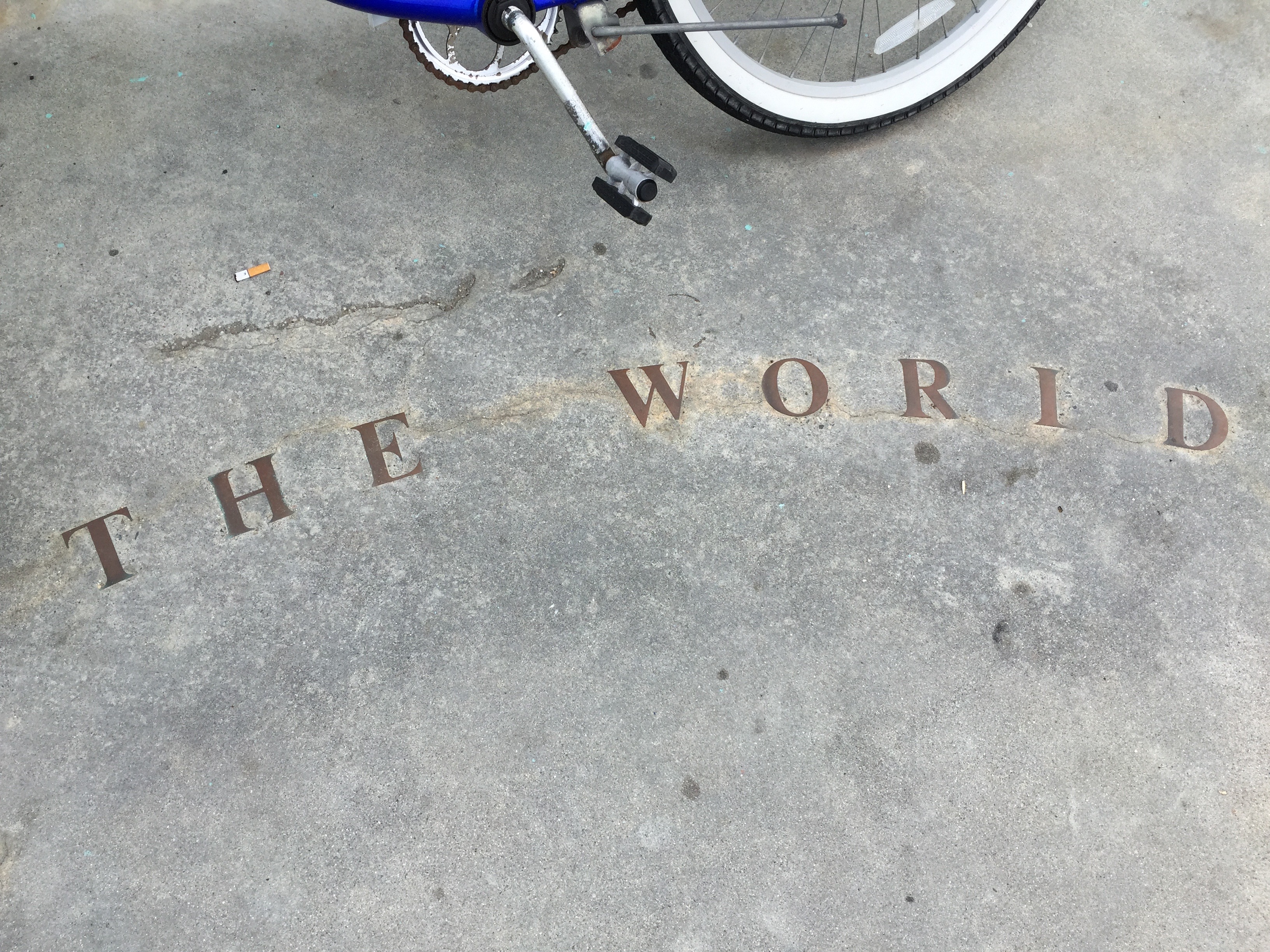
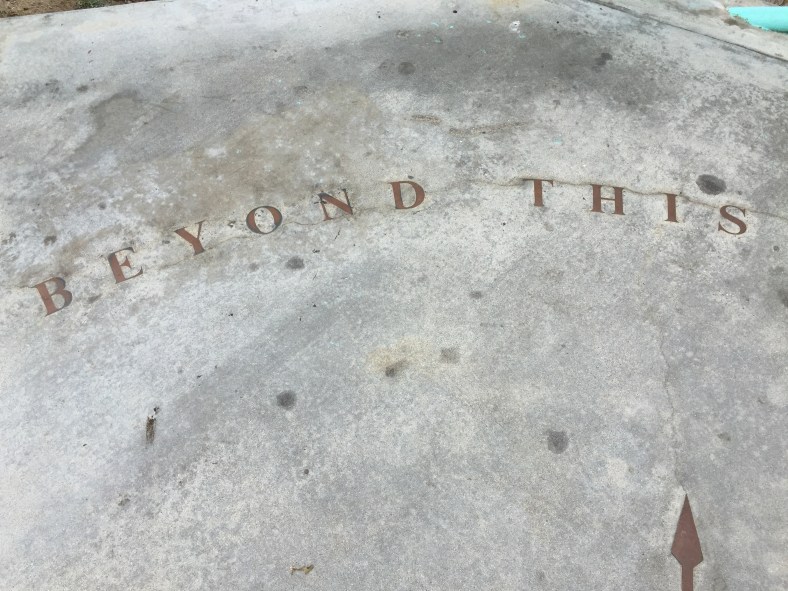
“Beyond this point lies the rest of the world”

I went for a walk this morning along the beach. It was cloudy, unusual for a summer day in California. I stopped in a parking lot to take a photo of the town’s iconic pier. I looked down for a minute and that’s when I spotted it. Embedded in the cement, facing the ocean are three directional arrows. In a semi-circle surrounding the arrows are the words “Beyond this point lies the rest of the world’.

There they were, nine simple words, welcoming visitors to imagine life beyond this point.

IMG_2554

In writing this blog I have often emphasized the importance of curiosity and creativity, urging readers to step away from what is familiar and risk failure to experience success. Here it is, a perfect invitation to imagination and exploration.

IMG_2560

You don’t have to travel to California and gaze at the Pacific. Just stop what you are doing, look up and remind yourself that that there is something bigger beyond where you sit.

IMG_2561

The Journey, a poem by Mary Oliver

I find that many people ‘shape shift’ their lives to meet the expectations of others. That may be a short term personal gratification strategy, but it’s not one for the long haul. In the end you lose who you are, and it may take a while for your GPS to recalculate.

The Friday poem is ‘The Journey’ by Pulitzer Prize winning poet, Mary Oliver. The poem is included in the collection, ‘New and Selected Poems, Volume One’ published in 1992 and recognized with the National Book Award.

The Journey

One day you finally knew
what you had to do, and began,
though the voices around you
kept shouting
their bad advice –
though the whole house
began to tremble
and you felt the old tug
at your ankles.
“Mend my life!”
each voice cried.
But you didn’t stop.
You knew what you had to do,
though the wind pried
with its stiff fingers
at the very foundations,
though their melancholy
was terrible.
It was already late
enough, and a wild night,
and the road full of fallen
branches and stones.
But little by little,
as you left their voices behind,
the stars began to burn
through the sheets of clouds,
and there was a new voice
which you slowly
recognized as your own,
that kept you company
as you strode deeper and deeper
into the world,
determined to do
the only thing you could do –
determined to save
the only life you could save.

Mary Oliver, 1986  First published in Dream Work, Atlantic Monthly Press. Reprinted in New and Selected Poems, Volume One, Beacon Press.

The Saturday Read – Roman Krznaric ‘How to Find Fulfilling Work’

This week’s Saturday Read is a small, yet significant work by ‘lifestyle philosopher’ Roman Krznaric. In ‘How to Find Fulfilling Work’ he suggests “We have entered a new age of fulfillment, in which the great dream is to trade up from money to meaning.” Think about that. He is proposing that meaning has more value than money.

There are shelves of books that are categorized as career guides. Only two or three are worth the price. I found this one on a visit to the small bookshop at the School of Life in London.

You’re not going to find your passion in six or fewer easy steps, and there is a rather narrow niche of folks who can make a living from a four hour work week. There is no gimmick in Mr. Krznaric’s narrative, only a well thought out work that draws from the disciplines of sociology, psychology, history and philosophy.

If you are the reader who has found that meaning holds more weight than dollar signs, this book is for you.

“The desire for fulfilling work – a job that provides a deep sense of purpose, reflects our values, passions and personality – is a modern invention…For centuries, most inhabitants of the Western world were too busy struggling to meet their subsistence needs to worry about whet they had an exciting career that used their talents and nurtured their wellbeing. But today, the spread of material prosperity has freed our minds to expect much more from the adventure of life.”

The author distinguishes between two approaches people take to finding work:

“The first is grin and bear it… The message of the ‘grin and bear it’ school of thought is that we need to accept the inevitable and put up with whatever job we can get, as long as it meets our financial needs and leaves us enough time to pursue our ‘real life’ outside of office hours.”

“I am more hopeful than this , and subscribe to a different approach, which is that it is possible to find work that is life-enhancing, that broadens our horizons and makes us feel more human.”

His goal is to encourage the reader to stop thinking about taking action and actually get out and do something. The book is essentially an answer to two questions:

“What are the core elements of a fulfilling career?” and “How do we go about changing career and making the best possible decisions along the way?”

We lead multidisciplinary lives. It makes sense to approach our thoughts on career through a multifaceted portal.

Enjoy the Saturday Read, and begin your journey to find fulfilling work.

Praise to the Rituals That Celebrate Change, a poem by Dana Gioia

High school graduation and university commencement celebrate major life transitions. The changes that come after are rarely celebrated with the same pomp and ceremony. For today’s Friday poem, Dana Gioia recognizes the rituals and suggests “the old be touched by youth’s wayward astonishment at learning something new…”

Change is the essence of our world today. At work and in life small quakes and seismic shifts alter our direction. We adapt and transition. Perhaps we should celebrate change, our evolution, with ritual and recognition. Eliminate the fear and reward transformation.

Praise to the Rituals That Celebrate Change

Praise to the rituals that celebrate change,
old robes worn for new beginnings,
solemn protocol where the mutable soul,
surrounded by ancient experience, grows
young in the imagination’s white dress.
Because it is not the rituals we honor
but our trust in what they signify, these rites
that honor us as witnesses—whether to watch
lovers swear loyalty in a careless world
or a newborn washed with water and oil.

So praise to innocence—impulsive and evergreen—
and let the old be touched by youth’s
wayward astonishment at learning something new,
and dream of a future so fitting and so just
that our desire will bring it into being.

Dana Gioia  2007

Neil Armstrong @ USC and the Class of 2005

Ten years ago today, Neil Armstrong, the American astronaut and first person to walk on the moon, addressed the graduating Class of 2005 at the University of Southern California. The man who announced to the world, on a July afternoon in 1969, “Houston, Tranquility Base here. The Eagle has landed.” never mentioned his achievement.

The day was about the graduates. Not about the man who walked on the moon.

But even the youngest family member in attendance knew who was speaking. A little boy climbed up a grassy hill behind a giant screen projecting the event. He had not come to watch TV, but to see the astronaut for himself, in person. This was his connection to dreams beyond. “Mommy, that’s the man who walked on the moon.”

Can you imagine your life defined by one historical, ‘out of this world’ event?

There are few things today that take our breath away. We have forgotten the mysteries of space travel as we contemplate only the familiar. We go about our work day as a space station circles above, with no thought of the explorers at work outside our atmosphere.

On that May morning, the parents, graduates, faculty and staff shared an historic moment with a legend. And the legend expressed his doubts about his ability to give advice.

“I feel a sense of discomfort in that responsibility as it requires more confidence than I possess to assume that my personal convictions deserve your attention.”

He encouraged the graduates to “appreciate the elegance of simplicity” and continued his address following his own advice.

“The single observation I would offer for your consideration is that some things are beyond your control. You can lose your health to illness or accident, you can lose your wealth to all manner of unpredictable sources.

What is not easily stolen from you without your cooperation is your principles and your values. They are your most precious possessions and, if carefully selected and nurtured, will well serve you and your fellow man.

Society’s future will depend on a continuous improvement program on the human character. What will the future bring? I don’t know, but it will be exciting.”

His challenge to us all is to lead a life of continuous learning and continuous improvement, even after you have achieved your ‘signature’ career experience.

The LA Times Festival of Books 2003 & David Halberstam

There’s a book festival this weekend in LA and one of my favorite writers will be missing. Eight years ago next week, Pulitzer Prize winning journalist and author David Halberstam died in a car crash in Menlo Park, California on his way to conduct an interview for his next book.

I thought it would be a good day to share my ‘memories at a distance’ of a journalist whose work continues to educate and inspire.

I first heard Mr. Halberstam speak at the University of Southern California commencement. His remarks were measured as he sought to reassure the Class of 2002; the first graduating class after 9/11. Words that are as relevant today as they were on that  May morning in South Central LA.

“We should, after all, all be aware of the blessings of our lives. The truth today, which I suspect you already know, is that you are among the fortunate of your generation. You have been given a priceless education in an age where work is increasingly defined not by muscularity but by intelligence, and therefore you are already advantaged. More, you have not only been given an exceptional education, but perhaps more importantly, you have been part of a rare community where the intellectual process is valued not just for what it can do for you economically but as an end in itself. Learning is not just a tool to bring you a better income; learning is an ongoing, never-ending process designed to bring you a fuller and richer life.

In addition, you are fortunate enough to live in an affluent, blessed society, not merely the strongest, but the freest society in the world. Our courts continue to uphold the inherent rights of ordinary citizens to seek the highest levels of personal freedom imaginable. In this country as in no other that I know of, ordinary people have the right to reinvent themselves to become the person of their dreams and not to live as prisoners of a more stratified, more hierarchical past. In America we have the right to choose who and what we want to be: to choose if we so want, any profession, any venue, any name.”

The next time I heard David Halberstam speak was on the UCLA campus in 2003.

I have this small yellow spiral notebook with blotched ink notes from the LA Times Festival of Books in 2003. I attended as many panels as I could fit, purchased cassette recordings of those I missed (it was the dark ages), and stood in line to garner author signatures in newly release titles. I took copious notes at every panel including one moderated by Marie Arana, (then book editor of The Washington Post), with authors Carolyn See, Terry Brooks and George Pelecanos. At the end of the day, in my notebook, there is only the title and the names of the panelists for ‘The Politics of Sport’. I couldn’t multitask. I could only listen as three literary lions shared their thoughts with a packed auditorium audience.

Author Gay Talese moderated the panel with Mr. Halberstam and George Plimpton. There were 322 other authors at the festival that weekend, but this discussion brought together three authors whose careers included journalism, war, media, sports, politics, civil rights and the founding of a major literary review. If you are looking for a book to read this weekend here are three of my picks, one from each author:

David Halberstam   ‘The Best and the Brightest’

George Plimpton   ‘Paper Lion’

Gay Talese   ‘The Kingdom and the Power’

The 20th annual LA Times Festival of Books takes place this weekend in Los Angeles on the campus of The University of Southern California. It’s the largest event centered on books in the country, showcasing fiction, non-fiction, travel, cooking, politics and biography.

It’s an opportunity to create an intellectual memory, stock your library for the coming months, and continue the never-ending process of learning to bring you a fuller and richer life.

The week @ work March 16 – 22

This week@work invited us to broaden our thinking with ideas from TED and SXSW, a suggested reading list from Mark Zuckerberg and a David Remnick pick from The New Yorker archive on the creative life. Using a variety of online resources and social networks we can construct an individualized professional development curriculum based on our interests and career aspirations.

On Friday The New York Times included a continuing education ‘special section’ in their print edition. In the lead article ‘That’s Edutainment’ reporter Greg Beato described the growing phenomenon of “the academization of leisure: casual learning propelled by web culture, a new economy and boomers with money.”

In a companion article, Peder Zane asked the question, “If you can know it all, how come you don’t?” He goes on to report on Jonathan Haber, a “52 year old from Lexington, Massachusetts” who is attempting to “meet all the standard requirements for a bachelor of arts degree in a single year.” And he is doing it by selecting from a menu of online offerings from Harvard, Yale and Stanford, chronicling his experience in a book and of course, online.

This past week folks came together to discuss ideas at the annual TED conference and celebrate music, film and interactive at SXSW.

You may categorize all these formal and informal experiences as ‘edutainment’, but I would suggest that lifelong learning, often promised, is finally here. And the topics discussed are widely relevant to today’s workplace.

Visit the TED website and access presentations recorded at the conference. One of the most compelling, Monica Lewinsky on our ‘culture of humiliation’. The Washington Post political reporter Chris Cillizza summarized the key point of her talk: “For nearly two decades now, we have slowly been sowing the seeds of shame and public humiliation in our cultural soil. Gossip Web sites, paparazzi, reality programming, politics, news outlets and sometimes hackers traffic in shame. Public humiliation as a blood sport has to stop. We need to return to a long-held value of compassion and empathy.”

And on the SXSW site, you can view film maker Ava DuVernay encouraging her audience to pay attention to their intention. She takes the audience on a narrative of her early success and then cautions from experience: “The dreams were too small. If your dream only includes you, its too small. If that dream is just about the thing you want to accomplish and you don’t even know why you want it…it’s to small…When you win awards and the light is on you, that’s not gonna be enough. If we limit our visions to those things outside of us to validate us, we’re making an intentional error that might very well bring the outside thing you want, but will bring hollow in the end.”

Online, lifelong learning allows us to make connections beyond our comfort zone, sparking new ideas and important conversations.

The availability of a variety of content online in a global economy where the majority does not have access to the innovators and great thinkers is a good thing. It’s a source of career inspiration for the young, professional development for the worker and sustained intellectual engagement for the retired.

Closing the week, David Remnick in his ‘Sunday with the New Yorker’ email recommends a selection of stories from The New Yorker archive on ‘The Creative Life’ including a 2007 profile of the British graffiti artist Banksy.

The value of TED in a distracted workplace

The sold-out TED Conference began yesterday in Vancouver. If your invite was lost in the mail, for $500 you can follow the entire conference on the live stream.

This year’s theme, ‘Truth and Dare’ challenges attendees to join a “quest to magnify the world as it might be. We will seek to challenge and reshape our core beliefs about today’s reality, but also to celebrate the thinkers, dreamers and mavericks who offer bold new alternatives.”

For critics who have likened TED to a revival meeting complete with evangelical speakers, this statement of purpose does seem to support their observations.

Before TED I thought ‘curators’ worked in museums and ‘thought leaders’ guided religious cults. But now my view has been broadened and I realize almost any experience worthwhile is ‘curated’ and ‘thought leaders’ are just folks whose publicists were more aggressive than the competition.

Criticism aside, TED provides a snapshot of where we are as a global culture, shining a spotlight on global issues in technology, entertainment and design. In 18 minute presentations, experts communicate an issue, suggest a solution and issue a call to action. Each video is professionally produced, with each speaker receiving coaching on image and delivery. Has the life been produced out of the presenters? Possibly.

For me, I view TED as a platform for online learning, a place to start research before delving more deeply into a topic.

It’s the rare employer who provides professional development programming in-house today. TED offers an introduction to important topics in ‘sound bursts’ that fit neatly into a workplace of distraction. This is where you can maintain your currency with trends and events. The TED Talks are one source to supplement your ability to talk for five minutes on a topic as you engage in conversations with colleagues and clients.

Here are three of my favorites:

Sherry Turkle: Connected, but alone?

Elizabeth Gilbert: Success, failure and the drive to keep creating.

Susan Cain: The Power of Introverts