The Friday Poem: ‘Today’ by Billy Collins

Spring arrived earlier this week. Time to take a break from your week@work and venture out beyond the confines of your work space. Cited by the Guardian as one of the ten best about spring, The Friday Poem is ‘Today’ by former Poet Laureate of the United States, Billy Collins.

“There is a delightful playfulness here – a sense of being, in spring, a mini-God within the kingdom of one’s own front room.”

Today
If ever there were a spring day so perfect,
so uplifted by a warm intermittent breeze

that it made you want to throw
open all the windows in the house

and unlatch the door to the canary’s cage,
indeed, rip the little door from its jamb,

a day when the cool brick paths
and the garden bursting with peonies

seemed so etched in sunlight
that you felt like taking

a hammer to the glass paperweight
on the living room end table,

releasing the inhabitants
from their snow-covered cottage

so they could walk out,
holding hands and squinting

into this larger dome of blue and white,
well, today is just that kind of day.

Billy Collins  Poetry Magazine, April 2000

176-1.jpg

The Friday Poem ‘Drowning the Shamrock’ by Frank Delaney

“How many Nobel Laureate does Dublin have? Four!” is the question posed and answered by the late author and broadcaster Frank Delaney in his poem for St. Patrick’s Day. If you’re one of the many who have often wondered why it’s OK to employ every imaginable stereotype of the Irish each March 17; this one’s for you.

The Friday Poem was composed for NPR’s Weekend Edition in 2012.

Mr. Delaney died last month in Connecticut.

“He had wanted to be a novelist since childhood, he said in a 2014 interview timed to coincide with the Dublin Writers Festival. “I’ve always relished the power of the tale,” he said, “how it grabs us and then absorbs us, and casts a spell over us, and teaches us.”

He was a radio and television reporter in Ireland; created the “Bookshelf” and “Word of Mouth” programs on BBC Radio and “The Book Show” on Sky News; and wrote “The Celts” for the BBC, the screenplay for the 2002 adaptation of “Goodbye, Mr. Chips,” the novel “Ireland” and nearly two dozen other fiction and nonfiction books, both in Britain and after moving to the United States in 2002.”

“Drowning the Shamrock” is Delaney’s irreverent “James Joyce-ian” take on St. Patrick’s Day, filled with Irish pride.”

Drowning the Shamrock

“Hail glorious Saint Patrick dear saint of our isle
On us thy poor children look down with a smile -”
But I’m not singing hymns and I’m not saying prayers
No, I’m gritting my teeth as I walk down the stairs
And into the street with these louts fiercely drinking
And screeching and lurching, and here’s what I’m thinking –
They’re using a stereotype, a narrow example,
A fraction, not even a marketing sample
To imitate Ireland, from which they don’t come!
So unless that’s just stupid, unless it’s plain dumb,
All these kids from New Jersey and the five boroughs
And hundreds of cities, all drowning their sorrows,
With bottles and glasses and heads getting broken
(Believe me, just ask the mayor of Hoboken)
All that mindlessness, shouting and getting plain stocious –
That isn’t Irish, that’s simply atrocious.
I’ve another word too for it, this one’s more stinging
I call it “racism.” See, just ’cause you’re singing
Some drunken old ballad on Saint Patrick’s Day
Does that make you Irish? Oh, no – no way.
Nor does a tee-shirt that asks you to kiss them –
If they never come back I surely won’t miss them
Or their beer cans and badges and wild maudlin bawling
And hammered and out of it, bodies all sprawling.

They’re not of Joyce or of Yeats, Wilde, or Shaw.
How many Nobel Laureates does Dublin have? Four!
Think of this as you wince through Saint Patrick’s guano –
Not every Italian is Tony Soprano.

Frank Delaney    NPR Weekend Edition – March 17, 2012


The Friday Poem ‘Happiness’ by Raymond Carver

Imagine a week@work when the barrage of beltway news is silenced. A workday morning that arrives, not with cable news, but a cup of coffee; taking in the view from the window as the neighborhood comes to life.

This was the scene imagined by the short story writer and poet, Raymond Carver.

The Friday Poem is ‘Happiness’.

Happiness

So early it’s still almost dark out.
I’m near the window with coffee,
and the usual early morning stuff
that passes for thought.
When I see the boy and his friend
walking up the road
to deliver the newspaper.
They wear caps and sweaters,
and one boy has a bag over his shoulder.
They are so happy
they aren’t saying anything, these boys.
I think if they could, they would take
each other’s arm.
It’s early in the morning,
and they are doing this thing together.
They come on, slowly.
The sky is taking on light,
though the moon still hangs pale over the water.
Such beauty that for a minute
death and ambition, even love,
doesn’t enter into this.
Happiness. It comes on
unexpectedly. And goes beyond, really,
any early morning talk about it.

Raymond Carver  Poetry Magazine February, 1985

145-5

The Friday Poem ‘Audition (The Fools Who Dream)’

It’s Oscar weekend and the Friday Poem selection comes from the soundtrack of this year’s Best Picture Nominee, ‘La La Land’. ‘Audition (The Fools Who Dream)’ is nominated for Best Original Song.

‘La La Land’ is a career story. ‘Audition’ is it’s anthem; a universal argument to pursue your dream, no matter how foolish it may seem.

In January, Elizabeth Flock interviewed composer Justin Hurwitz about “what it takes to compose an Oscar nominated song.”

“Hurwitz said he began composing “Audition,” back in 2011, after Chazelle had finished the screenplay for “La La Land.” But the musical stalled for years, as it struggled to get studio funding for a genre considered nearly extinct.

As Hurwitz composed what would become the final version of “Audition,” he thought carefully about the shape of the scene, which begins with Mia telling the casting agents about her aunt, and then transitions to a tribute to all dreamers. The second stanza of the song begins: “She smiled / Leapt, without looking / And She tumbled into the Seine!” while the third starts very differently: “Here’s to the ones / who dream / Foolish, as they may seem.”

“It switches from ‘she’ to ‘we,’ and I thought that was a brilliant and beautiful switch in the lyrics,” said Hurwitz, which he wanted reflected in the larger shape of the song.”

Audition (The Fools Who Dream)

My aunt used to live in Paris.
I remember, she used to come home and tell us these stories about being abroad and I remember she told us that she jumped into the river once, barefoot.

She smiled…

Leapt, without looking
And tumbled into the Seine
The water was freezing
She spent a month sneezing
But said she would do it again

Here’s to the ones who dream
Foolish as they may seem
Here’s to the hearts that ache
Here’s to the mess we make

She captured a feeling
Sky with no ceiling
The sunset inside a frame

She lived in her liquor
And died with a flicker
I’ll always remember the flame

Here’s to the ones who dream
Foolish as they may seem
Here’s to the hearts that ache
Here’s to the mess we make

She told me:
“A bit of madness is key
To give us new colors to see
Who knows where it will lead us?
And that’s why they need us”

So bring on the rebels
The ripples from pebbles
The painters, and poets, and plays

And here’s to the fools who dream
Crazy as they may seem
Here’s to the hearts that break
Here’s to the mess we make

I trace it all back to then
Her, and the snow, and the Seine
Smiling through it
She said she’d do it again

Composer Justin Hurwitz, Lyricists Benj Pasek and Justin Paul

The Friday Poem ‘Mourning What We Thought We Were’ by Frank Bidart

I’ve been making a list of things I’ve done since the Women’s March to oppose, not resist.

I’ve discovered only two degrees of separation connect me to a Syrian refugee family newly arrived in Dallas, Texas.

I’ve found it difficult to write, to reflect, on ideas away from the breaking news of the minute.

In the gap, poet Frank Bidart has captured this moment in our history. “We were born into an amazing experiment. At least we thought we were.”

The Friday Poem this week, from three time Pulitzer poetry finalist, and Bakersfield native Bidart, was published last month in The New Yorker.

Mourning What We Thought We Were

We were born into an amazing experiment.

At least we thought we were. We knew there was no
escaping human nature: my grandmother

taught me that: my own pitiless nature
taught me that: but we exist inside an order, I

thought, of which history
is the mere shadow—

*

Every serious work of art about America has the same
theme: America

is a great Idea: the reality leaves something to be desired.

Bakersfield. Marian Anderson, the first great black classical
contralto, whom the Daughters of the American Revolution

would not allow to sing in an unsegregated

Constitution Hall, who then was asked by Eleanor
Roosevelt to sing at the Lincoln Memorial before thousands

was refused a room at the Padre Hotel, Bakersfield.

My mother’s disgust
as she told me this. It confirmed her judgment about

what she never could escape, where she lived out her life.

My grandmother’s fury when, at the age of seven or
eight, I had eaten at the home of a black friend.

The forced camps at the end of The Grapes of Wrath
were outside

Bakersfield. When I was a kid, Okie

was still a common
term of casual derision and contempt.

*

So it was up to us, born
in Bakersfield, to carve a new history

of which history is the mere shadow—

*

To further the history of the spirit is our work:

therefore thank you, Lord
Whose Bounty Proceeds by Paradox,

for showing us we have failed to change.

*

Dark night, December 1st 2016.

White supremacists, once again in
America, are acceptable, respectable. America!

Bakersfield was first swamp, then
desert. We are sons of the desert
who cultivate the top half-inch of soil.


Frank Bidart from The New Yorker, January 23, 2017

The Friday Poem ‘The New Colossus’ by Emma Lazarus

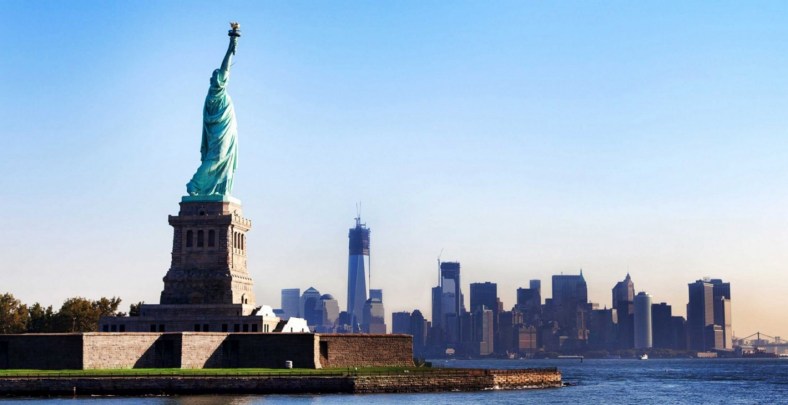
Most immigrants to the U.S. arrive by plane, bypassing the Statue of Liberty standing in New York harbor. Perhaps this detour has created a bit of amnesia regarding fundamental American values.

For the Friday poem this week, we travel back in time to 1883, when Emma Lazarus was asked to write a poem as part of fundraising effort to construct the pedestal for the statue.

Washington Post journalist Katie Mettler revisited Ms. Lazarus’ story on Wednesday, citing renewed interest in the sonnet in the aftermath of the executive order banning  U.S. entry to all Syrian refugees and citizens of seven Muslim countries

“What the poet didn’t know at the time — as a woman whose work as a “poetess” had been at times the subject of condescension — was that it would be her words, lyrical and poignant, that decades later came to define the American vision of liberty.

More than a century later, in 2017, the words are rallying people against a controversial president and his policies and attitudes toward immigrants.”

It’s time for these words to be posted at every point of entry to the U.S. to remind all of our core values.

The New Colossus 

Not like the brazen giant of Greek fame,
With conquering limbs astride from land to land;
Here at our sea-washed, sunset gates shall stand
A mighty woman with a torch, whose flame
Is the imprisoned lightning, and her name
Mother of Exiles. From her beacon-hand
Glows world-wide welcome; her mild eyes command
The air-bridged harbor that twin cities frame.
“Keep, ancient lands, your storied pomp!” cries she
With silent lips. “Give me your tired, your poor,
Your huddled masses yearning to breathe free,
The wretched refuse of your teeming shore.
Send these, the homeless, tempest-tost to me,
I lift my lamp beside the golden door!”

Emma Lazarus   ‘Emma Lazarus: Selected Poems and Other Writings’ (2002)

9781551112855-408x630.jpg


The Friday Poem ‘To The Indifferent Women’ by Charlotte Anna Perkins Gilman

On the eve of the ‘Women’s March’, the Friday Poem reprises ‘To The Indifferent Women’ by Charlotte Anna Perkins Gilman. I originally posted the poem in July after the first woman in U.S. history accepted her party’s nomination for president.

Sometimes things don’t work out as planned.

Tomorrow, in Washington D.C. and cities around the country, women will join together in a nation that could not ratify an equal rights amendment, or elect the first woman president, and remind those elected that women’s rights are human rights.

“In the spirit of democracy and honoring the champions of human rights, dignity, and justice who have come before us, we join in diversity to show our presence in numbers too great to ignore. The Women’s March on Washington will send a bold message to our new government on their first day in office, and to the world that women’s rights are human rights. We stand together, recognizing that defending the most marginalized among us is defending all of us.”

There is something going on here, as there was in 1911 when Ms. Perkins was writing for the cause of women’s rights.

One of the more stunning stories, in advance of the D.C. march, appears in today’s NY Times and profiles an unlikely activist contingent – ‘From Wall Street to National Mall: Women Overcome Fears to Attend March’.

“They are professionals in trading, public relations, marketing, deal-making, investing and the law. They keep punishing schedules, fear losing business by offending their clients and often feel that in an industry still overwhelmingly populated by men, the less attention drawn to their sex, the better.

But the inauguration of Mr. Trump has prompted a striking number of Wall Street women to overcome their worries about demonstrating in public.”

For those who will march and be questioned why, and for those still without weekend plans – a beautiful question from 1911.

“Do you believe the sorrow of the world
Does not concern you in your little homes?”

To The Indifferent Women

A Sestina

You who are happy in a thousand homes,
Or overworked therein, to a dumb peace;
Whose souls are wholly centered in the life
Of that small group you personally love;
Who told you that you need not know or care
About the sin and sorrow of the world?

Do you believe the sorrow of the world
Does not concern you in your little homes? —
That you are licensed to avoid the care
And toil for human progress, human peace,
And the enlargement of our power of love
Until it covers every field of life?

The one first duty of all human life
Is to promote the progress of the world
In righteousness, in wisdom, truth and love;
And you ignore it, hidden in your homes,
Content to keep them in uncertain peace,
Content to leave all else without your care.

Yet you are mothers! And a mother’s care
Is the first step toward friendly human life.
Life where all nations in untroubled peace
Unite to raise the standard of the world
And make the happiness we seek in homes
Spread everywhere in strong and fruitful love.

You are content to keep that mighty love
In its first steps forever; the crude care
Of animals for mate and young and homes,
Instead of pouring it abroad in life,
Its mighty current feeding all the world
Till every human child can grow in peace.

You cannot keep your small domestic peace
Your little pool of undeveloped love,
While the neglected, starved, unmothered world
Struggles and fights for lack of mother’s care,
And its tempestuous, bitter, broken life
Beats in upon you in your selfish homes.

We all may have our homes in joy and peace
When woman’s life, in its rich power of love
Is joined with man’s to care for all the world.

Charlotte Anna Perkins Gilman ‘Suffrage Songs and Voices’ 1911

41py0cnjwl-_sx331_bo1204203200_

Photo credit: Screen shot from Women’s March LA website


The Friday Poem “Hope” is the thing with feathers by Emily Dickinson

What do we have if we don’t have hope?

In December, U.S. First Lady Michelle Obama was interviewed by Oprah Winfrey. One of the most stunning, yet relatable, quotes concerned ‘hope’- the promise of her husband’s presidential campaign eight years ago.

“I think that we feel the difference now. See, now we’re feeling what not having hope feels like. 

“Hope is necessary. It’s a necessary concept, and Barack didn’t just talk about hope because he thought it was just a nice slogan to get votes.”

“What else do you have, if you don’t have hope? What do you give your kids if you can’t give them hope?”

The Friday poem this week is from the nineteenth century American poet, Emily Dickinson – because we all could use a little hope “perched in our soul” in this new year.

“Hope” is the thing with feathers

“Hope” is the thing with feathers –
That perches in the soul –
And sings the tune without the words –
And never stops – at all –

And sweetest – in the Gale – is heard –
And sore must be the storm –
That could abash the little Bird
That kept so many warm –

I’ve heard it in the chillest land –
And on the strangest Sea –
Yet – never – in Extremity,
It asked a crumb – of me.

Emily Dickinson ‘The Poems of Emily Dickinson’ edited by R.W. Franklin

9780674018242.jpg


The Friday Poem ‘Night Journey’ by Theodore Roethke

We will catch our breath if only we can make it to the holiday weekend. Rushing from work to catch the train, bus or plane we are singularly focused on our destination.

The Friday Poem this week comes from poet Theodore Roethke. ‘Night Journey’ from his ‘Collected Poems’ is a reminder to look out the window and take in the view.

“I stay up half the night. To see the land I love.”

“Poet and writer James Dickey once named Roethke the greatest of all American poets: “I don’t see anyone else that has the kind of deep, gut vitality that Roethke’s got. Whitman was a great poet, but he’s no competition for Roethke.”

The publication of Collected Poems in 1966 brought renewed interest in Roethke and prompted illuminating overviews of his work.”

Night Journey

Now as the train bears west,
Its rhythm rocks the earth,
And from my Pullman berth
I stare into the night
While others take their rest.
Bridges of iron lace,
A suddenness of trees,
A lap of mountain mist
All cross my line of sight,
Then a bleak wasted place,
And a lake below my knees.
Full on my neck I feel
The straining at a curve;
My muscles move with steel,
I wake in every nerve.
I watch a beacon swing
From dark to blazing bright;
We thunder through ravines
And gullies washed with light.
Beyond the mountain pass
Mist deepens on the pane;
We rush into a rain
That rattles double glass.
Wheels shake the roadbed stone,
The pistons jerk and shove,
I stay up half the night.
To see the land I love.

Theodore Roethke from ‘Theodore Roethke: Selected Poems’

411izrm4ull

The Friday Poem ‘Introduction to Poetry’ by Billy Collins

When I first started ‘workthoughts’ almost two years ago, I wanted to include a weekly poem or lyric. A colleague had once shared her secret of success@work, “I start my day reading a poem”.

I believe we all become a bit more creative when we discover the world through a poet’s eyes. Why don’t more of us include poetry in our work lives?

Former U.S. Poet Laureate Billy Collins shared his opinion in an interview to Ben Yakas of gothamist.com.

“…the teaching of poetry is often brutally centered on interpretation. This gives teachers power because they kind of “know the answer.” And I think there’s a streak of sadism in it as well as they watch students get the wrong answer by guessing.”

In October, Mr. Collins published his 12th book of poetry, ‘The Rain in Portugal’. The Friday Poem this week is from his first collection, ‘The Apple That Astonished Paris’, and is for all of you whose early love of poetry was extinguished by an overzealous pursuit of analysis.

Introduction to Poetry 

I ask them to take a poem
and hold it up to the light
like a color slide

or press an ear against its hive.

I say drop a mouse into a poem
and watch him probe his way out,

or walk inside the poem’s room
and feel the walls for a light switch.

I want them to waterski
across the surface of a poem
waving at the author’s name on the shore.

But all they want to do
is tie the poem to a chair with rope
and torture a confession out of it.

They begin beating it with a hose
to find out what it really means.

Billy Collins from ‘The Apple That Astonished Paris’ 1988

collins.png