‘Sending Flowers’ by Hannah Stephenson

On this Friday of Valentines weekend, a poem that celebrates the work of the florist, in a creative presentment of the vendor/customer relationship. The Friday Poem this week is ‘Sending Flowers’ by Hannah Stephenson.

Sending Flowers

The florist reads faces, reaches into the mouths of customers.
Turns curled tongues into rose petals,

teeth clinking against one another into baby’s breath.
She selects a cut bloom, a bit of leaf,

lays stem alongside of stem, as if building a wrist
from the inside. She binds them

when the message is right, and sighs at the pleasure
of her profession. Her trade:

to wrangle intensity, to gather blooms and say, here,
these do not grow together

but in this new arrangement is language. The florist
hands you a bouquet

yanked from your head, the things you could not say
with your ordinary voice.

Hannah Stephenson

‘Into the Lincoln Tunnel’ a poem by Deborah Garrison

The Friday Poem this week is for all the commuters who leave New Jersey every day and enter Manhattan via the Lincoln Tunnel. The poet, Deborah Garrison gives voice to the thoughts we sometimes entertain as passengers on a bus, in uncertain times, inhaling the fumes, the indigenous scent of New York Hudson crossings. “…please smile upon these good people who want to enter the city and work. Because work is good…”

Into the Lincoln Tunnel

The bus rolled into the Lincoln Tunnel,
and I was whispering a prayer
that it not be today, not today, please
no shenanigans, no blasts, no terrors,
just please the rocking, slightly nauseating
gray ride, stop and start, chug-a
in the dim fellowship of smaller cars,
bumper lights flickering hello and warning.
Yes, please smile upon these good
people who want to enter the city and work.
Because work is good, actually, and life is good,
despite everything, and I don’t mean to sound
spoiled, but please don’t think I don’t know
how grateful I should be
for what I do have —

I wonder whom I’m praying to.
Maybe Honest Abe himself,
craggy and splendid in his tall chair,
better than God to a kid;
Lincoln whose birthday I shared,
in whom I took secret pride: born, thus I was,
to be truthful, and love freedom.

Now with a silent collective sigh
steaming out into the broken winter sun,
up the ramp to greet buildings, blue brick
and brown stone and steel, candy-corn pylons
and curving guardrails massively bolted and men
in hard hats leaning on resting machines
with paper cups of coffee —

a cup of coffee, a modest thing to ask
Abe for,
dark, bitter, fresh
as an ordinary morning.

Deborah Garrison   ‘The Second Child’   Random House, 2008

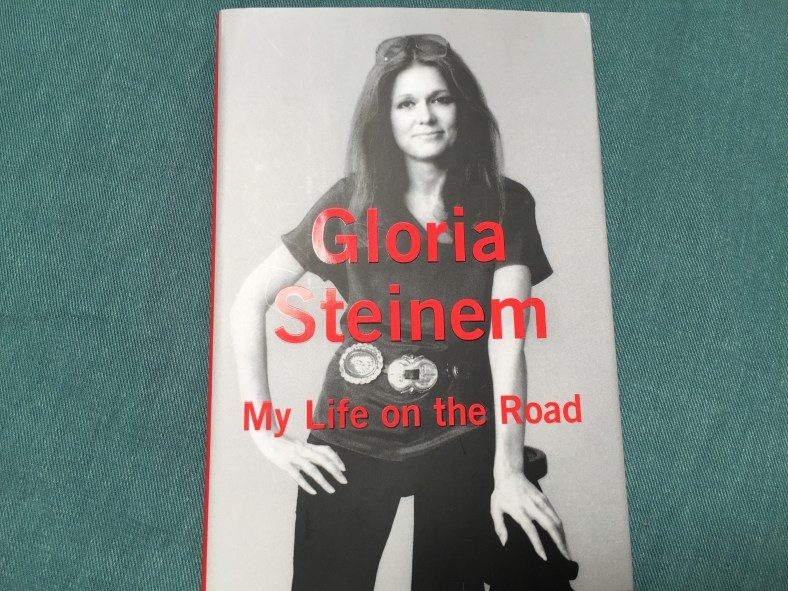
The Saturday Read ‘My Life on the Road’ by Gloria Steinem

The Saturday Read this week comes from an author who describes herself as “an entrepreneur of social change”.  It’s a work identity that encompasses writer. lecturer, political activist and feminist organizer. For this book, ‘My Life on the Road’, Gloria Steinem shares “the most important, longest-running, yet least visible part of my life”.

In the introduction, Ms. Steinem expresses her hope that her example of life on the road will tempt readers to explore the country – to have “an on the road state of mind and be present with all five senses.” 

“After I joined the ranks of traveling organizers – which just means being an entrepreneur of social change – I discovered the magic of people telling their own stories to groups of strangers. It’s as if attentive people create a magnetic force field for stories the tellers themselves didn’t know they had within them. Also, one of the simplest paths to deep change is for the less powerful to speak as much as they listen, and for the more powerful to listen as much as they speak.

One of these stories opens the book and involves a group of women arriving in South Dakota for a Lakota Sioux powwow, and a subsequent encounter at breakfast, with a couple attending one of the largest annual biker rallies in the country.

“I tell you this story because it’s the kind of lesson that can be learned only on the road. And also because I’ve come to believe that, inside, each of us has a purple motorcycle.

We only have to discover it and ride.”

The book is best read as a series of short stories, with each chapter offering a clue to Ms. Steinem’s own ‘purple motorcycle’ adventure.

In the chapter, ‘One Big Campus’ she describes the places where she has spent “the single largest slice of my traveling pie..”, from the early days of draft protests through through efforts to diversify curricula.

“How do I love campuses? Let me count the ways. I love the coffee shops and reading rooms where one can sit and talk or browse forever. I love the buildings with no addresses that only the initiated can find, and the idiosyncratic clothes that would never make it in the outside world. I love the flash parties that start in some odd spot and can’t be moved , and the flash seminars that any discussion can turn into. I love the bulletin boards that are an education in themselves, the friendships between people who would never have otherwise met, and the time for inventiveness that produces say, an exercise bike that powers a computer. Most of all I love graduations. They are individual and communal, an end and a beginning, more permanent than weddings, more inclusive than religions and possibly the most moving ceremonies on earth.”

She closes the chapter with an affirmation that the Internet is not enough and offers an argument for the value of college.

“…we need to keep creating the temporary world of meetings, small and large, on campuses and everywhere else. In them, we discover we are not alone, we learn from one another, and so we keep going toward shared goals.”

This is the narrative of a traveler who has discovered that home and the road are equally important.

“I can go on the road – because I can come home. I come home – because I am free to leave. Each way of being is more valued in the presence of the other. This balance between making camp and following the seasons is both very ancient and very new. We all need both.”  

And I believe she would like us all to venture beyond our address, be it physical or virtual.

“What seems to be one thing from a distance is very different close up.”  In reading ‘My Life on the Road’ what we might have perceived of Ms. Steinem in our rear view mirror, may appear a bit different, close-up.

After a 50 year absence, the humanities return to medicine

Medicine remains one of the fields that is defined by a hierarchy that would rival the world of Downton Abbey at its pinnacle. Over fifty years ago medical training lost track of the humanities and with it the ability to effectively connect with colleagues and patients as fellow humans.

The intensity of preparation for acceptance to a top medical school only deepens with competition for internships and residencies. Doctors in training represent the best and the brightest, but often not the top of the class when it comes to emotional intelligence.

At a time when college is increasingly defined as vocational prep, with students choosing majors based on perceived guarantees of post-grad employment, medicine is stepping back from its singular focus on the sciences and reintroducing the humanities to remove barriers created by hospital hierarchy, promote teamwork and improve patient communication.

Dr. Tara Narula, a medical contributor for CBS This Morning, reported Thursday on a program in Boston that “teaches physicians in training to use their eyes and ears to connect with patients and enhance the practice of medicine.”

“At the Brigham and Women’s Hospital, doctors, nurses and Harvard medical students are helping reshape medical education. By day, members of the integrated teaching unit, or ITU, focus on treating patients. But at night, they fix their sights on works of art.

At the Museum of Fine Arts in Boston, art becomes a catalyst to strengthen clinical and interpersonal skills, softening the hard science of medicine with creative expression.

Dr. Joel Katz designed the art curriculum at Brigham and Women’s, which has become a model for other hospitals.

Katz chose the art museum because it “allows everybody to focus on an external object in a way that I would say takes the personal aspects out and lets them solve problems together.”

Activities are carefully designed to enhance team-building, and to break down the hospital hierarchy, junior staff members are paired with more senior colleagues. Observing and describing art is used to promote problem solving, communication, thinking outside the box and appreciating other perspectives.”

Increasingly, schools of medicine are recognizing the need to ‘humanize’ medical practitioners, including Columbia University’s program in Narrative Medicine and Stanford University’s Medicine and the Muse program. And a quick review of the best seller lists over the past decade, will reveal an impressive list of physicians who have exercised their talents in the humanities: Adam Verghese, Atul Gawande, Oliver Sachs, Siddhartha Mukherjee, and this month, Paul Kalanithi.

“With this program, Dr. Joel Katz hopes to find some of the human interaction that has been lost in medicine.

In fact, as recently as 50 years ago, humanities were at the core of medical practice. While research into this program’s effects is still ongoing, there is strong anecdotal evidence that both patients and practitioners benefit.”


The week@work – issues that will shape the world in 2016, positive forecast on salary growth, George R.R. Martin misses a deadline and why we should focus on our ‘already done’ list

The past week@work marked the transition from the old year to the new. We have seen the last of the ‘best and worst of the year’ in every imaginable category and it’s time to turn our attention to the future. Here’s the problem; global issues, work issues, customer issues and career issues don’t magically resolve themselves at the stroke of midnight on 12/31.

What the new year does provide is a demarcation point in time, to set aside previous solutions and reimagine innovative answers. We have permission to start anew.

Rose Pastore offers a list of ’10 Issues That Will Shape the World In 2016′. Recognizing the continuum of events from the old year to the new – “The end of 2015 leaves many of the year’s most significant issues still very much in flux, including the reform of U.S. gun control laws, the fates of thousands of Syrian refugees, and the legal status of massive startups like Uber and Airbnb.”

Some of these issues seem so beyond our everyday lives that it may be hard to grasp a connection to our work and workplace. But somewhere, a diplomat, an entrepreneur, an educator or a student may seize the moment, and solve one piece of the puzzle, in one of our multiple global challenges: “the refugee crisis, climate change, data security, gun violence, social justice and regulating the sharing economy.” 

Don Lee reported on the view that salaries will increase in 2016, driven by the decrease in unemployment and the implementation of new minimum wage laws in a number of states.

“American workers are poised in 2016 to finally get what they’ve been missing for years: higher salaries.

…worker wages will get an additional boost from higher minimum wages taking effect in a number of cities and states. California’s new minimum pay goes to $10 an hour in January. The increase will amount to an 11% pay raise for Marco Ruiz, a carwash worker in Anaheim who earns $9 an hour.

That’s an additional $40 a week, more than enough to cover Ruiz’s bus fare to his job from his home in Norwalk, which he rents with his brother-in-law. “It’s marvelous,” said the divorced 35-year-old, who started at the carwash eight years ago making $7.50 an hour, the state’s minimum wage then.

Like Ruiz, most people in the U.S. already feel more secure in their jobs. As layoffs have receded sharply, weekly filings for new jobless benefits have fallen this year to numbers not seen since the early 1970s. And Gallup polls show workers’ “complete satisfaction” with job security rose to a 15-year high in summer 2014. Their overall satisfaction with pay, however, hasn’t returned to prerecession levels. In fact, many workers still feel that the recovery from the Great Recession passed them by.”

Early Saturday morning, author George R.R. Martin posted his admission, “THE WINDS OF WINTER is not finished.”

The year ended and the author of the series, ‘A Song of Ice and Fire’, publicly announced he had missed a deadline and gave us a glimpse of his creative process.

“Believe me, it gave me no pleasure to type those words. You’re disappointed, and you’re not alone. My editors and publishers are disappointed, HBO is disappointed, my agents and foreign publishers and translators are disappointed… but no one could possibly be more disappointed than me. For months now I have wanted nothing so much as to be able to say, “I have completed and delivered THE WINDS OF WINTER” on or before the last day of 2015.

But the book’s not done.

Nor is it likely to be finished tomorrow, or next week. Yes, there’s a lot written. Hundreds of pages. Dozens of chapters. (Those ‘no pages done’ reports were insane, the usual garbage internet journalism that I have learned to despise). But there’s also a lot still left to write. I am months away still… and that’s if the writing goes well. (Sometimes it does. Sometimes it doesn’t.) Chapters still to write, of course… but also rewriting. I always do a lot of rewriting, sometimes just polishing, sometimes pretty major restructures.”

Alison Flood of The Guardian reported on the response from readers and fans.

“This time, though, Martin’s readers were quick to encourage him, with the more than 1,000 comments on his blog ranging from “Love your work, George! Get it done when it’s done. I’ll be there” to “Don’t sweat it, George” and “Take as long as you need to, sir”.

“That couldn’t have been fun to write,” wrote one reader in response to Martin’s blog. “But fact is in 50 years readers will judge on the book’s quality and not if they met some arbitrary deadline and beat the TV adaptation. As much as I’d like to see it released soon, I ultimately approve of the priority on quality.”

For all of you who have started the new year with a missed deadline, consider the lesson here. It’s impossible to live without failure. Even the most successful fail. It’s the next step in the lifelong learning process that matters, and that might be the most important thought to hold in the new year.

Minda Zetlin offers some timely practical advice, that George R. R. Martin might consider ‘Five Reasons You Should Make an Already-Done List Right Now’.

“…if you want to feel motivated, set that to-do list aside, and make a list of what you’ve already accomplished instead.

That advice comes from best-selling author and executive coach Wendy Capland. A while back, I wrote a column from an interview with Capland and as a follow-up we decided she would coach me and that I would write about it. These coaching sessions come with homework, and one recent assignment was to make a list of all the things I had already done​ to advance toward my most ambitious goals. It was something I’d never done before, and it was a revelation.”

Perhaps the best advice is to start the year with an accomplishments audit, focusing on the strengths derived from your success (and failure) and build on that foundation @work in the new year.


Holiday Homework: Write your story

It’s the holiday season and you have one assignment to complete before the New Year begins – write your story.

During the Thanksgiving holiday I encouraged readers to participate in the Story Corps ‘Great Thanksgiving Listen’, conducting interviews  with relatives to capture the oral history narrative of America.

This week’s challenge is about you; to think about your life as it has evolved to this point, highs and lows, and write a short story, your story.

Before you craft your resume, schedule a meeting with a networking contact or head to an interview, you need a story; the narrative of how you arrived at this point in your life and career.

The end goal is to collect as much information about your past before you open your laptop and begin to browse resume formats. Most folks make the mistake of finding a template and relating their story via someone else’s outline. That doesn’t mean that there aren’t acceptable resume formats. It does mean that it’s premature to begin with the resume before you have considered the narrative you wish to convey.

Storytelling has become the latest marketing approach adopted by entrepreneurs to Fortune 500 CEOs. Google ‘storytelling’ and the initial search results will reflect current business practice vs. writers working on the great American novel or the hottest new screenplay.

Here’s the thing. If the folks you hope to work with are employing storytelling to advance their business goals, it may be time for you to practice your skill.

Buried in the list of google results is a link to an Atlantic.com video, ‘George Saunders Explains How To Tell A Good Story’. It’s one of the most viewed videos of the year, which may provide another hint to why you should take seven minutes out of your life this week and watch.

Let’s pause a minute to address all of you who have gotten to this point and are stressed because all you wanted was a few words on how to write a resume in ten seconds.

Nothing of quality results from ten seconds of effort. And this is your life, eight to ten hours of every five days of seven.

Back to George Saunders.

“A story is kind of a black box, you’re going to put the reader in there, she’s going to spend some time with this thing that you have made and when she comes out, what’s going to have happened to her in there is something kind of astonishing. It feels like the curtain’s been pulled back and she’s gotten a glimpse into a deeper truth…

As a story writer, that’s not as easy as it sounds..”

It’s not easy to tell your story. There’s a lot of stuff that in the end may have no relevance to your job search. But it’s important to conduct an annual rewrite to update and adapt your original script.

Let’s borrow a term from the screenwriters and suggest you are developing a draft ‘treatment’ before you write a resume, network and interview.

Micki Grover defines and describes how this summary of a story fits into the screenwriting process.

“All we’re talking about is a short document written in prose form and in the present tense that emphasizes, with vivid description, the major elements of a screenplay. Yes, treatments are actually written in prose! The essence of the story and the characters should be evoked through exhilarating language and imagery.

Treatments have a style of their own just as screenplays do, and they too take time to master. Writers who swear by using treatments find that it’s a fun outlet to write with a voice that screenplays and synopses sometimes constrain. The ultimate goal is simply to tell your story in an engaging way, as if you were passionately telling your best friend about a new script over coffee.”

That’s your holiday assignment. Develop a ‘treatment’ that tells your story in an engaging way, connecting the dots and inviting an audience who may be interested in promoting your talent.


The Saturday Read – a selection of the best articles of 2015 from Jon Ronson, Oliver Sacks, Kathryn Schulz and Nikil Saval

This week the recommendations for ‘The Saturday Read’ come from journalists who wrote some of the most popular long form articles of the year. Instead of a book, which might seem daunting in the midst of holiday shopping and celebrating, sample the writings of these four storytellers who tackled a range of topics including internet shaming, death, earthquakes and the origins of the white collar worker.

On Wednesday, ‘The Upshot’ covered ‘The Stories That Held You The Longest in 2015’. “We measured the favorite Times articles of 2015 in a new way — by the total combined time readers have spent looking at them. It’s a mix of ambitious investigative projects, big breaking news, features and service journalism.”

Number two on the list first appeared in the February 12, 2015 New York Times Magazine. Written by Jon Ronson, ‘How One Stupid Tweet Blew Up Justine Sacco’s Life’ tells the story of the world of public ‘internet shaming’ through the experience of its victims.

15sacco1-master1050-v3

“In the early days of Twitter, I was a keen shamer. When newspaper columnists made racist or homophobic statements, I joined the pile-on. Sometimes I led it…

Still, in those early days, the collective fury felt righteous, powerful and effective. It felt as if hierarchies were being dismantled, as if justice were being democratized. As time passed, though, I watched these shame campaigns multiply, to the point that they targeted not just powerful institutions and public figures but really anyone perceived to have done something offensive. I also began to marvel at the disconnect between the severity of the crime and the gleeful savagery of the punishment. It almost felt as if shamings were now happening for their own sake, as if they were following a script.”

Number ten on the list was an Op-Ed piece by neurologist and writer, Oliver Sachs, ‘My Own Life’, on learning he had terminal cancer.

19sacks-copy-blog427-v6

“Over the last few days, I have been able to see my life as from a great altitude, as a sort of landscape, and with a deepening sense of the connection of all its parts. This does not mean I am finished with life.

On the contrary, I feel intensely alive, and I want and hope in the time that remains to deepen my friendships, to say farewell to those I love, to write more, to travel if I have the strength, to achieve new levels of understanding and insight.

This will involve audacity, clarity and plain speaking; trying to straighten my accounts with the world. But there will be time, too, for some fun (and even some silliness, as well).”

A New Yorker article received a lot of attention when it first appeared in July. ‘The Really Big One’ was researched and written by contributor, Kathryn Schulz.

150720_r26752-320

“Most people in the United States know just one fault line by name: the San Andreas, which runs nearly the length of California and is perpetually rumored to be on the verge of unleashing “the big one.” That rumor is misleading, no matter what the San Andreas ever does. Every fault line has an upper limit to its potency, determined by its length and width, and by how far it can slip. For the San Andreas, one of the most extensively studied and best understood fault lines in the world, that upper limit is roughly an 8.2—a powerful earthquake, but, because the Richter scale is logarithmic, only six per cent as strong as the 2011 event in Japan.

Just north of the San Andreas, however, lies another fault line. Known as the Cascadia subduction zone, it runs for seven hundred miles off the coast of the Pacific Northwest, beginning near Cape Mendocino, California, continuing along Oregon and Washington, and terminating around Vancouver Island, Canada. The “Cascadia” part of its name comes from the Cascade Range, a chain of volcanic mountains that follow the same course a hundred or so miles inland. The “subduction zone” part refers to a region of the planet where one tectonic plate is sliding underneath (subducting) another. Tectonic plates are those slabs of mantle and crust that, in their epochs-long drift, rearrange the earth’s continents and oceans. Most of the time, their movement is slow, harmless, and all but undetectable. Occasionally, at the borders where they meet, it is not.”

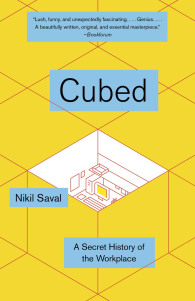
Longreads.com selected their ‘Best of 2015’ which included an excerpt from the book, ‘Cubed: A Secret History of the Workplace’. The fifth most popular article was ‘I Would Prefer Not To: The Origins of the White Collar Worker’, written by Nikil Saval.

9780345802804-1.jpg

“When does the office begin? It’s a question without an easy answer. One can associate the origins with the beginning of paperwork itself—until recently, the most common mental association with office work (think of the derogatory phrase “paper pusher”). In other words, since the invention of writing and the corresponding ability to keep records in a systematic manner, there have always been places that resemble offices: monasteries, libraries, scholars’ studies. Banking furnished an especially large amount of paperwork; the Uffizi, an incomparable gallery of Renaissance art in Florence, was also one of the first office buildings—the bookkeeping offices of the Medici family’s groundbreaking financial operations. Clerks, too, have existed for ages, many of them unclinching themselves from their desks to become quite famous: from Samuel Pepys, the British government diarist who reported on the gossipy world of seventeenth-century England, to Alexander Hamilton, who had cut his teeth as a merchants’ clerk before he became the first secretary of the Treasury of the United States; Benjamin Franklin, paragon of pecuniary restraint and bourgeois self-abnegation, started out as a dry goods clerk in 1727. Perhaps some of the tediousness of Franklin’s own writing was honed in the conditions of his first job: since clerks have had the opportunity to keep diaries, they have bemoaned the sheer boredom of their tasks—the endless copying, the awkward postures, the meaninglessness of their work. When not doing writing for the job, clerks have cultivated the habit of writing about the job—or literally around it…”


The week@work – Mark Zuckerberg writes a letter, equality comes to combat, 20 predictions/20 years, the November jobs report and terrorism@work

This week@work was dominated, until mid-week, by the story of the ‘Chan Zuckerberg initiative’ to set aside 99% of their Facebook wealth, and overshadowed a major shift in policy within the Pentagon, opening all combat jobs to women, without exception. The November jobs report continued the positive trajectory of the economy with the revision upward of September and October numbers. And the editor of Fast Company Magazine offered ‘Twenty Predictions for the Next Twenty Years’.

All of those stories pale in comparison to the return of terrorism to the workplace at a holiday party at 11 AM on Wednesday in San Bernardino, California.

Mark Zuckerberg wrote a letter to his new daughter and lots of attention was paid to the section on sharing his wealth.  Carmine Gallo of Forbes took closer look and noted that the letter read like a great speech.

“As you’ve probably read by now Facebook founder Mark Zuckerberg and his wife Priscilla Chan welcomed a daughter into the world in a very big way – with the creation of a new initiative to donate 99% of their Facebook shares ($45 billion currently) to philanthropy. That’s the headline. I was struck, however, by how the open letter to their daughter read more like a speech than a letter. It was meant for the eye…and the ear. It was meant to inspire a generation to commit itself to giving and to making the world a better place.

“Like all parents, we want you to grow up in a world better than ours today,” the letter begins. Read aloud at an average speaking pace, the 2,200-word letter takes about twelve minutes to recite, the ideal amount of time for a good speech (many of the most notable speeches in recent history clock in at 15 minutes or less).

Zuckerberg’s hope for his daughter’s generation provides the theme of the letter, a headline that fits into one short sentence. In bold letters, Zuckerberg writes:

“Advancing human potential and promoting equality.”

Amanda Platell of The Daily Mail offered an alternate version.

“Let’s start with the ‘friends’ you may have on Facebook. Do not confuse them with the friends you should trust in the real world. Many will barely know you, plenty may be jealous, others will be insincere and spiteful…

If I have learned anything from running Facebook, it’s that there is no such thing as privacy any more. After all, that’s how I made our billions!

Come to think of it, perhaps we won’t give you a computer until you’re 18, just to be safe. Love, Dad.”

On Thursday the Dan Lamothe reported on the groundbreaking change in staffing policy at the Pentagon.

“Defense Secretary Ashton B. Carter said Thursday that he is opening all jobs in combat units to women, a landmark decision that would for the first time allow female service members to join the country’s most elite military forces.

Women will now be eligible to join the Navy SEALs, Army Special Forces and other Special Operations Units. It also opens the Marine Corps infantry, a battle-hardened force that many service officials had openly advocated keeping closed to female service members.

“There will be no exceptions,” Carter said. “This means that, as long as they qualify and meet the standards, women will now be able to contribute to our mission in ways they could not before.”

Robert Safian, the editor-in-chief of Fast Company magazine marked the twentieth anniversary of the publication with ‘Twenty Predictions for the Next Twenty Years’.

“We celebrate birthdays to remember all that has gone before, and also what is to come. This month, with issue No. 201, we recognize Fast Company’s 20th anniversary by looking toward the future. The dynamic change of the past two decades is just a warm-up for what is still to come.

I have used the phrase Generation Flux to describe this era of transition. Because the changes are coming so fast, there is a rising premium on our ability to adjust, to be adaptable in new ways. This can be scary for some, but it is also undeniably exciting, and for those prepared to embrace this emerging reality, the possibilities are tantalizing.

What follows are 20 observations that we believe will hold fast in the years ahead. They are predictions and, as such, are fraught with limitation and supposition. None of them, on their own, is shocking. That is by design. In combination, though, they outline a world of tomorrow where work is still personal, computing is still social, and knowledge is still power. And where the rules for success will be ever-changing.”

Bouree Lam covered the optimistic economic report from the Labor Department on Friday.

“The November jobs report is out, and it’s meeting what were moderately high expectations. The figures from the Labor Department show that the unemployment rate remained at 5 percent and the economy added 211,000 jobs in November. Jobs were added in construction, health care, and “professional and technical services”—the Labor Department’s term for an assortment of white-collar jobs. Among those, the construction sector showing particularly strong growth, adding 46,000 jobs.”

On Wednesday morning a group of colleagues went to work at the Inland Regional Center in San Bernardino, California. As they were taking a break, preparing for a holiday celebration, one of their team and his wife, both heavily armed, entered the room and changed lives forever.

In 2014 there were 404 workplace homicides, 80% were shootings. The ‘mass shooting’ in San Bernardino was the fourth of this year.

Yesterday the editors of The New York Times published an editorial on the front page of the paper, ‘End the Gun Epidemic in America’.

I’m done with the retailers who give away guns to the first 200 customers on Black Friday. And I’m not comfortable with my cubicle mates carrying weapons to work. The workplace is a place to create, engage and perhaps follow a dream. Fear and hostility have never been a productive part of life @work. The last time leading by fear worked was in the mid-20th century Catholic grammar school classroom.

“It is a moral outrage and a national disgrace that civilians can legally purchase weapons designed specifically to kill people with brutal speed and efficiency. These are weapons of war, barely modified and deliberately marketed as tools of macho vigilantism and even insurrection. America’s elected leaders offer prayers for gun victims and then, callously and without fear of consequence, reject the most basic restrictions on weapons of mass killing, as they did on Thursday. They distract us with arguments about the word terrorism. Let’s be clear: These spree killings are all, in their own ways, acts of terrorism.”

On March 4, 1933 newly elected President Franklin Roosevelt delivered his inaugural address. The familiar phrase, “…the only thing we have to fear is fear itself..” has been whispering from the back of my mind since Wednesday and I think it’s particularly relevant to our political conversation today.

“This is preeminently the time to speak the truth, the whole truth, frankly and boldly. Nor need we shrink from honestly facing conditions in our country today. This great Nation will endure as it has endured, will revive and will prosper. So, first of all, let me assert my firm belief that the only thing we have to fear is fear itself—nameless, unreasoning, unjustified terror which paralyzes needed efforts to convert retreat into advance. In every dark hour of our national life a leadership of frankness and vigor has met with that understanding and support of the people themselves which is essential to victory. I am convinced that you will again give that support to leadership in these critical days.”


The Saturday Read – Gift a book this holiday season

One of the best presents one can give or receive is a book. #ShopSmall today and visit your local bookseller to find the perfect gift for everyone on your holiday list.

Let’s start with a client or your boss, two challenging categories for gift giving. You could go with a bottle of wine, chocolates, fruit basket or Starbucks card. But that’s what they’ll get from your competitors and colleagues. If you want to stand out and demonstrate, in a very tangible way, that you’ve been listening when they talk about their interests outside of work, a book just may be the way to make a connection. And I’m not talking about the latest business best seller.

Former Seattle librarian and current NPR commentator, Nancy Pearl has written a series of ‘Book Lust’ books recommending current and back list titles for “every mood, moment or reason and travelers, vagabonds and dreamers”. Her suggestions sample the catalog of titles published since 1960, so you will no doubt rediscover some gems to twinkle under the tree.

Create a list of folks @work. Then make a few notes about each and their interests. Visit an independent bookseller today, #SmallBusinessSaturday, and ask for suggestions. Often the best books of the year will never make The New York Times bestseller list, so you will need a little help from someone whose life is about books.

Barnes and Noble, Amazon and Costco don’t count. For the important task of matching books with colleagues and clients, you need the expertise of someone invested in presenting a diversity of titles.

“Independent bookstores never had to answer to the dictates of public markets. Many of their proprietors understood, intuitively and from conversations with customers, that a well-curated selection—an inventory of old and new books—was their primary and maybe only competitive advantage. In the words of Oren Teicher, CEO of the American Booksellers Association, “The indie bookselling amalgam of knowledge, innovation, passion, and business sophistication has created a unique shopping experience.”

Some may think a book is a risky gifting proposition. The risk lies only in not  paying attention and failing to seek out help from experts. Take some time today to shop on Main Street and pick up a few books for the holidays.

“Books make great gifts because they have whole worlds inside them, and it’s much cheaper to buy somebody a book than it is to buy them the whole world.” Neil Gaiman


#TheGreatListen 2015

What if you could capture a generation of American lives and experiences in one holiday weekend? That’s the vision of StoryCorps founder, Dave Isay, and he plans to fulfill his mission this Thanksgiving weekend through a combination of an app and an educators toolkit to enable DIY interviews to gather the wisdom of others. It’s the #GreatThanksgivingListen and you are invited to attend.

StoryCorps recently celebrated twelve years of conducting and recording oral history interviews, beginning with a booth in New York’s Grand Central Station and later taking the booth on the road to all 50 states creating the largest single collection of human voices ever gathered. The next step is to grow the archive of 100,000 to tens of thousands.

Dave Isay and his organization are the recipients of the 2015 TED Prize, and it was in his presentation to the annual conference in April that he outlined his proposal for a “national homework assignment”.

Here’s the plan. Download the app, select ‘helpful hints’ for a short tutorial. Select ‘browse’ to view previous StoryCorps recordings. Go to ‘my interviews’ to outline and record your interview. You can choose  from a list of sample questions by categories. Next step –  record!

“Who are they? What did they learn in life? How would they like to be remembered?”

And here’s the magical part. You can keep your recording for yourself or opt to upload it to the StoryCorps archive at the American Folklife Center at the Library of Congress. Imagine the story of your family intertwined with other American voices building upon a historical record of their time.

In his April TED talk, Isay described the power of “…everyday people talking about lives lived with kindness, courage, decency and dignity…it sometimes feels like you are walking on holy ground…”

If you believe that you learn from the wisdom of others, this holiday offers an opportunity to join “…a global movement to record and preserve meaningful conversations with one another that results in an ever growing digital archive of the collective wisdom of humanity.”