‘To Inez Milholland’ a poem by Edna St. Vincent Millay

On this last day of March, the Friday Poem is ‘To Inez Milholland’ by Edna St. Vincent Millay; reminding us to “to take up the song; forget the epitaph”.

In 1987 Congress designated March as Women’s History Month. Thirty years later, the month has not been a good one for women, with one bright exception. On March 23 the State of Nevada ratified the Equal Rights Amendment, thirty-five years after the 1982 deadline set by Congress.

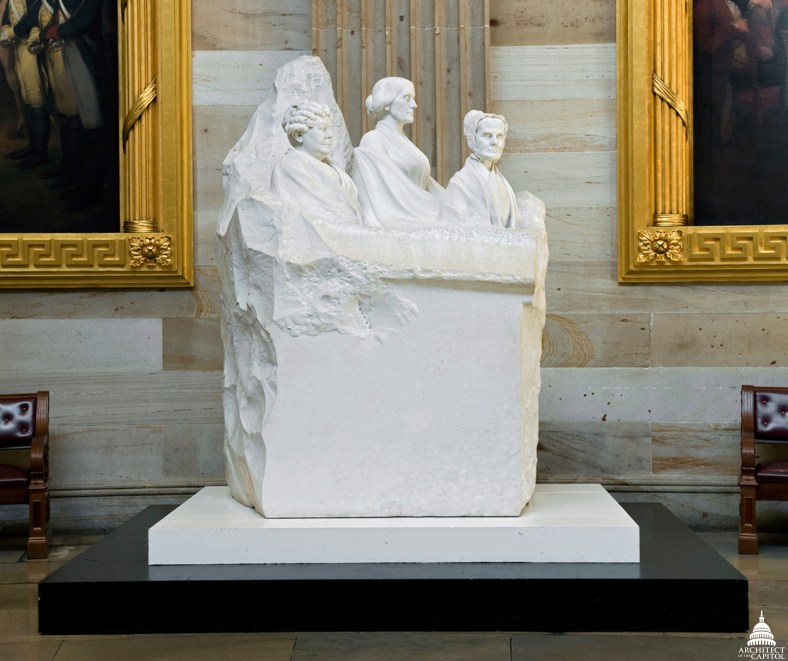
March is also the time of year that hundreds of U.S. school children visit Washington D.C. and traverse the Capitol rotunda. For many it’s their first encounter with the history of the women’s suffrage movement, as they pass the portrait monument to Lucretia Mott, Elizabeth Cady Stanton and Susan B. Anthony.

Missing from the statue is Inez Milholland Boissevain. “A rare woman, she earned a Law degree at NYU and promptly became involved with the labor strikes of the Women’s Garment Workers and the Triangle Shirtwaist factory struggle. Throughout her life, Inez worked and fought for the underrepresented and the oppressed.”

In 1916, Inez was on a cross country campaign in support of a federal suffrage amendment when she collapsed and died while delivering a speech in Los Angeles. Her last public words, “Mr. President, How Long Must Women Wait for Liberty?”

On Sunday, November 18, 1923 a ceremony was held in the Capitol to commemorate the 75th anniversary of the women’s rights movement. Poet Edna St. Vincent Millay Boissevain (yes, she married Inez’ widower) was part of the group of 200 women who participated in the event. The day before they had presented proposed new legislation, written by Alice Paul to the president – The Equal Rights Amendment.

“The “poem” that Edna read is the sonnet “The Pioneer,” which encouraged women to continue to fight for equal rights. It is unclear if Edna wrote the lines about Anthony, Stanton, and Mott (the pioneers in the marble statue) or about Inez — or about all of them. However, by 1928, Edna had retitled the sonnet “To Inez Milholland.”

To Inez Milholland

Upon this marble bust that is not I
Lay the round, formal wreath that is not fame;
But in the forum of my silenced cry
Root ye the living tree whose sap is flame.
I, that was proud and valiant, am no more; —
Save as a wind that rattles the stout door,
Troubling the ashes in the sheltered grate.
The stone will perish; I shall be twice dust.
Only my standard on a taken hill
Can cheat the mildew and the red-brown rust
And make immortal my adventurous will.
Even now the silk is tugging at the staff:
Take up the song; forget the epitaph.

Edna St. Vincent Millay 1923

Three additional links of interest @the end of Womens History Month

‘A Trove on the Women’s Suffrage Struggle, Found in an Old Box’ The New York Times, March 29, 2017

New York Historical Society Center for Women’s History

Inez Milholland ‘Forward Into the Light’

The week@work – the war for talent, following vs. leading, exhaustion, and maybe we should ask a sociologist

The last state to approve the Equal Rights Amendment to the Constitution was Indiana in 1977 – until Thursday when Nevada ratified the ERA, thirty-five years after the deadline imposed by Congress. It was a welcome antidote to the White House photo of the freedom caucus taken the same day (above). Any odds on an extension to revisit and ratify?

“Nevada has given NOW President Terry O’Neill new cause for hope. “Now it’s a two-state strategy,” she tells the Times. “It’s very exciting. Over the past five years, Illinois and Virginia have come close. I think there is clear interest in this.

In other stories this week@work, journalists and experts provided an update on the ‘war for talent’, offered an argument for balancing followers with leaders in the workplace, and expressed concern with a ‘gig economy’ advertising campaign that seemed to glorify exhaustion@work.  The last story this week@work re-examined an idea from the 60’s to establish a Council of Social Advisers to complement the Council of Economic Advisers in D.C. “It’s not just work; it’s how work offers a sense of purpose and identity.”

Dr. Tomas Chamorro-Premuzic and Adam Yearsley believe ‘The War for Talent Is Over, And Everyone Lost’. They cite workplace trends indicating more passive job seekers, the appeal of self-employment and the lure of entrepreneurship as competitive factors for employers to attract the best and the brightest, and offer a few best practices to turn things around.

IMGP1335.JPG

“In 1998, after a year-long study on the subject, McKinsey researchers declared that a “war for talent” was underway. In the years ahead, they said, organizations’ future success would depend on how well they could attract, develop, and retain talented employees–an ever more valuable asset in ever higher demand.

Instead of winning a war for talent, organizations appear to be waging a war on talent, repelling and alienating employees more successfully than harnessing their skills.

Today, in a world full of many more Chief People and Chief Happiness Officers, that war nevertheless appears to have been lost on all sides. Of course, many workers excel in their jobs and make pivotal contributions to their organizations. But for every one employee who does, there are many more who are underemployed, underperforming, and just plain miserable at work.”

One of the employer prescriptions for success is to “stop developing people’s leadership skills”.

get_more_instagram_followers-compressed.jpg

“…research suggests there’s a strong negative correlation between the amount of money spent on leadership development (which in the U.S. totals over $14 billion a year), and people’s confidence in their leaders. One of the reasons is that leaders are often deprived of negative feedback, even in training programs. We’ve gotten so used to coaching to people’s strengths that weaknesses get left unaddressed. The basics of human psychology magnify that issue; people are already prone to judging their own talents way too favorably, especially after experiencing a measure of success.”

Which links neatly into the next story of the week@work, Susan Cain‘s ‘Not Leadership Material? Good.The World Needs Followers.’

“Perhaps the biggest disservice done by the outsize glorification of “leadership skills” is to the practice of leadership itself — it hollows it out, it empties it of meaning. It attracts those who are motivated by the spotlight rather than by the ideas and people they serve. It teaches students to be a leader for the sake of being in charge, rather than in the name of a cause or idea they care about deeply. The difference between the two states of mind is profound. The latter belongs to transformative leaders like the Rev. Dr. Martin Luther King Jr. and Gandhi; the former to — well, we’ve all seen examples of this kind of leadership lately.”

Jia Tolentino used Fiverr’s new ad campaign to illustrate ‘The Gig Economy Celebrates Working Yourself To Death’.

Tolentino-TheGigEconomyCelebratesWorkingYourselftoDeath-1145.jpg

“It does require a fairly dystopian strain of doublethink for a company to celebrate how hard and how constantly its employees must work to make a living, given that these companies are themselves setting the terms. And yet this type of faux-inspirational tale has been appearing more lately, both in corporate advertising and in the news. Fiverr, an online freelance marketplace that promotes itself as being for “the lean entrepreneur”—as its name suggests, services advertised on Fiverr can be purchased for as low as five dollars—recently attracted ire for an ad campaign called “In Doers We Trust.” One ad, prominently displayed on some New York City subway cars, features a woman staring at the camera with a look of blank determination. “You eat a coffee for lunch,” the ad proclaims. “You follow through on your follow through. Sleep deprivation is your drug of choice. You might be a doer.”

A Fiverr press release about “In Doers We Trust” states, “The campaign positions Fiverr to seize today’s emerging zeitgeist of entrepreneurial flexibility, rapid experimentation, and doing more with less. It pushes against bureaucratic overthinking, analysis-paralysis, and excessive whiteboarding.” This is the jargon through which the essentially cannibalistic nature of the gig economy is dressed up as an aesthetic.”

Maybe we need a few less economists and a few more humanists to address our life@work

There was a lot of discussion in the media this weekend in the wake of the health care bill defeat. What are the lessons learned? We might ask the same question about the November election result, only this time maybe we should be consulting with sociologists vs. economists. Neil Irwin asked “What if Sociologists Had as Much Influence as Economists?”.

“For starters, while economists tend to view a job as a straightforward exchange of labor for money, a wide body of sociological research shows how tied up work is with a sense of purpose and identity.

“Wages are very important because of course they help people live and provide for their families,” said Herbert Gans, an emeritus professor of sociology at Columbia. “But what social values can do is say that unemployment isn’t just losing wages, it’s losing dignity and self-respect and a feeling of usefulness and all the things that make human beings happy and able to function.

…the economic nostalgia that fueled Donald J. Trump’s presidential campaign was not so much about the loss of income from vanishing manufacturing jobs. Rather, it may be that the industrial economy offered blue-collar men a sense of identity and purpose that the modern service economy doesn’t.”

At the beginning of this new week@work consider where work fits in your sense of identity and purpose. It’s not just work.


The Friday Poem: ‘Today’ by Billy Collins

Spring arrived earlier this week. Time to take a break from your week@work and venture out beyond the confines of your work space. Cited by the Guardian as one of the ten best about spring, The Friday Poem is ‘Today’ by former Poet Laureate of the United States, Billy Collins.

“There is a delightful playfulness here – a sense of being, in spring, a mini-God within the kingdom of one’s own front room.”

Today
If ever there were a spring day so perfect,
so uplifted by a warm intermittent breeze

that it made you want to throw
open all the windows in the house

and unlatch the door to the canary’s cage,
indeed, rip the little door from its jamb,

a day when the cool brick paths
and the garden bursting with peonies

seemed so etched in sunlight
that you felt like taking

a hammer to the glass paperweight
on the living room end table,

releasing the inhabitants
from their snow-covered cottage

so they could walk out,
holding hands and squinting

into this larger dome of blue and white,
well, today is just that kind of day.

Billy Collins  Poetry Magazine, April 2000

176-1.jpg

The Friday Poem ‘Drowning the Shamrock’ by Frank Delaney

“How many Nobel Laureate does Dublin have? Four!” is the question posed and answered by the late author and broadcaster Frank Delaney in his poem for St. Patrick’s Day. If you’re one of the many who have often wondered why it’s OK to employ every imaginable stereotype of the Irish each March 17; this one’s for you.

The Friday Poem was composed for NPR’s Weekend Edition in 2012.

Mr. Delaney died last month in Connecticut.

“He had wanted to be a novelist since childhood, he said in a 2014 interview timed to coincide with the Dublin Writers Festival. “I’ve always relished the power of the tale,” he said, “how it grabs us and then absorbs us, and casts a spell over us, and teaches us.”

He was a radio and television reporter in Ireland; created the “Bookshelf” and “Word of Mouth” programs on BBC Radio and “The Book Show” on Sky News; and wrote “The Celts” for the BBC, the screenplay for the 2002 adaptation of “Goodbye, Mr. Chips,” the novel “Ireland” and nearly two dozen other fiction and nonfiction books, both in Britain and after moving to the United States in 2002.”

“Drowning the Shamrock” is Delaney’s irreverent “James Joyce-ian” take on St. Patrick’s Day, filled with Irish pride.”

Drowning the Shamrock

“Hail glorious Saint Patrick dear saint of our isle
On us thy poor children look down with a smile -”
But I’m not singing hymns and I’m not saying prayers
No, I’m gritting my teeth as I walk down the stairs
And into the street with these louts fiercely drinking
And screeching and lurching, and here’s what I’m thinking –
They’re using a stereotype, a narrow example,
A fraction, not even a marketing sample
To imitate Ireland, from which they don’t come!
So unless that’s just stupid, unless it’s plain dumb,
All these kids from New Jersey and the five boroughs
And hundreds of cities, all drowning their sorrows,
With bottles and glasses and heads getting broken
(Believe me, just ask the mayor of Hoboken)
All that mindlessness, shouting and getting plain stocious –
That isn’t Irish, that’s simply atrocious.
I’ve another word too for it, this one’s more stinging
I call it “racism.” See, just ’cause you’re singing
Some drunken old ballad on Saint Patrick’s Day
Does that make you Irish? Oh, no – no way.
Nor does a tee-shirt that asks you to kiss them –
If they never come back I surely won’t miss them
Or their beer cans and badges and wild maudlin bawling
And hammered and out of it, bodies all sprawling.

They’re not of Joyce or of Yeats, Wilde, or Shaw.
How many Nobel Laureates does Dublin have? Four!
Think of this as you wince through Saint Patrick’s guano –
Not every Italian is Tony Soprano.

Frank Delaney    NPR Weekend Edition – March 17, 2012


The Friday Poem ‘Happiness’ by Raymond Carver

Imagine a week@work when the barrage of beltway news is silenced. A workday morning that arrives, not with cable news, but a cup of coffee; taking in the view from the window as the neighborhood comes to life.

This was the scene imagined by the short story writer and poet, Raymond Carver.

The Friday Poem is ‘Happiness’.

Happiness

So early it’s still almost dark out.
I’m near the window with coffee,
and the usual early morning stuff
that passes for thought.
When I see the boy and his friend
walking up the road
to deliver the newspaper.
They wear caps and sweaters,
and one boy has a bag over his shoulder.
They are so happy
they aren’t saying anything, these boys.
I think if they could, they would take
each other’s arm.
It’s early in the morning,
and they are doing this thing together.
They come on, slowly.
The sky is taking on light,
though the moon still hangs pale over the water.
Such beauty that for a minute
death and ambition, even love,
doesn’t enter into this.
Happiness. It comes on
unexpectedly. And goes beyond, really,
any early morning talk about it.

Raymond Carver  Poetry Magazine February, 1985

145-5

The Friday Poem ‘Audition (The Fools Who Dream)’

It’s Oscar weekend and the Friday Poem selection comes from the soundtrack of this year’s Best Picture Nominee, ‘La La Land’. ‘Audition (The Fools Who Dream)’ is nominated for Best Original Song.

‘La La Land’ is a career story. ‘Audition’ is it’s anthem; a universal argument to pursue your dream, no matter how foolish it may seem.

In January, Elizabeth Flock interviewed composer Justin Hurwitz about “what it takes to compose an Oscar nominated song.”

“Hurwitz said he began composing “Audition,” back in 2011, after Chazelle had finished the screenplay for “La La Land.” But the musical stalled for years, as it struggled to get studio funding for a genre considered nearly extinct.

As Hurwitz composed what would become the final version of “Audition,” he thought carefully about the shape of the scene, which begins with Mia telling the casting agents about her aunt, and then transitions to a tribute to all dreamers. The second stanza of the song begins: “She smiled / Leapt, without looking / And She tumbled into the Seine!” while the third starts very differently: “Here’s to the ones / who dream / Foolish, as they may seem.”

“It switches from ‘she’ to ‘we,’ and I thought that was a brilliant and beautiful switch in the lyrics,” said Hurwitz, which he wanted reflected in the larger shape of the song.”

Audition (The Fools Who Dream)

My aunt used to live in Paris.
I remember, she used to come home and tell us these stories about being abroad and I remember she told us that she jumped into the river once, barefoot.

She smiled…

Leapt, without looking
And tumbled into the Seine
The water was freezing
She spent a month sneezing
But said she would do it again

Here’s to the ones who dream
Foolish as they may seem
Here’s to the hearts that ache
Here’s to the mess we make

She captured a feeling
Sky with no ceiling
The sunset inside a frame

She lived in her liquor
And died with a flicker
I’ll always remember the flame

Here’s to the ones who dream
Foolish as they may seem
Here’s to the hearts that ache
Here’s to the mess we make

She told me:
“A bit of madness is key
To give us new colors to see
Who knows where it will lead us?
And that’s why they need us”

So bring on the rebels
The ripples from pebbles
The painters, and poets, and plays

And here’s to the fools who dream
Crazy as they may seem
Here’s to the hearts that break
Here’s to the mess we make

I trace it all back to then
Her, and the snow, and the Seine
Smiling through it
She said she’d do it again

Composer Justin Hurwitz, Lyricists Benj Pasek and Justin Paul

The week@work: innovative companies, Mark Zuckerberg’s global community, famous writers attend a security conference, and a design idea for a friendlier office

This week@work Fast Company announced the ‘World’s 50 Most Innovative Companies’ and Mark Zuckerberg shared a template for the future of Facebook – ‘Building Global Community’. In a first, the Munich Security Conference included literary panels on their agenda. And, we found a simple ‘office design hack’ to encourage communication.

Amazon was named #1 on the 2017 Fast Company ranking of the world’s most innovative companies “for offering even more, even faster and smarter”. Noah Robischon reported on Jeff Bezos’ ever-accelerating world of ‘continuous evolution’.

15amazondrone-sub-master768.jpg

“Unlike Apple, Google, and Microsoft, Amazon is not fixated on a tightly designed ecosystem of interlocking apps and services. Bezos instead emphasizes platforms that each serves its own customers in the best and fastest possible way. “Our customers are loyal to us right up until the second somebody offers them a better service,” he says. “And I love that. It’s super-motivating for us.” That impulse has spawned an awesome stream of creative firsts…

Bezos’s strategy of continuous evolution has allowed the company to experiment in adjacent areas—and then build them into franchises. The website that once sold only books now lets anyone set up a storefront and sell just about anything. The warehouse and logistics capabilities that Amazon built to sort, pack, and ship those books are available, for a price, to any seller. Amazon Web Services, which grew out of the company’s own e-commerce infrastructure needs, has become a $13 billion business that not only powers the likes of Airbnb and Netflix, but stores your Kindle e-book library and makes it possible for Alexa to tell you whether or not you’ll need an umbrella today.”

On Thursday Facebook CEO and Co-founder Mark Zuckerberg set out his vision for his company in a 5,000 word post on Facebook.

“On our journey to connect the world, we often discuss products we’re building and updates on our business. Today I want to focus on the most important question of all: are we building the world we all want?”

16804067_10103508274631311_8401613758833731878_o.jpg

Josh Constine reported on the ‘evolution’ of Facebook’s strategy.

“Mark Zuckerberg never saw Facebook as just a business, and so never accepted his role as just a businessman. 

Five years ago, in Zuckerberg’s pre-IPO letter to Facebook investors, he wrote, “There is a huge need and a huge opportunity to get everyone in the world connected, to give everyone a voice and to help transform society for the future.”

Now with Facebook reaching 1.86 billion users and building technology to expand internet access everywhere, his constituency exceeds that of any nation. He’s made monumental strides toward steps 1 and 2.

Today, Zuckerberg offers a vision and rallying call for working toward step 3 — to “develop the social infrastructure to give people the power to build a global community that works for all of us.”

Not everyone is sipping the magic elixir. From ‘across the pond’, Carole Cadwalladr shared her opinion for The Guardian.

“But here’s another response: where does that power end? Who holds it to account? What are the limits on it? Because the answer is there are none. Facebook’s power and dominance, its knowledge of every aspect of its users’ intimate lives, its ability to manipulate their – our – world view, its limitless ability to generate cash, is already beyond the reach of any government.

Because what Zuckerberg’s letter to the world shows is that he’s making a considered, personal attempt to answer… the wrong question. He is wrestling with the question of how Facebook can change the world. Whereas the question is: do we actually want Facebook to change the world? Do we want any corporation to have so much unchecked power?”

The annual Munich Security Conference included a literature panel, ‘The Cassandra Syndrome’. Madhvi Ramani considered the significance, asking the question, “Why are famous writers attending the world’s most important security conference?”

MSC cassandra syndrome.jpg

“With the rise of illiberalism, post-truth politics, and transatlantic uncertainty, the very pillars of the West are being shaken. In times of turmoil, people often look to literature for illumination.

Like Cassandra, who warned of disaster during the Trojan War, writers often take a longer view of issues. They are uniquely placed to examine and critique society from a removed perspective—as Don DeLillo once said, “The writer is the person who stands outside society, independent of affiliation and independent of influence.” All three writers involved in the MSC talks are known for their incisive, often critical, engagement with the politics, history, and cultures of their milieus.

Literature can help untangle the complexities of people’s lives and emotions and, as studies have shown, foster empathy: books are a key ingredient in an open, pluralistic, democratic society.”

Cari Romm shared the results of recent research from designer Daniel Krivens ‘The Design Hack That Makes for Friendlier Offices’ – eliminate “elevation segregation” by resetting the seating to ‘bar level’.

“…so many workplaces are designed to be a divided plane between those sitting, standing, and walking. When someone is sitting down, they are roughly 12 inches below the eye height of someone walking by—and this elevation segregation means everything to workplace productivity and conviviality.

What it means, essentially, is the difference between intentionally seeking someone out for a chat and just happening to fall into conversation.”

Finally this week@work, @YosemiteNPS, the annual phenomenon of ‘firefall’ as sunset reflects on the national park’s Horsetail Falls.

firefall.JPG


Photo Credits: Amazon drone photo/Amazon, MSC photo of author David Grossman  MSC/Koch, Yosemite firefall/ NPS Yosemite
The Friday Poem ‘Mourning What We Thought We Were’ by Frank Bidart

I’ve been making a list of things I’ve done since the Women’s March to oppose, not resist.

I’ve discovered only two degrees of separation connect me to a Syrian refugee family newly arrived in Dallas, Texas.

I’ve found it difficult to write, to reflect, on ideas away from the breaking news of the minute.

In the gap, poet Frank Bidart has captured this moment in our history. “We were born into an amazing experiment. At least we thought we were.”

The Friday Poem this week, from three time Pulitzer poetry finalist, and Bakersfield native Bidart, was published last month in The New Yorker.

Mourning What We Thought We Were

We were born into an amazing experiment.

At least we thought we were. We knew there was no
escaping human nature: my grandmother

taught me that: my own pitiless nature
taught me that: but we exist inside an order, I

thought, of which history
is the mere shadow—

*

Every serious work of art about America has the same
theme: America

is a great Idea: the reality leaves something to be desired.

Bakersfield. Marian Anderson, the first great black classical
contralto, whom the Daughters of the American Revolution

would not allow to sing in an unsegregated

Constitution Hall, who then was asked by Eleanor
Roosevelt to sing at the Lincoln Memorial before thousands

was refused a room at the Padre Hotel, Bakersfield.

My mother’s disgust
as she told me this. It confirmed her judgment about

what she never could escape, where she lived out her life.

My grandmother’s fury when, at the age of seven or
eight, I had eaten at the home of a black friend.

The forced camps at the end of The Grapes of Wrath
were outside

Bakersfield. When I was a kid, Okie

was still a common
term of casual derision and contempt.

*

So it was up to us, born
in Bakersfield, to carve a new history

of which history is the mere shadow—

*

To further the history of the spirit is our work:

therefore thank you, Lord
Whose Bounty Proceeds by Paradox,

for showing us we have failed to change.

*

Dark night, December 1st 2016.

White supremacists, once again in
America, are acceptable, respectable. America!

Bakersfield was first swamp, then
desert. We are sons of the desert
who cultivate the top half-inch of soil.


Frank Bidart from The New Yorker, January 23, 2017

The week@work – Davos, transition, transferable skills and a ‘profundo’ life


The headline of the week@work did not originate in Washington D.C., but in Davos, Switzerland: ‘Davos Elite Fret About Inequality Over Vintage Wine and Canapés’. “…globalization has reduced the bargaining power of workers, and corporations have taken advantage of it.”

In other news – January is often a month of transition, not just in government, but across all fields. Articles this week@work explored the value of being fired and finding the right ‘fit’ next time. Physicists are the new software engineers in Silicon Valley and PhDs just may be the newest entrepreneurs.

Finally, this week@work we remember Kevin Starr, who went to work every day as a historian chronicling the past of his home state, California. “I’ve always tried to write California history as American history.”

4096.jpgPeter S. Goodman covered the annual meeting of the World Economic Forum for The New York Times.

“What is striking is what generally is not discussed: bolstering the power of workers to bargain for better wages and redistributing wealth from the top to the bottom.

“That agenda is anathema to a lot of Davos men and women,” said Joseph E. Stiglitz, a Nobel laureate economist and author of numerous books on globalization and economic inequality. “More rights to bargain for workers, that’s the part where Davos man is going to get stuck. The stark reality is that globalization has reduced the bargaining power of workers, and corporations have taken advantage of it. ”

That perhaps private equity overseers should not be paid 1,000 times as much as teachers while availing themselves of tax breaks is thinking that gets little airing here.”

1e97282770fb153b749b691b25832c03.jpgFor those of us not networking with the super elite in the Swiss Alps, Julie Ma compiled a sampling of quotes from ’25 Famous Women on How Getting Fired Makes You Stronger’.

“If you don’t get fired at least once, you’re not trying hard enough. This isn’t quite true yet, but it is becoming truer. As the pace of change in business increases, the chances of having a placid career are receding. And if in this period of rapid change, you’re not making some notable mistakes along the way, you’re certainly not taking enough business and career chances.” Sallie Krawcheck, chair Ellevate

“Is it hard to say I was fired? No. I’ve said it about 20 times, and it’s not. I was in fact insistent that that be publicly clear because I was not ashamed of that. And I don’t think young women — it’s hard, I know — they should not feel stigmatized if they are fired. Especially in this economy people are fired right and left for arbitrary reasons, and there are sometimes forces beyond your control.”
Jill Abramson, author and faculty @Harvard

IMG_8148.jpgMost folks leave their life @work because of the ‘human factor’: colleagues, leadership and values. Sharon Daniels offered advice to those starting the job search.

“If you have passion and enthusiasm, you’re on your way. People want to be around people who have passion and enthusiasm, because we all gravitate toward something greater than ourselves. If you do something wholeheartedly versus halfheartedly, it’s going to have a completely different effect.”

Cade Metz reported on how transferable skills are changing the profile of some tech workers, ‘Move Over, Coders—Physicists Will Soon Rule Silicon Valley’.

“If physics and software engineering were subatomic particles, Silicon Valley has turned into the place where the fields collide…It’s not on purpose, exactly. “We didn’t go into the physics kindergarten and steal a basket of children,” says Stripe president and co-founder John Collison. “It just happened.” And it’s happening across Silicon Valley. Because structurally and technologically, the things that just about every internet company needs to do are more and more suited to the skill set of a physicist.”

Ainsley O’Connell described another experiment in skill transference, ‘Can Entrepreneurship Revive The Troubled PhD?’

“PhD students once dreamed of lifelong tenure, generous sabbaticals, and a closet full of jackets with elbow patches. Academic life, with its dusty-booked charm, ruled the day. No longer. Even in STEM fields, roughly 40% of PhDs are graduating without employment commitments. Could the solution be teaching postdocs to create their own jobs, as entrepreneurs?

In the heart of Manhattan, in a set of conference rooms on loan from Google, one radical experiment in postdoc entrepreneurship is now entering its fourth year. Called “Runway” and managed by Cornell Tech’s Jacobs Technion-Cornell Institute, the program bills itself as “part business school, part research institution, part startup incubator.” Since its founding, Runway postdocs have founded 13 companies, from an intelligent baby monitor to an urban planning analytics platform, and collectively raised $15 million in funding.”

img_8194

Finally, this week@work, we remember Kevin Starr, former California State Librarian, professor and author of an eight-volume history of his home state ‘Americans and the California Dream’.

Colleague William Deverell remembered the historian and author as ‘A Golden State Champion’.

“I knew Kevin Starr only as profundo. He was big, his voice was big, his persona was big, his books are big, his ideas are big, his influence is big. Some, and only some, of this has now been silenced by his death Saturday. Kevin’s outsize impact and his sheer significance to both our regional and our national culture, will continue long hence. Death has robbed us of the most important guide we have ever had to our state’s history and culture, our ingenious interpreter of the elusive and many meanings of the California Dream over several centuries.”


Pictures from the revolution – 1/21/17

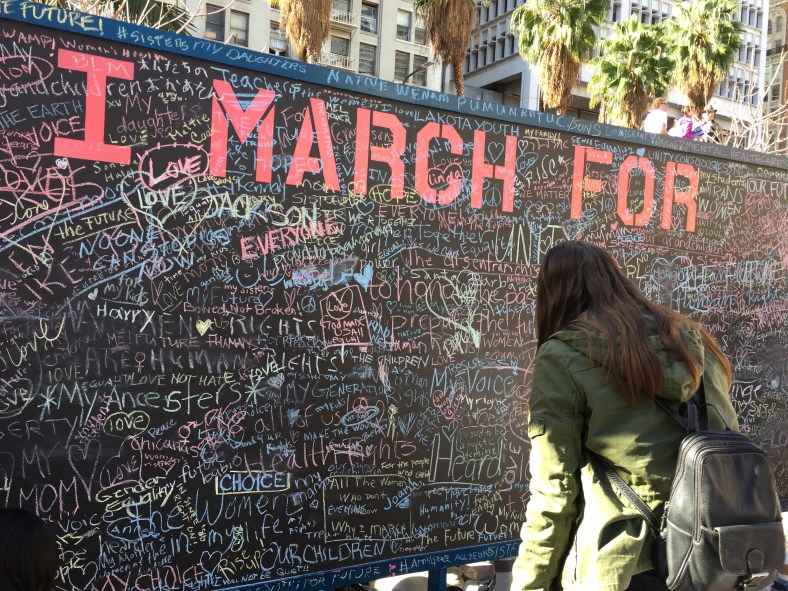
I got as far as Pershing Square in Downtown LA. There were too many people to ‘march’ to City Hall. The real estate in-between was occupied by a sea of veteran and newly-minted activists.

Eventually, we headed in the opposite direction along 6th and up Grand to the Disney Concert Hall. The thousands in the ‘tangent march’ I joined never heard the political speeches of the day, but were overjoyed in the surprise of the turnout.

We were a rainbow representation of the California we call home. We were messengers from divergent origin, chanting with one voice. “This is what democracy looks like”.

IMG_8183.jpgThis is what I want you to understand. The result of the U.S. election may have been the catalyst, but this is about families, values and redefining a new American dream. It’s not about following a 70 year old white man into the past, but creating a solid bridge to a viable global future for our children and grandchildren. It’s about legacy, not name calling.
IMG_8149.jpgIf we can harness the energy and creativity that knitted pink pussy hats, and illustrated catchy posters, we can change the world. The present day reality holds enough shock value without piling on with unproductive language that creates a diversion from authentic action.

 We are the parents who are the everyday role models for our children. It’s our lot in life to “go high, when others go low”. We are the adults in the room.

Many doubt our unity. They minimize our resolve. They write we cannot sustain the momentum initiated on 1/21/17.

img_8191How often, as women@work, have we heard those whispered doubts of our ability to get the job done – to compete? Enough.

I have great respect for those who have blazed trails so others might succeed, but it’s time to hand over the power to the next generation of dreamers – to trust their ability to employ genuine entrepreneurial skill to reimagine the future.

They were there on Saturday; on every street, in every city around the world.

IMG_8180.jpgWhere do we begin? Start local. Be a mentor, donate to organizations that support K-12 leadership initiatives. Invest in people.

Take any opportunity to start a conversation, and listen.

Read the constitution. Fill in the gaps in your knowledge of American history. Learn the words to ‘We Shall Overcome’.

Visit the library or local bookstore and read at least one book by an author from another culture.

Go to your state capitol, find your representative, and ask, what they are doing to encourage a new cohort of leaders? Offer to help.

If you have massive amounts of cash, avoid the temptation to create a private label on a building, and put your money toward those who will cement a more permanent legacy through public service.

If you can’t find an organization with a ‘mission match’ to your values, create one. It was one woman’s Facebook post that grew into the Women’s March.

IMG_8187.JPG

And so it begins…

Photo credit- Downtown LA – LA Mayor’s website