The week@work – the value of cross-functional experience, empowering introverts, economic recovery, and a new leader @librarycongress

It turns out that the path to leadership is paved not just by elite MBA degrees, but also with experience across a range of business functions. Once you arrive in the ‘C Suite’ it’s to your advantage to pay attention to the introverts in the room.

In other stories this week@work, evidence shows an increase in middle class incomes, there’s a new Librarian of Congress, and can you remember Oprah’s first book club pick 20 years ago?

Generalize or specialize? That is the question Neil Irwin answers in ‘A Winding Path to the Top’ for The New York Times.

“How does a person get to be the boss? What does it take for an ambitious young person starting a career to reach upper rungs of the corporate world — the C.E.O.’s office, or other jobs that come with words like “chief” or “vice president” on the office door?

The answer has always included hard work, brains, leadership ability and luck. But in the 21st century, another, less understood attribute seems to be particularly important.

To get a job as a top executive, new evidence shows, it helps greatly to have experience in as many of a business’s functional areas as possible. A person who burrows down for years in, say, the finance department stands less of a chance of reaching a top executive job than a corporate finance specialist who has also spent time in, say, marketing. Or engineering. Or both of those, plus others.”

Many corporations, in the past, had institutionalized ‘rotational assignments’ in a variety of business functions under the aegis of ‘leadership development programs’. When ‘shareowner’ value became the primary measure for CEOs, these internal employee development initiatives were shut down. But the need for cross-functional expertise never went away.

“To be a C.E.O. or other top executive, said Guy Berger, an economist at LinkedIn, “you need to understand how the different parts of a company work and how they interact with each other and understand how other people do their job, even if it’s something you don’t know well enough to do yourself.”

Developing multiple areas of expertise provide a pragmatic workplace foundation for the aspiring entrepreneur, the Fortune 500 CEO, and the variety of public and private leadership opportunities in between.

You learn the language, make life-long career connections, and maintain contact with your customer.

grand central ny.jpg

Location seems to influence opportunities as well. Take note, all you folks who hesitate to relocate.

“Beyond the results on job functions, the data from LinkedIn shows some trends for which the explanations aren’t completely obvious. For example, former consultants who lived in New York or Los Angeles had higher odds of ending up with a top job than people in other large cities like Washington or Houston. A former management consultant with 15 years of work experience in six different functions and an M.B.A. from a top school had a 66 percent chance of becoming a top executive if he lived in New York compared with a 38 percent chance in Washington.”

Bottom line, moving out of you career comfort zone, whether that means function or city, holds long-term implications for career success.

The second story this week@work comes from the print edition of The Economist, ‘Shhhh! Companies would benefit from helping introverts to thrive’.

Most companies worry about discriminating against their employees on the basis of race, gender or sexual preference. But they give little thought to their shabby treatment of introverts.

The recent fashion for hyper-connectedness also reinforces an ancient prejudice against introverts when it comes to promotion. Many companies unconsciously identify leadership skills with extroversion—that is, a willingness to project the ego, press the flesh and prattle on in public.

What can companies do to make life better for introverts? At the very least, managers should provide private office space and quiet areas where they can recharge. Firms need to recognise that introverts bring distinctive skills to their jobs. They may talk less in meetings, but they tend to put more thought into what they say. Leaders should look at their organisations through the introverts’ eyes. Does the company hold large meetings where the loudest voices prevail? That means that it is marginalising introverts. Does it select recruits mainly on the basis of how they acquit themselves in interviews? That could be blinding it to people who dislike performing in public.”

Jim Tankersley reported for The Washington Post Wonkblog, ‘Middle class incomes had their fastest growth on record last year’.

ny-corner

“Middle-class Americans and the poor enjoyed their best year of economic improvement in decades in 2015, the Census Bureau reported Tuesday, a spike that broke a years-long streak of disappointment for American workers but did not fully repair the damage inflicted by the Great Recession.

Real median household income was $56,500 in 2015, the bureau reported, up from $53,700 in 2014. That 5.2 percent increase was the largest, in percentage terms, recorded by the bureau since it began tracking median income statistics in the 1960s.

In addition, the poverty rate fell by 1.2 percentage points, the steepest decline since 1968. There were 43.1 million Americans in poverty on the year, 3.5 million fewer than in 2014. The share of Americans who lack health insurance continued a years-long decline, falling 1.3 percentage points, to 9.1 percent.

“The highest income growth was in the bottom fifth” of workers, “which is very welcome news,” said Lawrence Mishel, president of the liberal Economic Policy Institute think tank. Furman, of the White House, credited wage-boosting policy initiatives for some of that increase: “The fact that millions of workers have gotten a raise, as states have raised minimum wages, has definitely had an effect there,” he said.

All told, the gains brought median incomes nearly back to their levels before the recession, after adjusting for inflation, though they remain below 1999 levels. Bureau officials said the 5.2 percent growth rate was not statistically distinguishable from five other previous increases in the data, most recently the 3.7 percent jump from 1997 to 1998.”

On Wednesday, Carla Hayden was sworn in as the 14th Librarian of Congress“Hayden, the first woman and the first African American to lead the national library, was nominated to the position by President Barack Obama on February 24, 2016, and her nomination was confirmed by the U.S. Senate on July 13.”4532.jpg

Baynard Woods covered the appointment for The Guardian, ‘Carla Hayden: new librarian of Congress makes history, with an eye on the future’.“Even though librarianship is one of the four what they call feminized professions – social work, education nursing, and librarianship – where 85% of the workforce is female, there haven’t been an equal amount of women in the leadership positions,” Hayden said in an interview.

Hayden is also only the third Librarian of Congress to actually have training as a librarian.

“There have been lawyers and politicians, historians, scholars, librarians, and I think at this time it’s not a detriment to have a librarian be librarian of Congress,” she said.

The librarian of Congress oversees the world’s largest library system. As the name indicates, one of the main roles of the library is to assist Congress in the research it needs in order to pass bills. It also oversees the US copyright system, names the poet laureate, and preserves historical documents and books.

Hayden first came to national prominence in 2003 when she spoke out against certain elements of the Patriot Act as the head of the American Library Association. Attorney general John Ashcroft attacked Hayden for sowing “hysteria” about the provision of the act that would allow the government to search library and bookstore records.

Hayden shot back.

“We are deeply concerned that the attorney general should be so openly contemptuous of those who seek to defend our Constitution,” she said. “Rather than ask the nation’s librarians and Americans nationwide to ‘just trust him,’ Ashcroft could allay concerns by releasing aggregate information about the number of libraries visited using the expanded powers created by the USA Patriot Act.”

At the time, there was political risk in such statements, but Hayden said she never considered that.”

In history@work this week, September 17 marked the 20th anniversary of Oprah Winfrey’s Book Club. Do you remember the first pick? Jacquelyn Mitchard‘s ‘Deep End of the Ocean’.201603-ep521-own-watn-9-949x534.jpgOprah’s Book Club quickly became a hugely influential force in the publishing world, with the popular TV host’s endorsement capable of catapulting a previously little-known book onto best-seller lists.

When Oprah’s Book Club first launched, some in the publishing world were skeptical about its chances for success. As The New York Times noted: “Winfrey’s project—recommending books, even challenging literary novels, for viewers to read in advance of discussions on her talk show—initially provoked considerable skepticism in the literary world, where many associated daytime television with lowbrow entertainments like soap operas and game shows.” However, the club proved to be a hit with Winfrey’s legions of fans, and many of her picks sold over 1 million copies. (She earned no money from book sales.) Winfrey’s ability to turn not just books but almost any product or person she recommended into a phenomenon came to be known as the “Oprah Effect.”

Celebrate this week@work with a selection from Oprah’s long list of book recommendations.


Photo credit: Carla Hayden by Pablo Martinez Monsivais/AP

The Saturday Read ‘Wild Man: Patagonia’s conflicted philosopher-king’ by Nick Paumgarten

The Saturday Read this week is journalist Nick Paumgarten‘s profile of the “tiny terror”, Yvon Chouinard, founder of the outdoor clothing and gear company, Patagonia.

If you are not familiar with Patagonia, “Our Reason for Being” provides a concise tutorial.

“Patagonia grew out of a small company that made tools for climbers. Alpinism remains at the heart of a worldwide business that still makes clothes for climbing – as well as for skiing, snowboarding, surfing, fly fishing, paddling and trail running. These are all silent sports. None require a motor; none deliver the cheers of a crowd. In each sport, reward comes in the form of hard-won grace and moments of connection between us and nature.

Our values reflect those of a business started by a band of climbers and surfers, and the minimalist style they promoted. The approach we take towards product design demonstrates a bias for simplicity and utility.

For us at Patagonia, a love of wild and beautiful places demands participation in the fight to save them, and to help reverse the steep decline in the overall environmental health of our planet. We donate our time, services and at least 1% of our sales to hundreds of grassroots environmental groups all over the world who work to help reverse the tide.”

“Wild Man” is the story of how Chouinard’s career evolved over time, rooted in love and respect for nature. It’s an entrepreneur’s journey, with cameo appearances by familiar names: journalist Tom Brokaw, The North Face founder, Doug Tompkins, Royal Robbins and Tom Frost.

Nick Paumgarten’s first connection to Patagonia came in 1992 when he “had a job answering phones at Patagonia’s mail-order office, in Bozeman, Montana…As far as qualifications, I was another city kid, but I’d been out in nature a bit and was, in descending order of aptitude, a skier, whitewater kayaker, backpacker, mountain biker, and fly-rod flailer. I had come of age poring over the Patagonia catalogue, with its action shots and exotic locales, and I already had Yvon Chouinard right up there with Jack Kerouac and Jimi Hendrix on my list of great Americans. Plus, I liked the idea of getting good gear at a discount.”

When Paumgarten decides to leave the job early, he gets his first inkling of Patagonia’s corporate culture.

“I quit the job before I was supposed to, in order to go on a ski trip. Of the two women who’d hired me, one was angry and the other understanding. Their reaction embodied an intrinsic schizophrenia at Patagonia. Chouinard had always encouraged his employees to cut work and go surfing when the swell came in. But it was also a company trying to claw its way out of a hole.”

Patagonia survived the economic challenges of the early nineties with layoffs and loans “from a friend and from some Argentines who wanted to get their money out of the country.”

“It was hard,” Chouinard said. “I realized we were just growing for the sake of growing, which is bullshit.”

“The company, he worried, was straying from its hard-core origins. “I was faced with the prospect of owning a billion-dollar company, with thousands of employees making ‘outdoorlike’ clothing for posers,” he said early in 1991, in a speech to the employees, in which he outlined his misgivings and his new resolutions. These subsequently appeared in the Patagonia catalogue, as a manifesto, under the heading “The Next Hundred Years.”

This ‘long read’ is a primer for the aspiring entrepreneur. It’s a vivid narrative of the progression of one man’s career from childhood dreams of being a fur trapper, to climber, private detective, surfer and blacksmith; proving there are no straight career paths. Its also a lesson in failure, resilience and a realization over time that success can be a double- edged sword.

“Eco-conscious fun-hoggery, as an ethos, a culture, a life style, and an industry, spans the world, and even rules some corners of it. Chouinard is its best-known avatar and entrepreneur, its principal originator and philosopher-king, and is as responsible as anyone for guiding it from the primitive tin-can and hobnail aesthetic of the mid-twentieth century to the slackline and dome-tent attitude of today. He has made it more comfortable, and more glamorous, to be outside, in harsh conditions. His influence is way out of proportion to his revenue footprint. He has mixed feelings about all this—some apprehension about the world he has made. He celebrates the spread of an ecological consciousness but laments the disappearance of danger and novelty, and the way that the wilderness has become a hobby, or even a vocation. He disdains ski areas (“They’re golf courses”), the idea of professional climbing (“I just don’t like the whole paid-climber thing”), and the proliferation of extreme sports as programming and marketing (“Red Bull’s in the snuff-film business”).”

Malinda Chouinard, Yvon’s wife and business partner, was a pioneer in ‘on-site daycare’ and in 2012 her efforts resulted in Patagonia becoming “the first California business to become a B Corp.”

“Malinda is principally responsible for making the company a notably humane place to work. Many there cite the advantage of having day care on site. In 1985, Malinda created (and has since put aside a vast patchwork of space for) what became known as the Great Pacific Child Development Center, to which I didn’t give much consideration, until I got a tour. A staff of twenty-eight oversees some eighty kids, on sprawling grounds of more than twelve thousand square feet, roughly half of it outdoors, among the fruit trees. A recent baby boom had led to another expansion, which displaced the H.R. department to a trailer. “We’ve raised fifteen hundred kids so far,” Chouinard told me. “None of them have been in prison—that I know of, anyway.”

Chouinard’s management style?

“I’m just the owner.” He called his executive style “management by absence.” He used to read business books and study various executive styles and corporate structures, here and abroad, but he prefers to take his lessons from nature—from ant colonies, for example. “There’s no management,” he said. “Every ant just does his job. They communicate and figure it out. It’s like a Navy seal team. The whole team has to agree on what the mission is.” It’s also true, however, that Chouinard’s occasionally whimsical notions send the ants scurrying. Absent or not, he’s still the big ant.”

There are multiple gems of wisdom interspersed throughout the profile. When asked “if the prospect of death bothered him”, he shared his secret to a good life.

“Nah, I’ve always considered death to be a part of life,” he said. “Tell you the secret to a good life: always be the oldest one in the room.”


Photo credit: Patagonia annual report

The Friday Poem ‘The Land of Counterpane’ by Robert Louis Stevenson

There has been quite a bit of ‘health@work’ news this week as one of the major candidates for U.S. President took a couple of sick days away from her campaign.

In the spirit of taking a respite to heal, enter the imagination of writer and poet Robert Louis Stevenson.

The Land of Counterpane

When I was sick and lay a-bed,
I had two pillows at my head,
And all my toys beside me lay
To keep me happy all the day.

And sometimes for an hour or so
I watched my leaden soldiers go,
With different uniforms and drills,
Among the bed-clothes, through the hills;

And sometimes sent my ships in fleets
All up and down among the sheets;
Or brought my trees and houses out,
And planted cities all about.

I was the giant great and still
That sits upon the pillow-hill,
And sees before him, dale and plain,
The pleasant land of counterpane.

Robert Louis Stevenson  from ‘A Child’s Garden of Verses’ 1913

img_5559

The Saturday Read ‘New York Fashion Week: An Oral History’

‘The Saturday Read’ this week is an online interactive feature from the September 8, 2016 New York Times ‘Thursday Styles’ section, capturing a multi-media moment in fashion history as the baton is being passed to the next generation of designers. Ruth La Ferla brings us ‘Our Stories’, an oral history from fashion icons Ralph Lauren, Donna Karan, Calvin Klein, Carolina Herrera, Michael Kors, Issac Mizrahi and Alexander Wang.

This one is for all of you who are first to the newsstand for the September issues of Vogue and Harpers Bazaar, hoping to find a few classical wardrobe elements to update your look for fall. Designer outlets may be the closest most of us get to the runway, but many aspire to a career in one of the global capitals of fashion.

“As New York Fashion Week approaches its 75th year (the first official shows, massed under the heading of Press Week, were held in 1943), with 151 shows spread over nine days, many designers are questioning the future of this semiannual gathering. “We are facing the end of an era,” the designer Diane von Furstenberg said in a recent interview. “But there is nothing nostalgic about that. The future will be more exciting.”

The future may well be exciting, but for many in the industry, the past is one to savor and celebrate. Here, a crowd of fashion notables reflect on their experiences: the good, the bad, the awkward and the forever memorable.”

From their “first shows”, through the “unforgettable moments”, “growing pains”, “the glamour girls” and the “dark days” as AIDS devastated the industry, the top designers, models and fashion commentators share their success, and the mistakes along the way to being installed as icons. If you believe we learn from the wisdom of others, this interactive experience is required reading/viewing.

Here’s a sample.

ZAC POSEN

“In February 2002, when I showed my first collection, I did the setup preshow in my parents’ living room. I had done the collection with small seed money that was generally lent by friends, family and with my savings from the lemonade stand that I had started as a kid on Spring Street.”

ALEXANDER WANG

“Our first fashion week show, for fall 2007, was in a Chelsea warehouse. It was hectic backstage. I remember our casting director freaking out because all the models and dressers (who also happened to be my best friends) were eating greasy pizza, and the director was like, “Where’s Alex?” I was right there eating pizza, too. I guess I didn’t know any better.”

DONNA KARAN

“The turning point came in 1985 when I left Anne Klein. At the time I said to my bosses, “I have this vision for a little company.” Women in those years were wearing shirts and little ties to the office. I asked myself: “Where is the sexuality? Where is the comfort? Where are the clothes that go from day into night? How do you travel with your wardrobe in one bag?” And that’s how the Seven Easy Pieces came about.”

ALEK WEK
Model in the 1990s

“When I started modeling, people kept saying, “Oh, she’s so different, she’s bizarre,” like I wasn’t quite normal. Of course there was a racist element to those conversations. People were beating around the bush. But if I focused on that, I don’t think I would have stayed in fashion. Being viewed as different only gave me more incentive. I wanted people to know that your features or your color don’t make you less beautiful. My motivation was deeper than me just putting on makeup and clothes and doing shows.”

SIMON DOONAN

“All those people perished, and now many young people maybe don’t even know that Perry Ellis was an actual person. Many young African-American designers would be inspired to know how many great African-Americans had careers at the time.

These people didn’t all just get on a bus and drive off somewhere. They died excruciating deaths, some in the hallways of hospitals without help or support. In many instances, their families rejected them. I distinctly remember people who didn’t have a funeral or memorial. I had a friend who was buried in an unmarked grave.

It’s always troubled me that these supertalented original thinkers weren’t adequately memorialized.

They were Patrick Kelly, Angel Estrada, Isaia, Clovis Ruffin, Halston, Antonio Lopez and Juan Ramos, Tina Chow, Tim Hawkins, Robert Hayes and Laughlin Barker. And the photographers: David Seidner, Barry McKinley, Herb Ritts, Bill King and so many more. They were window-dresser friends: Bob Currie, Michael Cipriano, Bob Benzio, Stephen Di Petrie. The list goes on.”


The Friday Poem ‘Calling Him Back from Layoff’ by Bob Hicok

The Friday Poem this week captures a moment when a telephone rings and life changes for two American workers. ‘Calling Him Back from Layoff’ is poet and English professor Bob Hickok’s intimate portrait of the effects of economic downturn.

Written at a time when Detroit was the epicenter of job losses in manufacturing, the words continue to resonate today, as we address income inequality and the impermanence of the ‘gig’ economy.

Calling Him Back from Layoff 

I called a man today. After he said
hello and I said hello came a pause
during which it would have been

confusing to say hello again so I said
how are you doing and guess what, he said
fine and wondered aloud how I was

and it turns out I’m OK. He
was on the couch watching cars
painted with ads for Budweiser follow cars

painted with ads for Tide around an oval
that’s a metaphor for life because
most of us run out of gas and settle

for getting drunk in the stands
and shouting at someone in a t-shirt
we want kraut on our dog. I said

he could have his job back and during
the pause that followed his whiskers
scrubbed the mouthpiece clean

and his breath passed in and out
in the tidal fashion popular
with mammals until he broke through

with the words how soon thank you
ohmyGod which crossed his lips and drove
through the wires on the backs of ions

as one long word as one hard prayer
of relief meant to be heard
by the sky. When he began to cry I tried

with the shape of my silence to say
I understood but each confession
of fear and poverty was more awkward

than what you learn in the shower.
After he hung up I went outside and sat
with one hand in the bower of the other

and thought if I turn my head to the left
it changes the song of the oriole
and if I give a job to one stomach other

forks are naked and if tonight a steak
sizzles in his kitchen do the seven
other people staring at their phones

hear?

Bob Hicok  ‘Insomnia Diary’ University of Pittsburgh Press, 2004

insomnia-diary

Listen to Bob Hicok read the poem for ‘Poetry Everywhere’


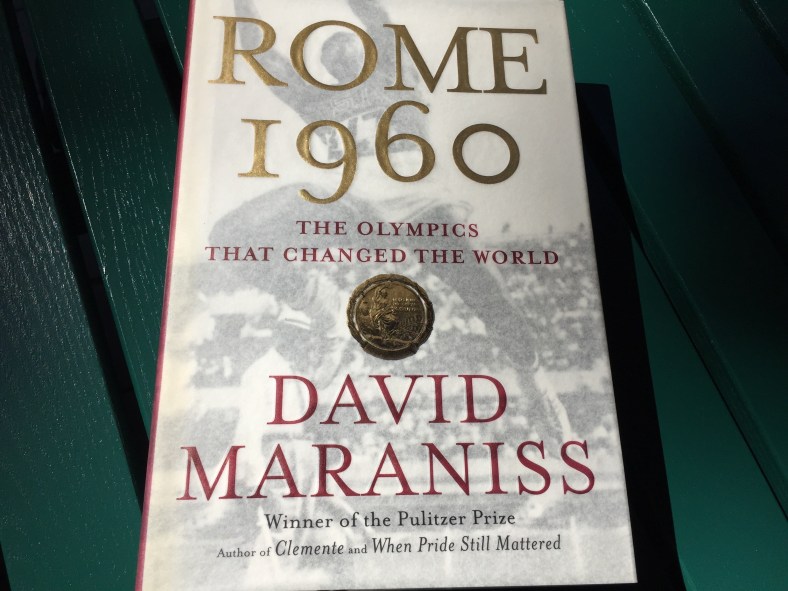
The Saturday Read ‘Rome 1960:The Olympics That Changed The World’ by David Maraniss

For the last weekend of summer 2016, the Saturday Read takes you to ‘Rome 1960: The Olympics That Changed The World’ by Pulitzer Prize winning journalist, David Maraniss.

In the summer of 1960 only 15 years had passed since the end of World War II. The superpowers were angling for global influence, and the XVII Olympiad in Rome provided one more stage to showcase the benefits of competing forms of government.

“History is replete with moments that ache with misplaced optimism, and that seemed true of the period of the 1960 Summer Olympics even as signs of a troubled world riddled those days of late August and early September. The Games were bookended by the Soviet spy trial of American U-2 pilot Frances Gary Powers and Khrushchev’s threat to stir up things at the UN, while in between came increasing tension in divided Berlin and violence in the rebellious Congo. Whatever Avery Brundage’s wishes, the Olympics were in no way isolated from the eruptions and disruptions of the modern world. Rome had its share of spies and propagandists looking to turn every situation to their advantage. Yet those days in Rome were infused with a golden hue nonetheless. The shimmering was literal – emanating from the autumnal sun; the ancient coloration of the streets, walls, and piazzas; the warm angles of refracted light – but it was also figurative, an illumining that comes with a moment of historical transition, when one era is dying and another is being born.”

The reader experiences the eighteen days of the Rome Olympics through Maraniss’ chronicle of events, athletes, coaches, sports writers, and a few nefarious government players. The narrative introduces us to the Americans and their competitors. It’s quite a cast of characters including then Cassius Clay, Rafer Johnson, C.K. Yang, Wilma Rudolph, and Abebe Bikila.

“The pressures of the cold war played an underappreciated role in forcing change in culture and sports, all much in evidence in Rome. At the opening Parade of Nations at the Stadio Olympico, the crowd was stirred by the sight of Rafer Johnson marching into the arena at the head of the U.S. delegation, the first black athlete to carry the American flag. Johnson’s historic act reflected his unsurpassed status as a world-class decathlete, but it also served as a symbolic weapon at a time when the United States was promoting freedom abroad but struggling to answer blatant racism at home, where millions of Americans were denied freedom because of the color of their skin.”

The author is at his best when sharing the story of Coach Edward Temple and his ‘Tigerbelles’ women’s track team from the Tennessee Agricultural and Industrial State University in Nashville. We time travel to an American South before the Civil Rights Act of 1964, when women’s sports were viewed as unimpressive adjuncts to the men’s competition.

“When Temple was named head coach at Tennessee A&I State after graduating in 1950, it was because nobody else wanted the job. His starting salary was $150 a month, which when added to his pay for teaching social science courses, brought a yearly sum of $5,196…By the mid fifties, even after Temple had established his program and led it to a national title, the athletic department still would not give him a desk, let alone an office. “

In Rome, as Olympic coach, Temple could only see a segment of the track from his position at the opening of the tunnel. One of his runners, Wilma Rudolph, who had overcome polio as a child, was competing in the 100 meter race. The day before, ‘Black Tuesday’, the U.S. men’s track and field team suffered its worst losses in the 100 meter, 200 meter, and 4×100 meter relay.

“Wilma won! Wilma won!” someone shouted at Temple in the tunnel. “You’re joking,” he said. Then he stepped into the golden late afternoon sunlight, and “they flashed it on the big scoreboard and put the time, the new Olympic record, ‘Wilma Rudolph, USA.’ and I said, ‘Hot Dog!’.

Earlier in the competition, Ed Temple’s greatest hope was just to get one of his runners on the medal stand. A bronze would do. But in the four days since Wilma Rudolph  won gold in the 100, all of that had changed. From a relative unknown, Rudolph had risen to international stardom, belle of the Olympics, the favorite in anything she did.”

Her success resonated with other athletes, including Anne Warner, a gold medal swimmer.

“I had read the stories about her fight against polio and what she had done. She was really a hero for a lot of us. It didn’t matter that it was a different sport. She was just such a beautiful runner. And I think that polio was such a part of our lives then, too, because we were swimmers. A lot of times your parents were nervous about going to swimming pools in that era. And there was no Salk vaccine yet when we were starting out. So the fact that she had polio meant something special to us.”

Maraniss’ command of the story places the reader ‘on location’ as events unfold.

Rafer Johnson was student body president at UCLA and a member of the track and field team along with CK Yang. On September 5, 1960 they met as competitors for the title of the world’s greatest athlete; Johnson representing the United States and C.K. Yang, Formosa. At the end of the first day of decathlon competition  Johnson led Yang by a slim 55 points.

“Few Olympic athletes know one another as thoroughly as Rafer Johnson and C.K. Yang. It was not that both had trained at UCLA for the same event under the same coaches. A deeper sensibility seemed at work in their symbiotic relationship, a spirited blend of admiration and competitiveness that pushed them to greater accomplishments together than they may have achieved apart.”

Across town, Cassius Clay was the unanimous winner in his bout with Zbigniew Pietrzkowski of Poland.

“Everyone seemed up and about early Tuesday morning. Cassius Clay paraded through the village before breakfast, gold medal dangling rom his neck. “I got to show this thing off!” he kept boasting…He was on his way to signing a professional contract, earning serious money, and becoming even more famous as the heavyweight champion of the world.”

Tuesday was day two of the decathlon.

“After back-to-back fourteen-hour days, ten events, draining humidity, evening chill, rain delays, unbearable tension, and the accumulation of an Olympic record 8392 points, (by the scoring system in 1960), Rafer Johnson left the Stadio Olimpico for the last time at eleven o’clock that night, retracing the steps he had taken nearly two weeks earlier as the captain and flag bearer for the U.S. Olympic team. As he trudged, relieved and exhausted, along the moonlit Tiber and over the bridge, C.K. Yang, now just a friend, no longer a competitor, walked once again at his side.”

The marathon was held on the final full day of competition in 1960. It was to produce one of the most remarkable stories in Olympic history.

Abebe Bikila of Ethiopia waited at the start, barefoot.

“Marathons traditionally were held during daylight and ended with the runners entering the main stadium…In the heat of Rome, the race began at twilight and proceeded into darkness; the finish line was not inside the Stadio Olympico but at the Arch of Constantine amid the Roman ruins.

The British writer Neil Allen, from his seat jammed amid his fellow journalists, feeling “the sudden chill of the night” and looking “dazedly at the floodlit Arch of Constantine,” could not believe it when the loudspeaker crackled the name of the leader, Abebe Bikila…”A completely unknown athlete from Ethiopia was going to win the Olympic marathon…Journalists and officials edged forward in their wooden stands, peering along the darkness of the Appian Way hoping to be the first to spot this last and most unexpected hero of the Games.” At last the lights of a convoy could be seen…There was a brief tussle with one of the persistent Lambretta scooters before it was bundled our of the way, and then – here he came!

The Rome Olympics were the first commercially televised summer games in history. In New York, Jim McKay was beginning his career in TV sports from a small studio in New York.

“It was all so minimal in Rome, with McKay in that little studio in New York, tapping our his own scripts on a portable typewriter, drawing information fro the Encyclopedia Britannica; and with Peter Molnar’s crew of fewer than fifty in Rome filming and editing on the fly, literally trying to beat the clock every night with their canisters winging west toward New York City in the bellies of commercial jets. The televising of the Olympic games grew from that infancy in Rome to an extravaganza, expanding every four years into an ever-larger enterprise that eventually entailed a broadcast army…”

As Rome prepares it’s bid to host the 2020 Olympics, enjoy David Maraniss’ account of the  first time the world came to compete for gold in ‘The Eternal City’.


The Friday Poem ‘Labor Day’ by Joseph Millar

Part of the year I live in a ‘swing state’ where the economy has not yet recovered, and politicians fill the airwaves with promises of transformational ‘greatness’. The Friday Poem this week is from Pennsylvania native, former telephone repairman, commercial fisherman, and poet Joseph Millar. ‘Labor Day’ captures the quiet of a national holiday, first celebrated in New York on September 5, 1882.

“The form that the observance and celebration of Labor Day should take was outlined in the first proposal of the holiday — a street parade to exhibit to the public “the strength and esprit de corps of the trade and labor organizations” of the community, followed by a festival for the recreation and amusement of the workers and their families. This became the pattern for the celebrations of Labor Day. Speeches by prominent men and women were introduced later, as more emphasis was placed upon the economic and civic significance of the holiday. Still later, by a resolution of the American Federation of Labor convention of 1909, the Sunday preceding Labor Day was adopted as Labor Sunday and dedicated to the spiritual and educational aspects of the labor movement.”

Labor Day

Even the bosses are sleeping late
in the dusty light of September.

The parking lot’s empty and no one cares.
No one unloads a ladder, steps on the gas

or starts up the big machines in the shop,
sanding and grinding, cutting and binding.

No one lays a flat bead of flux over a metal seam
or lowers the steel forks from a tailgate.

Shadows gather inside the sleeve
of the empty thermos beside the sink,

the bells go still by the channel buoy,
the wind lies down in the west,

the tuna boats rest on their tie-up lines
turning a little, this way and that.

Joseph Millar  from ‘Blue Rust’ Carnegie Mellon University Press, 2012

9780887485497.jpg

The Friday Poem: ‘The Boss’ by Deborah Garrison

One of the most important workplace relationships is the one between you and your direct supervisor. A good ‘boss’ will quickly sense your potential and connect your talents with work that challenges and enables professional growth. He/she employs personal experience to communicate the value of failure along with success. A good boss has a high EQ and a healthy dose of empathy for all.

For this week’s Friday Poem, a meditation on ‘The Boss’ through the eyes of poet Deborah Garrison.

The Boss

A firecracker, even after middle age

set in, a prince of repression

in his coat and tie, with cynical words


for everything dear to him.

Once I saw a snapshot of the house

he lives in, its fence painted


white, the flowers a wife

had planted leaning into the frame

on skinny stalks, shaking little pom-poms


of color, the dazzle all

accidental, and I felt

a hot, corrective


sting: our lives would never

intersect. At some point

he got older, trimmer, became


the formidable man around the office.

His bearing upright, what hair he has

silver and smooth, he shadows my doorway,


jostling the change in his pocket –

milder now, and mildly vexed.

The other day he asked what on earth


was wrong with me, and sat me down

on his big couch, where I cried

for twenty minutes straight,


snuffling, my eyeliner

betraying itself in the stained

tears. Impossible to say I was crying


because he had asked. He passed

tissues, at ease with the fearsome

womanly squall that made me alien


even to myself. No, it didn’t make him

squirm. Across his seventy years,

over his glasses, he eyed me kindly,


and I thought what countless scenes

of tears, of love revealed

he must have known.


Deborah Garrison   ‘A Working Girl Can’t Win’ 1998

a working girl can't win

Click on this link to hear the author read the poem as part of a 1999 interview with Bill Moyers.

“In this episode of Sounds of Poetry, Garrison tells Bill that poetry is about “trying to find a way to understand and describe the world that lifts you a little bit out of it, instead of just being in it and being lost.”

‘The Ageing Athlete’ a poem by Neil Weiss

As the Games of the XXXI Olympiad come to an end, a ‘Friday Poem’ to consider life after sport…and other career transitions.

The Aging Athlete

You’re through – no walking up and down,

you think of speed and dig your heels,

testing this soil and that for a start,

but it’s no go…Practicing for leaps,

you start forward but exhaust the push

and end up with a damaging rush,

arms hanging, hands twitching at your sides,

chin bobbing on your chest: no pride

that once sustained you as you leapt

the next hurdle, hair up then down,

the wind in your ears, the crowd beside

itself, shouting, Come on! Come on!

and you smashed the tape with your chest

and sank into the arms of many lovers.

Neil Weiss      Poetry Magazine, August 1956

1955-08.jpg

Photo Credit: Getty Images/USA TODAY Sports 8/15/16

The week@work or on vacation-what leadership looks like, what leadership reads & ‘wasting time’ on the Internet

This week@work, desks and cubicles are vacant as colleagues are catching a few last days of escape away from work. Among those still @work: a journalist shared a relic of presidential transition to remind us what leadership looks like, the White House tweeted the President’s vacation reading choices, Olympians continue to compete in Rio, and we may not be wasting time on the internet.

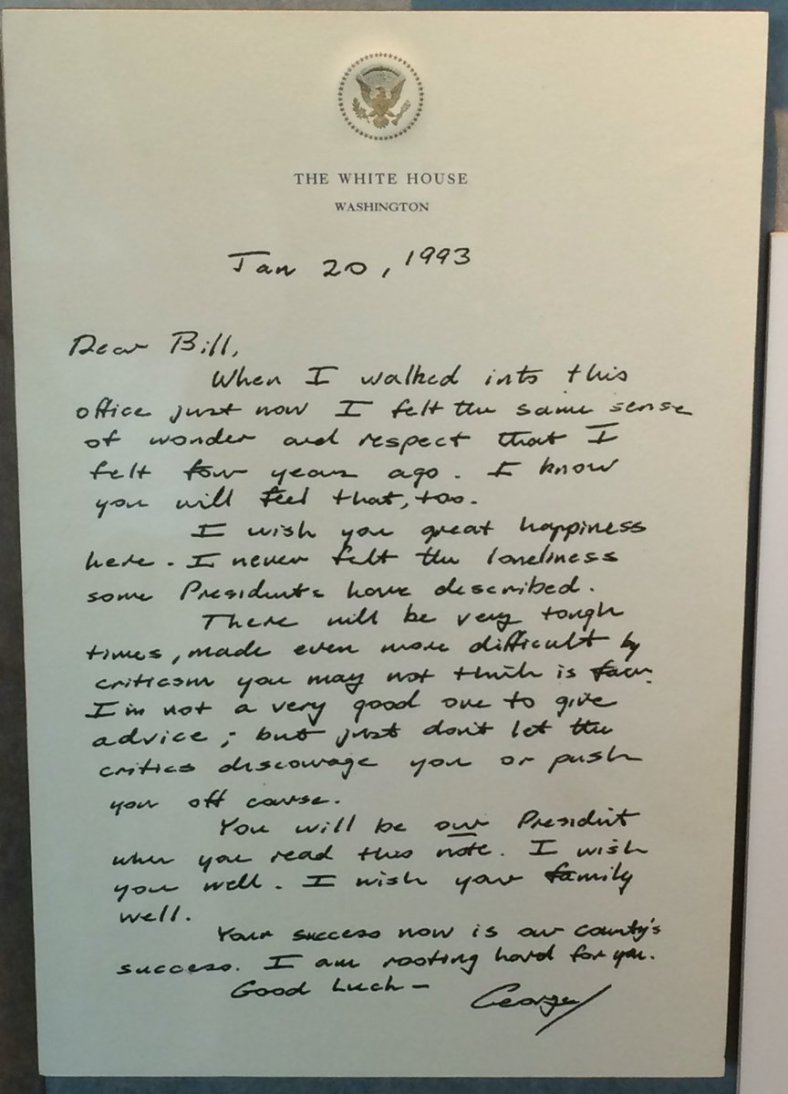
There’s been a copy of a letter circulating recently on the Internet. It arrived in my Twitter account this week via journalist Joyce Karam. It’s a handwritten note written on Inauguration Day, 1993 by departing President George H.W. Bush to his successor, President Bill Clinton.

bush to clinton.jpg

Imagine arriving at your new job on Monday morning and finding a handwritten note from your predecessor, wishing you great happiness @work. “Your success is now our success”.

What if you wrote a letter to the person taking over your desk on Monday morning? Could you convey a “sense of wonder and respect” for your workplace and your work?

Think about it. This is what leadership looks like.

While we are on the topic of U.S. Presidents, current President Obama is on vacation with family, friends and five ‘summer reads’ including Oprah’s recent Book Club selection and one of Bill Gates’ favorites.

readinglist2016_1200.jpeg

(A quick aside here on the Olympics. The photo at the top of the page captures the vacant volleyball nets this morning in Manhattan Beach, California. It’s the place where two U.S. Olympians, Kerry Walsh Jennings and April Ross went to work to get ready for Rio.)

Back to work, and reading, and surfing the Internet.

Kenneth Goldsmith, artist, professor and first poet laureate of the Museum of Modern Art, urged LA Times readers to ‘Go ahead: Waste time on the Internet’ with his OpEd this weekend.

“The notion that the Internet is bad for you seems premised on the idea that the Internet is one thing — a monolith. In reality it’s a befuddling mix of the stupid and the sublime, a shattered, contradictory, and fragmented medium. Internet detractors seem to miss this simple fact, which is why so many of their criticisms disintegrate under observation.”

He recently discussed his University of Pennsylvania course and new book ‘Wasting Time on the Internet’ with Quentin Hardy of The New York Times. Drawing on his personal observations of students and family, he imagined what an educated person will look like in the 21st century.

We still read great books, and there is a place for great universities. But an educated person in the future will be a curious person who collects better artifacts. The ability to call up and use facts is the new education. How to tap them, how to use them.

I’ve got a 10-year-old and 17-year-old. They’re thinking differently from me. They stay connected all the time, and they’re smart, they play baseball, they read, they spend time online. They’re not robots. Basic human qualities haven’t changed. I can find Plato in online life. When I read Samuel Pepys’s diary I see Facebook posts. We just find new ways to express things.

Go ahead, take a break this week@work. Stream the last week of the Olympics, read a great book, and follow the tangents of Internet exploration.