‘From the Somme’ a poem by Leslie Coulson

The Friday Poem this week is ‘From the Somme’, by journalist, poet and soldier of the first world war, Leslie Coulson. The poem was included in a collection of poetry, ‘first world war  poems’, published in 2014.

“Leslie Coulson fought in Malta, Egypt and Gallipoli, where he was wounded. He recovered in hospital in Egypt, was sent to France and was killed in action at the Battle of the Somme. Shortly before he died, he wrote in a letter, ‘If I should fall do not grieve for me. I shall be one with the wind and the sun and the flowers.'”

In remembrance of the Battle of the Somme, one of the lesser known poets of the great war reflects on the impact of the battle on his worldview. His voice carries through the century to speak to all who are transformed by tragedy.

From the Somme

In other days I sang of simple things,
Of summer dawn, and summer noon and night,
The dewy grass, the dew-wet fairy rings,
The larks long golden flight.

Deep in the forest I made melody
While squirrels cracked their hazel nuts on high,
Or I would cross the wet sand to the sea
And sing to sea and sky.

When came the silvered silence of the night
I stole to casements over scented lawns,
And softly sang of love and love’s delight
To mute white marble fauns.

Oft in the tavern parlour I would sing
Of morning sun upon the mountain vine,
And, calling for a chorus, sweep the string
In praise of good red wine.

I played with all the toys the gods provide,
I sang my songs and made glad holiday
Now I have cast my broken toys aside
And flung my lute away.

A singer once, I now am fain to weep,
Within my soul I feel strange music swell,
Vast chants of tragedy too deep – too deep
For my poor lips to tell.

Leslie Coulson (1889-1916)  ‘first world war poems’ edited by Jane McMorland Hunter, 2014

‘Transmission’ a poem by Rachel Richardson

On July 2nd, 1937 aviator Amelia Earhart was attempting to be the first woman to circumnavigate the globe. She and her navigator, Fred Noonan had completed 22,000 miles of a 29,000 mile journey when transmission was lost. Ten ships, 3,000 men and 100 aircraft searched for the missing plane. The disappearance remains a mystery and has generated multiple conspiracy theories and continuing efforts by private organizations to discover the wreckage.

Earhart had become an early twentieth century role model for women. Her final note to her husband acknowledged the danger as well as her feminism.

“Please know I am quite aware of the hazards of the trip. Women must try to do things as men have tried. When they fail, their failure must be but a challenge to others.”

The Friday Poem by Rachel Richardson captures an imagined ‘transmission’ from the final moments of that flight.

Transmission

There was a girl who heard it happen:
Amelia Earhart calling
on the radio, she and her navigator
alternately cursing and defining their position
by latitude, as best they could read it
in the bellowing wind, and by what
they could surmise of their rate per hour,
last land they’d seen. Stay with me, someone,
and the girl wrote each word
in her composition book, kept the channel
tuned, hunched to the receiver
when static overtook the line.
Why do I think of her?
The coast guard laughed at her father
holding out the schoolgirl scrawl
and sent him home ashamed. A lost woman
is a lost woman, he told her, and the sea
is dark and wide.

Rachel Richardson  The New York Times Magazine  January 22, 2016


The Friday Poem ‘so you want to be a writer?’ by Charles Bukowski

The Friday Poem selection this week asks a question about career choice. Poet Charles Bukowski is advising the aspiring writer, but his message is universal. Just substitute your dream job and recognize the parallels. “…if you’re doing it for money or fame, don’t do it.”

so you want to be a writer?

if it doesn’t come bursting out of you
in spite of everything,
don’t do it.
unless it comes unasked out of your
heart and your mind and your mouth
and your gut,
don’t do it.
if you have to sit for hours
staring at your computer screen
or hunched over your
typewriter
searching for words,
don’t do it.
if you’re doing it for money or
fame,
don’t do it.
if you’re doing it because you want
women in your bed,
don’t do it.
if you have to sit there and
rewrite it again and again,
don’t do it.
if it’s hard work just thinking about doing it,
don’t do it.
if you’re trying to write like somebody
else,
forget about it.

if you have to wait for it to roar out of
you,
then wait patiently.
if it never does roar out of you,
do something else.

if you first have to read it to your wife
or your girlfriend or your boyfriend
or your parents or to anybody at all,
you’re not ready.

don’t be like so many writers,
don’t be like so many thousands of
people who call themselves writers,
don’t be dull and boring and
pretentious, don’t be consumed with self-
love.
the libraries of the world have
yawned themselves to
sleep
over your kind.
don’t add to that.
don’t do it.
unless it comes out of
your soul like a rocket,
unless being still would
drive you to madness or
suicide or murder,
don’t do it.
unless the sun inside you is
burning your gut,
don’t do it.

when it is truly time,
and if you have been chosen,
it will do it by
itself and it will keep on doing it
until you die or it dies in you.

there is no other way.

and there never was.

Charles Bukowski  published posthumously 2003

The Friday Poem ‘A sonnet’ by Lin-Manuel Miranda

At a moment of career recognition, ‘Hamilton’ creator, Lin Manuel-Miranda shared a sonnet for his wife and the world about family, tragedy and love. At it’s center was his response to the terrorist, hate crime in Orlando.

The New York Times Sunday Styles reporter, Katie Rosman, shared the ‘back story’ of the sonnet from creation to delivery on the Beacon Theater stage Sunday evening.

“…as the first grim reports out of Orlando, Fla., were circulating, Mr. Miranda took out his phone and began to tap out the sonnet he would read aloud that night while accepting the Tony for best score. In 14 lines he paid tribute to his wife, his son and the victims of the massacre.

Back at the Mandarin Oriental before curtain time, he realized he would need a printout of the verse he had written. He called the suite where his father was staying and asked him if he wouldn’t mind taking care of it. Luis, 61, said yes, and traveled down a flight, where his son handed him a thumb drive. Lin-Manuel had one stipulation: “He said, ‘Can you please not read it?’”

He went down the elevator, thumb drive in hand, toward the concierge desk. There, employees of the Mandarin Oriental sprang into action.

Back in the elevator, with the printout, the father did the very thing his son had asked him not to do: He read the sonnet.

“That’s like asking me not to drink water when it’s 90 degrees out,” Luis said. “I thought it was very moving and pretty and important for the moment.”

Back in the suite, Luis listened as Lin-Manuel read it aloud, practicing for the big moment.”

Yesterday Mr. Miranda announced a fundraising effort, for Equality Florida. Revenue will be generated by the sale of a T shirt with words from the sonnet. “Here’s a thing that speaks for itself. I’m very excited about it and it’s a way you can help.” 

x2837DC2CA-99AA-9001-BE24B99096BFFE8E.jpg.pagespeed.ic.v2WAbmnIPw.jpg

The sonnet has been published in a variety of outlets since the awards ceremony. After the horror of this past week, there was no other choice for The Friday Poem.

My wife’s the reason anything gets done
She nudges me towards promise by degrees
She is a perfect symphony of one
Our son is her most beautiful reprise
We chase the melodies that seem to find us until they’re finished songs and start to play
When senseless acts of tragedy remind us that nothing here is promised, not one day
The show is proof that history remembers
We live through times when hate and fear seem stronger
We rise and fall and light from dying embers
Remembrances that hope and love last longer
And love is love is love is love is love is love is love is love
Cannot be killed or swept aside
I sing Vanessa’s symphony
Eliza tells her story
Now fill the world with music, love, and pride

Lin Manuel-Miranda   June 12, 2016


The Friday Poem @ the intersection of Maya Angelou, Hillary Clinton and Muhammad Ali

Maya, Muhammad and Hillary. Not three names you would intuitively link together, but that’s what history claimed this week, as a ‘political poet’ passed, and a deceased poet’s 2008 words echoed in the background of a rally at the Brooklyn Navy Yard.

The news of the death of Muhammad Ali literally stopped the presses at the New York Times early Saturday morning. On Wednesday, newspapers across the country led with the history making headline reporting “Hillary Clinton‘s nomination: A win 96 years in the making”.

It will not be an easy road to November for Secretary Clinton as reported by Patrick Healy and Sheryl Gay Stolberg.

“When Hillary Clinton swept onto the stage at her victory rally Tuesday night, the thunderbolt of history struck many Americans, no matter their love or loathing for her: A woman could be the next president of the United States.

But like so much about Mrs. Clinton, her speech, which lit up televisions and smartphones and social media all day Wednesday, produced conflicting emotions.

For some, it was an inspiring moment that brought home in a visceral way that Mrs. Clinton is the first woman to become the presumptive nominee of a major party. For others, there were chills and discomfort that this next step forward in our national story was unfolding with this particular woman.”

IMG_4810.jpg

The candidate might take heart from the poem Maya Angelou submitted to The Observer in 2008, with the backstory told by Vanessa Thorpe for The Guardian.

“She is supporting Clinton despite her close friendship with television personality and philanthropist Oprah Winfrey, a prominent backer of rival Democrat Barack Obama, the first black presidential hopeful with a real chance of reaching the White House.

Angelou is steadfast in her loyalty to Clinton. She said recently: ‘I made up my mind 15 years ago that if she ever ran for office I’d be on her wagon. My only difficulty with Senator Obama is that I believe in going out with who I went in with.’

Andrew Motion, the Poet Laureate, said of the poem: ‘This is a great thing for The Observer to have.’ He favourably compared it with the ‘vivid flourishes’ of Angelou’s recent work. ‘With this kind of poem Angelou has decided to interpret public writing as a verbal equivalent of making a poster, and there’s nothing wrong with this. The rhetoric is full of big gestures that make a direct appeal to our feelings, rather than getting to it by the little winding ways more personal poetry might use.'”

The poem:

State Package for Hillary Clinton

You may write me down in history

With your bitter, twisted lies,

You may tread me in the very dirt

But still, like dust, I’ll rise.

This is not the first time you have seen Hillary Clinton seemingly at her wits’ end, but she has always risen, always risen, don’t forget she has always risen, much to the dismay of her adversaries and the delight of her friends.

Hillary Clinton will not give up on you and all she asks of you is that you do not give up on her.

There is a world of difference between being a woman and being an old female. If you’re born a girl, grow up, and live long enough, you can become an old female. But to become a woman is a serious matter. A woman takes responsibility for the time she takes up and the space she occupies. Hillary Clinton is a woman. She has been there and done that and has still risen. She is in this race for the long haul. She intends to make a difference in our country. Hillary Clinton intends to help our country to be what it can become.

She declares she wants to see more smiles in the family, more courtesies between men and women, more honesty in the marketplace. She is the prayer of every woman and man who longs for fair play, healthy families, good schools, and a balanced economy.

She means to rise.

Don’t give up on Hillary. In fact, if you help her to rise, you will rise with her and help her make this country the wonderful, wonderful place where every man and every woman can live freely without sanctimonious piety and without crippling fear.

Rise, Hillary.

Rise.

Maya Angelou, 2008
20131006_dn_0mu24lap.jpg

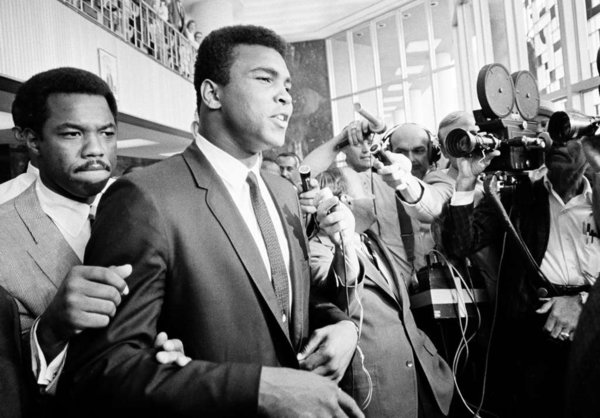
On Thursday, Henry Louis Gates Jr. recalled ‘Muhammad Ali, the Political Poet’. In the essay he linked Angelou and Ali by their poetry, often labeled ‘doggerel’.

“Perhaps Maya Angelou, whose own poetry is sometimes labeled doggerel, said it best: “It wasn’t only what he said and it wasn’t only how he said it; it was both of those things, and maybe there was a third thing in it, the spirit of Muhammad Ali, saying his poesies — ‘Float like a butterfly, sting like a bee.’ I mean, as a poet, I like that! If he hadn’t put his name on it, I might have chosen to use that!”

“It would be a mistake to say that Ali made black oral poetry more sophisticated or complex, but he did make it more political. After learning his local draft board had declared him eligible for induction into the Army in 1966, Ali recited this poem:

Keep asking me, no matter how long,
On the war in Vietnam,
I sing this song:
I ain’t got no quarrel with no Viet Cong.

On this Friday, we pause to remember the athlete, humanitarian and role model who was Muhammad Ali, we celebrate a milestone for women, and reflect on the words of two American poets who significantly influenced our culture.


‘The Work of Happiness’ a poem by May Sarton

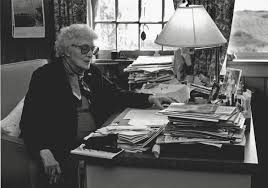
The Friday Poem this week is ‘The Work of Happiness’ by May Sarton a writer whose talent was expressed in fiction, autobiography and poetry.

“My first book was a book of poems, Encounter in April, followed by my first novel, The Single Hound. There was quite an interval before the second novel, The Bridge of Years. And then Shadow of a Man. Then it goes on and on for a long time with a book of poems between every novel. That was my wish, that the poems should be equal in number, that the novels should not be more important than the poems because the poems were what I cared about most. Much later, when I was forty-five or so, I began to do nonfiction—first the memoirs and finally the journals, which came as the last of the forms which I have been using. Altogether now I think it amounts to seventeen novels, I don’t know, five or six memoirs and journals, and then twelve books of poems, which are mostly in the collected poems now.”  The Paris Review interview, Fall 1983

Her poetry emerges from reflection and solitude, a choice she explored in a 1974 essay, ‘The Rewards of Living a Solitary Life’.

“The other day an acquaintance of mine, a gregarious and charming man, told me he had found himself unexpectedly alone in New York for an hour or two between appointments. He went to the Whitney and spent the “empty” time looking at things in solitary bliss. For him it proved to be a shock nearly as great as falling in love to discover that he could enjoy himself so much alone…Solitude is the salt of personhood. It brings out the authentic flavor of every experience.”

In the poem, Ms. Sarton provides an alternate view of happiness – “for what is happiness but growth in peace”.

The Work of Happiness

I thought of happiness, how it is woven
Out of the silence in the empty house each day
And how it is not sudden and it is not given
But is creation itself like the growth of a tree.
No one has seen it happen, but inside the bark
Another circle is growing in the expanding ring.
No one has heard the root go deeper in the dark,
But the tree is lifted by this inward work
And its plumes shine, and its leaves are glittering.

So happiness is woven out of the peace of hours
And strikes its roots deep in the house alone:
The old chest in the corner, cool waxed floors,
White curtains softly and continually blown
As the free air moves quietly about the room;
A shelf of books, a table, and the white-washed wall—
These are the dear familiar gods of home,
And here the work of faith can best be done,
The growing tree is green and musical.

For what is happiness but growth in peace,
The timeless sense of time when furniture
Has stood a life’s span in a single place,
And as the air moves, so the old dreams stir
The shining leaves of present happiness?
No one has heard thought or listened to a mind,
But where people have lived in inwardness
The air is charged with blessing and does bless;
Windows look out on mountains and the walls are kind.

May Sarton   ‘Collected Poems 1930 – 1993’

51rZ+x+OVKL._SX322_BO1,204,203,200_


‘Decoration Day’ a poem by Henry Wadsworth Longfellow

Before we head out for the holiday weekend, let’s take a minute to pause and remember those who went to work @war with ‘Decoration Day’, a poem, written in 1882 by Henry Wadsworth Longfellow.

On May 30, 1868 five thousand people gathered at Arlington National Cemetery to commemorate the first ‘Decoration Day’. An Ohio congressman, who had served as a major general in the Civil War, James A. Garfield addressed the crowd.

“I am oppressed with a sense of the impropriety of uttering words on this occasion. If silence is ever golden, it must be here beside the graves of fifteen thousand men, whose lives were more significant than speech, and whose death was a poem, the music of which can never be sung. With words we make promises, plight faith, praise virtue. Promises may not be kept; plighted faith may be broken; and vaunted virtue be only the cunning mask of vice. We do not know one promise these men made, one pledge they gave, one word they spoke; but we do know they summed up and perfected, by one supreme act, the highest virtues of men and citizens. For love of country they accepted death, and thus resolved all doubts, and made immortal their patriotism and their virtue. For the noblest man that lives, there still remains a conflict. He must still withstand the assaults of time and fortune, must still be assailed with temptations, before which lofty natures have fallen; but with these the conflict ended, the victory was won, when death stamped on them the great seal of heroic character, and closed a record which years can never blot.”

The Memorial Day we celebrate in the U.S. this weekend had its origins in the years after the Civil War. It was customary to ‘decorate’ the graves of those who had died in defense of their country, and on May 5, 1868  General John Logan designated May 30 as ‘Decoration Day’ “because it wasn’t the anniversary of any particular battle”.

David Barber introduced Longfellow’s poem for the Atlantic in 2011.

“Longfellow’s “Decoration Day” may not rank among his canonic Atlantic verse, but it imparts a burnished poignancy all its own. In the solemn, hymn-like strains that were a hallmark of the country’s foremost “Fireside Poet,” the poem pays tribute to what was then a new form of civic observance: a day set aside to commemorate those who had perished in the Civil War by placing flags and flowers on soldiers’ graves, a custom that gradually gave rise to our modern Memorial Day honoring all who give their lives in military service. Its first readers likely felt an elegaic pang all the more acutely: by the time the poem circulated in the June 1882 Atlantic, it would have been national news that Longfellow had died just a few weeks earlier at his home in Cambridge, at the age of 75.”

Decoration Day

Sleep, comrades, sleep and rest
On this Field of the Grounded Arms,
Where foes no more molest,
Nor sentry’s shot alarms!

Ye have slept on the ground before,
And started to your feet
At the cannon’s sudden roar,
Or the drum’s redoubling beat.

But in this camp of Death
No sound your slumber breaks;
Here is no fevered breath,
No wound that bleeds and aches.

All is repose and peace,
Untrampled lies the sod;
The shouts of battle cease,
It is the Truce of God!

Rest, comrades, rest and sleep!
The thoughts of men shall be
As sentinels to keep
Your rest from danger free.

Your silent tents of green
We deck with fragrant flowers
Yours has the suffering been,
The memory shall be ours.

Henry Wadsworth Longfellow

‘Thanks, Robert Frost’ a poem by David Ray


In the Friday Poem this week, poet David Ray poses a contemporary question to a legend of twentieth century American poetry, Robert Frost. “Do you have hope for the future?’

Frost was the writer the new U.S. President, John F. Kennedy, turned to for wisdom at his 1961 inaugural. Frost’s January, 1963 obituary described him as symbolizing “the rough-hewn individuality of the American creative spirit more than any other man.”

In this month of May when the inspirational messages of college commencement speakers  compete with the ceaseless, uncivil discourse of politicians, let’s revisit the wisdom of the previous century’s rural sage, through the gratitude of David Ray’s poem.

Thanks, Robert Frost

Do you have hope for the future?
someone asked Robert Frost, toward the end.
Yes, and even for the past, he replied,
that it will turn out to have been all right
for what it was, something we can accept,
mistakes made by the selves we had to be,
not able to be, perhaps, what we wished,
or what looking back half the time it seems
we could so easily have been, or ought…
The future, yes, and even for the past,
that it will become something we can bear.
And I too, and my children, so I hope,
will recall as not too heavy the tug
of those albatrosses I sadly placed
upon their tender necks. Hope for the past,
yes, old Frost, your words provide that courage,
and it brings strange peace that itself passes
into past, easier to bear because
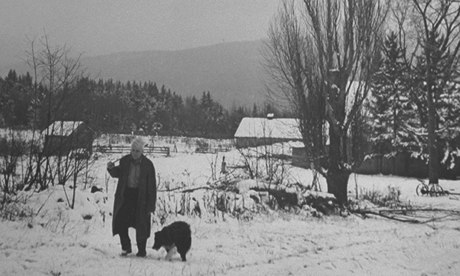
you said it, rather casually, as snow
went on falling in Vermont years ago.

David Ray   ‘Music of Time: Selected and New Poems’ 2006

9780978578244_p0_v1_s192x300.jpg


‘It Couldn’t Be Done’ a poem by Edgar Albert Guest


How many of us have been motivated by someone telling us ‘it couldn’t be done?’

In September 2007 Randy Pausch, professor and founder of the Carnegie Mellon Entertainment Technology Center, enumerated the brick walls he climbed to achieve his childhood dreams. The message of his now famous ‘Last Lecture’ was about overcoming obstacles, reframing our perception of obstruction.

“…the brick walls are there for a reason. The brick walls are not there to keep us out. The brick walls are there to give us a chance to show how badly we want something. Because the brick walls are there to stop the people who don’t want it badly enough. They’re there to stop the other people.”

Ninety years earlier, Edgar Albert Guest published his poem ‘It Couldn’t Be Done’. Paired with Pausch’s ‘Last Lecture’, this week’s Friday Poem encourages the Class of 2016 to follow their dreams, and not be sidetracked by the doubters.


It Couldn’t Be Done
Somebody said that it couldn’t be done
But he with a chuckle replied
That “maybe it couldn’t,” but he would be one
Who wouldn’t say so till he’d tried.
So he buckled right in with the trace of a grin
On his face. If he worried he hid it.
He started to sing as he tackled the thing
That couldn’t be done, and he did it!

Somebody scoffed: “Oh, you’ll never do that;
At least no one ever has done it;”
But he took off his coat and he took off his hat
And the first thing we knew he’d begun it.
With a lift of his chin and a bit of a grin,
Without any doubting or quiddit,
He started to sing as he tackled the thing
That couldn’t be done, and he did it.

There are thousands to tell you it cannot be done,
There are thousands to prophesy failure,
There are thousands to point out to you one by one,
The dangers that wait to assail you.
But just buckle in with a bit of a grin,
Just take off your coat and go to it;
Just start in to sing as you tackle the thing
That “cannot be done,” and you’ll do it.

Edgar Albert Guest   1917

51Si0nTDrXL._SX331_BO1,204,203,200_

‘A Way Back To Then’ words and music by Jeff Bowen

The Friday Poem this week comes from the one act musical, [title of show], which ran on Broadway for 102 performances in 2008. ‘A Way Back To Then’ was written by Jeff Bowen.

I discovered the words and music while listening to the ‘On Broadway’ channel as we drove across country this week.

This one is for all the dreamers, as a reminder that “when you least expect, opportunity walks through the door…and there you are, right in the middle of what you love…”

‘Finding My Way Back To Then’

Dancing in the backyard
Kool-aid moustache and butterfly wings
Hearing Andrea McArdle sing
From the hi-fi in the den
I’ve been waiting my whole life
To find a way back to then

I aimed for the sky
A nine-year-old can see so far
I’ll conquer the world and be a star
I’ll do it all by the time I’m ten
I would know that confidence
If I knew a way back to then

So I bailed on my hometown
And became a college theatre dork
I was eastbound and down
Moving to New York
So I crammed my life in a U-Haul
To find my part of it all

But the mundane sets in
We play by the rules
And plough through the days
The years take us miles away
From the time we wondered when
We’d find a way back to then

And when you least expect
Opportunity walks through the door
You suddenly connect
With the thing that you forgot
That you were looking for

And there you are
Right in the middle of what you love
With the craziest of company
You’re having a kick-ass time
And being who you wanted to be in this world

You’re that little girl
With her wings unfurled
Flying again
Back in your backyard dancing
I found a way back to then.