‘Poet’s work’ a poem by Lorine Niedecker

Do you remember the first bit of career advice you received from a grown-up? Poet Lorine Niedecker captured the advice given to her and her subsequent career choice in ‘Poet’s Work’ this week’s Friday Poem. “She is admired for the subtlety of her tightly crafted, nuanced and deliciously ironic poems, as well as for her total devotion to her calling.”

The biographical summary on the Poetry Foundation site describes the work of this twentieth century rural Wisconsin poet.

“Niedecker’s verse is praised for its stark, vivid imagery, subtle rhythms, and spare language…Concerned with the distillation of images and thoughts into concise expression, Niedecker described her work as a “condensery,” and several critics have compared her poetry to the delicate yet concrete verse of Chinese and Japanese writers. Although Niedecker’s long correspondence with Louis Zukofsky, who frequently submitted her poems to the journal, Origin, and contact with such respected writers as Cid Corman and Basil Bunting, brought her some critical notice, her work was generally overlooked until late in her life. Since her death in 1970, several critics have identified Niedecker as a significant and original voice in contemporary American poetry.”

Poet’s work

Grandfather
advised me:
Learn a trade

I learned
to sit at desk
and condense

No layoff
from this
condensery

A complete collection of her work was published by The University of California Press in 2004.

‘My Triumph’ a poem by John Greenleaf Whittier

The ‘Friday Poem’ this week marks the autumnal equinox with the words of American poet, John Greenleaf Whittier. The name may be familiar only in the memory of attending a ‘Whittier Elementary School’. Whittier was a courageous abolitionist whose essays and poems provided a way to communicate his views.

“His first book, Legends of New England in Prose and Verse, was published in 1831; from then until the Civil War, he wrote essays and articles as well as poems, almost all of which were concerned with abolition. In 1833 he wrote Justice and Expedience urging immediate abolition. In 1834 he was elected as a Whig for one term to the Massachusetts legislature; mobbed and stoned in Concord, New Hampshire, in 1835. He moved in 1836 to Amesbury, Massachusetts, where he worked for the American Anti-Slavery Society. During his tenure as editor of the Pennsylvania Freeman, in May 1838, the paper’s offices burned to the ground and were sacked during the destruction of Pennsylvania Hall by a mob.”

The Civil War was a turning point in his writing. Until his death in 1892 he wrote of religion, nature and rural life. ‘My Triumph’, written in 1870 reflects on seasonal and life transitions.

My Triumph

The autumn-time has come;
On woods that dream of bloom,
And over purpling vines,
The low sun fainter shines.

The aster-flower is failing,
The hazel’s gold is paling;
Yet overhead more near
The eternal stars appear!

And present gratitude
Insures the future’s good,
And for the things I see
I trust the things to be;

That in the paths untrod,
And the long days of God,
My feet shall still be led,
My heart be comforted.

O living friends who love me!
O dear ones gone above me!
Careless of other fame,
I leave to you my name.

Hide it from idle praises,
Save it from evil phrases:
Why, when dear lips that spake it
Are dumb, should strangers wake it?

Let the thick curtain fall;
I better know than all
How little I have gained,
How vast the unattained.

Not by the page word-painted
Let life be banned or sainted:
Deeper than written scroll
The colors of the soul.

Sweeter than any sung
My songs that found no tongue;
Nobler than any fact
My wish that failed of act.

Others shall sing the song,
Others shall right the wrong,—
Finish what I begin,
And all I fail of win.

What matter, I or they?
Mine or another’s day,
So the right word be said
And life the sweeter made?

Hail to the coming singers!
Hail to the brave light-bringers!
Forward I reach and share
All that they sing and dare.

The airs of heaven blow o’er me;
A glory shines before me
Of what mankind shall be,—
Pure, generous, brave, and free.

A dream of man and woman
Diviner but still human,
Solving the riddle old,
Shaping the Age of Gold!

The love of God and neighbor;
An equal-handed labor;
The richer life, where beauty
Walks hand in hand with duty.

Ring, bells in unreared steeples,
The joy of unborn peoples!
Sound, trumpets far off blown,
Your triumph is my own!

Parcel and part of all,
I keep the festival,
Fore-reach the good to be,
And share the victory.

I feel the earth move sunward,
I join the great march onward,
And take, by faith, while living,
My freehold of thanksgiving.

John Greenleaf Whittier  1870

‘A Man May Change’ a poem by Marvin Bell

Every four years we discover Iowa through the lens of the presidential primary. This week’s Friday Poem comes from Iowa’s first poet laureate, Marvin Bell. He was on the faculty of the University of Iowa until 2005 and toured with the garage band of authors, ‘The Rock Bottom Remainders’.

In a world of work where change is a constant, we may miss the slow erosion of self@work. “…it sometimes happens that a man has changed so slowly that he slips away before anyone notices and lives and dies before anyone can find out.”

A Man May Change

As simply as a self-effacing bar of soap
escaping by indiscernible degrees in the wash water
is how a man may change
and still hour by hour continue in his job.
There in the mirror he appears to be on fire
but here at the office he is dust.
So long as there remains a little moisture in the stains,
he stands easily on the pavement
and moves fluidly through the corridors. If only one
cloud can be seen, it is enough to know of others,
and life stands on the brink. It rains
or it doesn’t, or it rains and it rains again.
But let it go on raining for forty days and nights
or let the sun bake the ground for as long,
and it isn’t life, just life, anymore, it’s living.
In the meantime, in the regular weather of ordinary days,
it sometimes happens that a man has changed
so slowly that he slips away
before anyone notices
and lives and dies before anyone can find out.

Marvin Bell  Nightworks: Poems 1962-2000

‘Something Left Undone’ a poem by Henry Wadsworth Longfellow

As the Labor Day weekend begins, we are all probably leaving some work undone. Our Monday intentions were the best, to run through a list and finish them all by week’s end. But interruptions, distractions, and previously unscheduled meetings diverted us from the task.

The poet Henry Wadsworth Longfellow captures the feeling of the accumulating burden in this weeks’ Friday poem, Something Left Undone.

Something Left Undone

Labor with what zeal we will,
Something still remains undone,
Something uncompleted still
Waits the rising of the sun.
By the bedside, on the stair,
At the threshold, near the gates,
With its menace or its prayer,
Like a mendicant it waits;
Waits, and will not go away;
Waits, and will not be gainsaid;
By the cares of yesterday
Each to-day is heavier made;
Till at length the burden seems
Greater than our strength can bear,
Heavy as the weight of dreams,
Pressing on us everywhere.
And we stand from day to day,
Like the dwarfs of times gone by,
Who, as Northern legends say,
On their shoulders held the sky.

Henry Wadsworth Longfellow, Birds of Passage 1863

‘The End of Summer’ a poem by Rachel Hadas

It’s only a week until the ‘unofficial’ end of summer, the Labor Day holiday, celebrated in parades and barbecues. As the gravitational pull of work strengthens, resist for one more moment in the poetry of translator, professor and essayist Rachel Hadas

The Friday Poem this week is ‘The End of Summer’ from her collection ‘Halfway Down the Hall: New & Selected Poems’.

The End of Summer

Sweet smell of phlox drifting across the lawn—
an early warning of the end of summer.
August is fading fast, and by September
the little purple flowers will all be gone.

Season, project, and vacation done.
One more year in everybody’s life.
Add a notch to the old hunting knife
Time keeps testing with a horny thumb.

Over the summer months hung an unspoken
aura of urgency. In late July
galactic pulsings filled the midnight sky
like silent screaming, so that, strangely woken,

we looked at one another in the dark,
then at the milky magical debris
arcing across, dwarfing our meek mortality.
There were two ways to live: get on with work,

redeem the time, ignore the imminence
of cataclysm; or else take it slow,
be as tranquil as the neighbors’ cow
we love to tickle through the barbed wire fence
(she paces through her days in massive innocence,
or, seeing green pastures, we imagine so).

In fact, not being cows, we have no choice.
Summer or winter, country, city, we
are prisoners from the start and automatically,
hemmed in, harangued by the one clamorous voice.

Not light but language shocks us out of sleep
ideas of doom transformed to meteors
we translate back to portents of the wars
looming above the nervous watch we keep.

Rachel Hadas, “The End of Summer” from Halfway Down the Hall: New and Selected Poems, 1998

‘Summer Wind’ a poem by William Cullen Bryant

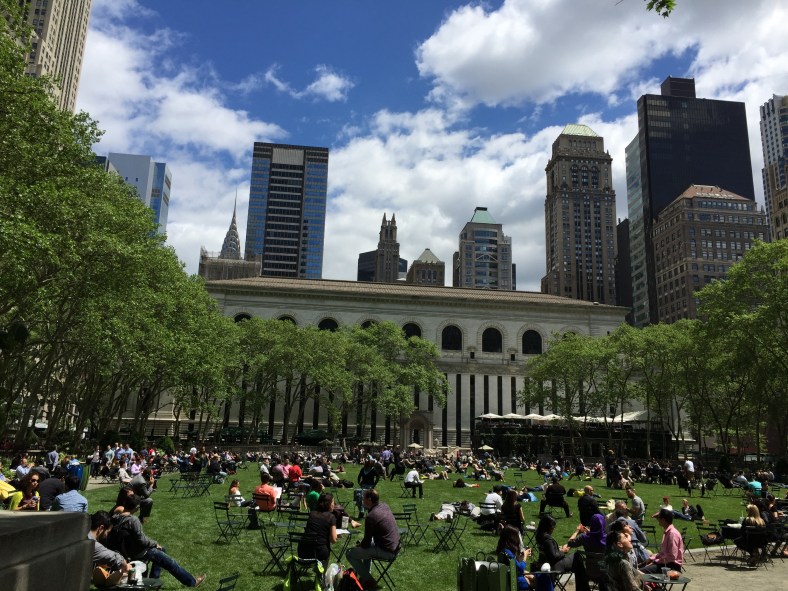
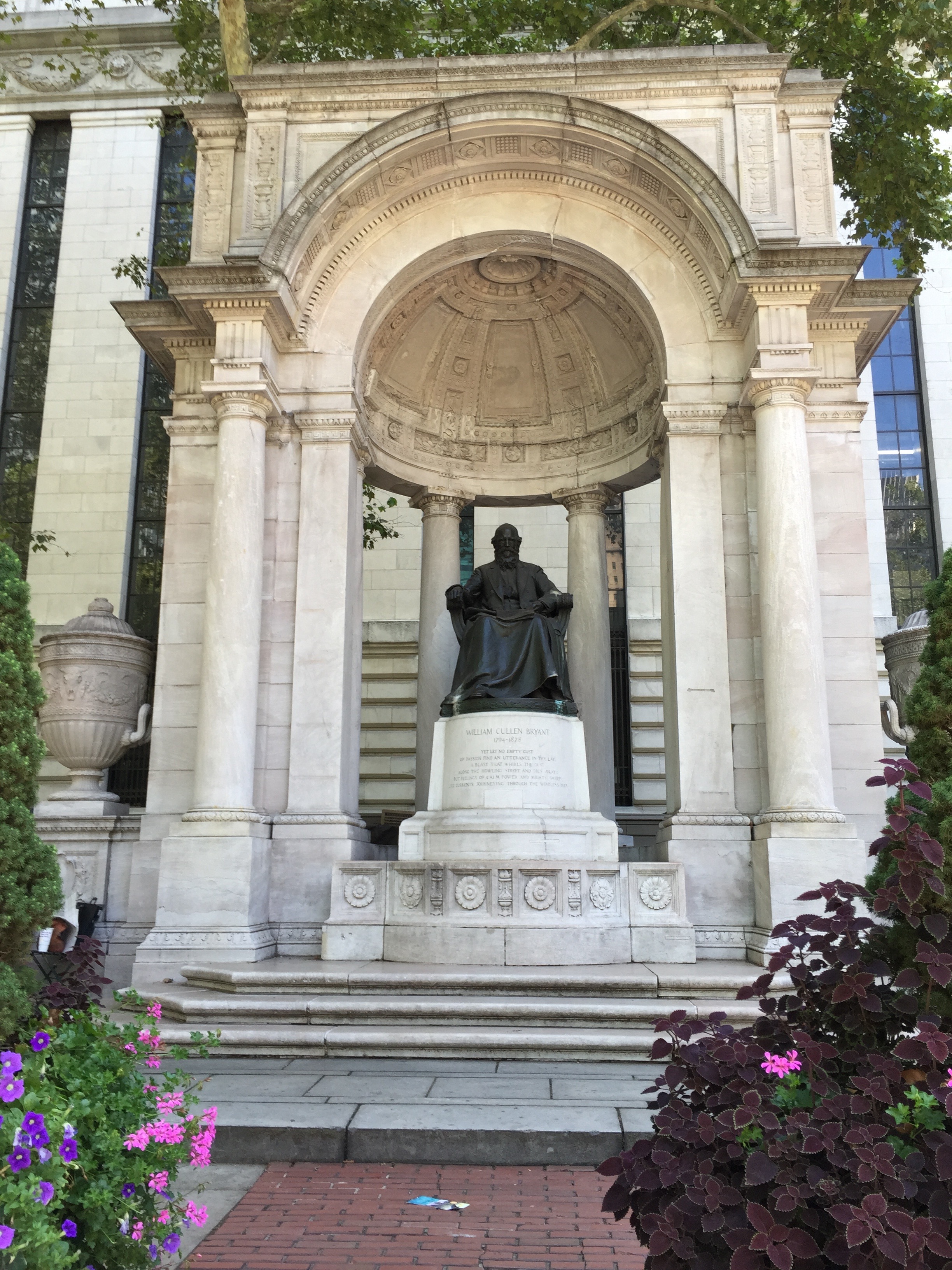
If you are in midtown Manhattan on a summer afternoon you may want to take a break from work in Bryant Park. The park’s namesake is honored in a bronze memorial sculpted by Herbert Adams. From his pedestal on the rear terrace of the New York Public Library William Cullen Bryant presides over generations of fellow New Yorkers.

Bryant arrived in New York in 1826 to become assistant editor of the New York Evening Post, founded in 1801 by Alexander Hamilton. He his tenure with the paper would last five decades. He became one of America’s most popular poets, a civic leader and led the effort to create Central Park.

“No line of his poetry survives in the consciousness of his nation, and none of his editorial pronouncements still resonates from his five decades with the New-York Evening Post, yet William Cullen Bryant stood among the most celebrated figures in the frieze of nineteenth-century America. The fame he won as a poet while in his youth remained with him as he entered his eighties; only Longfellow and Emerson were his rivals in popularity over the course of his life.” (Poetry Foundation)

His memorial was dedicated in 1911, coinciding with completion of construction on the library.

bryant

The Friday poem this week is ‘Summer Wind’ by William Cullen Bryant.

The poem was one of a series of 23 he submitted for publication in the Literary Gazette in 1824 while he was practicing law in Massachusetts. The image created by his verse recalls his memory of the landscape in the Berkshires.

Take a seat on one of those less than comfortable folding green chairs in Bryant Park and enjoy the Friday poem.

Summer Wind

It is a sultry day; the sun has drunk
The dew that lay upon the morning grass;
There is no rustling in the lofty elm
That canopies my dwelling, and its shade
Scarce cools me. All is silent, save the faint
And interrupted murmur of the bee,
Settling on the sick flowers, and then again
Instantly on the wing. The plants around
Feel the too potent fervors: the tall maize
Rolls up its long green leaves; the clover droops
Its tender foliage, and declines its blooms.
But far in the fierce sunshine tower the hills,
With all their growth of woods, silent and stern,
As if the scorching heat and dazzling light
Were but an element they loved. Bright clouds,
Motionless pillars of the brazen heaven–
Their bases on the mountains–their white tops
Shining in the far ether–fire the air
With a reflected radiance, and make turn
The gazer’s eye away. For me, I lie
Languidly in the shade, where the thick turf,
Yet virgin from the kisses of the sun,
Retains some freshness, and I woo the wind
That still delays his coming. Why so slow,
Gentle and voluble spirit of the air?
Oh, come and breathe upon the fainting earth
Coolness and life! Is it that in his caves
He hears me? See, on yonder woody ridge,
The pine is bending his proud top, and now
Among the nearer groves, chestnut and oak
Are tossing their green boughs about. He comes;
Lo, where the grassy meadow runs in waves!
The deep distressful silence of the scene
Breaks up with mingling of unnumbered sounds
And universal motion. He is come,
Shaking a shower of blossoms from the shrubs,
And bearing on their fragrance; and he brings
Music of birds, and rustling of young boughs,
And sound of swaying branches, and the voice
Of distant waterfalls. All the green herbs
Are stirring in his breath; a thousand flowers,
By the road-side and the borders of the brook,
Nod gayly to each other; glossy leaves
Are twinkling in the sun, as if the dew
Were on them yet, and silver waters break
Into small waves and sparkle as he comes.

William Cullen Bryant  1824