The Saturday Read ‘Wild Man: Patagonia’s conflicted philosopher-king’ by Nick Paumgarten

The Saturday Read this week is journalist Nick Paumgarten‘s profile of the “tiny terror”, Yvon Chouinard, founder of the outdoor clothing and gear company, Patagonia.

If you are not familiar with Patagonia, “Our Reason for Being” provides a concise tutorial.

“Patagonia grew out of a small company that made tools for climbers. Alpinism remains at the heart of a worldwide business that still makes clothes for climbing – as well as for skiing, snowboarding, surfing, fly fishing, paddling and trail running. These are all silent sports. None require a motor; none deliver the cheers of a crowd. In each sport, reward comes in the form of hard-won grace and moments of connection between us and nature.

Our values reflect those of a business started by a band of climbers and surfers, and the minimalist style they promoted. The approach we take towards product design demonstrates a bias for simplicity and utility.

For us at Patagonia, a love of wild and beautiful places demands participation in the fight to save them, and to help reverse the steep decline in the overall environmental health of our planet. We donate our time, services and at least 1% of our sales to hundreds of grassroots environmental groups all over the world who work to help reverse the tide.”

“Wild Man” is the story of how Chouinard’s career evolved over time, rooted in love and respect for nature. It’s an entrepreneur’s journey, with cameo appearances by familiar names: journalist Tom Brokaw, The North Face founder, Doug Tompkins, Royal Robbins and Tom Frost.

Nick Paumgarten’s first connection to Patagonia came in 1992 when he “had a job answering phones at Patagonia’s mail-order office, in Bozeman, Montana…As far as qualifications, I was another city kid, but I’d been out in nature a bit and was, in descending order of aptitude, a skier, whitewater kayaker, backpacker, mountain biker, and fly-rod flailer. I had come of age poring over the Patagonia catalogue, with its action shots and exotic locales, and I already had Yvon Chouinard right up there with Jack Kerouac and Jimi Hendrix on my list of great Americans. Plus, I liked the idea of getting good gear at a discount.”

When Paumgarten decides to leave the job early, he gets his first inkling of Patagonia’s corporate culture.

“I quit the job before I was supposed to, in order to go on a ski trip. Of the two women who’d hired me, one was angry and the other understanding. Their reaction embodied an intrinsic schizophrenia at Patagonia. Chouinard had always encouraged his employees to cut work and go surfing when the swell came in. But it was also a company trying to claw its way out of a hole.”

Patagonia survived the economic challenges of the early nineties with layoffs and loans “from a friend and from some Argentines who wanted to get their money out of the country.”

“It was hard,” Chouinard said. “I realized we were just growing for the sake of growing, which is bullshit.”

“The company, he worried, was straying from its hard-core origins. “I was faced with the prospect of owning a billion-dollar company, with thousands of employees making ‘outdoorlike’ clothing for posers,” he said early in 1991, in a speech to the employees, in which he outlined his misgivings and his new resolutions. These subsequently appeared in the Patagonia catalogue, as a manifesto, under the heading “The Next Hundred Years.”

This ‘long read’ is a primer for the aspiring entrepreneur. It’s a vivid narrative of the progression of one man’s career from childhood dreams of being a fur trapper, to climber, private detective, surfer and blacksmith; proving there are no straight career paths. Its also a lesson in failure, resilience and a realization over time that success can be a double- edged sword.

“Eco-conscious fun-hoggery, as an ethos, a culture, a life style, and an industry, spans the world, and even rules some corners of it. Chouinard is its best-known avatar and entrepreneur, its principal originator and philosopher-king, and is as responsible as anyone for guiding it from the primitive tin-can and hobnail aesthetic of the mid-twentieth century to the slackline and dome-tent attitude of today. He has made it more comfortable, and more glamorous, to be outside, in harsh conditions. His influence is way out of proportion to his revenue footprint. He has mixed feelings about all this—some apprehension about the world he has made. He celebrates the spread of an ecological consciousness but laments the disappearance of danger and novelty, and the way that the wilderness has become a hobby, or even a vocation. He disdains ski areas (“They’re golf courses”), the idea of professional climbing (“I just don’t like the whole paid-climber thing”), and the proliferation of extreme sports as programming and marketing (“Red Bull’s in the snuff-film business”).”

Malinda Chouinard, Yvon’s wife and business partner, was a pioneer in ‘on-site daycare’ and in 2012 her efforts resulted in Patagonia becoming “the first California business to become a B Corp.”

“Malinda is principally responsible for making the company a notably humane place to work. Many there cite the advantage of having day care on site. In 1985, Malinda created (and has since put aside a vast patchwork of space for) what became known as the Great Pacific Child Development Center, to which I didn’t give much consideration, until I got a tour. A staff of twenty-eight oversees some eighty kids, on sprawling grounds of more than twelve thousand square feet, roughly half of it outdoors, among the fruit trees. A recent baby boom had led to another expansion, which displaced the H.R. department to a trailer. “We’ve raised fifteen hundred kids so far,” Chouinard told me. “None of them have been in prison—that I know of, anyway.”

Chouinard’s management style?

“I’m just the owner.” He called his executive style “management by absence.” He used to read business books and study various executive styles and corporate structures, here and abroad, but he prefers to take his lessons from nature—from ant colonies, for example. “There’s no management,” he said. “Every ant just does his job. They communicate and figure it out. It’s like a Navy seal team. The whole team has to agree on what the mission is.” It’s also true, however, that Chouinard’s occasionally whimsical notions send the ants scurrying. Absent or not, he’s still the big ant.”

There are multiple gems of wisdom interspersed throughout the profile. When asked “if the prospect of death bothered him”, he shared his secret to a good life.

“Nah, I’ve always considered death to be a part of life,” he said. “Tell you the secret to a good life: always be the oldest one in the room.”


Photo credit: Patagonia annual report

The Saturday Read ‘New York Fashion Week: An Oral History’

‘The Saturday Read’ this week is an online interactive feature from the September 8, 2016 New York Times ‘Thursday Styles’ section, capturing a multi-media moment in fashion history as the baton is being passed to the next generation of designers. Ruth La Ferla brings us ‘Our Stories’, an oral history from fashion icons Ralph Lauren, Donna Karan, Calvin Klein, Carolina Herrera, Michael Kors, Issac Mizrahi and Alexander Wang.

This one is for all of you who are first to the newsstand for the September issues of Vogue and Harpers Bazaar, hoping to find a few classical wardrobe elements to update your look for fall. Designer outlets may be the closest most of us get to the runway, but many aspire to a career in one of the global capitals of fashion.

“As New York Fashion Week approaches its 75th year (the first official shows, massed under the heading of Press Week, were held in 1943), with 151 shows spread over nine days, many designers are questioning the future of this semiannual gathering. “We are facing the end of an era,” the designer Diane von Furstenberg said in a recent interview. “But there is nothing nostalgic about that. The future will be more exciting.”

The future may well be exciting, but for many in the industry, the past is one to savor and celebrate. Here, a crowd of fashion notables reflect on their experiences: the good, the bad, the awkward and the forever memorable.”

From their “first shows”, through the “unforgettable moments”, “growing pains”, “the glamour girls” and the “dark days” as AIDS devastated the industry, the top designers, models and fashion commentators share their success, and the mistakes along the way to being installed as icons. If you believe we learn from the wisdom of others, this interactive experience is required reading/viewing.

Here’s a sample.

ZAC POSEN

“In February 2002, when I showed my first collection, I did the setup preshow in my parents’ living room. I had done the collection with small seed money that was generally lent by friends, family and with my savings from the lemonade stand that I had started as a kid on Spring Street.”

ALEXANDER WANG

“Our first fashion week show, for fall 2007, was in a Chelsea warehouse. It was hectic backstage. I remember our casting director freaking out because all the models and dressers (who also happened to be my best friends) were eating greasy pizza, and the director was like, “Where’s Alex?” I was right there eating pizza, too. I guess I didn’t know any better.”

DONNA KARAN

“The turning point came in 1985 when I left Anne Klein. At the time I said to my bosses, “I have this vision for a little company.” Women in those years were wearing shirts and little ties to the office. I asked myself: “Where is the sexuality? Where is the comfort? Where are the clothes that go from day into night? How do you travel with your wardrobe in one bag?” And that’s how the Seven Easy Pieces came about.”

ALEK WEK
Model in the 1990s

“When I started modeling, people kept saying, “Oh, she’s so different, she’s bizarre,” like I wasn’t quite normal. Of course there was a racist element to those conversations. People were beating around the bush. But if I focused on that, I don’t think I would have stayed in fashion. Being viewed as different only gave me more incentive. I wanted people to know that your features or your color don’t make you less beautiful. My motivation was deeper than me just putting on makeup and clothes and doing shows.”

SIMON DOONAN

“All those people perished, and now many young people maybe don’t even know that Perry Ellis was an actual person. Many young African-American designers would be inspired to know how many great African-Americans had careers at the time.

These people didn’t all just get on a bus and drive off somewhere. They died excruciating deaths, some in the hallways of hospitals without help or support. In many instances, their families rejected them. I distinctly remember people who didn’t have a funeral or memorial. I had a friend who was buried in an unmarked grave.

It’s always troubled me that these supertalented original thinkers weren’t adequately memorialized.

They were Patrick Kelly, Angel Estrada, Isaia, Clovis Ruffin, Halston, Antonio Lopez and Juan Ramos, Tina Chow, Tim Hawkins, Robert Hayes and Laughlin Barker. And the photographers: David Seidner, Barry McKinley, Herb Ritts, Bill King and so many more. They were window-dresser friends: Bob Currie, Michael Cipriano, Bob Benzio, Stephen Di Petrie. The list goes on.”


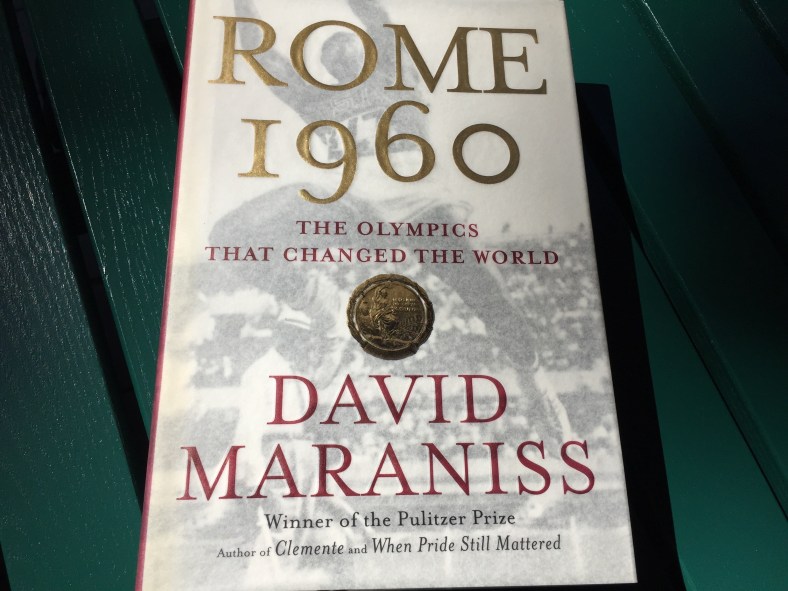
The Saturday Read ‘Rome 1960:The Olympics That Changed The World’ by David Maraniss

For the last weekend of summer 2016, the Saturday Read takes you to ‘Rome 1960: The Olympics That Changed The World’ by Pulitzer Prize winning journalist, David Maraniss.

In the summer of 1960 only 15 years had passed since the end of World War II. The superpowers were angling for global influence, and the XVII Olympiad in Rome provided one more stage to showcase the benefits of competing forms of government.

“History is replete with moments that ache with misplaced optimism, and that seemed true of the period of the 1960 Summer Olympics even as signs of a troubled world riddled those days of late August and early September. The Games were bookended by the Soviet spy trial of American U-2 pilot Frances Gary Powers and Khrushchev’s threat to stir up things at the UN, while in between came increasing tension in divided Berlin and violence in the rebellious Congo. Whatever Avery Brundage’s wishes, the Olympics were in no way isolated from the eruptions and disruptions of the modern world. Rome had its share of spies and propagandists looking to turn every situation to their advantage. Yet those days in Rome were infused with a golden hue nonetheless. The shimmering was literal – emanating from the autumnal sun; the ancient coloration of the streets, walls, and piazzas; the warm angles of refracted light – but it was also figurative, an illumining that comes with a moment of historical transition, when one era is dying and another is being born.”

The reader experiences the eighteen days of the Rome Olympics through Maraniss’ chronicle of events, athletes, coaches, sports writers, and a few nefarious government players. The narrative introduces us to the Americans and their competitors. It’s quite a cast of characters including then Cassius Clay, Rafer Johnson, C.K. Yang, Wilma Rudolph, and Abebe Bikila.

“The pressures of the cold war played an underappreciated role in forcing change in culture and sports, all much in evidence in Rome. At the opening Parade of Nations at the Stadio Olympico, the crowd was stirred by the sight of Rafer Johnson marching into the arena at the head of the U.S. delegation, the first black athlete to carry the American flag. Johnson’s historic act reflected his unsurpassed status as a world-class decathlete, but it also served as a symbolic weapon at a time when the United States was promoting freedom abroad but struggling to answer blatant racism at home, where millions of Americans were denied freedom because of the color of their skin.”

The author is at his best when sharing the story of Coach Edward Temple and his ‘Tigerbelles’ women’s track team from the Tennessee Agricultural and Industrial State University in Nashville. We time travel to an American South before the Civil Rights Act of 1964, when women’s sports were viewed as unimpressive adjuncts to the men’s competition.

“When Temple was named head coach at Tennessee A&I State after graduating in 1950, it was because nobody else wanted the job. His starting salary was $150 a month, which when added to his pay for teaching social science courses, brought a yearly sum of $5,196…By the mid fifties, even after Temple had established his program and led it to a national title, the athletic department still would not give him a desk, let alone an office. “

In Rome, as Olympic coach, Temple could only see a segment of the track from his position at the opening of the tunnel. One of his runners, Wilma Rudolph, who had overcome polio as a child, was competing in the 100 meter race. The day before, ‘Black Tuesday’, the U.S. men’s track and field team suffered its worst losses in the 100 meter, 200 meter, and 4×100 meter relay.

“Wilma won! Wilma won!” someone shouted at Temple in the tunnel. “You’re joking,” he said. Then he stepped into the golden late afternoon sunlight, and “they flashed it on the big scoreboard and put the time, the new Olympic record, ‘Wilma Rudolph, USA.’ and I said, ‘Hot Dog!’.

Earlier in the competition, Ed Temple’s greatest hope was just to get one of his runners on the medal stand. A bronze would do. But in the four days since Wilma Rudolph  won gold in the 100, all of that had changed. From a relative unknown, Rudolph had risen to international stardom, belle of the Olympics, the favorite in anything she did.”

Her success resonated with other athletes, including Anne Warner, a gold medal swimmer.

“I had read the stories about her fight against polio and what she had done. She was really a hero for a lot of us. It didn’t matter that it was a different sport. She was just such a beautiful runner. And I think that polio was such a part of our lives then, too, because we were swimmers. A lot of times your parents were nervous about going to swimming pools in that era. And there was no Salk vaccine yet when we were starting out. So the fact that she had polio meant something special to us.”

Maraniss’ command of the story places the reader ‘on location’ as events unfold.

Rafer Johnson was student body president at UCLA and a member of the track and field team along with CK Yang. On September 5, 1960 they met as competitors for the title of the world’s greatest athlete; Johnson representing the United States and C.K. Yang, Formosa. At the end of the first day of decathlon competition  Johnson led Yang by a slim 55 points.

“Few Olympic athletes know one another as thoroughly as Rafer Johnson and C.K. Yang. It was not that both had trained at UCLA for the same event under the same coaches. A deeper sensibility seemed at work in their symbiotic relationship, a spirited blend of admiration and competitiveness that pushed them to greater accomplishments together than they may have achieved apart.”

Across town, Cassius Clay was the unanimous winner in his bout with Zbigniew Pietrzkowski of Poland.

“Everyone seemed up and about early Tuesday morning. Cassius Clay paraded through the village before breakfast, gold medal dangling rom his neck. “I got to show this thing off!” he kept boasting…He was on his way to signing a professional contract, earning serious money, and becoming even more famous as the heavyweight champion of the world.”

Tuesday was day two of the decathlon.

“After back-to-back fourteen-hour days, ten events, draining humidity, evening chill, rain delays, unbearable tension, and the accumulation of an Olympic record 8392 points, (by the scoring system in 1960), Rafer Johnson left the Stadio Olimpico for the last time at eleven o’clock that night, retracing the steps he had taken nearly two weeks earlier as the captain and flag bearer for the U.S. Olympic team. As he trudged, relieved and exhausted, along the moonlit Tiber and over the bridge, C.K. Yang, now just a friend, no longer a competitor, walked once again at his side.”

The marathon was held on the final full day of competition in 1960. It was to produce one of the most remarkable stories in Olympic history.

Abebe Bikila of Ethiopia waited at the start, barefoot.

“Marathons traditionally were held during daylight and ended with the runners entering the main stadium…In the heat of Rome, the race began at twilight and proceeded into darkness; the finish line was not inside the Stadio Olympico but at the Arch of Constantine amid the Roman ruins.

The British writer Neil Allen, from his seat jammed amid his fellow journalists, feeling “the sudden chill of the night” and looking “dazedly at the floodlit Arch of Constantine,” could not believe it when the loudspeaker crackled the name of the leader, Abebe Bikila…”A completely unknown athlete from Ethiopia was going to win the Olympic marathon…Journalists and officials edged forward in their wooden stands, peering along the darkness of the Appian Way hoping to be the first to spot this last and most unexpected hero of the Games.” At last the lights of a convoy could be seen…There was a brief tussle with one of the persistent Lambretta scooters before it was bundled our of the way, and then – here he came!

The Rome Olympics were the first commercially televised summer games in history. In New York, Jim McKay was beginning his career in TV sports from a small studio in New York.

“It was all so minimal in Rome, with McKay in that little studio in New York, tapping our his own scripts on a portable typewriter, drawing information fro the Encyclopedia Britannica; and with Peter Molnar’s crew of fewer than fifty in Rome filming and editing on the fly, literally trying to beat the clock every night with their canisters winging west toward New York City in the bellies of commercial jets. The televising of the Olympic games grew from that infancy in Rome to an extravaganza, expanding every four years into an ever-larger enterprise that eventually entailed a broadcast army…”

As Rome prepares it’s bid to host the 2020 Olympics, enjoy David Maraniss’ account of the  first time the world came to compete for gold in ‘The Eternal City’.


The Saturday Read -‘How to Be an Explorer of the World: Portable Life Museum’ by Keri Smith

This is the first ‘Saturday Read’ that comes with a warning.

“! Warning to whomever has just picked up this book. If you find you are unable to use your imagination, you should put this book back immediately. It is not for you. In this book you will be repeatedly asked to…suspend your disbelief, complete tasks that make you feel a bit strange, look at the world in ways that make you think differently, conduct experiments on a regular basis, and see inanimate objects as alive.” 

If you need to improve your CQ (curiosity quotient), this week’s selection from author, illustrator and guerrilla artist, Keri Smith‘How to Be an Explorer of the World: Portable Life Museum’ is for you.

Author Smith invites the reader on a journey of discovery, loosely following a 13 point guide, which includes a “fieldwork section in the back of the book to record and discover findings.”

“You might want to think of this book as you metaphorical suitcase. A place to collect and document your findings. How do you see? It is also a museum. Your very own museum that will contain your unique vision of the world.”

After a couple of incredibly depressing weeks of global events, I was browsing the selection at Main Street Books in ‘downtown’ Davidson, North Carolina last weekend, when this book cover demanded I stop, open, and return to the wonder of our world; starting right where we sit. I was ready to pack my “metaphorical suitcase” and explore an alternate reality.

Here’s the other warning that should come with this book. ‘May be habit-forming.’

On page 13 ‘your mission’, if you choose to accept, is explained.

“The following pages include a variety of prompts and assignments that will help you on your travels. There is also a section on tools and techniques that will help you with documenting methods. You may use the worksheets included or create your own. Remember, all of your most important tools exist in your body! Use them. Collect as much data as you can – it may come in handing later on. Good luck on your journey.”

How to be an explorer? “Always be looking. Everything is interesting. Notice patterns, make connections. Use all of the senses in your investigations.” (and more)

Here’s an example, from the page I opened to first. “Exploration#7 World of Color”

“Collect paint chips from a paint or hardware store. Find colors you respond to in the world. Attempt to match them using the chips. ( You can also match the colors using a portable paint set.) Make notes of where you saw the colors. (Example: color #573 four leaf clover – My scarf, color #308 golden vista – Sunset 01/09/08)

Alternate: document colors from your favorite books, your dreams, your memories.”

There are 59 explorations that tease your inner Picasso or Shackleton, the last being “How to Wander Aimlessly”. This is a book for those of you on vacation, who missed the point of your break :“freedom or release from duty, business, or activity.”

How do you wander aimlessly? “Pay attention to the details. Lose all sense of time and place.” Reinhabit you inner four year old.

This book will plaster a smile on the crankiest visage.

In a month when the release of Pokemon Go has launched thousands of new adventures, ‘How to Be an Explorer of the World’ will reconnect you with a simpler time when all you needed for entertainment was a big box and an imagination to occupy yourself for hours.


The Saturday Read ‘The Missing of the Somme’ by Geoff Dyer

Geoff Dyer has a new book out this summer, ‘White Sands: Experiences From the Outside World’ , but it’s a book originally published in 1994 that is The Saturday Read this week – ‘The Missing of The Somme’.

Dyer may defy categorization as an author, but one constant in his writing, is a theme of travel, highlighted by his publisher in a description of the current title.

“Weaving stories about places to which he has recently traveled with images and memories that have persisted since childhood, Dyer tries “to work out what a certain place—a certain way of marking the landscape—means; what it’s trying to tell us; what we go to it for.”

‘The Missing of the Somme’ begins with the images and memory of his grandfather and continues on a road trip through the great war battlefields, pristinely kept, to ensure memory.

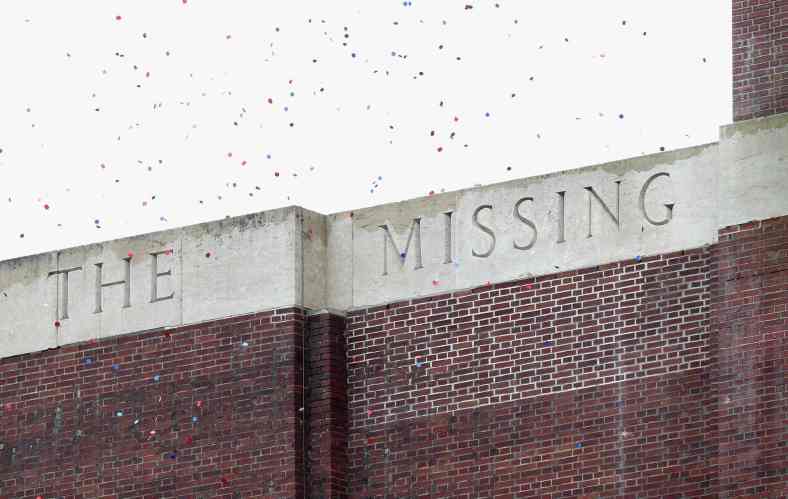
IMG_4961.jpg

The title comes from the memorial at Thiepval, France to ‘The Missing of the Somme’. The 131 pages explore the landscape of France and Belgium in an extended essay exploring the monuments, cemeteries, and literature that materialized from a time of “fear that people would forget”. A time when ‘soldier poets’ emerged from the battlefields to create a literary narrative of events, in contrast to the propaganda of the media.

This is Dyer’s strength in storytelling. You think you have opened a ‘war book’ and you find you have signed on for an unexpected adventure. The ‘origin’ story of the book is itself a tangent. He originally moved to Paris in the early 90’s to write a novel based on Fitzgerald’s ‘Tender is the Night’, and ended up writing a book about world war one. (F. Scott does make an appearance.)

In a 2013 Paris Review interview, Dyer addressed reader’s expectations, as a function of a publisher/marketer definition.

“I think the distinction between fiction and nonfiction is less about “Did it really happen or was it made up?” than it is about form. And, more than form, it’s about the expectations that are brought to certain forms. According to how a book is presented, packaged, or identified, readers have certain expectations. Following from that they expect books within broadly identified categories to behave in certain ways. So people can find it quite disconcerting when a book isn’t doing what they think it’s meant to be doing, even if the book is completely fine on its own terms and has no desire to conform to some external set of expectations. My books are often disappointing in that regard.”

You may read Dyer for the element of surprise, but it’s in his prose that your investment in time is rewarded, as illustrated in this short excerpt.

“But history does not lie uniformly over events. Here and there it forms drifts – and these drifts are at their deepest between the years 1914 – 1918. Watching footage of the Normandy landings, we can experience D-Day as it happened. History hangs in the balance, waiting to be made. The Battle of the Somme, by contrast, is deeply buried in its own aftermath. The euphoric intoxication of the early days of the French Revolution – ‘Bliss was it in that dawn’ – remains undiminished by the terror lying in wait a few chapters on. The young men queuing up to enlist in 1914 have the look of ghosts. They are queuing up to be slaughtered: they are already dead. By (Johan) Huizinga’s terms, the great war urges us to write the opposite of history: the story of effects generating their cause.”

“Even when it was raging, the characteristic attitude of the war was to look forward to the time it would be remembered.”

When ‘The Missing of the Somme’ was published in Great Britain, there was no American interest. The first world war still competes for attention in American culture. Fortunately, we have Geoff Dyer to remind us that “the war’s true subject is remembrance”.


The Saturday Read ‘I Was Amelia Earhart’ by Jane Mendelsohn

Sometimes the stories behind what we read are as interesting as the books themselves. We now know that the musical Hamilton had its inception when creator Lin-Manuel Miranda picked up a book in an airport on the way to vacation.

Jane Mendelsohn, the author of this week’s Saturday Read, ‘I Was Amelia Earhart’ found her inspiration reading a newspaper article about the aviator while riding a train into New York .

“I didn’t know much about Amelia Earhart, but the idea of her surviving on a desert island, even if only for a little while, appealed to me, sang to me, waved furiously to me from a great distance. Perhaps this was because I felt at the time as if I were flying hopelessly around the world and searching for land, longing for one of those islands of stability some of us keep looking for in our 20s, a braceleted wrist held up to the face, hand shielding our eyes from the harsh sun of adulthood, not realizing that we will have to build that island for ourselves. Whatever the reason, I was certainly not the first person to be fascinated by Earhart’s disappearance. Nor the last.”

Where will you find inspiration this holiday weekend?

On this 79th anniversary of Earhart’s disappearance, go back in time as newspapers around the world reported the news:

ClF9pAOXIAESRPy.jpg

“Coast Guard headquarters was advised tonight that Amelia Earhart was believed to have alighted on the Pacific Ocean near Howland Island shortly after 5 P.M. Eastern daylight time today.

A message from the cutter Itasca, stationed in the vicinity of the island in the mid-Pacific, said:

“Earhart unreported at Howland at 7 P.M. [E.D.T.]. Believe down shortly after 5 P.M. Am searching probable area and will continue.”

Author Mendelsohn imagines the other side of story, as Amelia Earhart and navigator Fred Noonan transition from pioneers of the sky, to survivors on a tiny Pacific atoll.

“It went very quickly, those first few days. They got out of the plane, and together looked around and tried to make sense of their surroundings. Then all of a sudden, as if part of the choreography of a dream, they set about performing the necessary rituals of survival.

They check the radio, which picks up nothing, and the fuel tank, which is low but not empty, and they confirm their worst suspicions – that they have no idea where they are…They build a fire on the beach to attract attention. They know that a search will have already begun.”

It’s not too long before Earhart spots a plane.

“In the morning I see a speck appear on the horizon, a black spot the size of an insect.

The point of blackness, which at first appears to be nothing more than a gnat, keeps coming closer, heading directly toward the island, and I tell myself that it must be a figment of my imagination. But after two minutes, it assumes the form of a plane to such perfection that I need a moment to recognize what it is…At first I take off my scarf and gesticulate furiously, but as the plane appears to lose altitude, I begin to relax and wave it calmly, welcoming it ashore. Everything about this plane conveys purpose and assurance, as if it had been designed solely to rescue us. I find the promise of its shape more beautiful than anything I have ever seen, but strangely lost to me, although I don’t understand why until it comes closer and I am able to determine that despite my wish it is not coming toward the island at all. It looked as if it were heading directly at me, but as I watch it grow larger I see it pass overhead, high above, too far to see me as I desperately shake my scarf. It circles once – for an instant I image that it is heading toward the water and I think I can make out black pontoons for landing – and then it makes a wide turn, points back to the mysterious place from whence it has come, and flies away. It hasn’t seen me at all.”

The mystery of Earhart’s disappearance continues to arouse interest as researchers continue to search for a remnant of the missing plane. Mendelsohn’s narrative offers the reader an alternative history, employing beautiful prose to recreate a time when “Planes used to be vehicles for dreaming…As soon as you saw a plane, you started dreaming. It was a thrill just to catch a glimpse of one. “

In 2012 Jane Mendelsohn revisited the subject of her 1996 novel in an Op-Ed for The New York Times.

“We still wonder what happened to Amelia Earhart — perhaps soon we may even find out — but do we know what to do with her? Do we know how to make not just her mysterious disappearance but also her miraculous life relevant and inspiring to our global society? And could she matter across the globe, that ball around which she tried to fly that feels so much smaller today but is in fact exactly the same size it was then?

Historically, one thing America has been good at is offering inspiration. We haven’t been doing a brilliant job of it lately, but in Amelia Earhart we have something, someone, to offer the 21st century: a heroine. She was a leader, not a passive bystander. She was strong, not a victim. And she was not born into a rich family, as were many other women pilots of her day, but was lifted up by her own accomplishments. In other words, she gives us good shoes to fill.”

On this weekend, when we celebrate our nation’s independence, read ‘I Was Amelia Earhart’ and discover why her life still inspires.

“Amelia Earhart can be a beacon for our country and for women and men around the globe because everyone, each of us, needs to be “aware of the hazards” and accept “the inevitable risks.”… Earhart’s mystery endures because of who she was as a person, the pilot of her own destiny, mistakes, failures and dreams, reachable and unreachable. She still beckons.”

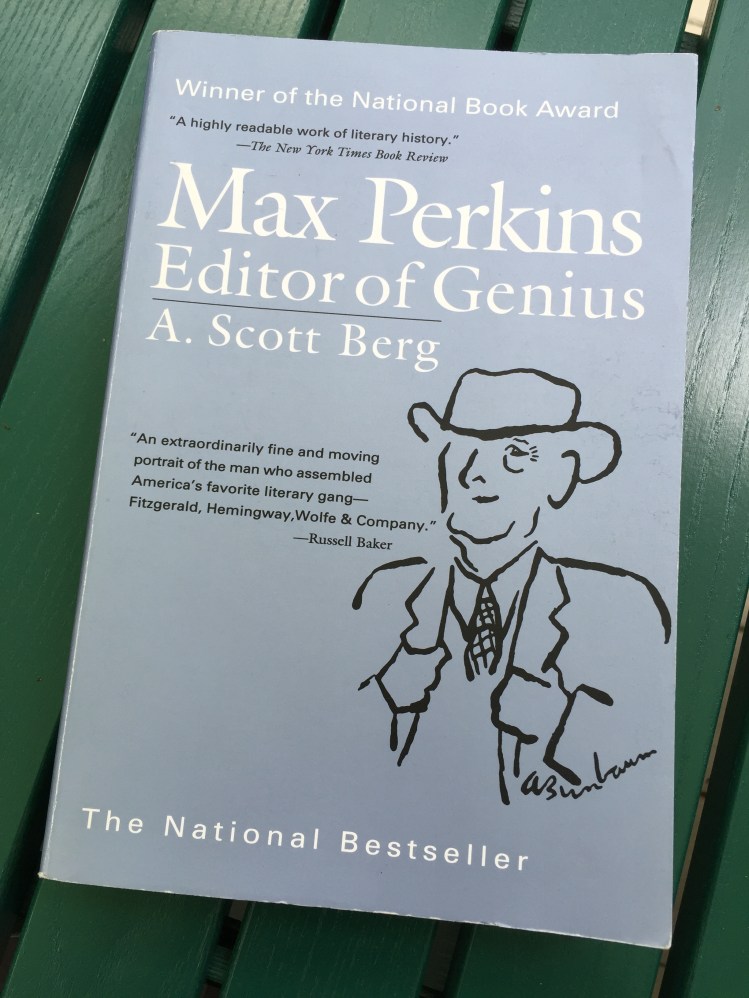
The Saturday Read ‘Max Perkins: Editor of Genius’ by A.Scott Berg

How many of you have turned your senior thesis into a career?

In 1971, recent Princeton graduate, A. Scott Berg began the seven-year process of expanding his college research into the biography of book editor Max Perkins. Earlier this month, a 38 year long journey, from the first film option of the 1978 National Book Award winning biography, ended with the opening of ‘Genius’ in theaters.

The Saturday Read this week is ‘Max Perkins:Editor of Genius’, a story that defines the role of a professional mentor as the narrative unfolds.

Allison Silver interviewed the author in 1981 for an article on the relationships between biographers and their subjects.

“Scott Berg’s biography ”Max Perkins: Editor of Genius” grew out of a fascination, bordering on fixation, for F. Scott Fitzgerald. At Princeton, Mr. Berg wrote his senior thesis on Perkins’s relations with Ernest Hemingway, Thomas Wolfe and Fitzgerald during the 1920’s. Mr. Berg realized there was a book in the life of the Scribner’s editor, and felt he was the one to write it. On graduation day, 1971, he told his roommate, ”I’ll take three months to research it, three months to write it and then another three months to get it published.” Mr. Berg remembers this philosophically. ”I was only six years off.”

Berg introduces Perkins at age sixty-one, in 1946, as he enters a storefront on Forty-third street in Manhattan, to speak to a group of students enrolled in an extension course on book publishing. “All were eager to find a foothold publishing and were attending the weekly seminars to increase their chances.”

“Maxwell Everts Perkins was unknown to the general public, but to people in the world of books he was a major figure, a kind of hero. For he was the consummate editor. As a young man he had discovered great new talents – such as F. Scott Fitzgerald, Ernest Hemingway, and Thomas Wolfe – and he had staked his career on them, defying the established tastes of the earlier generation and revolutionizing American literature. He had been associated with one firm, Charles Scribner’s Sons, for thirty-six years, and during that time, no editor at any house even approached his record for finding gifted authors and getting them into print.”

For many years this biography has been a ‘bible’ for aspiring editors. In this time of book publishing ‘disruption’, when editors have become an endangered species, it’s worth the readers’ time to travel to post WWI New York, when a different type of disruption was taking place as the novels of Fitzgerald, Hemingway and Wolfe began to appear on book shelves.

Let’s return to the 1946 extension class, as Berg continues his first chapter.

‘”The first thing you must remember,” he said, without quite facing his audience: “An editor does not add to a book. At best he serves as a handmaiden to an author. Don’t ever get to feeling important about yourself, because an editor at most releases energy. He creates nothing…A writers best work…comes entirely from himself…Because in the end an editor can get only as much out of an author as the author has in him.”‘

This advice, shared with folks pursuing a career in publishing, could be edited for any contemporary management text to define the modern day mentoring relationship.

“Beginning with Fitzgerald and continuing with each new writer he took on, he slowly altered the traditional notion of the editor’s role. He sought out authors who were not just “safe”, conventional in style and bland in content, but who spoke in a new voice about the values of the postwar world. In this way, as an editor he did more than reflect the standards of his age; he consciously influenced and changed them by the new talents he published…

The successful editor is one who is constantly finding new writers, nurturing their talents, and publishing them with critical and financial success. The thrill of developing fresh writing makes the search worthwhile, even when the waiting and working becomes months, sometimes years, of drudgery and frequent disappointment.”

The biography offers a chronological timeline of relationships with the icons of early twentieth century American literature: Fitzgerald, Hemingway, Wolfe and Ring Lardner. It also includes his nurturing of emerging women writers in the 1930s: Marcia Davenport, Marjorie Kinnan Rawlings, and Taylor Caldwell. In the final chapter, we meet two of the last authors Perkins edits in 1946 and 1947: James Jones, author of ‘From Here to Eternity’ and Alan Paton, author of ‘Cry, the Beloved Country’. Max Perkins died on June 17, 1947.

How do you turn you senior thesis into a career? In the 1981 interview with Allison Silver, Berg shared his secret.

“During his first months of research, the scope of his work broadened every day until, by the end of that summer, he says, ”I made a private pact with myself then that I would work on the book until I finished it.” Mr. Berg remembers deciding ”that I was not going to be a slave to arbitrary dates; because, in truth, I owed Max Perkins more than that. Suddenly I went into twilight-zone time.”

This attitude toward deadlines has remained with Mr. Berg. He recommends that anyone involved in a long project should ”move to Los Angeles, because the seasons don’t change and you’re not aware of the passage of time. To this day I cannot account for three months between May and September, 1974.”

The Saturday Read – Revisiting ‘The Sage of Waterloo’ by Leona Francombe

Two hundred and one years ago, on June 18, 1815, Napoleon Bonaparte led his troops in battle against those of the Duke of Wellington on a farm three miles south of Waterloo in Belgium. At the end of the day, close to 50,000 soldiers were dead and French domination of the continent came to an end.

A number of books were published last spring to commemorate the 200th anniversary of the bloodshed. One, ‘The Sage of Waterloo’ by Leona Francombe, recalls events through a very different form of ‘oral history’. For this ‘Saturday Read’ we return to Hougoumont.

“Hougoumont is…dear me, where are the words? It’s a mute place, you see, but with such startling eloquence. Perhaps the fact that few visitors to the battlefield even know it exists fosters the air of an unopened message. Physically speaking, it’s a ruin: a decaying farmstead of brick and sandstone in perfect complicity with the land. The other, less tangible things are far more difficult to describe. Go there yourself and you’ll feel it: the knowing wind; the trees scarred as leviathans; and a strange sort of peace that isn’t peaceful at all but alert with memory and other, less palatable phenomena. Sometimes, when the wind comes off the eastern fields, it’s as if a worn curtain is shifting, and through a tear in the fabric you can see something unimaginable for such a sleepy backwater.”

I reviewed this exquisite story last year, and after this week of tragedy in Orlando and Birstall, West Yorkshire, ‘The Sage’ seemed to beckon from the bookshelf, inviting a return to the wisdom of Old Lavender.

“”Nature never truly recovers from human cataclysms,” Grandmother said one day, to me alone. “Never.” She was using that tone: two parts old sage, one part female warrior, scant affection and no salt… Every creature who was anywhere near Waterloo sensed what was going to happen,” she explained. “If they could get out, they got out. Those who stayed and survived passed the experience on through collective memory, right down through the generations until the present day. Collective memory… and resonance.””

Author Francombe is a pianist and composer whose lyrical interpretation of history, through a narrator at ‘ground level’, delivers a timely reminder –

“There are sometimes no explanations, William. So don’t try to find them, or pretend that they’re there. They aren’t. But there’s always a way forward.”


The Saturday Read ‘A Whole Life’ by Robert Seethaler

Too often we seek advice and counsel from the plethora of self-help books that line the shelves of bookstores. What we miss are the life lessons divulged under the guise of fiction.

The Saturday Read this week takes us to the Austrian Alps in 1933 to observe ‘A Whole Life’, the best selling German novel by Robert Seethaler, translated by Charlotte Collins.

The story is Andreas Egger’s, an everyman’s narrative of life, work, tragedy and values. It’s short, the perfect read for a plane trip or a couple of days commute. In this case brevity doesn’t diminish the tale. The simple, beautiful language reveals a literary character that will stay with you long after the story ends.

Throughout the book, the author stores small gems of wisdom, life lessons. In one scene, Andreas approaches the general manager of a construction site to negotiate a raise. Upon reaching agreement on a salary increase, Andreas promises to work even harder. The manager replies:

“You can buy a man’s hours off him, you can steal his days from him, or you can rob him of his whole life, but no one can take away from any man so much as a single moment.”

After years in construction, and more years as a prisoner of war, Andreas returns to his village and eventually finds work as a hiking guide.

“Egger didn’t usually speak on his walks. ‘When someone opens their mouth they close their ears,’ Thomas Mattl had always said, and Egger was of the same opinion. Instead of talking, he preferred to listen to these people, whose breathless chatter revealed to him the secrets of other fates and opinions. People were evidently looking for something in the mountains that they believed they lost a long time ago. He never worked out what exactly this was, but over the years he became more and more certain that the tourists were stumbling not so much after him, but after some obscure, insatiable longing. 

In the closing pages, we observe Andreas in retirement, at the end of his ‘whole life’.

“Once a week he went down to the village to get matches and paint, or bread, onions, butter. He had realized long ago that people there speculated about him. When he set off for home…he would see them out of the corner of his eye, putting their heads together and starting to whisper behind his back. Then he would turn around and give them the blackest look of which he was capable. Yet in truth he didn’t much care about the villager’s opinions or their outrage. To them he was just an old man who lived in a dugout, talked to himself, and crouched in a mountain stream to wash every morning. As far as he was concerned, though, he had done all right, and thus had every reason to be content… In his life he too, like all people had harboured ideas and dreams. Some he had fulfilled for himself; some had been granted to him. Many things had remained out of reach, or barely had he reached them than they were torn from his hands again. But he was still here. And in the mornings after the first snowmelt, when he walked across the dew-soaked meadow outside his hut and lay down on one of the flat rocks scattered there, the cool stone on his back and the first warm rays of sun on his face, he felt that many things had not gone so badly after all.”

Reviewers have noted the book’s unique appeal as an understated novel in a publishing world sustained by hype and celebrity. Eileen Battersby concluded her analysis for the Irish Times with “No praise is too high for A Whole Life. Its daunting beauty lingers. This is a profound, wise and humane novel that no reader will forget.”

I agree.

The book, published in 2015 and shortlisted for the 2016 Man Booker International Prize will be published in the U.S. in September.


The Saturday Read – Four blogs/newsletters you should be reading

Before I started writing ‘Workthoughts’, I was reading other blogs. Maria Popova, author of my favorite, ‘Brainpickings’, was the 2016 commencement speaker at her alma mater, the University of Pennsylvania’s Annenberg School for Communication. She challenged the graduates to act as cultural change agents by continually broadening their horizons beyond a specific discipline.

“Today, the soul is in dire need of stewardship and protection from cynicism. The best defense against it is vigorous, intelligent, sincere hope — not blind optimism, because that too is a form of resignation, to believe that everything will work out just fine and we need not apply ourselves. I mean hope bolstered by critical thinking that is clear-headed in identifying what is lacking, in ourselves or the world, but then envisions ways to create it and endeavors to do that.

Whatever your specific vocation, your role as a creator of culture will be to help people discern what matters in the world and why by steering them away from the meaningless and toward the meaningful.”

annenberg_commencement-1

How do you maintain the discipline of the undergraduate learning experience and diversify your thinking?

In the past, traditional routes to post-graduate learning involved graduate and professional school. In rare cases, employers took on the role of educators, supplementing work with professional development options. Today, educational entrepreneurs are disrupting traditional education, offering countless ways to access knowledge online.

One of the most engaging options is to join folks who are exploring life’s mysteries and sharing their discoveries through blogs and newsletters.

For this week’s Saturday Read, I recommend four blogs/newsletters from contemporary ‘curators of culture’ that you should be reading to improve you critical thinking and supplement your journey of lifelong learning.

Brainpickings

Bruce Feiler, writing in The New York Times, described this blog as “the exploding online emporium of ideas”.

“She’s a celebrator,” said Anne-Marie Slaughter, a Princeton professor and former State Department official. “You feel the tremendous amount of pleasure she takes in finding these things and sharing them. It’s like walking into the Museum of Modern Art and having somebody give you a customized, guided tour.”

Since 2006, Maria Popova has been sharing her cross disciplinary expeditions with a growing audience of readers.

“Brain Pickings — which remains ad-free and supported by readers — is a cross-disciplinary LEGO treasure chest, full of pieces spanning art, science, psychology, design, philosophy, history, politics, anthropology, and more; pieces that enrich our mental pool of resources and empower combinatorial ideas that are stronger, smarter, richer, deeper and more impactful. Above all, it’s about how these different disciplines illuminate one another to glean some insight, directly or indirectly, into that grand question of how to live, and how to live well.”

The next selection comes from the mind of writer and ‘philosopher of everyday life’, Alain de Botton. If you read Brainpickings or Workthoughts, the name should be familiar. The founder of London’s School of Life, publishes a weekly newsletter, ‘The Book of Life’.


The Book of Life 

“It’s called The Book of Life because it’s about the most substantial things in your life: your relationships, your income, your career, your anxieties. There’s always been a longing to gather the important things in one place. Some of the appeal of a Bible or the collected works of a big name author is the sense that amidst all the chaos and disparate sources of knowledge, someone has taken the trouble to distill, to compress, to say what is essential. In a world overflowing with information, what we most need is curation. The Book of Life aims to be the curation of the best and most helpful ideas in the area of emotional life.”

For those of you technology and engineering gurus who feel a bit insecure when a client conversation turns literary, subscribe to the ‘Lit Hub Daily’.


Lit Hub

“Started last year, Lit Hub’s goal is to provide a “go-to daily source for all the news, ideas, and richness of contemporary literary life,” with curated and original content such as interviews, profiles and essays.”

“Literary Hub is an organizing principle in the service of literary culture, a single, trusted, daily source for all the news, ideas and richness of contemporary literary life. There is more great literary content online than ever before, but it is scattered, easily lost—with the help of its editorial partners, Lit Hub is a site readers can rely on for smart, engaged, entertaining writing about all things books.”

The latest newsletter I have added to my daily/weekly routine comes from writer Austin Kleon. His Friday newsletter is an eclectic collection of music, art, design and life. To give you a sample, this week’s edition included George Carlin’s Playboy interview, an HBO documentary on Studs Terkel and the Everything is a Remix series.

What makes Austin’s blog unique is the doodles; his visual interpretation of information.

kleon-200pxx1.jpg

Austin Kleon 

“I’m a writer who draws. I make art with words and books with pictures. Every week I send out a list of 10 things I think are worth sharing — new art, writing, and interesting links straight to your inbox.”

These four blogs/newsletters provide a customized curriculum of research and shared wisdom, delivered by a faculty of four non-traditional experts. Take a look, you may find one or more will fit with your individualized lifelong learning plan.