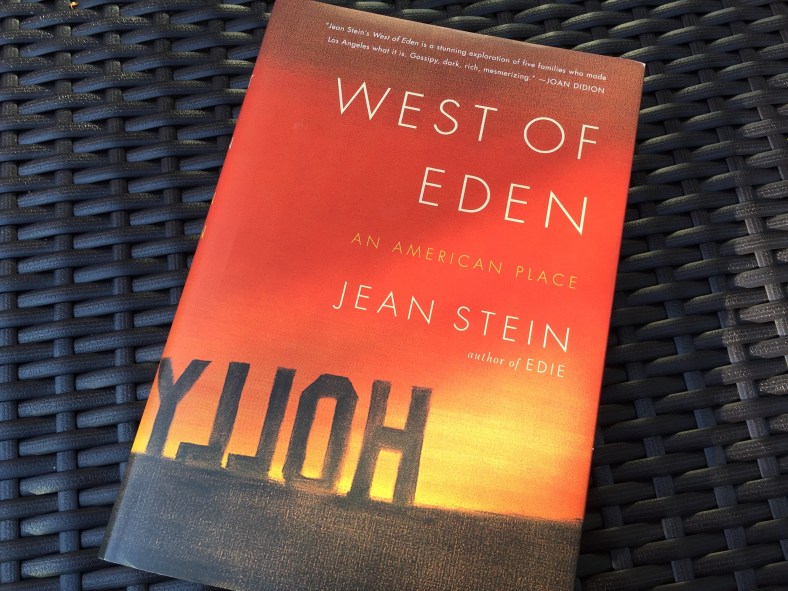
The Saturday Read ‘West of Eden: An American Place’ by Jean Stein

Were the initial seeds of relocation planted when you read a novel or work of non-fiction that transported you to that place on the globe where you could find success? In the Saturday Read this week we arrive in Hollywood, where author Jean Stein interweaves oral history and memory to tell the story, ‘West of Eden: An American Place’.

If you read the book through the lens of work, you come away with the story of the three industries that built LA: oil, real estate and the movies. As you turn the page, you listen to voices describing the culture and its effects on lives and careers.

When Po Bronson wrote his book, ‘What Should I Do With My Life?’, he had already spent time as a producer and writer in television. His observations on culture echo through Ms. Stein’s narrative.

“Every industry has a culture. And every culture is driven by a value system. In Hollywood, where praise is given too easily and thus has been devalued, the only honest metric is box-office receipts. So box-office receipts are all-important.

One of the most common mistakes is not recognizing how these value systems will shape you. People think that they can insulate themselves, that they’re different. They’re not. The relevant question in looking at a job is not What will I do? but Who will I become? What belief system will you adopt, and what will take on heightened importance in your life? Because once you’re rooted in a particular system — whether it’s medicine, New York City, Microsoft, or a startup — it’s often agonizingly difficult to unravel yourself from its values, practices, and rewards. Your money is good anywhere, but respect and status are only a local currency. They get heavily discounted when taken elsewhere. If you’re successful at the wrong thing, the mix of praise and opportunity can lock you in forever.”

‘West of Eden’ is the story of five families: the Dohenys, the Warners, Jane Garland, Jennifer Jones and the author’s own family, the Steins. As I read each section, I was reminded of Bronson’s comment. For the most part, the real life actors in the book were chasing the dream of wealth, status and celebrity; not considering the consequences, finding themselves in a world of praise and opportunity, locked in, in some cases, with tragic results.

Writer and historian, Mike Davis opens the book with his memories as a guide for Grey Line Tours, and it’s the map of celebrity homes that provides an outline for the book. We are introduced to the five stories by street address. Second stop, 1801 Angelo Drive, Beverly Hills, the Warner home. Arthur Miller captures the essence of early Hollywood.

“Jack Warner’s generation invented what turned out to be the major world culture – not just American, but a world culture. The world’s dream to escape the dreadful, ordinary, industrial, technological life. An you can understand how it happened if you think of where they came from, a place where there was absolutely no chance for anybody to do anything. They were living in a mud hole, but here the dreams were absolutely feasible. If you could think it, you could do it. It was magic. And they filled the movies with magic. George Cukor told me once, “Our object was to escape reality. We were quite conscious of all that.” It was a never-never land, a construct. These immigrants, these Jews from Eastern Europe, had developed this dream that had blond hair, blue eyes, and a straight nose. It all had to be beautiful. This was a fairy tale, because they were immigrants who saw this country as a fairy tale. It was incredible: it captured the whole country.”

These were the ‘culture builders’ whose legacy remains in the mansions, oil wells and studios, that fund the dreams of workers today. Their stories are told through neighbors, colleagues, family members and employees. David Geffen, who purchased Jack Warner’s home connects past to present:

“Jack Warner was a great character, like all of them. They were remarkable guys, but they were monsters. The movie business is a hard business, and you had to be a monster to create this industry. 

Jean Stein has called upon a lifetime network to craft and preserve the unique story of a place built on escape from the ordinary. A set of biographical notes at the end gives the reader thumbnail bios of each narrator, and it’s quite a cast of characters!

The book is required reading for the uninitiated and aspiring L.A. resident. There is drama worthy of an academy award, in every category from acting to costume design to hair and makeup and of course, visual effects.

“Another quality that all Californians who have spent any time on the edge of the Pacific are aware of is that the light is different. There’s a pressure on the eyes from the light. I’ve never felt it on the other coast.” (art curator, Walter Hopps)
The Saturday Read ‘War and Peace’ by Leo Tolstoy

Are you one of the many who fumbles their way through a conversation of the classics, with vague memories of the Cliff Notes version, having never read the original? You’re not alone, and the ‘Saturday Read’ this week is the first step to fill in the blanks with ‘War and Peace’ by Leo Tolstoy.

“Do you feel pressured to read certain books?” Journalist Alison Flood posed this question after a poll conducted by market research firm, ‘YouGov’, found that “Britons are weighed down with regret over novels they haven’t found ‘time and patience’ for”, garnering a series of Twitter comments concluding, you should try it, you might like it.

“…maybe it’s a classic because it’s good, not because it’s hard. I did precisely that with War and Peace; giving it a crack because I felt I should, and then being startled to discover that it was actually fun. Not a trial at all.”

Only 4% of Britons surveyed had read War and Peace, but that began to change with the broadcast this month of the Harvey Weinstein produced, BBC Television production of the novel as a four part, eight hour mini series.

“Judging by our recent sales … an awful lot of people have finally crossed this classic off their must-read list. Four different editions of the book have hit our bestseller list, shifting an almost equal number of copies each,” said Waterstones buyer Joseph Knobbs.

At publisher Wordsworth Editions, managing director Helen Trayler said that sales of War and Peace had grown steadily after the first episode of the new TV adaptation, with its edition in the top 20 of the Bookseller’s small publisher charts ever since the show launched.”

In December, 1,300 people joined together for a live, four day, marathon reading of the novel on Russian TV.

“Tolstoy’s great-great-granddaughter Fekla Tolstaya coordinated the participants, who are each reading a two to three-minute passage of the novel’s more than half a million words from schools, museums, libraries and other locations around the world.

Readers include Polish film director and Oscar winner Andrzej Wajda, Bolshoi Ballet director Vladimir Urin and Russian politician Valentina Matvienko. Cosmonaut Sergei Volkov contributed a reading from the International Space Station, and French readers were coordinated to read the book’s French sections”


IMG_3888

Yes, the book is written in French and English in the Pevear and Volokhonsky translation.

Clara Bell, reviewing the novel in 1886 for the New York Times criticized both the novel and Count Tolstoy’s domestic environment.

“In fact, War and Peace may be called an illustrated historical essay rather than a novel, there being no semblance of a plot, and the characters serving to develop the public events rather than being developed by them. This inversion of the usual rule, together with the subtle but unmistakeable savor of fatalism which pervades the whole work, disturbs the reader with the same sense of vague discomfort that must have chilled many of Count Tolstoi’s foreign admirers when they found their hero living in a shabby, comfortless, untidy house a little way out of Moscow, where carpets and clean tablecloths appeared to be equally rare.”

So we avoid reading ‘War and Peace’ because it’s described as daunting, boring, long, confusing and required. What if we took the advice of journalist Flood and read it for enjoyment? I did and it is long, but amazing and you will find the seeds of many subsequent classics, and ‘not so classic’ in the story.

It turns out Count Tolstoy had a lot to say about contemporary issues; the individual, happiness and occupation-work. One example, the thoughts of character Pierre Bezukov after he is released from prison at the end of the war.

“The absence of suffering, the satisfaction of one’s needs, and the resulting freedom to choose one’s occupation, that is, one’s way of life, now seemed to Pierre the highest and most unquestionable human happiness.

“…the satisfaction of his needs…now that he was deprived of them all, seemed perfect happiness to Pierre, and the choice of an occupation, that is, of a life, now, when that choice was so limited, seemed to him such an easy matter that he forgot that a superfluidity of life’s comforts destroys all the happiness of the satisfaction of one’s needs, and that a greater freedom to choose one’s occupation, the freedom which in this life was granted him by education, wealth, social position – precisely that freedom made the choice of an occupation insolubly difficult and destroyed the very need and possibility of an occupation.”

This is why we read ‘War and Peace’. It’s why Russian TV devoted four days to a live reading. And why one of Hollywood’s leaders decided to executive produce a screenplay of his favorite novel.

If you are still a bit of a skeptic, Philip Hensher of The Guardian offers ‘War and Peace: the 10 things you need to know (if you haven’t actually read it)’

” 7. Anyone who tells you that you can skip the “War” parts and only read the “Peace” parts is an idiot. The bits that interest you personally and the bits that you find of only abstract curiosity are going to change when you read the book at 20, and again at 50. The book is the product of a very big mind, who lost interest in almost everything War and Peace was about before he died. It is a living organism that is never quite the same as you remembered when you go back to it.”


The Saturday Read ‘The Geography of Bliss’ by Eric Weiner

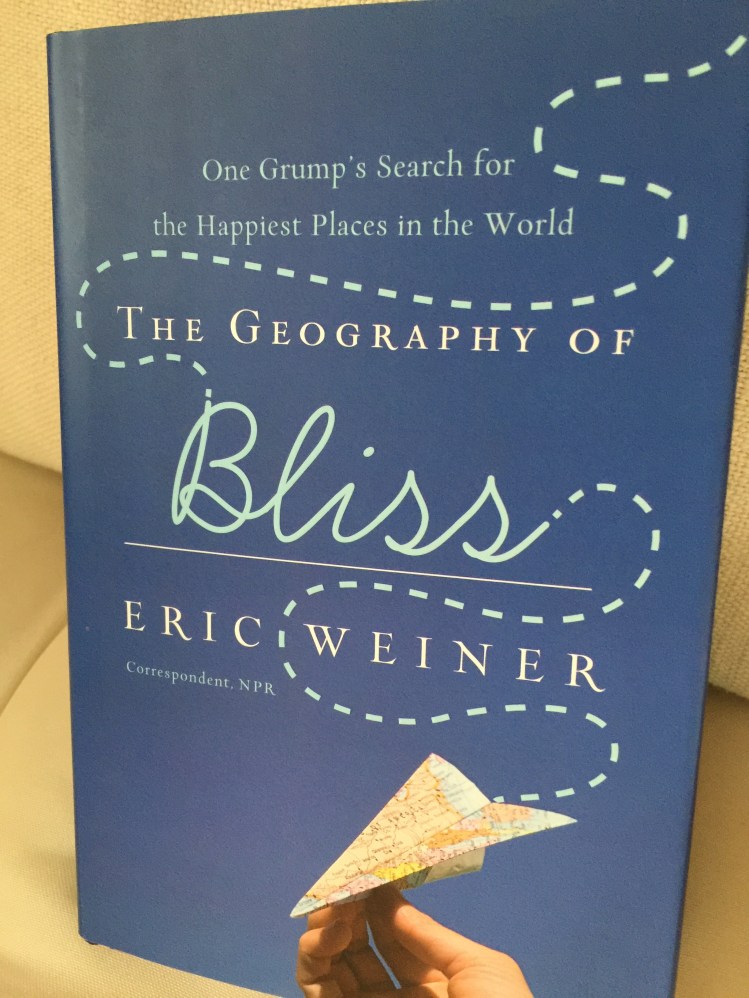
The Saturday Read this week is ‘The Geography of Bliss: One Grump’s Search for the Happiest Places in the World’, by former NPR correspondent and self-described philosophical traveler, Eric Weiner. It’s a travelogue of personal discovery with a universal  message, “where we are is vital to who we are”.

Early in his career decision process, Weiner decided travel was a necessary component to success – free travel. He started out as a foreign correspondent, going to some of the most unhappy global places. After a number of years covering conflicts in Iraq, Afghanistan and Indonesia he decided it was time to consider the alternative, the happy places.

“What if, I wondered, I spent a year traveling the globe, seeking out not the world’s well-trodden trouble spots but, rather, its unheralded happy places? Places that possess, in spades, one or more of the ingredients that we consider essential to the hearty stew of happiness: money, pleasure, spirituality, family and chocolate, among others.”

And we’re off. First to the Netherlands and the World Database of Happiness to meet Ruut Veenhoven, Professor of Happiness Studies.

Veenhoven was a graduate student in sociology when he found his calling in a new discipline, happiness studies. In a career story that may resonate with others in academia, he describes a meeting with his advisor. He was interested in the study of healthy minds and happy places. “His advisor, a sober man with solid academic credentials, told him, in no uncertain terms, to shut up and never mention that word again. Happiness was not a serious subject…Today, Veenhoven is at the forefront of a field that churns out hundreds of research papers each year.”

By simply asking folks if they are happy, researchers have found:

“Extroverts are happier than introverts; optimists are happier than pessimists; married people are happier than singles, though people with children are no happier than childless couples; Republicans are happier than Democrats; people who attend religious services are happier than those who do not; people with college degrees are happier than those without, though people with advanced degrees are less happy than those with just a B.A….people are least happy when commuting to work; busy people are happier than those with too little to do; wealthy people are happier than poor ones, but only slightly.”

Before returning home to the U.S., Weiner traveled to Switzerland, Bhutan, Qatar, Iceland, Moldova, Thailand, Great Britain, and India. Finding your bliss is subjective, but deeply rooted in culture.

“The glue that holds the entire enterprise together is culture.”  He embarked on an odyssey to find happiness, and discovered one of the key elements to success in life and work.

“…where we are is vital to who we are.”

“By ‘where’, I’m speaking not only of our physical environment but also of our cultural environment. Culture is the sea we swim in – so pervasive, so all-consuming, that we fail to notice its existence until we step out of it. It matters more than we think.”

Each new chapter invites the reader to experience another place, a new culture, citizens adapting to change, and challenges preconceived notions of the happiest places.

Sitting in an airport bar at the end of his journey, Weiner reflects on what he has learned. “Money matters, but less than we think and not in the way that we think. Family is important. So are friends. Envy is toxic. So is excessive thinking. Beaches are optional. Trust is not. Neither is gratitude…Happiness is not a noun or a verb. It’s a conjunction. Connective tissue.”

The shelves of bookstores are brimming with self help tomes on happiness. Eric Weiner’s global journey sets this book apart from the competition, transporting the reader on a round trip from domestic familiarity to places of contrasting mindsets, and back. It’s the perfect book for a winter read.


The Saturday Read ‘My Life on the Road’ by Gloria Steinem

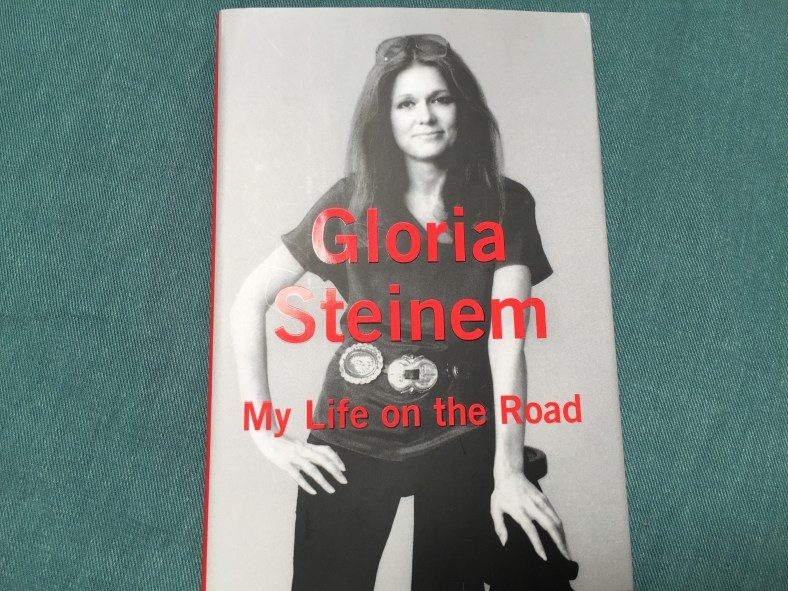
The Saturday Read this week comes from an author who describes herself as “an entrepreneur of social change”.  It’s a work identity that encompasses writer. lecturer, political activist and feminist organizer. For this book, ‘My Life on the Road’, Gloria Steinem shares “the most important, longest-running, yet least visible part of my life”.

In the introduction, Ms. Steinem expresses her hope that her example of life on the road will tempt readers to explore the country – to have “an on the road state of mind and be present with all five senses.” 

“After I joined the ranks of traveling organizers – which just means being an entrepreneur of social change – I discovered the magic of people telling their own stories to groups of strangers. It’s as if attentive people create a magnetic force field for stories the tellers themselves didn’t know they had within them. Also, one of the simplest paths to deep change is for the less powerful to speak as much as they listen, and for the more powerful to listen as much as they speak.

One of these stories opens the book and involves a group of women arriving in South Dakota for a Lakota Sioux powwow, and a subsequent encounter at breakfast, with a couple attending one of the largest annual biker rallies in the country.

“I tell you this story because it’s the kind of lesson that can be learned only on the road. And also because I’ve come to believe that, inside, each of us has a purple motorcycle.

We only have to discover it and ride.”

The book is best read as a series of short stories, with each chapter offering a clue to Ms. Steinem’s own ‘purple motorcycle’ adventure.

In the chapter, ‘One Big Campus’ she describes the places where she has spent “the single largest slice of my traveling pie..”, from the early days of draft protests through through efforts to diversify curricula.

“How do I love campuses? Let me count the ways. I love the coffee shops and reading rooms where one can sit and talk or browse forever. I love the buildings with no addresses that only the initiated can find, and the idiosyncratic clothes that would never make it in the outside world. I love the flash parties that start in some odd spot and can’t be moved , and the flash seminars that any discussion can turn into. I love the bulletin boards that are an education in themselves, the friendships between people who would never have otherwise met, and the time for inventiveness that produces say, an exercise bike that powers a computer. Most of all I love graduations. They are individual and communal, an end and a beginning, more permanent than weddings, more inclusive than religions and possibly the most moving ceremonies on earth.”

She closes the chapter with an affirmation that the Internet is not enough and offers an argument for the value of college.

“…we need to keep creating the temporary world of meetings, small and large, on campuses and everywhere else. In them, we discover we are not alone, we learn from one another, and so we keep going toward shared goals.”

This is the narrative of a traveler who has discovered that home and the road are equally important.

“I can go on the road – because I can come home. I come home – because I am free to leave. Each way of being is more valued in the presence of the other. This balance between making camp and following the seasons is both very ancient and very new. We all need both.”  

And I believe she would like us all to venture beyond our address, be it physical or virtual.

“What seems to be one thing from a distance is very different close up.”  In reading ‘My Life on the Road’ what we might have perceived of Ms. Steinem in our rear view mirror, may appear a bit different, close-up.

The Saturday Read – ‘When Breath Becomes Air’ by Paul Kalanithi

“I knew with certainty that I would never be a doctor.”  How many of us eliminated career options with such conviction in our final year of high school?

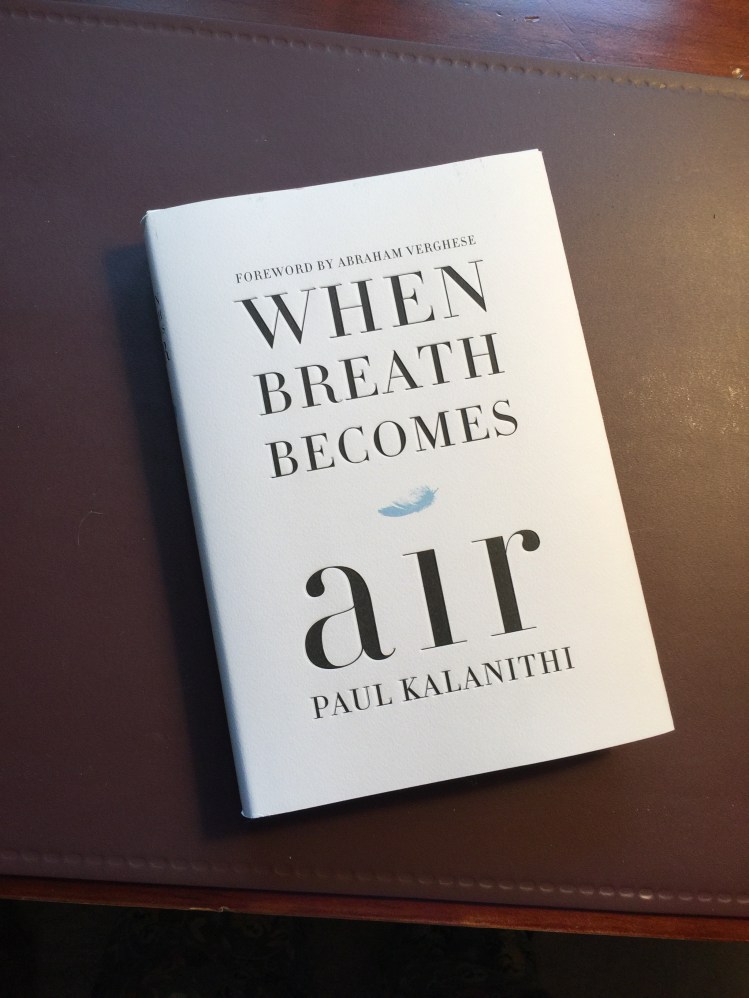
The Saturday Read is ‘When Breath Becomes Air’ by Paul Kalanithi. Although not intended as a ‘career’ book, the beautiful prose and compelling story will leave you reflecting on choices, time and values.

The book is a narrative revealed in two parts.

The first begins with the story of a college student making the most of his experience at Stanford, initially studying English literature, “…seeking a deeper understanding of a life of the mind” until his ultimate realization that “I was merely confirming what I already knew: I wanted that direct experience. It was only in practicing medicine that I could pursue a serious biological philosophy. Moral speculation was puny compared to moral action…I was going to Yale for medical school.”

The unintended value of the book’s Part I is a tutorial on the process of career decision making: exploration, reflection, discovery, reality testing, trade-offs and identity.

“In the fourth year of medical school, I watched as, one by one, many of my classmates elected to specialize in less demanding areas…and applied for their residencies. Puzzled by this, I gathered data from several elite medical schools and saw the trends were the same: by the end of medical school, most students tend to focus on “lifestyle” specialties – those with humane hours, higher salaries, and lower pressures – the idealism of their med school application essays tempered or lost…Indeed, this is how 99 percent of people select their jobs: pay, work environment, hours. But that’s the point. Putting lifestyle first is how you find a job – not a calling.”

Part II, “Cease Not till Death” addresses an essential question of life and career, What happens when your sense of identity is shaken?

“Lying next to Lucy in the hospital bed, both of us crying, the CT scan images still glowing on the computer screen, that identity as a physician – my identity – no longer mattered.

Instead of being the pastoral figure aiding a life transition, I found myself the sheep, lost and confused.”

Before the book was published, Dr. Kalanithi wrote two articles a year apart. Elements of both appear throughout the narrative. The first, ‘How Long Have I Got Left?’ for The New York Times in January 2014 described his role reversal as he “traversed the line from doctor to patient” and reflected on his own mortality.

“I began to realize that coming face to face with my own mortality, in a sense, had changed both nothing and everything. Before my cancer was diagnosed, I knew that someday I would die, but I didn’t know when. After the diagnosis, I knew that someday I would die, but I didn’t know when. But now I knew it acutely. The problem wasn’t really a scientific one. The fact of death is unsettling. Yet there is no other way to live.

Faced with mortality, scientific knowledge can provide only an ounce of certainty: Yes, you will die. But one wants a full pound of certainty, and that is not on offer.”

The second article, ‘Before I Go’ was published in the Spring 2015 issue of Stanford Medicine. Here he writes about time and career as the future “flattens out into a perpetual present”. 

“Time for me is double-edged: Every day brings me further from the low of my last cancer relapse, but every day also brings me closer to the next cancer recurrence — and eventually, death. Perhaps later than I think, but certainly sooner than I desire.

Everyone succumbs to finitude. I suspect I am not the only one who reaches this pluperfect state. Most ambitions are either achieved or abandoned; either way, they belong to the past. The future, instead of the ladder toward the goals of life, flattens out into a perpetual present. Money, status, all the vanities the preacher of Ecclesiastes described, hold so little interest: a chasing after wind, indeed.”

In the end, his illness brought him back to his love of literature and writing. His remarkable life informs this brilliant memoir. It’s a book for the new year, when resolutions are carelessly disregarded. The words, and Dr. Kalanithi’s legacy, reconnect us with the fundamentals of humanism. 


The Holiday Read – ‘Alexander Hamilton’ by Ron Chernow

Have you just entered the chaos of holiday travel at your local airport, and realized you forgot to bring something along to read? Quick, before you lose the wi-fi, download this week’s Saturday/Holiday read, ‘Alexander Hamilton’ by Ron Chernow.

This was the year American history left boring behind with the staging of the Broadway musical Hamilton. Based on Chernow’s 2004 best seller, Lin-Manuel Miranda transformed a casual airport bookstore purchase into a hip hop score, reflecting contemporary themes of immigration, revolution and finance. This holiday break is the perfect time to dive into the 700+ page biography.

David Brooksreview summarized why Hamilton had come to be erased from the national memory, to the point we are about to eliminate his last vestige on the ten dollar bill.

“He is the most neglected, first because he was a relentless climber (and nobody has unalloyed views about ambition), second because he was a great champion of commerce (and nobody has uncomplicated views about that either) and third because his most bitter rivals, Thomas Jefferson and John Adams, outlived him by decades and did everything they could to bury his reputation. So there is no Hamilton monument in Washington, but at least we now have Ron Chernow’s moving and masterly ”Alexander Hamilton,” which is by far the best biography ever written about the man.”

With the presidential primary season looming, ‘Alexander Hamilton’ is a reminder that current political tactics don’t fall far from the founders’ tree.

“In the polarized atmosphere of American politics, Burr knew that a northern renegade aligned with southern Republicans could provide a critical swing. This was Alexander Hamilton’s recurring nightmare: an electoral deal struck between Virginia and New York Republicans.

In the New York City elections that spring (1800), Hamilton and Burr descended from the lofty heights to spar in the grit and bustle of lower Manhattan ward politics…

That April, New Yorkers out for a stroll could have stumbled upon either Alexander Hamilton or Aaron Burr addressing crowds on street corners, sometimes alternating on the same platform.”

Hamilton lost, the Republican slate swept New York City, the Federalists were out and the road was paved for a Jefferson presidency.

Which brings us to a reader, like you, going on holiday, picking up a book in an airport bookstore, and the rest is, well, history.

“He told me as he was reading the book, hip-hop lyrics started rising off the page. I was completely astonished by his response.”

Miranda assured him that he was serious.

“He made a complete believer out of me,” Chernow said. “The story of Alexander Hamilton lends itself to hip-hop treatment. Hamilton’s personality is driven and unrelenting, and the music has that same quality. The music and the man mirror each other.”

Miranda purchased theatrical rights to the book and signed on Chernow as historical consultant.

“A lot of people might have started off with the unspoken assumption that history is boring — Lin-Manuel Miranda felt exactly the opposite,” Chernow said. “He felt the most dramatic way to tell the story was to stick to the facts. He felt the story was so sensational you couldn’t improve on it.”

Spend some time this holiday with the ‘sensational’ Alexander Hamilton.


The Saturday Read – a selection of the best articles of 2015 from Jon Ronson, Oliver Sacks, Kathryn Schulz and Nikil Saval

This week the recommendations for ‘The Saturday Read’ come from journalists who wrote some of the most popular long form articles of the year. Instead of a book, which might seem daunting in the midst of holiday shopping and celebrating, sample the writings of these four storytellers who tackled a range of topics including internet shaming, death, earthquakes and the origins of the white collar worker.

On Wednesday, ‘The Upshot’ covered ‘The Stories That Held You The Longest in 2015’. “We measured the favorite Times articles of 2015 in a new way — by the total combined time readers have spent looking at them. It’s a mix of ambitious investigative projects, big breaking news, features and service journalism.”

Number two on the list first appeared in the February 12, 2015 New York Times Magazine. Written by Jon Ronson, ‘How One Stupid Tweet Blew Up Justine Sacco’s Life’ tells the story of the world of public ‘internet shaming’ through the experience of its victims.

15sacco1-master1050-v3

“In the early days of Twitter, I was a keen shamer. When newspaper columnists made racist or homophobic statements, I joined the pile-on. Sometimes I led it…

Still, in those early days, the collective fury felt righteous, powerful and effective. It felt as if hierarchies were being dismantled, as if justice were being democratized. As time passed, though, I watched these shame campaigns multiply, to the point that they targeted not just powerful institutions and public figures but really anyone perceived to have done something offensive. I also began to marvel at the disconnect between the severity of the crime and the gleeful savagery of the punishment. It almost felt as if shamings were now happening for their own sake, as if they were following a script.”

Number ten on the list was an Op-Ed piece by neurologist and writer, Oliver Sachs, ‘My Own Life’, on learning he had terminal cancer.

19sacks-copy-blog427-v6

“Over the last few days, I have been able to see my life as from a great altitude, as a sort of landscape, and with a deepening sense of the connection of all its parts. This does not mean I am finished with life.

On the contrary, I feel intensely alive, and I want and hope in the time that remains to deepen my friendships, to say farewell to those I love, to write more, to travel if I have the strength, to achieve new levels of understanding and insight.

This will involve audacity, clarity and plain speaking; trying to straighten my accounts with the world. But there will be time, too, for some fun (and even some silliness, as well).”

A New Yorker article received a lot of attention when it first appeared in July. ‘The Really Big One’ was researched and written by contributor, Kathryn Schulz.

150720_r26752-320

“Most people in the United States know just one fault line by name: the San Andreas, which runs nearly the length of California and is perpetually rumored to be on the verge of unleashing “the big one.” That rumor is misleading, no matter what the San Andreas ever does. Every fault line has an upper limit to its potency, determined by its length and width, and by how far it can slip. For the San Andreas, one of the most extensively studied and best understood fault lines in the world, that upper limit is roughly an 8.2—a powerful earthquake, but, because the Richter scale is logarithmic, only six per cent as strong as the 2011 event in Japan.

Just north of the San Andreas, however, lies another fault line. Known as the Cascadia subduction zone, it runs for seven hundred miles off the coast of the Pacific Northwest, beginning near Cape Mendocino, California, continuing along Oregon and Washington, and terminating around Vancouver Island, Canada. The “Cascadia” part of its name comes from the Cascade Range, a chain of volcanic mountains that follow the same course a hundred or so miles inland. The “subduction zone” part refers to a region of the planet where one tectonic plate is sliding underneath (subducting) another. Tectonic plates are those slabs of mantle and crust that, in their epochs-long drift, rearrange the earth’s continents and oceans. Most of the time, their movement is slow, harmless, and all but undetectable. Occasionally, at the borders where they meet, it is not.”

Longreads.com selected their ‘Best of 2015’ which included an excerpt from the book, ‘Cubed: A Secret History of the Workplace’. The fifth most popular article was ‘I Would Prefer Not To: The Origins of the White Collar Worker’, written by Nikil Saval.

9780345802804-1.jpg

“When does the office begin? It’s a question without an easy answer. One can associate the origins with the beginning of paperwork itself—until recently, the most common mental association with office work (think of the derogatory phrase “paper pusher”). In other words, since the invention of writing and the corresponding ability to keep records in a systematic manner, there have always been places that resemble offices: monasteries, libraries, scholars’ studies. Banking furnished an especially large amount of paperwork; the Uffizi, an incomparable gallery of Renaissance art in Florence, was also one of the first office buildings—the bookkeeping offices of the Medici family’s groundbreaking financial operations. Clerks, too, have existed for ages, many of them unclinching themselves from their desks to become quite famous: from Samuel Pepys, the British government diarist who reported on the gossipy world of seventeenth-century England, to Alexander Hamilton, who had cut his teeth as a merchants’ clerk before he became the first secretary of the Treasury of the United States; Benjamin Franklin, paragon of pecuniary restraint and bourgeois self-abnegation, started out as a dry goods clerk in 1727. Perhaps some of the tediousness of Franklin’s own writing was honed in the conditions of his first job: since clerks have had the opportunity to keep diaries, they have bemoaned the sheer boredom of their tasks—the endless copying, the awkward postures, the meaninglessness of their work. When not doing writing for the job, clerks have cultivated the habit of writing about the job—or literally around it…”


The Saturday Read ‘Patience and Fortitude’ by Scott Sherman

In times of financial crisis, you start looking around the house for things you might sell off until you realize all you have left is the real estate under your roof. For the New York Public Library in the early years of the 21st century, the fine art had been sold at auction, the staff had been ‘right sized’ and all that was left to remain solvent were the private donors and the coveted real estate footprint of branch locations.

This week’s ‘Saturday Read’ is ‘Patience and Fortitude: Power, Real Estate, And The Fight To Save A Public Library’ by Scott Sherman.

“This is a book about a world-class library that lost its way in the digital age.”

patience and fortitude

A public library is a community sanctuary that has historically offered immigrants a way to the middle class. In the Preface, author Sherman retells the story of former New York Senator, Daniel Patrick Moynihan who was working as a boot-black in 1940s Times Square, visiting the main library at 42nd Street.  “It was the first time I was taught that I was welcome in a place of education and learning. I would go into that great marble palace, and I would check my shoeshine box. A gentleman in a brown cotton jacket would take it as if I’d passed over an umbrella and bowler hat.”

This is a New York story, but one that illustrates the fate of the non-profit organization in an economic downturn. In the case of the NYPL, originally founded by bankers and corporate titans, the seismic shifts in the economy forced the influential board, of modern day financiers, to engage big name consultants in an attempt to apply “free-market solutions to complex institutional problems.”

The central narrative of the book was first reported by author Sherman in the December 2011 issue of ‘The Nation’. ‘Upheaval at the New York Public Library’ made public a four year old ‘Central Library Plan’, conceived and ratified by the NYPL’s trustees.

“The core trustees – led by the developer Marshall Rose – did what came naturally to them: they sold the NYPL’s land and took steps to shrink an institution they may have viewed as bureaucratic and inefficient…Personal enrichment was certainly not the trustees’ intention; they were sincere in their desire to assist the Library. It was hubris that drove them forward, and which ultimately led them astray: they believed that corporate logic could be effortlessly applied to a sprawling, decrepit library system.”

Consider this the first shot across the bow, as the Sherman chronicles the response from writers, researchers, NYPL employees, politicians and library patrons.

A 2012 Op-Ed piece written by Theodore Roosevelt biographer, Edmund Morris for The New York Times offers a sample of the opposition.

“I read newspaper reports about the determination of Anthony W. Marx, the president of the library, to spend $300 million to transform the main building, long devoted to reference, into what sounds like a palace of presentism. He wants to close the library system’s biggest circulating branch, the Mid-Manhattan (located just across the street) and the Science, Industry and Business Library (also in Midtown) and somehow wedge their contents into the already overstocked central research library.

For that he will need all the spatial ingenuity of his trendy architect-designate, Norman Foster. But something’s going to have to give, and you can be sure that what is new and hard and digital will prevail over what is old and papery and transportable elsewhere.”

On May 7, 2014 Robin Pogrebin reported that the NYPL has abandoned its renovation plan.

Last month, Tom Mashberg of The New York Times reported on the new plan to create a high-tech space under Bryant Park to house 2.5 million research works from the original stacks.

“This was not, of course, Plan A. That plan entailed a makeover of the flagship Fifth Avenue library that would have sent the research books to Princeton, N.J. But it set off a virtual Fahrenheit 451 of outrage among scholars and others for whom the library’s role as a research mecca seemed endangered. Critics, who hoped the old steel stacks could stay in use, remain apprehensive about the new stocking and retrieval system, which they say is impressive but has not been tested.”

To be continued…

And while you wait, catch up on the history and the cast of characters who bring ‘Patience and Fortitude’ to life.


The Saturday Read – Gift a book this holiday season

One of the best presents one can give or receive is a book. #ShopSmall today and visit your local bookseller to find the perfect gift for everyone on your holiday list.

Let’s start with a client or your boss, two challenging categories for gift giving. You could go with a bottle of wine, chocolates, fruit basket or Starbucks card. But that’s what they’ll get from your competitors and colleagues. If you want to stand out and demonstrate, in a very tangible way, that you’ve been listening when they talk about their interests outside of work, a book just may be the way to make a connection. And I’m not talking about the latest business best seller.

Former Seattle librarian and current NPR commentator, Nancy Pearl has written a series of ‘Book Lust’ books recommending current and back list titles for “every mood, moment or reason and travelers, vagabonds and dreamers”. Her suggestions sample the catalog of titles published since 1960, so you will no doubt rediscover some gems to twinkle under the tree.

Create a list of folks @work. Then make a few notes about each and their interests. Visit an independent bookseller today, #SmallBusinessSaturday, and ask for suggestions. Often the best books of the year will never make The New York Times bestseller list, so you will need a little help from someone whose life is about books.

Barnes and Noble, Amazon and Costco don’t count. For the important task of matching books with colleagues and clients, you need the expertise of someone invested in presenting a diversity of titles.

“Independent bookstores never had to answer to the dictates of public markets. Many of their proprietors understood, intuitively and from conversations with customers, that a well-curated selection—an inventory of old and new books—was their primary and maybe only competitive advantage. In the words of Oren Teicher, CEO of the American Booksellers Association, “The indie bookselling amalgam of knowledge, innovation, passion, and business sophistication has created a unique shopping experience.”

Some may think a book is a risky gifting proposition. The risk lies only in not  paying attention and failing to seek out help from experts. Take some time today to shop on Main Street and pick up a few books for the holidays.

“Books make great gifts because they have whole worlds inside them, and it’s much cheaper to buy somebody a book than it is to buy them the whole world.” Neil Gaiman


The Saturday Read ‘Every Time I Find the Meaning of Life, They Change It’ by Daniel Klein

A U.S. Senator, a philosophy student and a welder walk into a bar…maybe not. In a debate last week U.S. Senator Marco Rubio questioned the value of a philosophy major in a world that needs more welders.

“I don’t know why we have stigmatized vocational education, welders make more money than philosophers. We need more welders and less philosophers.”

I can understand those who seek to define college as an extended vocational school experience, given the cost and potential for significant debt, but to limit the aspirations of 18 year olds diminishes the value of higher education. I think we go to college to figure things out. Part of that is the career decision, but the larger experience incorporates learning how to think, question, listen, reflect and argue in a quest to live our best life.

In defense of philosophy majors, and the politicians and welders who might benefit from their wisdom, The Saturday Read this week is ‘Every Time I Find the Meaning of Life, They Change It: Wisdom of the Great Philosophers on How to Live’ by Daniel Klein.

Like many college students, Klein didn’t have a clue as to what I wanted to do after college; basically all I knew was that I didn’t want to be a doctor, lawyer, or businessman, eliminations that put me in a distinct minority of my classmates. I figured studying philosophy would be just the ticket to give me direction.”

His father, like Senator Rubio, let him know that “studying philosophy was simply a wast of time.”

Fortunately for the reader, Klein continued his studies, recording selected ‘Pithies’ in a notebook hoping “to find some guidance from the great philosophers on how best to live my life.” These quotes and current reflections form the structure of the book.

“I now realized that those how-to-live questions were still very much alive in my mind. Sure, time had crept on and my life, with its ups and downs, had simply happened, as lives tend to do, by my appetite for philosophical ideas about life had not diminished in the least. In fact, as I look at life from the vantage point of my eighth decade, my hankering for such ideas has only increased. Late in the game as it may be, I still want to live my final years the best way I can. But more compellingly, I find myself at that stage of life when I want to give my personal history one last look-through, and I am curious to see how it measures up to fully considered ideas of a good life.”

Why this book? Because legislating, welding and philosophy should not be mutually exclusive terms. As the Thanksgiving inter-generational conversation turns to the big ‘vocational’ questions of choice and what you are doing with your life, it’s the central question of philosophy being posed, how to live the best possible life.

‘Every Time I Find the Meaning of Life, They Change It’ is an accessible, often humorous, tutorial, presenting a pageant of philosophy’s luminaries and author commentaries.

One quote in particular, resonated with me in light of the domestic and international scene this week, from British philosopher, Bertrand Russell.

“The man who has no tincture of philosophy goes through life imprisoned in the prejudices derived from common sense, from the habitual beliefs of his age or his nation, and from convictions which have grown up in his mind without the co-operation or consent of deliberate reason. To such a man the world tends to become definite, finite, obvious; common objects rouse no questions, and unfamiliar possibilities are contemptuously rejected…(But Philosophy) keeps alive ours sense of wonder by showing familiar things in an unfamiliar aspect.”