The Saturday Read – Tom Wolfe, ‘I Am Charlotte Simmons’

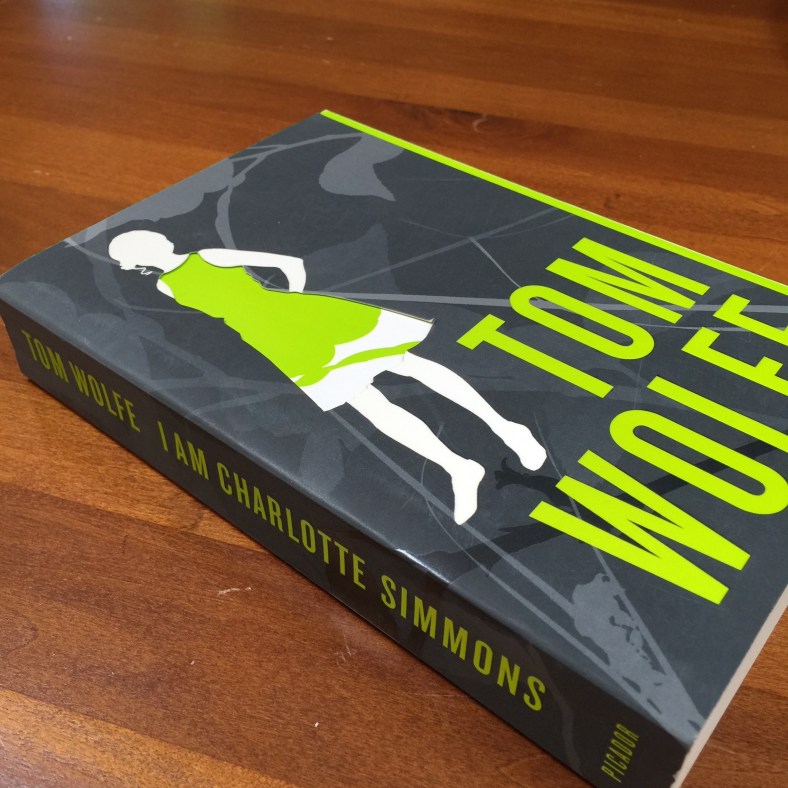
When this week’s selection for ‘The Saturday Read’ was released in 2004 the reviews were brutal and unusual for a writer with the reputation of Tom Wolfe. In hindsight, with the headlines from college campuses in the past year, the author might have been more in tune with campus life 11 years ago than reviewers acknowledged.

‘The Saturday Read’ this week is ‘I Am Charlotte Simmons’.

I recommend this novel for both students heading off to college and the parents left behind. In his dedication, author Wolfe acknowledged the contribution of his then college age children who provided input on authenticity throughout his writing process.

“You have been a joy, a surprise, a source of wonderment for me at every stage of your young lives. So I suppose I shouldn’t be astonished by what you have done for me and this book; but I am, and dedicating it to you is a mere whisper of my gratitude.”

“What I never imagined you could do – I couldn’t have done it at your age – was to step back in the most detached way and point out the workings of human nature in general and the esoteric workings of social status in particular.  I say “esoteric”, because in many cases these were areas of life one would not ordinarily think of as social at all. Given your powers of abstraction, you father had only to reassemble the material he had accumulated visiting campuses across the country. What I feel about you both I can say best with a long embrace.”

I include the dedication to remind parents that their children will return home surprisingly different, but recognizable. They may even amaze with their insight. And they will always welcome a long parental embrace.

Now back to Charlotte. She comes from a small Appalachian town in western North Carolina and arrives as a scholarship student at the elite Dupont University. Her acceptance was reported as the lead story in her hometown Allegheny News.

Charlotte is seeking a life of the mind but ends up with popularity and prestige linked to her relationship to a star basketball player. Her journey registered with a number of readers in college at the time of the book release.

The Yale Alumni magazine published comments from undergraduates to find out if alumnus Wolfe’s fictionalized view aligned with the student experience. Here is a sampling from three respondents.

“It’s possible! I certainly identified with Charlotte through much of the book. I came to Yale, I’d led a very sheltered life in a little suburb and couldn’t fathom what I’d find here, and it was shocking to me. In high school, none of my friends drank or smoked, so I was wide-eyed at the party scene here. While I think at times Wolfe took it too far, there were times when he was spot on. The other characters were somewhat stereotypical, but I did think that Charlotte was really complex, especially towards the beginning of the book.”

“I’m from a very small town in Ohio and though by no means was I as naïve as Charlotte, I identified with some of the class issues. There was definitely a difference between my life and the lives of my roommates, who were mostly from New York. I never felt the kind of shame that I think Charlotte does about her family, but it was definitely kind of funny when my dad, who’s a farmer, was hanging out with my friend’s father, who was a VP at Goldman Sachs. I do think that that’s an element that was portrayed very well in the book, when Charlotte’s father suggests to her rich roommate’s parents that they all go to the Sizzlin’ Skillet for dinner.”

“It’s almost like it was hard reading the book because it’s about us. I think he’s dead on with some of the observations.”

For Charlotte the college experience was transformational. And that’s why you go to college; not to get a job in the short term, not to be the same person you were on the first day of class, but to engage in the experience and grow into an ever curious, contributing member of society who will cause continual ‘surprise and wonderment’ in your parents.

Why read the book if you are not a college student or parent? ‘Charlotte’ is a narrative of change and sometimes startling interactions with a new environment. Our global workplace is one characterized by volatility and often unwelcome transition. Spending time in a fictionalized version of our reality provides an alternate narrative to explore. And it’s a good story, with good writing.

The Saturday Read – Ed Catmull with Amy Wallace ‘Creativity, Inc.’

If you can’t find a business book that meets your needs, write one. Last year Pixar’s Ed Catmull decided to do just that with ‘Creativity, Inc.’ In the introduction, he tells the reader the book “is about the ongoing work of paying attention – of leading by being self-aware, as managers and as companies. It is an expression of the ideas that I believe make the best in us possible.”

The Saturday Read this week is ‘Creativity, Inc: Overcoming The Unseen Forces That Stand In The Way Of True Inspiration’.

What differentiates this ‘management bible’ from the others is how well it integrates Catmull’s personal story into the evolution of his management values. We learn how our first interactions with the workplace can influence how we expect all our work places to be structured.

The author changed his undergraduate major from art to physics. In graduate school at the University of Utah he was encouraged by a professor, Ivan Sutherland to study computer graphics “in essence, the making of digital pictures out of numbers, or data that can be manipulated by a machine”. 

It was in this collegial environment that he first experienced “This tension between the individual’s personal creative contribution and the leverage of the group is a dynamic that exists in all creative environments…we had the genius who seemed to do amazing work on his or her own; on the other end, we had the group that excelled precisely because of its multiplicity of views.”

His experiential memory of the environment needed to create the impossible informed his management approach as his career unfolded.

“I would devote myself to learning how to build not just a successful company but a sustainable creative culture.”

His guiding principles remain consistent. In a 2008 Harvard Business Review article, ‘How Pixar Fosters Collective Creativity’ he outlined his management philosophy.

“Empower your creatives. Create a peer culture. Free up communication. Craft a learning environment. Get more out of post-mortems.”

‘Creativity, Inc.’ expands on these principles with experiential lessons in failure and success. It’s about values.

“My belief is that good leadership can help creative people stay on the path to excellence no matter what business they’re in.”

“We start from the presumption that our people are talented and want to contribute. We accept that, without meaning to, our company is stifling that talent in myriad unseen ways. Finally, we try to identify those impediments and fix them.”

“What makes Pixar special is that we acknowledge we will always have problems, many of them hidden from our view; that we work hard to uncover these problems, even if doing so means making ourselves uncomfortable; and that, when we come across a problem, we marshal all of our energies to solve it.”

Throughout the book we are learning about his leadership approach. It’s one that is not exclusive to the head of a major entertainment enterprise, but relevant to all managers from start ups to the Fortune 100.

“The way I see it, my job as manager is to create a fertile environment, keep it healthy, and watch for the things that undermine it. I believe, to my core, that everybody has the potential to be creative – whatever form that creativity takes – and that to encourage such development is a noble thing.”

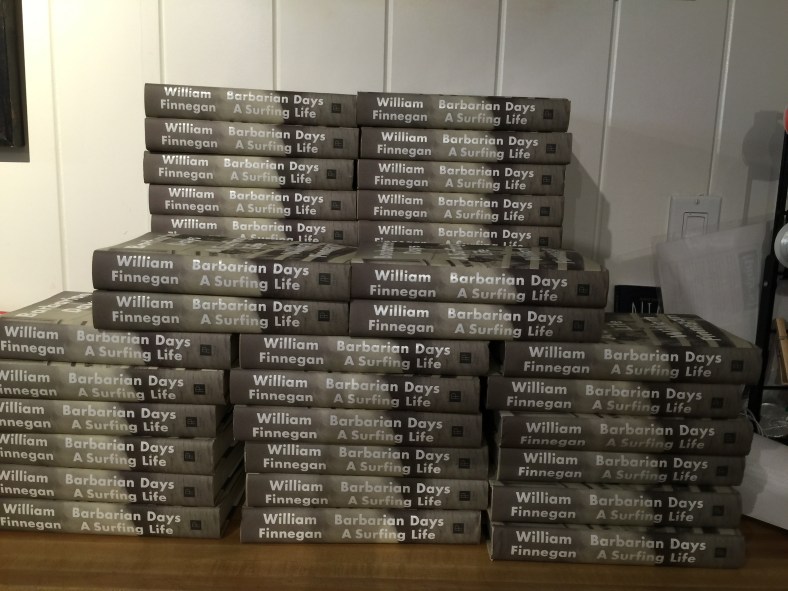
The Saturday Read – William Finnegan ‘Barbarian Days, A Surfing Life’

When you do a book reading in Manhattan Beach, California you need to use a microphone so the guys with ‘surfer’s ear’ in the back can understand you. Last night New Yorker journalist and lifetime surfer William Finnegan used a mic as he read from his well reviewed new book and this week’s ‘Saturday Read’, ‘Barbarian Days, A Surfing Life’.

The Q&A at the reading was closer to a book club discussion than a publicity event. Most of those attending had either read the book or the excerpt in the June 1 issue of the New Yorker magazine. This is not just a book about surfing. Mr. Finnegan is a well regarded journalist with a resume that includes reporting from South Africa, Somalia, the Balkans, Central America and Australia. Robert Boynton included him in his conversations with America’s best nonfiction writers in ‘The New New Journalism’.

“A self-described “specialist in the unexpected,” Finnegan writes stereotype-defying descriptions of the kinds of people—young, black, poor, foreign—mainstream journalism tends to dismiss with a pastiche of clichés and statistics.”

It’s this specialization in the unexpected that results in a memoir not just about surfing for surfers, but about life and friendship, as noted in The New York Times review:

“…a particularly remarkable feature of “Barbarian Days” is the generous yet unsparing portraits of competitive surf friendships that make up a major share of the narrative. As Finnegan writes: “Surfing is a secret garden, not easily entered. My memory of learning a spot, of coming to know and understand a wave, is usually inseparable from the friend with whom I tried to climb its walls.”

He first wrote about surfing in ‘Playing Doc’s Games’, profiling Mark Renneker for The New Yorker in 1992. Twenty three years later Doc returns along with a global cast of supporting characters inviting the reader to go out with them on the water.

Why should a non-surfer invest in a memoir subtitled ‘A Surfing Life’? Because it’s an everyman’s story of reconciling passions.

At the reading the author described surfing as “the North Pole of irresponsibility, the opposite of achievement. War reporting had a built in urgency, surfing did not.” He has spent 50 years managing the opposition between two drives: writing and chasing waves.

Surfers are our environmental ‘canaries in a coal mine’. Responding to a question on how surfing differs from other sports, the author focused on the “98% of surfing that is an absorption in the ocean, what your local spot is, how well you read the waves and ride. Surfing is not competitive, it’s an experience of beauty – an understanding and engagement with nature.”

Near the end of the book he refers to an A.J. Liebling essay, ‘Apology for Breathing’ noting that “Liebling was pretending to apologize for being from New York, a city he loved lavishly and precisely. Now I’m one of those New Yorkers incessantly on the point of going back where I came from. But with me it’s not a matter of packing up or staying on, but rather of being always half poised to flee my desk and ditch engagements in order to throw myself into some nearby patch of ocean at the moment when the waves and wind and tide might conspire to produce something ridable. That cracking, fugitive patch is where I come from.”

‘Barbarian Days’ is a beach book. It’s an ocean book. It’s a memoir to guide you to your own story and “that cracking, fugitive patch” where you come from.

The Saturday Read – Summer Reading Suggestions from TED speakers and attendees

Last week BuzzFeed Books posted a short quiz that professed to know how old you are based on your reading habits. Go ahead, take the quiz. You may find you have shaved 10 – 20 years from your chronological age. I’m once again enjoying my 23rd year.

The good news, we have more time to read, and this year the folks at TED have provided us with over 70 summer book suggestions from speakers and attendees.

After reviewing the list, I’ve picked a quartet of speakers and stories they recommend.

David Eagleman, neuroscientist and author:

Invisible Cities by Italo Calvino. “A series of very short stories that are all about the same thing: a single city in Kublai Khan’s empire. It’s mother’s milk for my own fiction writing.”

Dave Isay of StoryCorps:

The Bridge: The Building of the Verrazano-Narrows Bridge by Gay Talese. “An ode to the men who built the Verrazano-Narrows, it centers around the question, ‘Who are the high-wire walkers wearing boots and hard hats, earning their living by risking their lives in places where falls are often fatal and where the bridges and skyscrapers are looked upon as sepulchers by the families and coworkers of the deceased?’”

David Rothkopf, foreign policy thinker and senior editor of the FP Group:

The Idea Factory: Bell Labs and the Great Age of American Innovation by Jon Gertner. “My dad worked at Bell Labs, and my first summer jobs were there as well. It epitomized the power of pure research, and showed how big science and big government could collaborate. It is gone now, and its disappearance raises many questions about our future.”

Tony Fadell, Founder and CEO of Nest:

How Children Succeed: Grit, Curiosity, and the Hidden Power of Character by Paul Tough. “By offering evidence that traits like empathy, determination and self-control tend to be better predictors of success than IQ, Tough will make you think differently about raising kids in a highly competitive world.”

The Saturday Read – Ta-Nehisi Coates ‘Between the World and Me’

Early in his career, The Atlantic writer, Ta-Nehisi Coates was mentored by journalist, David Carr. In February he wrote ‘King David’, acknowledging his friend and brother. “David Carr convinced me that, through the constant and forceful application of principle, a young hopper, a fuck-up, a knucklehead, could bring the heavens, the vast heavens, to their knees.”

“I miss you terribly. I do not want to say goodbye. Tony says you were our champion. How can we go on, David? How can all of it just go on? Who will be our champion, now?”

In ‘Between the World and Me’ the author has brought ‘the vast heavens, to their knees’ and takes on the role of the champion he lost with the passing of Mr. Carr.

The ‘Saturday Read’ is not a ‘summer beach read’. It’s an important addition to the canon of the social sciences and business.

This book should be required reading for every member of the workforce, educators and in particular, those who pride themselves as leaders of diversity.

An excerpt of the book is available on The Atlantic website. Written as a letter to his son, the book needs to be read in its’ entirety.

“…Perhaps struggle is all we have. So you must wake up every morning knowing that no natural promise is unbreakable, least of all the promise of waking up at all. This is not despair. These are the preferences of the universe itself: verbs over nouns, actions over states, struggle over hope.

The birth of a better world is not ultimately up to you, though I know, each day, there are grown men and women who tell you otherwise. I am not a cynic. I love you, and I love the world, and I love it more with every new inch I discover. But you are a black boy, and you must be responsible for your body in a way that other boys cannot know. Indeed, you must be responsible for the worst actions of other black bodies, which, somehow, will always be assigned to you. And you must be responsible for the bodies of the powerful—the policeman who cracks you with a nightstick will quickly find his excuse in your furtive movements. You have to make your peace with the chaos, but you cannot lie. You cannot forget how much they took from us and how they transfigured our very bodies into sugar, tobacco, cotton, and gold.”

Among the positive reviews, Syreeta McFadden for The Guardian:

“I am in near-total agreement with Coates’s view of this world we share. Yet I did wonder where the stories of black women feature in all this death and plunder. Their names are not included in this work, and I am not the only one who has noticed it. Coates seems aware of the omission, but he still only manages to surface the experiences of black women through their (very real) pain at the death of black men. That lens isn’t Coates’s alone, but it’s one worth interrogating.

In fact, Between the World and Me doesn’t aspire to anything so large – or vague – as “overcoming” or “transcending” race to defeat racism. It is simply about surviving, and remembering. Coates’s preoccupation is not with saving the soul of America. It’s urging it, to borrow a phrase you see around a lot lately, to “stay woke”.

At the end of his tribute to David Carr, Mr. Coates reflects on Mr. Carr as a “tireless advocate of writers of color, of writers who were women, and of young writers of all tribes.”

“And I know that even I, who am no longer a young writer, do not always wear my best face for young writers. And among the many things I am taking from David’s death is to be better with young writers, and young people in general. Because every single time some editor shoved me down, David picked me back up.”

‘Between the World and Me’ is a gift to young writers. It’s a testament to the power of the written word amid the distractions of technology’s sound bites.

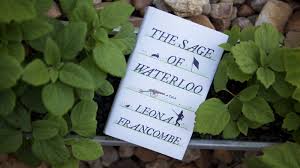
The Saturday Read – Leona Francombe ‘The Sage of Waterloo’

This year marks the bicentennial of the Battle of Waterloo. A number of books have been published to coincide with the anniversary, but it’s the unique storytelling of author Leona Francombe that gives us a very different view of the conflict. The ‘Saturday Read’ this week is ‘The Sage of Waterloo’.

The story begins when a French drummer boy releases a white rabbit into the Hougoumont gardens during the battle on June 18, 1815. Our narrator, William, is guided on his journey by his grandmother, Old Lavender and a wise researcher, Arthur. He invites us to join him along the route the rabbits call the ‘Hollow Way’:

“There are many soft hillocks and hollows along this part of the Way on which one can rest and look back, and I suggest that you do this, too, because the view behind is as clear as the view ahead, and offers some valuable lessons besides.”

Yes, we are talking bunnies. Or, the bunny is talking to us. And along his path we join the Battle of Waterloo.

“Waterloo is small as battlefields go…the Hougoumont part of it even smaller. How extraordinary, then, that my farm – my tiny corner of Belgium, which even today people have difficulty locating on a map – should have made history in just a few hours.”

For those readers unfamiliar with history, the Economist provides a thumbnail description:

“Waterloo not only brought to an end the extraordinary career of Napoleon Bonaparte, whose ambitions had led directly to the deaths of up to 6m people. It also redrew the map of Europe and was the climax of what has become known as the second Hundred Years War, a bitter commercial and colonial rivalry between Britain and France that had begun during the reign of Louis XIV. Through its dogged resistance to France’s hegemonic ambitions in the preceding 20 years, Britain helped create the conditions for the security system known as the Concert of Europe, established in 1815. The peace dividend Britain enjoyed for the next 40 years allowed it to emerge as the dominant global power of the 19th century.”

Which brings us back to our story and Arthur, the researcher, and did I mention black bird?, questioning humans’ short term memory.

“…they think they know what happened there. But their evolutionary process seems to be in reverse. They gradually forget the magnitude of what they’ve done – or at least, they’ve managed to disguise their violence as glory – so eventually, in the course of time, they can no longer feel what still hangs in the air. Not the way we do. So they don’t have any qualms about building cafes on burial grounds. They’ve never really stamped out their zeal for warmongering – quite the opposite, actually. They can’t seem to get enough of it.”

Near the end of the book William calculates an alternative if the soldiers had refused to fight: “approximately fifty thousand men would have lived. And ten thousand horses. And who knows how many rabbits?”

“Where did you learn all this?” I asked Arthur, after I’d finished my mulling. “Oh, you wouldn’t believe the things that remain in the woods around Hougoumont,” he said. “The resonance is quite astounding. Small creatures for miles around are still aware of the story.”

This small novel is a unique oral history of the Battle of Waterloo. Blending historical fact with fiction, author Francombe creates an unlikely ‘sage’ to carry the “collective memory…and resonance.” And reminds us to “feel what still hangs in the air” when we visit historic sites.

The Saturday Read – Alain de Botton ‘The Art of Travel’

This week’s ‘Saturday Read’ is ‘The Art of Travel’ by Alain de Botton. It’s not your typical travel guide, although scenes are set in a variety of global locations. We join the author as he navigates the world, his neighborhood and his room. We are accompanied on the journey by artists, explorers, poets and novelists: Wordsworth in The Lake District, Vincent van Gogh in Provence and Alexander von Humboldt in South America.

This wonderful book should be read in small bites, a tapas menu to savor, in advance of any journey you may have planned. It’s a philosophical view of travel and requires us to reflect through the lens of our fellow pilgrims before we rush on to the next chapter.

The book is segmented into four sections: departure, motives, art and return. In each the author is puzzling through why expectations of travel don’t quite live up to promise. We begin to examine our relationship to the distant and familiar as we eavesdrop on Mr. de Botton’s thoughts as he considers his relationship to place.

Early on, he realizes:

“A momentous but until then overlooked fact was making itself apparent: I had inadvertently brought myself with me to the island.”

Place has the potential to transform us, but our fundamental self remains our companion and colors our experience.

“What, then, is a traveling mind-set? Receptivity might be said to be its chief characteristic. Receptive, we approach new places with humility. We carry with us no rigid ideas about what is or is not interesting.

Home, by contrast, finds us more settled in our expectations. We feel assured that we have discovered everything interesting about our neighborhood, primarily by virtue of having lived there a long time. It seems inconceivable that there could be anything new to find in a place where we have been living for a decade or more. We have become habituated and therefore blind to it.”

How we respond to place is limited by the resources we utilize in our process of discovery. Travel companions share critiques and travel guides list the top ten things to see. Our expectations are set through the eyes of others who have gone before.

“Our responses to the world are crucially moulded by the company we keep, for we temper our curiosity to fit in with the expectations of others.”

On a visit to Madrid, the author ventures from his hotel:

“It was a sunny day, and crowds of tourists were stopping to take photographs and listen to guides. And I wondered, with mounting anxiety, What am I supposed to do here? What am I supposed to think?”

“Where guidebooks praised a site, they pressured a visitor to match their authoritative enthusiasm, and where they were silent, pleasure or interest seemed unwarranted.”

“..if my compass of curiosity had been allowed to settle according to its own logic, rather than being swayed by the unexpectedly powerful force field of a small green object by the name of The Michelin Street Guide to Madrid…”

We travel for different reasons. ‘The Art of Travel’ encourages us to trust our ‘compass of curiosity’ and discover our own wonders of the world.

The Saturday Read -Mark Vanhoenacker ‘Skyfaring’

This week’s ‘Saturday Read’ is for all of you who keep your window sashes up on transcontinental flights. And for those of you who don’t, author and pilot, Mark Vanhoenacker has a link on his website to share a glimpse of what you have been missing. And it’s not the grainy black and white video from the camera mounted underneath those Swiss Air flights.

The ‘Saturday Read’ is ‘Skyfaring: A Journey With A Pilot’.

What do we know of the work lives of pilots? These are the folks we trust to transport us across oceans, continents, cities and deserts. Our only contact through hours of flight is a welcome message, flight status update or a ‘thank you for choosing our airline’.

Turns out, pilots can be very interesting people. And, like many of us, they arrive at their ‘dream job’ after trying out other options. Mark Vanhoenacker’s career began in academia and management consulting. He started his flight training in 2001 after realizing all those plane flights were constant reminders of what he really wanted to do with his life.

Geoff Dyer reviewed the book for The Guardian newspaper:

“There is always something uplifting about people in love with their work, and on becoming an airline pilot Vanhoenacker (now a senior first officer with British Airways) seems to have attained a state of enviable grace. He loves everything about the job: the machinery, the language, the physics, the maps, the weather (always sunny up there above the lid of cloud), his colleagues, the rituals in which multiple layers of safety are embedded and encoded.”

Dwight Gardner‘s review in The New York Times cited “the intellectual and emotional delights of flying…

Mr. Vanhoenacker speaks often in “Skyfaring” about poetry and art and music. In Paris, he heads for the Musée Rodin. He has a well-stocked mind. Cumulus clouds remind him of the ceilings in the New York Public Library or Versailles; the earth’s rotation summons for him a passage from Marilynne Robinson’s novel “Gilead.” He mentions pilots who go to cooking schools or visit botanical gardens wherever they go.

Thus one of the vivid things about this book is that is makes you imagine the men and women who pilot the machines that fly over our heads as a merry band of scholars and aesthetes, rather than glorified bus drivers. It’s as if they’re racing up there to pluck the world’s best cultural fruit, fruit we are too hidebound to seek except rarely.”

And when Mr. Vanhoenacker is not flying the plane:

“One of my favorite things to do as a passenger is put music on and look out at the world. I think airplanes are one of the few places you can zone out. When you fly as a passenger you definitely have this meditative space. I never use Wi-Fi as a passenger.”  

In the first few pages of ‘Lift’, the first section of the book, the author shares three questions people ask when they learn he is a pilot:

“Is flying something I have always wanted to do? Have I ever seen anything “up there” that I cannot explain? And do I remember my first flight? I like these questions. They seem to have arrived, entirely intact, from a time before flying became ordinary and routine. They suggest that even now, when many of us so regularly leave one place on the earth and cross the high blue to another, we are not nearly as accustomed to flying as we think. These questions remind me that while airplanes have overturned many of our older sensibilities, a deeper part of our imagination lingers and still sparks in  the former realm, among ancient, even atavistic, ideas of distance and place, migrations and the sky.”

If this book doesn’t rekindle the wonder of air flight, check to see if you can still fog up a mirror. For those of you still breathing, invest some time this weekend to take flight with Mark Vanhoenacker as your pilot and rediscover the joy of getting lost in the clouds.

The Saturday Read – Summer Books

We have summer in our sights, anticipating travel, adventure, rest and relaxation. Harbingers of the coming season are the summer reading lists from the traditional print book review sources, the icons of Silicon Valley and the titans of Wall Street.

The act of picking up a book, unrelated to work or school, has moved away from the center and occurs only on the periphery of our lives. We seem to have relegated reading to the category of indulgence vs. necessity. We give ourselves permission to read in summer, during an interval when we step away from work.

Writing in The Irish Times, Isabelle Cartwright considered the question of why we read.

“…the simple answer is for pleasure. But what exactly is the nature of that pleasure? Reading removes us from the structure of our lives, from the routine, the sequential habits of our day-to-day living. We enter instead another time zone. The plot, characters and setting occupy us, and while we read we inhabit the others’ reality. The pleasure therefore is derived from escaping our own small, limited and often repetitive lives and entering an exotic elsewhere.

But perhaps there is also the attraction of reserving something private for ourselves, something outside of the public world of relationship, family, work and occupation; something that is not encumbered by the stricture of time and self.”

For those of you who need a utilitarian rationale to set aside time to read, there is research to show we are morally and socially better as a result of our efforts:

Raymond Mar, a psychologist at York University in Canada, and Keith Oatley, a professor emeritus of cognitive psychology at the University of Toronto, reported in studies published in 2006 and 2009 that individuals who often read fiction appear to be better able to understand other people, empathize with them and view the world from their perspective. This link persisted even after the researchers factored in the possibility that more empathetic individuals might choose to read more novels. A 2010 study by Mar found a similar result in young children: the more stories they had read to them, the keener their “theory of mind,” or mental model of other people’s intentions.”

We become more emotionally intelligent as we read.

If that doesn’t convince you, the ‘Lifehack blog’ lists ’10 Benefits of Reading: Why You Should Read Every Day’ (not just in summer): “Mental stimulation, stress reduction, knowledge, vocabulary expansion, memory improvement, stronger analytical skills, improved focus and concentration, better writing skills, tranquility and free entertainment.”

I think they’re on to something here, for all you skeptics. A few of these skills match exactly to what employers look for in potential candidates: communications and problem solving. Maybe reading is a necessity and not an indulgence.

Here is a menu of links to the popular reading lists this summer:

The Los Angeles Times – Summer reading guide: The 136 books you’ll want to read

The New York Times – When the Water’s Too Cold, Something Else to Dive Into, A Critic’s Survey of Summer Books

USA Today – 25 Hot Books for Summer

The Washington Post – A great leadership reading list — without any business books on it

Bloomberg – Books Worth Reading This Summer

NPR – Four Books That Deliver Unexpected And Delightful Surprises This Summer

A Year of Books, Mark Zuckerberg

Beach Reading (and More), Bill Gates

10 Beach Books from J.P. Morgan’s Summer Reading List

Happy sand in your toes, head in the clouds, sea spray on your face reading!

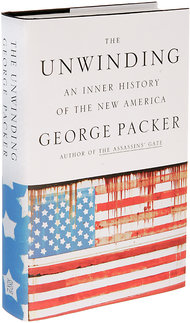
The Saturday Read – George Packer ‘The Unwinding’

If you need additional convincing that the income gap between the wealthy and the ‘middle class’ is widening, set aside some time to read George Packer‘s ‘The Unwinding: An Inner History Of The New America‘. Originally published in 2013, the book takes us on a pilgrimage with a lead cast of three ‘American dreamers’: Dean Price, Jeff Connaughton and Tammy Thomas.

We meet Dean and Jeff in 1978 and Tammy in 1984. As each of their stories unfold, the author adds a ‘supporting cast’ of politicians, journalists, Silicon Valley entrepreneurs and ‘institution men’. It’s this supporting cast that influence decisions that effect the lives of Dean, Jeff and Tammy, but they are fuzzy background noise to the reality of trying to make a living in today’s United States.

“No one can say when the unwinding began – when the bolts that held Americans together in its secure and sometimes stifling grip first gave way. Like any great change, the unwinding began at countless times, in countless ways – and at some moment the country, always the same country, crossed a line of history and became irretrievably different…When the norms that made the old institutions useful began to unwind, and the leaders abandoned their posts, the Roosevelt Republic that had reigned for almost half a century came undone. The void was filled by the default force in American life, organized money.”

We encounter our ‘ordinary’ Americans at the beginning of their respective careers.

Dean Price earned a degree in political science and is hired as a pharmaceutical rep for Johnson and Johnson.  “It didn’t take him long to realize that he hated his job…He had bought into a lie: go to college, get a good education, get a job with a Fortune 500 company, and you’d be happy. He had done all that and he was miserable…He decided to start over and do things his own way. He would become an entrepreneur.”

Jeff Connaughton first met Joe Biden in 1979 at a meeting of the National Student Congress in Philadelphia. “Biden was youthful, he was witty, he knew how to talk to college students. Connaughton never forgot the moment.” 

After earning an MBA from The University of Chicago Business school he moved to New York to work for Smith Barney in their public finance department. His next job was at E.F. Hutton where he survived the company’s wire and mail fraud scandal. “He was a twenty-seven-year-od assistant vice president making more than a hundred grand, and yet he went home in the evenings thinking that this was not what he wanted to do with his life.”

“Biden was like a cult figure to me,” Connaughton said much later. “He was the guy I was going to follow because he was my horse.  I was going to ride that horse into the White House. That was going to be my next stop in life. I had done Wall Street, and I was going to do the White House next.”

Tammy Thomas grew up in Youngstown, Ohio as the city began to decline. “Tammy vowed to herself that she would not go on welfare and live in the projects. She didn’t want to have just enough to barely get by but not enough to actually be able to do anything. She didn’t want to get stuck.”

“She finished high school on time, in 1984, and became the first person in her family to get a diploma…She got an associate’s degree at a technical college and worked for two years as a supermarket cashier in the hope that she’d get a management job, but none opened up…But up in Warren, the Packard Electric plants were still operating, with eight thousand workers making wiring harnesses and electrical components for General Motors cars. It was lighter, cleaner work than steelmaking, and two-thirds of the employees were women, a lot of them single mothers like Tammy. She went in to the interview and was hired for the assembly line at $7.30 an hour. So in 1988 she got off welfare and became a factory worker.”

This is a book that will reconnect you with reality. In his review of the book for The New York Times, Dwight Garner concluded:

“At one point in “The Unwinding” we meet a talented reporter in Florida who is writing about the foreclosure mess. This reporter, we read, “believed that there were two kinds of journalists — the ones who told stories, and the ones who uncovered wrongdoing.”

Mr. Packer is both, and he’s written something close to a nonfiction masterpiece.”