VOTE

Tomorrow, November 5, 2024 is election day, the culmination of a months long interview process to select the best candidate for one of the most challenging jobs in the world. If you have not already cast you ballot in early voting, make a plan to vote in person. (https://www.usa.gov/how-to-vote)

Why vote? Because it is the one concrete action you can take, as a citizen, to express your view of the future of this country, and its’ place in the world.

I will be voting for Vice President Kamala Harris and Governor Tim Waltz. I am voting for a new generational vision of our country, where all voices are heard and considered.

I am voting Harris/Waltz because I have a granddaughter, who today has fewer rights than I did 50 years ago.

I am voting to elect a leader who has communicated a vision that reflects her values: respect for the rule of law, compassion and empathy toward all, and a commitment to civility irrespective of party affiliation.

In previous blog posts, I’ve written about what it takes to be a leader: common sense, creativity, curiosity and joy.

The President of the United States is a role model to its’ citizens and a representative of American values to the rest of the world.

Kamala Harris is a leader who we can all aspire to be. That is the difference.

Your ‘guide on the side’

One of the most intimidating aspects of job search is networking. Along with that, one of the most mysterious – finding a mentor. Why the mystery? “We don’t know anyone.” And, our pandemic isolation has limited the professional opportunities for ‘accidental’ conversations.

Maybe we’ve just made the process a bit too complicated. 

Simplify and begin with two questions: Can you articulate your career expectations?  Do you believe we learn from the wisdom of others? Your answers emphasize a thoughtful assessment of your talent and a willingness to accept counsel from those who have faced challenges and succeeded over time.

“The best mentorship is not a kind of leading, but a kind of being with.”

Jenny Shank

This captures the essence of the ‘guide on the side’ definition of a mentor. It’s not about a Disney created fairy godmother waving a magic wand to grant your career wish. Rather, a GPS voice, in the background, recalculating as you ‘proceed to the route’ toward your destination. 

Along the way, developing a relationship with a mentor isn’t limited to career advancement. A mentor doesn’t have to be in your chosen career field. Basically, you’re looking for an adviser who is willing to share their experience, and whose advice you respect – a professional relationship that endures over time based on clear, engaged communication, beyond a specific job description. 

“In a time of incredible change, professional disruption, and overwhelming loneliness, mentorship can anchor us. The connection and meaning it can bring through rapport and clarity of purpose is critical to supporting people through turmoil, and it can strengthen relationships across one’s organization.” 

Mariana Tu and Michael Li

Ask questions. Be curious. Listen. Act on the feedback you receive.

“At its highest level, mentorship is about being “good people” and having the right “good people” around us — individuals committed to helping others become fuller versions of who they are.”

Anthony K. Tjan

In this time of the ‘great resignation’ little has been written about consultation and reflection. Major work/life changes can be scary and a ‘devil’s advocate’ is priceless as you evaluate the potential outcomes of your decision. When you embark on a new adventure, your ‘guide’ can help you focus and stay on course.

 “A true mentor does not have to open doors but instead show us how to endure and persist with grace when doors will inevitably be shut.” 

Jenny Shank

Maybe that’s what we need most right now, in a forever changed workplace – an ability to endure and persist with grace – open to the professional generosity of others.

“My work has taught me some valuable lessons, but perhaps the most important is that no matter what stage you’re at, it’s worth learning how to make an ask, nurture, and maintain these kinds of relationships.” 

Janet T. Phan  

Learn More:

‘What the best mentors do’ Anthony K. Tjan

‘The 5 types of mentors you need in your life’ Julia Fawal

‘What’s the right way to find a mentor?’ Janet T. Phan

‘What Great Mentorship Looks Like in a Hybrid Workplace’ Mariana Tu and Michael Li

‘Lucia Berlin: My Mentor in Being an Outsider’ Jenny Shank

The Friday Poem – ‘For the young who want to’ by Marge Piercy

When I started ‘work thoughts’ in 2015, I included a poem each Friday to allow the reader to step away from their daily workplace and gain a perspective of work through the words of various artists. To my surprise, looking back, the most searched topic on this site has been the poetry.

Sales for books of poetry have been increasing since 2019, with the majority of purchases in the ‘under-34’ demographic. “Poetry experts say that the pandemic, along with the social unrest the country has been experiencing, could have something to do with it..”

“We’ve been reminded during this time that poetry is an art form that people turn to in times of crisis for comfort and courage… “

Jennifer Benka, president and executive director of the Academy of American Poets

The selection this week is a reflection on work and recognition. Poet Marge Piercy (the first ‘Friday Poet’ considers her own profession as a writer, while offering advice ‘For the young who want to’. Her thoughts are equally relevant to each of us following our own unique calling.

For the young who want to

Talent is what they say
you have after the novel
is published and favorably
reviewed. Beforehand what
you have is a tedious
delusion, a hobby like knitting.

Work is what you have done
after the play is produced
and the audience claps.
Before that friends keep asking
when you are planning to go
out and get a job.

Genius is what they know you
had after the third volume
of remarkable poems. Earlier
they accuse you of withdrawing,
ask why you don’t have a baby,
call you a bum.

The reason why people want M.F.A.’s,
take workshops with fancy names
when all you can really
learn is a few techniques,
typing instructions and some-
body else’s mannerisms

is that every artist lacks
a license to hang on the wall
like your optician, your vet
proving you may be a clumsy sadist
whose fillings fall into the stew
but you’re certified a dentist.

The real writer is one
who really writes. Talent
is an invention like phlogiston
after the fact of fire.
Work is its own cure. You have to
like it better than being loved.

Marge Piercy, ‘Circles on the Water: Selected Poems’  (NY: Alfred A. Knopf, 1982)

Photo credit: BillMoyers.com ‘Sounds of Poetry’ 1999

The Future is NOT One Thing

Did the pandemic cause us to think differently about work? Did the constant reminder of our mortality in the sound of sirens and breaking news alerts, stop us in our career tracks? Has a ‘great reflection’ occurred to prompt the ‘great resignation’? 

“I think of all the people playing roles, getting further and further away from themselves, from what moves them, what stirs them all up inside.”  Lily King, ‘Writers and Lovers: A Novel’                                          

Have we stepped back, recalculated and narrowed the gap between who we are at work and who we are? 

How do we even do that?

I think the first step is to recognize that we have a choice – at every career ‘hinge-point’ – we can choose. 

And it’s not one decision. Choosing a major in college doesn’t determine your life path. An internship isn’t a lifetime commitment. The first job is just that. 

‘Try to do the work that brings out the best in you. I say this to my university students: You are at university to understand your gifts and what you love to do. If you are lucky, they will be the same thing. If not, let’s talk and see if we can increase the overlap. If you relish your work, you will not have a disappointing career. When failure comes, and they come to everyone, you will have loved the work itself.” Sherry Turkle, ‘The Empathy Diaries’ 

‘If you relish your work, you will not have a disappointing career.” It’s the curiosity thing. The question that you leave at the end of the day, that compels you to get up the following morning. It’s the energy of colleagues who encourage and challenge. It’s being in a place where you can succeed. It’s discovering your gifts as you actively engage with all aspects of your workplace. It’s about sharing those gifts as you put your experience to work.

“That’s what I hope students in MFA programs now can understand – the future is not one thing. So many possibilities can arise as a result of intelligence, education, curiosity, and hard work. No one ever told me that, and I’m sorry it took this long for me to figure it out… My MFA showed me the importance of community. We are social creatures. Even the introverted readers, the silent writers, want a place where they feel welcomed and understood. I had wanted that once, and now I can give it to others. That’s how I’ve wound up putting my degree to work. That’s how I discovered that my truest destiny was I thing I never saw coming.” Ann Patchett, ‘These Precious Days: Essays’

That other thing we learned in the pandemic- we are much better humans as part of a community – face to face. 

As we emerge from our bubbles and begin to connect, we will rediscover how who we are at work can meld with who we are. It really does take a village and in building ours anew, we may discover our destiny is the thing we never saw coming.

“Becoming open again to the generosity of others offers a fresh way to see the world. Small kindnesses from friends and strangers suddenly feel outsize in their humanity.”  Sarah Wildman, ‘Self-Sufficiency Is Overrated’

The future is not one thing. (And, we are not alone.)

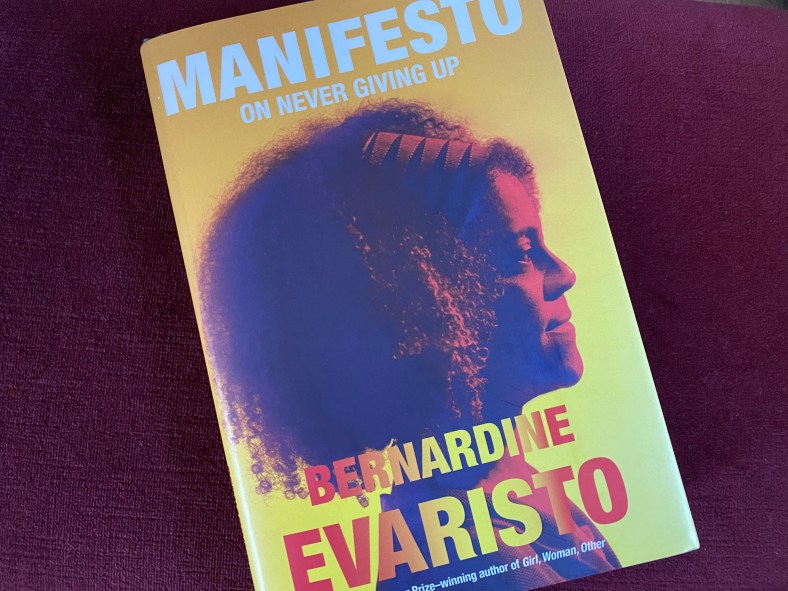
The Saturday Read: ‘Manifesto’ by Bernardine Evaristo

“I was never prepared to settle for less than I desired.”

I sometimes think our investment in professional development is better made on novels and memoirs vs. management guides. If you agree, head to your local independent bookstore for a copy of author Bernardine Evaristo’s ‘Manifesto’. (You may add an underlining marker to your purchase as well – take notes!) This memoir by the Booker Prize winning author follows her life and career trajectory and in doing so, describes influences, struggles, priorities, commitment, and the value of life-long learning.

She begins with a question: “Most people in the arts have role models –writers, artists, creatives – who have inspired them, but what are the other elements that lay the foundation for our creativity and steer the direction of our careers?”

How do you find a path to success when you don’t have access to the resources of the elite? How do you move beyond “My school didn’t inspire me to greatness… Nobody encouraged us to think big and make our dreams come true.”?  

In seven chapters, Ms. Evaristo details the evolution of her work ethic, commitment to craft and determination to mentor those who follow. Her story is a lived example of the value and responsibility of experience. Her narrative is relevant because each reader will find a point of connection in following the writer’s journey. 

“… we all learn, eventually that life demands a lot more from us than the ability to get good grades. Combating struggle and disappointment early on in life can instill a strength and determination we would not otherwise possess… Life presents us with obstacles. It’s never a completely smooth ride for anyone, and while nobody wants to struggle, it’s the only way to build resilience.”

And we don’t stop learning. “My goal, as always, is to continue to write stories and to develop my skills. There is no point of arrival whereby one stops growing as a creative person; to think otherwise will lead to creative repetition and stagnation.”

We read memoirs because we are curious. At the center, who is this person?

“I am first and foremost a writer; the written word is how I process everything – myself, life, society, history, politics. It’s not just a job or a passion, but it is at the very heart of how I exist in the world, and I am addicted to the adventure of storytelling as my most powerful means of communication.”

But that’s only part of the story. In her book review for NPR, writer Hope Wabuke described the ‘real world’ impact of Ms. Evaristo’s commitment and influence. “Evaristo’s work in supporting inclusivity in the literary arts is legend. It includes the commission of a Free Verse report, which found that less than 1% of poetry books in the United Kingdom were published by poets of color, and then creating a mentorship program, The Complete Works, to do something about it; this program mentored 30 poets over two years. Evaristo’s advocacy work also created the Brunel Poetry Prize for African writers, the first and largest award of its kind, and led her to work alongside Kwame Dawes in situating the African Poetry Book Fund as a force that has changed the shape of contemporary publishing. Most recently, as the curator of Black Britain: Writing Black, Evaristo is republishing overlooked books by Black authors such as Minty Alley, by C.L.R James originally published in 1936.”

‘Manifesto’ is one more creative endeavor for Ms. Evaristo to share her wisdom. Not all influences are one-on-one connections. Sometimes we find direction in a book. 

“We must pass on what we know to the next generation, & express gratitude to those who help us – nobody gets anywhere on their own.”

Learn more:

Bernardine Evaristo books – https://bevaristo.com/books/

Black Britain: Writing Back – https://www.theguardian.com/books/2021/jan/09/booker-winners-mission-to-put-uks-forgotten-black-writers-back-in-print

Brunel African Poetry Prize – https://www.africanpoetryprize.org

An aside: I picked up two new applicable concepts: “period of self-calibration” (which we can all use about now) and “to bounce back in the act of falling.” (advice to her students to continue to be positive) 

The Friday Poem: ‘How Will This Pandemic Affect Poetry?’ by Julia Alvarez

Last spring, author Valeria Luiselli accepted the British Rathbone Folio Prize for her novel, ‘Lost Children Archive’. She spoke of the writer’s responsibility, “whether a science-fiction writer, a journalist, a poet, each at their own pace and within their own capacities, to document this moment”.

“We are going to need this narrative fabric, some sort of fabric for us to lay down once we overcome this.”

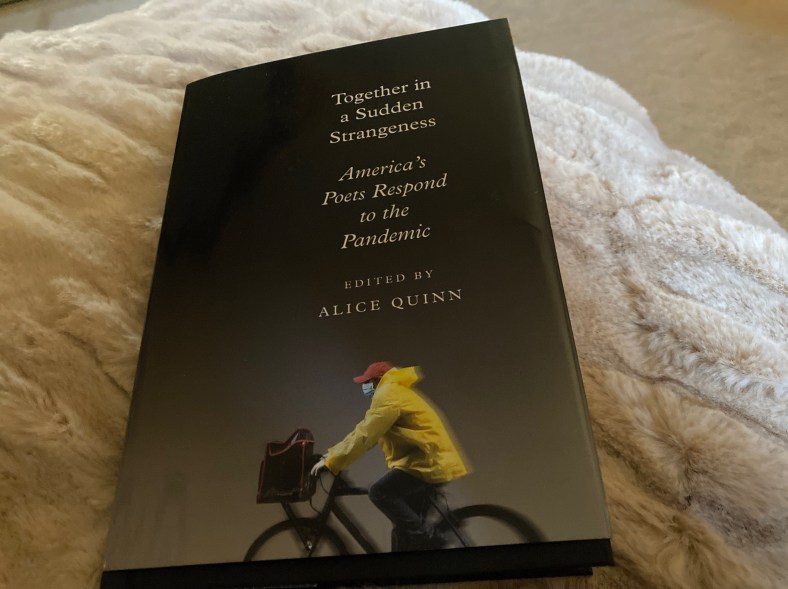
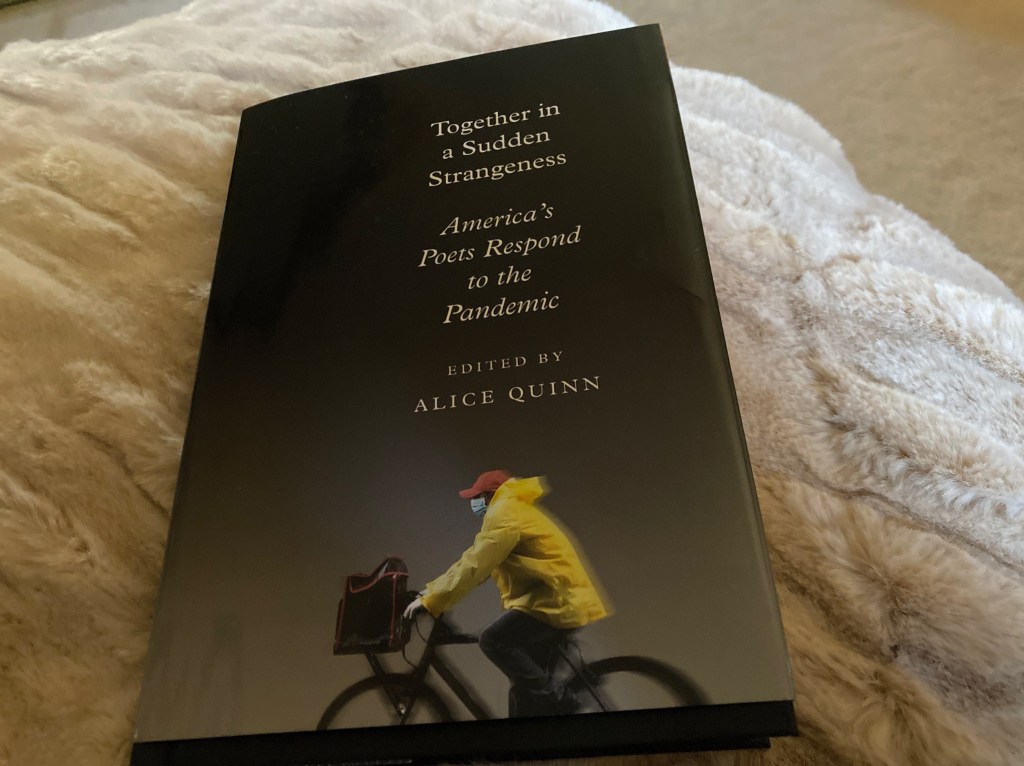
One expression of this “narrative fabric” is the recently published poetry anthology, ‘Together in a Sudden Strangeness’ edited by Alice Quinn.  

The Friday Poem selection for this week is Julia Alvarez’s ‘How Will This Pandemic Affect Poetry?’ As we reimagine our priorities ‘after’, framed by our experience in the ‘before times’ and pandemic isolation, where will art reside? 

How Will This Pandemic Affect Poetry?

Will the lines be six feet apart?

Will these hexameters be heroic like Homer’s?

(Will) (each) (word) (have) (to) (be) (masked) (?)

Will there be poetry insecurity?

Will there be enough poetry to go around?

Will poems be our preferred form of travel?

Will we undertake odysseys searching for Ithacas inside us?

Will poetry go viral?

Will its dis/ease infect us?

Will it help build up antibodies against indifference?

Will poems be the only safe spaces where we can gather together:

            enter their immense silences

            see snakes slithering inside sestinas, 

            listen to nightingales singing on the boughs of odes –

            hark! a lark in the terza rima,

            a hawk in a haiku?

What if only poetry will see us through?

What if this poem is the vaccine already working inside you?

Julia Alvarez

April 27 – May 8, 2020

Weybridge, Vermont

‘Together in a Sudden Strangeness: America’s Poets Respond to the Pandemic’

Alice Quinn, editor    Alfred A. Knopf, New York    2020

And then we came to the middle…

“Are we there yet?” could be the quote of the pandemic. The answer is no. The problem hasn’t been solved, although we continue to pretend it has. Just take a detour past your local food bank and you’ll experience an instant reality check on expectations. A visit to your local post office might offer a clue to what your workplace might look like if you ever return.

We stayed inside… for a time. And that eased the crisis in many ‘hot spots’ for hospitals and health care professionals. But then we got tired of ‘stay at home’. We saw folks venturing out and government leaders relaxing rules. But the problem hadn’t been solved. We’re still in the middle. Research into a vaccine is progressing, but testing still lags, and nothing has really changed from those early weeks in March. The virus is still out there seeking every opportunity to sink its ‘hooks’ into our various critical organs. What has changed is our belief that “we can handle it” – the reward far outweighs the risk – FOMO on career and life. 

We’re not an ‘in limbo’ culture of humans. Uncertainty is not our strong suit. We avoid commitments that might exceed 200 pages or two weeks. We’re more at home at the movies where all is resolved in 90 – 120 minutes.

But, COVID. Our momentum slowed. It took a bit of time to adjust – to the quiet, the change in energy, the middle. 

Here we are in a place with time to observe and reflect – an unscheduled leave of absence from our previous life – in the home of innovation and creativity. Yes, the middle is where imagination carves out our path to ‘THE END’.

A simple ‘construct as creative catalyst’ was provided by former Irish president and High Commissioner for Human Rights, Mary Robinson at the Edinburgh Book Festival in 2019. Speaking on the topic of climate change (insert your idea) she suggested three steps:

‘Make climate change (or your idea) personal in your life.

Get angry and get active.

Imagine this world we want to hurry towards.”

Imagine the world we want to hurry towards – that’s what we do when we’re in the middle. 

That’s why we’re here at the nexus of past and future – not to consider a ‘new normal’, but to invent the unimaginable. And that takes time – the time we have now, in the middle. 

#LetsTalkAboutWork

Three years ago I suggested that we use the Labor Day holiday as a catalyst to begin a national conversation about work. 

A lot has happened in those three years, but for the most part, the American worker is in about the same place they were then when USA TODAY led with this headline: “Labor Day by the Numbers: Americans Can’t Stop, Won’t Stop Working”. The updated numbers from CNN: “768 million days went unused in 2018, a 9% increase from 2017. Of those, 236 million were completely forfeited, which comes out to $65.5 billion in lost benefits.Fifty-five percent of workers reported that they did not use all of their vacation days.”

We are spending more time @work and less time considering why. 

Out of necessity we maintain a laser focus on our own career goals, spending most of the 365 days a year securing our future as best we can in an ever changing workplace. What if we just took one of those days to consider the workplace issues we face as part of a larger context?

The Labor Day holiday was originally conceived as “…a creation of the labor movement and is dedicated to the social and economic achievements of American workers. It constitutes a yearly national tribute to the contributions workers have made to the strength, prosperity, and well-being of our country.” *

What better way to offer a tribute to the American worker than to engage in a national discussion that restores respect and considers the reality of today’s workplace?

This is not a political issue. It’s a human dignity issue. Rather than divide, this conversation should unite us.

Access to education and a right to work are fundamental American values. It’s how we define ourselves when asked ‘what do you do?’. Imagine the despair for those with no answer.

It’s time to reestablish the voice of the American worker and address both the barriers to workplace entry, and the challenges @work once you arrive.

Share your ideas @workthoughts.com #LetsTalkAboutWork!

(*original quote from the U.S. Department of Labor site which no longer seems to be working.)

The Friday Poem ‘Of History and Hope by Miller Williams

For the first ‘Friday Poem’ of 2019, I’ve gone back into the Workthoughts archives to reprise Miller Williams‘ poem ‘Of History and Hope’ delivered at the Inauguration of William Jefferson Clinton in 1997.

The Washington Post obituary for professor Williams, who died on New Years Day in 2015, included an excerpt of an interview with the Oxford American magazine. In the interview the poet shared the intent behind the words.

“…he wanted the poem to be a “consideration of how a look at a nation’s past might help determine where it could be led in the future.

“I knew that the poem would be listened to by a great many people, reprinted around the country, and discussed in a lot of classrooms, so I wanted it to be true, understandable, and agreeable…”

The words of the poet, recited from the steps of the U.S. Capitol building, 22 years ago, speak to us in this current place that is American, 2019.

“We mean to be the people we meant to be,
to keep on going where we meant to go.”

Of History and Hope

We have memorized America,
how it was born and who we have been and where.
In ceremonies and silence we say the words,
telling the stories, singing the old songs.
We like the places they take us. Mostly we do.
The great and all the anonymous dead are there.
We know the sound of all the sounds we brought.
The rich taste of it is on our tongues.
But where are we going to be, and why, and who?
The disenfranchised dead want to know.
We mean to be the people we meant to be,
to keep on going where we meant to go.

But how do we fashion the future? Who can say how
except in the minds of those who will call it Now?
The children. The children. And how does our garden grow?
With waving hands—oh, rarely in a row—
and flowering faces. And brambles, that we can no longer allow.

Who were many people coming together
cannot become one people falling apart.
Who dreamed for every child an even chance
cannot let luck alone turn doorknobs or not.
Whose law was never so much of the hand as the head
cannot let chaos make its way to the heart.
Who have seen learning struggle from teacher to child
cannot let ignorance spread itself like rot.
We know what we have done and what we have said,
and how we have grown, degree by slow degree,
believing ourselves toward all we have tried to become—
just and compassionate, equal, able, and free.

All this in the hands of children, eyes already set
on a land we never can visit—it isn’t there yet—
but looking through their eyes, we can see
what our long gift to them may come to be.
If we can truly remember, they will not forget.

Miller Williams  ‘Some Jazz A While: Collected Poems’  1999


The Friday Poem ‘truth’ by Gwendolyn Brooks

It’s a popular talking point among pundits to observe we live in a ‘post-truth’ age: an era defined by the Oxford Dictionary as one “in which objective facts are less influential in shaping public opinion than appeals to emotion and personal belief.”

Pulitzer prize winning poet, Gwendolyn Brooks described this place we now find ourselves in her poem ‘truth’.

“And if the sun comes
How shall we greet him?
Shall we not dread him,
Shall we not fear him
After so lengthy a
Session with shade?”

truth

And if sun comes
How shall we greet him?
Shall we not dread him,
Shall we not fear him
After so lengthy a
Session with shade?

Though we have wept for him,
Though we have prayed
All through the night-years—
What if we wake one shimmering morning to
Hear the fierce hammering
Of his firm knuckles
Hard on the door?

Shall we not shudder?—
Shall we not flee
Into the shelter, the dear thick shelter
Of the familiar
Propitious haze?

Sweet is it, sweet is it
To sleep in the coolness
Of snug unawareness.

The dark hangs heavily
Over the eyes.

Gwendolyn Brooks,  ‘Blacks’  Third World Press, 1987

31rHoqqoFGL._SX334_BO1,204,203,200_