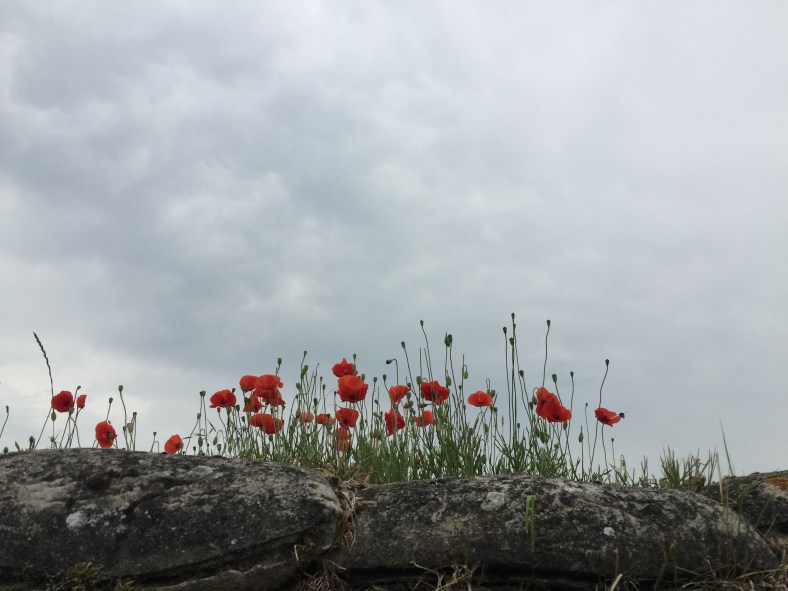
‘To One Who Was With Me in the War’ a poem for Veteran’s Day by Siegfried Sassoon

To One Who Was With Me in the War

It was too long ago – the Company which we served with…

We call it back in visual fragments, you and I,

Who seem, ourselves, like relics casually preserved with

Our mindfulness of old bombardments when the sky

With blundering din blinked cavernous,

Yet a sense of power

Invaded us when, recapturing an ungodly hour

Of ante-zero crisis, in one thought we’ve met

To stand in some redoubt of Time – to share again

All but the actual wetness of the flare-lit rain,

All but the living presences who haunt us yet

With gloom-patrolling eyes.

Remembering; we forget

Much that was monstrous, much that clogged our souls with clay

When hours were guides who led us by the longest way –

And when the worst had been endured could still disclose

Another worst to thwart us…

We forget our fear…

And, while the uncouth Event begins to lour less near.

Discern the mad magnificence whose storm-light throws

Wild shadows on these after-thoughts that sent your brain

Back beyond Peace, exploring sunken ruinous roads.

Your brain, with files of flitting forms hump-backed with loads,

On its own helmet hears the tinkling drops of rain, –

Follows to an end some night-relief, and strangely sees

The quiet no-man’s-land of daybreak, jagg’d with trees

That loom like giant Germans…

I’ll go with you then,

Since you must play this game of ghosts. At listening-posts

We’ll peer across dim craters: joke with jaded men

Whose names we’ve long forgotten. (Stoop low there; it’s the place

The sniper enfilades.) Round the next bay you’ll meet

A drenched platoon-commander; chilled he drums his feet

On squelching duck-boards; winds his wrist watch, turns his head,

And shows you how you looked – your ten- years-vanished face,

Hoping the War will end next week…

What’s that you said?

Siegfried Sassoon (1886-1967) from ‘first world war poems’ ed. Jane McMorland Hunter, 2014

‘Taking One for the Team’ a poem by Sara Holbrook

The workplace is full of motivational ‘teamwork’ analogies. Many come from the world of sports and famous coaches: fields, courts and pitches where team behavior is on view for all to observe.

“Individual commitment to a group effort–that is what makes a team work, a company work, a society work, a civilization work.” –Vince Lombardi

“The strength of the team is each individual member. The strength of each member is the team.” –Phil Jackson

“To me, teamwork is the beauty of our sport, where you have five acting as one. You become selfless.” –Mike Krzyzewski

The Friday Poem this week is from performance poet, Sara Holbrook and seems particularly fitting for those of us who are NY Mets fans as the World Series came to an end late Sunday night.

The poem is for all those who have given their best effort only to become spectators to an opponent’s victory celebration.“I’m proud to say I lost with you.” 

Taking One for the Team

We practiced together,
sweat and stained.
We pummeled each other
and laughed off pain.
Teams may disagree,
may tease,
may blame.
Teams may bicker and whine,
but get down for the game.

You had my back.
We fought the fight.
And though our score
was less last night,
we’re walking tall.
Our team came through
and stuck together like Crazy Glue.
I’m proud to say
I lost with you.

Sara Holbrook   ‘Weird? (Me, Too!) Let’s Be Friends’ 2011

‘The Names’ a poem by Billy Collins

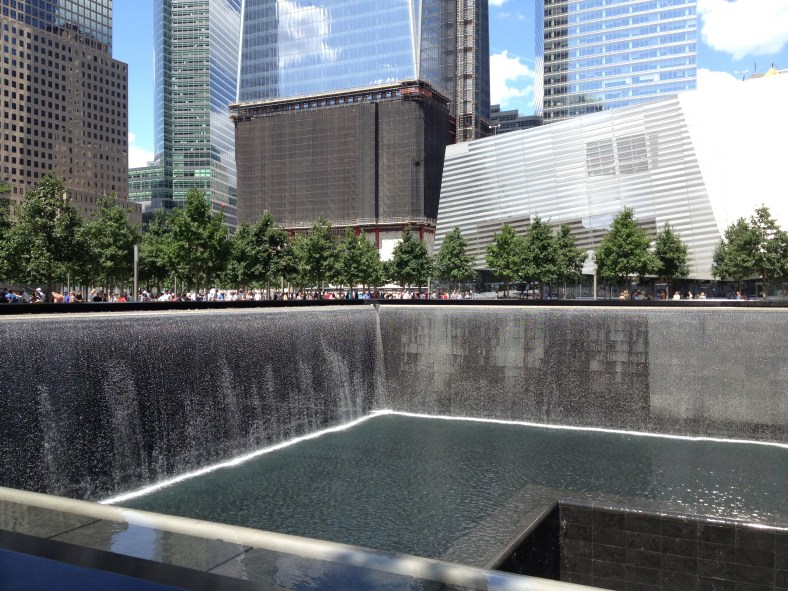
Today we remember those who headed to work on a beautiful September morning in 2001. It has been fourteen years since they did not return home.

Poetry flourished in New York in the aftermath of the attacks. “By February, 2002, over 25,000 poems written in response to 9/11 had been published on poems.com alone. Three years later, the number of poems there had more than doubled.”

Billy Collins was the U.S. Poet Laureate in 2001. The Friday Poem, ‘The Names’, was delivered to a joint session of Congress in 2002.

The Names

Yesterday, I lay awake in the palm of the night.

A soft rain stole in, unhelped by any breeze,

And when I saw the silver glaze on the windows,

I started with A, with Ackerman, as it happened,

Then Baxter and Calabro,

Davis and Eberling, names falling into place

As droplets fell through the dark.

Names printed on the ceiling of the night.

Names slipping around a watery bend.

Twenty-six willows on the banks of a stream.

In the morning, I walked out barefoot

Among thousands of flowers

Heavy with dew like the eyes of tears,

And each had a name —

Fiori inscribed on a yellow petal

Then Gonzalez and Han, Ishikawa and Jenkins.

Names written in the air

And stitched into the cloth of the day.

A name under a photograph taped to a mailbox.

Monogram on a torn shirt,

I see you spelled out on storefront windows

And on the bright unfurled awnings of this city.

I say the syllables as I turn a corner —

Kelly and Lee,

Medina, Nardella, and O’Connor.

When I peer into the woods,

I see a thick tangle where letters are hidden

As in a puzzle concocted for children.

Parker and Quigley in the twigs of an ash,

Rizzo, Schubert, Torres, and Upton,

Secrets in the boughs of an ancient maple.

Names written in the pale sky.

Names rising in the updraft amid buildings.

Names silent in stone

Or cried out behind a door.

Names blown over the earth and out to sea.

In the evening — weakening light, the last swallows.

A boy on a lake lifts his oars.

A woman by a window puts a match to a candle,

And the names are outlined on the rose clouds —

Vanacore and Wallace,

(let X stand, if it can, for the ones unfound)

Then Young and Ziminsky, the final jolt of Z.

Names etched on the head of a pin.

One name spanning a bridge, another undergoing a tunnel.

A blue name needled into the skin.

Names of citizens, workers, mothers and fathers,

The bright-eyed daughter, the quick son.

Alphabet of names in a green field.

Names in the small tracks of birds.

Names lifted from a hat

Or balanced on the tip of the tongue.

Names wheeled into the dim warehouse of memory.

So many names, there is barely room on the walls of the heart.

Billy Collins, 2002

‘Of History and Hope’ a poem by Miller Williams

This week’s ‘Friday Poem’ is for the citizen workers. In a week of presidential debates, Miller Williams‘ poem ‘Of History and Hope’ seems particularly relevant.

He was selected by President Clinton as the third inaugural poet. ‘Of History and Hope’ was delivered at the second Clinton inauguration in 1997.

The Washington Post obituary for professor Williams included an excerpt of an interview with the Oxford American magazine. In the interview the poet shared the intent behind the words.

“…he wanted the poem to be a “consideration of how a look at a nation’s past might help determine where it could be led in the future.

“I knew that the poem would be listened to by a great many people, reprinted around the country, and discussed in a lot of classrooms, so I wanted it to be true, understandable, and agreeable…”

Of History and Hope

We have memorized America,
how it was born and who we have been and where.
In ceremonies and silence we say the words,
telling the stories, singing the old songs.
We like the places they take us. Mostly we do.
The great and all the anonymous dead are there.
We know the sound of all the sounds we brought.
The rich taste of it is on our tongues.
But where are we going to be, and why, and who?
The disenfranchised dead want to know.
We mean to be the people we meant to be,
to keep on going where we meant to go.

But how do we fashion the future? Who can say how
except in the minds of those who will call it Now?
The children. The children. And how does our garden grow?
With waving hands—oh, rarely in a row—
and flowering faces. And brambles, that we can no longer allow.

Who were many people coming together
cannot become one people falling apart.
Who dreamed for every child an even chance
cannot let luck alone turn doorknobs or not.
Whose law was never so much of the hand as the head
cannot let chaos make its way to the heart.
Who have seen learning struggle from teacher to child
cannot let ignorance spread itself like rot.
We know what we have done and what we have said,
and how we have grown, degree by slow degree,
believing ourselves toward all we have tried to become—
just and compassionate, equal, able, and free.

All this in the hands of children, eyes already set
on a land we never can visit—it isn’t there yet—
but looking through their eyes, we can see
what our long gift to them may come to be.
If we can truly remember, they will not forget.

Miller Williams  ‘Some Jazz A While: Collected Poems’  1999

‘The Last Hours’ a poem by Stephen Dunn

The ‘Friday poem’ this week is ‘Last Hours’ from the Pulitzer Prize winning collection, ‘Different Hours’ by Stephen Dunn. The poem is set in an office in 1964 at nineteen minutes to five.

NPR editor Barrie Hardymon selected her interview with the poet as a favorite in 2014. “This was one of these moments where, you know, he writes this very accessible poetry – and I mean that not to damn it with faint praise. You are still in the chapel of language that poetry is, but it is so – it still feels like a friend is whispering in your year very wise things. And he had that quality about him.”

The interview began with “how he has used poetry in his own life”.

“What good literature has always done is give me the language with the occasion – a lot of times not, of course. But I think the poems that matter to me are the ones that speak to that which cannot easily be said.”

“I was not a particularly good student, and I was a pretty good basketball player. I’ve written an essay called “Basketball And Poetry,” in which I try not to push the metaphor too far. But one of the points that I make in the essay is the similarity between poetry and basketball is the chance to be better than yourself, to transcend yourself, if you’re hot that day. And that happens in writing in our best moments, where we find ourselves saying what we didn’t know we knew or couldn’t have said in any other circumstance. Those are the moments in poetry I live for now.”

Does our ‘work place’ also gives us a chance to be better than ourselves? Enter ‘the chapel of language’ in the Friday poem, The Last Hours.

The Last Hours

There’s some innocence left,
and these are the last hours of an empty afternoon
at the office, and there’s the clock
on the wall, and my friend Frank
in the adjacent cubicle selling himself
on the phone.
I’m twenty-five, on the shaky
ladder up, my father’s son, corporate,
clean-shaven, and I know only what I don’t want,
which is almost everything I have.
A meeting ends.
Men in serious suits, intelligent men
who’ve been thinking hard about marketing snacks,
move back now to their window offices, worried
or proud. The big boss, Horace,
had called them in to approve this, reject that–
the big boss, a first-name, how’s-your-family
kind of assassin, who likes me.
It’s 1964.
The sixties haven’t begun yet. Cuba is a larger name
than Vietnam. The Soviets are behind
everything that could be wrong. Where I sit
it’s exactly nineteen minutes to five. My phone rings.
Horace would like me to stop in
before I leave. Stop in. Code words,
leisurely words, that mean now.
Would I be willing
to take on this? Would X’s office, who by the way
is no longer with us, be satisfactory?
About money, will this be enough?
I smile, I say yes and yes and yes,
but–I don’t know from what calm place
this comes–I’m translating
his beneficence into a lifetime, a life
of selling snacks, talking snack strategy,
thinking snack thoughts.
On the elevator down
it’s a small knot, I’d like to say, of joy.
That’s how I tell it now, here in the future,
the fear long gone.
By the time I reach the subway it’s grown,
it’s outsized, an attitude finally come round,
and I say it quietly to myself, I quit,
and keep saying it, knowing I will say it, sure
of nothing else but.

Stephen Dunn, from Different Hours (W.W. Norton)

‘A Step Away From Them’ a poem by Frank O’Hara

The ‘Friday Poem’ this week invites us back to a summer lunch hour in the early 1960s. ‘A Step Away From Them’ was written by poet Frank O’Hara.

O’Hara’s work was first brought to the attention of the wider public, like that of so many others of his generation, by Allen’s timely and historic anthology, The New American Poetry (1960). It was not until O’Hara’s Lunch Poems was published in 1965 that his reputation gained ground and not until after his sudden death that his recognition increased. Now his reputation is secure as an important and even popular poet in the great upsurge of American poetry following World War II.”

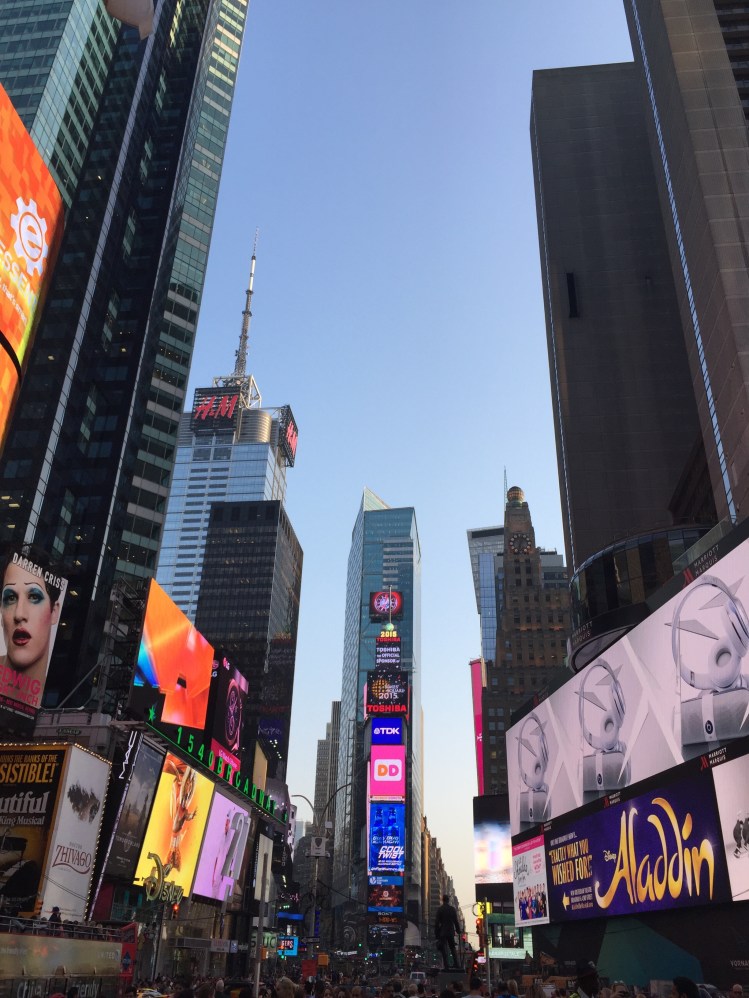
The Times Square of 2015 differs, yet in some ways echoes the observations of O’Hara in 1964. Today electronic billboards create daylight 24×7, parts of the street is a promenade and Uber drivers vie for passengers with yellow cabs. But office workers still pour into the streets at lunchtime as the heat rises from subway grates and bursts of cool air are released by revolving doors.

Take a walk at lunch and enjoy the ‘Friday Poem.’

A Step Away from Them

It’s my lunch hour, so I go
for a walk among the hum-colored
cabs. First, down the sidewalk
where laborers feed their dirty
glistening torsos sandwiches
and Coca-Cola, with yellow helmets
on. They protect them from falling
bricks, I guess. Then onto the
avenue where skirts are flipping
above heels and blow up over
grates. The sun is hot, but the
cabs stir up the air. I look
at bargains in wristwatches. There
are cats playing in sawdust.
On
to Times Square, where the sign
blows smoke over my head, and higher
the waterfall pours lightly. A
Negro stands in a doorway with a
toothpick, languorously agitating.
A blonde chorus girl clicks: he
smiles and rubs his chin. Everything
suddenly honks: it is 12:40 of
a Thursday.
Neon in daylight is a
great pleasure, as Edwin Denby would
write, as are light bulbs in daylight.
I stop for a cheeseburger at JULIET’S
CORNER. Giulietta Masina, wife of
Federico Fellini, è bell’ attrice.
And chocolate malted. A lady in
foxes on such a day puts her poodle
in a cab.
There are several Puerto
Ricans on the avenue today, which
makes it beautiful and warm. First
Bunny died, then John Latouche,
then Jackson Pollock. But is the
earth as full as life was full, of them?
And one has eaten and one walks,
past the magazines with nudes
and the posters for BULLFIGHT and
the Manhattan Storage Warehouse,
which they’ll soon tear down. I
used to think they had the Armory
Show there.
A glass of papaya juice
and back to work. My heart is in my
pocket, it is Poems by Pierre Reverdy.

Frank O’Hara ‘Lunch Poems’ 1964

‘Working Together’ a poem, by David Whyte

I first encountered David Whyte when a mentor recommended his 1994 book, ‘The Heart Aroused:Poetry and the Preservation of the Soul in Corporate America’.  For the ‘Friday Poem’ this week, I was looking for one that reflected a bit of the ‘magic’ of teamwork. My search brought me back to the poet and author. ‘Working Together’ was composed by David Whyte for Boeing to mark the introduction of the 777 jetliner.

Writing in the preface to the revised edition of ‘The Heart Aroused’ the poet cited his challenge:

“The impossible task was to bring together the supposedly strategic world of business with the great inheritance of the human literary imagination, particularly through the difficult art, poetry, and particularly through the fierce, unremitting wish for the dangerous truth that is poetry’s special gift.”

On the occasion of the ‘fly by’ of the dwarf planet Pluto and in celebration of creativity, engagement and courage in the workplace, enjoy ‘Working Together’.

Working Together

We shape our self
to fit this world

and by the world
are shaped again.

The visible
and the invisible

working together
in common cause,

to produce
the miraculous.

I am thinking of the way
the intangible air

passed at speed
round a shaped wing

easily
holds our weight.

So may we, in this life
trust

to those elements
we have yet to see

or imagine,
and look for the true

shape of our own self,
by forming it well

to the great
intangibles about us.

— David Whyte
from The House of Belonging
©1996 Many Rivers Press

The ‘deer in the headlights’ interview question: What do you do for fun?

The interview has been going well. You have been ‘on point’ with your answers about education and skills, and then from out of nowhere comes the curve ball question: What do you do for fun?

What? What do I do for fun? Are you kidding me?

No, it’s actually a very serious important question. How you answer demonstrates the added dimensions you will bring to the workplace.

This is my ‘personal favorite’ interview question. My intent is not to ‘catch’ folks off guard. My goal is to determine if you will succeed as part of an organization. Are you a fit with the other members of the team? Do you have the potential to build successful relationships with clients?  It’s one thing to be driven and intense. It’s a totally other thing when you scare colleagues and customers with that intensity.

The ‘perfect resume’, relevant work experience and great references unlock the door to the interview. Once the interview begins It’s critical to let your humanity shine through. Folks will be spending a lot of time with you in the workplace. A sense of humor can go a long way to diffusing tension. A conversation about interests offers a bridge to developing trust.

I am astounded by how many people are totally sidelined by this question – lots of silence before a stammering attempt to come up with the ‘right’ answer.

There is no right answer. This is the question about who you are outside work. This should be the easiest question to answer.

I know I have the right candidate when the question diffuses tension and a smile transforms a previously sober candidate into one who is sharing a passion that may have no perceived relevance to the job description.

And this is where the majority of candidates get it wrong. Your passions outside of work inform and energize your life at work.

Think about your answer – not too much. Your response should be spontaneous, but you shouldn’t be surprised.

‘747 (London-Chicago)’ a poem by Robert Conquest

The Friday poem this week comes from Stanford University historian and poet, Robert Conquest. He is the author of twenty-one books on Soviet history, politics, and international affairs, including the classic ‘The Great Terror’ – which has been translated into twenty languages – and the acclaimed ‘Harvest of Sorrow’ (1986).

In a 2010 profile for the Stanford news he offered this advice to young poets, “Write under a pseudonym, and pretend it’s a translation from the Portuguese.”

The profile also includes observations by his friends:

“As a poet Bob is funny, intensely lyrical and deeply reflective,”(R.S.) Gwynn said. “Whenever I read him I think of how rarely we are allowed to see a mind at work, and what a mind it is.”

“(Christopher) Hitchens, speaking of Conquest’s “devastatingly dry and lethal manner,” also wrote that his was “the softest voice that ever brought down an ideological tyranny.” Naming Conquest among his handful of favorite poets, Hitchens called him not only “the king of the limerick” but also “the dragon slayer of the Stalinoid apologists.”

This poem is for all you ‘dragon slayers @ work’, boarding a flight home.

‘747 (London-Chicago)

After the horrors of Heathrow
A calmness settles in.
A window seat, an ambient glow,
A tonic-weakened gin.

The pale-grey wings, the pale-blue sky,
The tiny sun’s sharp shine,
The engines’ drone, or rather sigh;
A single calm design.

Those great wings flex to altering air.
Ten thousand feet below
We watch the endless miles of glare,
Like slightly lumpy dough.

Below that white all’s grey and grim,
The wrong side of the sky.
Reality’s down in that dim
Old formicary? Why?

What though through years, the same old way,
That world spins on its hub?
The mayfly’s simple summer day
Beats lifetimes as a grub!

A geologic fault, this flight:
Those debts, that former wife,
Make some moraine down out of sight,
Old debris of a life.

(Only one figure, far and clear
Looks upward from that trough
A face still visible from here
-The girl who saw him off.)

The huge machine’s apart, alone.
The yielding hours go by.
We form a culture of our own
Inhabiting the sky.

Too short? Yet every art replies,
Preferring for its praise
To Egypt’s smouldering centuries
The brief Athenian blaze …

That flame-point sun, a blue-set jewel,
Blazed blurredly as it went.
Our arguments run out of fuel.
We dip for our descent.

We drift down from pure white and blue
To what awaits us there
In customs shed and passport queue
-The horrors of O’Hare.

Robert Conquest, 1988

Richard Avedon, a poem by Jeffrey Brown

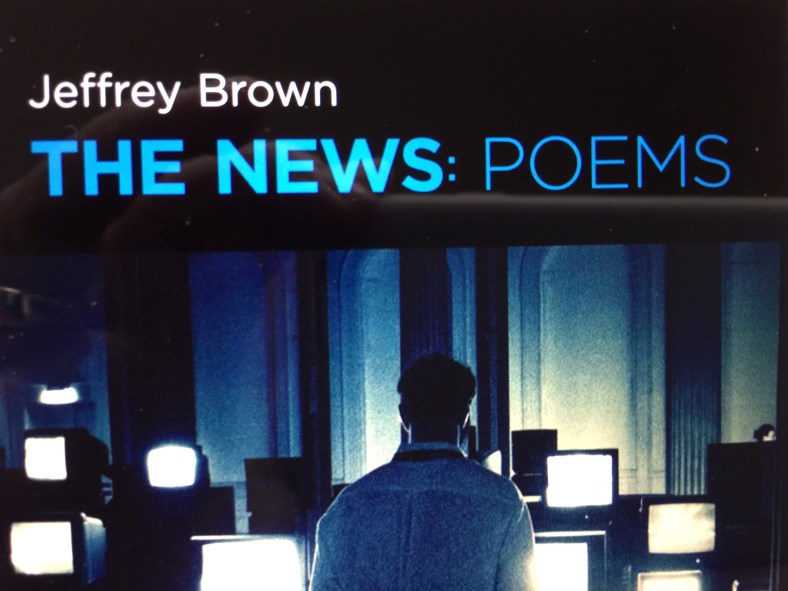
Earlier this month, Emmy award winning journalist Jeffrey Brown published his first book, ‘The News: Poems’. The PBS Newshour chief correspondent for arts, culture and society was interviewed by Gwen Ifill on a recent broadcast and described his goal to tell the stories he reported “in a different voice with different words”.

“I am a hard-bitten news guy. I mean, that’s our world, right? We go out into the world, we see things, we tell stories, we meet people.

But there’s a side of me that loves literature, that loves poetry, that loves history, that loves ideas, that loves music. It comes out, I hope, on the program as well.

I started writing a long time ago. I wrote at different times during my life. I would write. I would pick up snippets from along the way.

I started realizing that I wanted to go back and look at stories that I had done and sort of rethink them, reimagine them, tell them in a different voice with different words. And I — it was just — it was — it was fun for me. It was interesting to do.”

He went back and looked at transcripts of old interviews and used quotes to create the scaffolding of his poems.

This week’s Friday poem reflects his conversation with the photographer, Richard Avedon.

“He said — and we did an interview late at night in the Metropolitan Museum surrounded by his grand portraits.

And we were talking, because this is a subject that fascinates me, as it does with him, anybody who has a camera in front of them. What does the camera tell you? Well, it tells you a truth, but it doesn’t tell you the whole truth.”

Richard Avedon

Look around you: all gone

all dead. The heavy-lidded,

snake-charmed, sunbaked.

The poets and actors, Capote

with the blotched face, Marilyn

in sequins, Beckett and one

of his drifters, the powerful

and the pretenders.

They stood before a white screen

as close to me as you are now –

a confrontation that will last.

Eyes closed tight and eyes alert.

Eyes ahead and eyes askew,

as though they knew not to stare

at the viewer – click! – forever.

All gone, all dead – forever.

That is why I call the taking

of portraits a sad art, he said.

The camera lies all the time,

it’s all it does is lie. But this

is no lie: over there, my father –

Sarasota, August 25, 1973,

staring at me, forever. He does

not age. But he will not return.

Jeffrey Brown, ‘The News’ 2015