The week@work – Unemployment, economic mobility, parental leave, a tribute to #55 and anticipating Rio

The week@work included the first debate of the 2016 election season, the release of economic indicators and two American corporations announcing generous parental leave policies. This week also marks one year until those who work in sports will demonstrate their skills at the Summer Olympics in Brazil. And the NFL, in its wisdom, denied a Hall of Fame inductee’s daughter the opportunity to fulfill a father’s wish.

Once again, the week@work was about values: those we hold as a society and those organizations demonstrate not just in policies, but in action.

The June jobs numbers were released by the Labor Department on Thursday. Ben Casselman reported on the numbers behind the numbers in his article for ‘FiveThirtyEight’, ‘Don’t Forget The Workers The Recovery Is Leaving Behind’.

“U.S. employers added 215,000 jobs in July, the Bureau of Labor Statistics said in its monthly jobs report on Friday. It was the third straight month of job growth above 200,000, and the 10th in the past year. Revisions to prior months’ data added another 14,000 jobs, and the unemployment rate held steady at 5.3 percent, the lowest it’s been since before the recession.

Although the progress has been impressive, it has not been absolute. The headline unemployment rate is nearing a level most economists consider healthy — policymakers at the Federal Reserve consider a rate of between 5 percent and 5.2 percent “normal” over the long term — but the government’s official definition of unemployment leaves out people who have stopped looking for work or are stuck in part-time jobs. A broader underemployment rate, which includes both groups, stood at 10.4 percent in July, still well above its prerecession level.

It’s worth paying particular attention to a handful of groups that were hard-hit by the recession and continue to struggle in the recovery: African-Americans, young people, the less-educated and the long-term unemployed. The good news: All four groups are seeing some improvement, in some cases rapid improvement. But all of them have a long way to go before their employment could be considered healthy.”

In a related opinion piece, Nicholas Kristof posed the question, ‘U.S.A., Land of Limitations?

“Researchers have repeatedly found that in the United States, there is now less economic mobility than in Canada or much of Europe. A child born in the bottom quintile of incomes in the United States has only a 4 percent chance of rising to the top quintile, according to a Pew study.

…more children in America live in poverty now (22 percent at last count) than at the start of the financial crisis in 2008 (18 percent). They grow up not in a “land of opportunity,” but in the kind of socially rigid hierarchies that our ancestors fled, the kind of society in which your outcome is largely determined by your beginning.”

The week@work story with the most press was the decision by Netflix, soon followed by an announcement from Microsoft, to offer extended parental leave.

Vauhini Vara writing in The New Yorker reports on ‘Why Parental Leave Remains a Privilege’.

“There are other reasons for policies like Netflix’s, besides the fight over talented workers. Gerry Ledford, a senior research scientist at the University of Southern California’s Center for Effective Organizations, pointed out that the companies that offer costly benefits, like long paid parental leaves, tend to be financially successful, with money available to spend on H.R. perks. Google and Facebook are highly profitable, and while Netflix is only barely profitable, investors don’t seem to mind; the company’s share price set a new record on the day that Netflix announced its updated parental-leave policy. A third factor—and perhaps the least known—has to do with Silicon Valley’s location in California, where all workers have access to some amount of paid leave for the first six weeks after the birth or adoption of a child; it’s easier for a company to justify generous parental leave when many of their employees were already taking time off anyway.”

This time next year we will all be cheering our respective nations as athletes compete at the Summer Olympics in Brazil. As NBC rolled out their initial commercials in anticipation of hours of broadcast time, two stories offered a preview of the competition.

The first was part of a series of videos produced by GoPro. Beach volleyball competitor and Olympic silver medalist April Ross narrates a four minute video describing her ‘life @work’ on the beach. For young women who aspire to elite competition, April’s perspective is a window on the dedication required to succeed. She shares her pride at winning silver but is motivated to take that “one step up on the podium” in Rio. Her best advice, “Don’t get caught up in other people’s expectations”.

And then there is the young woman who goes to work every day in the water. Katie Ledecky startled all in London in 2012, when she earned gold in the 800 meter freestyle. This week she won five gold medals at the World Championships. The New York Times reported on her achievement, becoming “the first to win the 200, 400, 800 and 1,500-meter freestyles in a major competition.”

“Ledecky capped off a history-making week on Saturday at Kazan Arena with another milestone. In the 800-meter freestyle, the event that launched Ledecky into the international spotlight at the 2012 London Olympics, she set her 10th world record of the past 24 months with a clocking of 8 minutes 7.39 seconds. The time was 3.61 seconds better than her 13-month-old mark.

Ledecky, 18, slapped the water three times — once for each individual world record she set at these world championships.”

Junior Seau was a football player. On Saturday he was inducted along with seven others into the Football Hall of Fame in Canton, Ohio. The New York Times covered the ceremony and the story behind the story.

“In his 20-year N.F.L. career, Junior Seau established himself as one of the game’s greatest linebackers. He committed suicide in 2012 at age 43 and was subsequently found to have had a degenerative brain condition linked to repeated hits to the head. Before his death, Seau told his daughter Sydney that she should speak on his behalf if he made it into the Pro Football Hall of Fame. But the Hall, citing a five-year-old policy of not letting others give full speeches for deceased inductees, did not allow Sydney to deliver her speech.”

Today, The New York Times printed Sydney’s complete remarks as the full page lead story of the sports section. Her words reflect the sincere love and respect of a daughter for a father and a desire to fulfill his wish. One wonders, one more time, about the disconnect at the NFL between stated and demonstrated values.

“The two words that exemplify my dad the most are “passion” and “love.” Everything he achieved, accomplished or set his mind to was done with both qualities. In every situation — whether it be practice, a game, a family barbecue, an impromptu ukulele song or just a run on the Oceanside Strand — he always gave you all of himself because to him, there was never any other option.”

“Being the first Polynesian and Samoan to make it into the Hall of Fame is such an accomplishment. He is proof that even a young boy from Oceanside can make his dreams a reality. All his success is a direct reflection of the Oceanside community and family that raised him and molded him into the man he became. Although he is the first Polynesian to make it into the Hall, I know he will not be the last.”

The Saturday Read – Ed Catmull with Amy Wallace ‘Creativity, Inc.’

If you can’t find a business book that meets your needs, write one. Last year Pixar’s Ed Catmull decided to do just that with ‘Creativity, Inc.’ In the introduction, he tells the reader the book “is about the ongoing work of paying attention – of leading by being self-aware, as managers and as companies. It is an expression of the ideas that I believe make the best in us possible.”

The Saturday Read this week is ‘Creativity, Inc: Overcoming The Unseen Forces That Stand In The Way Of True Inspiration’.

What differentiates this ‘management bible’ from the others is how well it integrates Catmull’s personal story into the evolution of his management values. We learn how our first interactions with the workplace can influence how we expect all our work places to be structured.

The author changed his undergraduate major from art to physics. In graduate school at the University of Utah he was encouraged by a professor, Ivan Sutherland to study computer graphics “in essence, the making of digital pictures out of numbers, or data that can be manipulated by a machine”. 

It was in this collegial environment that he first experienced “This tension between the individual’s personal creative contribution and the leverage of the group is a dynamic that exists in all creative environments…we had the genius who seemed to do amazing work on his or her own; on the other end, we had the group that excelled precisely because of its multiplicity of views.”

His experiential memory of the environment needed to create the impossible informed his management approach as his career unfolded.

“I would devote myself to learning how to build not just a successful company but a sustainable creative culture.”

His guiding principles remain consistent. In a 2008 Harvard Business Review article, ‘How Pixar Fosters Collective Creativity’ he outlined his management philosophy.

“Empower your creatives. Create a peer culture. Free up communication. Craft a learning environment. Get more out of post-mortems.”

‘Creativity, Inc.’ expands on these principles with experiential lessons in failure and success. It’s about values.

“My belief is that good leadership can help creative people stay on the path to excellence no matter what business they’re in.”

“We start from the presumption that our people are talented and want to contribute. We accept that, without meaning to, our company is stifling that talent in myriad unseen ways. Finally, we try to identify those impediments and fix them.”

“What makes Pixar special is that we acknowledge we will always have problems, many of them hidden from our view; that we work hard to uncover these problems, even if doing so means making ourselves uncomfortable; and that, when we come across a problem, we marshal all of our energies to solve it.”

Throughout the book we are learning about his leadership approach. It’s one that is not exclusive to the head of a major entertainment enterprise, but relevant to all managers from start ups to the Fortune 100.

“The way I see it, my job as manager is to create a fertile environment, keep it healthy, and watch for the things that undermine it. I believe, to my core, that everybody has the potential to be creative – whatever form that creativity takes – and that to encourage such development is a noble thing.”

‘Of History and Hope’ a poem by Miller Williams

This week’s ‘Friday Poem’ is for the citizen workers. In a week of presidential debates, Miller Williams‘ poem ‘Of History and Hope’ seems particularly relevant.

He was selected by President Clinton as the third inaugural poet. ‘Of History and Hope’ was delivered at the second Clinton inauguration in 1997.

The Washington Post obituary for professor Williams included an excerpt of an interview with the Oxford American magazine. In the interview the poet shared the intent behind the words.

“…he wanted the poem to be a “consideration of how a look at a nation’s past might help determine where it could be led in the future.

“I knew that the poem would be listened to by a great many people, reprinted around the country, and discussed in a lot of classrooms, so I wanted it to be true, understandable, and agreeable…”

Of History and Hope

We have memorized America,
how it was born and who we have been and where.
In ceremonies and silence we say the words,
telling the stories, singing the old songs.
We like the places they take us. Mostly we do.
The great and all the anonymous dead are there.
We know the sound of all the sounds we brought.
The rich taste of it is on our tongues.
But where are we going to be, and why, and who?
The disenfranchised dead want to know.
We mean to be the people we meant to be,
to keep on going where we meant to go.

But how do we fashion the future? Who can say how
except in the minds of those who will call it Now?
The children. The children. And how does our garden grow?
With waving hands—oh, rarely in a row—
and flowering faces. And brambles, that we can no longer allow.

Who were many people coming together
cannot become one people falling apart.
Who dreamed for every child an even chance
cannot let luck alone turn doorknobs or not.
Whose law was never so much of the hand as the head
cannot let chaos make its way to the heart.
Who have seen learning struggle from teacher to child
cannot let ignorance spread itself like rot.
We know what we have done and what we have said,
and how we have grown, degree by slow degree,
believing ourselves toward all we have tried to become—
just and compassionate, equal, able, and free.

All this in the hands of children, eyes already set
on a land we never can visit—it isn’t there yet—
but looking through their eyes, we can see
what our long gift to them may come to be.
If we can truly remember, they will not forget.

Miller Williams  ‘Some Jazz A While: Collected Poems’  1999

Fear of public speaking is #1

Tonight the cast of the musical ‘Hamilton’ will officially ‘open’ on Broadway and ten Republican candidates competing for the U.S. presidency will debate on a stage in Cleveland, Ohio. Across the globe thousands of professionals in their respective fields will stand in front of an audience and present their expertise. What do all these folks have in common? Stagefright.

Joan Acocella, the dance critic for The New Yorker magazine wrote about stagefight in this week’s issue.

“Stagefright has not been heavily studied, which is strange because, as Solovitch tells us, it is common not only among those who make their living on the stage but among the rest of us, too. In 2012, two researchers at the University of Nebraska-Omaha, Karen Dwyer and Marlina Davidson, administered a survey to eight hundred and fifteen college students, asking them to select their three greatest fears from a list that included, among other things, heights, flying, financial problems, deep water, death, and “speaking before a group.” Speaking before a group beat out all the others, even death.”

Comedian Jerry Seinfeld‘s joke about public speaking echoes the research.

“According to most studies, people’s number one fear is public speaking. Number two is death. Death is number two. Does that sound right? This means to the average person, if you go to a funeral, you’re better off in the casket than doing the eulogy.”

There are famous examples which Ms. Acocella cites in her article.

“…Barbra Streisand, singing in front of more than a hundred thousand people in Central Park, one night in 1967, repeatedly forgot her lyrics. For twenty-seven years thereafter, she refused to perform live except at charity concerts.”

“Two years ago, before undertaking a one-woman show on Broadway, Bette Midler told Patrick Healy, of the Times, that she had wanted to be a serious dramatic actress but had faltered for lack of courage. “I have that terror,” she said. “Will people like you? Will they ask you back? Did I make the cut? That’s always on my mind.” To hear the brash, funny, commanding (as far as we knew) Midler tell of worrying whether people would like her is painful. But, in every group of artists, the insiders can tell you who, among them, should have had a bigger career but, for some reason, was held back.”

For most of us, our career depends on our ability to convey our ideas credibly in a variety of public venues. It’s great to know we have something in common with Barbara Streisand and Bette Midler, but what we don’t have is an alternative to make a living.

How do you transform the fear into confidence?

Before you step up to a podium, stand in front of your local school board, or pitch an idea to a potential investor, do your research. If you know what you’re talking about, you are halfway there.

One technique that has always worked for me is to come up with three things I want people to remember when they leave the room. Structure your presentation to start with these three things, elaborate on each one and summarize the three at the end.

Avoid too many visuals. If they don’t complement your points, you create a distraction.

Rehearse, but don’t practice you personality out of your pitch. Your audience is there for you and your expertise.

Seek out opportunities to present. Public speaking is a talent that requires nurturing. Your comfort level and confidence will increase in proportion to the frequency of your speeches.

None of these suggestions eliminate the initial terror of being in the spotlight in front of strangers. Just remind yourself why you are there and what you want to accomplish before you leave the stage.

Ms. Acocella found that the fear is not always viewed as a negative.  “Sometimes, when performers speak of stagefright, one senses that they do not actually wish it gone—that, for them, it is almost a badge of honor, or, at least, proof that they’re serious about their work.”

The week@work – How to live wisely, raise strong women, the value of a liberal arts education and more

It’s that time of year, ‘back to school’. It doesn’t matter if you are preschool or college, your local retail outlet is ready to meet every consumer need to outfit you or your dorm room. It’s also ‘back to work’ for those returning from vacation ( if you are one of the six in ten who took some leave this summer). There was a lot going on this week@work. Here are a few stories to get your Monday morning office conversations going.

Harvard professor Richard J. Light, the author of a 2001 book, ‘How to Make the Most of College’ asked New York Times readers to imagine they were dean for a day in a new article, ‘How to Live Wisely’. Before you skip to the next paragraph, stay with me. His questions have relevance for all leaders.

“Imagine you are Dean for a Day. What is one actionable change you would implement to enhance the college experience on campus?

I have asked students this question for years. The answers can be eye-opening. A few years ago, the responses began to move away from “tweak the history course” or “change the ways labs are structured.” A different commentary, about learning to live wisely, has emerged.

What does it mean to live a good life? What about a productive life? How about a happy life? How might I think about these ideas if the answers conflict with one another? And how do I use my time here at college to build on the answers to these tough questions?”

Once we leave college and begin to move ahead in our careers these questions become even more critical in our quest of life long learning.

Professor Light offers “five exercises that tackle the big questions”. Number three:

“I call this the Broad vs. Deep Exercise. If you could become extraordinarily good at one thing versus being pretty good at many things, which approach would you choose? We invite students to think about how to organize their college life to follow their chosen path in a purposeful way.”

Rephrase this one in respect to your career preparation. Have you organized your life around your choice to develop an expertise or be more of a generalist?

The next story may be too late for some struggling small colleges, but Forbes magazine reported ‘That ‘Useless’ Liberal Arts Degree Has Become Tech’s Hottest Ticket’. ( Full disclosure here, I have one of those ‘useless’ degrees and have found it extremely complementary to my career choices.)

“Engineers may still command the biggest salaries, but at disruptive juggernauts such as Facebook and Uber, the war for talent has moved to nontechnical jobs, particularly sales and marketing. The more that audacious coders dream of changing the world, the more they need to fill their companies with social alchemists who can connect with customers–and make progress seem pleasant.”

Liberal Arts = Social Alchemy? Has a six figure ring to it.

On the millennial front this week there were two stories in The New York Times. The first reported on a new Pew Research Study which found that millenials are less likely to leave the nest.

“In 2010, according to the study, 69 percent of 18- to 34-year-olds lived independently. During the first four months of this year, just 67 percent of that same age group was living independently. From 2010 to April 2015, the share of young adults living in their parents’ homes has increased to 26 percent from 24 percent, the study said.”

For those who have left the nest to build their own, another Times report found ‘Millennial Men Aren’t the Dads They Thought They’d Be’.

“Young men today have aspirations of being hands-on fathers as well as breadwinners — supportive husbands who also do dishes.

But as they enter that more responsibility-filled stage of life, something changes: Their roles often become much more traditional.

Millennial men — ages 18 to early 30s — have much more egalitarian attitudes about family, career and gender roles inside marriage than generations before them, according to a variety of research by social scientists. Yet they struggle to achieve their goals once they start families, researchers say. Some researchers think that’s because workplace policies have not caught up to changing expectations at home.”

This research and story is one to follow as this generation now makes up the largest % of the workforce. As they progress in their careers it will be interesting to see if attitudes begin to align with work/life policies.

Amy Joyce reporting in the Washington Post poses the question: ‘Are you holding your own daughter back? Here are 5 ways to raise girls to be leaders.’ This is another must read article with research backed practical suggestions for parents to avoid gender bias.

“Think you’re raising your daughter to be a strong leader? Look more closely: You, and the people around her, may unwittingly be doing just the opposite.

Teen boys, teen girls, and, yes, even parents have biases against girls and women as leaders, new research from the Harvard Graduate School of Education and its Making Caring Common project found.

Richard Weissbourd, a Harvard psychologist who runs the Making Caring Common project, said he was “surprised by the extent of it … how gendered both the boys’ and the girls’ responses were.”

Weissbourd decided to look at bias as part of the larger goal of helping children learn to be kind. “We were concerned that biases get in the way of people caring about and respecting other people, so our initial study was just looking at biases,” he said. “And one of the striking findings that emerged was gender bias.”

And the last story is related to the photo in the header. Erica Murphy, editorial assistant at Levo shared ‘7 Things I Learned About Life From Completely Unplugging’. (This one’s for you – the 4 in 10 who have not taken vacation this summer) My two favorites (you can read the rest) – “No one cares & a tech free world does exist”.

“When you live in a big city like New York, you forget that people out there do lead simple lives. And honestly? It’s not so bad. I don’t think I could deal with no running water all the time, but it’s nice to be out in the country sometimes and just relax. Maybe Potter County isn’t on your radar, but it’s the same idea as finding a nearby park and leaving your phone at home. Or maybe you go hiking for the day and really connect with nature. With our lives getting more hectic every day, it’s important to find that time for yourself to decompress.”

Hoping you find time to unplug this week@work.

The Saturday Read – William Finnegan ‘Barbarian Days, A Surfing Life’

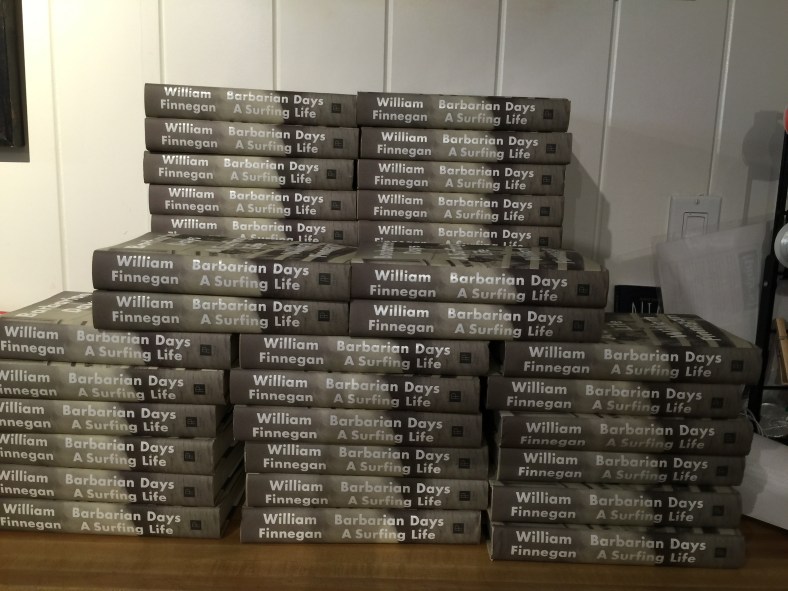
When you do a book reading in Manhattan Beach, California you need to use a microphone so the guys with ‘surfer’s ear’ in the back can understand you. Last night New Yorker journalist and lifetime surfer William Finnegan used a mic as he read from his well reviewed new book and this week’s ‘Saturday Read’, ‘Barbarian Days, A Surfing Life’.

The Q&A at the reading was closer to a book club discussion than a publicity event. Most of those attending had either read the book or the excerpt in the June 1 issue of the New Yorker magazine. This is not just a book about surfing. Mr. Finnegan is a well regarded journalist with a resume that includes reporting from South Africa, Somalia, the Balkans, Central America and Australia. Robert Boynton included him in his conversations with America’s best nonfiction writers in ‘The New New Journalism’.

“A self-described “specialist in the unexpected,” Finnegan writes stereotype-defying descriptions of the kinds of people—young, black, poor, foreign—mainstream journalism tends to dismiss with a pastiche of clichés and statistics.”

It’s this specialization in the unexpected that results in a memoir not just about surfing for surfers, but about life and friendship, as noted in The New York Times review:

“…a particularly remarkable feature of “Barbarian Days” is the generous yet unsparing portraits of competitive surf friendships that make up a major share of the narrative. As Finnegan writes: “Surfing is a secret garden, not easily entered. My memory of learning a spot, of coming to know and understand a wave, is usually inseparable from the friend with whom I tried to climb its walls.”

He first wrote about surfing in ‘Playing Doc’s Games’, profiling Mark Renneker for The New Yorker in 1992. Twenty three years later Doc returns along with a global cast of supporting characters inviting the reader to go out with them on the water.

Why should a non-surfer invest in a memoir subtitled ‘A Surfing Life’? Because it’s an everyman’s story of reconciling passions.

At the reading the author described surfing as “the North Pole of irresponsibility, the opposite of achievement. War reporting had a built in urgency, surfing did not.” He has spent 50 years managing the opposition between two drives: writing and chasing waves.

Surfers are our environmental ‘canaries in a coal mine’. Responding to a question on how surfing differs from other sports, the author focused on the “98% of surfing that is an absorption in the ocean, what your local spot is, how well you read the waves and ride. Surfing is not competitive, it’s an experience of beauty – an understanding and engagement with nature.”

Near the end of the book he refers to an A.J. Liebling essay, ‘Apology for Breathing’ noting that “Liebling was pretending to apologize for being from New York, a city he loved lavishly and precisely. Now I’m one of those New Yorkers incessantly on the point of going back where I came from. But with me it’s not a matter of packing up or staying on, but rather of being always half poised to flee my desk and ditch engagements in order to throw myself into some nearby patch of ocean at the moment when the waves and wind and tide might conspire to produce something ridable. That cracking, fugitive patch is where I come from.”

‘Barbarian Days’ is a beach book. It’s an ocean book. It’s a memoir to guide you to your own story and “that cracking, fugitive patch” where you come from.

‘The Last Hours’ a poem by Stephen Dunn

The ‘Friday poem’ this week is ‘Last Hours’ from the Pulitzer Prize winning collection, ‘Different Hours’ by Stephen Dunn. The poem is set in an office in 1964 at nineteen minutes to five.

NPR editor Barrie Hardymon selected her interview with the poet as a favorite in 2014. “This was one of these moments where, you know, he writes this very accessible poetry – and I mean that not to damn it with faint praise. You are still in the chapel of language that poetry is, but it is so – it still feels like a friend is whispering in your year very wise things. And he had that quality about him.”

The interview began with “how he has used poetry in his own life”.

“What good literature has always done is give me the language with the occasion – a lot of times not, of course. But I think the poems that matter to me are the ones that speak to that which cannot easily be said.”

“I was not a particularly good student, and I was a pretty good basketball player. I’ve written an essay called “Basketball And Poetry,” in which I try not to push the metaphor too far. But one of the points that I make in the essay is the similarity between poetry and basketball is the chance to be better than yourself, to transcend yourself, if you’re hot that day. And that happens in writing in our best moments, where we find ourselves saying what we didn’t know we knew or couldn’t have said in any other circumstance. Those are the moments in poetry I live for now.”

Does our ‘work place’ also gives us a chance to be better than ourselves? Enter ‘the chapel of language’ in the Friday poem, The Last Hours.

The Last Hours

There’s some innocence left,
and these are the last hours of an empty afternoon
at the office, and there’s the clock
on the wall, and my friend Frank
in the adjacent cubicle selling himself
on the phone.
I’m twenty-five, on the shaky
ladder up, my father’s son, corporate,
clean-shaven, and I know only what I don’t want,
which is almost everything I have.
A meeting ends.
Men in serious suits, intelligent men
who’ve been thinking hard about marketing snacks,
move back now to their window offices, worried
or proud. The big boss, Horace,
had called them in to approve this, reject that–
the big boss, a first-name, how’s-your-family
kind of assassin, who likes me.
It’s 1964.
The sixties haven’t begun yet. Cuba is a larger name
than Vietnam. The Soviets are behind
everything that could be wrong. Where I sit
it’s exactly nineteen minutes to five. My phone rings.
Horace would like me to stop in
before I leave. Stop in. Code words,
leisurely words, that mean now.
Would I be willing
to take on this? Would X’s office, who by the way
is no longer with us, be satisfactory?
About money, will this be enough?
I smile, I say yes and yes and yes,
but–I don’t know from what calm place
this comes–I’m translating
his beneficence into a lifetime, a life
of selling snacks, talking snack strategy,
thinking snack thoughts.
On the elevator down
it’s a small knot, I’d like to say, of joy.
That’s how I tell it now, here in the future,
the fear long gone.
By the time I reach the subway it’s grown,
it’s outsized, an attitude finally come round,
and I say it quietly to myself, I quit,
and keep saying it, knowing I will say it, sure
of nothing else but.

Stephen Dunn, from Different Hours (W.W. Norton)

“Beyond this point lies the rest of the world”

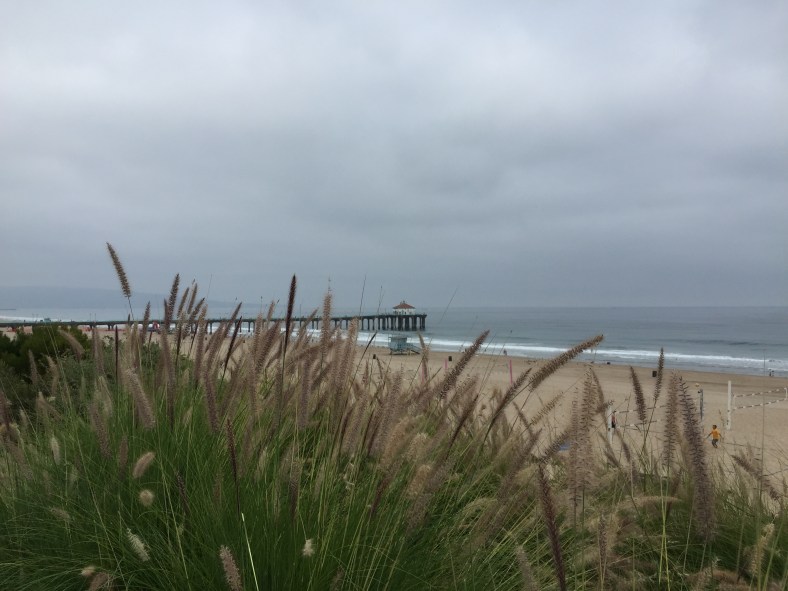
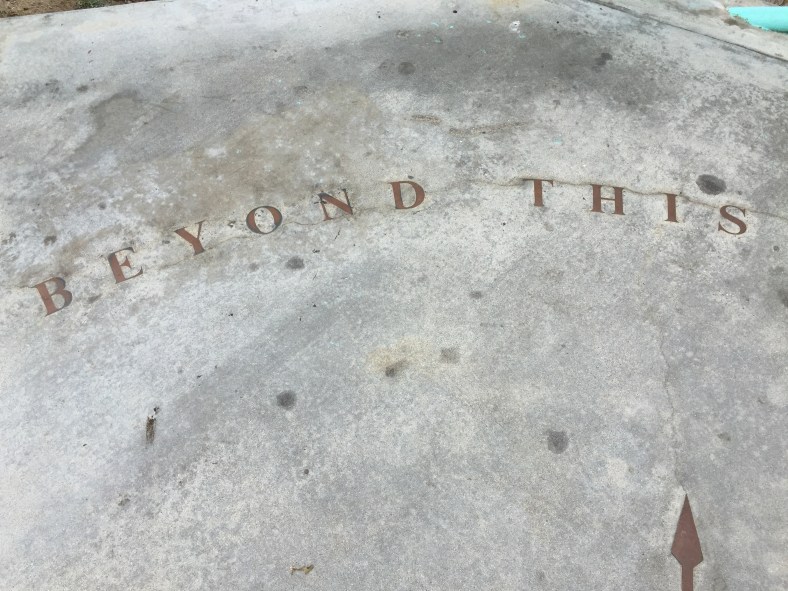
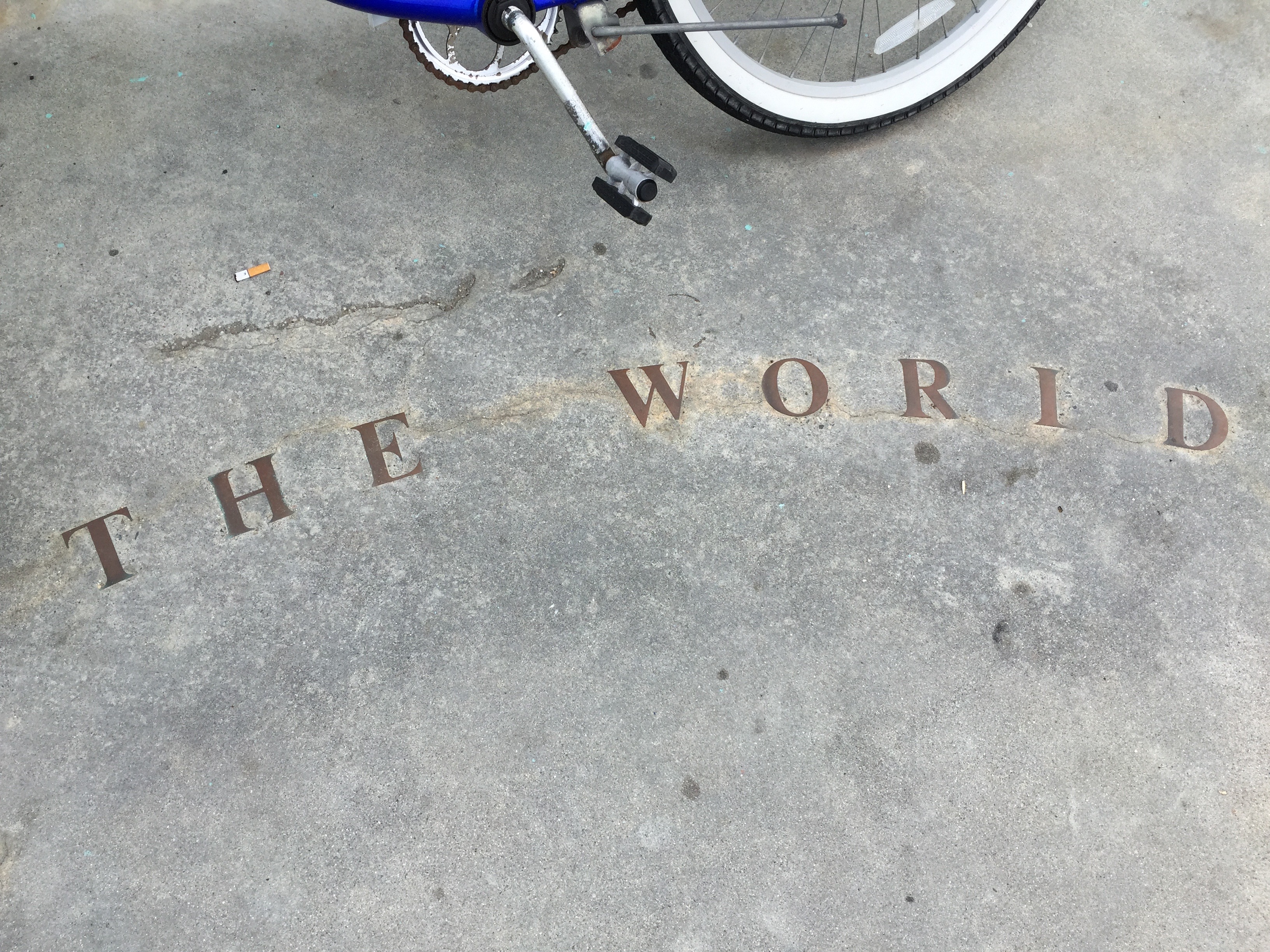
I went for a walk this morning along the beach. It was cloudy, unusual for a summer day in California. I stopped in a parking lot to take a photo of the town’s iconic pier. I looked down for a minute and that’s when I spotted it. Embedded in the cement, facing the ocean are three directional arrows. In a semi-circle surrounding the arrows are the words “Beyond this point lies the rest of the world’.

There they were, nine simple words, welcoming visitors to imagine life beyond this point.

IMG_2554

In writing this blog I have often emphasized the importance of curiosity and creativity, urging readers to step away from what is familiar and risk failure to experience success. Here it is, a perfect invitation to imagination and exploration.

IMG_2560

You don’t have to travel to California and gaze at the Pacific. Just stop what you are doing, look up and remind yourself that that there is something bigger beyond where you sit.

IMG_2561

The mysteries of networking – part three

Everyone tells you to ‘network’ to find a job. And yet the majority of us freeze at the thought of connecting with strangers to obtain information about careers. And it’s not just being shy. Most professionals who have made connections to establish business relationships find it difficult to translate those same skills to find a job.

Summer gives us an opportunity to ease into the process. We tend to think of networking as a formal meeting that involves lots of preparation in advance. There’s another approach that involves the chance encounter and spontaneous conversation away from the workplace. Vacation travel can offer unique alternatives to test your informal networking skills.

Last week while I was waiting for my delayed flight at Newark Liberty I observed a conversation between a pilot and a passenger in the boarding area. At first there was the normal exchange, sharing travel disruptions past, but that was followed with introductions, exchange of business cards and a more in depth conversation about work and life. Amid the chaos of summer travel two professional were networking.

It starts with curiosity and a desire to be continually learning.

While you are traveling, relaxing on a beach or hiking in the mountains be receptive to an opportunity for unexpected connection. Take a few minutes and disconnect from your electronics and observe your surroundings and fellow travelers. Test your ‘talking with strangers’ skills by noting something about an individual and initiate a conversation. It could be as simple as a comment to someone wearing clothing with a logo of your alma mater or favorite sports team.

These random conversations may not result in information directly related to your career advancement. But if you believe we learn from the wisdom of others, the conversations will yield valuable clues to experience, failure and success.

Nurture these informal connections along with those directly affiliated with your career field. Keep in touch via social networking. Never underestimate the value of your informal network to inform and influence your career choices.

The week@work – The odds of being poor@some point, how walking in nature changes the brain, young women envision pauses in their career and advice to working mothers

One story stood out from the rest this week@work. Washington Post journalists Emily Badger and Christopher Ingraham reported on the findings of sociologist Mark Rand at Washington University. The title alone was attention grabbing: ‘The remarkably high odds you’ll be poor at some point in your life’.

“The poor in America are not a permanent class of people. Who’s poor in any given year is different from who’s poor a few years later.

By the time they’re 60 years old, Rank has found, nearly four in five people experience some kind of economic hardship: They’ve gone through a spell of unemployment, or spent time relying on a government program for the poor like food stamps, or lived at least one year in poverty or very close to it.

By age 60, nearly 80 percent of us will have gone through a rough stretch.

“Rather than an uncommon event,” Rank says, “poverty was much more common than many people had assumed once you looked over a long period of time.”

The age of job stability is over, if anyone was still hanging on to an ideal of job security. Financial planning is a critical component of long term career planning. The reality of the research is that there will be periods of economic challenge alternating with periods of affluence. The ‘poor’ are not some abstract population. They are your neighbors, family and friends.

A story in The New York Times offered an example of how attitudes toward work and career might alter a family’s income. Journalist Claire Cain Miller writing for the Upshot found that the most recent entrants to the workplace envision planned pauses in their careers.

“The youngest generation of women in the work force — the millennials, age 18 to early 30s — is defining career success differently and less linearly than previous generations of women. A variety of survey data shows that educated, working young women are more likely than those before them to expect their career and family priorities to shift over time.

The surveys highlighted that two generations after women entered the business world in large numbers, it can still be hard for women to work. Even those with the highest career ambitions are more likely than their predecessors to plan to scale back at work at certain times or to seek out flexible jobs.

You might call them the planning generation: Their approach is less all or nothing — climb the career ladder or stay home with children — and more give and take.”

Recalling the career of journalist Marlene Sanders who died last week, Katherine Rosman shared the story of a member of the generation who achieved professional distinction while being among the first to ‘work outside the home’.

“In 2000, Cynthia McFadden, the senior legal and investigative correspondent for NBC News, attended a party given by her friend Jeffrey Toobin, a staff writer for The New Yorker and legal analyst for CNN. There, Ms. McFadden was catching up with Mr. Toobin’s mother, Marlene Sanders, the pioneering television reporter. She asked for her advice on managing motherhood and a career.

Ms. Sanders put both hands on Ms. McFadden’s shoulders and peered into her eyes. “Never apologize for working,” the older woman said. “You love what you do, and loving what you do is a great gift to give your child.”

Over the years, Ms. McFadden said, Mr. Toobin told her he loved having a mother who worked outside the home, even in an era when it was not that common. It was a sentiment he reiterated in an interview on Wednesday. “I found her career exciting,” he said. “I loved to watch her on TV. Guilt was never part of the equation. And given her temperament, if she had been home all the time, it would have been a close contest to determine whether she or I went insane first.”

The last story of the week shares research that should encourage you to take a walk in the park. Reporting on a study at Stanford University, Gretchen Reynolds found:

A walk in the park may soothe the mind and, in the process, change the workings of our brains in ways that improve our mental health, according to an interesting new study of the physical effects on the brain of visiting nature.

But just how a visit to a park or other green space might alter mood has been unclear. Does experiencing nature actually change our brains in some way that affects our emotional health?

That possibility intrigued Gregory Bratman, a graduate student at the Emmett Interdisciplinary Program in Environment and Resources at Stanford University, who has been studying the psychological effects of urban living. In an earlier study published last month, he and his colleagues found that volunteers who walked briefly through a lush, green portion of the Stanford campus were more attentive and happier afterward than volunteers who strolled for the same amount of time near heavy traffic.”

In summary this week@work – take a walk in the park and consider your career path. Lose the guilt if you are a working mother, and plan for both the expected as well as the unexpected shifts in work/life balance.