Why has it been so hard to shatter the glass ceiling?

Forbes Magazine’s most powerful woman, German Chancellor Angela Merkel was caught in conversation with President Obama yesterday at the G7 Summit. She was not, as the media suggested, auditioning for the lead role in the Sound of Music.

The G7 leaders are dealing with serious economic and political issues that will eventually trickle down to effect us all. But the media focus was on a photograph and a caricature that diminished the accomplishments of the German leader.

The Washington Post headlined “A remarkable photo of President Obama and Angela Merkel” and continued:

“The backdrop to the 41st G7 Summit held in Germany is breathtaking, with its green trees and towering mountains. It makes for great image of German Chancellor Angela Merkel talking and gesturing with a seated President Obama.

It’s made all the better with Merkel’s shruggie pose ¯\_(ツ)_/¯, which also just so happens to look like that one scene from “The Sound of Music.”

Really? Is this journalism? Here is a woman whose leadership skills have kept the European Union together, maintained a dialog with the Russian president in a difficult political climate and has transformed her country since her election in 2005.

And, American journalists covering the summit have likened the German Chancellor to a singing nun.

Bryce Covert, writing in The New York Times on Friday, chronicled “our problem with powerful women”. She described Hillary Clinton being “optimistic about the path of progress toward gender equality. She called the presidency the “highest, hardest glass ceiling.” But she also said that it had “about 18 million cracks in it, and the light is shining through like never before, filling us all with the hope and the sure knowledge that the path will be a little easier next time.”

In reality, Ms. Covert’s research shows, “Too few women make it into corporate leadership.”

“Progress is not inevitable, though, nor is it fixed. The country has a complicated relationship with powerful women: They have to keep proving themselves over and over again, being twice as good, and dragging one woman through the process doesn’t make it easier for those who follow.

Individual women might hope that their struggles blaze trails for everyone else. Mrs. Clinton must feel optimistic about her chances to win the presidency a second time around. But the reality is that the country hasn’t gotten used to women in charge. A crack in the glass ceiling in one place could very well just reinforce it for everyone else.”

Maybe it was Angela Merkel’s crack in the glass ceiling that has made it so hard for Mrs. Clinton. I might also suggest to the female journalists who enthusiastically broadcast ‘the sound of music photo’ on air last night, you’re not helping. You’re like the Safelight Auto Glass repair guy, making sure you seal up all those cracks and fortify glass ceiling.

Take another look at the photo. I think Chancellor Merkel is asking President Obama, “What’s wrong with you people? What is your problem with powerful women leaders?”

The week@work – the economy improves, the downside of ‘cultural fit’ & the new Fortune 500

The ‘big’ stories in this week@work included the release of the May 2015 US employment report and the 61st version of the Fortune 500. The small stories with potential ‘big’ impact told of the growing concern of the majority of Americans about income inequality and research showing discrimination at work is increasing as hiring managers rely more on ‘cultural fit’ to select employees.

On Friday the U.S. Department of Labor, Bureau of Labor Statistics released the May 2015 employment report.

“Worries about the American economy’s momentum were blunted on Friday by the government’s announcement that employers added a hefty 280,000 jobs in May, well above the monthly average logged over the last year.

The official unemployment rate ticked up slightly to 5.5 percent as more Americans jumped back into the labor pool and began the job hunt. Hourly wages, which have grown fitfully, rose 0.3 percent last month, possibly helping to lure back some discouraged workers who had been staying on the sidelines.” (The New York Times)

Fortune magazine announced it’s annual listing of the largest U.S. companies by revenue.

“This year’s Fortune 500 marks the 61st running of the list. In total, the Fortune 500 companies account for $12.5 trillion in revenues, $945 billion in profits, $17 trillion in market value and employ 26.8 million people worldwide.”

The top ten companies are Walmart, Exxon Mobil, Chevron, Berkshire Hathaway, Apple, GM, Phillips 66, GE, Ford Motor Company and CVS Health. Compare that to the  top ten in Forbes Magazines’ list of ‘World’s Most Innovative Companies’ or Fast Company’s ‘Most Innovative Companies 2015’, and there is only one company that appears on two lists, Apple (Fortune and Fast Company). Forbes’ #1 company, Salesforce, the biggest tech company in San Francisco, appeared on the Fortune list for the first time in its’ 16 year history at #483.

Fortune’s number one, Walmart, is the company George Packer described in his book, ‘The Unwinding’, as the model that continues to influence our economy on a much broader scale:

“Over the years, America had become more like Walmart. It had gotten cheap. Prices were lower, and wages were lower. There were fewer union factory jobs, and more part-time jobs as store greeters…The hollowing out of the heartland was good for the company’s bottom line.”

A CBS/New York Times poll released on Wednesday found that the majority of Americans are concerned about the widening income gap that separates the Walmart shoppers from those on Rodeo Drive.

“The poll found that a strong majority say that wealth should be more evenly divided and that it is a problem that should be addressed urgently. Nearly six in 10 Americans said government should do more to reduce the gap between the rich and the poor, but they split sharply along partisan lines. Only one-third of Republicans supported a more active government role, versus eight in 10 of Democrats.

Far from a strictly partisan issue, inequality looms large in the minds of almost half of Republicans and two-thirds of independents, suggesting that it will outlive the presidential primary contests and become a central theme in next year’s general election campaign.”

The last story of the week concerned the downside of ‘cultural fit’. Lauren A. Rivera, a professor at Northwestern University’s Kellogg School of Management, shared her research on candidate selection in ‘Guess Who Doesn’t Fit In At Work’.

“When done carefully, selecting new workers this way can make organizations more productive and profitable. But cultural fit has morphed into a far more nebulous and potentially dangerous concept. It has shifted from systematic analysis of who will thrive in a given workplace to snap judgments by managers about who they’d rather hang out with. In the process, fit has become a catchall used to justify hiring people who are similar to decision makers and rejecting people who are not.”

At the end of the week@work we know the economy is improving and folks are becoming increasingly aware of income disparity.

But is anyone concerned that the largest revenue generating companies have no relationship to the most innovative companies in the world? If you are starting out your career or considering a move, do you choose a revenue generating behemoth or a venture capitalized innovative organization?

And for all of us @work – we want to ‘fit in’ to the organization culture, but with our talents, not personal similarities.

The Saturday Read – Summer Books

We have summer in our sights, anticipating travel, adventure, rest and relaxation. Harbingers of the coming season are the summer reading lists from the traditional print book review sources, the icons of Silicon Valley and the titans of Wall Street.

The act of picking up a book, unrelated to work or school, has moved away from the center and occurs only on the periphery of our lives. We seem to have relegated reading to the category of indulgence vs. necessity. We give ourselves permission to read in summer, during an interval when we step away from work.

Writing in The Irish Times, Isabelle Cartwright considered the question of why we read.

“…the simple answer is for pleasure. But what exactly is the nature of that pleasure? Reading removes us from the structure of our lives, from the routine, the sequential habits of our day-to-day living. We enter instead another time zone. The plot, characters and setting occupy us, and while we read we inhabit the others’ reality. The pleasure therefore is derived from escaping our own small, limited and often repetitive lives and entering an exotic elsewhere.

But perhaps there is also the attraction of reserving something private for ourselves, something outside of the public world of relationship, family, work and occupation; something that is not encumbered by the stricture of time and self.”

For those of you who need a utilitarian rationale to set aside time to read, there is research to show we are morally and socially better as a result of our efforts:

Raymond Mar, a psychologist at York University in Canada, and Keith Oatley, a professor emeritus of cognitive psychology at the University of Toronto, reported in studies published in 2006 and 2009 that individuals who often read fiction appear to be better able to understand other people, empathize with them and view the world from their perspective. This link persisted even after the researchers factored in the possibility that more empathetic individuals might choose to read more novels. A 2010 study by Mar found a similar result in young children: the more stories they had read to them, the keener their “theory of mind,” or mental model of other people’s intentions.”

We become more emotionally intelligent as we read.

If that doesn’t convince you, the ‘Lifehack blog’ lists ’10 Benefits of Reading: Why You Should Read Every Day’ (not just in summer): “Mental stimulation, stress reduction, knowledge, vocabulary expansion, memory improvement, stronger analytical skills, improved focus and concentration, better writing skills, tranquility and free entertainment.”

I think they’re on to something here, for all you skeptics. A few of these skills match exactly to what employers look for in potential candidates: communications and problem solving. Maybe reading is a necessity and not an indulgence.

Here is a menu of links to the popular reading lists this summer:

The Los Angeles Times – Summer reading guide: The 136 books you’ll want to read

The New York Times – When the Water’s Too Cold, Something Else to Dive Into, A Critic’s Survey of Summer Books

USA Today – 25 Hot Books for Summer

The Washington Post – A great leadership reading list — without any business books on it

Bloomberg – Books Worth Reading This Summer

NPR – Four Books That Deliver Unexpected And Delightful Surprises This Summer

A Year of Books, Mark Zuckerberg

Beach Reading (and More), Bill Gates

10 Beach Books from J.P. Morgan’s Summer Reading List

Happy sand in your toes, head in the clouds, sea spray on your face reading!

Self-Inquiry Before the Job Interview, a poem by Gary Soto

Poet Gary Soto‘s work reflects his experience growing up in the San Joaquin Valley of Central California. “I’m one who provides portraits of people in the rush of life.” In his poem, ‘Self-Inquiry Before the Job Interview’, originally published in the July, 2001 issue of Poetry magazine and later included in the collection, ‘One Kind of Faith’, he shares his perspective of job search.

The Friday poem is for all of you getting up this morning, heading out and hoping to find work.

Self-Inquiry Before the Job Interview

Did you sneeze?
Yes, I rid myself of the imposter inside me.

Did you iron your shirt?
Yes, I used the steam of mother’s hate.

Did you wash your hands?
Yes, I learned my hygiene from a raccoon.

I prayed on my knees, and my knees answered with pain.
I gargled. I polished my shoes until I saw who I was.
I inflated my résumé by employing my middle name.

I walked to my interview, early,
The sun like a ring on an electric stove.
I patted my hair when I entered the wind of a revolving door.
The guard said, For a guy like you, it’s the 19th floor.

The economy was up. Flags whipped in every city plaza
In America. This I saw for myself as I rode the elevator,
Empty because everyone had a job but me.

Did you clean your ears?
Yes, I heard my fate in the drinking fountain’s idiotic drivel.

Did you slice a banana into your daily mush?
I added a pinch of salt, two raisins to sweeten my breath.

Did you remember your pen?
I remembered my fingers when the elevator opened.

I shook hands that dripped like a dirty sea.
I found a chair and desk. My name tag said my name.
Through the glass ceiling, I saw the heavy rumps of CEOs.
Outside my window, the sun was a burning stove,
All of us pushing papers
To keep it going.

Gary Soto   2001

The Art of the Interview

Most of us approach a job interview as an interrogation instead of a conversation. What if the interview was a bit more like those conducted in front of an audience by James Lipton or a podcast by Debbie Millman?

I’ve been thinking a lot about how we select employees for our organizations. Today, in our age of analytics, large corporations believe they can select a candidate using an algorithm to build a scaffolding of interview questions. The process of determining ‘cultural fit’ has morphed into finding folks you would like to hang out with vs. ones who have the skills to do the job.

Both approaches seem to miss something. On one hand, science excludes humanity and on the other, the modern version of the ‘old boy’ network finds its’ candidates at the familiar fraternity mixer. Neither path leads to a diverse organization. Maybe it’s time to look outside current human resources thinking and learn from the ‘masters’ of the interview.

I have this one touchstone article that continues to resonate on a variety of levels. It’s a Harvard Business Review article published in December 2009, ‘The Innovator’s DNA’. In it, the authors (Jeffrey H. Dyer, Hal B. Gregersen and Clayton M. Christensen) posed the question, “What makes innovators different?”

The first skill:

“Associating, or the ability to successfully connect seemingly unrelated questions, problems, or ideas from different fields, is central to the innovator’s DNA.”

 The second, questioning:

“innovators constantly ask questions that challenge common wisdom”. 

Networking, the third skill:

“Devoting time and energy to finding and testing ideas through a network of diverse individuals gives innovators a radically different perspective. Unlike most executives—who network to access resources, to sell themselves or their companies, or to boost their careers— innovative entrepreneurs go out of their way to meet people with different kinds of ideas and perspectives to extend their own knowledge domains.”

With this framework in mind, I was reading Debbie Millman’s 2010 ‘How to Think Like a Great Graphic Designer’ last night, and it all came together. In his foreward, Steven Heller, describes the role of an interviewer:

“Interviews must be tackled with zeal, and the interviewer must control the discussion while waiting for that unexpected revelation to leak out. A skilled host must therefore prepare exhaustively: Take James Lipton of ‘inside the Actors Studio’, with his famously large stack of blue index cards, each containing a pointed question neatly integrated into a systematic progression; while he theatrically examines the narratives of his subjects’ careers, he is always flexible enough to flow with the unforeseen currents of conversation…”

Interviewing requires considerable acumen to enable both the expressive and, especially, the reticent guest to open up. 

Debbie Millman, who has hosted the Internet radio program, ‘Design Matters’ since 2005, always does her homework – and then some…she plies each of her visitors with questions to evoke the unexpected response. At the same time, she inspires their confidence, owing to her sincere interest in the life and work she’s exploring.”

We ask candidates to prepare, but often the distractions of the other things we do, besides recruiting, interfere to a point where we ‘wing it’ as interviewers and rely on the algorithm generated questions. We end up with plain vanilla data to compare with other plain vanilla data and add a dash of our subjective judgment.  The lead candidate we hoped to recruit was probably not too impressed with the experience, knowing he or she was just another cog in the assembly line of interviews of the day.

This may not be a new idea, actually it’s quite fundamental. But imagine the success of an interview when both parties are prepared for the conversation, the interviewer inspires confidence in the candidate to present their authentic self and both can demonstrate a sincere interest in the life and work of the organization.

Should I stay or should I go? The impact of a 24×7 work culture

Late spring is a time of major career transition as interns arrive for summer assignments, college students begin their careers and the rest of the workforce assesses their place at work and considers next steps. Do I stay or should I go?

Three articles in the past three days develop an argument that we are long overdue for an accounting of the way work is structured, expectations set, and effort rewarded.

In the first article, psychologist Art Markham was asked the question, ‘Is it hurting my career to skip happy hour with co-workers?’ Here is a question that gets right to the issue of work/life balance. What activities in the workplace are optional?

He responded:

“Your question…brings two aspects of workplace happiness into conflict. On the one hand, research suggest that people who feel like they have good friends at work are happier than those who don’t. On the other hand, research also suggests that your long-term happiness at work requires that you feel like you can express your authentic self at work. If you don’t like to go out for drinks with a crowd, then forcing yourself to go is not an authentic expression of who you are.

The main principle here is that the social time with your colleagues is an important way to feel included in the community. You don’t have to become a party animal to make that happen, but you might have to put in some effort to create these social opportunities. Developing your relationships with your colleagues will help you feel closer to the group and will improve your overall satisfaction with your job.”

Nice idea, but here is the reality. You are on deadline to complete a project and at the same time you are watching the clock and trying to calculate how much time you have, building in a possible SIG alert, to get to the day care center before they turn the lights out and leave your children on the steps.

Which bring me to the second article, ‘The 24/7 Work Culture’s Toll on Families and Gender Equality’. It surveys a group of studies, the most recent being released by Harvard Business School as part of a gender initiative led by Professor Robin Ely.

Professor Ely and her colleagues studied “a global consulting firm, which was not named. The firm, where 90 percent of the partners were men, asked the professors what it could do to decrease the number of women who quit and increase the number who were promoted. In exchange, the academics could collect data for their research. The firm was typical in that employees averaged 60 to 65 hours of work a week.”

After conducting “.. in-depth interviews with 107 employees, men were at least as likely as women to say the long hours interfered with their family lives, and they quit at the same rate. One told the researchers: “Last year was hard with my 105 flights. I was feeling pretty fried. I’ve missed too much of my kids’ lives.”

The researchers said that when they told the consulting firm they had diagnosed a bigger problem than a lack of family-friendly policies for women — that long hours were taking a toll on both men and women — the firm rejected that conclusion. The firm’s representatives said the goal was to focus only on policies for women, and that men were largely immune to these issues.”

Which transitions to the final article, ‘Reflections on Stress and Long Hours on Wall Street’. In a previous life, I often advised students who were considering internships or full time positions with investment banks. The high paying starting salaries were difficult to ignore. For some, financial services was the perfect cultural fit, but for those whose only incentive was money, it was a quick calculation to determine the breakdown of the princely starting offer to the actual hourly wage.

In The New York Times article, Andrew Ross Sorkin reports on the stress on Wall Street and reflects on recent deaths that may be attributed to long hours and an out of balance work load.

“Studies have suggested that financial service employees are at higher risk than those in many other industries. According to the National Occupational Mortality Surveillance, individuals who work in financial services are 1.5 times more likely to commit suicide than the national average. The highest suicide rates in the United States are among doctors, dentists and veterinarians.”

Changes in policies have not worked, with those excused from Saturday work, showing up on Sunday and working late into the night.

“Some banks, like Goldman, are also taking new steps, like introducing more efficient software and technology to help young analysts do their work more quickly. And investment banks say they are hiring more analysts to help balance the workload.

That may help. But as long as young analysts are expected to work 80 to 100 hours a week, invariably some run the risk of finding themselves in a situation they cannot handle. With new classes of such analysts arriving each year, it is incumbent on the industry to make sure it is doing everything possible to make sure that no one is too overwhelmed.”

And this is where your value radar clicks on. Every career decision is a result of a series of tradeoffs. However, no client, no deal is worth sacrificing family, health and well-being. And if you are in a place that truly believes those are fair tradeoffs, it’s a no brainer… you should go.

The week@work – Leadership lessons from FIFA, ways to boost job security & the ‘small, happy life’

Early Wednesday morning Swiss authorities entered a high end hotel in Zurich and arrested 14 FIFA officials on a variety of charges including wire fraud, money laundering and racketeering. On Friday, Seth Blatter was reelected to his fifth term as President of FIFA. Subsequent reports throughout the week illuminated Mr. Blatter’s leadership style.

His response to the arrests and accepting responsibility as the most powerful leader in soccer:

“Many people hold me responsible. I can’t monitor everyone all of the time. If people want to do wrong, they will also try to hide it.”

Apparently the buck doesn’t stop at Mr. Blatter’s desk.

Writing in the Opinion Pages of The New York Times, columnist, Roger Cohen provided a rationale for Blatter to step down:

“Mr. Blatter, your time is up.

Why? Because the corruption charges against current and former FIFA vice presidents and others reflect an organization rotten to its core, operating in the absence of any meaningful oversight, without term limits for a president whose salary is of course unknown (but estimated by Bloomberg to be “in the low double-digit” millions), overseeing $5.72 billion in partially unaccounted revenue for the four years to December 2014, governing a sport in which matches and World Cup venues and in fact just about everything appears to have been up for sale, burying a report it commissioned by a former United States attorney into the bidding process for the next two World Cups, and generally operating in a culture of cavalier disdain personified by Blatter, whose big cash awards to soccer federations in poorer countries have turned the delegates from many of FIFA’s 209 member associations into his fawning acolytes.”

Why should we care? On Wednesday, Christopher Ingraham of the Washington Post published a story, ‘The human toll of FIFA’s corruption’.

“On the surface, it’s just another white collar crime story: rich, powerful men making themselves richer and more powerful. But a closer look suggests that there is a lot of real-world suffering happening as a direct result of FIFA’s decisions.”

“Human rights advocates’ worst fears about Qatar seemed to be confirmed as Qatar began building the infrastructure to host the Cup, and reports of migrant worker deaths started to pile up. The numbers, to the extent that we know them, appear startling: A Guardian investigation last year revealed that Nepalese migrant workers were dying at a rate of one every two days. In sum, the Guardian put the total Qatar death toll of workers from Nepal, India and Bangladesh at 964 in 2012 and 2013.”

Perhaps we would all like to be a bit more secure at work, while not employing the extreme tactics of the FIFA president.

The ABC network affiliate in Sacramento, California aired a story on ‘Nine Ways to Boost Your Job Security‘. Number one is to do good work. Some of the other suggestions included continuing to learn to maintain your competitive advantage and never get too comfortable in your job. In other words, security and comfort are not synonymous.

The two tactics that stood out for me were to know yourself, and establish alternate revenue streams. “A 401k plan, prudent investments, side businesses, and lucrative hobbies can offer temporary financial support if you were to find yourself without a steady income.”

From the billions of FIFA to normal folk seeking security at work, the last story of the week comes from The New York Times columnist, David Brooks. On Friday his topic was ‘The Small, Happy Life’. He was surprised by the result of his request for essays from readers on “their purpose in life and how they found it”.

“I expected most contributors would follow the commencement-speech clichés of our high-achieving culture: dream big; set ambitious goals; try to change the world. In fact, a surprising number of people found their purpose by going the other way, by pursuing the small, happy life.”

So here’s one for you, Mr. Blatter. Not that you will ever read it. But if you did, you could learn something from the response from one of Mr. Brooks’ readers.

“Elizabeth Young once heard the story of a man who was asked by a journalist to show his most precious possession. The man, Young wrote, “was proud and excited to show the journalist the gift he had been bequeathed. A banged up tin pot he kept carefully wrapped in cloth as though it was fragile. The journalist was confused, what made this dingy old pot so valuable? ‘The message,’ the friend replied. The message was ‘we do not all have to shine.’ This story resonated deeply. In that moment I was able to relieve myself of the need to do something important, from which I would reap praise and be rewarded with fulfillment. My vision cleared.”

The Saturday Read – George Packer ‘The Unwinding’

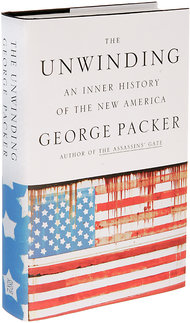
If you need additional convincing that the income gap between the wealthy and the ‘middle class’ is widening, set aside some time to read George Packer‘s ‘The Unwinding: An Inner History Of The New America‘. Originally published in 2013, the book takes us on a pilgrimage with a lead cast of three ‘American dreamers’: Dean Price, Jeff Connaughton and Tammy Thomas.

We meet Dean and Jeff in 1978 and Tammy in 1984. As each of their stories unfold, the author adds a ‘supporting cast’ of politicians, journalists, Silicon Valley entrepreneurs and ‘institution men’. It’s this supporting cast that influence decisions that effect the lives of Dean, Jeff and Tammy, but they are fuzzy background noise to the reality of trying to make a living in today’s United States.

“No one can say when the unwinding began – when the bolts that held Americans together in its secure and sometimes stifling grip first gave way. Like any great change, the unwinding began at countless times, in countless ways – and at some moment the country, always the same country, crossed a line of history and became irretrievably different…When the norms that made the old institutions useful began to unwind, and the leaders abandoned their posts, the Roosevelt Republic that had reigned for almost half a century came undone. The void was filled by the default force in American life, organized money.”

We encounter our ‘ordinary’ Americans at the beginning of their respective careers.

Dean Price earned a degree in political science and is hired as a pharmaceutical rep for Johnson and Johnson.  “It didn’t take him long to realize that he hated his job…He had bought into a lie: go to college, get a good education, get a job with a Fortune 500 company, and you’d be happy. He had done all that and he was miserable…He decided to start over and do things his own way. He would become an entrepreneur.”

Jeff Connaughton first met Joe Biden in 1979 at a meeting of the National Student Congress in Philadelphia. “Biden was youthful, he was witty, he knew how to talk to college students. Connaughton never forgot the moment.” 

After earning an MBA from The University of Chicago Business school he moved to New York to work for Smith Barney in their public finance department. His next job was at E.F. Hutton where he survived the company’s wire and mail fraud scandal. “He was a twenty-seven-year-od assistant vice president making more than a hundred grand, and yet he went home in the evenings thinking that this was not what he wanted to do with his life.”

“Biden was like a cult figure to me,” Connaughton said much later. “He was the guy I was going to follow because he was my horse.  I was going to ride that horse into the White House. That was going to be my next stop in life. I had done Wall Street, and I was going to do the White House next.”

Tammy Thomas grew up in Youngstown, Ohio as the city began to decline. “Tammy vowed to herself that she would not go on welfare and live in the projects. She didn’t want to have just enough to barely get by but not enough to actually be able to do anything. She didn’t want to get stuck.”

“She finished high school on time, in 1984, and became the first person in her family to get a diploma…She got an associate’s degree at a technical college and worked for two years as a supermarket cashier in the hope that she’d get a management job, but none opened up…But up in Warren, the Packard Electric plants were still operating, with eight thousand workers making wiring harnesses and electrical components for General Motors cars. It was lighter, cleaner work than steelmaking, and two-thirds of the employees were women, a lot of them single mothers like Tammy. She went in to the interview and was hired for the assembly line at $7.30 an hour. So in 1988 she got off welfare and became a factory worker.”

This is a book that will reconnect you with reality. In his review of the book for The New York Times, Dwight Garner concluded:

“At one point in “The Unwinding” we meet a talented reporter in Florida who is writing about the foreclosure mess. This reporter, we read, “believed that there were two kinds of journalists — the ones who told stories, and the ones who uncovered wrongdoing.”

Mr. Packer is both, and he’s written something close to a nonfiction masterpiece.”

The Journey, a poem by Mary Oliver

I find that many people ‘shape shift’ their lives to meet the expectations of others. That may be a short term personal gratification strategy, but it’s not one for the long haul. In the end you lose who you are, and it may take a while for your GPS to recalculate.

The Friday poem is ‘The Journey’ by Pulitzer Prize winning poet, Mary Oliver. The poem is included in the collection, ‘New and Selected Poems, Volume One’ published in 1992 and recognized with the National Book Award.

The Journey

One day you finally knew
what you had to do, and began,
though the voices around you
kept shouting
their bad advice –
though the whole house
began to tremble
and you felt the old tug
at your ankles.
“Mend my life!”
each voice cried.
But you didn’t stop.
You knew what you had to do,
though the wind pried
with its stiff fingers
at the very foundations,
though their melancholy
was terrible.
It was already late
enough, and a wild night,
and the road full of fallen
branches and stones.
But little by little,
as you left their voices behind,
the stars began to burn
through the sheets of clouds,
and there was a new voice
which you slowly
recognized as your own,
that kept you company
as you strode deeper and deeper
into the world,
determined to do
the only thing you could do –
determined to save
the only life you could save.

Mary Oliver, 1986  First published in Dream Work, Atlantic Monthly Press. Reprinted in New and Selected Poems, Volume One, Beacon Press.

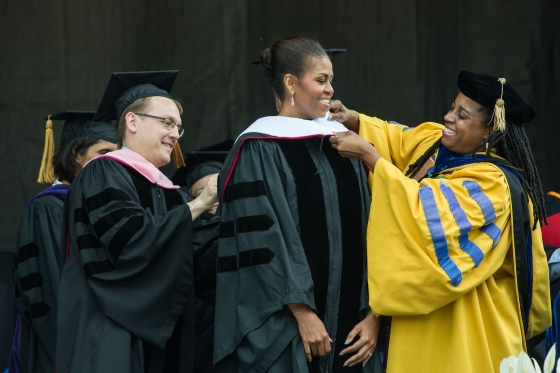
First Lady Michelle Obama @ Oberlin College & Tuskegee University – “Rise above the noise”

First Lady Michelle Obama delivered two commencement addresses this spring. The first, in early May at Tuskegee University and the second over the weekend at Oberlin College. Respect and civility were on her mind and the narrative of her experience gave credence to the challenge she posed to graduates at both institutions: “stay true to who you are and where you come from” and “rise above the noise and shape the revolutions of your time”.

The position of First Lady of the United States is a career choice. The interview process is tangential to the candidate for president, but the spouse’s background is equally examined under the microscope of the 24×7 news cycle. In her speech to the Tuskegee graduating class, Mrs. Obama was candid in her reflections on the impact of the campaign and shared a leadership lesson in her resolve to not let others define her.

“Back when my husband first started campaigning for President, folks had all sorts of questions of me: What kind of First Lady would I be? What kinds of issues would I take on? Would I be more like Laura Bush, or Hillary Clinton, or Nancy Reagan? And the truth is, those same questions would have been posed to any candidate’s spouse. That’s just the way the process works. But, as potentially the first African American First Lady, I was also the focus of another set of questions and speculations; conversations sometimes rooted in the fears and misperceptions of others. Was I too loud, or too angry, or too emasculating?  Or was I too soft, too much of a mom, not enough of a career woman?

But eventually, I realized that if I wanted to keep my sanity and not let others define me, there was only one thing I could do, and that was to have faith in God’s plan for me. I had to ignore all of the noise and be true to myself — and the rest would work itself out. 

So throughout this journey, I have learned to block everything out and focus on my truth. I had to answer some basic questions for myself: Who am I? No, really, who am I? What do I care about?”

The most respected of the management gurus are adamant that before you can lead, you have to know who you are, your values and what you care about. This is your anchor throughout your career.

“And at the end of the day, by staying true to the me I’ve always known, I found that this journey has been incredibly freeing. Because no matter what happened, I had the peace of mind of knowing that all of the chatter, the name calling, the doubting — all of it was just noise. It did not define me. It didn’t change who I was. And most importantly, it couldn’t hold me back. I have learned that as long as I hold fast to my beliefs and values — and follow my own moral compass — then the only expectations I need to live up to are my own.”

At Oberlin College, Mrs. Obama acknowledged the campus culture of service and social justice and encouraged graduates to take a leadership role “to actively seek out the most contentious, polarized, gridlocked places you can find. Because so often, throughout our history, those have been the places where progress really happens –- the places where minds are changed, lives transformed, where our great American story unfolds.”  

“And the truth is, graduates, after four years of thoughtful, respectful discussion and debate here at Oberlin -– those seminars where you explored new ideas together, those late-night conversations where you challenged each other and learned from each other — after all of that, you might find yourself a little dismayed by the clamor outside these walls — the name-calling, the negative ads, the folks yelling at each other on TV. After being surrounded by people who are so dedicated to serving others and making the world a better place, you might feel a little discouraged by the polarization and gridlock that too often characterize our politics and civic life.

Her address continued with a call to citizenship. Recognizing the temptation to “run the other way as fast as you can…you need to run to, and not away from, the noise.” 

So get out there and volunteer on campaigns, and then hold the folks you elect accountable. Follow what’s happening in your city hall, your statehouse, Washington, D.C. Better yet, run for office yourself. Get in there. Shake things up. Don’t be afraid.  And get out and vote in every election -– not just the big national ones that get all the attention, but every single election. Make sure the folks who represent you share your values and aspirations.

See, that is how you will rise above the noise and shape the revolutions of your time.”