The Saturday Read ‘War and Peace’ by Leo Tolstoy

Are you one of the many who fumbles their way through a conversation of the classics, with vague memories of the Cliff Notes version, having never read the original? You’re not alone, and the ‘Saturday Read’ this week is the first step to fill in the blanks with ‘War and Peace’ by Leo Tolstoy.

“Do you feel pressured to read certain books?” Journalist Alison Flood posed this question after a poll conducted by market research firm, ‘YouGov’, found that “Britons are weighed down with regret over novels they haven’t found ‘time and patience’ for”, garnering a series of Twitter comments concluding, you should try it, you might like it.

“…maybe it’s a classic because it’s good, not because it’s hard. I did precisely that with War and Peace; giving it a crack because I felt I should, and then being startled to discover that it was actually fun. Not a trial at all.”

Only 4% of Britons surveyed had read War and Peace, but that began to change with the broadcast this month of the Harvey Weinstein produced, BBC Television production of the novel as a four part, eight hour mini series.

“Judging by our recent sales … an awful lot of people have finally crossed this classic off their must-read list. Four different editions of the book have hit our bestseller list, shifting an almost equal number of copies each,” said Waterstones buyer Joseph Knobbs.

At publisher Wordsworth Editions, managing director Helen Trayler said that sales of War and Peace had grown steadily after the first episode of the new TV adaptation, with its edition in the top 20 of the Bookseller’s small publisher charts ever since the show launched.”

In December, 1,300 people joined together for a live, four day, marathon reading of the novel on Russian TV.

“Tolstoy’s great-great-granddaughter Fekla Tolstaya coordinated the participants, who are each reading a two to three-minute passage of the novel’s more than half a million words from schools, museums, libraries and other locations around the world.

Readers include Polish film director and Oscar winner Andrzej Wajda, Bolshoi Ballet director Vladimir Urin and Russian politician Valentina Matvienko. Cosmonaut Sergei Volkov contributed a reading from the International Space Station, and French readers were coordinated to read the book’s French sections”
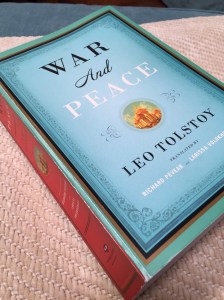
 

IMG_3888

Yes, the book is written in French and English in the Pevear and Volokhonsky translation.

Clara Bell, reviewing the novel in 1886 for the New York Times criticized both the novel and Count Tolstoy’s domestic environment.

“In fact, War and Peace may be called an illustrated historical essay rather than a novel, there being no semblance of a plot, and the characters serving to develop the public events rather than being developed by them. This inversion of the usual rule, together with the subtle but unmistakeable savor of fatalism which pervades the whole work, disturbs the reader with the same sense of vague discomfort that must have chilled many of Count Tolstoi’s foreign admirers when they found their hero living in a shabby, comfortless, untidy house a little way out of Moscow, where carpets and clean tablecloths appeared to be equally rare.”

So we avoid reading ‘War and Peace’ because it’s described as daunting, boring, long, confusing and required. What if we took the advice of journalist Flood and read it for enjoyment? I did and it is long, but amazing and you will find the seeds of many subsequent classics, and ‘not so classic’ in the story.

It turns out Count Tolstoy had a lot to say about contemporary issues; the individual, happiness and occupation-work. One example, the thoughts of character Pierre Bezukov after he is released from prison at the end of the war.

“The absence of suffering, the satisfaction of one’s needs, and the resulting freedom to choose one’s occupation, that is, one’s way of life, now seemed to Pierre the highest and most unquestionable human happiness.

“…the satisfaction of his needs…now that he was deprived of them all, seemed perfect happiness to Pierre, and the choice of an occupation, that is, of a life, now, when that choice was so limited, seemed to him such an easy matter that he forgot that a superfluidity of life’s comforts destroys all the happiness of the satisfaction of one’s needs, and that a greater freedom to choose one’s occupation, the freedom which in this life was granted him by education, wealth, social position – precisely that freedom made the choice of an occupation insolubly difficult and destroyed the very need and possibility of an occupation.”

This is why we read ‘War and Peace’. It’s why Russian TV devoted four days to a live reading. And why one of Hollywood’s leaders decided to executive produce a screenplay of his favorite novel.

If you are still a bit of a skeptic, Philip Hensher of The Guardian offers ‘War and Peace: the 10 things you need to know (if you haven’t actually read it)’

” 7. Anyone who tells you that you can skip the “War” parts and only read the “Peace” parts is an idiot. The bits that interest you personally and the bits that you find of only abstract curiosity are going to change when you read the book at 20, and again at 50. The book is the product of a very big mind, who lost interest in almost everything War and Peace was about before he died. It is a living organism that is never quite the same as you remembered when you go back to it.”


The week@work – issues that will shape the world in 2016, positive forecast on salary growth, George R.R. Martin misses a deadline and why we should focus on our ‘already done’ list

The past week@work marked the transition from the old year to the new. We have seen the last of the ‘best and worst of the year’ in every imaginable category and it’s time to turn our attention to the future. Here’s the problem; global issues, work issues, customer issues and career issues don’t magically resolve themselves at the stroke of midnight on 12/31.

What the new year does provide is a demarcation point in time, to set aside previous solutions and reimagine innovative answers. We have permission to start anew.

Rose Pastore offers a list of ’10 Issues That Will Shape the World In 2016′. Recognizing the continuum of events from the old year to the new – “The end of 2015 leaves many of the year’s most significant issues still very much in flux, including the reform of U.S. gun control laws, the fates of thousands of Syrian refugees, and the legal status of massive startups like Uber and Airbnb.”

Some of these issues seem so beyond our everyday lives that it may be hard to grasp a connection to our work and workplace. But somewhere, a diplomat, an entrepreneur, an educator or a student may seize the moment, and solve one piece of the puzzle, in one of our multiple global challenges: “the refugee crisis, climate change, data security, gun violence, social justice and regulating the sharing economy.” 

Don Lee reported on the view that salaries will increase in 2016, driven by the decrease in unemployment and the implementation of new minimum wage laws in a number of states.

“American workers are poised in 2016 to finally get what they’ve been missing for years: higher salaries.

…worker wages will get an additional boost from higher minimum wages taking effect in a number of cities and states. California’s new minimum pay goes to $10 an hour in January. The increase will amount to an 11% pay raise for Marco Ruiz, a carwash worker in Anaheim who earns $9 an hour.

That’s an additional $40 a week, more than enough to cover Ruiz’s bus fare to his job from his home in Norwalk, which he rents with his brother-in-law. “It’s marvelous,” said the divorced 35-year-old, who started at the carwash eight years ago making $7.50 an hour, the state’s minimum wage then.

Like Ruiz, most people in the U.S. already feel more secure in their jobs. As layoffs have receded sharply, weekly filings for new jobless benefits have fallen this year to numbers not seen since the early 1970s. And Gallup polls show workers’ “complete satisfaction” with job security rose to a 15-year high in summer 2014. Their overall satisfaction with pay, however, hasn’t returned to prerecession levels. In fact, many workers still feel that the recovery from the Great Recession passed them by.”

Early Saturday morning, author George R.R. Martin posted his admission, “THE WINDS OF WINTER is not finished.”

The year ended and the author of the series, ‘A Song of Ice and Fire’, publicly announced he had missed a deadline and gave us a glimpse of his creative process.

“Believe me, it gave me no pleasure to type those words. You’re disappointed, and you’re not alone. My editors and publishers are disappointed, HBO is disappointed, my agents and foreign publishers and translators are disappointed… but no one could possibly be more disappointed than me. For months now I have wanted nothing so much as to be able to say, “I have completed and delivered THE WINDS OF WINTER” on or before the last day of 2015.

But the book’s not done.

Nor is it likely to be finished tomorrow, or next week. Yes, there’s a lot written. Hundreds of pages. Dozens of chapters. (Those ‘no pages done’ reports were insane, the usual garbage internet journalism that I have learned to despise). But there’s also a lot still left to write. I am months away still… and that’s if the writing goes well. (Sometimes it does. Sometimes it doesn’t.) Chapters still to write, of course… but also rewriting. I always do a lot of rewriting, sometimes just polishing, sometimes pretty major restructures.”

Alison Flood of The Guardian reported on the response from readers and fans.

“This time, though, Martin’s readers were quick to encourage him, with the more than 1,000 comments on his blog ranging from “Love your work, George! Get it done when it’s done. I’ll be there” to “Don’t sweat it, George” and “Take as long as you need to, sir”.

“That couldn’t have been fun to write,” wrote one reader in response to Martin’s blog. “But fact is in 50 years readers will judge on the book’s quality and not if they met some arbitrary deadline and beat the TV adaptation. As much as I’d like to see it released soon, I ultimately approve of the priority on quality.”

For all of you who have started the new year with a missed deadline, consider the lesson here. It’s impossible to live without failure. Even the most successful fail. It’s the next step in the lifelong learning process that matters, and that might be the most important thought to hold in the new year.

Minda Zetlin offers some timely practical advice, that George R. R. Martin might consider ‘Five Reasons You Should Make an Already-Done List Right Now’.

“…if you want to feel motivated, set that to-do list aside, and make a list of what you’ve already accomplished instead.

That advice comes from best-selling author and executive coach Wendy Capland. A while back, I wrote a column from an interview with Capland and as a follow-up we decided she would coach me and that I would write about it. These coaching sessions come with homework, and one recent assignment was to make a list of all the things I had already done​ to advance toward my most ambitious goals. It was something I’d never done before, and it was a revelation.”

Perhaps the best advice is to start the year with an accomplishments audit, focusing on the strengths derived from your success (and failure) and build on that foundation @work in the new year.