The week@work or on vacation-what leadership looks like, what leadership reads & ‘wasting time’ on the Internet

This week@work, desks and cubicles are vacant as colleagues are catching a few last days of escape away from work. Among those still @work: a journalist shared a relic of presidential transition to remind us what leadership looks like, the White House tweeted the President’s vacation reading choices, Olympians continue to compete in Rio, and we may not be wasting time on the internet.

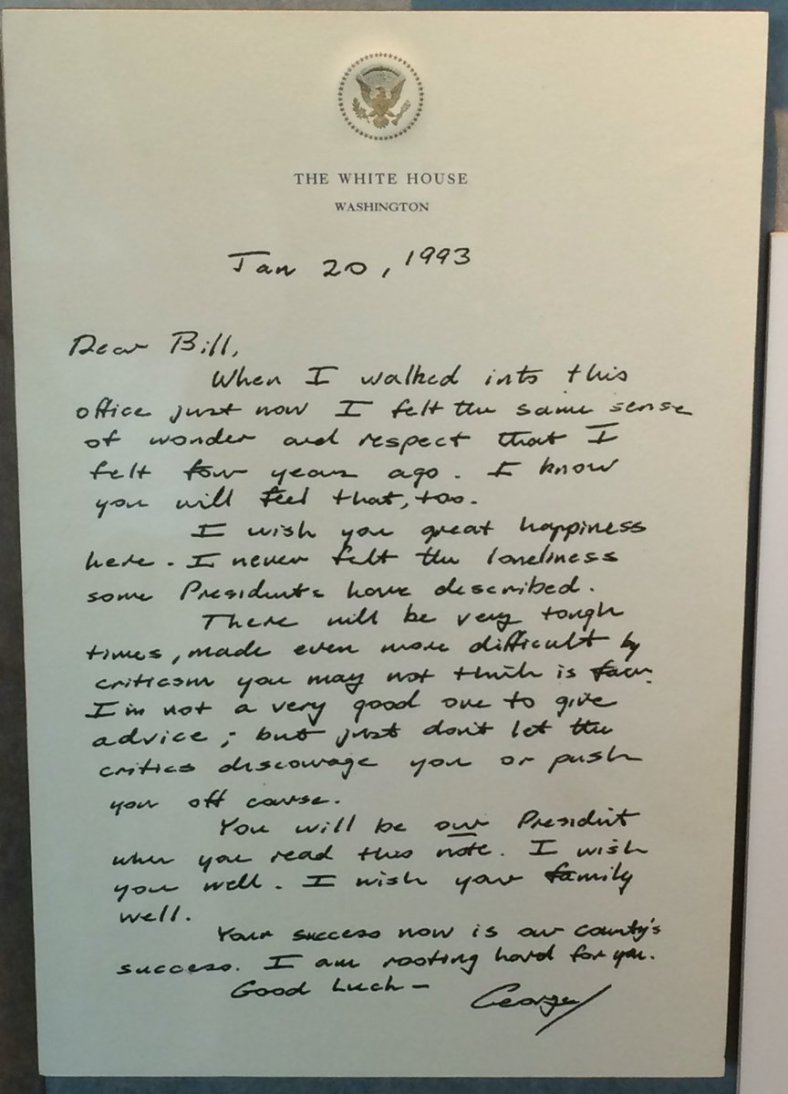
There’s been a copy of a letter circulating recently on the Internet. It arrived in my Twitter account this week via journalist Joyce Karam. It’s a handwritten note written on Inauguration Day, 1993 by departing President George H.W. Bush to his successor, President Bill Clinton.
bush to clinton.jpg

Imagine arriving at your new job on Monday morning and finding a handwritten note from your predecessor, wishing you great happiness @work. “Your success is now our success”.

What if you wrote a letter to the person taking over your desk on Monday morning? Could you convey a “sense of wonder and respect” for your workplace and your work?

Think about it. This is what leadership looks like.

While we are on the topic of U.S. Presidents, current President Obama is on vacation with family, friends and five ‘summer reads’ including Oprah’s recent Book Club selection and one of Bill Gates’ favorites.

readinglist2016_1200.jpeg

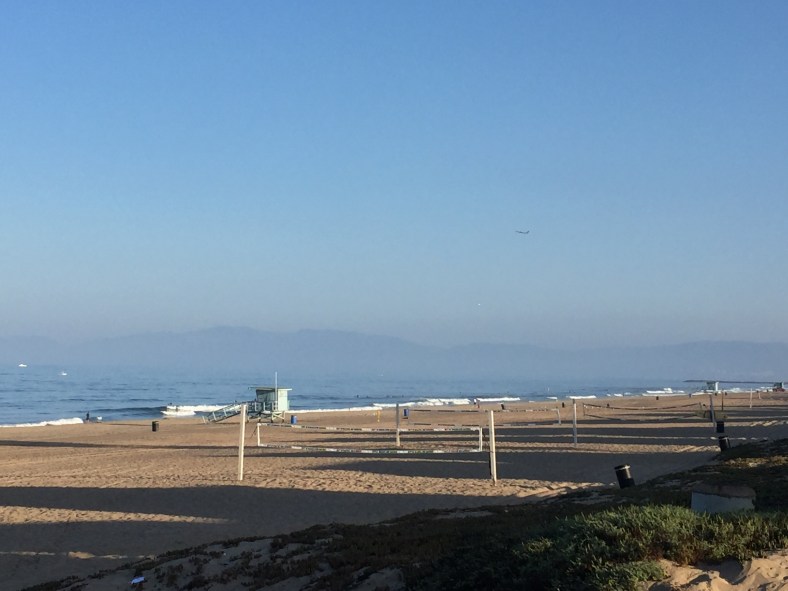
(A quick aside here on the Olympics. The photo at the top of the page captures the vacant volleyball nets this morning in Manhattan Beach, California. It’s the place where two U.S. Olympians, Kerry Walsh Jennings and April Ross went to work to get ready for Rio.)

Back to work, and reading, and surfing the Internet.

Kenneth Goldsmith, artist, professor and first poet laureate of the Museum of Modern Art, urged LA Times readers to ‘Go ahead: Waste time on the Internet’ with his OpEd this weekend.

“The notion that the Internet is bad for you seems premised on the idea that the Internet is one thing — a monolith. In reality it’s a befuddling mix of the stupid and the sublime, a shattered, contradictory, and fragmented medium. Internet detractors seem to miss this simple fact, which is why so many of their criticisms disintegrate under observation.”

He recently discussed his University of Pennsylvania course and new book ‘Wasting Time on the Internet’ with Quentin Hardy of The New York Times. Drawing on his personal observations of students and family, he imagined what an educated person will look like in the 21st century.

We still read great books, and there is a place for great universities. But an educated person in the future will be a curious person who collects better artifacts. The ability to call up and use facts is the new education. How to tap them, how to use them.

I’ve got a 10-year-old and 17-year-old. They’re thinking differently from me. They stay connected all the time, and they’re smart, they play baseball, they read, they spend time online. They’re not robots. Basic human qualities haven’t changed. I can find Plato in online life. When I read Samuel Pepys’s diary I see Facebook posts. We just find new ways to express things.

Go ahead, take a break this week@work. Stream the last week of the Olympics, read a great book, and follow the tangents of Internet exploration.
The Saturday Read – Summer Books

We have summer in our sights, anticipating travel, adventure, rest and relaxation. Harbingers of the coming season are the summer reading lists from the traditional print book review sources, the icons of Silicon Valley and the titans of Wall Street.

The act of picking up a book, unrelated to work or school, has moved away from the center and occurs only on the periphery of our lives. We seem to have relegated reading to the category of indulgence vs. necessity. We give ourselves permission to read in summer, during an interval when we step away from work.

Writing in The Irish Times, Isabelle Cartwright considered the question of why we read.

“…the simple answer is for pleasure. But what exactly is the nature of that pleasure? Reading removes us from the structure of our lives, from the routine, the sequential habits of our day-to-day living. We enter instead another time zone. The plot, characters and setting occupy us, and while we read we inhabit the others’ reality. The pleasure therefore is derived from escaping our own small, limited and often repetitive lives and entering an exotic elsewhere.

But perhaps there is also the attraction of reserving something private for ourselves, something outside of the public world of relationship, family, work and occupation; something that is not encumbered by the stricture of time and self.”

For those of you who need a utilitarian rationale to set aside time to read, there is research to show we are morally and socially better as a result of our efforts:

Raymond Mar, a psychologist at York University in Canada, and Keith Oatley, a professor emeritus of cognitive psychology at the University of Toronto, reported in studies published in 2006 and 2009 that individuals who often read fiction appear to be better able to understand other people, empathize with them and view the world from their perspective. This link persisted even after the researchers factored in the possibility that more empathetic individuals might choose to read more novels. A 2010 study by Mar found a similar result in young children: the more stories they had read to them, the keener their “theory of mind,” or mental model of other people’s intentions.”

We become more emotionally intelligent as we read.

If that doesn’t convince you, the ‘Lifehack blog’ lists ’10 Benefits of Reading: Why You Should Read Every Day’ (not just in summer): “Mental stimulation, stress reduction, knowledge, vocabulary expansion, memory improvement, stronger analytical skills, improved focus and concentration, better writing skills, tranquility and free entertainment.”

I think they’re on to something here, for all you skeptics. A few of these skills match exactly to what employers look for in potential candidates: communications and problem solving. Maybe reading is a necessity and not an indulgence.

Here is a menu of links to the popular reading lists this summer:

The Los Angeles Times – Summer reading guide: The 136 books you’ll want to read

The New York Times – When the Water’s Too Cold, Something Else to Dive Into, A Critic’s Survey of Summer Books

USA Today – 25 Hot Books for Summer

The Washington Post – A great leadership reading list — without any business books on it

Bloomberg – Books Worth Reading This Summer

NPR – Four Books That Deliver Unexpected And Delightful Surprises This Summer

A Year of Books, Mark Zuckerberg

Beach Reading (and More), Bill Gates

10 Beach Books from J.P. Morgan’s Summer Reading List

Happy sand in your toes, head in the clouds, sea spray on your face reading!

Do What You Love, Love What You Do

It’s Valentines Day, a day to reflect on relationships and celebrate love. It’s also a good day to have a conversation about our relationship with work and the often quoted mantra, ‘do what you love, love what you do’.

Last year an article in Jacobin magazine, later republished on Slate by Miya Tokumitsu offered the opinion that the concept of ‘do what you love’ degrades work that is not done from love. I would counter that ‘do what you love’ sets an aspirational goal beyond our current situation. That goal will evolve over time, and may even be overhauled with life changing events. But too many people, famous and not so famous, believe that you will only find success and add value to the lives of others if you are doing what you love.

Since his death, the 2005 Stanford commencement speech by Steve Jobs has received a lot of attention for his advice to the graduates. His work/life experience led him to believe: “Your work is going to fill a large part of your life, and the only way to be truly satisfied is to do what you believe is great work. And the only way to do great work is to love what you do.”

He was not alone in his conviction.  Artists, business leaders and politicians have shared their beliefs on the topic and some of the most inspirational been collected on Michael D. Pollack’s website. Here is a sample:

“You can only become truly accomplished at something you love. Don’t make money your goal. Instead pursue the things you love doing and then do them so well that people can’t take their eyes off of you.” Maya Angelou

“Just don’t give up trying to do what you really want to do. Where there is love and inspiration, I don’t think you can go wrong.” Ella Fitzgerald

“Paul and I, we never thought that we would make much money out of the thing. We just loved writing software.” Bill Gates

This doesn’t mean that we love everything we do at work. There is no magic wand that turns the toads into princes of productivity. There is conflict, confusion, uncertainty and ambiguity. But if there were no problems, there would be no work.

If you are not there yet, consider where you would be if you loved what you do and did what you loved. Maybe it’s time to get out the GPS, enter the destination and start your journey.