Sarah Boseley reported on Wednesday on the health risks of working long hours for The Guardian newspaper in the UK.
“The largest study conducted on the issue, carried out in three continents and led by scientists at University College London, found that those who work more than 55 hours a week have a 33% increased risk of stroke compared with those who work a 35- to 40-hour week. They also have a 13% increased risk of coronary heart disease.
The findings will confirm the assumptions of many that a long-hours culture, in which people work from early in the morning until well into the evening, with work also intruding into weekends, is potentially harmful to health.”
During a discussion of these findings on CBS This Morning, co-anchor Charlie Rose turned the conversation to a discussion of how we define work.
“For some people reading a lot is play and pleasure. For others it’s work. It’s part of what they do and how they spend their time. It’s one thing to be on an assembly line, I think, and another thing to be reading a novel in preparation to interview someone.
Where do we draw the line? Is there a line? That is the topic of the next article this week@work.
The New Yorker writer, Tim Wu thinks ‘You Really Don’t Need To Work So Much’. He questions why we have allowed ourselves to become players in “a football game where the whistle is never blown”. His solution, work should fulfill society’s needs with minimal effort. Let the workaholics have their fun, but not at the expense of the rest of us.
“The past fifty years have seen massive gains in productivity, the invention of countless labor-saving devices, and the mass entry of women into the formal workforce. If we assume that there is, to a certain degree, a fixed amount of work necessary for society to function, how can we at once be more productive, have more workers, and yet still be working more hours? Something else must be going on.”
“…in white-collar jobs, the amount of work can expand infinitely through the generation of false necessities—that is, reasons for driving people as hard as possible that have nothing to do with real social or economic needs.”
“The antidote is simple to prescribe but hard to achieve: it is a return to the goal of efficiency in work—fulfilling whatever needs we have, as a society, with the minimal effort required, while leaving the option of more work as a hobby for those who happen to love it.”
Does society need more unpaid interns? Apparently the United Nations thinks so and has grown their ‘volunteer workforce’ from 131 in 1996 to over 4,000 worldwide this year. ‘The Economist Explains why the UN doesn’t pay it’s interns’.
“The story of an unpaid intern living in a tent in Geneva did not make the United Nations look good. David Hyde, a fresh-faced 22-year-old from New Zealand, said he set up camp on the banks of Lake Geneva because he could not afford the Swiss city’s exorbitant rents while working for free. The news stirred up public outrage as well as sympathy from Mr Hyde’s colleagues: scores of UN interns in Geneva walked off the job on August 14th to protest against his plight. That same day a cluster of “interns’ rights” groups penned an open letter to the UN’s secretary-general, Ban Ki-moon, pointing out that the practice of not paying interns sits awkwardly with Article 23 of the organisation’s own Universal Declaration of Human Rights (“Everyone who works has the right to just and favourable remuneration ensuring for himself and his family an existence worthy of human dignity”). So why doesn’t the UN pay its interns?”
“They fear that paid internships may become a back door for recruitment and increase competition for coveted low-level “professional” positions.”
Excuse me, isn’t that why you do an internship? Isn’t this the apprenticeship that may one day lead to a full time job?
And while we are on the subject, let’s turn our attention to another group of unpaid collegians in the news this week, college football players. On Monday the U.S. National Labor Relations Board dismissed a petition from Northwestern University football players to form a union.
Ben Strauss reported on the board’s rationale in The New York Times:
“The board did not rule directly on the central question in the case — whether the players, who spend long hours on football and help generate millions of dollars for Northwestern, are university employees. Instead, it found that the novelty of the petition and its potentially wide-ranging impacts on college sports would not have promoted “stability in labor relations.”
Citing competitive balance and the potential impact on N.C.A.A. rules, the board made it clear that it harbored many reservations about the ramifications of granting college athletes, much less a single team, collective bargaining rights.”
For some college football players, their teammates are their best friends. And it may explain why many are so resilient.
Melissa Dahl described recent research in the UK for New York Magazine, ‘Having Just One Good Friend Strengthens Kids’ Resilience’.
“Let’s take a moment to praise the wonders of the true-blue best friendship, an especially powerful thing during the teenage years. A new study, published earlier this summer in the British Journal of Psychology, looked at this idea specifically among kids from low-income neighborhoods, and found that kids with just one solid, supportive friendship also tended to show signs of greater resilience when facing adversity than the kids with lower-quality friendships.
In their analysis, the researchers found an association between higher-quality friendships and greater resilience, likely, they theorize, because of the emotional support and the sounding board a real best friend provides.”
Here are a few more articles from the week@work that you may have missed.
The Future of Work and Workers – The Pacific Standard began a series this week exploring “What worries you most—and/or excites you most—about the future of work and workers? Put another way: What will be the most consequential changes in the world of work and workers, and what anxieties and possibilities will they produce?”
What the First Female Rangers Prove – Elizabeth Samet for Bloomberg View “Access to Ranger School, and combat units, is really about access to leadership opportunities. Of the 12 four-star Army generals currently on active duty, all are men. Eleven began their careers in the infantry or armor branch. Ten wear the Ranger tab. In other words, if you want a chance of running the Army, you would do well to go to Ranger School.”
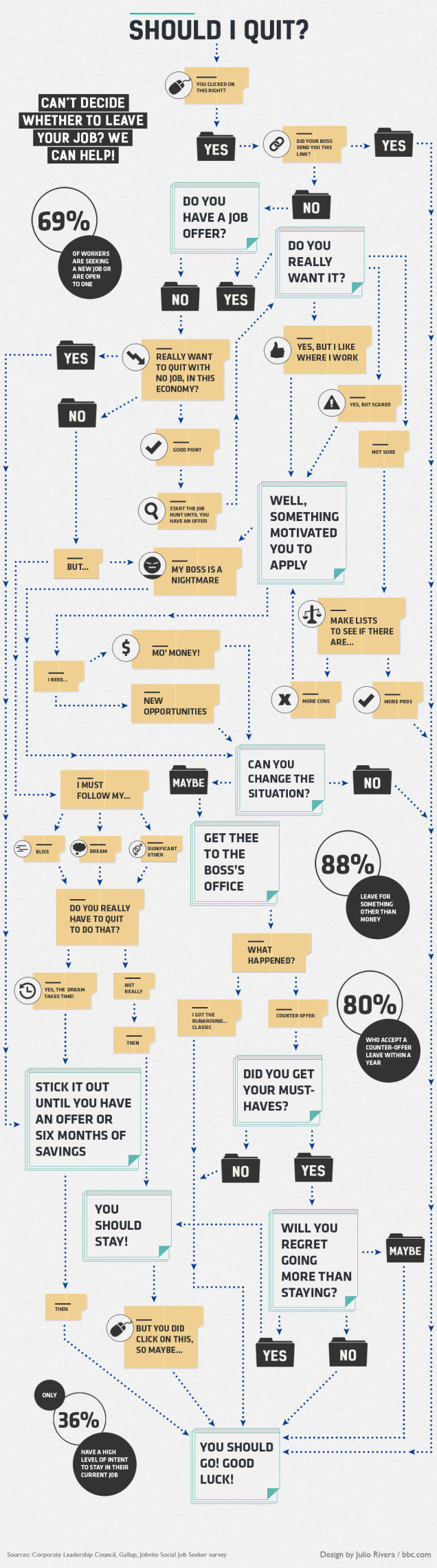
To Quit Or Not To Quit? This Flowchart Tells If It’s Time George Mortimer for Lifehack “Changing jobs or careers is something many people think about, but never seriously consider until it’s too late to change. The use of this flowchart makes it easier for you to determine if your current job satisfies your lifestyle. In basic terms, if your job isn’t making your life better you’re probably better off finding a new one.”


 workthoughts