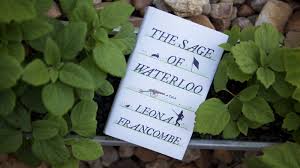
The Saturday Read – Revisiting ‘The Sage of Waterloo’ by Leona Francombe

Two hundred and one years ago, on June 18, 1815, Napoleon Bonaparte led his troops in battle against those of the Duke of Wellington on a farm three miles south of Waterloo in Belgium. At the end of the day, close to 50,000 soldiers were dead and French domination of the continent came to an end.

A number of books were published last spring to commemorate the 200th anniversary of the bloodshed. One, ‘The Sage of Waterloo’ by Leona Francombe, recalls events through a very different form of ‘oral history’. For this ‘Saturday Read’ we return to Hougoumont.

“Hougoumont is…dear me, where are the words? It’s a mute place, you see, but with such startling eloquence. Perhaps the fact that few visitors to the battlefield even know it exists fosters the air of an unopened message. Physically speaking, it’s a ruin: a decaying farmstead of brick and sandstone in perfect complicity with the land. The other, less tangible things are far more difficult to describe. Go there yourself and you’ll feel it: the knowing wind; the trees scarred as leviathans; and a strange sort of peace that isn’t peaceful at all but alert with memory and other, less palatable phenomena. Sometimes, when the wind comes off the eastern fields, it’s as if a worn curtain is shifting, and through a tear in the fabric you can see something unimaginable for such a sleepy backwater.”

I reviewed this exquisite story last year, and after this week of tragedy in Orlando and Birstall, West Yorkshire, ‘The Sage’ seemed to beckon from the bookshelf, inviting a return to the wisdom of Old Lavender.

“”Nature never truly recovers from human cataclysms,” Grandmother said one day, to me alone. “Never.” She was using that tone: two parts old sage, one part female warrior, scant affection and no salt… Every creature who was anywhere near Waterloo sensed what was going to happen,” she explained. “If they could get out, they got out. Those who stayed and survived passed the experience on through collective memory, right down through the generations until the present day. Collective memory… and resonance.””

Author Francombe is a pianist and composer whose lyrical interpretation of history, through a narrator at ‘ground level’, delivers a timely reminder –

“There are sometimes no explanations, William. So don’t try to find them, or pretend that they’re there. They aren’t. But there’s always a way forward.”


The Saturday Read – Best of the summer for Labor Day reading

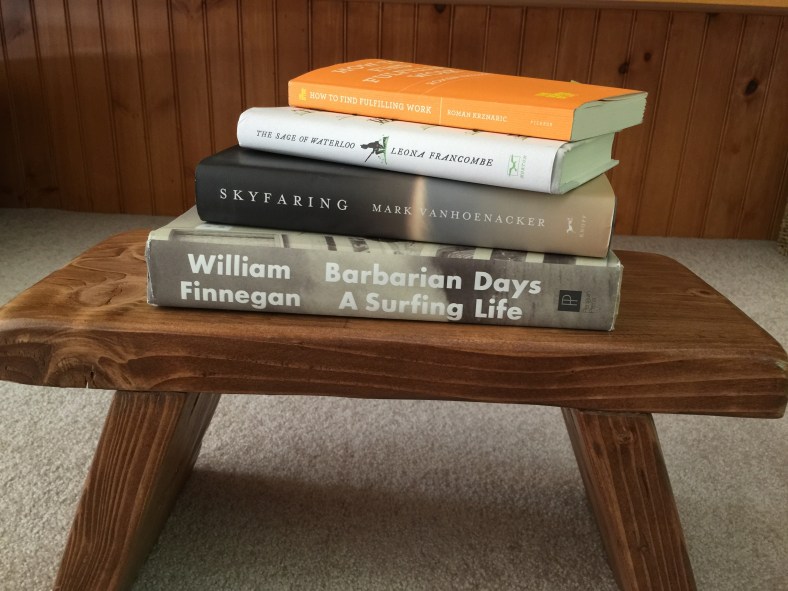
It’s the last long weekend of summer and one more opportunity to get lost in a story – in a beach chair, a park bench or your favorite comfy spot at home. I am suggesting four books from the archive of ‘The Saturday Read’. The narrators of these stories include the founder of the world’s first empathy museum, a management consultant turned pilot, a political writer and surfer and an oral historian with floppy ears. Pick the one that fits your mood or motivation.

If you’ve decided it’s time to rethink your career, ‘How to Find Fulfilling Work’ by Roman Krznaric is my pick. He suggests “We have entered a new age of fulfillment, in which the great dream is to trade up from money to meaning.” Think about that. He is proposing that meaning has more value than money.

His goal is to encourage the reader to stop thinking about taking action and actually get out and do something. The book is essentially an answer to two questions:

“What are the core elements of a fulfilling career?” and “How do we go about changing career and making the best possible decisions along the way?”

The best ‘travel’ book of the summer and best book about work is ‘Skyfaring’ by Mark Vanhoenacker.

What do we know of the work lives of pilots? These are the folks we trust to transport us across oceans, continents, cities and deserts. Our only contact through hours of flight is a welcome message, flight status update or a ‘thank you for choosing our airline’.

Turns out, pilots can be very interesting people. And, like many of us, they arrive at their ‘dream job’ after trying out other options. Mark Vanhoenacker’s career began in academia and management consulting. He started his flight training in 2001 after realizing all those plane flights were constant reminders of what he really wanted to do with his life.

“Is flying something I have always wanted to do? Have I ever seen anything “up there” that I cannot explain? And do I remember my first flight? I like these questions. They seem to have arrived, entirely intact, from a time before flying became ordinary and routine. They suggest that even now, when many of us so regularly leave one place on the earth and cross the high blue to another, we are not nearly as accustomed to flying as we think. These questions remind me that while airplanes have overturned many of our older sensibilities, a deeper part of our imagination lingers and still sparks in the former realm, among ancient, even atavistic, ideas of distance and place, migrations and the sky.”

What if your life passion is surfing, but your ‘day job’ is war reporter and international correspondent? If you wrote a memoir, would your work be taken less seriously? Apparently not, as my third pick for the upcoming weekend, ‘Barbarian Days’ by William Finnegan debuted on The New York Times hardcover non-fiction list at number five.

He first wrote about surfing in ‘Playing Doc’s Games’, profiling Mark Renneker for The New Yorker in 1992. Twenty three years later Doc returns along with a global cast of supporting characters inviting the reader to go out with them on the water.

Why should a non-surfer invest in a memoir subtitled ‘A Surfing Life’? Because it’s an everyman’s story of reconciling passions.

“Yes, I had been bewitched by surfing as a kid – trotting dreamily down a path at dawn, lit by visions of trade-blown waves, rapt even about the long paddle to Cliffs. The old spell had been broken, at times, or seemed to be. But it always lay there, under the surface, dormant but undestroyed while I knocked around the far world, living in waveless places – Montana, London, New York.”

“Here I was writing, often contentiously, about poverty, politics, race, U.S. foreign policy, criminal justice, and economic development, hoping to have my arguments taken seriously. I wasn’t sure that coming out of the closet as a surfer would be helpful. Other policy wonks might say, Oh, you’re just a dumb surfer, what do you know?”

The last recommendation is my favorite book of summer  This year marks the bicentennial of the Battle of Waterloo. A number of books have been published to coincide with the anniversary, but it’s the unique storytelling of author Leona Francombe in ‘The Sage of Waterloo’ that gives us a very different view of the conflict.

The story begins when a French drummer boy releases a white rabbit into the Hougoumont gardens during the battle on June 18, 1815. Our narrator, William, is guided on his journey by his grandmother, Old Lavender and a wise researcher, Arthur. He invites us to join him along the route the rabbits call the ‘Hollow Way’:

“There are many soft hillocks and hollows along this part of the Way on which one can rest and look back, and I suggest that you do this, too, because the view behind is as clear as the view ahead, and offers some valuable lessons besides.”

Yes, we are talking bunnies. Or, the bunny is talking to us. And along his path we join the Battle of Waterloo.

“Waterloo is small as battlefields go…the Hougoumont part of it even smaller. How extraordinary, then, that my farm – my tiny corner of Belgium, which even today people have difficulty locating on a map – should have made history in just a few hours.”

This small novel is a unique oral history of the Battle of Waterloo. Blending historical fact with fiction, author Francombe creates an unlikely ‘sage’ to carry the “collective memory…and resonance.” And reminds us to “feel what still hangs in the air” when we visit historic sites.

The Saturday Read – Leona Francombe ‘The Sage of Waterloo’

This year marks the bicentennial of the Battle of Waterloo. A number of books have been published to coincide with the anniversary, but it’s the unique storytelling of author Leona Francombe that gives us a very different view of the conflict. The ‘Saturday Read’ this week is ‘The Sage of Waterloo’.

The story begins when a French drummer boy releases a white rabbit into the Hougoumont gardens during the battle on June 18, 1815. Our narrator, William, is guided on his journey by his grandmother, Old Lavender and a wise researcher, Arthur. He invites us to join him along the route the rabbits call the ‘Hollow Way’:

“There are many soft hillocks and hollows along this part of the Way on which one can rest and look back, and I suggest that you do this, too, because the view behind is as clear as the view ahead, and offers some valuable lessons besides.”

Yes, we are talking bunnies. Or, the bunny is talking to us. And along his path we join the Battle of Waterloo.

“Waterloo is small as battlefields go…the Hougoumont part of it even smaller. How extraordinary, then, that my farm – my tiny corner of Belgium, which even today people have difficulty locating on a map – should have made history in just a few hours.”

For those readers unfamiliar with history, the Economist provides a thumbnail description:

“Waterloo not only brought to an end the extraordinary career of Napoleon Bonaparte, whose ambitions had led directly to the deaths of up to 6m people. It also redrew the map of Europe and was the climax of what has become known as the second Hundred Years War, a bitter commercial and colonial rivalry between Britain and France that had begun during the reign of Louis XIV. Through its dogged resistance to France’s hegemonic ambitions in the preceding 20 years, Britain helped create the conditions for the security system known as the Concert of Europe, established in 1815. The peace dividend Britain enjoyed for the next 40 years allowed it to emerge as the dominant global power of the 19th century.”

Which brings us back to our story and Arthur, the researcher, and did I mention black bird?, questioning humans’ short term memory.

“…they think they know what happened there. But their evolutionary process seems to be in reverse. They gradually forget the magnitude of what they’ve done – or at least, they’ve managed to disguise their violence as glory – so eventually, in the course of time, they can no longer feel what still hangs in the air. Not the way we do. So they don’t have any qualms about building cafes on burial grounds. They’ve never really stamped out their zeal for warmongering – quite the opposite, actually. They can’t seem to get enough of it.”

Near the end of the book William calculates an alternative if the soldiers had refused to fight: “approximately fifty thousand men would have lived. And ten thousand horses. And who knows how many rabbits?”

“Where did you learn all this?” I asked Arthur, after I’d finished my mulling. “Oh, you wouldn’t believe the things that remain in the woods around Hougoumont,” he said. “The resonance is quite astounding. Small creatures for miles around are still aware of the story.”

This small novel is a unique oral history of the Battle of Waterloo. Blending historical fact with fiction, author Francombe creates an unlikely ‘sage’ to carry the “collective memory…and resonance.” And reminds us to “feel what still hangs in the air” when we visit historic sites.