
Maya, Muhammad and Hillary. Not three names you would intuitively link together, but that’s what history claimed this week, as a ‘political poet’ passed, and a deceased poet’s 2008 words echoed in the background of a rally at the Brooklyn Navy Yard.
The news of the death of Muhammad Ali literally stopped the presses at the New York Times early Saturday morning. On Wednesday, newspapers across the country led with the history making headline reporting “Hillary Clinton‘s nomination: A win 96 years in the making”.
It will not be an easy road to November for Secretary Clinton as reported by Patrick Healy and Sheryl Gay Stolberg.
“When Hillary Clinton swept onto the stage at her victory rally Tuesday night, the thunderbolt of history struck many Americans, no matter their love or loathing for her: A woman could be the next president of the United States.
But like so much about Mrs. Clinton, her speech, which lit up televisions and smartphones and social media all day Wednesday, produced conflicting emotions.
For some, it was an inspiring moment that brought home in a visceral way that Mrs. Clinton is the first woman to become the presumptive nominee of a major party. For others, there were chills and discomfort that this next step forward in our national story was unfolding with this particular woman.”

The candidate might take heart from the poem Maya Angelou submitted to The Observer in 2008, with the backstory told by Vanessa Thorpe for The Guardian.
“She is supporting Clinton despite her close friendship with television personality and philanthropist Oprah Winfrey, a prominent backer of rival Democrat Barack Obama, the first black presidential hopeful with a real chance of reaching the White House.
Angelou is steadfast in her loyalty to Clinton. She said recently: ‘I made up my mind 15 years ago that if she ever ran for office I’d be on her wagon. My only difficulty with Senator Obama is that I believe in going out with who I went in with.’
Andrew Motion, the Poet Laureate, said of the poem: ‘This is a great thing for The Observer to have.’ He favourably compared it with the ‘vivid flourishes’ of Angelou’s recent work. ‘With this kind of poem Angelou has decided to interpret public writing as a verbal equivalent of making a poster, and there’s nothing wrong with this. The rhetoric is full of big gestures that make a direct appeal to our feelings, rather than getting to it by the little winding ways more personal poetry might use.'”
The poem:
State Package for Hillary Clinton
You may write me down in history
With your bitter, twisted lies,
You may tread me in the very dirt
But still, like dust, I’ll rise.
This is not the first time you have seen Hillary Clinton seemingly at her wits’ end, but she has always risen, always risen, don’t forget she has always risen, much to the dismay of her adversaries and the delight of her friends.
Hillary Clinton will not give up on you and all she asks of you is that you do not give up on her.
There is a world of difference between being a woman and being an old female. If you’re born a girl, grow up, and live long enough, you can become an old female. But to become a woman is a serious matter. A woman takes responsibility for the time she takes up and the space she occupies. Hillary Clinton is a woman. She has been there and done that and has still risen. She is in this race for the long haul. She intends to make a difference in our country. Hillary Clinton intends to help our country to be what it can become.
She declares she wants to see more smiles in the family, more courtesies between men and women, more honesty in the marketplace. She is the prayer of every woman and man who longs for fair play, healthy families, good schools, and a balanced economy.
She means to rise.
Don’t give up on Hillary. In fact, if you help her to rise, you will rise with her and help her make this country the wonderful, wonderful place where every man and every woman can live freely without sanctimonious piety and without crippling fear.
Rise, Hillary.
Rise.
Maya Angelou, 2008
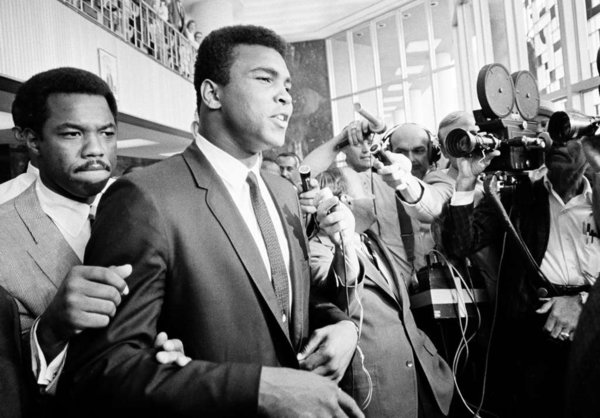
On Thursday, Henry Louis Gates Jr. recalled ‘Muhammad Ali, the Political Poet’. In the essay he linked Angelou and Ali by their poetry, often labeled ‘doggerel’.
“Perhaps Maya Angelou, whose own poetry is sometimes labeled doggerel, said it best: “It wasn’t only what he said and it wasn’t only how he said it; it was both of those things, and maybe there was a third thing in it, the spirit of Muhammad Ali, saying his poesies — ‘Float like a butterfly, sting like a bee.’ I mean, as a poet, I like that! If he hadn’t put his name on it, I might have chosen to use that!”
“It would be a mistake to say that Ali made black oral poetry more sophisticated or complex, but he did make it more political. After learning his local draft board had declared him eligible for induction into the Army in 1966, Ali recited this poem:
Keep asking me, no matter how long,
On the war in Vietnam,
I sing this song:
I ain’t got no quarrel with no Viet Cong.
On this Friday, we pause to remember the athlete, humanitarian and role model who was Muhammad Ali, we celebrate a milestone for women, and reflect on the words of two American poets who significantly influenced our culture.
 workthoughts