
This week@work we learned that the sculptor Kristen Visbal’s ‘Fearless Girl’ will remain on Wall Street though the beginning of 2018. A timely, symbolic decision given the other news of the week for women@work, which could convince one that they had time traveled back to 1957: continuing sexual harassment allegations @Fox, declining numbers of female coaches in women’s college basketball, Mike Pence’s views on lunch meetings, new research indicating a possible retreat from gender equality, and the headline from the Daily Mail which covered Brexit talks between Theresa May and Nicola Sturgeon as ‘Legs-It’.
In other stories this week@work, office supply company Staples is partnering with Workbar to offer co-working spaces, author Michael Lewis’ described how laziness contributed to his success, and various experts offered suggestions to secure your digital privacy in light of internet protections repeal.
Last night, the University of South Carolina’s womens’ basketball team won the NCAA national championship.
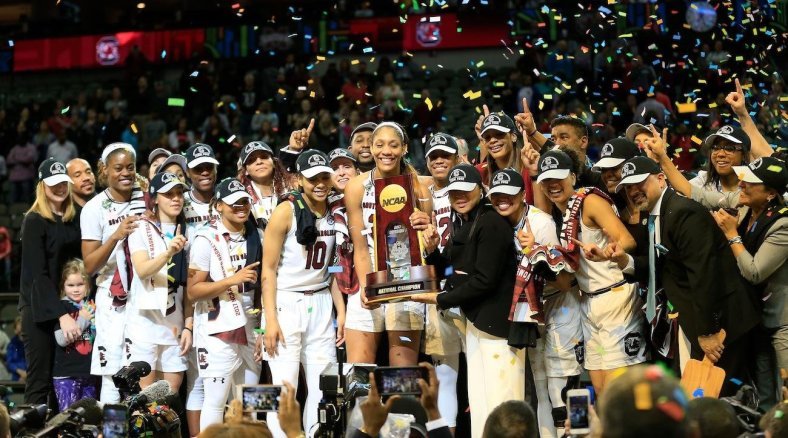
“Dawn Staley finally could raise an NCAA championship trophy…Staley made the Final Four three times as a player at Virginia but never won. She also led the Gamecocks to the national semifinals two years ago before losing to Notre Dame.”
Earlier this month Coach Staley was named the U.S. Olympic women’s basketball coach through 2020. Jere Longman reported on the state of college coaching as the ‘Number of Women Coaching in College Has Plummeted in Title IX Era’.
“Tara VanDerveer has won two national championships at Stanford and coached the American women to a gold medal at the 1996 Atlanta Olympics. Dawn Staley, the recently named 2020 Olympic coach, won three gold medals as a player and has guided South Carolina to the national semifinals for the second time in three seasons.
Yet even as VanDerveer and Staley again appear on their sport’s most visible stage, the opportunity for women to coach female collegiate athletes has stagnated after a decades-long decline.
In 1972, when the gender equity law known as Title IX was enacted, women were head coaches of more than 90 percent of women’s college teams across two dozen sports. Now that number has decreased to about 40 percent.”
On Wednesday, The Guardian journalists Anushka Asthana and Rowena Mason reported on the initiation of the formal process to separate Great Britain from the European Union.

“A letter signed by the prime minister will be hand-delivered to the president of the European council at about 12.30pm – as she rises in Westminster to deliver a statement to MPs signalling the end of the UK’s most significant diplomatic association since the end of the second world war.”
Unfortunately, the momentous occasion was not compelling enough. A photo soon emerged of the prime minister and first minister of Scotland provoking a sexist headline and article from the Daily Mail, prompting “immediate criticism from politicians, commentators and members of the public after it first appeared on Twitter on Monday night. Conservative MP and former Education Minister Nicky Morgan accused the paper of “appalling sexism”.
“Seriously? Our two most senior female politicians are judged for their legs not what they said #appallingsexism,” Ms Morgan said.
Labour MP Yvette Cooper joked that the clocks had “gone forward this weekend, not 50 years back”, while former Labour Leader Ed Miliband wrote the “1950s called and asked for their headline back”.
And then there was this, ‘Do Millennial Men Want Stay-at-Home Wives?’. Stephanie Coontz shared new research on attitudes toward gender equity.
“…a set of reports released Friday by the Council on Contemporary Families reveals, fewer of the youngest millennials, those aged 18 to 25, support egalitarian family arrangements than did the same age group 20 years earlier.
Using a survey that has monitored the attitudes of high school seniors for nearly 40 years, the sociologists Joanna Pepin and David Cotter find that the proportion of young people holding egalitarian views about gender relationships rose steadily from 1977 to the mid-1990s but has fallen since. In 1994, only 42 percent of high school seniors agreed that the best family was one where the man was the main income earner and the woman took care of the home. But in 2014, 58 percent of seniors said they preferred that arrangement. In 1994, fewer than 30 percent of high school seniors thought “the husband should make all the important decisions in the family.” By 2014, nearly 40 percent subscribed to that premise.”
Rose Leadem reported on the new joint co-work space venture between Staples and Workbar.

“Staples isn’t just for office supplies or printing anymore. Three of the company’s Massachusetts stores now include happy hour, retro music and mod seating — that is, it’s adding coworking spaces.
Since September, more than 200 people have signed up for memberships, which cost $130 a month. The company hasn’t revealed plans for more locations, but according to Bloomberg, Goodman hopes to “dominate the $80 billion-a-year U.S. midmarket, or businesses with fewer than 200 employees.”
Minda Zetlin interviewed writer Michael Lewis and found ‘Being Lazy Is the Key to Success, According to the Best-Selling Author of ‘Moneyball’.
“Embracing laziness has helped him be successful because he focuses his efforts only where it really matters, he explained. Here’s how that can create a real advantage:
Being willing to be inactive or less active means you’ll be available when something truly worthy of your best effort comes along. It also means you’ll have the time and space to go looking for those really worthwhile projects. If you’re busy being busy, you’ll miss them…
“People waste years of their lives not being willing to waste hours of their lives. If you mistake busyness for importance–which we do a lot–you’re not able to see what really is important.”
“My laziness serves as a filter,” Lewis said. “Something has to be really good before I’ll decide to work on it.”
While embracing laziness, you may want to think about securing your online privacy. With the roll back of internet privacy regulations last week, Marguerite Reardon offered background and analysis, ‘Congress just killed online privacy rules. Now what?’

“The House of Representatives on Tuesday voted 215-205 to stop FCC regulations from taking effect that would have required broadband and wireless companies to ask your permission before sharing sensitive information about you, such as the websites you visit, the apps you use or even your location. The rules would have also set standards for broadband providers to protect information they collect and store. And they would have set requirements for when and how companies would inform you if your data was stolen.
Since the FCC’s rules never actually went into effect, you won’t notice much difference in how companies are protecting your privacy. But eventually, you’ll see a lot more targeted advertising and creepy ads that follow you all over the internet. Your broadband provider, whether that’s AT&T, Verizon or Comcast, will still be able to sell some information about you to advertisers, just as Google and Facebook can.
Broadband providers are already moving into the content business, and they’re likely to get more aggressive in how the information is used and who gets to use it.”
#3 on the most read, shared and discussed posts from across the New York Times was an updated article that originally appeared in November, ‘Protecting Your Digital Life in 8 Easy Steps’. Don’t forget to cover your webcam with tape…
Photo credits: Theresa May – Downing Street/Twitter,

 workthoughts