
This week@work Harvard Ph.D. student Robert Manduca shared his visual representation of every job on a map of the United States. Three of the locations plotted were sites of interesting stories about work this week: Las Vegas and Zappos‘ experiment with ‘holacracy’, Laurel, Maryland home to the Pluto exploring ‘New Horizons’ team and Seattle…well more about that later.
Thanks to the research of Robert Manduca, we can now see concentrations of economic sectors across the U.S. Writing in the Washington Post, ‘Wonkblog’ author Emily Badger cited the significance of his work:
“Among all the things that distinguish American cities from one another — their architecture, their demographics, their history and their terrain — their economies vary widely, too. Washington is, of course, a city of government work. Charlotte is a banking hub, Manhattan a financial center, Boston an education mecca. Metropolitan Cleveland remains relatively industrial, while Las Vegas runs on tourism.
These differences form economic identities that shape each city as much as their culture and geography do.”
Where we choose to work, geographically, can have a significant impact on our success. Cultures of organizations fit within the larger communities where they are located. When considering career advancement it’s important to examine the size of a particular sector within the local economy. Will the geography lend itself to a variety of opportunities when you decide to move on?
Maybe even more important is your social life outside of work. The folks that make up your community will in some ways reflect the values of the places they go to work each day. If you really didn’t like your classmates in that ‘Intro to Finance’ class, you may want to think twice about living and working where these same folks are now grown-ups working in investment banking.
Las Vegas is one place you might consider if you were interested in the hospitality industry. It’s also the home to online retailer Zappos.com.
In his article, ‘At Zappos, Pushing Shoes and a Vision’ NY Times reporter David Gelles chronicles the experiment in ‘holacracy’ or self management which began in 2013. Tony Hsieh has run Zappos for 16 years. He has been viewed as a visionary by many and realized change was needed to sustain the corporate culture he built.
“The goal of Holacracy is to create a dynamic workplace where everyone has a voice and bureaucracy doesn’t stifle innovation.
At Zappos, this means traditional corporate hierarchy is gone. Managers no longer exist. The company’s 1,500 employees define their own jobs. Anyone can set the agenda for a meeting. To prevent anarchy, processes are strictly enforced.
At Zappos, Mr. Hsieh seems to regard Holacracy as a way to revive the close-knit community feeling that made the company so special 10 years ago, when it was just a few hundred people taking on the giants of e-commerce. “Once you have that level of friendship, there’s higher levels of trust,” he said. “Communication is better; you can send emails without fear of being misinterpreted; people do favors for one another.”
If only it were so simple. Holacracy has been met with everything from cautious embrace to outright revulsion at Zappos, but little unequivocal enthusiasm.”
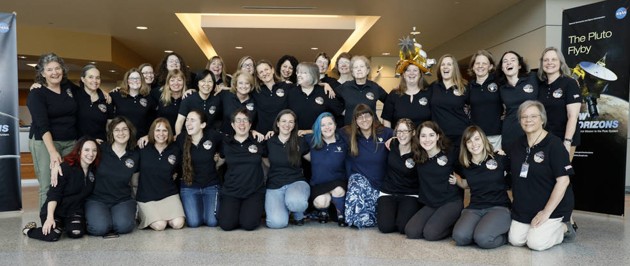
Another point on the map is Laurel, Maryland home to the ‘New Horizons’ team that piloted a piano sized spacecraft to Pluto and beyond. The workplace story here is the dedication of a team to a long term goal, the implementation of a ‘longevity plan’ to ensure program success over nine years and the joy of scientific discovery way outside the box.
It’s that shear joy that was expressed by New Horizons scientist Carey Lysse in an NBC interview:
“I love to explore. It’s one of the reasons I’m a scientist. This is one of those red letter days that doesn’t happen every day and so I’ll remember it for the rest of my life. It’s incredible.”
And now about Seattle. If you are thinking of relocating you may want to read Kathryn Shultz’s New Yorker Magazine article, ‘The Really Big One’.
“Most people in the United States know just one fault line by name: the San Andreas, which runs nearly the length of California and is perpetually rumored to be on the verge of unleashing “the big one.” That rumor is misleading, no matter what the San Andreas ever does. Every fault line has an upper limit to its potency, determined by its length and width, and by how far it can slip. For the San Andreas, one of the most extensively studied and best understood fault lines in the world, that upper limit is roughly an 8.2—a powerful earthquake, but, because the Richter scale is logarithmic, only six per cent as strong as the 2011 event in Japan.
Just north of the San Andreas, however, lies another fault line. Known as the Cascadia subduction zone, it runs for seven hundred miles off the coast of the Pacific Northwest, beginning near Cape Mendocino, California, continuing along Oregon and Washington, and terminating around Vancouver Island, Canada. The “Cascadia” part of its name comes from the Cascade Range, a chain of volcanic mountains that follow the same course a hundred or so miles inland. The “subduction zone” part refers to a region of the planet where one tectonic plate is sliding underneath (subducting) another. Tectonic plates are those slabs of mantle and crust that, in their epochs-long drift, rearrange the earth’s continents and oceans. Most of the time, their movement is slow, harmless, and all but undetectable. Occasionally, at the borders where they meet, it is not.”
 workthoughts