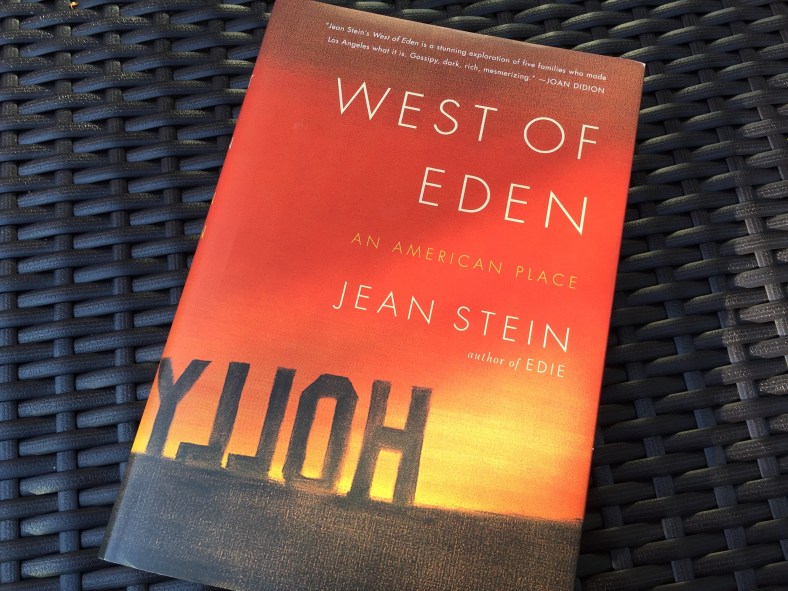
Were the initial seeds of relocation planted when you read a novel or work of non-fiction that transported you to that place on the globe where you could find success? In the Saturday Read this week we arrive in Hollywood, where author Jean Stein interweaves oral history and memory to tell the story, ‘West of Eden: An American Place’.
If you read the book through the lens of work, you come away with the story of the three industries that built LA: oil, real estate and the movies. As you turn the page, you listen to voices describing the culture and its effects on lives and careers.
When Po Bronson wrote his book, ‘What Should I Do With My Life?’, he had already spent time as a producer and writer in television. His observations on culture echo through Ms. Stein’s narrative.
“Every industry has a culture. And every culture is driven by a value system. In Hollywood, where praise is given too easily and thus has been devalued, the only honest metric is box-office receipts. So box-office receipts are all-important.
One of the most common mistakes is not recognizing how these value systems will shape you. People think that they can insulate themselves, that they’re different. They’re not. The relevant question in looking at a job is not What will I do? but Who will I become? What belief system will you adopt, and what will take on heightened importance in your life? Because once you’re rooted in a particular system — whether it’s medicine, New York City, Microsoft, or a startup — it’s often agonizingly difficult to unravel yourself from its values, practices, and rewards. Your money is good anywhere, but respect and status are only a local currency. They get heavily discounted when taken elsewhere. If you’re successful at the wrong thing, the mix of praise and opportunity can lock you in forever.”
‘West of Eden’ is the story of five families: the Dohenys, the Warners, Jane Garland, Jennifer Jones and the author’s own family, the Steins. As I read each section, I was reminded of Bronson’s comment. For the most part, the real life actors in the book were chasing the dream of wealth, status and celebrity; not considering the consequences, finding themselves in a world of praise and opportunity, locked in, in some cases, with tragic results.
Writer and historian, Mike Davis opens the book with his memories as a guide for Grey Line Tours, and it’s the map of celebrity homes that provides an outline for the book. We are introduced to the five stories by street address. Second stop, 1801 Angelo Drive, Beverly Hills, the Warner home. Arthur Miller captures the essence of early Hollywood.
“Jack Warner’s generation invented what turned out to be the major world culture – not just American, but a world culture. The world’s dream to escape the dreadful, ordinary, industrial, technological life. An you can understand how it happened if you think of where they came from, a place where there was absolutely no chance for anybody to do anything. They were living in a mud hole, but here the dreams were absolutely feasible. If you could think it, you could do it. It was magic. And they filled the movies with magic. George Cukor told me once, “Our object was to escape reality. We were quite conscious of all that.” It was a never-never land, a construct. These immigrants, these Jews from Eastern Europe, had developed this dream that had blond hair, blue eyes, and a straight nose. It all had to be beautiful. This was a fairy tale, because they were immigrants who saw this country as a fairy tale. It was incredible: it captured the whole country.”
These were the ‘culture builders’ whose legacy remains in the mansions, oil wells and studios, that fund the dreams of workers today. Their stories are told through neighbors, colleagues, family members and employees. David Geffen, who purchased Jack Warner’s home connects past to present:
“Jack Warner was a great character, like all of them. They were remarkable guys, but they were monsters. The movie business is a hard business, and you had to be a monster to create this industry.
Jean Stein has called upon a lifetime network to craft and preserve the unique story of a place built on escape from the ordinary. A set of biographical notes at the end gives the reader thumbnail bios of each narrator, and it’s quite a cast of characters!
The book is required reading for the uninitiated and aspiring L.A. resident. There is drama worthy of an academy award, in every category from acting to costume design to hair and makeup and of course, visual effects.
“Another quality that all Californians who have spent any time on the edge of the Pacific are aware of is that the light is different. There’s a pressure on the eyes from the light. I’ve never felt it on the other coast.” (art curator, Walter Hopps)

 workthoughts