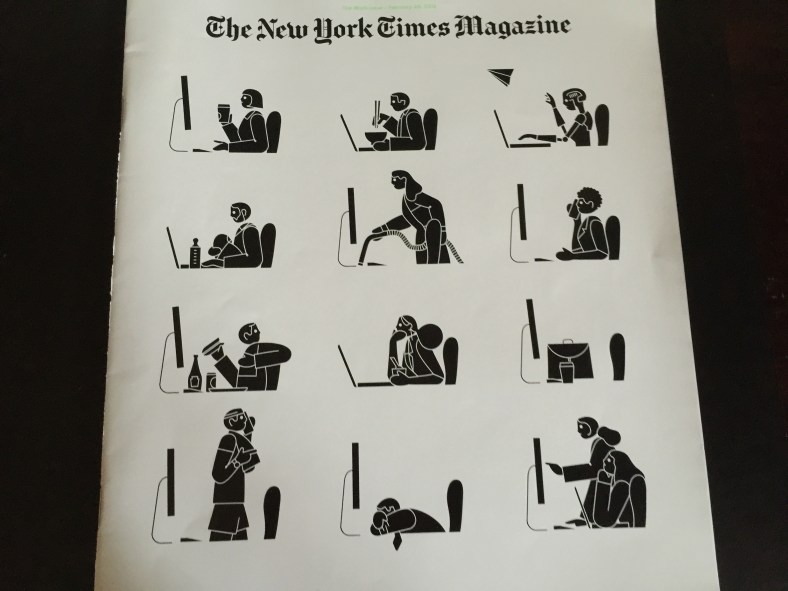
The Saturday Read ‘Worklife: Rethinking the office for an always-on economy’

The Saturday Read this week is a compilation of articles that appeared in the February 28, 2016 ‘work issue’ of The New York Times Magazine.

A group of journalists and writers contributed coverage on a variety of work/life topics, adding new perspectives from groundbreaking research, demonstrating that, regardless of profession, it’s all about the culture. And the culture is in need of change.

Organization culture determines who succeeds, fails, and communicates ‘hints’ through recruiting practices, and the daily process of getting things done; meetings, teamwork and office space.

“We do often work at home. But we also work at work, before going home to work more. The office has persisted, becoming even bigger, weirder, stranger: a symbol of its outsize presence in our lives.”

The ‘work issue’ is an interesting survey of some of the most pressing issues @work today. The sampling of the content below is meant to serve as an introduction, with a recommendation to take the time to read the edition in its entirety.

NYT staff writer, Susan Dominus challenges us to think about balance beyond policies by ‘Rethinking the Work-Life Equation’, reporting on the research of Phyllis Moen of the University of Minnesota and Erin Kelly of M.I.T.

“Workers in the experimental group were told they could work wherever, and whenever, they chose so long as projects were completed on time and goals were met; the new emphasis would be on results rather than on the number of hours spent in the office. Managers were trained to be supportive of their employees’ personal issues and were formally encouraged to open up about their own priorities outside work — an ill parent, or a child wanting her mom to watch her soccer games. Managers were given iPods that buzzed twice a day to remind them to think about the various ways they could support their employees as they managed their jobs and home lives.

The research found that employees in the experimental group met their goals as reliably as those in the control group, and they were, in short, much happier: They were sleeping better, were healthier and experienced less stress. Other studies examining the same workplace found that the effects even cascaded down to employees’ children, who reported less volatility around their own daily stresses; adolescents saw the quality of their sleep improve. A year out, and then three years out, employees in the experimental group reported less interest in leaving the organization than those in the control group.

…sometimes there is little more than tradition holding organizations back from making meaningful changes that bring tremendous peace of mind to their employees.”

Five years ago, Google decided to determine what makes a ‘perfect team’. Pulitzer prize winning New York Times reporter Charles Duhigg reports on the results in an excerpt from his new book, ‘Smarter Faster Better: The Secrets of Being Productive in Life and Business’.

“For Project Aristotle, research on psychological safety pointed to particular norms that are vital to success. There were other behaviors that seemed important as well — like making sure teams had clear goals and creating a culture of dependability. But Google’s data indicated that psychological safety, more than anything else, was critical to making a team work.

However, establishing psychological safety is, by its very nature, somewhat messy and difficult to implement. You can tell people to take turns during a conversation and to listen to one another more. You can instruct employees to be sensitive to how their colleagues feel and to notice when someone seems upset. But the kinds of people who work at Google are often the ones who became software engineers because they wanted to avoid talking about feelings in the first place.

What Project Aristotle has taught people within Google is that no one wants to put on a ‘‘work face’’ when they get to the office. No one wants to leave part of their personality and inner life at home. But to be fully present at work, to feel ‘‘psychologically safe,’’ we must know that we can be free enough, sometimes, to share the things that scare us without fear of recriminations. We must be able to talk about what is messy or sad, to have hard conversations with colleagues who are driving us crazy. We can’t be focused just on efficiency. Rather, when we start the morning by collaborating with a team of engineers and then send emails to our marketing colleagues and then jump on a conference call, we want to know that those people really hear us. We want to know that work is more than just labor.”

Nikil Saval, who wrote about the evolution of the office in ‘Cubed: The Secret History of the Workplace’, writes about new experiments with office space, ‘Labor/atories’

“The sudden efflorescence of the tech industry in the late ’90s took us from the desert of cubicles to the milk-and-honey offices of today. Many of the dot-commers had graduated from (or, very often, dropped out of) cozy university campuses to toil in big corporations. Starting their own companies, they recreated the effortless drift between work and play that characterized their college lives. The cubicle walls came down, and in the wide, open warehouse and loft spaces they occupied, exceptionally long workdays would be punctuated by frenzied Mario Kart races or fierce Ping-Pong battles. Creating a playful office became one of the standard ways of attracting skilled employees in a competitive environment: The hope was that a talented engineer wouldn’t leave a tech behemoth for the dinky start-up next door that didn’t have a gym and a resistance pool. Thus has the ‘‘fun office’’ spread throughout the world.”

Each of the articles provides a ‘take away’ to apply @work. If you’re a leader, you’ll rethink your approach as you begin to understand what your competitors are doing to recruit and retain employees. As a manager, you’ll learn ways to improve the daily routine of meetings, but more important, reinforce behavior that will encourage employees to be productive. For the rest of us, a window has been opened to view alternative approaches to work and workplace. What will you do on Monday to turn policy into practice?


The week@work – innovative organizations, AT&T’s new culture, Shonda Rhimes @TED, the online platform economy and pausing to enjoy the view

The week@work was dominated by the story of Apple’s opposition to the court order to unlock the San Bernardino gunman’s IPhone. Simultaneously, news was being made as Fast Company released its annual list of the ‘Most Innovative Companies’, AT&T’s leadership challenged workers to reinvent themselves,  Shonda Rhimes shared her ‘year of yes’ @TED, and the JP Morgan Chase Institute released a study examining the online platform economy, and its impact on one million of its customers.

And for balance, in this centennial year of the National Park Service, enjoy the view of Horsetail Fall in Yosemite National Park as sunset transforms the waterfall into an apparent stream of hot lava. Sangeeta Day captured the photo above for National Geographic.

On Monday, Fast Company released their list of The Most Innovative Companies of 2016. The top five are BuzzFeed, Facebook, CVS Health, Uber and Netflix.

3055973-poster-c-1-TOC-march-2016.jpg

BuzzFeed CEO, Jonah Peretti’s vision drew on his fascination with Paramount Pictures, CNN and JayZ. “BuzzFeed has built its success, like Paramount a century ago, by owning all the elements of a modern media business: a global news team, its own video pro­duction studio, a sophisticated data operation, and an in-house creative ad agency.” 

“The “bored-at-work network,” as Peretti himself once called it, was merely a single U.S. website. In late 2014, he foresaw that people wouldn’t want to leave their social apps, so Peretti drastically shifted his company’s strategy: Instead of trying to lure eyeballs to its own website, the way most publishers do, BuzzFeed would publish original text, images, and video directly to where its audience already spent its time, some 30 different global platforms, from Facebook to the Russian social networks VK and Telegram. Rather than write one definitive article and publish it on every platform (the de facto standard in the media business), BuzzFeed would tailor content specifically for the network and audience where it’s being viewed.

How’d that turn out? Across all the platforms where it now publishes content, the company generates 5 billion monthly views—half from video, a business that effectively did not exist two years ago. Traffic to the website has remained steady—80 million people in the U.S. every month, putting it ahead of The New York Times—even though as much as 75% of BuzzFeed’s content is now published somewhere else.”

at-and-t-squarelogo.png


One company that has lost its standing in the top 50 innovators is legacy telecom AT&T. As the competitors have changed with the shift from traditional phone and cellular carriers to Internet and cloud computing, the company’s leadership team is making new demands on its workforce, resetting the culture, again.

“AT&T’s competitors are not just Verizon and Sprint, but also tech giants like Amazon and Google. For the company to survive in this environment, Mr. Stephenson needs to retrain its 280,000 employees so they can improve their coding skills, or learn them, and make quick business decisions based on a fire hose of data coming into the company.

In an ambitious corporate education program that started about two years ago, he is offering to pay for classes (at least some of them) to help employees modernize their skills. But there’s a catch: They have to take these classes on their own time and sometimes pay for them with their own money.

To Mr. Stephenson, it should be an easy choice for most workers: Learn new skills or find your career choices are very limited.”

Adapting to change, learning new skills, saying yes, and taking time to play were all part of television producer Shonda Rhimes’ TED Talk in Vancouver.

d80be53df8b115a4e19b5182ccfd653380dee585_254x191.jpg

“You can do it too, say yes every time your child asks you to play. Are you thinking that maybe I’m an idiot in diamond shoes? You’re right, but you can still do this. You have time. You know why? Because you’re not Rihanna and you’re not a Muppet. Your child does not think you’re that interesting.

I said yes to less work and more play, and somehow I still run my world. My brain is still global. My campfires still burn. The more I play, the happier I am, and the happier my kids are. The more I play, the more I feel like a good mother. The more I play, the freer my mind becomes. The more I play, the better I work. The more I play, the more I feel the hum, the nation I’m building, the marathon I’m running, the troops, the canvas, the high note, the hum, the hum, the other hum, the real hum, life’s hum. The more I feel that hum, the more this strange, quivering, uncocooned, awkward, brand new, alive non-titan feels like me. The more I feel that hum, the more I know who I am. I’m a writer, I make stuff up, I imagine. That part of the job, that’s living the dream. That’s the dream of the job. Because a dream job should be a little bit dreamy.”

de3d8aa4bfe6c55dba2d3a5e60101d6f9ffde7cb_800x600.jpg

In other news @TED, the annual $1 million TED Prize was awarded to Sarah H. Parcak, a space archaeologist who uses satellite imagery to discover ancient sites, and map looting.

“I wish for us to discover the millions of unknown archaeological sites across the globe. By building an online citizen science platform and training a 21st century army of global explorers, we’ll find and protect the world’s hidden heritage, which contains clues to humankind’s collective resilience and creativity.”

Unknown.jpegEric Morath reported the findings of a JP Morgan Institute Study of market volatility and the emergence of  “a new marketplace for work by unbundling a job into discrete tasks and directly connecting individual sellers with consumers.” 

Call it ‘gig’ or ‘sharing’, the economy is being supported by folks who are supplementing their income with ‘app jobs’.

“The share of Americans earning income from digital platforms such as Uber and Airbnb is growing rapidly, but those gigs typically supplement incomes rather than replace full-time work.

Nearly 1% of U.S. adults earned income in September 2015 via one of the growing number of firms that are part of the sharing or gig economy, according to a study of bank transactions by the JPMorgan Chase Institute, released Thursday. Participation has exploded since October 2012, when just 0.1% of adults were paid by such platforms.

At 2.5 million, the sharing labor force is roughly equivalent to the number of teachers and others that work for public schools in the U.S., though the study finds that people driving for Lyft or selling crafts on eBay typically have other sources of income.

The average monthly income for someone who provided labor via one of the platforms was $533, representing a third of total income. The share of active participants earning 50% or more of their monthly income has fallen since the summer of 2014, as the total number making some money increased.”

In other stories of interest this week@work:

‘Channing Dungey to Succeed Paul Lee as Chief of ABC Entertainment’ by Brooks Barnes and John Koblin   “Channing Dungey, previously ABC’s drama chief, will take over as the head of ABC entertainment, making her the first black network president.

Ms. Dungey’s elevation is a breakthrough for an industry that has often struggled with diversity, especially among the senior executive ranks.”

‘Fashion Week’s Shift Toward Diversity’ by Ruth La Ferla  “Well before the Oscars stirred a diversity debate, Seventh Avenue had been the target of stinging criticism for the sin of omission, routinely parading mostly white models on its runways.

In this latest round of shows, which ended on Thursday, many designers appeared to have taken a hard look at the highly charged issue of casting, stepping up their efforts to hire racial and ethnic minorities and sounding a chord for inclusiveness.”

And because it’s the beginning of Oscar Week:

b67e67830551ea34f84eb0edf7900236553b83045ca648f52711fe9838b7a681‘Films once were an escape from work. Now, they celebrate it. What gives?’ by Charles McNulty  “There was a time when Americans went to the movies to escape the workplace. These days, in keeping with the way our offices have taken over our lives, filmmakers have turned the big screen into one long career day.

Audiences have been invited to experience first-hand the everyday grind of being a journalist (“Spotlight”), an astronaut (“The Martian”), a screenwriter (“Trumbo”), a fur trapper (“The Revenant”) and even an inventor of kitchen mops (“Joy”).”

Pleasant dreams of gold for all, this week@work.