The Friday Poem ‘Voyage to the Moon’ by Archibald MacLeish

On July 20, 1969 NASA landed two U.S. astronauts on the surface of the moon. The following day, under the headline “Men Land On Moon” there were two bylines on the front page of The New York Times: science reporter, John Noble Wilford and poet, Archibald MacLeish.

Reporter Stephen Farrell recently covered their ‘story behind the story’ in ‘You Might Call It A Moonstruck Career’.

“In July 1969, the National Aeronautics and Space Administration won that Cold War contest by landing the Apollo 11 astronauts Neil A. Armstrong and Col. Edwin E. Aldrin Jr. on the lunar surface, while Michael Collins remained in orbit above. Marking that achievement, Mr. Wilford’s name was at the top of the front page of the Times edition of July 21, 1969 beneath the banner headline: “Men Walk on Moon.” You could buy a copy for 10 cents.

The front page’s only other byline was that of Archibald MacLeish, a three-time Pulitzer Prize winner who contributed an accompanying poem, “Voyage to the Moon.”

Twenty years after the landing, former NY Times Editor, A.M. Rosenthal recounted his decision to include poetry on page one.

“We decided what the front page of The Times would need when the men landed was a poem.

What the poet wrote would count most, but we also wanted to say to our readers, look, this paper does not know how to express how it feels this day and perhaps you don’t either, so here is a fellow, a poet, who will try for all of us.

We called one poet who just did not think much of moons or us, and then decided to reach higher for somebody with more zest in his soul – for Archibald MacLeish, winner of three Pulitzer Prizes. He turned in his poem on time and entitled it ”Voyage to the Moon.”

0720_big

In commemoration of the moon landing, and a time when those who worked as poets were celebrated and gave voice to “one of the biggest stories of the century”, today’s Friday Poem –

VOYAGE TO THE MOON

Presence among us,
wanderer in the skies,

dazzle of silver in our leaves and on our
waters silver,

O

silver evasion in our farthest thought–
“the visiting moon” . . . “the glimpses of the moon” . . .

and we have touched you!

From the first of time,
before the first of time, before the
first men tasted time, we thought of you.
You were a wonder to us, unattainable,
a longing past the reach of longing,
a light beyond our light, our lives–perhaps
a meaning to us…

Now

our hands have touched you in your depth of night.

Three days and three nights we journeyed,
steered by farthest stars, climbed outward,
crossed the invisible tide-rip where the floating dust
falls one way or the other in the void between,
followed that other down, encountered
cold, faced death–unfathomable emptiness . . .

Then, the fourth day evening, we descended,
made fast, set foot at dawn upon your beaches,
sifted between our fingers your cold sand.

We stand here in the dusk, the cold, the silence . . .

and here, as at the first of time, we lift our heads.
Over us, more beautiful than the moon, a
moon, a wonder to us, unattainable,
a longing past the reach of longing,
a light beyond our light, our lives–perhaps
a meaning to us . . .

O, a meaning!

over us on these silent beaches the bright earth,

presence among us.

Archibald MacLeish for The New York Times, July 21, 1969

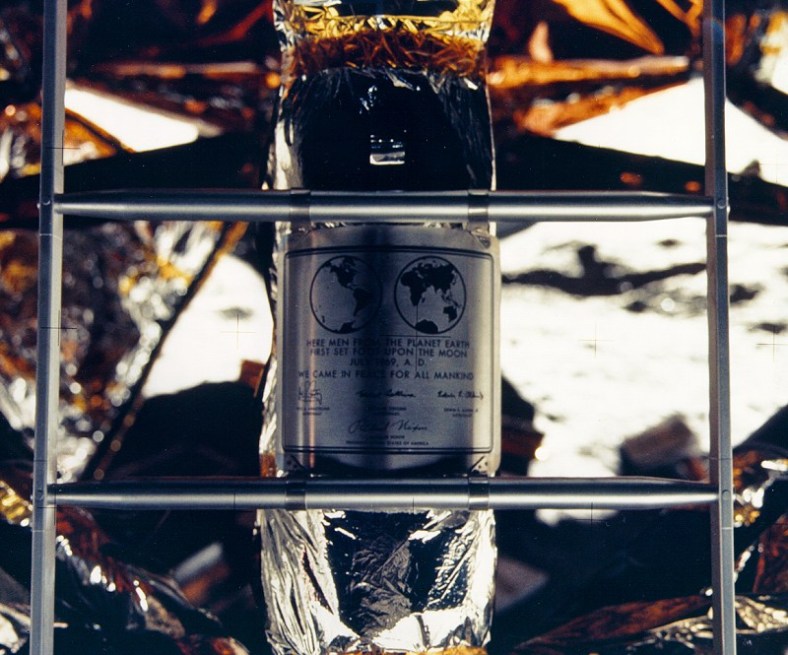
Photo credits: NASA plaque “Here men from the planet Earth first set foot upon the Moon July 1969, A.D. We came in peace for all mankind.”, The New York Times

The Friday Poem ‘The Way It Is’ by William Stafford

“There’s a thread you follow.” opens this week’s Friday Poem, ‘The Way It Is’, from poet, writer, and photographer William Stafford.

As a conscientious objector during the second World War, Stafford worked in civilian public service camps for the U.S. Forest Service in Arkansas and California. In 1948 he moved to Oregon to teach at Lewis and Clark College.

In 1963 he was selected to receive the National Book Award from a group of nominees including William Carlos Williams and Robert Frost. He served as Consultant in Poetry to the Library of Congress in 1970, a position that today carries the title of Poet Laureate.

In addition to his 65 volumes of poetry and prose, he left a collection of 16,000 photographic negatives to the archive at Lewis and Clark College. In a 2014 interview for Oregon Public Broadcasting, his son, Kim Stafford commented on his father’s discomfort with the spotlight. “When he became famous, the camera allowed him to leave the center of the circle and document the other writers.”

His lifetime spanned decades of dramatic change, and yet he stayed true to his values. His accomplishments and awards did not distract. “…You don’t ever let go of the thread”.

The Way It Is

There’s a thread you follow. It goes among
things that change. But it doesn’t change.
People wonder about what you are pursuing.
You have to explain about the thread.
But it is hard for others to see.
While you hold it you can’t get lost.
Tragedies happen; people get hurt
or die; and you suffer and get old.
Nothing you do can stop time’s unfolding.
You don’t ever let go of the thread.

William Stafford   ‘The Way It Is’   Graywolf Press, 1999

9781555972844

Photo credit: Kim Stafford

The Friday Poem ‘Remember’ by Joy Harjo

April is National Poetry Month and next Thursday, April 27 is ‘poem in your pocket day’. Download your favorite poem or one from the Academy of American poets site, carry it around with you for the day and share it with friends and colleagues.

The Friday Poem this week comes from the Academy’s selection, ‘Remember’ by Joy Harjo.

Remember

Remember the sky that you were born under,
know each of the star’s stories.
Remember the moon, know who she is.
Remember the sun’s birth at dawn, that is the
strongest point of time. Remember sundown
and the giving away to night.
Remember your birth, how your mother struggled
to give you form and breath. You are evidence of
her life, and her mother’s, and hers.
Remember your father. He is your life, also.
Remember the earth whose skin you are:
red earth, black earth, yellow earth, white earth
brown earth, we are earth.
Remember the plants, trees, animal life who all have their
tribes, their families, their histories, too. Talk to them,
listen to them. They are alive poems.
Remember the wind. Remember her voice. She knows the
origin of this universe.
Remember you are all people and all people
are you.
Remember you are this universe and this
universe is you.
Remember all is in motion, is growing, is you.
Remember language comes from this.
Remember the dance language is, that life is.
Remember.
9780393334210_198.jpg


The Friday Poem ‘Baseball’ by Gail Mazur

The Friday Poem this week is for those whose workplace is the ballpark. It’s the first week of April and the dream of a World Series Championship is possible for each of Major League Baseball’s thirty franchises and their fans.

Our ‘national pastime’ has often been used as a metaphor for life. Poet Gail Mazur shared her connection to the diamond with her poem ‘Baseball’.

“Well, of course, baseball, to the ardent fan, IS a metaphor and more. I couldn’t write that poem until I thought of denying baseball was a metaphor, then I could go all out. Everything about the game and the park seemed like metaphor. And a fan’s sense of loss—or exhilaration—no matter how intense, is more bearable than the real losses in our lives. But still, but still, one feels one lives and dies, as the saying goes, with one’s team! After the first line, I wrote it in a few minutes, one of those gifts”

Baseball
for John Limon

The game of baseball is not a metaphor
and I know it’s not really life.
The chalky green diamond, the lovely
dusty brown lanes I see from airplanes
multiplying around the cities
are only neat playing fields.
Their structure is not the frame
of history carved out of forest,
that is not what I see on my ascent.

And down in the stadium,
the veteran catcher guiding the young
pitcher through the innings, the line
of concentration between them,
that delicate filament is not
like the way you are helping me,
only it reminds me when I strain
for analogies, the way a rookie strains
for perfection, and the veteran,
in his wisdom, seems to promise it,
it glows from his upheld glove,

and the man in front of me
in the grandstand, drinking banana
daiquiris from a thermos,
continuing through a whole dinner
to the aromatic cigar even as our team
is shut out, nearly hitless, he is
not like the farmer that Auden speaks
of in Breughel’s Icarus,
or the four inevitable woman-hating
drunkards, yelling, hugging
each other and moving up and down
continuously for more beer

and the young wife trying to understand
what a full count could be
to please her husband happy in
his old dreams, or the little boy
in the Yankees cap already nodding
off to sleep against his father,
program and popcorn memories
sliding into the future,
and the old woman from Lincoln, Maine,
screaming at the Yankee slugger
with wounded knees to break his leg

this is not a microcosm,
not even a slice of life

and the terrible slumps,
when the greatest hitter mysteriously
goes hitless for weeks, or
the pitcher’s stuff is all junk
who threw like a magician all last month,
or the days when our guys look
like Sennett cops, slipping, bumping
each other, then suddenly, the play
that wasn’t humanly possible, the Kid
we know isn’t ready for the big leagues,
leaps into the air to catch a ball
that should have gone downtown,
and coming off the field is hugged
and bottom-slapped by the sudden
sorcerers, the winning team

the question of what makes a man
slump when his form, his eye,
his power aren’t to blame, this isn’t
like the bad luck that hounds us,
and his frustration in the games
not like our deep rage
for disappointing ourselves

the ball park is an artifact,
manicured, safe, “scene in an Easter egg”,
and the order of the ball game,
the firm structure with the mystery
of accidents always contained,
not the wild field we wander in,
where I’m trying to recite the rules,
to repeat the statistics of the game,
and the wind keeps carrying my words away

Gail Mazur  ‘Zeppo’s First Wife: New and Selected Poems’ 1978

41SVK0y1lOL._SX359_BO1,204,203,200_

The Friday Poem: ‘Today’ by Billy Collins

Spring arrived earlier this week. Time to take a break from your week@work and venture out beyond the confines of your work space. Cited by the Guardian as one of the ten best about spring, The Friday Poem is ‘Today’ by former Poet Laureate of the United States, Billy Collins.

“There is a delightful playfulness here – a sense of being, in spring, a mini-God within the kingdom of one’s own front room.”

Today
If ever there were a spring day so perfect,
so uplifted by a warm intermittent breeze

that it made you want to throw
open all the windows in the house

and unlatch the door to the canary’s cage,
indeed, rip the little door from its jamb,

a day when the cool brick paths
and the garden bursting with peonies

seemed so etched in sunlight
that you felt like taking

a hammer to the glass paperweight
on the living room end table,

releasing the inhabitants
from their snow-covered cottage

so they could walk out,
holding hands and squinting

into this larger dome of blue and white,
well, today is just that kind of day.

Billy Collins  Poetry Magazine, April 2000

176-1.jpg

The Friday Poem ‘Happiness’ by Raymond Carver

Imagine a week@work when the barrage of beltway news is silenced. A workday morning that arrives, not with cable news, but a cup of coffee; taking in the view from the window as the neighborhood comes to life.

This was the scene imagined by the short story writer and poet, Raymond Carver.

The Friday Poem is ‘Happiness’.

Happiness

So early it’s still almost dark out.
I’m near the window with coffee,
and the usual early morning stuff
that passes for thought.
When I see the boy and his friend
walking up the road
to deliver the newspaper.
They wear caps and sweaters,
and one boy has a bag over his shoulder.
They are so happy
they aren’t saying anything, these boys.
I think if they could, they would take
each other’s arm.
It’s early in the morning,
and they are doing this thing together.
They come on, slowly.
The sky is taking on light,
though the moon still hangs pale over the water.
Such beauty that for a minute
death and ambition, even love,
doesn’t enter into this.
Happiness. It comes on
unexpectedly. And goes beyond, really,
any early morning talk about it.

Raymond Carver  Poetry Magazine February, 1985

145-5

The Friday Poem ‘The New Colossus’ by Emma Lazarus

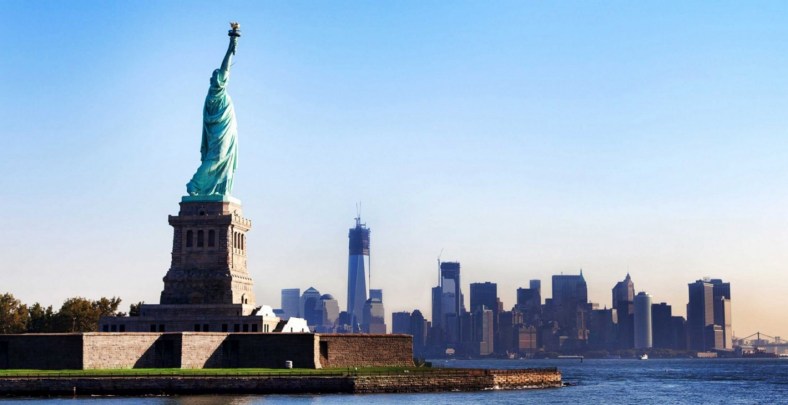
Most immigrants to the U.S. arrive by plane, bypassing the Statue of Liberty standing in New York harbor. Perhaps this detour has created a bit of amnesia regarding fundamental American values.

For the Friday poem this week, we travel back in time to 1883, when Emma Lazarus was asked to write a poem as part of fundraising effort to construct the pedestal for the statue.

Washington Post journalist Katie Mettler revisited Ms. Lazarus’ story on Wednesday, citing renewed interest in the sonnet in the aftermath of the executive order banning  U.S. entry to all Syrian refugees and citizens of seven Muslim countries

“What the poet didn’t know at the time — as a woman whose work as a “poetess” had been at times the subject of condescension — was that it would be her words, lyrical and poignant, that decades later came to define the American vision of liberty.

More than a century later, in 2017, the words are rallying people against a controversial president and his policies and attitudes toward immigrants.”

It’s time for these words to be posted at every point of entry to the U.S. to remind all of our core values.

The New Colossus 

Not like the brazen giant of Greek fame,
With conquering limbs astride from land to land;
Here at our sea-washed, sunset gates shall stand
A mighty woman with a torch, whose flame
Is the imprisoned lightning, and her name
Mother of Exiles. From her beacon-hand
Glows world-wide welcome; her mild eyes command
The air-bridged harbor that twin cities frame.
“Keep, ancient lands, your storied pomp!” cries she
With silent lips. “Give me your tired, your poor,
Your huddled masses yearning to breathe free,
The wretched refuse of your teeming shore.
Send these, the homeless, tempest-tost to me,
I lift my lamp beside the golden door!”

Emma Lazarus   ‘Emma Lazarus: Selected Poems and Other Writings’ (2002)

9781551112855-408x630.jpg


The Friday Poem ‘To The Indifferent Women’ by Charlotte Anna Perkins Gilman

On the eve of the ‘Women’s March’, the Friday Poem reprises ‘To The Indifferent Women’ by Charlotte Anna Perkins Gilman. I originally posted the poem in July after the first woman in U.S. history accepted her party’s nomination for president.

Sometimes things don’t work out as planned.

Tomorrow, in Washington D.C. and cities around the country, women will join together in a nation that could not ratify an equal rights amendment, or elect the first woman president, and remind those elected that women’s rights are human rights.

“In the spirit of democracy and honoring the champions of human rights, dignity, and justice who have come before us, we join in diversity to show our presence in numbers too great to ignore. The Women’s March on Washington will send a bold message to our new government on their first day in office, and to the world that women’s rights are human rights. We stand together, recognizing that defending the most marginalized among us is defending all of us.”

There is something going on here, as there was in 1911 when Ms. Perkins was writing for the cause of women’s rights.

One of the more stunning stories, in advance of the D.C. march, appears in today’s NY Times and profiles an unlikely activist contingent – ‘From Wall Street to National Mall: Women Overcome Fears to Attend March’.

“They are professionals in trading, public relations, marketing, deal-making, investing and the law. They keep punishing schedules, fear losing business by offending their clients and often feel that in an industry still overwhelmingly populated by men, the less attention drawn to their sex, the better.

But the inauguration of Mr. Trump has prompted a striking number of Wall Street women to overcome their worries about demonstrating in public.”

For those who will march and be questioned why, and for those still without weekend plans – a beautiful question from 1911.

“Do you believe the sorrow of the world
Does not concern you in your little homes?”

To The Indifferent Women

A Sestina

You who are happy in a thousand homes,
Or overworked therein, to a dumb peace;
Whose souls are wholly centered in the life
Of that small group you personally love;
Who told you that you need not know or care
About the sin and sorrow of the world?

Do you believe the sorrow of the world
Does not concern you in your little homes? —
That you are licensed to avoid the care
And toil for human progress, human peace,
And the enlargement of our power of love
Until it covers every field of life?

The one first duty of all human life
Is to promote the progress of the world
In righteousness, in wisdom, truth and love;
And you ignore it, hidden in your homes,
Content to keep them in uncertain peace,
Content to leave all else without your care.

Yet you are mothers! And a mother’s care
Is the first step toward friendly human life.
Life where all nations in untroubled peace
Unite to raise the standard of the world
And make the happiness we seek in homes
Spread everywhere in strong and fruitful love.

You are content to keep that mighty love
In its first steps forever; the crude care
Of animals for mate and young and homes,
Instead of pouring it abroad in life,
Its mighty current feeding all the world
Till every human child can grow in peace.

You cannot keep your small domestic peace
Your little pool of undeveloped love,
While the neglected, starved, unmothered world
Struggles and fights for lack of mother’s care,
And its tempestuous, bitter, broken life
Beats in upon you in your selfish homes.

We all may have our homes in joy and peace
When woman’s life, in its rich power of love
Is joined with man’s to care for all the world.

Charlotte Anna Perkins Gilman ‘Suffrage Songs and Voices’ 1911

41py0cnjwl-_sx331_bo1204203200_

Photo credit: Screen shot from Women’s March LA website


The Friday Poem ‘Introduction to Poetry’ by Billy Collins

When I first started ‘workthoughts’ almost two years ago, I wanted to include a weekly poem or lyric. A colleague had once shared her secret of success@work, “I start my day reading a poem”.

I believe we all become a bit more creative when we discover the world through a poet’s eyes. Why don’t more of us include poetry in our work lives?

Former U.S. Poet Laureate Billy Collins shared his opinion in an interview to Ben Yakas of gothamist.com.

“…the teaching of poetry is often brutally centered on interpretation. This gives teachers power because they kind of “know the answer.” And I think there’s a streak of sadism in it as well as they watch students get the wrong answer by guessing.”

In October, Mr. Collins published his 12th book of poetry, ‘The Rain in Portugal’. The Friday Poem this week is from his first collection, ‘The Apple That Astonished Paris’, and is for all of you whose early love of poetry was extinguished by an overzealous pursuit of analysis.

Introduction to Poetry 

I ask them to take a poem
and hold it up to the light
like a color slide

or press an ear against its hive.

I say drop a mouse into a poem
and watch him probe his way out,

or walk inside the poem’s room
and feel the walls for a light switch.

I want them to waterski
across the surface of a poem
waving at the author’s name on the shore.

But all they want to do
is tie the poem to a chair with rope
and torture a confession out of it.

They begin beating it with a hose
to find out what it really means.

Billy Collins from ‘The Apple That Astonished Paris’ 1988

collins.png

The Friday Poem ‘Voice’ by Jeffrey Brown


Walking west on 40th Street, between 7th & 8th, you pass the entrance to the CCNY Graduate School of Journalism. In the space of a city block, those aspiring to pursue a career reporting the news, cross paths with the the best in the field @work in The New York Times building.

There was a time when the most trusted man in America was a television journalist. Today, journalists across the globe find themselves at risk when reporting the truth. ‘Fake news’ sites proliferate where fiction replaces fact.

Lost in the cacophony of the latest news cycle is the value professional journalists provide in our society; collecting and communicating information that empowers the rest of us to make the best decisions.

This week, The Friday Poem is for those who follow their dream to newsrooms around the corner, and around the world. ‘Voice’ was written by NPR journalist and poet, Jeffrey Brown.

Voice

for Robert MacNeil and Jim Lehrer

There are those with a voice so rich,

so bell-strong, time chiseled, and alive

they can read the phone book and

you will hear the deeds and failings

in every name, the laughter and wailing

of ghosts who inhabit each address,

the infinite possibility


in every number. There are those

with a voice that rich, he says –

the lucky ones. But that is not us.

We open our mouths and out comes a

small, high sound, cracking midsentence,

straining to tell the story we know

to be true. There are things you can do:


Learn to breathe. Stand up straight and

let the air flow through you, belly to

chest and into the mask of your face.

Take a bit of chocolate, sip on your

coffee – excite the senses. Imagine

the people in their hoes hungry for

dinner and for news of the world.


Underline phrases, emphasize what

should be emphasized, diminish

the less important. Decide what is

important. Be sure you understand

the meaning of what you are to say.

Do not yell, do not whisper, look ahead,

not down, fill your lungs, open your mouth


and speak. The Zen master says “You

find your voice when you find yourself.”

But that, too, is not for us. (Who knows

What else you’ll find there? he laughs).

Better to listen to that voice

as though from afar, as though it

is not yours. Then speak again.

Jeffrey Brown from ‘The News:Poems’ 2015

51snA65oWyL._AC_US320_QL65_.jpg