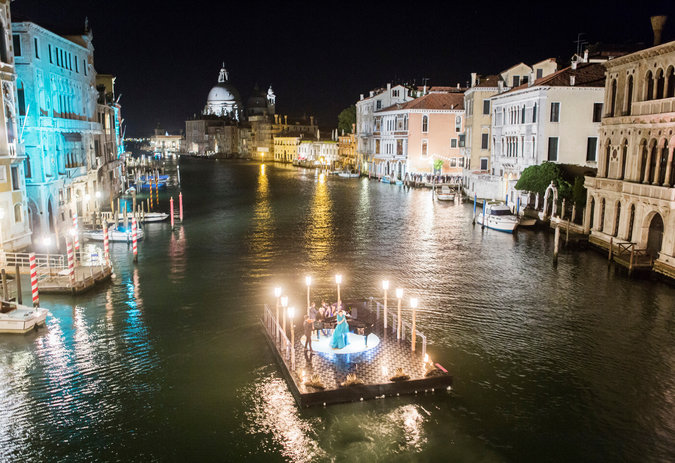
This week@work was hot, with a meteorological ‘heat dome’ encasing most of the continental United States. When I saw the photo above in The New York Times on Wednesday, I just wanted to be transported to a barge in Venice where the cast of Amazon’s ‘Mozart in the Jungle’ were filming. (Enjoy the view from Gianni Cipriano for The New York Times)
In other stories this week, the Republican Party chose their candidate for president and initiated a valuable conversation about plagiarism. The ‘Pokemon Go’ app provided a much needed diversion as thousands engaged in this new high tech sport of creature collection. Vindu Goel took a stroll down memory lane to a time when Yahoo reigned over Silicon Valley. Life/work coaches are the new workplace perk, and classical musicians are returning to the small screen.

No that is not a photo of Zeus expressing displeasure with politicians in Cleveland. It’s Port Washington, Wisconsin photographed by AP photographer Jeffrey Phelps.
Rebecca Herscher reported on the weather for NPR.
“A heat dome occurs when high pressure in the upper atmosphere acts as a lid, preventing hot air from escaping. The air is forced to sink back to the surface, warming even further on the way. This phenomenon will result in dangerously hot temperatures that will envelop the nation throughout the week.”
NASA reported on Tuesday that ‘2016 Climate Trends Continue to Break Records’.
“Each of the first six months of 2016 set a record as the warmest respective month globally in the modern temperature record, which dates to 1880, according to scientists at NASA’s Goddard Institute for Space Studies (GISS) in New York. The six-month period from January to June was also the planet’s warmest half-year on record, with an average temperature 1.3 degrees Celsius (2.4 degrees Fahrenheit) warmer than the late nineteenth century.”
We are hot. We are busy. We live in a time of ‘short-cuts’. Workplace deadlines force creativity into ‘cut and paste’ document creation. Original thought becomes a casualty of increased workload. Sometimes we forget to give credit to other’s ideas and find ourselves on the slippery slope of plagiarism.
Last week the Republican National Convention became the unexpected catalyst for a discussion of this topic, an essential component of every college new student orientation program.
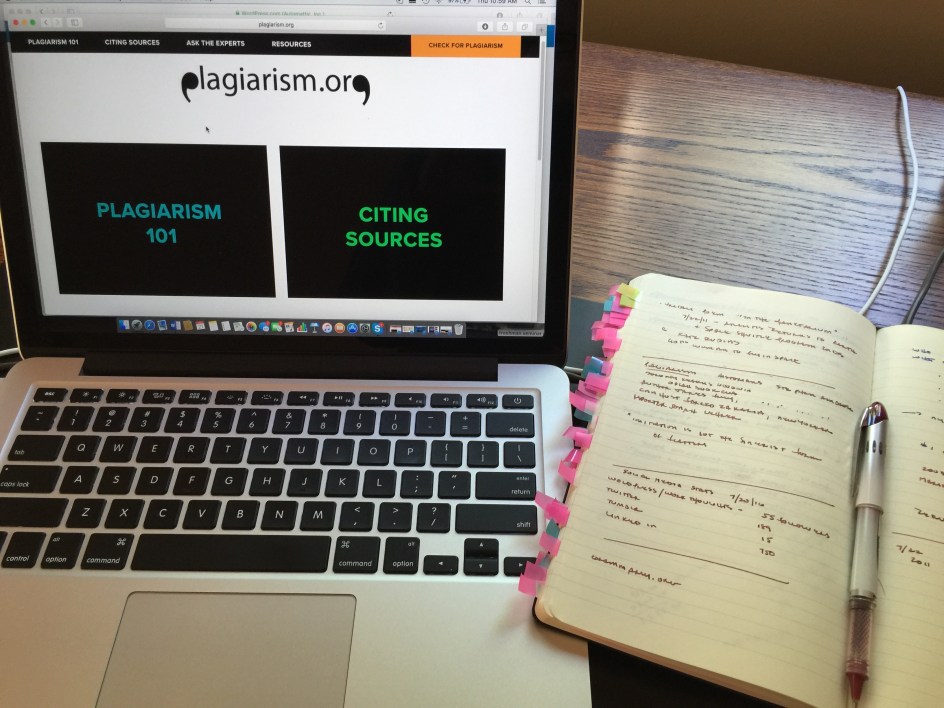
Writing on huffingtonpost.com, Karen Topham offered ‘An English Teacher’s View Of The Trump Plagiarism Issue’.
“Plagiarism is any unattributed content. It’s kind of like pregnancy: you can’t plagiarize just a little because even a little is plagiarism.
I had my last case of plagiarism late last winter. A girl was under the gun and copied an essay from the internet. I explained to her (as I’d done so often before) that she was probably lucky in the long run that I had caught her. Anyone who gets away with this stuff is likely to try it again. In high school, it’s a zero and maybe a chance to do it over. But in most colleges, it’s a violation of academic honesty that can get you expelled. And this is my point: we hold college students to this very high standard.”
You have been warned.
On the lighter side, David Streitfeld gave a first person account of ‘Chasing Pokemon In Search of Reality In a Game’: downloading the app, setting out to capture a few creatures, and meeting fellow gamers along the way.

“In this season of random assassinations and political uproar, who could resist the temptation to supplement a high-strung and frightening reality with some gentle make-believe?
Fifty years ago, the F.B.I., worried that the youth of America might foment revolution, would infiltrate San Francisco demonstrations. Now the tech companies are doing the monitoring, wondering if games like Pokémon represent a threat that must be neutralized or an opportunity to be exploited. That’s progress for you.”
In other Silicon Valley News, Wall Street Journal reporters Ryan Knutson and Deepa Seetharaman confirmed the Verizon acquisition of Yahoo.

“Verizon Communications Inc. has agreed to pay $4.8 billion to acquire Yahoo Inc., according to a person familiar with the matter, ending a drawn-out auction process for the beleaguered internet company.
The price tag, which includes Yahoo’s core internet business and some real estate, is a remarkable fall for the Silicon Valley web pioneer that once had a market capitalization of more than $125 billion at the height of the dot-com boom.
For New York-based Verizon, the deal simply adds another piece to the digital media and advertising business it is trying to build.
The deal is expected to be announced early Monday. The news was earlier reported by Recode and Bloomberg.”
In an article earlier in the week, Vindu Goel revisited a time ‘When Yahoo Ruled the Valley’.
“Back in the mid-1990s, before Google even existed, the world’s best guides to the internet sat in Silicon Valley cubicles, visiting websites and carefully categorizing them by hand.
They were called surfers, and they were a collection of mostly 20-somethings — including a yoga lover, an ex-banker, a divinity student, a recent college grad from Ohio hungry for adventure — all hired by a start-up called Yahoo to build a directory of the world’s most interesting websites.
Today, with more than one billion websites across the globe, the very notion seems mad. Even then, there was a hint of insanity about the enterprise.”
Two additional articles of interest from the week@work cover a new benefit for employees transitioning back to work after a leave and a TV series providing classical music performers with visibility not seen since the days of Ed Sullivan.
‘A New Perk For Parents: Life-Work Coaches’ by Tara Siegel Bernard
“At a time when new parents may find themselves overwhelmed — even sobbing late at night as they deal with their new at-home responsibilities while trying to hold down a full-time job — a growing number of companies are making efforts to soften the blow. They are providing employees with coaching sessions, either in person, over the phone or through small group sessions that may be broadcast over the web. The services are often available to new fathers, too.”
‘Classical Stars Seek TV’s Elusive Spotlight’ by Michael Cooper
“It was after midnight on the Grand Canal here, and Plácido Domingo was standing on a floating stage slowly motoring toward the Accademia Bridge, singing the opening lines of a duet from “Don Giovanni.”
With this operatically over-the-top spectacle last week — which drew squeals and flurries of smartphone photos as people passed on a vaporetto, or water bus — Mr. Domingo became the latest classical star to shoot a cameo for “Mozart in the Jungle,” the Amazon comedy about a fictional New York orchestra.
Paul Weitz, who was directing the episode with Mr. Domingo and is an executive producer of the show with Roman Coppola and Mr. Schwartzman, said that the possibility of reaching those viewers was especially enticing to the musicians who have appeared.
“Obviously, it’s a huge issue, and it’s something that is dealt with in the show a lot, about whether classical music is going to be passed on to a new generation,” Mr. Weitz said between shots in his director’s chair. “And all these artists, the reasons that they’re doing this show is because they feel like it’s good for that aspect of the art — that it can bring the music to different people. And anecdotally, I think that’s actually the case.”
Stay cool this week@work with a favorite piece of classical music.



 workthoughts