The ‘gig economy’ and ‘the new romantics’

The ground is shifting the foundations of our world@work. New economic models are emerging of mosaic careers where freelancing is the predominant driver of income. In order to flourish workers will have to reimagine their life@work and add skills previously delivered through full time employers. This is the conversation that should be taking place in corporate boardrooms, university classrooms, state legislatures and presidential debates.

Don’t believe me? How did you get to work? Uber? Where did you stay on vacation? Airbnb?

The initial repercussions of the new world@work are being felt in the halls of justice as folks try to fit old definitions of work and workers into new, entrepreneurial business models.

Sarah Kessler writing for Fast Company summarized the dilemma.

“What’s at stake with these lawsuits and protests? The very definition of “employee” in a tech-enabled, service-driven 21st century American economy. Gig economy companies do not own cars, hotels, or even their workers’ cleaning supplies. What they own is a marketplace with two sides. On one side are people who need a job done—a ride to the airport, a clean house, a lunchtime delivery. On the other are people who are willing to do that job. If Uber and other companies are going to be as big as some claim, a new deal has to be brokered, one that squares the legal rules governing work with new products and services. What benefits can you expect from a quasi-employer? What does it mean to be both independent and tethered to an app-based company? The social contract between gig economy workers and employers is broken. Who will fix it, and how, will determine the fate of thousands of workers and hundreds of millions of dollars.”

James Surowiecki writing in The New Yorker described just how difficult it is to define the difference between an employee and an independent contractor.

“We hear a lot these days about the gig economy, but the issue of whether a worker is an employee or an independent contractor has been the subject of intense legal battles for decades. The distinction can be surprisingly hard to make. The I.R.S. has a list of twenty factors that it takes into account, but other federal agencies have different criteria, as do most states. The fundamental issue is usually whether an employer has “control” over the work being done, but defining control isn’t always easy.”

This is where it begins in the U.S., in the court system. Meanwhile, entrepreneurs will continue to connect clients with products and hire workers who will supplement their income performing a variety of part-time professional services. Eventually the laws will catch up with the workplace reality. But in the interim, universities have to decipher the emerging skill set and prepare the next generation of workers for success.

Joseph Aoun, President of Northeastern University in Boston conducted an informal survey of the university community, tweeting the question, “What skills will graduates need for success in the gig economy?”

“…we can see five skills that will be invaluable for thriving in the gig economy:

Generativity: How to create something unique, be it a product, a service, or an idea. E.g., coming up with the idea for a widget.

Entrepreneurship: How to spot an opportunity and act on it effectively. Discovering a market for widgets.

Originality: How to view an existing subject through an unexpected lens. Realizing that the widget can be made more sustainably from recycled water bottles.

Interdisciplinary thought: How to bridge concepts from different fields to form new ideas. Combining engineering and design so that the widget is not only functional, but beautiful.

Dealing with ambiguity: How to confidently address a problem with no clear solution, often by using a blend of experience, intuition, and grasp of human nature. Faced with plunging stock prices, reinventing the company as a widget-sharing app.”

The ‘new gig workers’ will also need a basic understanding of business law and finance. Arun Sundararajan writing in The Guardian assesses the micro and macro implications of the new model.

“There’s certainly something empowering about being your own boss. With the right mindset, you can achieve a better work-life balance. But there’s also something empowering about a steady pay cheque, fixed work hours and company-provided benefits. It’s harder to plan your life longer term when you don’t know how much money you’re going to be making next year.”

In many countries, key slices of the social safety net are tied to full-time employment with a company or the government. Although the broader socioeconomic effects of the gig economy are as yet unclear, it is clear we must rethink the provision of our safety net, decoupling it from salaried jobs and making it more readily available to independent workers.”

Fundamentally, the new ‘gig worker’ will focus on human interaction vs. transactional activities. We are back to the core curriculum of a liberal arts education. The lawyers, politicians and business folk will figure out the structure and protections. The humanists will find job security in the ‘gig economy’.

David Brooks writing in The New York Times imagines the new world@work.

“What are the activities that we humans, driven by our deepest nature or by the realities of daily life, will simply insist be performed by other humans?”

“Secure workers will combine technical knowledge with social awareness — the sort of thing you get from your genes, from growing up in a certain sort of family and by widening your repertoire of emotions through reflection, literature and a capacity for intimacy.”

“I could imagine a time when young thinkers discard the strictures of the academic professionalism and try to revive the model of the intellectual as secular sage. I could see other young people tiring of résumé-building do-goodism and trying to live more radically for the poor. The romantic tries as much as possible to ground his or her life in purer love that transforms — making him or her more inspired, creative and dedicated, and therefore better able to live as a modern instantiation of some ideal.”

Gig learning is lifelong learning. We will need leaders in both education and business who will welcome the feedback of their constituencies and be nimble in their response to a world@work that is driven by human interaction in the relational and supported by technology in the transactional.

The week@work – The time we spend @work, unpaid interns@the UN, no union for college football and the value of one good friend

Sarah Boseley reported on Wednesday on the health risks of working long hours for The Guardian newspaper in the UK.

“The largest study conducted on the issue, carried out in three continents and led by scientists at University College London, found that those who work more than 55 hours a week have a 33% increased risk of stroke compared with those who work a 35- to 40-hour week. They also have a 13% increased risk of coronary heart disease.

The findings will confirm the assumptions of many that a long-hours culture, in which people work from early in the morning until well into the evening, with work also intruding into weekends, is potentially harmful to health.”

During a discussion of these findings on CBS This Morning, co-anchor Charlie Rose turned the conversation to a discussion of how we define work.

“For some people reading a lot is play and pleasure. For others it’s work. It’s part of what they do and how they spend their time. It’s one thing to be on an assembly line, I think, and another thing to be reading a novel in preparation to interview someone. 

Where do we draw the line? Is there a line? That is the topic of the next article this week@work.

The New Yorker writer, Tim Wu thinks ‘You Really Don’t Need To Work So Much’. He questions why we have allowed ourselves to become players in “a football game where the whistle is never blown”. His solution, work should fulfill society’s needs with minimal effort. Let the workaholics have their fun, but not at the expense of the rest of us.

“The past fifty years have seen massive gains in productivity, the invention of countless labor-saving devices, and the mass entry of women into the formal workforce. If we assume that there is, to a certain degree, a fixed amount of work necessary for society to function, how can we at once be more productive, have more workers, and yet still be working more hours? Something else must be going on.”

“…in white-collar jobs, the amount of work can expand infinitely through the generation of false necessities—that is, reasons for driving people as hard as possible that have nothing to do with real social or economic needs.”

“The antidote is simple to prescribe but hard to achieve: it is a return to the goal of efficiency in work—fulfilling whatever needs we have, as a society, with the minimal effort required, while leaving the option of more work as a hobby for those who happen to love it.”

Does society need more unpaid interns? Apparently the United Nations thinks so and has grown their ‘volunteer workforce’ from 131 in 1996 to over 4,000 worldwide this year. ‘The Economist Explains why the UN doesn’t pay it’s interns’.

“The story of an unpaid intern living in a tent in Geneva did not make the United Nations look good. David Hyde, a fresh-faced 22-year-old from New Zealand, said he set up camp on the banks of Lake Geneva because he could not afford the Swiss city’s exorbitant rents while working for free. The news stirred up public outrage as well as sympathy from Mr Hyde’s colleagues: scores of UN interns in Geneva walked off the job on August 14th to protest against his plight. That same day a cluster of “interns’ rights” groups penned an open letter to the UN’s secretary-general, Ban Ki-moon, pointing out that the practice of not paying interns sits awkwardly with Article 23 of the organisation’s own Universal Declaration of Human Rights (“Everyone who works has the right to just and favourable remuneration ensuring for himself and his family an existence worthy of human dignity”). So why doesn’t the UN pay its interns?”

“They fear that paid internships may become a back door for recruitment and increase competition for coveted low-level “professional” positions.”

Excuse me, isn’t that why you do an internship? Isn’t this the apprenticeship that may one day lead to a full time job?

And while we are on the subject, let’s turn our attention to another group of unpaid collegians in the news this week, college football players. On Monday the U.S. National Labor Relations Board dismissed a petition from Northwestern University football players to form a union.

Ben Strauss reported on the board’s rationale in The New York Times:

“The board did not rule directly on the central question in the case — whether the players, who spend long hours on football and help generate millions of dollars for Northwestern, are university employees. Instead, it found that the novelty of the petition and its potentially wide-ranging impacts on college sports would not have promoted “stability in labor relations.”

Citing competitive balance and the potential impact on N.C.A.A. rules, the board made it clear that it harbored many reservations about the ramifications of granting college athletes, much less a single team, collective bargaining rights.”

For some college football players, their teammates are their best friends. And it may explain why many are so resilient.

Melissa Dahl described recent research in the UK for New York Magazine, ‘Having Just One Good Friend Strengthens Kids’ Resilience’.

“Let’s take a moment to praise the wonders of the true-blue best friendship, an especially powerful thing during the teenage years. A new study, published earlier this summer in the British Journal of Psychology, looked at this idea specifically among kids from low-income neighborhoods, and found that kids with just one solid, supportive friendship also tended to show signs of greater resilience when facing adversity than the kids with lower-quality friendships.

In their analysis, the researchers found an association between higher-quality friendships and greater resilience, likely, they theorize, because of the emotional support and the sounding board a real best friend provides.”

Here are a few more articles from the week@work that you may have missed.

The Future of Work and Workers – The Pacific Standard began a series this week exploring “What worries you most—and/or excites you most—about the future of work and workers? Put another way: What will be the most consequential changes in the world of work and workers, and what anxieties and possibilities will they produce?”

What the First Female Rangers ProveElizabeth Samet for Bloomberg View “Access to Ranger School, and combat units, is really about access to leadership opportunities. Of the 12 four-star Army generals currently on active duty, all are men. Eleven began their careers in the infantry or armor branch. Ten wear the Ranger tab. In other words, if you want a chance of running the Army, you would do well to go to Ranger School.”

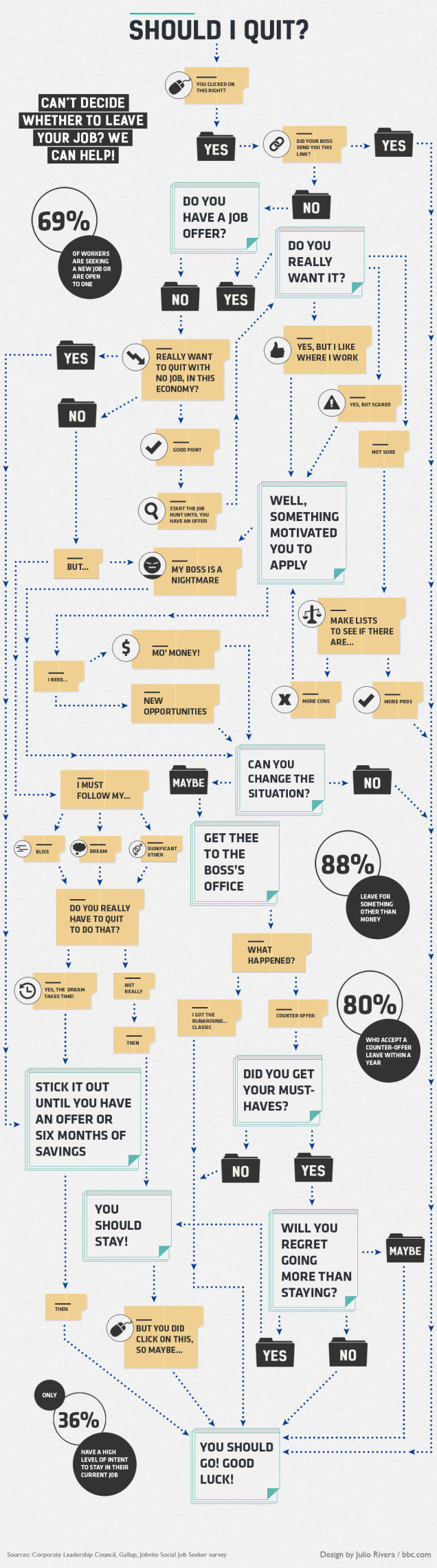
To Quit Or Not To Quit? This Flowchart Tells If It’s Time George Mortimer for Lifehack “Changing jobs or careers is something many people think about, but never seriously consider until it’s too late to change. The use of this flowchart makes it easier for you to determine if your current job satisfies your lifestyle. In basic terms, if your job isn’t making your life better you’re probably better off finding a new one.”

1372360723813364326

Fear of public speaking is #1

Tonight the cast of the musical ‘Hamilton’ will officially ‘open’ on Broadway and ten Republican candidates competing for the U.S. presidency will debate on a stage in Cleveland, Ohio. Across the globe thousands of professionals in their respective fields will stand in front of an audience and present their expertise. What do all these folks have in common? Stagefright.

Joan Acocella, the dance critic for The New Yorker magazine wrote about stagefight in this week’s issue.

“Stagefright has not been heavily studied, which is strange because, as Solovitch tells us, it is common not only among those who make their living on the stage but among the rest of us, too. In 2012, two researchers at the University of Nebraska-Omaha, Karen Dwyer and Marlina Davidson, administered a survey to eight hundred and fifteen college students, asking them to select their three greatest fears from a list that included, among other things, heights, flying, financial problems, deep water, death, and “speaking before a group.” Speaking before a group beat out all the others, even death.”

Comedian Jerry Seinfeld‘s joke about public speaking echoes the research.

“According to most studies, people’s number one fear is public speaking. Number two is death. Death is number two. Does that sound right? This means to the average person, if you go to a funeral, you’re better off in the casket than doing the eulogy.”

There are famous examples which Ms. Acocella cites in her article.

“…Barbra Streisand, singing in front of more than a hundred thousand people in Central Park, one night in 1967, repeatedly forgot her lyrics. For twenty-seven years thereafter, she refused to perform live except at charity concerts.”

“Two years ago, before undertaking a one-woman show on Broadway, Bette Midler told Patrick Healy, of the Times, that she had wanted to be a serious dramatic actress but had faltered for lack of courage. “I have that terror,” she said. “Will people like you? Will they ask you back? Did I make the cut? That’s always on my mind.” To hear the brash, funny, commanding (as far as we knew) Midler tell of worrying whether people would like her is painful. But, in every group of artists, the insiders can tell you who, among them, should have had a bigger career but, for some reason, was held back.”

For most of us, our career depends on our ability to convey our ideas credibly in a variety of public venues. It’s great to know we have something in common with Barbara Streisand and Bette Midler, but what we don’t have is an alternative to make a living.

How do you transform the fear into confidence?

Before you step up to a podium, stand in front of your local school board, or pitch an idea to a potential investor, do your research. If you know what you’re talking about, you are halfway there.

One technique that has always worked for me is to come up with three things I want people to remember when they leave the room. Structure your presentation to start with these three things, elaborate on each one and summarize the three at the end.

Avoid too many visuals. If they don’t complement your points, you create a distraction.

Rehearse, but don’t practice you personality out of your pitch. Your audience is there for you and your expertise.

Seek out opportunities to present. Public speaking is a talent that requires nurturing. Your comfort level and confidence will increase in proportion to the frequency of your speeches.

None of these suggestions eliminate the initial terror of being in the spotlight in front of strangers. Just remind yourself why you are there and what you want to accomplish before you leave the stage.

Ms. Acocella found that the fear is not always viewed as a negative.  “Sometimes, when performers speak of stagefright, one senses that they do not actually wish it gone—that, for them, it is almost a badge of honor, or, at least, proof that they’re serious about their work.”

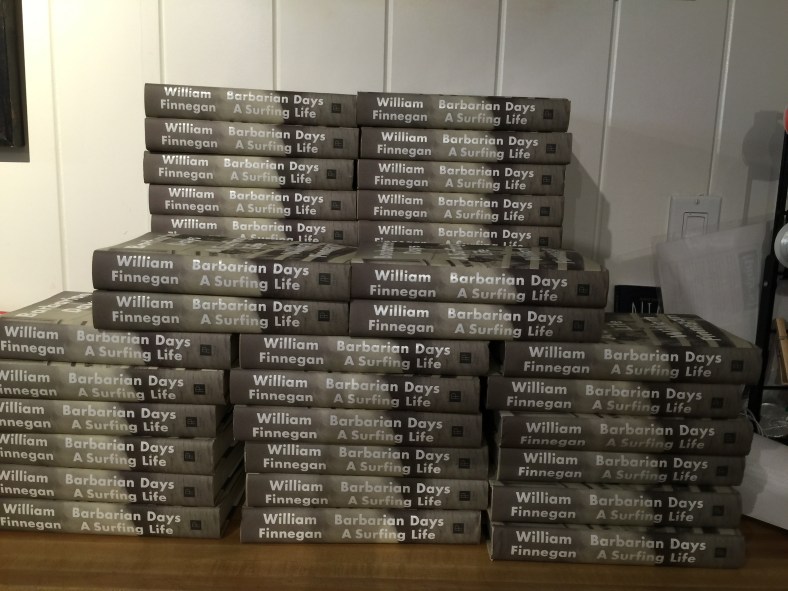
The Saturday Read – William Finnegan ‘Barbarian Days, A Surfing Life’

When you do a book reading in Manhattan Beach, California you need to use a microphone so the guys with ‘surfer’s ear’ in the back can understand you. Last night New Yorker journalist and lifetime surfer William Finnegan used a mic as he read from his well reviewed new book and this week’s ‘Saturday Read’, ‘Barbarian Days, A Surfing Life’.

The Q&A at the reading was closer to a book club discussion than a publicity event. Most of those attending had either read the book or the excerpt in the June 1 issue of the New Yorker magazine. This is not just a book about surfing. Mr. Finnegan is a well regarded journalist with a resume that includes reporting from South Africa, Somalia, the Balkans, Central America and Australia. Robert Boynton included him in his conversations with America’s best nonfiction writers in ‘The New New Journalism’.

“A self-described “specialist in the unexpected,” Finnegan writes stereotype-defying descriptions of the kinds of people—young, black, poor, foreign—mainstream journalism tends to dismiss with a pastiche of clichés and statistics.”

It’s this specialization in the unexpected that results in a memoir not just about surfing for surfers, but about life and friendship, as noted in The New York Times review:

“…a particularly remarkable feature of “Barbarian Days” is the generous yet unsparing portraits of competitive surf friendships that make up a major share of the narrative. As Finnegan writes: “Surfing is a secret garden, not easily entered. My memory of learning a spot, of coming to know and understand a wave, is usually inseparable from the friend with whom I tried to climb its walls.”

He first wrote about surfing in ‘Playing Doc’s Games’, profiling Mark Renneker for The New Yorker in 1992. Twenty three years later Doc returns along with a global cast of supporting characters inviting the reader to go out with them on the water.

Why should a non-surfer invest in a memoir subtitled ‘A Surfing Life’? Because it’s an everyman’s story of reconciling passions.

At the reading the author described surfing as “the North Pole of irresponsibility, the opposite of achievement. War reporting had a built in urgency, surfing did not.” He has spent 50 years managing the opposition between two drives: writing and chasing waves.

Surfers are our environmental ‘canaries in a coal mine’. Responding to a question on how surfing differs from other sports, the author focused on the “98% of surfing that is an absorption in the ocean, what your local spot is, how well you read the waves and ride. Surfing is not competitive, it’s an experience of beauty – an understanding and engagement with nature.”

Near the end of the book he refers to an A.J. Liebling essay, ‘Apology for Breathing’ noting that “Liebling was pretending to apologize for being from New York, a city he loved lavishly and precisely. Now I’m one of those New Yorkers incessantly on the point of going back where I came from. But with me it’s not a matter of packing up or staying on, but rather of being always half poised to flee my desk and ditch engagements in order to throw myself into some nearby patch of ocean at the moment when the waves and wind and tide might conspire to produce something ridable. That cracking, fugitive patch is where I come from.”

‘Barbarian Days’ is a beach book. It’s an ocean book. It’s a memoir to guide you to your own story and “that cracking, fugitive patch” where you come from.

The week@work – Holacracy@Zappos, Exploring Pluto, Earthquakes in Seattle and Every Job in America on a Map

This week@work Harvard Ph.D. student Robert Manduca shared his visual representation of every job on a map of the United States. Three of the locations plotted were sites of interesting stories about work this week: Las Vegas and Zappos‘ experiment with ‘holacracy’, Laurel, Maryland home to the Pluto exploring ‘New Horizons’ team and Seattle…well more about that later.

Thanks to the research of Robert Manduca, we can now see concentrations of economic sectors across the U.S. Writing in the Washington Post, ‘Wonkblog’ author Emily Badger cited the significance of his work:

“Among all the things that distinguish American cities from one another — their architecture, their demographics, their history and their terrain — their economies vary widely, too. Washington is, of course, a city of government work. Charlotte is a banking hub, Manhattan a financial center, Boston an education mecca. Metropolitan Cleveland remains relatively industrial, while Las Vegas runs on tourism.

These differences form economic identities that shape each city as much as their culture and geography do.”

Where we choose to work, geographically, can have a significant impact on our success. Cultures of organizations fit within the larger communities where they are located. When considering career advancement it’s important to examine the size of a particular sector within the local economy. Will the geography lend itself to a variety of opportunities when you decide to move on?

Maybe even more important is your social life outside of work. The folks that make up your community will in some ways reflect the values of the places they go to work each day. If you really didn’t like your classmates in that ‘Intro to Finance’ class, you may want to think twice about living and working where these same folks are now grown-ups working in investment banking.

Las Vegas is one place you might consider if you were interested in the hospitality industry. It’s also the home to online retailer Zappos.com.

In his article, ‘At Zappos, Pushing Shoes and a Vision’ NY Times reporter David Gelles chronicles the experiment in ‘holacracy’ or self management which began in 2013. Tony Hsieh has run Zappos for 16 years. He has been viewed as a visionary by many and realized change was needed to sustain the corporate culture he built.

“The goal of Holacracy is to create a dynamic workplace where everyone has a voice and bureaucracy doesn’t stifle innovation.

At Zappos, this means traditional corporate hierarchy is gone. Managers no longer exist. The company’s 1,500 employees define their own jobs. Anyone can set the agenda for a meeting. To prevent anarchy, processes are strictly enforced.

At Zappos, Mr. Hsieh seems to regard Holacracy as a way to revive the close-knit community feeling that made the company so special 10 years ago, when it was just a few hundred people taking on the giants of e-commerce. “Once you have that level of friendship, there’s higher levels of trust,” he said. “Communication is better; you can send emails without fear of being misinterpreted; people do favors for one another.”

If only it were so simple. Holacracy has been met with everything from cautious embrace to outright revulsion at Zappos, but little unequivocal enthusiasm.”

Another point on the map is Laurel, Maryland home to the ‘New Horizons’ team that piloted a piano sized spacecraft to Pluto and beyond. The workplace story here is the dedication of a team to a long term goal, the implementation of a ‘longevity plan’ to ensure program success over nine years and the joy of scientific discovery way outside the box.

It’s that shear joy that was expressed by New Horizons scientist Carey Lysse in an NBC interview:

“I love to explore. It’s one of the reasons I’m a scientist. This is one of those red letter days that doesn’t happen every day and so I’ll remember it for the rest of my life. It’s incredible.”

And now about Seattle. If you are thinking of relocating you may want to read Kathryn Shultz’s  New Yorker Magazine article, ‘The Really Big One’.

“Most people in the United States know just one fault line by name: the San Andreas, which runs nearly the length of California and is perpetually rumored to be on the verge of unleashing “the big one.” That rumor is misleading, no matter what the San Andreas ever does. Every fault line has an upper limit to its potency, determined by its length and width, and by how far it can slip. For the San Andreas, one of the most extensively studied and best understood fault lines in the world, that upper limit is roughly an 8.2—a powerful earthquake, but, because the Richter scale is logarithmic, only six per cent as strong as the 2011 event in Japan.

Just north of the San Andreas, however, lies another fault line. Known as the Cascadia subduction zone, it runs for seven hundred miles off the coast of the Pacific Northwest, beginning near Cape Mendocino, California, continuing along Oregon and Washington, and terminating around Vancouver Island, Canada. The “Cascadia” part of its name comes from the Cascade Range, a chain of volcanic mountains that follow the same course a hundred or so miles inland. The “subduction zone” part refers to a region of the planet where one tectonic plate is sliding underneath (subducting) another. Tectonic plates are those slabs of mantle and crust that, in their epochs-long drift, rearrange the earth’s continents and oceans. Most of the time, their movement is slow, harmless, and all but undetectable. Occasionally, at the borders where they meet, it is not.”

The week@work – Apple’s diversity problem, top cities for worker satisfaction, college is not a commodity and AstroSamantha returns to earth

This week@work we welcomed astronaut, Sam Cristoforetti, back to the home planet, and female senior executives at Apple to the Worldwide Developers Conference stage. A former Ivy League president reminded us that college is not a commodity and we learned where we should be living to have the best opportunity for job satisfaction.

Sam Cristoforetti, aka AstroSamantha, returned to earth and the steppes of Kazakhstan on Thursday. Her fan base grew to  558.1K followers on Twitter during her 199 days in space. Now that she has returned, we will miss her end of day wishes: “Buona notte dallo spazio.” Welcome home, Captain Cristoforetti.

The LA Times covered the Apple Worldwide Developers Conference, taking note of the participation of senior, female executives:

“Apple Music, new operating systems and a smarter Siri were front and center at Apple Inc.’s Worldwide Developers Conference, but it wasn’t a new product that got people talking — it was women.

During Monday’s keynote presentation, Jennifer Bailey, Apple’s vice president of Internet services, and Susan Prescott, vice president of product marketing, took the stage to announce new developments with Apple Pay and a news reading app. It was the first time that Apple has had female executives on stage at any of its major events since at least the launch of the first iPhone in 2007.”

In an interview with Mashable prior to the meeting, Apple CEO, Tim Cook shared responsibility for the lack of diversity in Silicon Valley:

“Cook doesn’t subscribe to the idea that women just don’t want to be involved in tech — calling that argument a “cop-out.”

“I think it’s our fault — ‘our’ meaning the whole tech community,” he says. “I think in general we haven’t done enough to reach out and show young women that it’s cool to do it and how much fun it can be.”

If you are interested in working for Apple, the good news is San Francisco is at the top of ‘Forbes Top Cities for Employee Satisfaction’.

Topping the list is San Francisco, where a largely tech-focused workforce finds the deepest levels of satisfaction with their work. In fact, several California cities can claim deeply engaged workforces, as San Jose and San Diego round out the top three spots on this ranking.

Many smaller cities fare well for employee satisfaction as well. Salt Lake City, Austin, Raleigh-Durham, and Oklahoma City all make the cut. Major east coast mainstays Boston and Washington, D.C. have satisfied workforces as well, as does the Pacific Northwest’s tech flagship, Seattle.”

Hunter Rawlings, former president of Cornell University and current president of the Association of American Universities disputed the view that college is a commodity.

“A college education, then, if it is a commodity, is no car. The courses the student decides to take (and not take), the amount of work the student does, the intellectual curiosity the student exhibits, her participation in class, his focus and determination — all contribute far more to her educational “outcome” than the college’s overall curriculum, much less its amenities and social life. Yet most public discussion of higher ed today pretends that students simply receive their education from colleges the way a person walks out of Best Buy with a television.

Students need to apply themselves to the daunting task of using their minds, a much harder challenge than most people realize, until they actually try to do it. To write a thoughtful, persuasive argument requires hard thinking and clear, cogent rhetoric. To research any moderately complex topic requires formulating good questions, critically examining lots of evidence, analyzing one’s data, and presenting one’s findings in succinct prose or scientific formulas.”

The Atlantic’s Michael Levitin reflected on ‘The Triumph of Occupy Wall Street’.

“Nearly four years after the precipitous rise of Occupy Wall Street, the movement so many thought had disappeared has instead splintered and regrown into a variety of focused causes. Income inequality is the crisis du jour—a problem that all 2016 presidential candidates must grapple with because they can no longer afford not to. And, in fact, it’s just one of a long list of legislative and political successes for which the Occupy movement can take credit.”

And finally, for all you sports fans, the US Women’s National Team began their quest for soccer’s world cup with a win over Australia and a draw with Sweden.  Caitlyn Kelley, writing in The New Yorker, ‘The Hope Solo Fiasco’, asked the question on the minds of many loyal followers, “Am I going to have to root for Hope Solo if I want to root for Team U.S.A.?”

“This summer it will be sixteen years since the U.S. women last won the World Cup, which was hosted in the United States. The success of the tournament—not just the fact that the American women took home the trophy but that they did it in front of packed stadiums and record millions of television viewers—was an affirmation of the value of Title IX. Thanks to that piece of legislation, we want and expect women to have the same opportunities as men in sports. We should hold women athletes—and their organizations—equally accountable for mistakes, too.”

Recapture the global imagination

‘The whole world is going to university’ is the cover story in the March 28 issue of The Economist. In the special report ‘Excellence v Equity’, a series of articles examines the current state of global higher education beginning with a thumbnail summary of its’ history to date:

“The modern research university, a marriage of the Oxbridge college and the German research institute, was invented in America, and has become the gold standard for the world. Mass higher education started in America in the 19th century, spread to Europe and East Asia in the 20th and is now happening pretty much everywhere except sub-Saharan Africa.”

According to the report, we question of the value of university today because of the tension between research and teaching, and between excellence and equity.

Why the tension between research and teaching? Why are these written about as if they were mutually exclusive activities?

Let’s look at it from the perspective of the work and compensation. A tenure track faculty member is rewarded for research and publications. The percentage of compensation dependent on teaching is only a small part of his or her package. So where would you put your effort? You set your priorities on advancement and compensation.

The skill set of a researcher is not always the same as a great teacher. It’s the rare faculty member who can combine the talents  of research, emotional intelligence and public speaking. On a large research university campus you can probably name 10-20 and these are the classes students place at the top of their list.

To address this, universities spend significant effort working with aspiring faculty who serve as teaching assistants to help them develop their  skills in public speaking and curriculum development. In many cases you are forcing a size 12 foot into a glass slipper.

The tension comes from the culture where teaching and research are not equally valued.

Why can’t we have ‘master’ teachers exist next to researchers in a partnership that clearly articulates research results, identifies ‘real world’ applications and motivates students to dig deeper?

There are many articles and opinion pieces that have circulated recently confirming the belief that adjunct faculty are viewed as ‘second-class’. This is not healthy for an institution advertising itself as ‘world class.’ A university benefits from a faculty that is diverse and combines research with practical application.

The second point of tension identified in the article is between excellence and equity.

How do we determine excellence in higher education? How are we to compare institutions?

Malcolm Gladwell wrote an article in The New Yorker magazine in 2011, ‘The Order of Things: What college rankings really tell us.’ In it he tries to demystify the college ranking system. And he finds “There’s no direct way to measure the quality of an institution – how well a college manages to inform, inspire, and challenge its students.” He finds the ‘proxy’ measures used by U.S. News to be lacking. He is particularly critical of comparing universities with missions to serve a wide range of students to those who are more selective. “Rankings are not benign. They enshrine very particular ideologies, and, at a time when American higher education is facing a crisis of accessibility and affordability, we have adopted a de-facto standard of college quality that is uninterested in both of these factors.”

The larger consequence of this process results in employer recruiting behavior that targets graduates of the most highly selective universities, ignoring the potential candidates who might be a better ‘fit’, congratulating themselves in annual reports for their ‘elite’ candidate pool.

How we value higher education is about how we value the people in a university community: faculty, students, administrators and alumni. Leaders in higher education should step back an reevaluate what it is that makes their community unique. Have the courage to ignore the ratings and compete with the talent and resources they have to articulate a clear vision of their place in society. Create a place of work, study and research that anticipates global problems and is situated to be the first responder with solutions. Recapture the global imagination.