@ the Crossroads – A Sudden American Poem by Juan Felipe Herrera

The Friday Poem this week was posted on Sunday by U.S. Poet Laureate, Juan Felipe Herrera.

“The Poet Laureate Consultant in Poetry to the Library of Congress serves as the nation’s official lightning rod for the poetic impulse of Americans. During his or her term, the Poet Laureate seeks to raise the national consciousness to a greater appreciation of the reading and writing of poetry.”

With ‘@ the Crossroads – A Sudden American Poem’, Mr. Herrera fulfills his national role in memorializing and celebrating the lives of all…as a first step.

@ the Crossroads—A Sudden American Poem

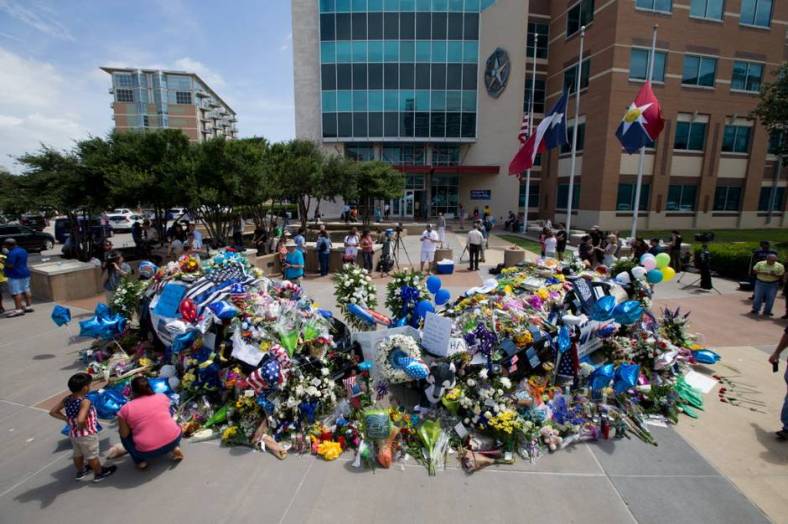
RIP Philando Castile, Alton Sterling, Dallas police
officers Lorne Ahrens, Michael Krol, Michael J. Smith,
Brent Thompson, and Patrick Zamarripa—and all their families. And to all those injured.

Let us celebrate the lives of all

As we reflect & pray & meditate on their brutal deaths

Let us celebrate those who marched at night who spoke of peace

& chanted Black Lives Matter

Let us celebrate the officers dressed in Blues ready to protect

Let us know the departed as we did not know them before—their faces,

Bodies, names—what they loved, their words, the stories they often spoke

Before we return to the usual business of our days, let us know their lives intimately

Let us take this moment & impossible as this may sound—let us find

The beauty in their lives in the midst of their sudden & never imagined vanishing
Let us consider the Dallas shooter—what made him

what happened in Afghanistan

what

flames burned inside
(Who was that man in Baton Rouge with a red shirt selling CDs in the parking lot

Who was that man in Minnesota toppled on the car seat with a perforated arm

& a continent-shaped flood of blood on his white T who was

That man prone & gone by the night pillar of El Centro College in Dallas)
This could be the first step

in the new evaluation of our society This could be

the first step of all of our lives

Juan Felipe Herrera,  July 8, 2016  (originally published on Poets.org)

The week@work – “our culture is changing”, internship access, sexual harassment@Fox & the June jobs report

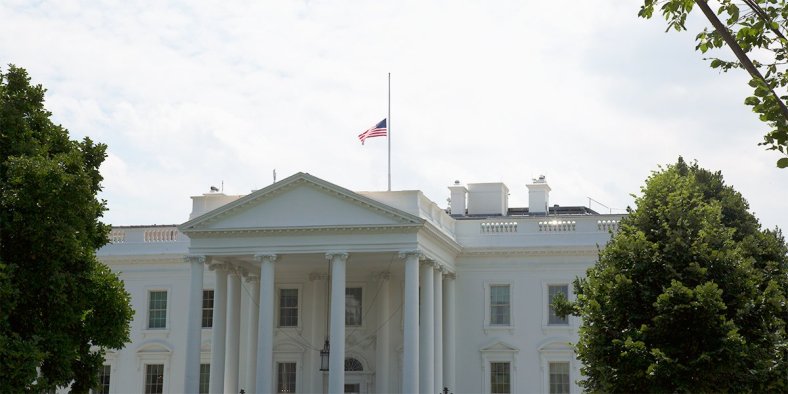
For the 67th time in his term, President Obama ordered the flag of the United States be flown at half-staff; this time in memory of the police officers in Dallas. Sixty-seven times, a record for a presidential administration.

This week@work we look at two responses to the violence, consider an opinion on internship access, examine a high profile workplace harassment lawsuit, and the implications of the June jobs report.

“As a mark of respect for the victims of the attack on police officers perpetrated on Thursday, July 7, 2016, in Dallas, Texas, by the authority vested in me as President of the United States by the Constitution and the laws of the United States of America, I hereby order that the flag of the United States shall be flown at half-staff at the White House and upon all public buildings and grounds, at all military posts and naval stations, and on all naval vessels of the Federal Government in the District of Columbia and throughout the United States and its Territories and possessions until sunset, July 12, 2016. I also direct that the flag shall be flown at half-staff for the same length of time at all United States embassies, legations, consular offices, and other facilities abroad, including all military facilities and naval vessels and stations.”

images.jpeg

On Friday morning, veteran CBS newsman, Bob Schieffer, was asked to provide context to the events of the past week, drawing on his 50 years as a journalist.

“One thing we overlook: our culture is changing…We are becoming a less patient society, we are becoming a more demanding society, for want of a better word, we are becoming a ruder society, and we see this playing out in road rage, in the way we treat one another…Nobody is satisfied with anything now…People are dissatisfied, frustrated and they act out…”

Libby Hill of the Los Angeles times reported on host of the Daily Show Trevor Noah‘s, seven-minute monologue “in the wake of the police-involved killings of Alton Sterling and Philando Castile.”

“It always feels like, in America, if you take a stand for something, you are automatically against something else…It’s either one or the other…But with police shootings it shouldn’t have to work that way.

 You can be to be pro-cop and pro-black. Which is what we should all be. It is what we should all be aiming for…The point is you shouldn’t have to choose between the police and the citizens they are sworn to protect.”

If the world is changing outside our workplace, what’s the impact on our daily work lives? Does frustration on the 405 translate into contention in the conference room? Our lives don’t fit neatly into the ‘work’ and ‘life’ box. We will need to draw on every ounce of empathy to listen, reflect, respect and respond.

Sometimes we just don’t think about how the system is ‘rigged’ and why people are angry. Skeptical? Let’s talk internships.

photo_61045_landscape_650x433

On Tuesday, Darren Walker, the president of the Ford Foundation penned an opinion for the New York Times, ‘Internships Are Not A Privilege’.

“Talent is equally distributed, but opportunity is not. And while many Americans believe fervently and faithfully in expanding opportunity, America’s internship-industrial complex does just the opposite.

And whether it’s an internship, college admission or any of the many other factors that determine a successful life, leaders who say they want to address inequality actually — and often unconsciously — reinforce the dynamics that create inequality in their own lives.

The broader implication is privilege multiplied by privilege, a compounding effect prejudiced against students who come from working-class or lower-income circumstances. By shutting out these students from entry-level experiences in certain fields, entire sectors engineer long-term deficits of much-needed talent and perspective. In other words, we’re all paying the price for unpaid internships.

For countless Americans, me among them, internships have provided a foothold on the path to the American dream. Simply by making them more accessible to all, we can narrow the inequality gap while widening the circle of opportunity, long after the summer ends.”

Another major workplace story broke on Wednesday with news that Gretchen Carlson had filed a lawsuit against Fox News chairman, Roger Ailes, exposing a culture of sexism and workplace sexual harassment.

-J3Fem6E_400x400.jpg

Gabriel Sherman covered the story for New York Magazine, reporting:

“Fox News host Gretchen Carlson may be the highest-profile woman to accuse Roger Ailes of sexual harassment, but she is not the first. In my 2014 biography of the Fox News chief, I included interviews with four women who told me Ailes had used his position of power to make either unwanted sexual advances or inappropriate sexual comments in the office.

And it appears she won’t be the last, either. In recent days, more than a dozen women have contacted Carlson’s New Jersey-based attorney, Nancy Erika Smith, and made detailed allegations of sexual harassment by Ailes over a 25-year period dating back to the 1960s when he was a producer on The Mike Douglas Show. “These are women who have never told these stories until now,” Smith told me. “Some are in lot of pain.” Taken together, these stories portray Ailes as a boss who spoke openly of expecting women to perform sexual favors in exchange for job opportunities. “He said that’s how all these men in media and politics work — everyone’s got their friend,” recalled Kellie Boyle, who says Ailes propositioned her in 1989, shortly after he helped George H.W. Bush become president, serving as his chief media strategist.”

And while we are on the topic of women@work, Andrew Das reported on the ongoing story, ‘U.S. Women’s Soccer Players Renew Their Fight for Equal Pay’.

screenshot-11.png“Beaten in federal court and rebuffed at the negotiating table, the United States women’s national soccer team is taking its fight for equal pay back to friendlier turf: the court of public opinion.

Beginning with an exhibition match this weekend in Chicago and continuing through the Olympics next month in Brazil, members of the team said on Thursday that they would embark on a campaign that they hope will increase the pressure on the United States soccer federation to pay the women compensation equal to their counterparts on the men’s national team in their next collective bargaining agreement.”

On Friday, Adam Shell of USA TODAY, analyzed the June jobs report from the U.S. Labor Department.

“After stalling briefly, the U.S. job-creation engine is again revving into high gear, rejuvenating Wall Street and sending stocks close to record highs.

The U.S. economy created 287,000 new jobs in June, which was 100,000 more than economists had forecast and the best monthly gain since October 2015.

And that is about as good a news headline as Wall Street could ask for after May’s gloomy jobs report (the initial 38,000 May jobs count was revised down to a paltry 11,000 in Friday’s report) and all the Brexit-related doom-and-gloom the past few weeks that put a scare into investors.”

cm-p12vwiaeczwd-jpg-large.jpegOn Saturday evening, for ‘one last time‘ –  “Lin-Manuel Miranda, the creator and star of the Broadway smash “Hamilton,” made a subdued final bow Saturday alongside two other departing stars — Leslie Odom Jr. and Phillipa Soo — in the show that has become a cultural phenomenon.”

Miranda’s final performance Saturday at the Richard Rodgers Theatre was also the last for Odom Jr., who won a Tony Award as Aaron Burr, and Soo, a Tony nominee who portrayed Eliza Schuyler. The three — plus an ensemble member — took their bows together but none said anything.”

Hoping for a better week@work to come.


The Saturday Read ‘The Missing of the Somme’ by Geoff Dyer

Geoff Dyer has a new book out this summer, ‘White Sands: Experiences From the Outside World’ , but it’s a book originally published in 1994 that is The Saturday Read this week – ‘The Missing of The Somme’.

Dyer may defy categorization as an author, but one constant in his writing, is a theme of travel, highlighted by his publisher in a description of the current title.

“Weaving stories about places to which he has recently traveled with images and memories that have persisted since childhood, Dyer tries “to work out what a certain place—a certain way of marking the landscape—means; what it’s trying to tell us; what we go to it for.”

‘The Missing of the Somme’ begins with the images and memory of his grandfather and continues on a road trip through the great war battlefields, pristinely kept, to ensure memory.

IMG_4961.jpg

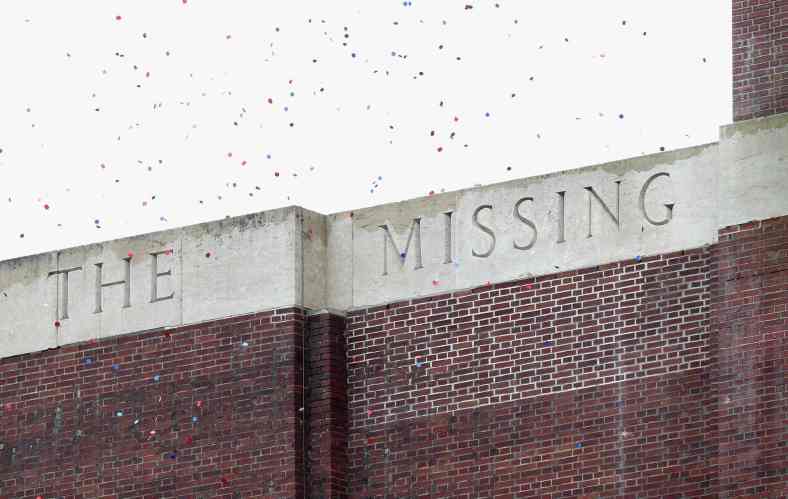
The title comes from the memorial at Thiepval, France to ‘The Missing of the Somme’. The 131 pages explore the landscape of France and Belgium in an extended essay exploring the monuments, cemeteries, and literature that materialized from a time of “fear that people would forget”. A time when ‘soldier poets’ emerged from the battlefields to create a literary narrative of events, in contrast to the propaganda of the media.

This is Dyer’s strength in storytelling. You think you have opened a ‘war book’ and you find you have signed on for an unexpected adventure. The ‘origin’ story of the book is itself a tangent. He originally moved to Paris in the early 90’s to write a novel based on Fitzgerald’s ‘Tender is the Night’, and ended up writing a book about world war one. (F. Scott does make an appearance.)

In a 2013 Paris Review interview, Dyer addressed reader’s expectations, as a function of a publisher/marketer definition.

“I think the distinction between fiction and nonfiction is less about “Did it really happen or was it made up?” than it is about form. And, more than form, it’s about the expectations that are brought to certain forms. According to how a book is presented, packaged, or identified, readers have certain expectations. Following from that they expect books within broadly identified categories to behave in certain ways. So people can find it quite disconcerting when a book isn’t doing what they think it’s meant to be doing, even if the book is completely fine on its own terms and has no desire to conform to some external set of expectations. My books are often disappointing in that regard.”

You may read Dyer for the element of surprise, but it’s in his prose that your investment in time is rewarded, as illustrated in this short excerpt.

“But history does not lie uniformly over events. Here and there it forms drifts – and these drifts are at their deepest between the years 1914 – 1918. Watching footage of the Normandy landings, we can experience D-Day as it happened. History hangs in the balance, waiting to be made. The Battle of the Somme, by contrast, is deeply buried in its own aftermath. The euphoric intoxication of the early days of the French Revolution – ‘Bliss was it in that dawn’ – remains undiminished by the terror lying in wait a few chapters on. The young men queuing up to enlist in 1914 have the look of ghosts. They are queuing up to be slaughtered: they are already dead. By (Johan) Huizinga’s terms, the great war urges us to write the opposite of history: the story of effects generating their cause.”

“Even when it was raging, the characteristic attitude of the war was to look forward to the time it would be remembered.”

When ‘The Missing of the Somme’ was published in Great Britain, there was no American interest. The first world war still competes for attention in American culture. Fortunately, we have Geoff Dyer to remind us that “the war’s true subject is remembrance”.


‘From the Somme’ a poem by Leslie Coulson

The Friday Poem this week is ‘From the Somme’, by journalist, poet and soldier of the first world war, Leslie Coulson. The poem was included in a collection of poetry, ‘first world war  poems’, published in 2014.

“Leslie Coulson fought in Malta, Egypt and Gallipoli, where he was wounded. He recovered in hospital in Egypt, was sent to France and was killed in action at the Battle of the Somme. Shortly before he died, he wrote in a letter, ‘If I should fall do not grieve for me. I shall be one with the wind and the sun and the flowers.'”

In remembrance of the Battle of the Somme, one of the lesser known poets of the great war reflects on the impact of the battle on his worldview. His voice carries through the century to speak to all who are transformed by tragedy.

From the Somme

In other days I sang of simple things,
Of summer dawn, and summer noon and night,
The dewy grass, the dew-wet fairy rings,
The larks long golden flight.

Deep in the forest I made melody
While squirrels cracked their hazel nuts on high,
Or I would cross the wet sand to the sea
And sing to sea and sky.

When came the silvered silence of the night
I stole to casements over scented lawns,
And softly sang of love and love’s delight
To mute white marble fauns.

Oft in the tavern parlour I would sing
Of morning sun upon the mountain vine,
And, calling for a chorus, sweep the string
In praise of good red wine.

I played with all the toys the gods provide,
I sang my songs and made glad holiday
Now I have cast my broken toys aside
And flung my lute away.

A singer once, I now am fain to weep,
Within my soul I feel strange music swell,
Vast chants of tragedy too deep – too deep
For my poor lips to tell.

Leslie Coulson (1889-1916)  ‘first world war poems’ edited by Jane McMorland Hunter, 2014

The generational divide – #wearehere and #Brexit

A collection of amateur photos taken by ordinary British citizens, on the 100th anniversary of the Battle of the Somme, served to bridge a century, and punctuate the generational divide that led ‘the lost generation’ to war, and ‘the millennials’ to #Brexit.

The topic #wearehere started trending early Friday morning as British citizens headed to work and encountered young men clad in the uniforms of World War I. For a few hours, in London, Aberystwyth, Birmingham, Sheffield, Salisbury, and Plymouth, the ghost soldiers of the Somme walked among their contemporaries.

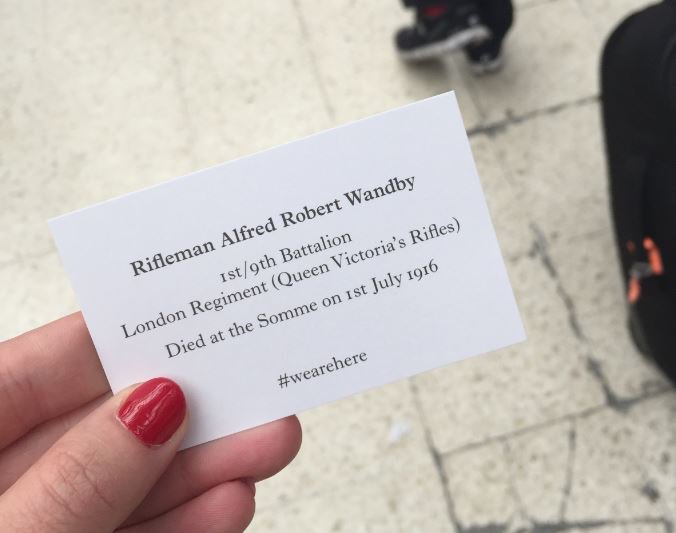
Many of those first encounters were recorded on Twitter and Instagram, as commuters received cards from these ‘soldiers’.CmRNYS-UkAUqr3d“Thousands of volunteers took part in a UK-wide event on Friday 1 July 2016, as a modern memorial to mark the centenary of the Battle of the Somme. 19,240 men were killed on the first day of the battle in 1916 – the bloodiest day in British military history.
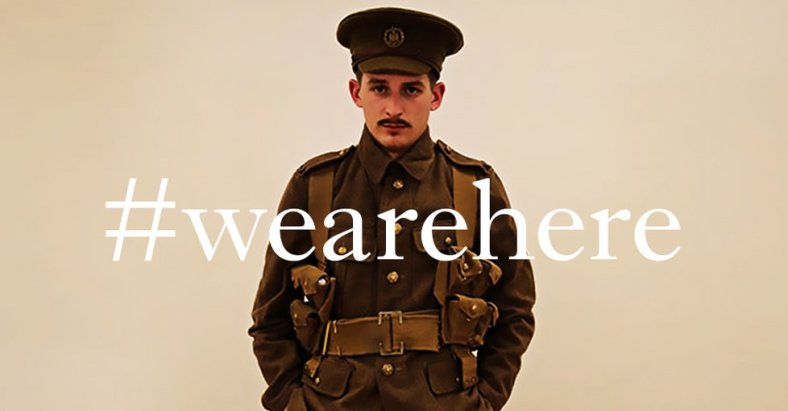
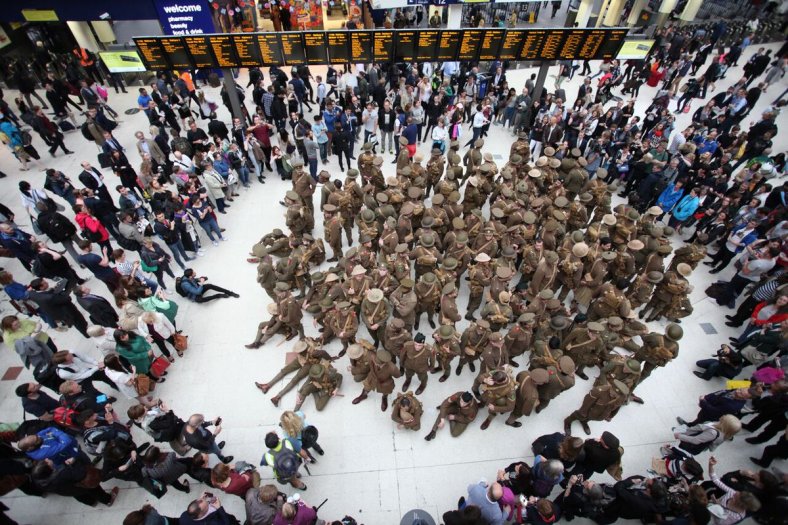
‘we’re here because we’re here’ saw around 1400 voluntary participants dressed in First World War uniform appear unexpectedly in locations across the UK. Each participant represented an individual soldier who was killed on that day one hundred years before.”

proxy.jpg

Charlotte Higgins reported on the day for The Guardian newspaper. “The event, which unfolded without advance publicity, can now be revealed as a work by Jeremy Deller, the Turner prize-winning artist…Deller worked with Rufus Norris, the artistic director of the National Theatre in London, and theatres throughout the UK to train the volunteer army.

Deller was approached to devise an artwork to mark the centenary of the first day of the Battle of the Somme by 14-18 NOW, the body responsible for art commissions commemorating the war. “I quickly realised that what I didn’t want was a static memorial that the public went to to be sad,” he said. “In the 21st century I felt we had do something different. So I thought about the memorial being human, and travelling round the country. It would take itself to the public rather than the public taking itself to the memorial.”

somme.jpg

“And also the public wouldn’t know in advance that there was this thing happening – they would encounter it in the shopping centres and carparks and outside schools and in everyday British life. And I wanted to avoid heritage places – churches, war memorials. I wanted to take it to the public.” His key idea, he said, was to “avoid sentimentality”.

Look at the photo of the finale at Waterloo Station. A group of soldiers at the center are surrounded by their contemporaries, telegraphing the moment to social media. Two generations, a century apart facing unknown fates @war, and after #Brexit.

CmcwkjWWcAAb1sy.jpgThe politics of the early 20th century led to over a million British, French and German casualties in the Battle of the Somme between July 1 and November 18, 1916.

The rhetoric of current political leaders called into question today’s younger generation’s European identity.

So what have we learned in 100 years?

Someone thought it would be a great idea to preserve the peace and form a European Union. For all its frailties, its crowning achievement was replacing nationalism with an overlay of a ‘European’ identity; a multilingual, multicultural generation that travels freely across the continent to study, work, live and love.

Francesca Barber, a self-described ‘transnational’, gave voice to this dilemma of altered identity in the wake of #Brexit.

“I was born in Washington in the late 1980s, grew up in Brussels, moved to London and then returned to the United States, where I lived in New York City; Providence, R.I.; and San Francisco.

My parents are English. My first language was French. I went to a Belgian school and the European School in Brussels, where my classmates almost always spoke at least three languages.

My childhood was defined by endless car journeys across Europe. And as an adult, I have enjoyed the benefits of cheap deals on low-cost European airlines. Most of my friends have gone to school and worked in at least two European countries. I am part of the Erasmus generation. My friends and my roots are everywhere — and only now do I realize how much I took that for granted.

The “Brexit” vote on June 23 was the most serious geopolitical event for Europe since the fall of the Berlin Wall. But lost in all the geopolitics is another important message: It was a resounding vote against globalization from a country that has for so long been a proud champion of globalization.

But this vote was also a rejection by my fellow countrymen, from my parents’ generation to mine, of everything I cherished about Europe, Britain and my own childhood: the sense that our differences were less important than our shared experiences.”

Maybe it’s time for a ‘we are here’ for the European millennials – a ‘counter Brexit’, public art project.  What if, on a Friday morning, all over Britain, young workers approached commuters with CV profile cards, each participant representing a dream lost to Brexit? Mr. Deller, Mr. Norris we could use your help here.


The Saturday Read ‘I Was Amelia Earhart’ by Jane Mendelsohn

Sometimes the stories behind what we read are as interesting as the books themselves. We now know that the musical Hamilton had its inception when creator Lin-Manuel Miranda picked up a book in an airport on the way to vacation.

Jane Mendelsohn, the author of this week’s Saturday Read, ‘I Was Amelia Earhart’ found her inspiration reading a newspaper article about the aviator while riding a train into New York .

“I didn’t know much about Amelia Earhart, but the idea of her surviving on a desert island, even if only for a little while, appealed to me, sang to me, waved furiously to me from a great distance. Perhaps this was because I felt at the time as if I were flying hopelessly around the world and searching for land, longing for one of those islands of stability some of us keep looking for in our 20s, a braceleted wrist held up to the face, hand shielding our eyes from the harsh sun of adulthood, not realizing that we will have to build that island for ourselves. Whatever the reason, I was certainly not the first person to be fascinated by Earhart’s disappearance. Nor the last.”

Where will you find inspiration this holiday weekend?

On this 79th anniversary of Earhart’s disappearance, go back in time as newspapers around the world reported the news:

ClF9pAOXIAESRPy.jpg

“Coast Guard headquarters was advised tonight that Amelia Earhart was believed to have alighted on the Pacific Ocean near Howland Island shortly after 5 P.M. Eastern daylight time today.

A message from the cutter Itasca, stationed in the vicinity of the island in the mid-Pacific, said:

“Earhart unreported at Howland at 7 P.M. [E.D.T.]. Believe down shortly after 5 P.M. Am searching probable area and will continue.”

Author Mendelsohn imagines the other side of story, as Amelia Earhart and navigator Fred Noonan transition from pioneers of the sky, to survivors on a tiny Pacific atoll.

“It went very quickly, those first few days. They got out of the plane, and together looked around and tried to make sense of their surroundings. Then all of a sudden, as if part of the choreography of a dream, they set about performing the necessary rituals of survival.

They check the radio, which picks up nothing, and the fuel tank, which is low but not empty, and they confirm their worst suspicions – that they have no idea where they are…They build a fire on the beach to attract attention. They know that a search will have already begun.”

It’s not too long before Earhart spots a plane.

“In the morning I see a speck appear on the horizon, a black spot the size of an insect.

The point of blackness, which at first appears to be nothing more than a gnat, keeps coming closer, heading directly toward the island, and I tell myself that it must be a figment of my imagination. But after two minutes, it assumes the form of a plane to such perfection that I need a moment to recognize what it is…At first I take off my scarf and gesticulate furiously, but as the plane appears to lose altitude, I begin to relax and wave it calmly, welcoming it ashore. Everything about this plane conveys purpose and assurance, as if it had been designed solely to rescue us. I find the promise of its shape more beautiful than anything I have ever seen, but strangely lost to me, although I don’t understand why until it comes closer and I am able to determine that despite my wish it is not coming toward the island at all. It looked as if it were heading directly at me, but as I watch it grow larger I see it pass overhead, high above, too far to see me as I desperately shake my scarf. It circles once – for an instant I image that it is heading toward the water and I think I can make out black pontoons for landing – and then it makes a wide turn, points back to the mysterious place from whence it has come, and flies away. It hasn’t seen me at all.”

The mystery of Earhart’s disappearance continues to arouse interest as researchers continue to search for a remnant of the missing plane. Mendelsohn’s narrative offers the reader an alternative history, employing beautiful prose to recreate a time when “Planes used to be vehicles for dreaming…As soon as you saw a plane, you started dreaming. It was a thrill just to catch a glimpse of one. “

In 2012 Jane Mendelsohn revisited the subject of her 1996 novel in an Op-Ed for The New York Times.

“We still wonder what happened to Amelia Earhart — perhaps soon we may even find out — but do we know what to do with her? Do we know how to make not just her mysterious disappearance but also her miraculous life relevant and inspiring to our global society? And could she matter across the globe, that ball around which she tried to fly that feels so much smaller today but is in fact exactly the same size it was then?

Historically, one thing America has been good at is offering inspiration. We haven’t been doing a brilliant job of it lately, but in Amelia Earhart we have something, someone, to offer the 21st century: a heroine. She was a leader, not a passive bystander. She was strong, not a victim. And she was not born into a rich family, as were many other women pilots of her day, but was lifted up by her own accomplishments. In other words, she gives us good shoes to fill.”

On this weekend, when we celebrate our nation’s independence, read ‘I Was Amelia Earhart’ and discover why her life still inspires.

“Amelia Earhart can be a beacon for our country and for women and men around the globe because everyone, each of us, needs to be “aware of the hazards” and accept “the inevitable risks.”… Earhart’s mystery endures because of who she was as a person, the pilot of her own destiny, mistakes, failures and dreams, reachable and unreachable. She still beckons.”

‘Transmission’ a poem by Rachel Richardson

On July 2nd, 1937 aviator Amelia Earhart was attempting to be the first woman to circumnavigate the globe. She and her navigator, Fred Noonan had completed 22,000 miles of a 29,000 mile journey when transmission was lost. Ten ships, 3,000 men and 100 aircraft searched for the missing plane. The disappearance remains a mystery and has generated multiple conspiracy theories and continuing efforts by private organizations to discover the wreckage.

Earhart had become an early twentieth century role model for women. Her final note to her husband acknowledged the danger as well as her feminism.

“Please know I am quite aware of the hazards of the trip. Women must try to do things as men have tried. When they fail, their failure must be but a challenge to others.”

The Friday Poem by Rachel Richardson captures an imagined ‘transmission’ from the final moments of that flight.

Transmission

There was a girl who heard it happen:
Amelia Earhart calling
on the radio, she and her navigator
alternately cursing and defining their position
by latitude, as best they could read it
in the bellowing wind, and by what
they could surmise of their rate per hour,
last land they’d seen. Stay with me, someone,
and the girl wrote each word
in her composition book, kept the channel
tuned, hunched to the receiver
when static overtook the line.
Why do I think of her?
The coast guard laughed at her father
holding out the schoolgirl scrawl
and sent him home ashamed. A lost woman
is a lost woman, he told her, and the sea
is dark and wide.

Rachel Richardson  The New York Times Magazine  January 22, 2016


‘Other duties as assigned’- In search of a congressional job description

Last week members of the U.S. House of Representatives staged a ‘sit in’ on the House floor – #NoBillNoBreak and then went home. In London, Members of Parliament argued the outcome of the #Brexit vote, trying to gain a foothold in a new world order. It got me thinking. With all this visibility, maybe more folks would be interested in a career as a congressman/congresswoman or MP.

Like any job seeker, I decided to look for a job description. You know, one of those outlines of responsibilities and ‘other duties as assigned’. I started my research where we all start, on Google.

For the UK, it was quite easy to come up with an ‘MP’s generic job description’ on the official UK Parliament website. Although it seems not to have been updated since 2001, it clearly sets out the scope of the job.

Job purpose

Represent, defend and promote national interests and further the needs and interests of constituents wherever possible.

Principal accountabilities

1.Help furnish and maintain Government and Opposition so that the business of parliamentary democracy may proceed.

2.Monitor, stimulate and challenge the Executive in order to influence and where possible change government action in ways which are considered desirable.

3.Initiate, seek to amend and review legislation so as to help maintain a continually relevant and appropriate body of law.

4.Establish and maintain a range of contacts throughout the constituency, and proper knowledge of its characteristics, so as to identify and understand issues affecting it and, wherever possible, further the interests of the constituency generally.

5.Provide appropriate assistance to individual constituents, through using knowledge of local and national government agencies and institutions, to progress and where possible help resolve their problems.

6.Contribute to the formulation of party policy to ensure that it reflects views and national needs which are seen to be relevant and important.

7.Promote public understanding of party policies in the constituency, media and elsewhere to facilitate the achievement of party objectives.

It’s even written in clear ‘accomplishment’ language that can easily transfer to a resume or CV.

Next, I searched House.gov, the official website of the U.S. House of Representatives. This is what I came up with.

What is a Representative?

Also referred to as a congressman or congresswoman, each representative is elected to a two-year term serving the people of a specific congressional district. Among other duties, representatives introduce bills and resolutions, offer amendments and serve on committees.

Not very accomplishment oriented.

Maybe I was using the wrong search terms. Following logic, I decided to check if there was a ‘new employee handbook’. There is – a ‘Members Congressional Handbook’ that spells out, in painful detail, staff categories, office expenses, communications, travel and House Documents. Still no job description. But clearly, you need to hire folks, budget, manage a staff, talk to colleagues, travel and submit expense reports.

And then there is the fundraising. A CBS 60 Minutes segment examined another ‘job requirement’ – telemarketing – for 30 hours a week.

“The American public has a low opinion of Congress. Only 14 percent think it’s doing a good job. But Congress has excelled in one way. Raising money. Members of Congress raised more than a billion dollars for their 2014 election. And they never stop.”

Check the box on fundraising, but 30 hours?

Here’s my question. How can we measure our representatives without a job description? We think they’re not doing a good job, but where in that short paragraph does it spell out how a member of Congress ‘serves’ the people.

In the UK, elected leaders are beginning a process to decouple from the European Union, not because they want to, but because the democratic referendum requires them to proceed. They have a job description that clearly guides their actions.

In the U.S. if you are 25, a U.S. citizen for seven years, and a resident of the district you wish to represent, you can begin the process to run for election. But what are you running for?

I think it’s time to create a few goals for our elected leaders; not political, but aspirational. For example – at the end of your two year term you will have effectively represented your constituents by visiting, listening and communicating their hopes for this country to your colleagues. You will represent the interests of your party as long as they coincide with the interests of your district. And when your personal views contradict those you represent, you will have the courage to be a servant leader.

We all operate in a workplace where half our day is spent doing things outside our job description. The point is, we are compensated for what we were hired to do. When the ‘other duties as assigned’ overwhelm our original purpose, it’s time to redefine the scope of what we do.

It’s time for a job description for Congress.


The week@work – Brexit, #Regrexit, Euro2016, Christo’s floating piers, Bill Cunningham’s photos, Goldman Sachs’ video recruiting strategy, and education for a jobless future

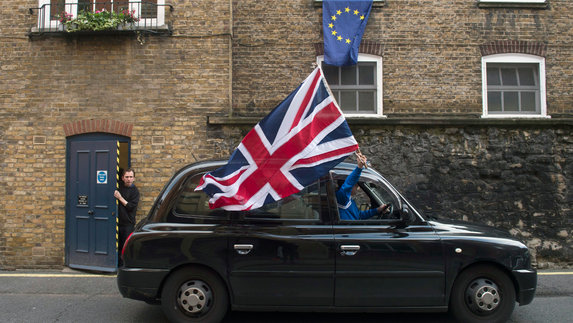
I was a history major, so the past week@work included an inordinate amount of time spent in the company of various traditional and social media portals, monitoring the results of the Brexit vote and its aftermath.

In between, there were intervals of soccer, viewing both Copa America and Euro 2016. There was also art in Christo’s installation in Lake Iseo, Italy and reflected brilliance in the photography of Bill Cunningham, who died this weekend. Goldman Sachs announced a new campus recruiting strategy (good news for history majors), and a journalist asked if education is preparing students adequately for a jobless future.

25Brexit-HP-SS-slide-9PT7-largeWidescreen573-v3.jpg

On Thursday evening I watched part of CNN International’s ‘Brexit’ election coverage, which included an animated discussion between anchor Christiane Amanpour and historian Simon Schama. As it became clear that ‘Leave’ was overtaking ‘Remain’ in the vote count, Schama cited the referendum results as one more example of “a world phenomenon of tribal nationalism”.

The historian has been actively engaged on Twitter and in an interview with NPR’s Robert Siegel described the vote as “a turning point for Great Britain”.

Here’s a sample of the conversation:

SIEGEL:” Culturally, there is a generation of educated young Europeans – and I include Brits in that – who think of themselves at some level as being European. Maybe it’s not their only identity. Do you think that goes away in Britain and does a different identity take shape, or do those people grow up and change in this country?”

SCHAMA: “No, I think they’re in distress. I mean, I’m sure you’ve said, it’s very striking that the 18 to 24s voted something like 75 percent to stay in. And I suppose it depends where you are in London. We have more immigrants than anywhere else, and we’re least bothered by it. And I think when the shock subsides a bit, the young may well fight to be at least as European as they’ve been led to believe they are. That’s my hope, actually.”

SIEGEL: “If you can imagine a historian 50 years hence writing the sentence that will sum up what happened on this day, what do you think it’ll be?”

SCHAMA:” The greatest act of unforced national self-harm yet known in modern history.”

It’s always helpful to have a historian in the house. And it’s stunning to realize the generational split in voting: “Among 18-24-year-olds, the age category that’s going to have to live with the consequences of this vote for all of their working lives, 75 percent voted to stay.”

As to #Regrexit, writer and comedian, John Oliver reminded his countrymen, “there are no f______do-overs”.

In 2004 journalist Franklin Foer wrote ‘How Soccer Explains the World: An Unlikely Theory of Globalization’. Seemed like a good read to revisit after Brexit and an opportunity for a diversion while following Copa America and Euro 2016. The book treats soccer stories as globalization case studies. And I think we could use some ‘best practices’ right about now.

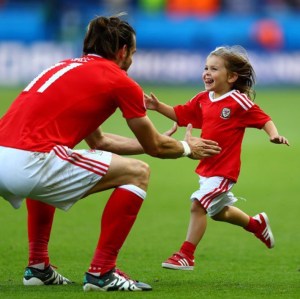
Full disclosure, I am rooting for the Welsh National Football Team as they face Belgium on Friday. My favorite work/life balance photo of the week – Wales’ Gareth Bale and daughter after the team advanced to the Euro 2016 quarter finals.

IMG_4935

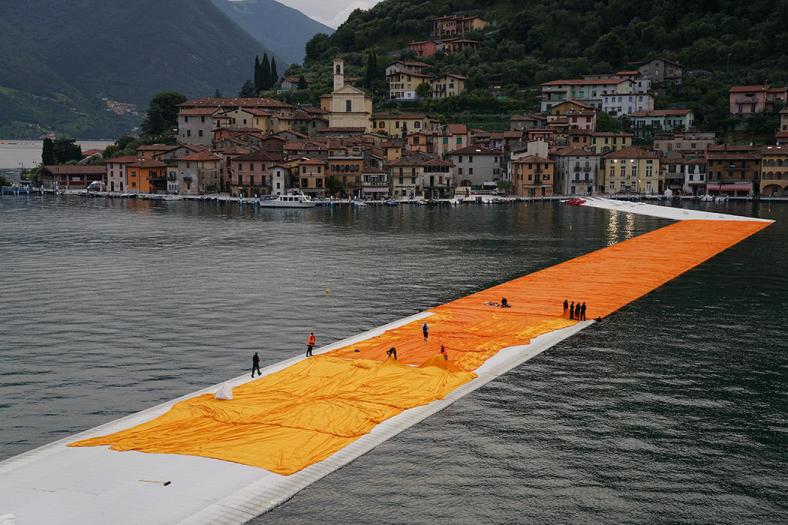
Art is another outlet for expression in chaos and ambiguity. A new Christo work debuted last week. The Guardian reported on the popularity of the ‘Floating Piers’ in Lake Iseo in northern Italy.

58af48a0cb7e83c7f1e3dbf9b4a50e7e.jpg

“A giant floating walkway made out of fabric on an Italian lake has had to be closed at night after tens of thousands of visitors began to wear it out.

The 1.9-mile (3km) walkway of 200,000 floating cubes covered in orange fabric was created by artist Christo and has proved a major attraction since it opened on Saturday on Lake Iseo.

However, 270,000 visitors have flocked to see the free installation – called “the Floating Piers” – in less than five days, far exceeding organisers’ expectations of about 500,000 over 16 days.”

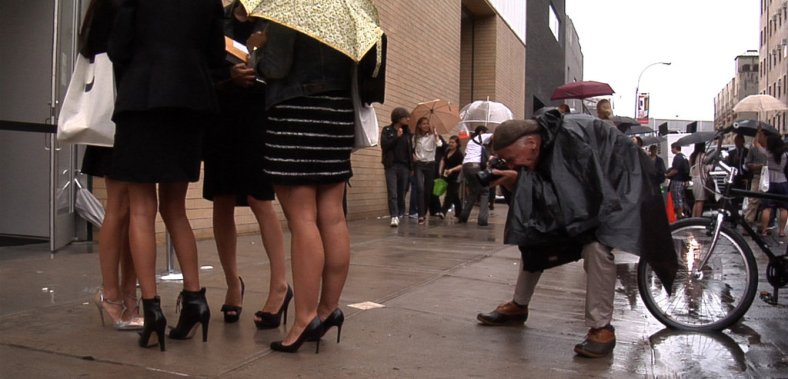
On Saturday, The New York Times chronicled the career of one of their ‘house icons’, photographer Bill Cunningham.

BILL-jumbo.jpg

“Mr. Cunningham was such a singular presence in the city that, in 2009, he was designated a living landmark. And he was an easy one to spot, riding his bicycle through Midtown, where he did most of his field work: his bony-thin frame draped in his utilitarian blue French worker’s jacket, khaki pants and black sneakers (he himself was no one’s idea of a fashion plate), with his 35-millimeter camera slung around his neck, ever at the ready for the next fashion statement to come around the corner.

Nothing escaped his notice: not the fanny packs, not the Birkin bags, not the gingham shirts, not the fluorescent biker shorts.

In his nearly 40 years working for The Times, Mr. Cunningham snapped away at changing dress habits to chart the broader shift away from formality and toward something more diffuse and individualistic.”

Two stories about the transition from school to work round out this week@work.

On Friday, bbc.com reported “Goldman Sachs is scrapping face-to-face interviews on university campuses in a bid to attract a wider range of talent.
The US investment bank will switch to video interviews with first-round undergraduate candidates from next month.

“Edith Cooper, Goldman’s global head of human capital management said: “We want to hire not just the economics or business undergraduate but there is that pure liberal arts or “history major that could be the next Lloyd Blankfein.”

Mr Blankfein, the bank’s chief executive, went to Harvard, one of America’s elite Ivy League universities, where he studied history.”

On Tuesday, Washington Post contributor, Jeffrey J. Selingo asked ‘Are colleges preparing students for the workforce?’

“While students are often encouraged to major in job-ready fields like STEM (science, technology, engineering, and math), graduates of those programs are unlikely to find employment without solid grounding in the liberal arts and experiences outside the classroom to build their soft skills.

In the future work world, it’s critical that new graduates stay one step ahead of technology and focus more on what computers can’t yet do well: show creativity, have judgment, play well with others, and navigate ambiguity.”

It was a good week to be a history major.


The Saturday Read ‘Max Perkins: Editor of Genius’ by A.Scott Berg

How many of you have turned your senior thesis into a career?

In 1971, recent Princeton graduate, A. Scott Berg began the seven-year process of expanding his college research into the biography of book editor Max Perkins. Earlier this month, a 38 year long journey, from the first film option of the 1978 National Book Award winning biography, ended with the opening of ‘Genius’ in theaters.

The Saturday Read this week is ‘Max Perkins:Editor of Genius’, a story that defines the role of a professional mentor as the narrative unfolds.

Allison Silver interviewed the author in 1981 for an article on the relationships between biographers and their subjects.

“Scott Berg’s biography ”Max Perkins: Editor of Genius” grew out of a fascination, bordering on fixation, for F. Scott Fitzgerald. At Princeton, Mr. Berg wrote his senior thesis on Perkins’s relations with Ernest Hemingway, Thomas Wolfe and Fitzgerald during the 1920’s. Mr. Berg realized there was a book in the life of the Scribner’s editor, and felt he was the one to write it. On graduation day, 1971, he told his roommate, ”I’ll take three months to research it, three months to write it and then another three months to get it published.” Mr. Berg remembers this philosophically. ”I was only six years off.”

Berg introduces Perkins at age sixty-one, in 1946, as he enters a storefront on Forty-third street in Manhattan, to speak to a group of students enrolled in an extension course on book publishing. “All were eager to find a foothold publishing and were attending the weekly seminars to increase their chances.”

“Maxwell Everts Perkins was unknown to the general public, but to people in the world of books he was a major figure, a kind of hero. For he was the consummate editor. As a young man he had discovered great new talents – such as F. Scott Fitzgerald, Ernest Hemingway, and Thomas Wolfe – and he had staked his career on them, defying the established tastes of the earlier generation and revolutionizing American literature. He had been associated with one firm, Charles Scribner’s Sons, for thirty-six years, and during that time, no editor at any house even approached his record for finding gifted authors and getting them into print.”

For many years this biography has been a ‘bible’ for aspiring editors. In this time of book publishing ‘disruption’, when editors have become an endangered species, it’s worth the readers’ time to travel to post WWI New York, when a different type of disruption was taking place as the novels of Fitzgerald, Hemingway and Wolfe began to appear on book shelves.

Let’s return to the 1946 extension class, as Berg continues his first chapter.

‘”The first thing you must remember,” he said, without quite facing his audience: “An editor does not add to a book. At best he serves as a handmaiden to an author. Don’t ever get to feeling important about yourself, because an editor at most releases energy. He creates nothing…A writers best work…comes entirely from himself…Because in the end an editor can get only as much out of an author as the author has in him.”‘

This advice, shared with folks pursuing a career in publishing, could be edited for any contemporary management text to define the modern day mentoring relationship.

“Beginning with Fitzgerald and continuing with each new writer he took on, he slowly altered the traditional notion of the editor’s role. He sought out authors who were not just “safe”, conventional in style and bland in content, but who spoke in a new voice about the values of the postwar world. In this way, as an editor he did more than reflect the standards of his age; he consciously influenced and changed them by the new talents he published…

The successful editor is one who is constantly finding new writers, nurturing their talents, and publishing them with critical and financial success. The thrill of developing fresh writing makes the search worthwhile, even when the waiting and working becomes months, sometimes years, of drudgery and frequent disappointment.”

The biography offers a chronological timeline of relationships with the icons of early twentieth century American literature: Fitzgerald, Hemingway, Wolfe and Ring Lardner. It also includes his nurturing of emerging women writers in the 1930s: Marcia Davenport, Marjorie Kinnan Rawlings, and Taylor Caldwell. In the final chapter, we meet two of the last authors Perkins edits in 1946 and 1947: James Jones, author of ‘From Here to Eternity’ and Alan Paton, author of ‘Cry, the Beloved Country’. Max Perkins died on June 17, 1947.

How do you turn you senior thesis into a career? In the 1981 interview with Allison Silver, Berg shared his secret.

“During his first months of research, the scope of his work broadened every day until, by the end of that summer, he says, ”I made a private pact with myself then that I would work on the book until I finished it.” Mr. Berg remembers deciding ”that I was not going to be a slave to arbitrary dates; because, in truth, I owed Max Perkins more than that. Suddenly I went into twilight-zone time.”

This attitude toward deadlines has remained with Mr. Berg. He recommends that anyone involved in a long project should ”move to Los Angeles, because the seasons don’t change and you’re not aware of the passage of time. To this day I cannot account for three months between May and September, 1974.”