The week@work – It’s in the stars: Hollywood stories, #YearInSpace & 18,300 applications

The stories behind the headlines this week@work originate in Hollywood, Geneva, Washington D.C., and on the International Space Station.

The careers of a U.S. deputy trade ambassador and an executive editor for the Washington Post converge in Hollywood, astronaut Scott Kelly captures the final week of his #YearInSpace in photos, and 18,300 applicants aspire to take his place.

Unknown

Would you get up at 4:30 AM every day to pursue your dream? Alexandra Alter reported on a ‘behind the scenes’ Hollywood story about working beyond your ‘day job’.

One of the most successful global trade negotiators added a few hours to his work day 17 years ago to write a novel about fur trader Hugh Glass. His book, ‘The Revenant’ was published in 2002 and sold 15,000 copies. Last year publisher Picador reissued the novel, selling over half a million copies.
images

Michael Punke, the deputy United States Trade Representative and the United States ambassador to the World Trade Organization and author, has become a rock star among colleagues in global trade.

“We all think it’s quite cool,” said Keith Rockwell, a spokesman for the W.T.O., who added that colleagues occasionally tease Mr. Punke by asking him how his buddy Leo is doing. “The W.T.O. isn’t normally known for having a Hollywood connection.”

Some of his colleagues marvel that he has such a successful side career, while steering the country’s international trade policy from his post in Geneva.

“The guy is so talented, you read his bio, and it’s like he has two lives,” said Christopher Wenk, the executive director for international policy at the U.S. Chamber of Commerce.”

Joining Ambassador Punke at the Dolby Theater on Oscar night is current Washington Post executive editor and former Boston Globe editor Martin Baron.

In November, Esquire Magazine ran a career profile asking ‘Is Martin Baron the Best News Editor of All Time?’. In the Oscar nominated film, ‘Spotlight’, actor Liev Schreiber’s performance channels the editor who led the Pulitzer Prize winning team investigating the child abuse scandal in the Catholic Church.
Unknown-1.jpeg

This week, Mr. Baron used his time in the Oscar ‘spotlight’ to reflect on the long term rewards of the film and journalism today, ‘I’m in ‘Spotlight’, but it’s not really about me. It’s about the power of journalism.’

“Aside from the acclaim of critics, “Spotlight” already has delivered one gratifying result. In emails, tweets and Facebook posts, journalists have declared themselves inspired, buoyed and affirmed. That is no small matter in this badly bruised profession. We have felt the traumatizing financial effect of the Internet and been berated by just about everyone, especially politicians in a campaign season that has seen us cynically labeled “scum.”

One journalist wrote me that “the story that inspired the movie serves as a wonderful, wonderful reminder why so many of us got into this business in the first place and why so many stayed despite all the gloom and doom and all the left hooks that landed squarely on our chins along the way.”

The article is required reading for all who earn a living pursuing a journalism career. It should be framed on the walls of journalism schools and be the first google search result on the world ‘journalism’.

Two additional stories about work in Hollywood this week addressed the ongoing conversation on inclusion:

‘From C-Suite to Characters on Screen: How inclusive is the entertainment industry?’ USC Annenberg professor Stacy L. Smith authored the MDSC Initiative’s first report on diversity in the entertainment industry.

Melena Ryzik profiled 27 industry professionals in ‘What It’s Really Like to Work in Hollywood*  (*If you’re not a straight white man.)’

Before leaving the week@work, let’s travel to the International Space Station where astronaut Scott Kelly is completing his 240 day mission in space.

CTeSzSOWIAApQID

“10,944 sunrises and sunsets

“The International Space Station zips around Earth at more than 17,000 miles per hour, or once every 90 minutes. That means over the course of Mr. Kelly’s stay, the space station will have made 5,440 orbits, and the sun will have gone up and down 10,944 times from the perspective of the astronauts aboard. Of course, Mr. Kelly did not see all of them. He is not continuously looking out the window, and he sleeps, too.”

(Scott Kelly tweeted the photo above of sunrise on February 27 and ice earlier today)CcT9mfcW4AAZFvx.jpg

NASA announced this week that it had received 18,300 applications for 14 open spots in the new astronaut class. The recruiting effort which began in the fall demonstrates a rekindled interest in exploration and discovery.

“Now that NASA’s Feb. 18 deadline for applicants has passed, the agency’s 18-month winnowing process has begun.

NASA staff will look at 400 to 600 applicants who survive the initial purge and identify those who pass reference and background checks. Then 120 will be invited to the Johnson Space Center for interviews.

The final 14 will be announced in July 2017 and begin two years of extensive training on spacecraft systems, spacewalking skills, team building and Russian language. Those who complete the program will be assigned to NASA’s Orion deep space exploration ship, the International Space Station or one of two commercial vehicles in development.”

As @StationCDRKelley vacates his spot on the ISS, it’s good to know there are thousands who hope to fill his seat.

This week@work – it’s in the stars, and the dreams of those who aspire to be actors, film makers, journalists, writers, astronauts, and international trade negotiators.

 

The Saturday Read ‘West of Eden: An American Place’ by Jean Stein

Were the initial seeds of relocation planted when you read a novel or work of non-fiction that transported you to that place on the globe where you could find success? In the Saturday Read this week we arrive in Hollywood, where author Jean Stein interweaves oral history and memory to tell the story, ‘West of Eden: An American Place’.

If you read the book through the lens of work, you come away with the story of the three industries that built LA: oil, real estate and the movies. As you turn the page, you listen to voices describing the culture and its effects on lives and careers.

When Po Bronson wrote his book, ‘What Should I Do With My Life?’, he had already spent time as a producer and writer in television. His observations on culture echo through Ms. Stein’s narrative.

“Every industry has a culture. And every culture is driven by a value system. In Hollywood, where praise is given too easily and thus has been devalued, the only honest metric is box-office receipts. So box-office receipts are all-important.

One of the most common mistakes is not recognizing how these value systems will shape you. People think that they can insulate themselves, that they’re different. They’re not. The relevant question in looking at a job is not What will I do? but Who will I become? What belief system will you adopt, and what will take on heightened importance in your life? Because once you’re rooted in a particular system — whether it’s medicine, New York City, Microsoft, or a startup — it’s often agonizingly difficult to unravel yourself from its values, practices, and rewards. Your money is good anywhere, but respect and status are only a local currency. They get heavily discounted when taken elsewhere. If you’re successful at the wrong thing, the mix of praise and opportunity can lock you in forever.”

‘West of Eden’ is the story of five families: the Dohenys, the Warners, Jane Garland, Jennifer Jones and the author’s own family, the Steins. As I read each section, I was reminded of Bronson’s comment. For the most part, the real life actors in the book were chasing the dream of wealth, status and celebrity; not considering the consequences, finding themselves in a world of praise and opportunity, locked in, in some cases, with tragic results.

Writer and historian, Mike Davis opens the book with his memories as a guide for Grey Line Tours, and it’s the map of celebrity homes that provides an outline for the book. We are introduced to the five stories by street address. Second stop, 1801 Angelo Drive, Beverly Hills, the Warner home. Arthur Miller captures the essence of early Hollywood.

“Jack Warner’s generation invented what turned out to be the major world culture – not just American, but a world culture. The world’s dream to escape the dreadful, ordinary, industrial, technological life. An you can understand how it happened if you think of where they came from, a place where there was absolutely no chance for anybody to do anything. They were living in a mud hole, but here the dreams were absolutely feasible. If you could think it, you could do it. It was magic. And they filled the movies with magic. George Cukor told me once, “Our object was to escape reality. We were quite conscious of all that.” It was a never-never land, a construct. These immigrants, these Jews from Eastern Europe, had developed this dream that had blond hair, blue eyes, and a straight nose. It all had to be beautiful. This was a fairy tale, because they were immigrants who saw this country as a fairy tale. It was incredible: it captured the whole country.”

These were the ‘culture builders’ whose legacy remains in the mansions, oil wells and studios, that fund the dreams of workers today. Their stories are told through neighbors, colleagues, family members and employees. David Geffen, who purchased Jack Warner’s home connects past to present:

“Jack Warner was a great character, like all of them. They were remarkable guys, but they were monsters. The movie business is a hard business, and you had to be a monster to create this industry. 

Jean Stein has called upon a lifetime network to craft and preserve the unique story of a place built on escape from the ordinary. A set of biographical notes at the end gives the reader thumbnail bios of each narrator, and it’s quite a cast of characters!

The book is required reading for the uninitiated and aspiring L.A. resident. There is drama worthy of an academy award, in every category from acting to costume design to hair and makeup and of course, visual effects.

“Another quality that all Californians who have spent any time on the edge of the Pacific are aware of is that the light is different. There’s a pressure on the eyes from the light. I’ve never felt it on the other coast.” (art curator, Walter Hopps)

The week@work – innovative organizations, AT&T’s new culture, Shonda Rhimes @TED, the online platform economy and pausing to enjoy the view

The week@work was dominated by the story of Apple’s opposition to the court order to unlock the San Bernardino gunman’s IPhone. Simultaneously, news was being made as Fast Company released its annual list of the ‘Most Innovative Companies’, AT&T’s leadership challenged workers to reinvent themselves,  Shonda Rhimes shared her ‘year of yes’ @TED, and the JP Morgan Chase Institute released a study examining the online platform economy, and its impact on one million of its customers.

And for balance, in this centennial year of the National Park Service, enjoy the view of Horsetail Fall in Yosemite National Park as sunset transforms the waterfall into an apparent stream of hot lava. Sangeeta Day captured the photo above for National Geographic.

On Monday, Fast Company released their list of The Most Innovative Companies of 2016. The top five are BuzzFeed, Facebook, CVS Health, Uber and Netflix.

3055973-poster-c-1-TOC-march-2016.jpg

BuzzFeed CEO, Jonah Peretti’s vision drew on his fascination with Paramount Pictures, CNN and JayZ. “BuzzFeed has built its success, like Paramount a century ago, by owning all the elements of a modern media business: a global news team, its own video pro­duction studio, a sophisticated data operation, and an in-house creative ad agency.” 

“The “bored-at-work network,” as Peretti himself once called it, was merely a single U.S. website. In late 2014, he foresaw that people wouldn’t want to leave their social apps, so Peretti drastically shifted his company’s strategy: Instead of trying to lure eyeballs to its own website, the way most publishers do, BuzzFeed would publish original text, images, and video directly to where its audience already spent its time, some 30 different global platforms, from Facebook to the Russian social networks VK and Telegram. Rather than write one definitive article and publish it on every platform (the de facto standard in the media business), BuzzFeed would tailor content specifically for the network and audience where it’s being viewed.

How’d that turn out? Across all the platforms where it now publishes content, the company generates 5 billion monthly views—half from video, a business that effectively did not exist two years ago. Traffic to the website has remained steady—80 million people in the U.S. every month, putting it ahead of The New York Times—even though as much as 75% of BuzzFeed’s content is now published somewhere else.”

at-and-t-squarelogo.png


One company that has lost its standing in the top 50 innovators is legacy telecom AT&T. As the competitors have changed with the shift from traditional phone and cellular carriers to Internet and cloud computing, the company’s leadership team is making new demands on its workforce, resetting the culture, again.

“AT&T’s competitors are not just Verizon and Sprint, but also tech giants like Amazon and Google. For the company to survive in this environment, Mr. Stephenson needs to retrain its 280,000 employees so they can improve their coding skills, or learn them, and make quick business decisions based on a fire hose of data coming into the company.

In an ambitious corporate education program that started about two years ago, he is offering to pay for classes (at least some of them) to help employees modernize their skills. But there’s a catch: They have to take these classes on their own time and sometimes pay for them with their own money.

To Mr. Stephenson, it should be an easy choice for most workers: Learn new skills or find your career choices are very limited.”

Adapting to change, learning new skills, saying yes, and taking time to play were all part of television producer Shonda Rhimes’ TED Talk in Vancouver.

d80be53df8b115a4e19b5182ccfd653380dee585_254x191.jpg

“You can do it too, say yes every time your child asks you to play. Are you thinking that maybe I’m an idiot in diamond shoes? You’re right, but you can still do this. You have time. You know why? Because you’re not Rihanna and you’re not a Muppet. Your child does not think you’re that interesting.

I said yes to less work and more play, and somehow I still run my world. My brain is still global. My campfires still burn. The more I play, the happier I am, and the happier my kids are. The more I play, the more I feel like a good mother. The more I play, the freer my mind becomes. The more I play, the better I work. The more I play, the more I feel the hum, the nation I’m building, the marathon I’m running, the troops, the canvas, the high note, the hum, the hum, the other hum, the real hum, life’s hum. The more I feel that hum, the more this strange, quivering, uncocooned, awkward, brand new, alive non-titan feels like me. The more I feel that hum, the more I know who I am. I’m a writer, I make stuff up, I imagine. That part of the job, that’s living the dream. That’s the dream of the job. Because a dream job should be a little bit dreamy.”

de3d8aa4bfe6c55dba2d3a5e60101d6f9ffde7cb_800x600.jpg

In other news @TED, the annual $1 million TED Prize was awarded to Sarah H. Parcak, a space archaeologist who uses satellite imagery to discover ancient sites, and map looting.

“I wish for us to discover the millions of unknown archaeological sites across the globe. By building an online citizen science platform and training a 21st century army of global explorers, we’ll find and protect the world’s hidden heritage, which contains clues to humankind’s collective resilience and creativity.”

Unknown.jpegEric Morath reported the findings of a JP Morgan Institute Study of market volatility and the emergence of  “a new marketplace for work by unbundling a job into discrete tasks and directly connecting individual sellers with consumers.” 

Call it ‘gig’ or ‘sharing’, the economy is being supported by folks who are supplementing their income with ‘app jobs’.

“The share of Americans earning income from digital platforms such as Uber and Airbnb is growing rapidly, but those gigs typically supplement incomes rather than replace full-time work.

Nearly 1% of U.S. adults earned income in September 2015 via one of the growing number of firms that are part of the sharing or gig economy, according to a study of bank transactions by the JPMorgan Chase Institute, released Thursday. Participation has exploded since October 2012, when just 0.1% of adults were paid by such platforms.

At 2.5 million, the sharing labor force is roughly equivalent to the number of teachers and others that work for public schools in the U.S., though the study finds that people driving for Lyft or selling crafts on eBay typically have other sources of income.

The average monthly income for someone who provided labor via one of the platforms was $533, representing a third of total income. The share of active participants earning 50% or more of their monthly income has fallen since the summer of 2014, as the total number making some money increased.”

In other stories of interest this week@work:

‘Channing Dungey to Succeed Paul Lee as Chief of ABC Entertainment’ by Brooks Barnes and John Koblin   “Channing Dungey, previously ABC’s drama chief, will take over as the head of ABC entertainment, making her the first black network president.

Ms. Dungey’s elevation is a breakthrough for an industry that has often struggled with diversity, especially among the senior executive ranks.”

‘Fashion Week’s Shift Toward Diversity’ by Ruth La Ferla  “Well before the Oscars stirred a diversity debate, Seventh Avenue had been the target of stinging criticism for the sin of omission, routinely parading mostly white models on its runways.

In this latest round of shows, which ended on Thursday, many designers appeared to have taken a hard look at the highly charged issue of casting, stepping up their efforts to hire racial and ethnic minorities and sounding a chord for inclusiveness.”

And because it’s the beginning of Oscar Week:

b67e67830551ea34f84eb0edf7900236553b83045ca648f52711fe9838b7a681‘Films once were an escape from work. Now, they celebrate it. What gives?’ by Charles McNulty  “There was a time when Americans went to the movies to escape the workplace. These days, in keeping with the way our offices have taken over our lives, filmmakers have turned the big screen into one long career day.

Audiences have been invited to experience first-hand the everyday grind of being a journalist (“Spotlight”), an astronaut (“The Martian”), a screenwriter (“Trumbo”), a fur trapper (“The Revenant”) and even an inventor of kitchen mops (“Joy”).”

Pleasant dreams of gold for all, this week@work.


The week@work – A vacancy on the Supreme Court, the power of creative cross training, deciding to ‘jump ship’ and targeting teachers

The headline story of the week@work came with the late Saturday evening announcement of the death of U.S. Supreme Court Justice Antonin Scalia. The theme of transition was echoed in other stories this week, on creative cross-training and deciding when to make your next career move. If you are a teacher, you may be considering both, as educational reform efforts seem to be targeting those leading the classroom vs. students.

A few hours before the Republican candidates were to take the stage in their on-going interview process for the job of U.S. president, news broke that conservative Supreme Court Justice Antonin Scalia had died. Within seconds, it seemed, politicians were redefining the rules on the naming of a successor. In terms of job openings, it’s one of the most coveted appointments in government. The vacancy in the judicial branch will be added to the open position of President and 469 seats in Congress on November 8. It’s enough to overwhelm your average Human Resources manager. Oh, wait, we are the human resources manager here. Time to start paying attention to resumes and experience.

Most of us hope to find meaning in our work, and make some impact on our community with our efforts. For Justice Scalia, his impact was described by Jeffrey Toobin for The New Yorker.

“The loss of Justice Antonin Scalia is immensely significant on two levels. First, Scalia himself ranks among the most influential Justices in American history, alongside such figures as John Marshall, Oliver Wendell Holmes, Jr., and William Brennan. Second, Scalia was the linchpin of the Supreme Court’s five-justice conservative majority. His departure gives President Obama—or a Democratic successor—the opportunity to reshape the ideological balance among the Justices.

When Scalia joined the court, in 1986, the leading school of constitutional interpretation was the “living Constitution”—the claim that the meaning of the document evolves with changes in American society. Scalia brought with him the concept of “originalism”—that the Constitution should be interpreted as its eighteenth-century framers understood it. In practical terms, originalism gives constitutional sanction to conservative politics.

In interpreting laws, he was the leading spokesperson for “textualism,” the idea that, when interpreting laws, courts should look not to legislative history, or congressional “intent,” but rather only to the words of the law itself. While originalism remains controversial within the legal community, textualism won support from nearly all his colleagues (all except Stephen Breyer). This means that the Justices will limit the reach of laws to their precise terms, expanding the court’s power over Congress.”

Srinivas Rao writes about ‘The Power of Creative Cross Training: How Experimentation Creates Possibility’.

Although he is describing the careers of creative professionals, his suggestions to immerse  yourself in tangential activities to broaden your thinking and portfolio, has broad application across career disciplines.

“For most creative professionals, we have a tendency to live within the limitations of our labels: copywriter, web designer, filmmaker, illustrator, and author. Those are the things we do and we get paid for.

The point of creative cross training is to immerse yourself for a short period of time in an art form that is not your primary one. For a writer that could mean designing or drawing something. For a visual artist, that could mean learning to write code.”

An entrepreneur doesn’t have the luxury of labels, and must continually cross train to develop a suite of skills in marketing, finance, customer relations and communication. If you have the mindset of an entrepreneur, creative cross training will become your mandatory daily ritual to stay competitive irrespective of profession.

Creative cross training allows you to take ownership of your career and be prepared for changes @work. Paul Sullivan explored the risks for folks who have ‘jumped ship’, leaving  a stable career to pursue a passion.

“…a Gallup Poll in October found that when American workers make a career change, they almost always do so by leaving their employer instead of taking a new job within the company. Some 93 percent said they took a new role elsewhere. The survey found this was true whether the job change occurred 30 years ago or within the last year.

…consider the tale of DeJuan Stroud, a former Wall Street broker and compliance officer…he gave up his well-paid job and put their modest savings at risk to turn a hobby — floral design, which he had learned from his grandmother growing up in Alabama — into a business.

Now, two decades later, Mr. Stroud is one of the most sought-after floral and event designers in New York City.

His is a success story. But there are big risks in following a similar path — giving up a regular salary and losing your savings for one; throwing away the security of a career is another. For those who go forward, the payoff may be more psychic than monetary, and they need to feel comfortable that the chance of a more modest lifestyle is worth it.”

For some reason, its become ok in our society to devalue the folks who inspire, encourage and transfer knowledge to each generation. Well, it’s not ok and David Denby urges us to ‘Stop Humiliating Teachers’.

“A necessary commonplace: Almost everyone we know has been turned around, or at least seriously shaken, by a teacher—in college, maybe, but often in high school, often by a man or a woman who drove home a point or two about physics, literature, or ethics, and looked at us sternly and said, in effect, You could be more than what you are. At their best, teachers are everyday gods, standing at the entryway to the world. If they are fair and good, they are possibly the most morally impressive adults that their students will ever know. For a while, they are the law, they are knowledge, they are justice.

Our view of American public education in general has been warped by our knowledge of these failing kids in inner-city and rural schools. In particular, the system as a whole has been described by “reformers” as approaching breakdown. But this is nonsense. There are actually many good schools in the United States—in cities, in suburbs, in rural areas. Pathologizing the system as a whole, reformers insist on drastic reorganization, on drastic methods of teacher accountability. In the past dozen or so years, we’ve seen the efforts, often led by billionaires and hedge-fund managers and supported by elected officials, to infuse K-12 education with models and methods derived from the business world—for instance, the drive to privatize education as much as possible with charter schools, which receive public money but are independently run and often financed by entrepreneurs. This drive is accompanied by a stream of venom aimed at unions, as if they were the problem in American education. (Most charter schools hire non-union teachers.) In the real world, however, highly unionized areas of the country, such as the Northeast, produce students with scores higher than the national average in standardized tests; the Deep South, where union teachers are more scarce, produces scores that are lower. So unions alone can hardly be the problem.”

Many recent college graduates, and career changers consider teaching as a career. In reality, our society values the profession at 70% of what peers in other professions earn.  Teachers may not be motivated by money, but that doesn’t allow the rest of us to abdicate our responsibility. It’s time to place a higher premium on those who significantly influence our future.

Two additional articles of interest to consider this week@work:

‘Women in Company Leadership Tied to Stronger Profits, Study Says’ by Daniel Victor “Having women in the highest corporate offices is correlated with increased profitability, according to a new study of nearly 22,000 publicly traded companies in 91 countries.”

‘Why do my co-workers keep confusing me with other people? Because I’m Asian.’ by Iris Kuo   “All my life I’ve been mistaken for other people of my race. It’s a degrading and thoughtless error that boils away my identity and simplifies me as one thing: “that Asian.”


The week@work – Super Bowl@50, Facebook@12 and unemployment@4.9%

This week@work the center of the media universe shifted from Iowa to New Hampshire, and Silicon Valley where, separated by about 12 miles on Highway 101, Levi Stadium in Santa Clara will host the 50th Super Bowl game, and Facebook celebrated it’s twelfth birthday at corporate HQ in Menlo Park. And, in the U.S. the unemployment rate dropped to 4.9%, the lowest since 2008.

In the lead up to the big game there were hundreds of stories about those who choose football as a career, from the high school senior announcing a college choice to the veteran player rewarded with membership in the Football Hall of Fame.

The typical NFL player takes their first step in their career at the annual February ritual, ‘National Signing Day’. It’s the day high school football players sign a ‘Letter of Intent’ to accept an offer of admission and commit to play football at the collegiate level. This year, Tom Brady and Derek Jeter were on hand in Ann Arbor, Michigan to participate in ‘The Signing of the Stars’ “a flamboyant national signing day pep rally streamed live on Wednesday by The Players’ Tribune — the website founded by Jeter, a Michigan native — and intended to build the hype around this year’s class of prospective Wolverines football players.”

Time will tell if the top college recruit, Rashan Gary, from Paramus Catholic High School in New Jersey will advance beyond his playing days at Michigan.

On the other end of the football career spectrum is recognition as an inductee into the NFL Hall of Fame. The class of 2016 includes former Oakland Raiders quarterback, Ken Stabler who let his team to their first Super Bowl victory after the 1976 season.

“While generally a cause for celebration, Saturday’s announcement of the class of 2016 for the Pro Football Hall of Fame carried a somber tone as Ken Stabler, a Super Bowl-winning quarterback for the Oakland Raiders, was elected days after it was publicly revealed that he had had Stage 3 chronic traumatic encephalopathy, or C.T.E., a degenerative brain disease, before his death in July.

Stabler, known as the Snake, who won a Most Valuable Player Award for the 1974 season and led the Raiders to the team’s first Super Bowl victory after the 1976 season, was previously a finalist for election three times, but this year, as a senior candidate, he was elected alongside Dick Stanfel, a star offensive lineman in the 1950s. The modern-era electees were Brett Favre, Marvin Harrison, Kevin Greene, Orlando Pace and Tony Dungy, as well as Edward J. DeBartolo Jr., who owned the San Francisco 49ers for all five of their Super Bowl wins and was elected as a contributor.”

On Wednesday, journalist, John Branch’s profile of Stabler, and his life after football with chronic traumatic encephalopathy (C.T.E.) was published in The New York Times.

“After retiring from football, Stabler worked as a broadcast analyst for the N.F.L. and for the University of Alabama, where he had played quarterback under Coach Bear Bryant. His damaged knees became such a problem in the past 10 years that he rarely ventured out.

“His vision of what a leader is, what a strong person is, is someone who did not show signs of weakness,” said Alexa Stabler, 29, the second of Stabler’s three grown daughters. “Because it would affect the people he relied on and the people he cared about, whether that was his family or his teammates.”

When Stabler was 31, a 1977 Sports Illustrated feature story detailed his penchant for honky-tonks and marinas, usually with a drink in one hand and a pretty woman in the other…He pondered what he might do after football.

“My lifestyle is too rough — too much booze and babes and cigarettes — to be a high school coach,” Stabler said. “I’d hardly be a shining example to the young athletes of the future.”

His family hopes that the most powerful lesson he provides is the one delivered after he was gone.

In between signing day and induction into the Football Hall of Fame, if you’re impossibly lucky, is a chance to compete in the national championship of professional football, the Super Bowl.

The annual spectacle, held this year in the vortex of Silicon Valley has exposed the growing economic divide, “gentrification, sky-high housing prices and the technology industry’s influence on local government, even the nation’s biggest party has become a battleground.”

“The cost of hosting the Super Bowl — estimated at about $5 million for the city — has unleashed a storm of anger among residents already resentful of the influx of expensive restaurants, high-end stores and rich, young tech workers who have snapped up apartments in historically low-income neighborhoods. To tidy up for the tourists, the city’s large homeless population has been swept out of view, which some people here see as evidence that this city, long a seat of leftist activism, has sold itself to corporate interests.

“In San Francisco, we’re supposed to be the bastion of crazy liberals,” Ms. Leitner said. “Instead of raising wages for teachers so they can afford to live here, why are we spending money on a party for people who work for the N.F.L.?”

Fast Company writer, Michael Grothaus marked the birthday celebration on Thursday at Facebook.

“It’s a bit crazy when you think about it, but Facebook is 12 years old today. On February 4, 2004, Mark Zuckerberg launched his fledgling social media site at Harvard. And the rest, as they say, is history. Twelve years on, Facebook has become the largest social media company ever. It influences myriad aspects of our lives and recently passed a billion active users each day.

It’s also kind of doing what candy makers and online retailers have tried to do in the past by deeming February 4th as an unofficial holiday that it hopes catches on: Friend’s Day.”

A look back to the 2004 Harvard Crimson article about ‘thefacebook.com’ may be the best  argument for why venture capitalists should be reading their alma mater’s student newspaper.

“Thousands of students across the country use it. Major corporations are falling over themselves to buy it.

But nearly a semester after creating thefacebook.com, a social networking website launched on Feb. 4, Mark E. Zuckerberg ’06 doesn’t seem to have let things go to his head.

Wearing a yellow t-shirt, blue jeans, and open-toe Adidas sandals, Zuckerberg sits on a ragged couch in the middle of a messy Kirkland House common room, surrounded by strewn clothes and half-closed boxes.

Amidst this squalor, he smiles.

“I’m just like a little kid. I get bored easily and computers excite me. Those are the two driving factors here.”

Thefacebook.com allows university students to create personal profiles listing their interests, contact info, relationship status, classes and more.

It started locally at Harvard. It now has almost 160,000 members from across the country.”

Twelve years later, Thomas Friedman considers the question, ‘Social Media: Destroyer or Creator?’

“Over the last few years we’ve been treated to a number of “Facebook revolutions,” from the Arab Spring to Occupy Wall Street to the squares of Istanbul, Kiev and Hong Kong, all fueled by social media. But once the smoke cleared, most of these revolutions failed to build any sustainable new political order, in part because as so many voices got amplified, consensus-building became impossible.

Question: Does it turn out that social media is better at breaking things than at making things?

Recently, an important voice answered this question with a big “ yes.” That voice was Wael Ghonim, the Egyptian Google employee whose anonymous Facebook page helped to launch the Tahrir Square revolution in early 2011 that toppled President Hosni Mubarak — but then failed to give birth to a true democratic alternative.

“Five years ago,” concluded Ghonim, “I said, ‘If you want to liberate society, all you need is the Internet.’ Today I believe if we want to liberate society, we first need to liberate the Internet.”

Beyond the Super Bowl and Facebook, the economy continues to improve. The jobless rate is under 5% and wages are rising.

“It’s not that the new data blew the lid off expectations or pointed to some radical acceleration in job growth in the opening weeks of 2016. Quite the contrary. The nation added 151,000 jobs in January, which was below analysts’ expectations and well below the revised 262,000 jobs added in December. That looks an awful lot like “reversion to the mean,” and it wouldn’t be surprising if final revisions show a slower pace of job growth across the two months.

But while economists and financial markets have traditionally placed the greatest weight on that payroll number as the key indicator of whether economic growth is speeding up or slowing down, we’re entering a phase where some other components of the jobs report are more important.”

Two additional articles of interest this week profile the executive who created the culture at Netflix and a BBC photo essay on the career dreams of the children who have fled Syria.

‘The Woman Who Created Netflix’s Enviable Company Culture’  Vivian Giang for Fast Company – “The woman behind “Netflix Culture: Freedom & Responsibility” was the company’s chief talent officer at the time, Patty McCord…Instead of listing the company’s core values like every other company was doing, McCord decide to write down the things the company valued, what mattered to them, what they expected in their people.”

‘When I grow up I want to be…’ (BBC) “Despite their current predicament, children who have fled the conflict in Syria and are now living in neighbouring countries dream of what the future holds for them, and the International Rescue Committee (IRC) sent photographer Meredith Hutchison to find out.”

To end this week@work, let me introduce you to Rama, age 13, and her dream of becoming a doctor, as a reminder to honor your dreams.

_88034777_a80f7902-6be1-4991-913e-aed456838390.jpg“Walking down the street as a young girl in Syria or Jordan, I encountered many people suffering – sick or injured – and I always wanted to have the power and skills to help them.

“Now, as a great physician in my community, I have that ability. Easing someone’s pain in the most rewarding aspect of my job. To be able to give them relief is the most rewarding aspect of my job. To be able to give them relief and make them smile – this is what I love most.”


“People do not decide to become extraordinary…”


Did you ever dream of becoming an astronaut? On November 4, 2015 NASA offered an opportunity to realize that dream, announcing it would begin recruiting the next astronaut class, a month after the release of the movie, ‘The Martian’.

Using the #JourneyToMars, NASA initiated an online recruiting strategy in advance of the availability of online applications.

“Recently named the best place to work in the federal government for the fourth year in a row, NASA is looking for the best candidates to work in the best job on or off the planet. The astronaut candidate application website now is live and accepting submissions through Feb. 18.”

As the application deadline of approaches, NASA is pausing today to remember and celebrate the lives of the space explorers lost pursuing their dream on Apollo 1, Challenger and Columbia.

On January 28, 1986, NASA was hoping to instill a passion for space exploration in a new generation. The STS-51L mission included the first civilian crew member, and competitively selected, ‘teacher in space’ Christa McAuliffe.

The other members of the diverse crew who went to work on Challenger that cold winter day were spacecraft commander Dick Scobee, pilot Michael J. Smith, mission specialist Judith A. Resnick, mission specialist Ronald E. McNair, mission specialist Ellison S. Onizuka, and payload specialist Gregory B. Jarvis.

Search ‘Challenger’ and it’s permanently linked to ‘disaster’. View the videos of the crew en route to the launch pad and gain an alternative view of individuals excited and energized at the prospect of lift-off.

It’s easy to forget the risks of exploration amid the successes. And for those completing the application to become a member of the next generation of space explorers, the anticipation of adventure far outweighs consideration of danger.

“This next group of American space explorers will inspire the Mars generation to reach for new heights, and help us realize the goal of putting boot prints on the Red Planet,” said NASA Administrator Charles Bolden. “Those selected for this service will fly on U.S. made spacecraft from American soil, advance critical science and research aboard the International Space Station, and help push the boundaries of technology in the proving ground of deep space.

Take a minute today to consider dreams and dreamers with a quote from Everest explorer, Edmund Hillary, who reached as far into the sky as you can with your feet still planted on the ground.

“People do not decide to become extraordinary. They decide to accomplish extraordinary things.” 


The week@work – Davos, Sundance, transparency and the benefits of procrastination

This week@work world leaders and policy gurus headed to Davos, Switzerland for the annual World Economic Forum, actors and directors arrived in Park City, Utah for the Sundance Film Festival and the rest of us enjoyed a snow day without the airfare. Transparency was suggested as a way to close the pay gap and provide a fair balloting process for the Oscars. And finally, for you procrastinators, research finds your approach to problem solving is more creative.

Of all the tweets emanating from the World Economic Forum, the most stunning came from Sharan Burrow, participating on ‘The New Climate and Development Imperative’ panel. Ms. Burrow is General Secretary of the International Trade Union Confederation. In discussing the drivers of action for development and climate targets she stated, “For workers, there are no jobs on a dead planet.” If that doesn’t bring home the reality of climate change to each global citizen, I’m not sure what will.

One of the ten major global challenges identified by the WEF poses the question, What does the world of work look like today and what will it look like in the future?

x_XWsHJRi2iKmV_VfOn05Y-3m7PnuCjow9VbC0kvDgc

“The scale of the employment challenge is vast. The International Labour Organization estimates that more than 61 million jobs have been lost since the start of the global economic crisis in 2008, leaving more than 200 million people unemployed globally.

Nearly 500 million new jobs will need to be created by 2020 to provide opportunities to those currently unemployed and to the young people who are projected to join the workforce over the next few years.

At the same time, many industries are facing difficulty hiring qualified staff. One 2015 survey found that, globally, 38% of all employers are reporting difficulty filling jobs, a two-percentage point rise from 2014.

Put simply, we need jobs for the hundreds of millions of unemployed people around the world, and we need the skilled employees that businesses are struggling to find.”

Two additional perspectives of the Davos conference were provided by Alexandra Stevenson for The New York Times, ‘Glass Ceilings at Davos, Now on the Agenda’, and Anne Marie Slaughter‘s ‘A Tale of Two Feminisms at Davos’.

Several time zones west, the Sundance Film Festival began its ten day run in Park City, Utah. Since 1978, it has been the place for independent film makers to show their dramatic and documentary films. A number of these films eventually became Oscar nominees, which brings us to a conversation on transparency.

For the past two weeks, since the announcement of the Academy Awards, the major recognition for those who work in film, the conversation has centered on the lack of progress in diversifying the industry and its major export, films. How many of us even knew how the voting was done as we mindlessly watch red carpet arrivals and comment on fashion, performances and our bets to win?

Glenn Whipp of the LA Times shared ‘Here’s How Oscar Voting Is Done’.

“Who nominates the actors for the Oscars? And how does the voting process work? Here’s a step-by-step primer:

The Motion Picture Academy of Arts and Sciences has 6,261 voting members. The entire body votes for best picture.

Nominations for most of the remaining categories are determined by the balloting of the academy’s various branches. A committee selects the foreign-language film nominees.”

The full article, though short, will definitely make your hair hurt, and prompt the question, why the delay in reform?

Film mogul, actor and producer, Tyler Perry offered his solution “If the Academy – I think all this would go away if they revealed the votes,” Perry said. “If you look at a movie like ‘Straight Outta Compton’ right and just say it got 1,000 votes and ‘The Revenant’ got 1, 001 votes, is that racism or is it just this is the way the votes went?”

We might all benefit from transparency and a clear set of rules beyond the intersection of Hollywood and Vine. Claire Cain Miller proposes we “publish everyone’s pay” as one answer to ‘What We Can Do to Close the Pay Gap’.

“When the comedian Ricky Gervais joked that he was paid the same to host the Golden Globes as the actresses Tina Fey and Amy Poehler — combined — his barbed humor most likely resonated in many workplaces.

When employers publish people’s salaries, the pay gap shrinks.

Jake Rosenfeld, a sociologist at Washington University, has found that salary transparency raises wages, in part by lending legitimacy to employees’ arguments in wage bargaining. “Even being cognizant of gender pay disparity being an issue can change norms,” he said.

That has been true in the public sector, where disclosing pay information is often required. Alexandre Mas, an economist at Princeton, studied the effects of a 2010 California law that required cities to publish municipal salaries. It prompted pay cuts, but only among men.

Women might have been spurred to negotiate after seeing that their salaries were lower, he theorized, or cities might have made salaries more equitable to avoid lawsuits.”

Bottom line, there are a lot of global and domestic problems to be solved and they require serious thought, teamwork and creativity.

Wharton professor Adam Grant shared the benefits of re-thinking his pre-crastination habit in ‘Why I Taught Myself to Procrastinate’, and found “..while procrastination is a vice for productivity, I’ve learned — against my natural inclinations — that it’s a virtue for creativity. It turns out postponement can encourage divergent thinking.

A few years ago, though, one of my most creative students, Jihae Shin, questioned my expeditious habits. She told me her most original ideas came to her after she procrastinated. I challenged her to prove it. She got access to a couple of companies, surveyed people on how often they procrastinated, and asked their supervisors to rate their creativity. Procrastinators earned significantly higher creativity scores than pre-crastinators like me.”


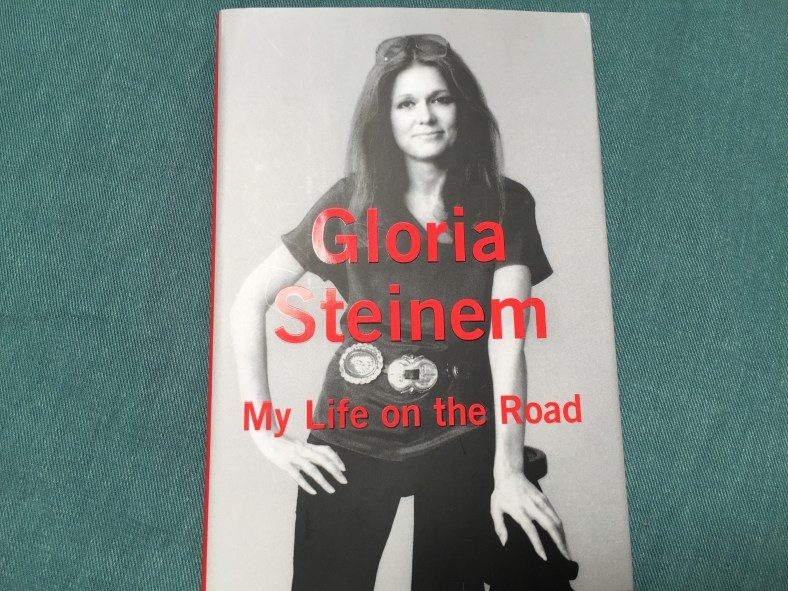
The Saturday Read ‘My Life on the Road’ by Gloria Steinem

The Saturday Read this week comes from an author who describes herself as “an entrepreneur of social change”.  It’s a work identity that encompasses writer. lecturer, political activist and feminist organizer. For this book, ‘My Life on the Road’, Gloria Steinem shares “the most important, longest-running, yet least visible part of my life”.

In the introduction, Ms. Steinem expresses her hope that her example of life on the road will tempt readers to explore the country – to have “an on the road state of mind and be present with all five senses.” 

“After I joined the ranks of traveling organizers – which just means being an entrepreneur of social change – I discovered the magic of people telling their own stories to groups of strangers. It’s as if attentive people create a magnetic force field for stories the tellers themselves didn’t know they had within them. Also, one of the simplest paths to deep change is for the less powerful to speak as much as they listen, and for the more powerful to listen as much as they speak.

One of these stories opens the book and involves a group of women arriving in South Dakota for a Lakota Sioux powwow, and a subsequent encounter at breakfast, with a couple attending one of the largest annual biker rallies in the country.

“I tell you this story because it’s the kind of lesson that can be learned only on the road. And also because I’ve come to believe that, inside, each of us has a purple motorcycle.

We only have to discover it and ride.”

The book is best read as a series of short stories, with each chapter offering a clue to Ms. Steinem’s own ‘purple motorcycle’ adventure.

In the chapter, ‘One Big Campus’ she describes the places where she has spent “the single largest slice of my traveling pie..”, from the early days of draft protests through through efforts to diversify curricula.

“How do I love campuses? Let me count the ways. I love the coffee shops and reading rooms where one can sit and talk or browse forever. I love the buildings with no addresses that only the initiated can find, and the idiosyncratic clothes that would never make it in the outside world. I love the flash parties that start in some odd spot and can’t be moved , and the flash seminars that any discussion can turn into. I love the bulletin boards that are an education in themselves, the friendships between people who would never have otherwise met, and the time for inventiveness that produces say, an exercise bike that powers a computer. Most of all I love graduations. They are individual and communal, an end and a beginning, more permanent than weddings, more inclusive than religions and possibly the most moving ceremonies on earth.”

She closes the chapter with an affirmation that the Internet is not enough and offers an argument for the value of college.

“…we need to keep creating the temporary world of meetings, small and large, on campuses and everywhere else. In them, we discover we are not alone, we learn from one another, and so we keep going toward shared goals.”

This is the narrative of a traveler who has discovered that home and the road are equally important.

“I can go on the road – because I can come home. I come home – because I am free to leave. Each way of being is more valued in the presence of the other. This balance between making camp and following the seasons is both very ancient and very new. We all need both.”  

And I believe she would like us all to venture beyond our address, be it physical or virtual.

“What seems to be one thing from a distance is very different close up.”  In reading ‘My Life on the Road’ what we might have perceived of Ms. Steinem in our rear view mirror, may appear a bit different, close-up.

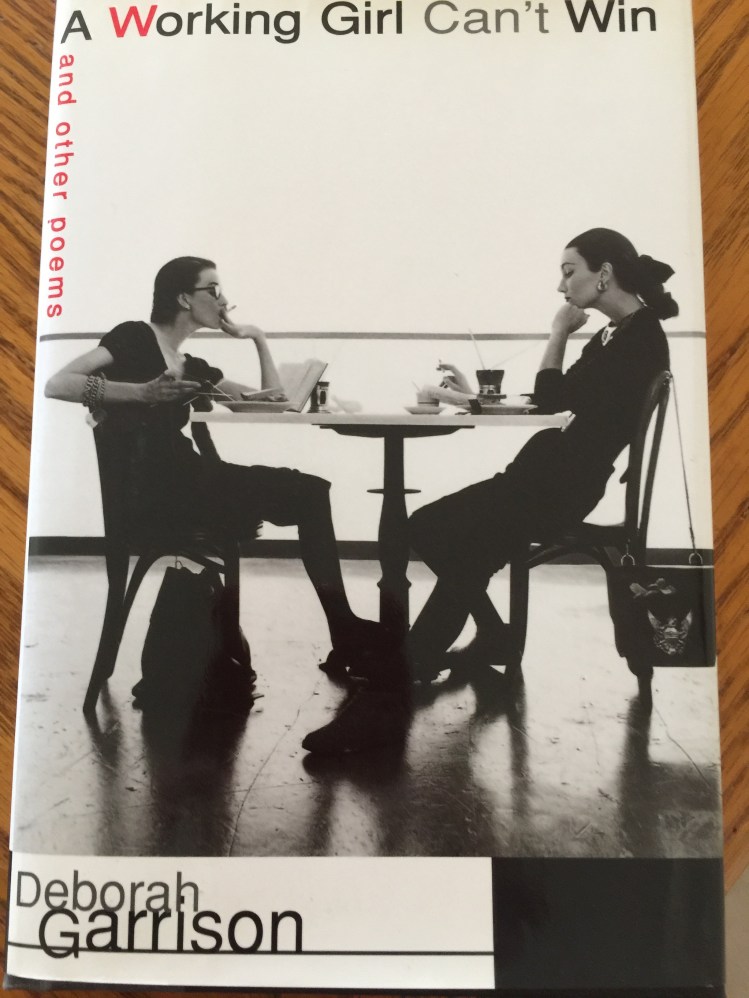
‘Worked Late on a Tuesday Night’ a poem by Deborah Garrison

Have you ever read a poem and realized that the poet has somehow snatched your body and experience, and transcribed both into a lyrical expression of your reality? There was a time, in the late 90s, working in New York, when the poetry of Deborah Garrison gave voice to those who believed you could have it all.

The Friday poem this week is ‘Worked Late on a Tuesday Night’, with Garrison’s words still relevant, even if Uber robs us of the experience of standing in the freezing rain trying to hail a cab.

Worked Late on a Tuesday Night

Again.
Midtown is blasted out and silent,
drained of the crowd and its doggy day.
I trample the scraps of deli lunches
some ate outdoors as they stared dumbly
or hooted at us career girls—the haggard
beauties, the vivid can-dos, open raincoats aflap
in the March wind as we crossed to and fro
in front of the Public Library.

Never thought you’d be one of them,
did you, little Lady?
Little Miss Phi Beta Kappa,
with your closetful of pleated
skirts, twenty-nine till death do us
part! Don’t you see?
The good schoolgirl turns thirty,
forty, singing the song of time management
all day long, lugging the briefcase

home. So at 10:00 PM
you’re standing here
with your hand in the air,
cold but too stubborn to reach
into your pocket for a glove, cursing
the freezing rain as though it were
your difficulty. It’s pathetic,
and nobody’s fault but
your own. Now

the tears,
down into the collar.
Cabs, cabs, but none for hire.
I haven’t had dinner; I’m not half
of what I meant to be.
Among other things, the mother
of three. Too tired, tonight,
to seduce the father.

Deborah Garrison   ‘A Working Girl Can’t Win: and other poems’ 1998

After a 50 year absence, the humanities return to medicine

Medicine remains one of the fields that is defined by a hierarchy that would rival the world of Downton Abbey at its pinnacle. Over fifty years ago medical training lost track of the humanities and with it the ability to effectively connect with colleagues and patients as fellow humans.

The intensity of preparation for acceptance to a top medical school only deepens with competition for internships and residencies. Doctors in training represent the best and the brightest, but often not the top of the class when it comes to emotional intelligence.

At a time when college is increasingly defined as vocational prep, with students choosing majors based on perceived guarantees of post-grad employment, medicine is stepping back from its singular focus on the sciences and reintroducing the humanities to remove barriers created by hospital hierarchy, promote teamwork and improve patient communication.

Dr. Tara Narula, a medical contributor for CBS This Morning, reported Thursday on a program in Boston that “teaches physicians in training to use their eyes and ears to connect with patients and enhance the practice of medicine.”

“At the Brigham and Women’s Hospital, doctors, nurses and Harvard medical students are helping reshape medical education. By day, members of the integrated teaching unit, or ITU, focus on treating patients. But at night, they fix their sights on works of art.

At the Museum of Fine Arts in Boston, art becomes a catalyst to strengthen clinical and interpersonal skills, softening the hard science of medicine with creative expression.

Dr. Joel Katz designed the art curriculum at Brigham and Women’s, which has become a model for other hospitals.

Katz chose the art museum because it “allows everybody to focus on an external object in a way that I would say takes the personal aspects out and lets them solve problems together.”

Activities are carefully designed to enhance team-building, and to break down the hospital hierarchy, junior staff members are paired with more senior colleagues. Observing and describing art is used to promote problem solving, communication, thinking outside the box and appreciating other perspectives.”

Increasingly, schools of medicine are recognizing the need to ‘humanize’ medical practitioners, including Columbia University’s program in Narrative Medicine and Stanford University’s Medicine and the Muse program. And a quick review of the best seller lists over the past decade, will reveal an impressive list of physicians who have exercised their talents in the humanities: Adam Verghese, Atul Gawande, Oliver Sachs, Siddhartha Mukherjee, and this month, Paul Kalanithi.

“With this program, Dr. Joel Katz hopes to find some of the human interaction that has been lost in medicine.

In fact, as recently as 50 years ago, humanities were at the core of medical practice. While research into this program’s effects is still ongoing, there is strong anecdotal evidence that both patients and practitioners benefit.”