The Year@Work: 2017

The workplace took center stage in the global news of 2017. This was the year of the journalist, women@work, side-hustles and maintaining focus. It was also the year that we, as a society questioned expertise.

Two quotes summed up 2017 for me:

“I want one day without a CNN alert that scares the hell out of me”
Cecily Strong  (2/12 SNL skit )

“How do we measure ‘fulfillment’ in work, and where do we find it when the traditional channels have given way to a round-the-clock hustle?”
Meghan Daum (9/15 NYT Book Review)

It was a year of constant distraction, disruption and fake news. The workplace became a refuge, and activism an essential ‘after hours’ pursuit. Low unemployment rates held, while wages stagnated. The income inequality gap widened.

An overheard conversation on the street this week: “I haven’t had a day off since September 1, with the three jobs I’ve been juggling.” This is the new American workplace.

The year@work was the year of the journalist. Although many were bullied and threatened, the coverage of workplace issues was stellar. For this year in review, I recommend some of the best writing of the year, suggest a book from the new genre ‘UpLit’ and share a few random thoughts.
IMG_8149.jpgWomen@work
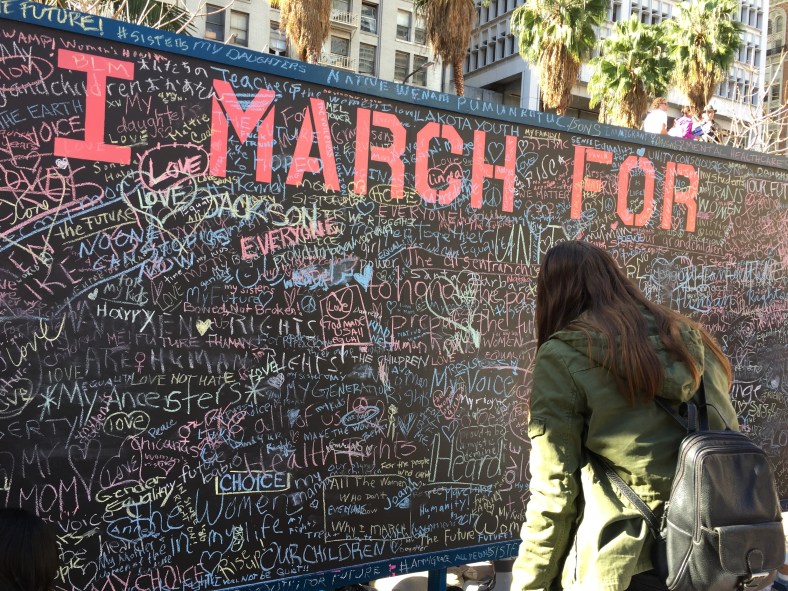
On a cool Saturday morning in January we headed downtown to join a protest march. The plan had been to park the car and take the light rail. There were no parking spaces. There are always parking spaces. Something was different.

What was different was this wasn’t a march, it was a ‘standing in place’ because there were too many people and nowhere to go. In downtown LA the crowd was a mosaic of SoCal demographics. It wasn’t a ‘woman’s march’, it was a ‘families march’ in support of women. I think that may be the one thing the press missed this year.

IMG_8191.jpgAt the time many were skeptical.  The Los Angeles Times reported: “New protest era may be emerging, but sustaining unity could prove difficult.”

Yes, it has been difficult, but subsequent elections on local, state and federal levels demonstrated an ongoing commitment to civic engagement. The gig economy has a new ‘side-hustle’ and it’s called involvement.

I believe the seeds for #MeToo were planted on January 21, 2017.

Workplace Harassment

On February 19, former Uber employee, Susan Fowler posted a blog about her experience as a software engineer. “It’s a strange, fascinating, and slightly horrifying story that deserves to be told while it is still fresh in my mind, so here we go…”

On December 11, Ms. Fowler was named the Financial Times’ Person of the Year.
“Women have been speaking up for many, many years, but were very rarely believed, and there were almost never any real consequences for offenders,” Ms Fowler told the Financial Times. “This year, that completely changed.”

Two other stories of note broadened the narrative of women@work in Silicon Valley:
‘The Ellen Pao Effect Is What Happens After Lean In’Jessi Hempel for Wired, September 20, 2017
‘Why is Silicon Valley So Awful to Women?’Liza Mundy for The Atlantic, April 2017
fearless girl.jpgOn October 5 the first major story on workplace harassment in Hollywood was reported in The New York Times.  Since then, some of the best journalists have both reported and reflected on the relationship between men, power and women@work.

Here’s a sampling of the best:
‘Harvey Weinstein Paid Off Sexual Harassment Accusers for Decades’Jodi Kantor and Megan Twohey for The New York Times, October 5, 2017
‘From Aggressive Overtures to Sexual Assault: Harvey Weinstein’s Accusers Tell Their Stories’Ronan Farrow for The New Yorker, October 10, 2017
‘Your Reckoning and Mine’Rebecca Traister for The Cut, November 12, 2017
‘The Cost of Devaluing Women’Sallie Krawcheck for The New York Times, December 2, 2017
rose reading room.jpgThe questioning of expertise

At work, you know the value of the expertise you bring to your organization. You may be a generalist, a specialist or a combination. You bear the scars and carry the laurels of hard won achievement, and you are compensated for your talent. Colleagues ‘pick your brain’ to complement their own skill set. Customers rely on your advice.

That’s why ‘How America Lost Faith in Expertise’ by Tom Nichols is required reading.

“I fear we are moving beyond a natural skepticism regarding expert claims to the death of the ideal of expertise itself: a Google-fueled, Wikipedia-based, blog-sodden collapse of any division between professionals and laypeople, teachers and students, knowers and wonderers — in other words, between those with achievement in an area and those with none.

A modern society cannot function without a social division of labor. No one is an expert on everything. We prosper because we specialize, developing formal and informal mechanisms and practices that allow us to trust one another in those specializations and gain the collective benefit of our individual expertise…The relationship between expert and citizens rests on a foundation of mutual respect and trust.”
IMG_8367.jpgThe gig/side-hustle career

The world of work has changed. We’re not going to time-travel back to a magical place where work fit neatly into single employer; 9-5, five-day a week increments. Whatever you choose to label the current paradigm, it’s a patchwork of assignments, for a variety of employers: some resulting in valuable skill development and others providing the means to an end. And it’s exhausting.

Jia Tolentino examined the consequences of our new work/life for the New Yorker.
‘The Gig Economy Celebrates Working Yourself to Death’ March 22, 2017. “It does require a fairly dystopian strain of doublethink for a company to celebrate how hard and how constantly its employees must work to make a living, given that these companies are themselves setting the terms. And yet this type of faux-inspirational tale has been appearing more lately, both in corporate advertising and in the news.

“There’s a painful distance between the chipper narratives surrounding labor and success in America and the lived experience of workers.”

IMG_9786.jpgUp lit: A new genre emerges in publishing

In the September article for the NYT Book Review, Meghan Daum reviewed three memoirs.“I’ve always believed some of the best material comes from the workplace…it’s the job site, the place where our skills are honed and our labors converted to currency, that truly defines not just our proficiencies but our element.”

I would agree.

Danuta Kean reported for the Guardian: ‘Up lit: The new book trend with kindness at its core’ “A bruising year dominated by political and economic uncertainty, terrorism and tragedy has, publishers say, kickstarted a new trend they have have branded “up lit”…bookbuyers are seeking out novels and nonfiction that is optimistic rather than feelgood.”

One of her favorites was also mine. ‘Eleanor Oliphant is Completely Fine’ by Gail Honeyman, a perfect example of how fiction can outdistance non-fiction when it comes to our relationship to work and our colleagues.

IMG_9162.jpgIt begins: “When people ask me what I do – taxi drivers, hairdressers – I tell them I work in an office. In almost nine years, no one’s ever asked what kind of office, or what sort of job I do there. I can’t decide whether that’s because I fit perfectly with their idea of what an office worker looks like, or whether people hear the phrase work ‘in an office’ and automatically fill in the blanks themselves – lady doing photocopying, man tapping at a keyboard. I’m not complaining, I’m delighted that I don’t have to get into the fascinating intricacies of accounts receivable with them.”

One other recommendation, looking at work from a different life cycle perspective:
‘Lillian Boxfish Takes A Walk’ by Kathleen Rooney.

“Now I don’t work anymore, and the world is uncomfortable.”

The world is uncomfortable, for many reasons. As 2017 merges into 2018 the question remains for all @work: How will we find fulfillment @work in the new year, amidst a shape-shifting environment where the familiar has been replaced by a round-the-clock hustle?

IMG_8236.jpg

‘Open A New Window’ – Music & Lyrics by Jerry Herman

The ‘Friday Poem’ this holiday week comes from the 1966 Broadway musical, ‘Mame’: the lyrics to ‘Open A New Window’ by Jerry Herman.

The musical, based on the 1955 novel ‘Auntie Mame’ by Patrick Denis, “opened on Broadway at the Winter Garden Theatre on May 24, 1966. Three years later, it transferred to the Broadway Theatre, where it remained until closing on January 3, 1970. It ran a total of 1,508 performances and five previews.”

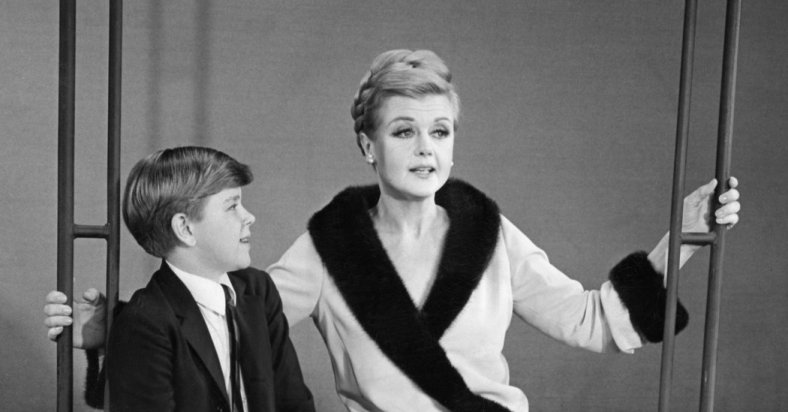
This was the play that produced ‘We Need A Little Christmas’, and the lesser known ‘Open A New Window’. Sung by Angela Lansbury to Frankie Michaels playing her nephew, it conveys some of the best ‘mentoring’ advice for the new year.

Open a New Window

Open a new window,
Open a new door,
Travel a new highway,
That’s never been tried before;
Before you find you’re a dull fellow,
Punching the same clock,
Walking the same tight rope
As everyone on the block.
The fellow you ought to be is three dimensional,
Soaking up life down to your toes,
Whenever they say you’re slightly unconventional,
Just put your thumb up to your nose.
And show ’em how to dance to a new rhythm,
Whistle a new song,
Toast with a new vintage,
The fizz doesn’t fizz too long.
There’s only one way to make the bubbles stay,
Simply travel a new high way,
Dance to a new rhythm,
Open a new window ev’ry day!

Jerry Herman 1966 (Original Cast Recording)


I

The Friday Poem ‘A Copywriter’s Christmas’ by Margaret Fishback

One of my favorite novels of the year was ‘Lillian Boxfish Takes A Walk’ by Kathleen Rooney. The title character was “inspired by the life and work of the poet and ad woman Margaret Fishback, herself the real highest paid female advertising copywriter in the world during the 1930s, thanks to her brilliant work for R.H. Macy’s.”

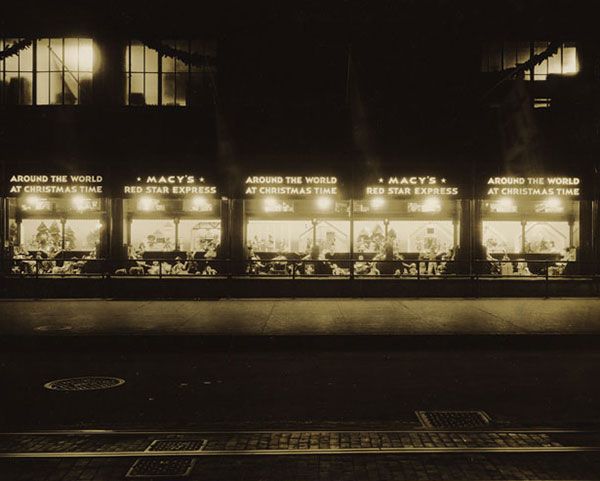
Macy’s holiday windows have become one of the traditions of Christmas in New York. The Friday Poem this week is ‘A Copywriter’s Christmas’ by Margaret Fishback. The photo above captures the 1933 window display, ‘Around the World At Christmas Time’. The country was in the middle of the Great Depression and FDR was in his first year as president.

A Copywriter’s Christmas

The Twenty-fifth is imminent
And every known expedient
Designed for making Christmas pay
Is getting swiftly under way.
Observe the people swarming to
And fro, somnambulating through
The stores in search of ties and shirts
And gloves to give until it hurts.

They’re eyeing gifts in Saks’ and Hearn’s
And Macy’s, not to mention Stern’s,
While earnest copywriters are
Hitching their copy to the star
Of Bethlehem quite shamelessly,
For they are duty bound to see
That Peace On Earth Good Will To Men
Gets adequate results again.

Margaret Fishback   ‘Out of My Head’ 1933

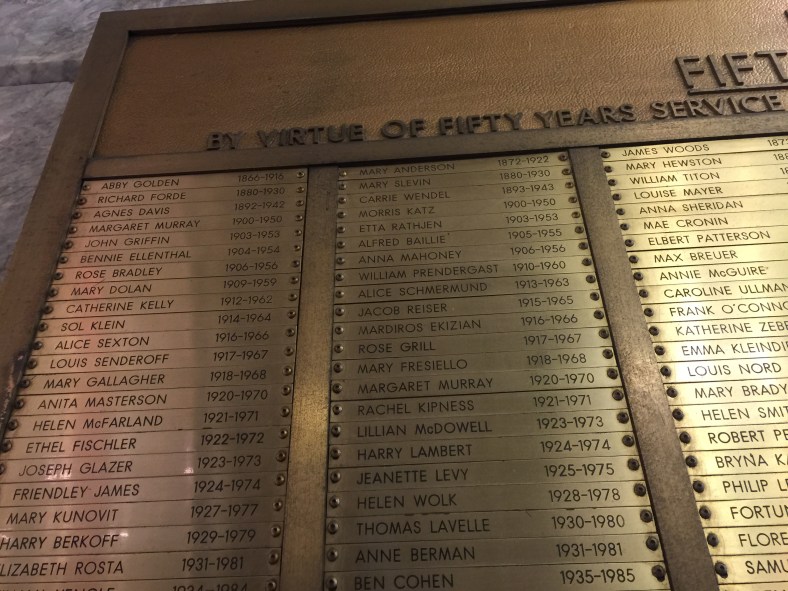
There was another Margaret at Macy’s in 1933, my great-aunt, Margaret Murray. Her 50 years of service is recognized on a plaque inside the 34th St. Memorial Entrance.

50 year plaque.jpg

Photo credit: Macy’s Christmas display, ‘Around the World at Christmas Time’ 1933 Image courtesy of Landy R. Hales papers, Archives Center, National Museum of American History, Smithsonian Institution


The week@work: three questions, a tree, a word, a phrase (and a rabbit)

It’s almost over. A year of continual brain-numbing ‘breaking news’ and distraction. This week@work the focus is on communication and understanding. A teacher posed three important questions to her students, two journalists tracked the odyssey of a balsam fir tree, Merriam-Webster and Oxford dictionaries selected the word of the year and we found the origin of  the phrase ‘glass ceiling’. (And there’s a rabbit.)

The New York Times investigative journalist and author Jodi Kantor‘s work breaking the Harvey Weinstein story demonstrated the value of solid reporting in a time of fake news. But it was her tweet last week that caught my attention.

These are “excellent questions” to ask when evaluating a news story. They can also be added or modified to our repertoire@work. Questions@work are essential, as Academy Award winning producer Brian Grazer noted in his 2015 book, ‘A Curious Mind: The Secret to a Bigger Life’.

“If you’re the boss, and you manage by asking questions, you’re laying the foundation for the culture of your company or group. 

You’re letting people know that the boss is willing to listen. This isn’t about being “warm” or “friendly”. It’s about understanding how complicated the modern business world is, how indispensable diversity of perspective is, and how hard creative work is.”

And now, a holiday story: the modern tale of a tree, a farmer, a trucker, a lot owner and a customer.

The American Christmas Tree Association reported “More that 94 million American households, or 79 percent of all households, will display a Christmas tree in their home this holiday season…This represents a slight increase overall in the number of households displaying a Christmas tree this year compared to last year. Of those trees, 80 percent will be artificial trees and 20 percent will be real.”

nypl tree.jpg

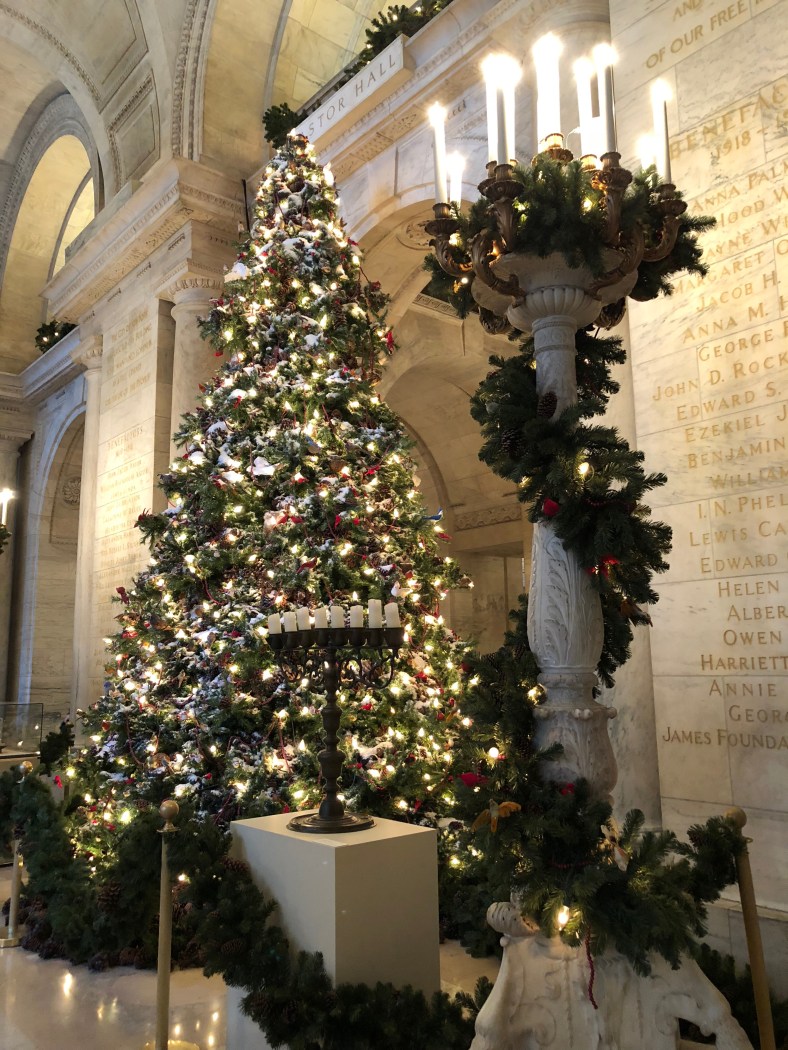
In ‘1,000 miles. Five Days. Four Familes. One Tree.’, journalists Tiffany Hsu and Roger Kisby followed the supply chain of a single ‘real’ balsam fir from a Nova Scotia farm to a living room in Queens.

“In Lunenburg County, a chunk of Nova Scotia pockmarked by lakes and patches of balsam firs, Silver’s Farm hugs a hill with 45 acres of farmland splayed out in front and 150 acres of Christmas trees behind, all growing naturally and tightly “like the hairs on a dog’s back,” said Wayne Silver.

His operation is small, felling just 3,000 trees a season. Some Nova Scotia farms cut down tens of thousands of trees annually and even ship some overseas.

Mr. Silver took over the farm in 1991 from his father, who took it over from his father, who began cutting Christmas trees in the 1930s. Trees “are in my blood,” he said.

Help is scarce. In a tight labor market with low unemployment, many other tree farmers are hiring migrants from Mexico and Jamaica. Mr. Silver will likely follow suit next year.

“I just work too many long hours,” he said.”

This ‘must read’ multi-media gem captures the changing world of work in North America for farmers, truckers, small business owners and customers.

WOTY-youthquake-banner-760x220.jpg

It’s that time of year when those @work in the cataloging of words announce their ‘word of the year’. The Oxford Dictionaries chose “the noun, youthquake, defined as ‘a significant cultural, political, or social change arising from the actions or influence of young people’.”

IMG_8130

“Merriam-Webster’s Word of the Year for 2017 is feminism. The word was a top lookup throughout the year, with several spikes that corresponded to various news reports and events. The general rise in lookups tells us that many people are interested in this word; specific spikes give us insight into some of the reasons why.”

And while we’re on the topic, did you ever wonder where the phrase ‘glass ceiling’ originated? This past week, the BBC interviewed management consultant Marilyn Loden who coined the phrase almost 40 years ago.

“I first used the phrase “glass ceiling” in 1978 during a panel discussion about women’s aspirations. As I listened, I noted how the (female) panellists focused on the deficiencies in women’s socialisation, the self-deprecating ways in which women behaved, and the poor self-image that many women allegedly carried.

It was a struggle to sit quietly and listen to the criticisms.

True, women did seem unable to climb the career ladder beyond the lowest rung of middle management, but I argued that the “invisible glass ceiling” – the barriers to advancement that were cultural not personal – was doing the bulk of the damage to women’s career aspirations and opportunities.

javits-center.jpg

On 24 May 2018, the “glass ceiling” will be 40 years old.

What has changed for working women in that time? The sheer number of female managers has increased dramatically across most industries and yet the metaphor continues to symbolise an enduring barrier to gender equality – one that has been normalised in many organisations where there is now a sense of complacency about the lack of women at the top.”

One last story this week@work: ‘Harvey Is A Great Holiday Movie’ by Jennifer Finney Boylan
“…if the holiday season means anything at all, it’s about believing in things that we cannot actually see. That virtues as shopworn as faith, hope and love can abide, even if others think you’re a crazy person for believing in them. That those we have lost — parents, friends, even our own younger selves — can live on, in us. That there really are spirits that can make us more than ourselves, that can turn our perilous, fallen lives into something sacred.”


IMG_7796.jpg


The week@work: Person of the Year, Pantone color of the year, unemployment and Colin Kaepernick

This week@work Time Magazine announced their Person of the Year for 2017 and Pantone launched the annual color for 2018. The unemployment rate remained at 4.1% and Colin Kaepernick received Sports Illustrated’s Muhammad Ali Legacy Award.

On Wednesday morning Time Magazine announced the 2017 Person of the Year: ‘The Silence Breakers’. Chosen from a group of ten finalists, the magazine recognized a group of people who came forward to unmask workplace harassment.

person-of-year-2017-time-magazine-cover1

“This reckoning appears to have sprung up overnight. But it has actually been simmering for years, decades, centuries. Women have had it with bosses and co-workers who not only cross boundaries but don’t even seem to know that boundaries exist. They’ve had it with the fear of retaliation, of being blackballed, of being fired from a job they can’t afford to lose. They’ve had it with the code of going along to get along. They’ve had it with men who use their power to take what they want from women. These silence breakers have started a revolution of refusal, gathering strength by the day, and in the past two months alone, their collective anger has spurred immediate and shocking results: nearly every day, CEOs have been fired, moguls toppled, icons disgraced. In some cases, criminal charges have been brought.”

“The women and men who have broken their silence span all races, all income classes, all occupations and virtually all corners of the globe. They might labor in California fields, or behind the front desk at New York City’s regal Plaza Hotel, or in the European Parliament. They’re part of a movement that has no formal name. But now they have a voice.”

In the workplace, everyone loses  when women are devalued. Sallie Krawcheck tallied the cost in one of the most widely read articles last week.

“What we are only beginning to recognize is that demeaning and devaluing women is an insidious, expensive problem. It’s not just the eye-popping settlements in some cases, like the $32 million paid by Bill O’Reilly to settle a harassment claim. Nor is it just the high salaries network stars have been making while allegedly assaulting subordinates, like the $20 million, or more, for Matt Lauer. It only starts there.

The bigger cost derives from how women’s ideas are discounted and their talent ignored. I have seen it up close in the two worlds I know best: Wall Street, where I was chief executive of Smith Barney and of Merrill Lynch Wealth Management, and in Silicon Valley, where I’ve raised money to run my start-up, Ellevest. These places are perhaps the purest microcosms of capitalism, and their lessons are instructive for all of us.”

While we’re on the topic, Katie Rogers explored the bias ‘When Our Trusted Storytellers Are Also the Abusers’.

“For decades, the journalists Matt Lauer, Charlie Rose, Bill O’Reilly and Mark Halperin appeared in front of cameras and tried to help Americans understand the country and one another. Now that they’ve lost their jobs after multiple accusations of sexual abuse, we are left wondering what they taught us.

How much did the abuse of women — often younger, subordinate or not famous — by powerful male journalists factor into the stories they told us? What did we learn about power, politics, accountability, elections — or even about Hillary Clinton, the first female presidential candidate from a major party?”

On a lighter, more regal note, Pantone has announced its color choice for 2018, moving away from 2017’s ‘Greenery’ to ‘Ultra Violet’, just in time for holiday shopping.

pantone-color-of-the-year-2018-ultra-violet-banner.jpg

Camila Domonoske reported on the shift. “Each color of the year encompasses something about fashion, decorating and design trends while also reflecting “what’s needed in our world today,” the Pantone Color Institute’s vice president, Laurie Pressman asserted in a statement.

So. What does purple have to say about our planet in 2018?

It’s “a dramatically provocative and thoughtful purple shade,” Pantone says, one that “communicates originality, ingenuity, and visionary thinking that points us towards the future.”

Purple is often associated with royalty, nobility, luxury, power, and ambition. Which now may be attainable with a simple wardrobe update. Or, hard work; which more of us are doing as the Labor Department released the new unemployment report showing an unexpected addition of 228,000 jobs in November. “Economists expect that in time, wages will post a sustained pickup, which has remained elusive in this expansion even though labor-market slack is steadily disappearing.”

One of the finalists for Time’s Person of the Year, former San Francisco 49ers quarterback, Colin Kaepernick, received the Muhammad Ali Legacy Award from Sports Illustrated on Tuesday night.

Colin-Kaepernick-Man-of-the-Year-1217-GQ-FECK02-01.jpg

“Kaepernick began kneeling during the national anthem last season to protest racial inequality and police brutality. The demonstration sparked a wave of protests by NFL players during the anthem that repeatedly have been denounced by President Donald Trump.

He spoke Tuesday about continuing Ali’s legacy of fighting social injustice, saying the boxing great “mentored me without ever meeting me.”

Kaepernick has not had a contract since leaving the 49ers in March and recently filed a grievance vs. the NFL. Ken Belson provided an update, ‘Explaining the Grievance Case That Kaepernick Filed Against the NFL’.

“You may not have heard much about it lately because it is transpiring behind closed doors. And it is unlike any legal proceeding you might have seen before, not really a trial but with elements of one.

The rules on how the investigation is conducted and by whom — and all the quirks of what evidence is allowed — are detailed in the byzantine labor agreement between the league and players.

It was designed with due process in mind, but as often happens with cases involving the N.F.L., the decisions are appealed and end up in federal court.”

If he is successful, “Kaepernick would receive twice what he might have earned if he was playing. However, “The league cannot force a team to assess or sign Kaepernick.”

To all the ‘silence breakers’, this was your week@work.


Martha Stewart’s Thanksgiving/Job Search Advice

With Thanksgiving only a few days away, it’s the season to consult Martha Stewart for job search advice.

In a book published in 2005 entitled ‘The Martha Rules’, Ms. Stewart defined ten essentials for achieving business success. Let’s focus on #8 – “The pie isn’t perfect? Cut it into wedges – When faced with a business challenge, evaluate or assess the situation, gather the good things in sight, abandon the bad, clear your mind and move on.”

How do you apply this to your job search? Maybe the thought of competing in this economy is just overwhelming. Or, you’ve been going through a series of first round interviews and none have materialized into a full time offer. You have a business challenge. Time to assess you progress. What have you learned from the process so far? Are you focused on the rejections or the possibilities?

The job search is difficult. It requires a lot of hard work. You may be discouraged by rejection. Rather than focusing on the negative, use this holiday break as a point to leave the bad behind and as Martha says, clear your mind and move on.

To be successful in a job search today you need to honestly evaluate your strengths. What’s your area of expertise? Which employers can best use your skill set? Don’t waste time on job listings that don’t match your talents. If you find a perfect match, but the employer decides you’re not qualified, move on to the next one on your list.

Which brings me to Martha rule #6: ”Quality every day – Strive for quality in every decision, every day.” There are no short cuts. Approach each new opportunity with the energy of your first choice.

The Friday Poem ‘Thanksgiving’ by Linda McCarriston

This year poetry has regained its’ place in our culture. One poem, meant to be read as a whole, can express our peculiar moment in time with a single line. “Any deliberate leap into chaos, small or large, with an intent to make order, matters.” Written in 1984, the Friday poem is ‘Thanksgiving’ by Linda McCarriston.

Thanksgiving

Every year we call it down upon ourselves,
the chaos of the day before the occasion,
the morning before the meal. Outdoors,
the men cut wood, fueling appetite
in the gray air, as Nana, Arlene, Mary,
Robin—whatever women we amount to—
turn loose from their wrappers the raw,
unmade ingredients. A flour sack leaks,
potatoes wobble down counter tops
tracking dirt like kids, blue hubbard erupts
into shards and sticky pulp when it’s whacked
with the big knife, cranberries leap away
rather than be halved. And the bird, poor
blue thing—only we see it in its dead skin—
gives up for good the long, obscene neck, the gizzard,
the liver quivering in my hand, the heart.

So what? What of it? Besides the laughter,
I mean, or the steam that shades the windows
so that the youngest sons must come inside
to see how the smells look. Besides
the piled wood closing over the porch windows,
the pipes the men fill, the beers
they crack, waiting in front of the game.

Any deliberate leap into chaos, small or large,
with an intent to make order, matters. That’s what.
A whole day has passed between the first apple
cored for pie, and the last glass polished
and set down. This is a feast we know how to make,
a Day of Feast, a day of thanksgiving
for all we have and all we are and whatever
we’ve learned to do with it: Dear God, we thank you
for your gifts in this kitchen, the fire,
the food, the wine. That we are together here.
Bless the world that swirls outside these windows—
a room full of gifts seeming raw and disordered,
a great room in which the stoves are cold,
the food scattered, the children locked forever
outside dark windows. Dear God, grant
to the makers and keepers power to save it all.

from ‘Talking Soft Dutch’   Texas Tech Press   1984

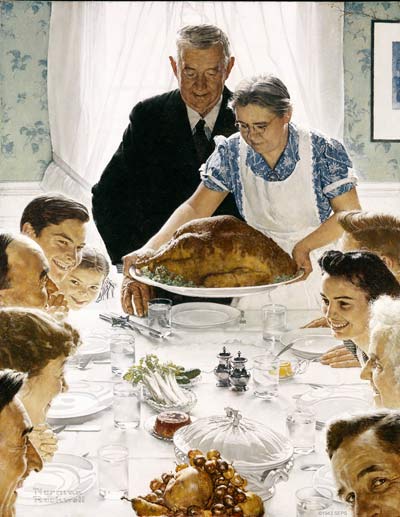
Photo credit: ‘Freedom from Want’ Norman Rockwell for The Saturday Evening Post March 13,1943

The week@work – why the world comes to NY, the last ‘corner office’,”the things I shrugged off” & Shalane Flanagan

This week@work we remember the victims of terrorism on the bicycle path in Lower Manhattan and reflect on why the world comes to New York. On Sunday, the weekly ‘Corner Office’ column came to an end, a journalist shared her experience in the ‘gray area’ of sexual harassment and an American woman won the New York Marathon.

Memory
“I remember so well the first time I visited New York.” Contributing Op-Ed writer, Aatish Taseer shared his personal connection to the city as he honored Tuesday’s victims. “Most of the eight people killed in the terrorist attack in Lower Manhattan on Tuesday were foreigners visiting New York. One group, especially — five friends from Argentina celebrating the 30th anniversary of their high school graduation — had been planning their trip for years. They were part of a great unorganized commonwealth of people, out in the world, whose imagination New York has captured. It is heartbreaking to think that those for whom the dream of New York is most alluring should be the victims of so vivid a nightmare.”

Leadership
After 525 ‘Corner Office’ columns, journalist Adam Bryant ended his series with ‘How to Be The Big Boss’.

IMG_9900.jpg

“It started with a simple idea: What if I sat down with chief executives, and never asked them about their companies?

The notion occurred to me roughly a decade ago, after spending years as a reporter and interviewing C.E.O.s about many of the expected things: their growth plans, the competition, the economic forces driving their industries. But the more time I spent doing this, the more I found myself wanting to ask instead about more expansive themes — not about pivoting, scaling or moving to the cloud, but how they lead their employees, how they hire, and the life advice they give or wish they had received.

My vote for career advice goes to something I heard from Joseph Plumeri, the vice chairman of First Data, a payments-processing company, and former chief executive of Willis Group Holdings. His biggest career inflection points, he told me, came from chance meetings, giving rise to his advice: “Play in traffic.”

“It means that if you go push yourself out there and you see people and do things and participate and get involved, something happens,” he said. “Both of my great occasions in life happened by accident simply because I showed up.”

Harassment
“What do you do when the big bank CEO calls your hotel room at 11 p.m.? Journalist and radio host Lizzie O’Leary reflected on a career of compromises and broadened the audience who might identify with #MeToo.

“Over the course of my career, I have shrugged off things that horrify me now. I learned to push through the routine humiliation. As an ambitious woman, I often ran an internal calculation about how much “trouble” I was willing to make. Should I fight about the story I want to do or the unwelcome remark about my legs? Time and time again, I went with the former. If I hadn’t, I don’t know if I would have been as successful. I’m not ashamed about wanting a career, but I can’t look back at some of my actions without wincing.

Now, in a senior position, I look at my brilliant younger colleagues, and I never want them to endure what for years I told myself was “gray stuff.” Ignoring it, as I’d learned to do, only lets it fester and continue.

I don’t know how to change centuries of conditioning. How to make men see women as peers. To let us just do our jobs. But maybe acknowledging that we live in a culture that doesn’t do that, is a start. I’m a radio host now. I believe strongly in the power of conversation. It is incumbent on everyone to talk about this.”

Career
What did you do on Sunday for two hours and 26 minutes? Shalane Flanagan ran through the streets of New York to become the first American woman in 40 years to win the New York Marathon.

shalane flanagan.jpg

Bonnie Ford reported on the athlete and the race.
“How my career ends is super important to me,” she told me in early April, still recovering from an iliac fracture that kept her out of her hometown Boston Marathon and unsure when she’d be able to resume high-volume training. “It doesn’t mean I’m going to win a major, but at least I’m going to try to win a major marathon in the U.S., and I need at least two more events.”

She said it again and again and again, right up until the ever of Sunday’s race. She’s also savvy enough to recognize that happy endings are especially hard to come by for marathoners, who generally have just two chances per calendar year in the window between their mid-20s and mid-30s, if they stay healthy.

Will New York be Flanagan’s walk-off run? The emotional lure of Boston is still out there, not to mention her instantly increased marketability. But her business, in a deeper sense, is finished. “This means a lot to me, to my family, and hopefully inspires the next generation of American women to just be patient,” Flanagan told reporters Sunday. Patient until the road starts to run out, and it’s time to make a move.”


Photo credit: Shalane Flanagan – AP Photo/Seth Wenig

The Friday Poem – The Purpose of Poetry

On October 26, 1963, less than a month before his death, U.S. President John F. Kennedy visited Amherst College to deliver a speech at the groundbreaking for the Robert Frost Library.

“In publishing the remarks after Kennedy’s murder, The Atlantic noted that he“identified himself, as no president before him has done so poignantly, with ‘books and men and learning.’ ”

Today, 54 years later, rather than a Friday Poem, the text of the address delivered that day by the 35th President of the United States, in recognition of the contribution of Robert Frost and the place of poetry in our national value set. This is what American leadership looks like.

Our national strength matters, but the spirit which informs and controls our strength matters just as much. This was the special significance of Robert Frost. He brought an unsparing instinct for reality to bear on the platitudes and pieties of society. His sense of the human tragedy fortified him against self-deception and easy consolation. “I have been” he wrote, “one acquainted with the night.” And because he knew the midnight as well as the high noon, because he understood the ordeal as well as the triumph of the human spirit, he gave his age strength with which to overcome despair. At bottom, he held a deep faith in the spirit of man, and it is hardly an accident that Robert Frost coupled poetry and power, for he saw poetry as the means of saving power from itself. When power leads men towards arrogance, poetry reminds him of his limitations. When power narrows the areas of man’s concern, poetry reminds him of the richness and diversity of his existence. When power corrupts, poetry cleanses. For art establishes the basic human truth which must serve as the touchstone of our judgment.

The artist, however faithful to his personal vision of reality, becomes the last champion of the individual mind and sensibility against an intrusive society and an officious state. The great artist is thus a solitary figure. He has, as Frost said, a lover’s quarrel with the world. In pursuing his perceptions of reality, he must often sail against the currents of his time. This is not a popular role. If Robert Frost was much honored in his lifetime, it was because a good many preferred to ignore his darker truths. Yet in retrospect, we see how the artist’s fidelity has strengthened the fibre of our national life.

If sometimes our great artists have been the most critical of our society, it is because their sensitivity and their concern for justice, which must motivate any true artist, makes him aware that our Nation falls short of its highest potential. I see little of more importance to the future of our country and our civilization than full recognition of the place of the artist.

If art is to nourish the roots of our culture, society must set the artist free to follow his vision wherever it takes him. We must never forget that art is not a form of propaganda; it is a form of truth. And as Mr. MacLeish once remarked of poets, there is nothing worse for our trade than to be in style. In free society art is not a weapon and it does not belong to the spheres of polemic and ideology. Artists are not engineers of the soul. It may be different elsewhere. But democratic society–in it, the highest duty of the writer, the composer, the artist is to remain true to himself and to let the chips fall where they may. In serving his vision of the truth, the artist best serves his nation. And the nation which disdains the mission of art invites the fate of Robert Frost’s hired man, the fate of having “nothing to look backward to with pride, and nothing to look forward to with hope.”

I look forward to a great future for America, a future in which our country will match its military strength with our moral restraint, its wealth with our wisdom, its power with our purpose. I look forward to an America which will not be afraid of grace and beauty, which will protect the beauty of our natural environment, which will preserve the great old American houses and squares and parks of our national past, and which will build handsome and balanced cities for our future.

I look forward to an America which will reward achievement in the arts as we reward achievement in business or statecraft. I look forward to an America which will steadily raise the standards of artistic accomplishment and which will steadily enlarge cultural opportunities for all of our citizens. And I look forward to an America which commands respect throughout the world not only for its strength but for its civilization as well. And I look forward to a world which will be safe not only for democracy and diversity but also for personal distinction.

Robert Frost was often skeptical about projects for human improvement, yet I do not think he would disdain this hope. As he wrote during the uncertain days of the Second War:

Take human nature altogether since time began . . .
And it must be a little more in favor of man,
Say a fraction of one percent at the very least . . .
Our hold on this planet wouldn’t have so increased.

Because of Mr. Frost’s life and work, because of the life and work of this college, our hold on this planet has increased.”

Listen to speech

Text and recording courtesy of the John F. Kennedy Library and the U.S. National Archives.


The week@work: the crisis of civic education, karoshi, unemployment & the future of office attire

This week@work stories examine the role of education in creating civil discourse, the consequences of karoshi, the impact of weather on unemployment and the future of office attire.

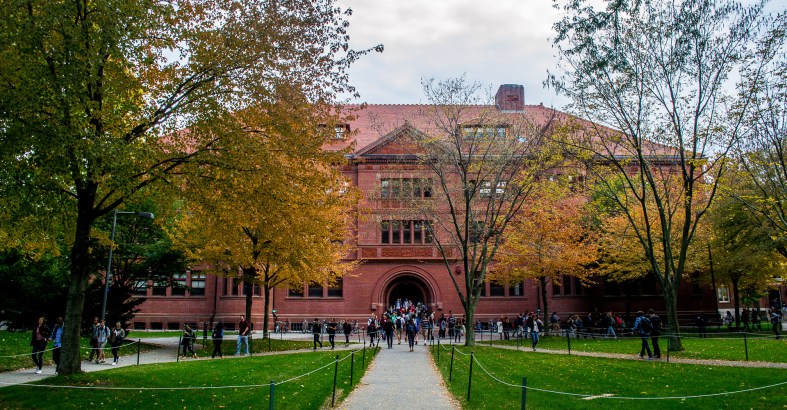
While walking through the U.S.Capitol Visitor Center last week I encountered a group of junior high school students who were shrieking at each other as they reported a sighting of House Speaker Paul Ryan as if he were a chart topping rock star. What if the majority of junior high and high school students had the opportunity to walk the halls of Congress and observe the process of governing?

Harvard president emeritus, Derek Bok examines ‘The Crisis of Civic Education’.

“Schools have long been the primary source of civic education in America. As an early champion of public education, Horace Mann, pointed out more than 150 years ago: “One of the highest and most valuable objects to which the influences of a school can be made conducive consists in training our children to self-government. Yet schools cannot accomplish this task by themselves. Many studies have pointed to the difficulties that hamper their efforts, including inadequate funding and pressures on teachers from school boards, parents, politicians, and textbook publishers. In view of those problems, it is not surprising that the National Assessment of Educational Progress, which periodically evaluates the knowledge of America’s schoolchildren, concluded in 2010 that more than two-thirds of high-school seniors scored below “proficient” in their knowledge of civics and government.”

Once the American high school senior transitions to college, there is no imperative to incorporate “essential courses to equip them to perform their civic functions more effectively” into their curriculum.

HCF_desktop.jpg

“While many colleges claim to be preparing citizens…and although they offer many classes and activities that can contribute to this end, few provide any required courses aimed at achieving that result. Instead, learning to become an active and informed citizen is simply treated as an option — much like preparing to be a doctor or a lawyer or a business executive — even though becoming a citizen is not a choice but a status acquired automatically by the vast majority of undergraduates.”

Bok suggests a number of approaches: linking community involvement experience with academic coursework; connecting the dots between the activity and public policy, engagement with student government and establishing multi-cultural residence halls.

Colleges have a responsibility to lead on this issue. Colleges own this one. If not here, where?

“In today’s diverse and highly partisan society, it is particularly important to teach undergraduates to take account of contrary opinions and arguments and to discuss such differences respectfully. Most campuses are well positioned to encourage these habits…The recent election underscores the importance of extending such efforts to encourage interaction among classmates with different political ideologies and socioeconomic backgrounds.”

Walter Sim reported on ‘Death by overwork: Will Japan finally face up to ‘karoshi’?

“With her mobile phone in hand as if waiting for her next assignment, a 31-year-old political reporter with broadcaster NHK died of heart failure in her sleep in July 2013 after clocking nearly 160 hours of overtime the month before.

Two years later, on Christmas Day, a rookie at advertising giant Dentsu leapt to her death after being subjected to a gruelling schedule and harassment at her workplace.

Osaka Sphere Building

The statistics nationwide are quite startling. Japan’s second annual karoshi White Paper, released last Friday, said there were 191 work-related deaths and attempted suicides in the fiscal year ending March 2017. This was two more than the previous year. In the same fiscal year, 498 cases of mental illness, such as depression, were deemed work-related.

And from January 2010 to March 2015, 368 suicides – 352 men and 16 women – were deemed as karoshi.”

Patricia Cohen reported ‘U.S. Lost 33,000 Jobs in September; Unemployment Rate Dips to 4.2%’.

“Staggering from the impact of hurricanes that walloped Texas, Florida and neighboring states, the economy lost 33,000 jobs in September, the first monthly decline in employment in seven years, the government reported on Friday.

But economists discounted the discouraging report, describing it as a blip in a job market that was fundamentally strong.”

Wondering what to wear this week@work? Jessica Holland asks ‘Are tracksuits and trainers the future of office attire?’

sykes london.jpeg

“They were all wearing trainers and layers of black,” says Evelyn Cotter, a career coach based in London. She’s describing a recent public speaking conference she attended, where the crowd of ambitious young professionals were dressed in a uniform way.

“Everyone had come straight from work, they were wearing black jeans and smart sneakers, but it definitely felt professional,” adds Cotter. “It’s a conscious style choice. It’s not just what you throw on to play with your dog in the garden.”

“The industry of ‘athleisure’ – sporty clothes and shoes that people don’t necessarily wear to play sport – grew by a staggering 42% between 2008 and 2015, according to Morgan Stanley research. More recently, its influence has begun to creep into offices, where workers’ clothing is becoming increasingly relaxed and designed for comfort. The Society for Human Resource Management, an international organisation, tracks how many employers allow workers to dress casually every day, and that figure rose from 32% in 2014 to 44% in 2016.”

Before you head out to your favorite ‘athleisure’ retailer, check the culture and style of your employer. On days when you are meeting with clients, it’s always a good idea to mirror the style of your customer. (or their expectations)

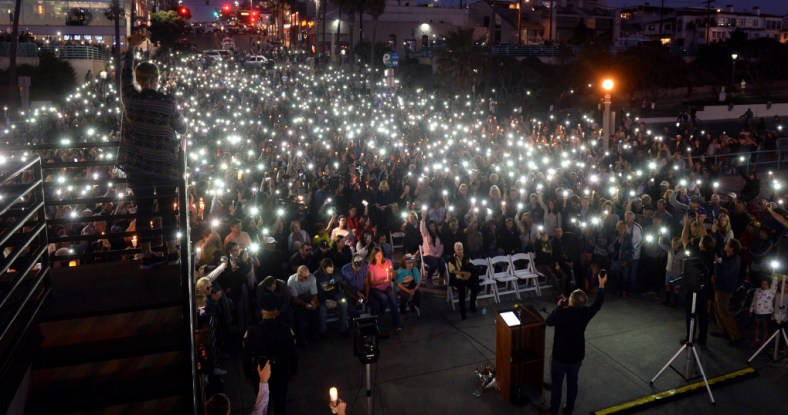
The last story this week@work, was the first story breaking on Monday morning. Folks taking a break from work at a music festival on a Sunday evening in Las Vegas became targets of a mass shooting. In twelve minutes 58 people between the ages of 20 and 67 were murdered; 489 were injured. On Wednesday, the citizens of Manhattan Beach, California gathered on a pier overlooking the Pacific to mourn two of the victims: Sandy Casey, 35, a special education teacher at Manhattan Beach Middle School and Rachael Parker, 33, a records technician with the Manhattan Beach Police Department.

1005_nws_tdb-l-mbvigil-carr01-1.jpgThis week@work consider how you might do more than send thoughts and prayers.


Photo credit: Manhattan Beach vigil, Steve Carr for the Daily Breeze/ Office Attire, Sykes London for British Vogue