The week@work – It’s in the stars: Hollywood stories, #YearInSpace & 18,300 applications

The stories behind the headlines this week@work originate in Hollywood, Geneva, Washington D.C., and on the International Space Station.

The careers of a U.S. deputy trade ambassador and an executive editor for the Washington Post converge in Hollywood, astronaut Scott Kelly captures the final week of his #YearInSpace in photos, and 18,300 applicants aspire to take his place.

Unknown

Would you get up at 4:30 AM every day to pursue your dream? Alexandra Alter reported on a ‘behind the scenes’ Hollywood story about working beyond your ‘day job’.

One of the most successful global trade negotiators added a few hours to his work day 17 years ago to write a novel about fur trader Hugh Glass. His book, ‘The Revenant’ was published in 2002 and sold 15,000 copies. Last year publisher Picador reissued the novel, selling over half a million copies.
images

Michael Punke, the deputy United States Trade Representative and the United States ambassador to the World Trade Organization and author, has become a rock star among colleagues in global trade.

“We all think it’s quite cool,” said Keith Rockwell, a spokesman for the W.T.O., who added that colleagues occasionally tease Mr. Punke by asking him how his buddy Leo is doing. “The W.T.O. isn’t normally known for having a Hollywood connection.”

Some of his colleagues marvel that he has such a successful side career, while steering the country’s international trade policy from his post in Geneva.

“The guy is so talented, you read his bio, and it’s like he has two lives,” said Christopher Wenk, the executive director for international policy at the U.S. Chamber of Commerce.”

Joining Ambassador Punke at the Dolby Theater on Oscar night is current Washington Post executive editor and former Boston Globe editor Martin Baron.

In November, Esquire Magazine ran a career profile asking ‘Is Martin Baron the Best News Editor of All Time?’. In the Oscar nominated film, ‘Spotlight’, actor Liev Schreiber’s performance channels the editor who led the Pulitzer Prize winning team investigating the child abuse scandal in the Catholic Church.
Unknown-1.jpeg

This week, Mr. Baron used his time in the Oscar ‘spotlight’ to reflect on the long term rewards of the film and journalism today, ‘I’m in ‘Spotlight’, but it’s not really about me. It’s about the power of journalism.’

“Aside from the acclaim of critics, “Spotlight” already has delivered one gratifying result. In emails, tweets and Facebook posts, journalists have declared themselves inspired, buoyed and affirmed. That is no small matter in this badly bruised profession. We have felt the traumatizing financial effect of the Internet and been berated by just about everyone, especially politicians in a campaign season that has seen us cynically labeled “scum.”

One journalist wrote me that “the story that inspired the movie serves as a wonderful, wonderful reminder why so many of us got into this business in the first place and why so many stayed despite all the gloom and doom and all the left hooks that landed squarely on our chins along the way.”

The article is required reading for all who earn a living pursuing a journalism career. It should be framed on the walls of journalism schools and be the first google search result on the world ‘journalism’.

Two additional stories about work in Hollywood this week addressed the ongoing conversation on inclusion:

‘From C-Suite to Characters on Screen: How inclusive is the entertainment industry?’ USC Annenberg professor Stacy L. Smith authored the MDSC Initiative’s first report on diversity in the entertainment industry.

Melena Ryzik profiled 27 industry professionals in ‘What It’s Really Like to Work in Hollywood*  (*If you’re not a straight white man.)’

Before leaving the week@work, let’s travel to the International Space Station where astronaut Scott Kelly is completing his 240 day mission in space.

CTeSzSOWIAApQID

“10,944 sunrises and sunsets

“The International Space Station zips around Earth at more than 17,000 miles per hour, or once every 90 minutes. That means over the course of Mr. Kelly’s stay, the space station will have made 5,440 orbits, and the sun will have gone up and down 10,944 times from the perspective of the astronauts aboard. Of course, Mr. Kelly did not see all of them. He is not continuously looking out the window, and he sleeps, too.”

(Scott Kelly tweeted the photo above of sunrise on February 27 and ice earlier today)CcT9mfcW4AAZFvx.jpg

NASA announced this week that it had received 18,300 applications for 14 open spots in the new astronaut class. The recruiting effort which began in the fall demonstrates a rekindled interest in exploration and discovery.

“Now that NASA’s Feb. 18 deadline for applicants has passed, the agency’s 18-month winnowing process has begun.

NASA staff will look at 400 to 600 applicants who survive the initial purge and identify those who pass reference and background checks. Then 120 will be invited to the Johnson Space Center for interviews.

The final 14 will be announced in July 2017 and begin two years of extensive training on spacecraft systems, spacewalking skills, team building and Russian language. Those who complete the program will be assigned to NASA’s Orion deep space exploration ship, the International Space Station or one of two commercial vehicles in development.”

As @StationCDRKelley vacates his spot on the ISS, it’s good to know there are thousands who hope to fill his seat.

This week@work – it’s in the stars, and the dreams of those who aspire to be actors, film makers, journalists, writers, astronauts, and international trade negotiators.


The week@work – A vacancy on the Supreme Court, the power of creative cross training, deciding to ‘jump ship’ and targeting teachers

The headline story of the week@work came with the late Saturday evening announcement of the death of U.S. Supreme Court Justice Antonin Scalia. The theme of transition was echoed in other stories this week, on creative cross-training and deciding when to make your next career move. If you are a teacher, you may be considering both, as educational reform efforts seem to be targeting those leading the classroom vs. students.

A few hours before the Republican candidates were to take the stage in their on-going interview process for the job of U.S. president, news broke that conservative Supreme Court Justice Antonin Scalia had died. Within seconds, it seemed, politicians were redefining the rules on the naming of a successor. In terms of job openings, it’s one of the most coveted appointments in government. The vacancy in the judicial branch will be added to the open position of President and 469 seats in Congress on November 8. It’s enough to overwhelm your average Human Resources manager. Oh, wait, we are the human resources manager here. Time to start paying attention to resumes and experience.

Most of us hope to find meaning in our work, and make some impact on our community with our efforts. For Justice Scalia, his impact was described by Jeffrey Toobin for The New Yorker.

“The loss of Justice Antonin Scalia is immensely significant on two levels. First, Scalia himself ranks among the most influential Justices in American history, alongside such figures as John Marshall, Oliver Wendell Holmes, Jr., and William Brennan. Second, Scalia was the linchpin of the Supreme Court’s five-justice conservative majority. His departure gives President Obama—or a Democratic successor—the opportunity to reshape the ideological balance among the Justices.

When Scalia joined the court, in 1986, the leading school of constitutional interpretation was the “living Constitution”—the claim that the meaning of the document evolves with changes in American society. Scalia brought with him the concept of “originalism”—that the Constitution should be interpreted as its eighteenth-century framers understood it. In practical terms, originalism gives constitutional sanction to conservative politics.

In interpreting laws, he was the leading spokesperson for “textualism,” the idea that, when interpreting laws, courts should look not to legislative history, or congressional “intent,” but rather only to the words of the law itself. While originalism remains controversial within the legal community, textualism won support from nearly all his colleagues (all except Stephen Breyer). This means that the Justices will limit the reach of laws to their precise terms, expanding the court’s power over Congress.”

Srinivas Rao writes about ‘The Power of Creative Cross Training: How Experimentation Creates Possibility’.

Although he is describing the careers of creative professionals, his suggestions to immerse  yourself in tangential activities to broaden your thinking and portfolio, has broad application across career disciplines.

“For most creative professionals, we have a tendency to live within the limitations of our labels: copywriter, web designer, filmmaker, illustrator, and author. Those are the things we do and we get paid for.

The point of creative cross training is to immerse yourself for a short period of time in an art form that is not your primary one. For a writer that could mean designing or drawing something. For a visual artist, that could mean learning to write code.”

An entrepreneur doesn’t have the luxury of labels, and must continually cross train to develop a suite of skills in marketing, finance, customer relations and communication. If you have the mindset of an entrepreneur, creative cross training will become your mandatory daily ritual to stay competitive irrespective of profession.

Creative cross training allows you to take ownership of your career and be prepared for changes @work. Paul Sullivan explored the risks for folks who have ‘jumped ship’, leaving  a stable career to pursue a passion.

“…a Gallup Poll in October found that when American workers make a career change, they almost always do so by leaving their employer instead of taking a new job within the company. Some 93 percent said they took a new role elsewhere. The survey found this was true whether the job change occurred 30 years ago or within the last year.

…consider the tale of DeJuan Stroud, a former Wall Street broker and compliance officer…he gave up his well-paid job and put their modest savings at risk to turn a hobby — floral design, which he had learned from his grandmother growing up in Alabama — into a business.

Now, two decades later, Mr. Stroud is one of the most sought-after floral and event designers in New York City.

His is a success story. But there are big risks in following a similar path — giving up a regular salary and losing your savings for one; throwing away the security of a career is another. For those who go forward, the payoff may be more psychic than monetary, and they need to feel comfortable that the chance of a more modest lifestyle is worth it.”

For some reason, its become ok in our society to devalue the folks who inspire, encourage and transfer knowledge to each generation. Well, it’s not ok and David Denby urges us to ‘Stop Humiliating Teachers’.

“A necessary commonplace: Almost everyone we know has been turned around, or at least seriously shaken, by a teacher—in college, maybe, but often in high school, often by a man or a woman who drove home a point or two about physics, literature, or ethics, and looked at us sternly and said, in effect, You could be more than what you are. At their best, teachers are everyday gods, standing at the entryway to the world. If they are fair and good, they are possibly the most morally impressive adults that their students will ever know. For a while, they are the law, they are knowledge, they are justice.

Our view of American public education in general has been warped by our knowledge of these failing kids in inner-city and rural schools. In particular, the system as a whole has been described by “reformers” as approaching breakdown. But this is nonsense. There are actually many good schools in the United States—in cities, in suburbs, in rural areas. Pathologizing the system as a whole, reformers insist on drastic reorganization, on drastic methods of teacher accountability. In the past dozen or so years, we’ve seen the efforts, often led by billionaires and hedge-fund managers and supported by elected officials, to infuse K-12 education with models and methods derived from the business world—for instance, the drive to privatize education as much as possible with charter schools, which receive public money but are independently run and often financed by entrepreneurs. This drive is accompanied by a stream of venom aimed at unions, as if they were the problem in American education. (Most charter schools hire non-union teachers.) In the real world, however, highly unionized areas of the country, such as the Northeast, produce students with scores higher than the national average in standardized tests; the Deep South, where union teachers are more scarce, produces scores that are lower. So unions alone can hardly be the problem.”

Many recent college graduates, and career changers consider teaching as a career. In reality, our society values the profession at 70% of what peers in other professions earn.  Teachers may not be motivated by money, but that doesn’t allow the rest of us to abdicate our responsibility. It’s time to place a higher premium on those who significantly influence our future.

Two additional articles of interest to consider this week@work:

‘Women in Company Leadership Tied to Stronger Profits, Study Says’ by Daniel Victor “Having women in the highest corporate offices is correlated with increased profitability, according to a new study of nearly 22,000 publicly traded companies in 91 countries.”

‘Why do my co-workers keep confusing me with other people? Because I’m Asian.’ by Iris Kuo   “All my life I’ve been mistaken for other people of my race. It’s a degrading and thoughtless error that boils away my identity and simplifies me as one thing: “that Asian.”


‘Sending Flowers’ by Hannah Stephenson

On this Friday of Valentines weekend, a poem that celebrates the work of the florist, in a creative presentment of the vendor/customer relationship. The Friday Poem this week is ‘Sending Flowers’ by Hannah Stephenson.

Sending Flowers

The florist reads faces, reaches into the mouths of customers.
Turns curled tongues into rose petals,

teeth clinking against one another into baby’s breath.
She selects a cut bloom, a bit of leaf,

lays stem alongside of stem, as if building a wrist
from the inside. She binds them

when the message is right, and sighs at the pleasure
of her profession. Her trade:

to wrangle intensity, to gather blooms and say, here,
these do not grow together

but in this new arrangement is language. The florist
hands you a bouquet

yanked from your head, the things you could not say
with your ordinary voice.

Hannah Stephenson

The week@work – It’s still 3 minutes to midnight, an engineer’s regret, a world run by millennials and the myth of the ‘best jobs’ lists

This week@work began with the announcement that the ‘Doomsday Clock’ has remained at 3 minutes to midnight, and ended with a remembrance day for NASA astronauts lost. Millennials will soon assume a larger role in global leadership and may move the hands of that clock backward, and ‘astronaut’ does not appear on either list released last week, ranking top jobs for 2016.

“Martyl Langsdorf’s “Doomsday Clock,” which first graced the cover of the Bulletin’s print edition in 1947, has served for 69 years to focus the world’s attention on the most pressing global threats. The time on the Clock reflects whether we are more or less safe than last year, and compares the current situation to years further in the past; the decision on where to set the Clock’s hands is an attempt to reconcile the achievements and breakdowns in security efforts, broadly defined, that occur each and every year.

Last year, the Science and Security Board moved the Doomsday Clock forward to three minutes to midnight, noting: ‘The probability of global catastrophe is very high, and the actions needed to reduce the risks of disaster must be taken very soon.’ That probability has not been reduced. The Clock ticks. Global danger looms. Wise leaders should act—immediately.” Bulletin of the Atomic Scientists, 2016

While many hold personal memories of where we were on January 28, 1986, those closest to the program provide a cautionary tale on leadership, communication and the value of trusting the voice of your employees.

As NASA observed a ‘Day of Remembrance’, NPR correspondent, Howard Berkes, returned to Bringham City, Utah to interview Bob Ebling, ’30 Years After Explosion, Challenger Engineer Still Blames Himself’.

“Thirty years ago, as the nation mourned the loss of seven astronauts on the space shuttle Challenger, Bob Ebeling was steeped in his own deep grief.

The night before the launch, Ebeling and four other engineers at NASA contractor Morton Thiokol had tried to stop the launch. Their managers and NASA overruled them.

That night, he told his wife, Darlene, “It’s going to blow up.”

When Challenger exploded 73 seconds after liftoff, Ebeling and his colleagues sat stunned in a conference room at Thiokol’s headquarters outside Brigham City, Utah. They watched the spacecraft explode on a giant television screen and they knew exactly what had happened.”

The Economist contemplated a new global order when the millennials take charge, ‘When the young get older: their time will come’.

“Where some see a generation in crisis, others think the young are adapting quite well to the challenges of a changing world. They flit from job to job not because they are fickle but because job security is a thing of the past. They demand flexible hours and work-life balance because they know they don’t have to be in the office to be productive. They spend six hours a day online because that is how they work, and also how they relax. Their enthusiasm for new ideas (and lack of spare cash) has kickstarted money-saving technologies from Uber to WhatsApp. They take longer to settle down and have children, but so what? They will also be working far later in life than their parents did.

In every generation, the young are the first to take to the streets to demand reform. Sometimes their fury leads nowhere, but autocrats still fear it. That is why China’s government rolled tanks over the Tiananmen Square protesters, and why it censors social media today. Young Africans, for their part, may not put up indefinitely with gerontocrats such as 91-year-old Robert Mugabe of Zimbabwe and 82-year-old Paul Biya of Cameroon.

In democracies, young people will some day realise that signing online petitions is no substitute for voting (just as their elders started voting when they acquired grey hairs and mortgages and sent their children to government schools). When the young show up at polling stations, democratic governments will heed their views. And when the millennials start calling the shots more widely in society, they will do so for a long time. For thanks to steady advances in medical technology, they will remain healthy and able to work for longer than any previous generation. Indeed, if scientists’ efforts to crack the “ageing code” in human genes bear fruit, many of them will live past 120.”

Where are the jobs? That’s the question the experts try to answer each year, identifying the best jobs and best places to work.

U.S. News and World Report announced their 2016 Best Jobs Rankings and glassdoor.com ranked the 25 Best Jobs in America. Orthodontist, dentist, computer systems analyst, nurse anesthetist and physician assistant led the U.S. News Top 100. The glassdooor.com list’s top five included data scientist, tax manager, solutions architect, engagement manager and mobile developer.

It’s always good to have a snapshot of market driven job titles, but it doesn’t help if your ‘dream job’ doesn’t make the list, or even exist. The myth of these lists lie in the impermanence of work. The top jobs this year may vanish from the list next year. It’s about the work you want to do, and the job title you imagine or may create.

Three additional stories this week were reported by journalists at The New York Times: an analysis of the success of Iowa’s economic development, commentary on the career of a veteran NFL quarterback who found joy in his sport but will now have the long off season to consider lessons from a loss, and advice on how to raise a creative child.

‘In Iowa, Jobs Are Plentiful but Workers Are Not’ Patricia Cohen

“At 3.4 percent, Iowa’s unemployment rate is among the lowest in the country. With major metropolitan areas — crowded with hard-hat construction sites — painting an alluring picture of steady economic progress, business leaders here retain a sunny optimism that is rarely heard from the presidential candidates.

But now that Iowa has achieved a tightening labor market that is the envy of most other states, many companies are confronted with a different set of challenges pushing them to rethink everything from recruiting to economic development.”

‘Carson Palmer’s Memorable Season Ends With a Forgettable Night’  William C. Rhoden

“I’ll look back at this season at some point, but not tonight,” Palmer said. “This is the only game that’s on my mind, not the other 16, 17.”

Despite Sunday’s disaster, this was a season in which Palmer reclaimed some of the joy that the business of football and the grind of the sport had taken away.”

‘How to Raise a Creative Child. Step One: Back Off’  Adam Grant

“Child prodigies rarely become adult geniuses who change the world…What holds them back is that they don’t learn to be original. They strive to earn the approval of their parents and the admiration of their teachers. But as they perform in Carnegie Hall and become chess champions, something unexpected happens: Practice makes perfect, but it doesn’t make new.”


After a 50 year absence, the humanities return to medicine

Medicine remains one of the fields that is defined by a hierarchy that would rival the world of Downton Abbey at its pinnacle. Over fifty years ago medical training lost track of the humanities and with it the ability to effectively connect with colleagues and patients as fellow humans.

The intensity of preparation for acceptance to a top medical school only deepens with competition for internships and residencies. Doctors in training represent the best and the brightest, but often not the top of the class when it comes to emotional intelligence.

At a time when college is increasingly defined as vocational prep, with students choosing majors based on perceived guarantees of post-grad employment, medicine is stepping back from its singular focus on the sciences and reintroducing the humanities to remove barriers created by hospital hierarchy, promote teamwork and improve patient communication.

Dr. Tara Narula, a medical contributor for CBS This Morning, reported Thursday on a program in Boston that “teaches physicians in training to use their eyes and ears to connect with patients and enhance the practice of medicine.”

“At the Brigham and Women’s Hospital, doctors, nurses and Harvard medical students are helping reshape medical education. By day, members of the integrated teaching unit, or ITU, focus on treating patients. But at night, they fix their sights on works of art.

At the Museum of Fine Arts in Boston, art becomes a catalyst to strengthen clinical and interpersonal skills, softening the hard science of medicine with creative expression.

Dr. Joel Katz designed the art curriculum at Brigham and Women’s, which has become a model for other hospitals.

Katz chose the art museum because it “allows everybody to focus on an external object in a way that I would say takes the personal aspects out and lets them solve problems together.”

Activities are carefully designed to enhance team-building, and to break down the hospital hierarchy, junior staff members are paired with more senior colleagues. Observing and describing art is used to promote problem solving, communication, thinking outside the box and appreciating other perspectives.”

Increasingly, schools of medicine are recognizing the need to ‘humanize’ medical practitioners, including Columbia University’s program in Narrative Medicine and Stanford University’s Medicine and the Muse program. And a quick review of the best seller lists over the past decade, will reveal an impressive list of physicians who have exercised their talents in the humanities: Adam Verghese, Atul Gawande, Oliver Sachs, Siddhartha Mukherjee, and this month, Paul Kalanithi.

“With this program, Dr. Joel Katz hopes to find some of the human interaction that has been lost in medicine.

In fact, as recently as 50 years ago, humanities were at the core of medical practice. While research into this program’s effects is still ongoing, there is strong anecdotal evidence that both patients and practitioners benefit.”


The week@work – agents of change, NY values and imagining a windfall

The week@work was dominated by stories of the small group of workers in entertainment, sports and politics. It was also the week that everyone had the opportunity to imagine entry into the world of celebrity via the purchase of a single $2 lottery ticket.

On Sunday evening the Hollywood Foreign Press Association handed out their annual Golden Globes, with the surprise winner being Mexican actor, Gael Garcia Bernal for his role as conductor of the fictional ‘New York Symphony’ in Amazon’s Golden Globe winning ‘Mozart in the Jungle’. “I want to dedicate this to music, to all the people that find the music and common ground for communication, for justice for happiness.”

As Huell Howser might say, “This is amazing!”, that a series about classical musicians led by a talented Mexican actor, wins an award in a year of political polarization and classical music’s declining prominence in our culture.

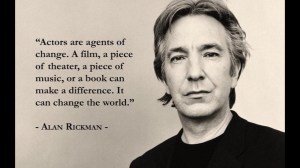
On Thursday, the actor who played Severus Snape in the Harry Potter series, Alan Rickman died. “With the last film it was very cathartic because you were finally able to see who he was,” Mr. Rickman said “It was strange, in a way, to play stuff that was so emotional. A lot of the time you’re working in two dimensions, not three.”

CYs2JjqWkAAWSqZ

Agents of change in theater, music, and the workplace challenge our thinking. On Monday we learned of the death of another transformational icon, David Bowie.

“In his dazzling artistry, daring style, unabashed intelligence, intensity of emotion, cultivation of magic, mystery and imagination, Bowie was a figure who bridged high and low culture, reverberating on so many different levels.”

On Monday morning, NPR replayed his 2002 interview with ‘Fresh Air’ host Terry Gross.

“I’m not actually a very keen performer. I like putting shows together. I like putting events together. In fact, everything I do is about the conceptualizing and realization of a piece of work, whether it’s the recording or the performance side. And kind of when I put the thing together, I don’t mind doing it for a few weeks, but then, quite frankly, I get incredibly, incredibly bored because I don’t see myself so much as a – I mean, I don’t live for the stage. I don’t live for an audience.”

David Bowie event planner? When we think of careers, we make assumptions about success, only to realize that each of us holds a unique definition which sculpts our approach to a calling.

“People often forgot, but up until his death, on Sunday at age 69, Mr. Bowie was a New Yorker

And though Mr. Bowie was enormously wealthy, he wasn’t one of those rich guys who kept an apartment in the city, along with a portfolio of global real estate holdings, and flew in. Aside from a mountain retreat in Ulster County, N.Y., his Manhattan apartment was his only home.

You may not have considered all this because Mr. Bowie was an apparition in the city, rarely glimpsed. You heard it mentioned that he lived here. Somewhere downtown, someone thought. But seeing him out? Good luck.”

Which brings us to the political discourse on ‘New York values’ and its relevance to job search. Relocation is a major consideration for many seeking career advancement. Understanding the character of the community you join outside of your workplace is equally, if not more important to understanding the values of your workplace community.

How many folks have decided to take a job in New York or LA only to later realize a major disconnect? This is not a value judgement, just a realization that we all need to find a place where we can be successful. Unfortunately, the job perks sometimes outweigh the geographical/cultural component in the decision making mix and it’s only when we are fully committed to our workplace that we begin to realize our success is being eroded by deficiencies in our neighborhood.

On to the world of sports. On Monday evening, two college football teams competed in the College Football National Championship game in Arizona. The University of Alabama’s team won by a score of 45-40 over Clemson. A few days later at the NCAA’s annual meeting, “NCAA president Mark Emmert praised student-athlete activism during his annual speech Thursday at the NCAA convention.”

During his 20-minute address at the NCAA’s opening business session, Emmert urged schools to continue to emphasize academics, fairness and the health and well-being of student-athletes.”

And yet, actions speak louder than words. Inside Higher Education reported“While the time demands on college athletes ­became the central focus of the National Collegiate Athletic Association’s annual meeting here this week, several proposals to deal with the issue were seemingly tabled the day before the NCAA’s five wealthiest conferences were scheduled to vote on them.”

Here’s the thing. With the exception of college coaches, everyone is in agreement that the ‘student’ in the ‘student-athlete’ equation takes priority. ‘Official’ time demands don’t begin to reflect the ‘unofficial’ time requirements of competing in Division I sports. And with only a select few moving on to compete in their sport as professionals, these students need the flexibility to explore career opportunities and participate in internships.

“Roderick McDavis, president of Ohio University, said it would be a mistake for colleges to wait for NCAA policy changes to prompt that shift. “Policies don’t change behavior,” he said. “People change behavior. We can hope that the NCAA catches up with us all one day, but what I know I can control is I can go home tomorrow and make a difference on my campus.”

And then there were the omnipresent billboards advertising the Powerball Jackpot at $999 million. Except the amount had grown to over $1.5 billion, which gave us all an opportunity to contemplate what we would do with that amount of money.

On a CNN broadcast the night before the drawing, international anchor Richard Quest asked anchor Anderson Cooper what he would do with the winnings if he had the lucky set of numbers. (You may know that Mr. Cooper is a Vanderbilt by ancestry.) His response, “I would buy a watch.” And he would be back at work the next day.

Here are a few additional articles that you may have missed from the past week.

‘Why I Always Wanted to Be a Secretary’ by Bryn Greenwood – Does your work define you? What if your dream job is central to an organization, but society’s definition is demeaning?

‘At Work And Feeling All Alone’ by Phyllis Korkki – In the world of telecommuting, new research indicates those left behind in the office have ended up feeling lonely and disconnected.

‘60% of Women in Silicon Valley Have Been Sexually Harassed’ by Lydia Dishman – Results of a survey of 200 women demonstrates a serious level of dysfunction in the tech giants’ workplace.

‘Yahoo’s Brain Drain Shows a Loss of Faith Inside the Company’ by Vindu Goel – “More than a third of the company’s work force has left in the last year, say people familiar with the data. Worried about the brain drain, Ms. Mayer has been approving hefty retention packages — in some cases, millions of dollars — to persuade people to reject job offers from other companies. But those bonuses have had the side effect of creating resentment among other Yahoo employees who have stayed loyal and not sought jobs elsewhere.”


The week@work – issues that will shape the world in 2016, positive forecast on salary growth, George R.R. Martin misses a deadline and why we should focus on our ‘already done’ list

The past week@work marked the transition from the old year to the new. We have seen the last of the ‘best and worst of the year’ in every imaginable category and it’s time to turn our attention to the future. Here’s the problem; global issues, work issues, customer issues and career issues don’t magically resolve themselves at the stroke of midnight on 12/31.

What the new year does provide is a demarcation point in time, to set aside previous solutions and reimagine innovative answers. We have permission to start anew.

Rose Pastore offers a list of ’10 Issues That Will Shape the World In 2016′. Recognizing the continuum of events from the old year to the new – “The end of 2015 leaves many of the year’s most significant issues still very much in flux, including the reform of U.S. gun control laws, the fates of thousands of Syrian refugees, and the legal status of massive startups like Uber and Airbnb.”

Some of these issues seem so beyond our everyday lives that it may be hard to grasp a connection to our work and workplace. But somewhere, a diplomat, an entrepreneur, an educator or a student may seize the moment, and solve one piece of the puzzle, in one of our multiple global challenges: “the refugee crisis, climate change, data security, gun violence, social justice and regulating the sharing economy.” 

Don Lee reported on the view that salaries will increase in 2016, driven by the decrease in unemployment and the implementation of new minimum wage laws in a number of states.

“American workers are poised in 2016 to finally get what they’ve been missing for years: higher salaries.

…worker wages will get an additional boost from higher minimum wages taking effect in a number of cities and states. California’s new minimum pay goes to $10 an hour in January. The increase will amount to an 11% pay raise for Marco Ruiz, a carwash worker in Anaheim who earns $9 an hour.

That’s an additional $40 a week, more than enough to cover Ruiz’s bus fare to his job from his home in Norwalk, which he rents with his brother-in-law. “It’s marvelous,” said the divorced 35-year-old, who started at the carwash eight years ago making $7.50 an hour, the state’s minimum wage then.

Like Ruiz, most people in the U.S. already feel more secure in their jobs. As layoffs have receded sharply, weekly filings for new jobless benefits have fallen this year to numbers not seen since the early 1970s. And Gallup polls show workers’ “complete satisfaction” with job security rose to a 15-year high in summer 2014. Their overall satisfaction with pay, however, hasn’t returned to prerecession levels. In fact, many workers still feel that the recovery from the Great Recession passed them by.”

Early Saturday morning, author George R.R. Martin posted his admission, “THE WINDS OF WINTER is not finished.”

The year ended and the author of the series, ‘A Song of Ice and Fire’, publicly announced he had missed a deadline and gave us a glimpse of his creative process.

“Believe me, it gave me no pleasure to type those words. You’re disappointed, and you’re not alone. My editors and publishers are disappointed, HBO is disappointed, my agents and foreign publishers and translators are disappointed… but no one could possibly be more disappointed than me. For months now I have wanted nothing so much as to be able to say, “I have completed and delivered THE WINDS OF WINTER” on or before the last day of 2015.

But the book’s not done.

Nor is it likely to be finished tomorrow, or next week. Yes, there’s a lot written. Hundreds of pages. Dozens of chapters. (Those ‘no pages done’ reports were insane, the usual garbage internet journalism that I have learned to despise). But there’s also a lot still left to write. I am months away still… and that’s if the writing goes well. (Sometimes it does. Sometimes it doesn’t.) Chapters still to write, of course… but also rewriting. I always do a lot of rewriting, sometimes just polishing, sometimes pretty major restructures.”

Alison Flood of The Guardian reported on the response from readers and fans.

“This time, though, Martin’s readers were quick to encourage him, with the more than 1,000 comments on his blog ranging from “Love your work, George! Get it done when it’s done. I’ll be there” to “Don’t sweat it, George” and “Take as long as you need to, sir”.

“That couldn’t have been fun to write,” wrote one reader in response to Martin’s blog. “But fact is in 50 years readers will judge on the book’s quality and not if they met some arbitrary deadline and beat the TV adaptation. As much as I’d like to see it released soon, I ultimately approve of the priority on quality.”

For all of you who have started the new year with a missed deadline, consider the lesson here. It’s impossible to live without failure. Even the most successful fail. It’s the next step in the lifelong learning process that matters, and that might be the most important thought to hold in the new year.

Minda Zetlin offers some timely practical advice, that George R. R. Martin might consider ‘Five Reasons You Should Make an Already-Done List Right Now’.

“…if you want to feel motivated, set that to-do list aside, and make a list of what you’ve already accomplished instead.

That advice comes from best-selling author and executive coach Wendy Capland. A while back, I wrote a column from an interview with Capland and as a follow-up we decided she would coach me and that I would write about it. These coaching sessions come with homework, and one recent assignment was to make a list of all the things I had already done​ to advance toward my most ambitious goals. It was something I’d never done before, and it was a revelation.”

Perhaps the best advice is to start the year with an accomplishments audit, focusing on the strengths derived from your success (and failure) and build on that foundation @work in the new year.


‘The World I Live In’ a poem by Mary Oliver

The Friday Poem this week is from Pulitzer Prize winning poet Mary Oliver‘s new collection, ‘Felicity’ published this fall. Merry Christmas!

The World I Live In

I have refused to live

locked in the orderly house of

reasons and proofs.

The world I live in and believe in

Is wider than that. And anyway,

what’s wrong with Maybe?


You wouldn’t believe what once or

twice I have seen. I’ll just

tell you this:

only if there are angels in your head will you

ever, possibly, see one.

Mary Oliver  ‘Felicity’  Penguin Press, 2015

Holiday Homework: Write your story

It’s the holiday season and you have one assignment to complete before the New Year begins – write your story.

During the Thanksgiving holiday I encouraged readers to participate in the Story Corps ‘Great Thanksgiving Listen’, conducting interviews  with relatives to capture the oral history narrative of America.

This week’s challenge is about you; to think about your life as it has evolved to this point, highs and lows, and write a short story, your story.

Before you craft your resume, schedule a meeting with a networking contact or head to an interview, you need a story; the narrative of how you arrived at this point in your life and career.

The end goal is to collect as much information about your past before you open your laptop and begin to browse resume formats. Most folks make the mistake of finding a template and relating their story via someone else’s outline. That doesn’t mean that there aren’t acceptable resume formats. It does mean that it’s premature to begin with the resume before you have considered the narrative you wish to convey.

Storytelling has become the latest marketing approach adopted by entrepreneurs to Fortune 500 CEOs. Google ‘storytelling’ and the initial search results will reflect current business practice vs. writers working on the great American novel or the hottest new screenplay.

Here’s the thing. If the folks you hope to work with are employing storytelling to advance their business goals, it may be time for you to practice your skill.

Buried in the list of google results is a link to an Atlantic.com video, ‘George Saunders Explains How To Tell A Good Story’. It’s one of the most viewed videos of the year, which may provide another hint to why you should take seven minutes out of your life this week and watch.

Let’s pause a minute to address all of you who have gotten to this point and are stressed because all you wanted was a few words on how to write a resume in ten seconds.

Nothing of quality results from ten seconds of effort. And this is your life, eight to ten hours of every five days of seven.

Back to George Saunders.

“A story is kind of a black box, you’re going to put the reader in there, she’s going to spend some time with this thing that you have made and when she comes out, what’s going to have happened to her in there is something kind of astonishing. It feels like the curtain’s been pulled back and she’s gotten a glimpse into a deeper truth…

As a story writer, that’s not as easy as it sounds..”

It’s not easy to tell your story. There’s a lot of stuff that in the end may have no relevance to your job search. But it’s important to conduct an annual rewrite to update and adapt your original script.

Let’s borrow a term from the screenwriters and suggest you are developing a draft ‘treatment’ before you write a resume, network and interview.

Micki Grover defines and describes how this summary of a story fits into the screenwriting process.

“All we’re talking about is a short document written in prose form and in the present tense that emphasizes, with vivid description, the major elements of a screenplay. Yes, treatments are actually written in prose! The essence of the story and the characters should be evoked through exhilarating language and imagery.

Treatments have a style of their own just as screenplays do, and they too take time to master. Writers who swear by using treatments find that it’s a fun outlet to write with a voice that screenplays and synopses sometimes constrain. The ultimate goal is simply to tell your story in an engaging way, as if you were passionately telling your best friend about a new script over coffee.”

That’s your holiday assignment. Develop a ‘treatment’ that tells your story in an engaging way, connecting the dots and inviting an audience who may be interested in promoting your talent.


The week@work – The Fed raises rates, Martin Shkreli is arrested, ‘The Big Short’ premieres and so does a small film about a galaxy far, far away

It’s that time of year when the world of finance takes center stage, only to be bested by the creativity of those who work in Hollywood. This week@work the Federal Reserve raised its benchmark rate, pharmaceutical executive, Martin Shkreli was arrested on securities fraud and the 2008 financial crisis originally chronicled by Michael Lewis, made its way onto the big screen in ‘The Big Short’. And that small movie from Disney? ‘Star Wars: The Force Awakens’ set new records with a $238 million weekend opening.

On Wednesday, the Wall Street Journal reported on the decision by the Federal Reserve to raise interest rates for the first time in seven years.

“The Fed’s decision today reflects our confidence in the U.S. economy,” Fed Chairwoman Janet Yellen said Wednesday in a press conference after a two-day policy meeting. “We believe we have seen substantial improvement in labor market conditions and while things may be uneven across regions of the country, and different industrial sectors, we see an economy that is on a path of sustainable improvement.

New projections show officials expect the fed-funds rate to creep up to 1.375% by the end of 2016, according to the median projection of 17 officials, to 2.375% by the end of 2017 and 3.25% in three years. That implies four quarter-percentage-point interest rate increases next year, four the next and three or four the following. It depends on whether the Fed’s forecasts for the economy—which have frequently been wrong in this expansion—hold up.”

The Fed rate increase was one of the ‘Four Charts That Defined the World in 2015’.

2014_Charts_Federal-690

Vauhini Vara writing in The New Yorker listed the other three:

“For the first time, fewer than ten per cent of people in the world were living in extreme poverty.

Facebook took over the world.

Greece’s economy started growing again—and then shrank.”

On Thursday, Bloomberg Business noted the arrest of Martin Shkreli, the infamous pharmaceutical head, and everyone’s leading candidate for this year’s Scrooge. You may remember Shkreli from his multiple media appearances after raising the price of the drug Daraprim from $13.50 a pill to $750. Apparently he not only violated the golden rule, but also an unspoken pact among those in financial services, not to draw attention to themselves or their activities.

“While the 32-year-old has earned a rare level of infamy for his brazenness in business and his personal life, what he was charged with had nothing to do with skyrocketing drug prices. He is accused of repeatedly losing money for investors and lying to them about it, illegally taking assets from one of his companies to pay off debtors in another.

“Shkreli essentially ran his company like a Ponzi scheme where he used each subsequent company to pay off defrauded investors from the prior company,” Brooklyn U.S. Attorney Robert Capers said at a press conference.”

He was released on bail on Friday and did what we would all do after being publicly shamed, began live streaming, chatting with ‘supporters’.

“Which brings me to a new movie the enemies of financial regulation really, really don’t want you to see.” writes nobel prize winner, Paul Krugman in The New York Times.

“But you don’t want me to play film critic; you want to know whether the movie (The Big Short) got the underlying economic, financial and political story right. And the answer is yes, in all the ways that matter.

I could quibble over a few points: The group of people who recognized that we were experiencing the mother of all housing bubbles, and that this posed big dangers to the real economy, was bigger than the film might lead you to believe. It even included a few (cough) mainstream economists. But it is true that many influential, seemingly authoritative players, from Alan Greenspan on down, insisted not only that there was no bubble but that no bubble was even possible.

And the bubble whose existence they denied really was inflated largely via opaque financial schemes that in many cases amounted to outright fraud — and it is an outrage that basically nobody ended up being punished for those sins aside from innocent bystanders, namely the millions of workers who lost their jobs and the millions of families that lost their homes.”

Need a holiday escape from everyday villains and economic reality? The folks at the ‘house the mouse built’ offer a 135 minute visit to an alternate universe.

“Chewie, we’re home” teases the plot in the trailer for the new Star Wars movie. This week the cast of the seventh installment of the intergalactic saga walked the red carpet, four blocks long, at the Hollywood premiere.

Variety covered the opening weekend box office results.

“Director J.J. Abrams’ nostalgic take on the series of space operas George Lucas created four decades ago was a hit with critics and fans, earning strong reviews and an A CinemaScore. Its opening soared past the previous high-water mark of $208.8 million established last summer by “Jurassic World.” It more than doubles “The Hobbit: An Unexpected Journey’s” December record debut of $84.6 million.

Globally, “Star Wars: The Force Awakens” scored the second-biggest opening in history, earning $517 million worldwide, behind only “Jurassic World’s” $525 million bow. Unlike “Jurassic World,” the seventh film in the “Star Wars” franchise did not have the benefit of showing in China on its inaugural weekend. It opens there on Jan. 9.”