The week@work – the top stories of ’16, a new year, the eternal optimist’s talking points, French workers get the right to disconnect, and leadership lessons from Michelle Obama

Happy New Year! This week@work we take a final look at the top stories of 2016, and the stories from the first week of 2017. On the work-life balance front – French workers now have the legal right to disconnect from the office. The U.S. unemployment rate is at 4.7%, with hourly salary earnings rising 2.9%. And for women@work, an article considered the future of women in this new year, as First Lady Michelle Obama delivered her final formal remarks on Friday, giving us a parting gift – a model for what a leader looks like.

The Economist’s top ten most read stories of 2016 centered on the U.S. election and Brexit. In the U.S., NPR’s top 20 did not include Brexit, but the question of how Donald Trump will govern, led the list. “The top 20 most popular stories from the past year ranged from fact checks to mosquito bites, from Aleppo to taxes, and how to raise kids who will thrive, whatever the future brings.” 

There were many stories about work and the workplace, but most became a subset of the larger stories. Susan Chira reflected on ‘What Women Lost’.

“This was supposed to be the year of triumph for American women.

A year that would cap an arc of progress: Seneca Falls, 1848. The 19th Amendment, 1920. The first female American president, 2017. An inauguration that would usher in a triumvirate of women running major Western democracies. Little girls getting to see a woman in the White House.

Instead, for those at the forefront of the women’s movement, there is despair, division and defiance. Hillary Clinton’s loss was feminism’s, too.”

2017 will be the year we ask, what are the long term implications for women@work? On January 21, in Washington, and cities around the country, women will have an opportunity to reinsert themselves into the national conversation.

Unknown.png

For additional reading @year end:

‘The Echoes of 1914’ by historian Margaret MacMillan for the BBC. She responsed to a query about which year in history most closely resembled 2016.

“I wish I could stop, but I find myself thinking of 1914. The world then had seemed so stable, so manageable. Crises – political, social, economic, military – came and went but “they”, bankers, statesmen, politicians, always managed them in the end.

Yes, there were grumblings – from the working classes or women, or those who were losing their livelihoods because of free trade or mechanisation.

And there were some strong emotions about: fears of rapid change, passionate nationalisms that meant love of one’s own country and hatred of others. Ominous in retrospect because we know what happened. But at the time there was a complacency – it would surely all work out all right.

That confidence was dangerous because it meant that people didn’t take the warning signs seriously enough.

I wish I could stop making the comparisons.

In ‘1999 Was The Last Time Everything Was Fine’ BuzzFeed Culture Writer Doree Shafrir revisited her first year@work.

“I had no job and almost no money. My parents had given me the security deposit on the apartment as a graduation present, but now I was on my own. I was entranced by the classifieds section of the New York Times, with its pages and pages of appeals for secretaries and programmers and architects and retail store managers. I didn’t really know what I wanted to do. I knew I liked to be around words, but I wasn’t sure what that meant in terms of actually making money. Maybe now was the time to try something new. Maybe I could close my eyes and point to something on the page and that would be my destiny.

That was how 1999 felt, like anything was possible.”

Artist Tucker Nichols created a rainbow rendering of an ‘Eternal Optimist Talking Points for 2017’ as OpArt for The New York Times.  A sample of musings: “Somehow not as freaked out by scary clowns anymore…Midtown traffic has always been pretty jammed up…Smog makes great sunsets…Still a chance it’s a very long dream.”

On January 1, a new law in France went into effect allowing workers to ‘disconnect’ from their workplace.

IMG_5895.jpg

The BBC reported on France’s implementation of a law to protect work-life balance.

“Companies with more than 50 workers will be obliged to draw up a charter of good conduct, setting out the hours when staff are not supposed to send or answer emails. France has a working week of 35 hours, in place since 2000.”

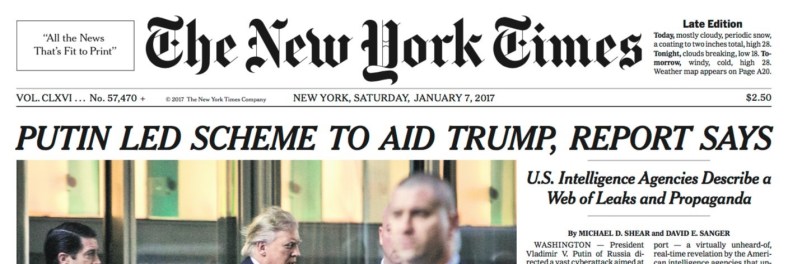
And then there was this from the professionals who go to work every day in U.S. Intelligence Services.IMG_8057.JPG
On Friday afternoon, First Lady Michelle Obama gave a memorable farewell speech at a White House event honoring the 2017 School Counselor of the Year. The text set an aspirational vision for all Americans and provides all of us with a lesson in leadership.

“…for all the young people in this room and those who are watching, know that this country belongs to you — to all of you, from every background and walk of life. If you or your parents are immigrants, know that you are part of a proud American tradition — the infusion of new cultures, talents and ideas, generation after generation, that has made us the greatest country on earth.”

C1hKGRJUcAAgab2.jpg

“If your family doesn’t have much money, I want you to remember that in this country, plenty of folks, including me and my husband — we started out with very little. But with a lot of hard work and a good education, anything is possible — even becoming President. That’s what the American Dream is all about.

But I also want to be very clear: This right isn’t just handed to you. No, this right has to be earned every single day. You cannot take your freedoms for granted. Just like generations who have come before you, you have to do your part to preserve and protect those freedoms. And that starts right now, when you’re young.

Right now, you need to be preparing yourself to add your voice to our national conversation. You need to prepare yourself to be informed and engaged as a citizen, to serve and to lead, to stand up for our proud American values and to honor them in your daily lives. And that means getting the best education possible so you can think critically, so you can express yourself clearly, so you can get a good job and support yourself and your family, so you can be a positive force in your communities.

And when you encounter obstacles — because I guarantee you, you will, and many of you already have — when you are struggling and you start thinking about giving up, I want you to remember something that my husband and I have talked about since we first started this journey nearly a decade ago, something that has carried us through every moment in this White House and every moment of our lives, and that is the power of hope — the belief that something better is always possible if you’re willing to work for it and fight for it.

It is our fundamental belief in the power of hope that has allowed us to rise above the voices of doubt and division, of anger and fear that we have faced in our own lives and in the life of this country. Our hope that if we work hard enough and believe in ourselves, then we can be whatever we dream, regardless of the limitations that others may place on us. The hope that when people see us for who we truly are, maybe, just maybe they, too, will be inspired to rise to their best possible selves.

So that’s my final message to young people as First Lady. It is simple. I want our young people to know that they matter, that they belong. So don’t be afraid — you hear me, young people? Don’t be afraid. Be focused. Be determined. Be hopeful. Be empowered. Empower yourselves with a good education, then get out there and use that education to build a country worthy of your boundless promise. Lead by example with hope, never fear. And know that I will be with you, rooting for you and working to support you for the rest of my life.”

We work in the context of global events, as responsible citizens. Our role in our workplace is to reflect the best in human and organizational values. In this new year@work, stay focused, be determined and lead by example with hope, never fear.


Photo credits: New Year’s Eve London – Ben Cawthra/LNP, Michelle Obama – BBC.com
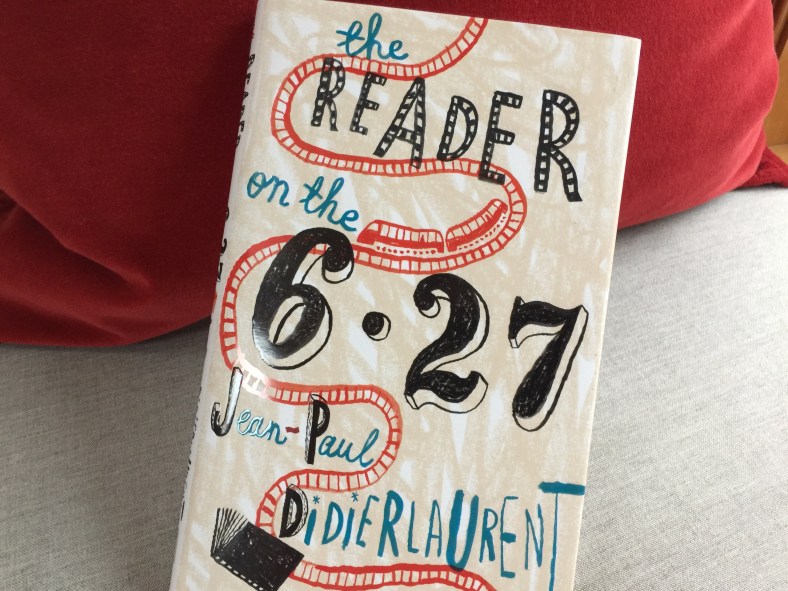
The Saturday Read ‘The Reader on the 6.27’ by Jean-Paul Didierlaurent (translated by Ros Schwartz)

Does our work define us? Many would argue it doesn’t and yet, we carry the bias of standard stereotypes throughout our work day toward those we encounter along the way.

This question of work identity and expectations forms the center of the story of ‘The Reader on the 6.27’ by French writer Jean-Paul Didierlaurent.

In this novel, I wanted to highlight the invisible, the battered lives, the ordinary people who often go unnoticed; and I wanted to show that each of them could have their own unexpected story. In a society where looks have become a religion and where we judge more on appearance, I wanted to highlight our prejudices and show that the clothes do not always make the man. But this book is also a declaration of love for words and for reading. All the characters have a close relationship with words – the words they read, the words they speak and finally the words of love. These words are the real cement of the novel.”

The novel’s hero is Guylain Vignolles whose workplace is dominated by an overbearing caricature of the worst boss ever, and ‘The Thing’.

“The Thing sat there, huge and menacing, right in the centre of the plant. In the fifteen years he had worked there, Guylain had never been able to call it by its real name, as if the simple act of naming it might be to acknowledge it, to demonstrate a sort of tacit acceptance, which he did not want at any cost. Refusing to name it was the last bastion he had managed to erect between it and himself, to avoid selling his soul for good.”

What if your job was to destroy the thing you loved most? That’s Guylain’s dilemma. ‘The Thing’ – the Zerstor 500 – is a hungry metal behemoth that turns books into sludge. (You will have a different view of recycling after reading the description.)

Guylain finds meaning in rescuing sheets of paper from the jaws of the “eleven-tonne monstrosity” and reading these disjointed narratives to his fellow commuters each morning on the 6.27.

Then, one day he finds a memory stick “through pure chance” as “it jumped out of the folding seat as he lowered it. A little plastic thing barely the size of a domino which bounced across the floor of the compartment and came to a halt between his feet..”

The contents of the USB are revealed as Guylain, the ‘reader on the 6.27’, replaces his daily narration from the remainders of ‘the thing’ with the story of a mysterious stranger.

“Once a year, at the spring equinox, I do a recount. Just to see, to make sure that nothing ever changes. At this very special time of year, when day and night share time equally, I do a recount with, lodged in the back of my mind, the ludicrous idea that perhaps, yes, perhaps one day, even something as unchanging as the number of tiles covering my domain from floor to ceiling might change.  It’s as hopeless and stupid as believing in the existence of Prince Charming, but deep down inside me is that little girl who refuses to die and who, once a year wants to believe in miracles.”

Julie’s domain is in the basement of a mall. And it’s her story that should forever challenge the reader’s preconceptions of society’s work identity assignments.

“When you’re a public lavatory attendant, wherever that may be, you’re not expected to keep a diary and sit there tapping away on the keyboard of your laptop. You’re only good for wiping from morning to evening, shining the chrome, scrubbing, polishing, rinsing, refurbishing the cubicles with toilet paper, and that’s it. A loo attendant is meant to clean, not to write…It’s as if there has been a misunderstanding, a miscasting. In the nether world, even a miserable twelve-inch laptop next to the tips saucer will always be a blot on the landscape…”

“I quickly had to come to terms with the fact that people generally expect only one thing of you: that you reflect back the image of what they want you to be.”

“Fit docilely into the mould, slip into this lavatory attendant’s costume – which is what I am paid to do – and play the part, sticking closely to the script.”

Mr. Didierlaurent has filled the gap in workplace literature with a beautifully told story of memorable characters who reside in the periphery of vision, but will long linger in the reader’s memory. Here is a novelist providing the lesson that not all workplace advice is to be found in the business section of the bookstore.

After reading the novel, and becoming acquainted with a cast of characters who bring it to life, perhaps we can reorient our expectations, and look beyond the surface for the complementing prism of talent that defines us all.

Resist “sticking closely to the script”, and follow Julie’s advice.

“I advance in small steps. Not a single day goes by without my writing. Not to do so would be as if I had restricted myself to the role of loo-poo-puke cleaner that they want me to play, a poor creature whose only raison d’être is the lowly occupation for which she is paid.”


The Friday Poem ‘Night Journey’ by Theodore Roethke

We will catch our breath if only we can make it to the holiday weekend. Rushing from work to catch the train, bus or plane we are singularly focused on our destination.

The Friday Poem this week comes from poet Theodore Roethke. ‘Night Journey’ from his ‘Collected Poems’ is a reminder to look out the window and take in the view.

“I stay up half the night. To see the land I love.”

“Poet and writer James Dickey once named Roethke the greatest of all American poets: “I don’t see anyone else that has the kind of deep, gut vitality that Roethke’s got. Whitman was a great poet, but he’s no competition for Roethke.”

The publication of Collected Poems in 1966 brought renewed interest in Roethke and prompted illuminating overviews of his work.”

Night Journey

Now as the train bears west,
Its rhythm rocks the earth,
And from my Pullman berth
I stare into the night
While others take their rest.
Bridges of iron lace,
A suddenness of trees,
A lap of mountain mist
All cross my line of sight,
Then a bleak wasted place,
And a lake below my knees.
Full on my neck I feel
The straining at a curve;
My muscles move with steel,
I wake in every nerve.
I watch a beacon swing
From dark to blazing bright;
We thunder through ravines
And gullies washed with light.
Beyond the mountain pass
Mist deepens on the pane;
We rush into a rain
That rattles double glass.
Wheels shake the roadbed stone,
The pistons jerk and shove,
I stay up half the night.
To see the land I love.

Theodore Roethke from ‘Theodore Roethke: Selected Poems’

411izrm4ull

The Friday Poem ‘Introduction to Poetry’ by Billy Collins

When I first started ‘workthoughts’ almost two years ago, I wanted to include a weekly poem or lyric. A colleague had once shared her secret of success@work, “I start my day reading a poem”.

I believe we all become a bit more creative when we discover the world through a poet’s eyes. Why don’t more of us include poetry in our work lives?

Former U.S. Poet Laureate Billy Collins shared his opinion in an interview to Ben Yakas of gothamist.com.

“…the teaching of poetry is often brutally centered on interpretation. This gives teachers power because they kind of “know the answer.” And I think there’s a streak of sadism in it as well as they watch students get the wrong answer by guessing.”

In October, Mr. Collins published his 12th book of poetry, ‘The Rain in Portugal’. The Friday Poem this week is from his first collection, ‘The Apple That Astonished Paris’, and is for all of you whose early love of poetry was extinguished by an overzealous pursuit of analysis.

Introduction to Poetry 

I ask them to take a poem
and hold it up to the light
like a color slide

or press an ear against its hive.

I say drop a mouse into a poem
and watch him probe his way out,

or walk inside the poem’s room
and feel the walls for a light switch.

I want them to waterski
across the surface of a poem
waving at the author’s name on the shore.

But all they want to do
is tie the poem to a chair with rope
and torture a confession out of it.

They begin beating it with a hose
to find out what it really means.

Billy Collins from ‘The Apple That Astonished Paris’ 1988

collins.png

The Friday Poem ‘Voice’ by Jeffrey Brown


Walking west on 40th Street, between 7th & 8th, you pass the entrance to the CCNY Graduate School of Journalism. In the space of a city block, those aspiring to pursue a career reporting the news, cross paths with the the best in the field @work in The New York Times building.

There was a time when the most trusted man in America was a television journalist. Today, journalists across the globe find themselves at risk when reporting the truth. ‘Fake news’ sites proliferate where fiction replaces fact.

Lost in the cacophony of the latest news cycle is the value professional journalists provide in our society; collecting and communicating information that empowers the rest of us to make the best decisions.

This week, The Friday Poem is for those who follow their dream to newsrooms around the corner, and around the world. ‘Voice’ was written by NPR journalist and poet, Jeffrey Brown.

Voice

for Robert MacNeil and Jim Lehrer

There are those with a voice so rich,

so bell-strong, time chiseled, and alive

they can read the phone book and

you will hear the deeds and failings

in every name, the laughter and wailing

of ghosts who inhabit each address,

the infinite possibility


in every number. There are those

with a voice that rich, he says –

the lucky ones. But that is not us.

We open our mouths and out comes a

small, high sound, cracking midsentence,

straining to tell the story we know

to be true. There are things you can do:


Learn to breathe. Stand up straight and

let the air flow through you, belly to

chest and into the mask of your face.

Take a bit of chocolate, sip on your

coffee – excite the senses. Imagine

the people in their hoes hungry for

dinner and for news of the world.


Underline phrases, emphasize what

should be emphasized, diminish

the less important. Decide what is

important. Be sure you understand

the meaning of what you are to say.

Do not yell, do not whisper, look ahead,

not down, fill your lungs, open your mouth


and speak. The Zen master says “You

find your voice when you find yourself.”

But that, too, is not for us. (Who knows

What else you’ll find there? he laughs).

Better to listen to that voice

as though from afar, as though it

is not yours. Then speak again.

Jeffrey Brown from ‘The News:Poems’ 2015

51snA65oWyL._AC_US320_QL65_.jpg


The ‘Black’ Friday Poem – ‘Why I Have A Crush On You, UPS Man’ by Alice N. Persons

It’s the perfect poem for ‘Black’ Friday or ‘Cyber’ Monday. Soon the big brown box trucks will be delivering all sorts of packages for the holidays. This one, from poet Alice N. Persons, is for all those who work at UPS (including the drivers of those tandem trucks on Interstate 40 who terrify me twice a year on my cross country journeys).

Why I Have A Crush On You, UPS Man

you bring me all the things I order
are never in a bad mood
always have a jaunty wave as you drive away
look good in your brown shorts
we have an ideal uncomplicated relationship
you’re like a cute boyfriend with great legs
who always brings the perfect present
(why, it’s just what I’ve always wanted!)
and then is considerate enough to go away
oh, UPS Man, let’s hop in your clean brown truck and elope !
ditch your job, I’ll ditch mine
let’s hit the road for Brownsville
and tempt each other
with all the luscious brown foods —
roast beef, dark chocolate,
brownies, Guinness, homemade pumpernickel, molasses cookies
I’ll make you my mama’s bourbon pecan pie
we’ll give all the packages to kind looking strangers
live in a cozy wood cabin
with a brown dog or two
and a black and brown tabby
I’m serious, UPS Man. Let’s do it.
Where do I sign?

Alice N. Persons  ‘Don’t Be A Stranger’, Sheltering Pines Press 2007

The Times They Are A-Changin’

On Thursday morning Professor Sara Danius, Permanent Secretary of the Swedish Academy, announced the 2016 Nobel Prize in Literature.

“The Nobel Prize in Literature for 2016 is awarded to Bob Dylan “for having created new poetic expressions within the great American song tradition”.

In the hours that followed, the surprise decision was debated by the literati. A frequently mentioned candidate for the prize in literature, author Salman Rushdie, placed the choice in context via Twitter.

“From Orpheus to Faiz, song & poetry have been closely linked. Dylan is the brilliant inheritor of the bardic tradition. Great choice.”

In honor of that choice, the Friday Poem this week is Dylan’s ‘The Times They Are A-Changin’.


The Times They Are A-Changin’

Come gather ’round people
Wherever you roam
And admit that the waters
Around you have grown
And accept it that soon
You’ll be drenched to the bone
If your time to you is worth savin’
Then you better start swimmin’ or you’ll sink like a stone
For the times they are a-changin’

Come writers and critics
Who prophesize with your pen
And keep your eyes wide
The chance won’t come again
And don’t speak too soon
For the wheel’s still in spin
And there’s no tellin’ who that it’s namin’
For the loser now will be later to win
For the times they are a-changin’

Come senators, congressmen
Please heed the call
Don’t stand in the doorway
Don’t block up the hall
For he that gets hurt
Will be he who has stalled
There’s a battle outside and it is ragin’
It’ll soon shake your windows and rattle your walls
For the times they are a-changin’

Come mothers and fathers
Throughout the land
And don’t criticize
What you can’t understand
Your sons and your daughters
Are beyond your command
Your old road is rapidly agin’
Please get out of the new one if you can’t lend your hand
For the times they are a-changin’

The line it is drawn
The curse it is cast
The slow one now
Will later be fast
As the present now
Will later be past
The order is rapidly fadin’
And the first one now will later be last
For the times they are a-changin’

Bob Dylan, 1963

3992253_159.jpg

Photo credit: Rolling Stone Magazine

The Saturday Read – The National Book Award ‘Long List’

This past week The National Book Foundation announced the ‘long list’ of nominees for The National Book Award to be announced on November 16. The books nominated fall into four categories: Fiction, Non-Fiction, Poetry, and Young People’s Literature.

A quick review of the titles provides a cultural snapshot of the issues we face as individuals and society as a whole. ‘The Saturday Read’ this week offers a list those nominated in the  fiction and non-fiction categories.

The fiction nominees includes an Oprah Book Club pick, my favorite of the past year, and an anticipated new novel to be released in October.

In non-fiction, racism is a common topic; echoing the theme of last year’s ‘required reading’, 2016 award winner, Ta-Nehisi Coates’ ‘Between the World and Me’. The nominees in this category remind us why we read non-fiction: to listen, to understand the world in all its complexity, and to make thoughtful decisions about our future.

Fiction

Chris Bachelder, The Throwback Special (W. W. Norton & Company)

Garth Greenwell, What Belongs to You (Farrar, Straus and Giroux/Macmillan)

Adam Haslett, Imagine Me Gone (Little, Brown and Company/Hachette Book Group)

Paulette Jiles, News of the World (William Morrow/HarperCollinsPublishers)

Karan Mahajan, The Association of Small Bombs (Viking Books/Penguin Random House)

Elizabeth McKenzie, The Portable Veblen (Penguin Press/Penguin Random House)

Lydia Millet, Sweet Lamb of Heaven (W. W. Norton & Company)

Brad Watson, Miss Jane (W. W. Norton & Company)

Colson Whitehead, The Underground Railroad (Doubleday/Penguin Random House)

Jacqueline Woodson, Another Brooklyn (Amistad/HarperCollinsPublishers)

Non-Fiction

Andrew J. Bacevich, America’s War for the Greater Middle East: A Military History
(Random House/Penguin Random House)

Patricia Bell-Scott, The Firebrand and the First Lady: Portrait of a Friendship: Pauli Murray, Eleanor Roosevelt, and the Struggle for Social Justice (Alfred A. Knopf /Penguin Random House)

Adam Cohen, Imbeciles: The Supreme Court, American Eugenics, and the Sterilization of Carrie Buck (Penguin Press/Penguin Random House)

Arlie Russell Hochschild, Strangers in Their Own Land: Anger and Mourning on the American Right (The New Press)

Ibram X. Kendi, Stamped from the Beginning: The Definitive History of Racist Ideas in America (Nation Books)

Viet Thanh Nguyen, Nothing Ever Dies: Vietnam and the Memory of War
(Harvard University Press)

Cathy O’Neil, Weapons of Math Destruction: How Big Data Increases Inequality and Threatens Democracy (Crown Publishing Group/Penguin Random House)

Andrés Reséndez, The Other Slavery: The Uncovered Story of Indian Enslavement in America (Houghton Mifflin Harcourt)

Manisha Sinha, The Slave’s Cause: A History of Abolition (Yale University Press)

Heather Ann Thompson, Blood in the Water: The Attica Prison Uprising of 1971 and Its Legacy (Pantheon Books/Penguin Random House)


The Friday Poem ‘Fall Song’ by Mary Oliver

On Thursday those of us living in the Northern Hemisphere transitioned into fall. At the moment the sun was directly over the equator, the seasons changed. In celebration of change, the Friday Poem this week is Mary Oliver’s ‘Fall Song’.

Fall Song

Another year gone, leaving everywhere
its rich spiced residues: vines, leaves,

the uneaten fruits crumbling damply
in the shadows, unmattering back

from the particular island
of this summer, this NOW, that now is nowhere

except underfoot, moldering
in that black subterranean castle

of unobservable mysteries – roots and sealed seeds
and the wanderings of water. This

I try to remember when time’s measure
painfully chafes, for instance when autumn

flares out at the last, boisterous and like us longing
to stay – how everything lives, shifting

from one bright vision to another, forever
in these momentary pastures.

Mary Oliver, winner of the Pulitzer Prize and author, most recently of ‘Felicity’, a collection of poems

The mysteries of networking #5: Try it in reverse

Folks entering the job market for the first time are often hesitant to reach out to potential networking contacts. What do I have to give in return? is a common question. The answer may be to ‘network in reverse’.

Traditional networking is a commitment of mutual support over time. The majority of established professionals hold no expectation of immediate reciprocity when advising newbies to the job market.

Turns out, their expectations need revision; there’s quite a bit of knowledge to be shared by the most recent additions to the workplace. Just don’t be surprised when you get the call from someone twice your age asking, Will you mentor me?

That’s exactly what happened when The New York Times assignment editor, Phyllis Korkki approached social editor, Talya Minsberg.

Let’s start with a quick inventory of your skill set. What is the skill that has been burning a hole on your ‘to do’ list for the last six months? You know, that one thing you are a bit afraid of, but would catapult your career if you just spent some time learning?

Who do you know who can serve as a bridge to knowledge or provide a bit of training and support?

That’s basically the story of Phyllis and Talya, a ‘reverse mentorship’ initiated around the joys of technology, specifically Snapchat.

Phyllis shared her story, ‘Schooled by a Mentor Half My Age’.

“How on earth did I become an “older worker?”

It was only a few years ago, it seems, that I set out to climb the ladder in my chosen field. That field happens to be journalism, but it shares many attributes with countless other workplaces. For instance, back when I was one of the youngest people in the room, I was helped by experienced elders who taught me the ropes.

Now, shockingly, I’m one of the elders. And I’ve watched my industry undergo significant change. That’s why I recently went searching for a young mentor — yes, a younger colleague to mentor me.”

She found that ‘reverse mentor’ in Talya who was ‘Seeing Age With a New Lens’.

 “A few months ago, Phyllis Korkki, an assignment editor at The New York Times who sits a few cubicles away, approached me with a question that gave me pause. “Will you mentor me?” she asked.

I gave her what I imagine was a blank stare, and responded, “Wait, what?”

Phyllis is a longtime Times employee, an accomplished journalist and an author. So the fact that she was approaching me for mentorship was unexpected.

She wanted to do what she was calling a reverse mentorship. She wanted to challenge herself and learn something new, something outside her comfort zone, she said. She wanted to learn how to use Snapchat.

Snapchat is a popular social mobile app that features, among other things, stories that live for just a day. And she came to me because a large part of my role has been guiding editorial strategy in the brave new world of stories that disappear in 24 hours.

So of course I was happy to meet with Phyllis one on one.

But a mentorship? I was honored, albeit a bit perplexed.”

It was at this nexus of generational knowledge transfer, that the two connected in an informal ‘reverse networking’ relationship that has benefited both, and serves as a model for an ‘older brain’/ ‘younger brain’ mind meld.

Phyllis realized the benefit of utilizing a new application @work, as well as the learning experience itself.

“It was exhilarating to see my progress — and embarrassing to witness my missteps, like putting my finger over the camera at the close of the cat cafe video. (But have you ever tried to record yourself while trying to keep a cat on your shoulder?)”

Talya, the mentor, observed Phyllis’ first venture into Snapchat’s geofilters and emoji.

“Eventually, Phyllis took to the official New York Times Snapchat account to broadcast three stories. And three times I waited with bated breath to watch those stories, feeling like a teacher in the back of a classroom waiting for a student to give a big presentation. Each time, she got better — and I was eager to tell her about it in person.

When I gave Phyllis a glowing review, she kept saying, “Really? You like it?” I think we both recognized the moment as a milestone in the reverse mentorship. We both felt success.”

And  that’s the ultimate benefit of a mentoring relationship: both participants experience success.

Your assignment, this week@work, should you choose to accept it: go find your Phyllis or Talya and engage in the career energizing process of a ‘reverse mentorship.”