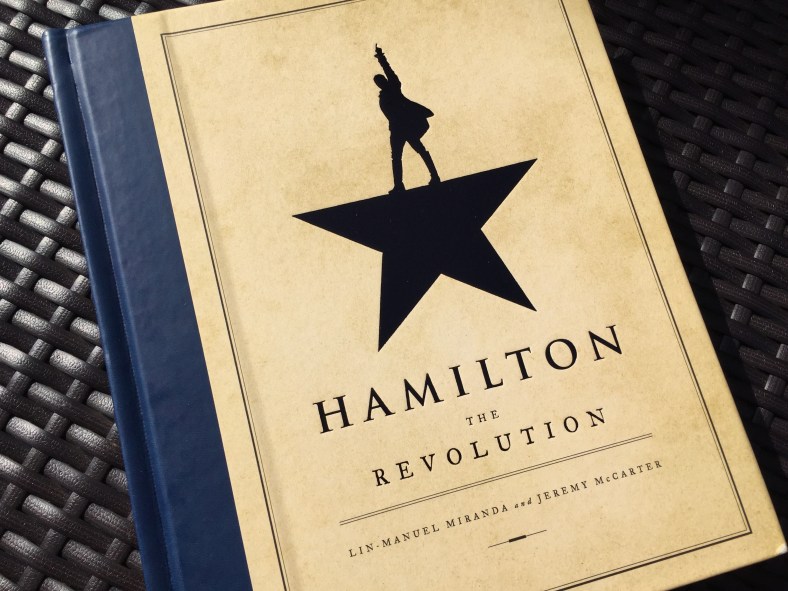
The Saturday Read ‘Hamilton The Revolution’ by Lin-Manuel Miranda and Jeremy McCarter

I saw the hat first, ‘A.HAM’ emblazoned on its crown. In the midst of the crowds converging on the campus of the University of Southern California last weekend for the LA Times Festival of Books, a student and her parents were headed to an open house hosted by the School of Dramatic Arts. The black and gold logo was a reminder that the phenomena that is ‘Hamilton’ continues to spark the dreams of the aspiring actor, striving historian, and would-be composer.

First there was Ron Chernow‘s 2004 book, ‘Alexander Hamilton’. Last summer, ‘Hamilton’, the musical debuted on Broadway. In February, the original cast recording won a Grammy for Best Musical Theater Album. This week the ‘Hamiltome’ arrived in bookstores and immediately sold out on Amazon. The Saturday Read is ‘Hamilton The Revolution’ by Lin-Manuel Miranda and Jeremy McCarter.
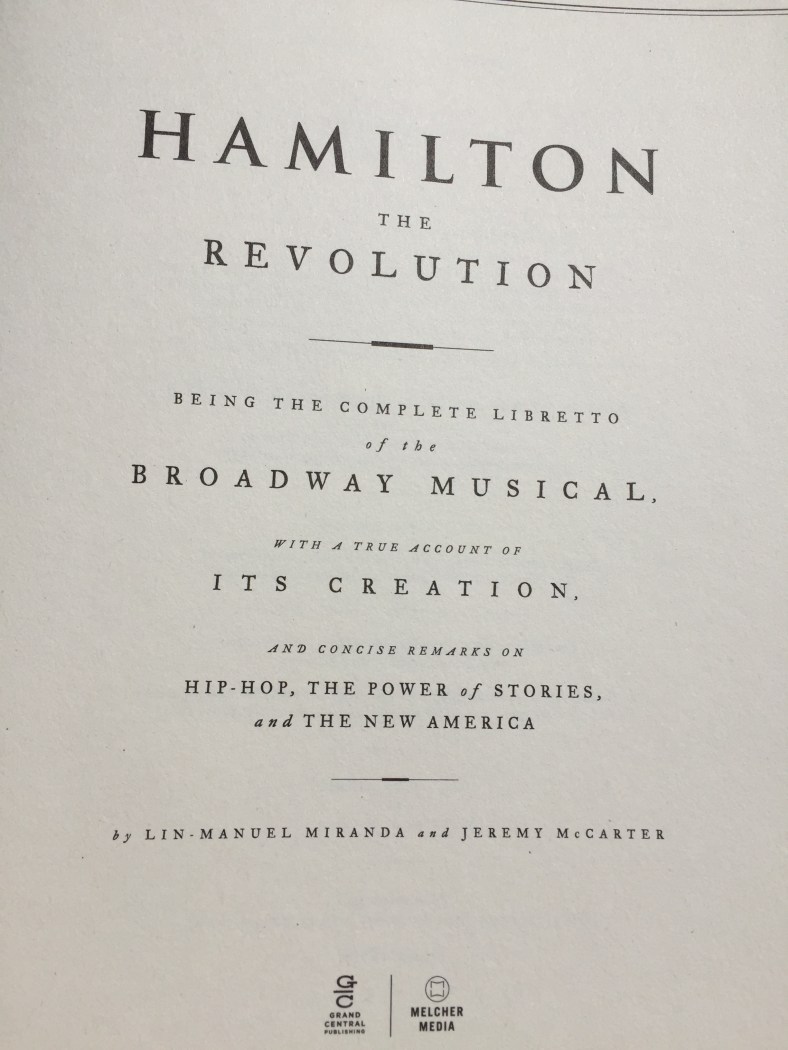
title page.jpg

In 2007 Jeremy McCarter, then drama critic for New York Magazine, reviewed a new play, ‘In The Heights’ and posed the question “Could musicals actually be adapting to a new century’s audience?”

“The most obvious of the show’s many virtues is that it doesn’t sound like the half-assed pseudo-pop that clutters up Broadway. Miranda’s score is rich and kaleidoscopic, as it needs to be.”

In the Introduction to ‘HTR’, Mr. McCarter reflects on his time at New York Magazine and his frustration with lack of interest in the possibilities of hip-hop.

“After many disappointments and false alarms, Heights had made me sit up in my aisle seat: Here’s the guy. Lin’s show about immigration in Upper Manhattan fused salsa, hip-hop, and traditional Broadway ballads to make something old and new, familiar and surprising. Best of all, he made the leap that virtually nobody else had made, using hip-hop to tell a story that had nothing to do with hip-hop – using it as form, not content.”

The writer, director and producer McCarter, who studied history at Harvard connected with the composer, lyricist, actor and Wesleyan alum, Miranda and began a collaboration that resulted in ‘Hamilton The Revolution’.

“It tells the story of two revolutions. There’s the American Revolution of the 18th century, which flares to life in Lin’s libretto, the complete text of which is published here, with his annotations. There’s also the revolution of the show itself: a musical that changes the way that Broadway sounds, and alters who gets to tell the story of our founding, that let’s us glimpse the new, more diverse America rushing our way.”

IMG_4314.jpgThe book is a ‘behind the scenes’ look at the development of a musical. It’s a narrative of the creative process and a roadmap for future generations who will replicate the production on high school and summer stages.

In an interview with CBS This Morning, Mr. McCarter stressed the importance of cataloging the moments from the first rap performance at the White House through the six years to opening night.

We wanted to “tell the story which is not about this historical fact or that historical fact, it’s about the emotional reality that these people were living through…This is not just what happened, but this is how it felt at the time. This is the experience that we all went through…So that ten years from now when kids are doing it they can pick up this book and say ‘Oh, that’s how they did it’, now I understand.”

Where do we find inspiration? It’s the curiosity thing. Mr.Miranda is the master of the inquisitive. And he seems to drawn on every life experience and relationship to connect the dots to his project. Here’s one example from the annotations to ‘You’ll Be Back’.

“I was having a drink with Hugh Laurie, with whom I’d worked on his series ‘House’, and I told him I wanted to write a breakup letter from King George to the colonies. Without blinking, he improv’d at me, “Awwww, you’ll be back,” wagging his finger. I laughed and filed it away. Thanks, Hugh Laurie.”

IMG_4308.jpgWe learn from the wisdom of others. ‘Hamilton The Revolution’ introduces us to a serious set of theater luminaries and traces each of their stories as the words and music evolve.

@work we casually use the buzz words creativity and innovation interchangeably. We imagine we are all curious, exemplars of transformational thinking. But most of us can’t reimagine our way out of our comfort zone. Creativity is hard work.

‘HTR’ is the story of a musical. Its value, for those who work outside the theater, is to show us where curiosity can lead and what creativity looks like.

IMG_4309.jpg

“The last song in the show captures the bitter historical truth that every one of Hamilton’s enemies outlived him, and they did all they could to efface his memory. By ending with Hamilton’s afterlife, not his death, the show asks us to think about what we leave behind when we’re gone: It invites us to think about legacies.”

When Ben Brantley reviewed the musical for the New York Times, he wrote “Hamilton” is, among other things, about who owns history, who gets to be in charge of the narrative.”

Lin-Manuel Miranda and Jeremy McCarter own ‘HTR’, their story, and leave no doubt about who is in charge of the narrative.

“Who tells your story?”


‘Big Dreams’ a poem by April Halprin Wayland

Time to add a bit of whimsy to the end of the week with ‘Big Dreams’.

We discover our first dreams in the magic of children’s literature: the poetry of great writers, and the illustrations of great artists. The Friday Poem this week encourages us to revisit those dreams through the words of April Halprin Wayland.

“For four and a half years I worked in the marketing department of Pacific Bell, which became AT&T. I knew that world was not for me. To keep my sanity, I took a class at UCLA Extension called Writing for Children, taught by Terry Dunnahoo. Terry’s class changed my life. It was as if I had fallen madly, deeply in love. When I walked to lunch with my corporate buddies, the men at construction sites whistled at me. They hadn’t whistled at me before I was in Terry’s class. Something huge had shifted in me; I was electric. I knew I had to take the leap. In one of my last meetings at AT&T, I pretended to take notes, but was actually writing a poem about a child who runs away to live with rabbits and slowly turns into one. I don’t know if I was writing about me, turning into a corporate bunny…or if I was writing about my desperate need to run away from the corporate life.”

Big Dreams

The scruffy house cat
aches to fly—
she dreams all day of
wings and sky!

So tonight
she climbs the ladder,
mounts a platform,
nothing matters

except to catch
a thin trapeze
then hold on tight
with grace and ease.

She swings herself
by both front paws
then somesaults
to wild applause

of kitchen mice,
who, though dizzy,
encourage Cat,
to keep her busy.

April Halprin Wayland

What do you do? Crafting an answer of identity @work

It’s the icebreaker question, ‘What do you do?’ It seems like a simple question, but it’s often difficult to explain our life’s work to strangers. Our workplace is defined by acronyms, our comfort zone is among our peers who share a common language.

It was the dilemma writer Elizabeth McCracken expressed in a 2014 tweet.

“21 years into a publishing career & I still have no idea what to say when someone says, “A writer? Have I heard of anything you’ve written?”

Maybe it’s not just the question, but the response we get when we attempt an answer. It’s the incorrect assumptions folks hold when they have a passing familiarity with a career.

Lincoln Michel used the query to imagine ‘If Strangers Talked to Everybody Like They Talk to Writers’.

“There is something unique about the way people talk to writers. Strangers seem very willing to offer career advice — “self-publishing is where the money is!” — literary advice — “People love vampires!” — or to oddly ask you to guess what work they’ve read in their life and if any of yours is among it. It got me thinking about what it would be like it people talked about other professions in this way.”

“Huh. A chef. Do people still eat food?”

“An accountant? Wow, I haven’t even looked at a number since high school.”

“Software programmer? Like, for actual computers sold in stores or just as a hobby?”

It’s not just writers. Most of us have embarked on career paths that carry with them a variety of inaccurate stereotypes.

Is it possible to craft an answer that informs, clarifies and avoids unsolicited advice?

Yes, and it’s storytelling without revealing the ending.

First, decide what you want to share about your work. Then imagine you are describing what you do to aliens. Finally, think function, product, audience and benefit.

Let’s go back to the writer, who may want to keep their work confidential, and avoid unsolicited feedback.

Authors are familiar with providing ‘soundbite’ summaries of their work to ‘sell’ a book proposal, and can employ the same technique to describe their work. For example: “I’m a writer and I recently completed a memoir that will be released in the fall. My next project is a profile for a weekly magazine which involves travel to Austin, Texas next week. Have you been to Austin? Can you suggest any good restaurants in the area?”

This sample response answers the question without divulging confidences, describes the work in familiar terms and redirects the conversation to connect on another, recognizable topic, food.

Who knew writers accumulate frequent flyer miles, get stuck in long TSA lines and patronize fashionable restaurants?

In crafting your response, consider your audience. How likely are they to be aware of your work? This is not about ‘dumbing down’ an answer, but about connecting through shared language and experience.


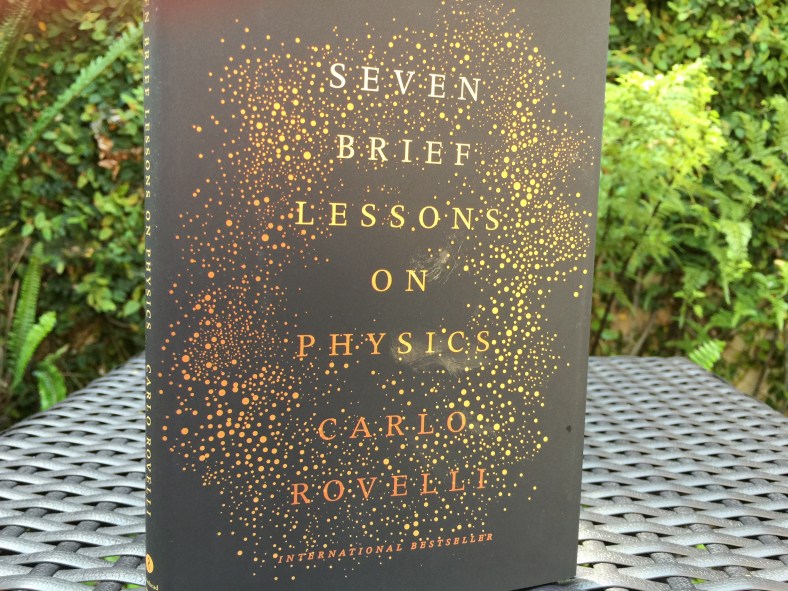
The Saturday Read ‘Seven Brief Lessons On Physics’ by Carlo Rovelli

It was the ‘chirp’ heard around the world. In February scientists announced the discovery of gravitational waves formed by two black holes colliding, confirming the century old predictions of Albert Einstein.

If you’re not a physicist or a physics major, you may have only a passing familiarity with the terms used in the previous sentence. And yet, we just experienced, in a ‘galaxy far far away’, what the New York Times science reporter Dennis Overbye described as a moment “destined to take its place among the great sound bites of science, ranking with Alexander Graham Bell’s “Mr. Watson — come here” and Sputnik’s first beeps from orbit.” 

The Saturday Read this week is ‘Seven Brief Lessons on Physics’ by physicist Carlo Rovelli of Aix-Marseille University and the Intitut Universitaire de France. Spend some time with this exquisite book and become a bit more fluent in the language of physics.

“These lessons were written for those who know little or nothing about modern science. Together they provide a rapid overview of the most fascinating aspects of the great revolution that has occurred in physics in the twentieth and twenty-first centuries, and of the questions and mysteries that this revolution has opened up. Because science shows us how to better understand the world, but it also reveals to us just how vast is the extent of what is still not known.”

Beginning with Einstein’s ‘beautiful theory’ of relativity, Rovelli follows the science beyond gravity to quantum mechanics and quantum gravity.

Is your hair is hurting? Hang in there.

“Physics opens windows through which we see far into the distance. What we see does not cease to astonish us. We realize that we are full of prejudices and that our intuitive image of the world is partial, parochial, inadequate. Earth is not flat; it is not stationary. The world continues to change before our eyes as we gradually see it more extensively and more clearly.”

Are we still talking about science? The magic of Rovelli’s prose is its simplicity in conveying painfully complex theories.

We learn the value of ‘wasting’ time.

“In his youth Albert Einstein spent a year loafing aimlessly. You don’t get anywhere by not ‘wasting’ time – something, unfortunately, that the parents of teenagers tend frequently to forget.”

And that we live in “A world of happenings, not of things.”

Rovelli describes concepts visually.

“…before experiments, measurements, mathematics, and rigorous deductions, science is about all about visions. Science begins with a vision. Scientific thought is fed by the capacity to ‘see’ things differently than they have been previously seen.”

And reminds us that “Genius hesitates.”

The essays originally appeared as a series for the culture section of  Il Sole 24 Ore, the Italian newspaper. Released last month in the U.S., the book is ranked third on the New York Times combined print & e-book nonfiction list.

Why read ‘Seven Brief Lessons on Physics’? Because it will take you on an adventure beyond your comfort zone in the time it takes you to commute to work.

“We are made of the same stardust of which all things are made, and when we are immersed in suffering or when we are experiencing intense joy, we are nothing other than what we can’t help but be: a part of our world.”


The Saturday Read ‘A Sense of Where You Are’ by John McPhee

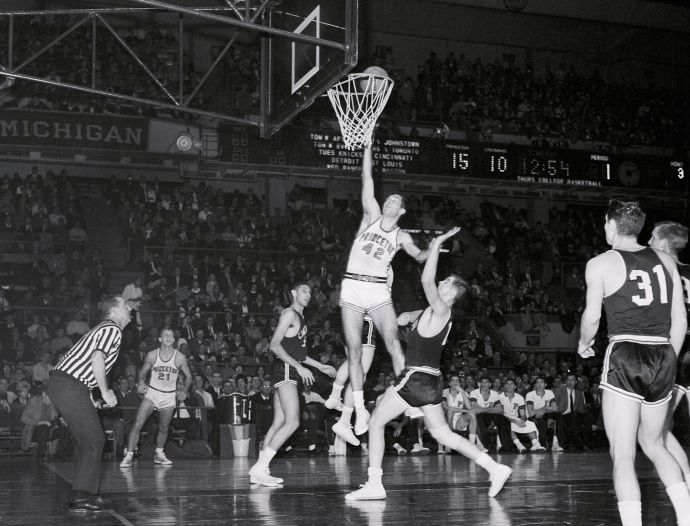
In 1964 Bill Bradley was a senior at Princeton University, and a star player on the basketball team. John McPhee was just beginning his career as a writer. In a moment to make networking history, McPhee’s dad, the athletic department physician, suggested John visit campus and profile the Ivy League phenom.

The Saturday Read this week is ‘A Sense of Where You Are’, the original New Yorker article, published in the January 23, 1965 issue.

images.jpeg

As the NCAA tournament narrows the field from 64 to 16 this weekend, let John McPhee be  your ‘throwback Saturday’ guide to Princeton University in the fall of 1964.

“The basketball locker room in the gymnasium at Princeton has no blackboard, no water fountain, and, in fact, no lockers. Up on the main floor, things go along in the same vein. Collapsible grandstands pull out of the walls and crowd up to the edge of the court. Jolly alumni sometimes wander in just before a game begins, sit down on the players’ bench, and are permitted to stay there. The players themselves are a little slow getting started each year, because if they try to do some practicing on their own during the autumn they find the gymnasium full of graduate students who know their rights and won’t move over. When a fellow does get some action, it can be dangerous. The gym is so poorly designed that a scrimmaging player can be knocked down one of two flights of concrete stairs. It hardly seems possible, but at the moment this scandalous milieu includes William Warren Bradley, who is the best amateur basketball player in the United States and among the best players, amateur or professional, in the history of the sport.”

McPhee introduces us to Bradley, his work ethic, and a time when basketball competition provided “a real period of relief from the academic load”.

Stay with me, fellow time traveller. This is not fiction. This is the future Pulitzer Prize winner, and pioneer of creative non-fiction, John McPhee, painting a picture of college life and basketball in the early 1960s.

In September of his senior year, Bradley competed on the U.S. Olympic basketball team in Tokyo, defeating Russia for the gold medal. In December, he was elected a Rhodes Scholar. He opted out of an opportunity to play for the NY Knicks to study at Oxford.

“Bradley says that when he was seventeen he came to realize that life was much longer than a few winters of basketball. He is quite serious in his application to the game, but he has wider interests and, particularly, bigger ambitions.”

Last year Marc Tracy revisited McPhee, the profile that began his career at The New Yorker, and Bradley’s last NCAA tournament.

“Fifty years earlier, McPhee had good reason to be at the Palestra for a basketball game, and for looking more than simply interested. He was covering an N.C.A.A. tournament game between Princeton and Penn State. Princeton won and then, at College Park, Md., defeated North Carolina State (whose zone press had just handled Duke) and Providence to advance to the Final Four in Portland, Ore. There, it lost to Michigan and, in the consolation game, devastated Wichita State, 118-82.”

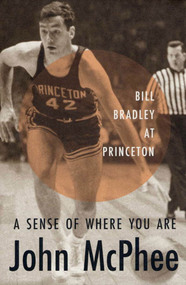
The profile, which was later expanded into a book of the same title, provides a tutorial on basketball, and the life of one true ‘student-athlete’, as he balances his academics, sport, and community involvement.

9780374526894.jpg

About that title:

“I asked him what he called his over-the-shoulder shot. He said that he had never heard a name for it, but that he had seen Oscar Robertson, of the Cincinnati Royals, and Jerry West, of the Los Angeles Lakers, do it, and had worked it out for himself. He went on to say that it is a much simpler shot than it appears to be, and, to illustrate, he tossed a ball over his shoulder and into the basket while he was talking and looking me in the eye. I retrieved the ball and handed it back to him. “When you have played basketball for a while, you don’t need to look at the basket when you are in close like this,” he said, throwing it over his shoulder again and right through the hoop. “You develop a sense of where you are.”

In 1964 his classmates predicted Bradley might run for governor in his home state of Missouri, and one day run for president.

With Bradley off to Oxford, McPhee closed his profile with this sentence.

“And like Hank Luisetti, of Stanford, who never played professional basketball, he will have the almost unique distinction of taking only the name of his college with him into the chronicles of the sport.”

That was not the end of the story.

Bradley returned after earning a masters degree at Oxford to play ten seasons with the NY Knicks, and was inducted into the Basketball Hall of Fame in 1983. He served as the U.S. Senator from New Jersey (not Missouri) from 1979-1997. And he ran for president in 2000.

In the 2015, NY Times article,“Bradley explained what the book’s title means to him”.

“You have a sense of where you are in life,” he said. “You don’t get carried away. You know who you are. You understand the environment, the context in which you’re living, and you make decisions based upon the centeredness.”

He added, “You’re also always working on who you are.”


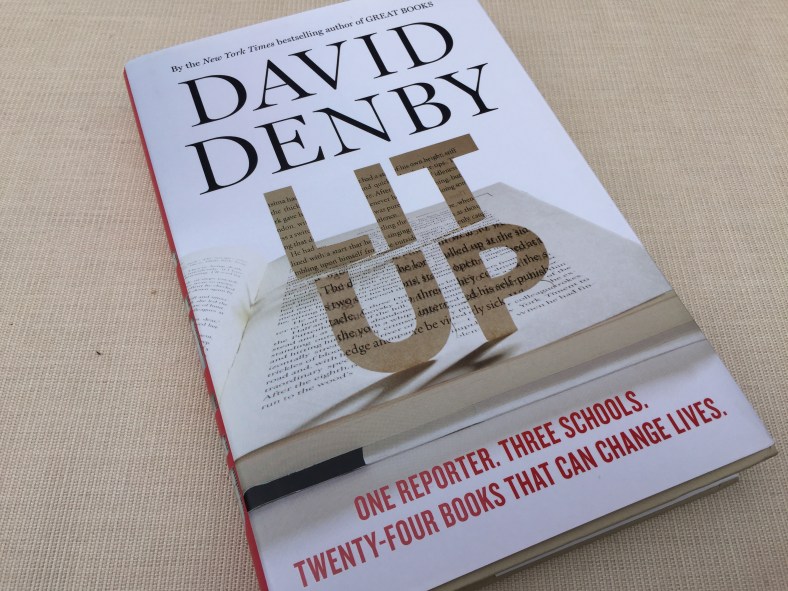
The Saturday Read ‘LIT UP: One Reporter, Three Schools. Twenty-Four Books That Can Change Lives.’ by David Denby

If you believe that the humanities are as critical as STEM skills in the 21st century workplace, take a trip back to high school with David Denby and this week’s Saturday Read, ‘LIT UP’: One Reporter. Three Schools. Twenty-Four Books That Can Change Lives.

We have this basic disconnect in our workplace today that is pitting generalists against specialists. The consequences are trickling down into our public education system.

If you’re a parent considering where to invest in your child’s college education, you’re probably looking at ‘vocational’ programs that ‘guarantee’ a job at graduation. If you’re that same parent, but now in the role of organization executive, you realize your recruiting efforts must consider ‘cultural contribution’; potential in addition to skill set. If you’re a student, you hear ‘STEM good, humanities bad; or worse, a waste of time’.

Writing in The New Yorker in February, Mr. Denby addressed the challenge in advocating for the humanities in today’s skill driven education/employer complex. He cited recent state government efforts to offer ‘bonus premiums’ in financial aid to students enrolled in STEM degree programs by cutting funding to students in the humanities.

“Lifetime readers know that reading literature can be transformative, but they can’t prove it. If they tried, they would have to buck the metric prejudice, the American notion that assertions unsupported with statistics are virtually meaningless. What they know about literature and its effects is literally and spiritually immeasurable. They would have to buck common marketplace wisdom, too: in an economy demanding “skill sets”—defined narrowly as technical and business skills—that deep-reading stuff won’t get you anywhere.” 

In ‘LIT UP’ David Denby is searching for the magic that transforms a young reader into a lifetime reader. “How do you establish reading pleasure in busy screen-loving teenagers – and in particular, pleasure in reading serious work? Is it still possible to raise teenagers who can’t live without reading something good? Or is that idea absurd? And could the struggle to create such hunger have any effect on the character of boys and girls?”

He chooses to go back to school for the 2011-12 academic year at Beacon, a New York City magnet high school, at the time located on West 61st St, observing teacher Sean Leon‘s tenth grade English class.

“School was the place to find out. And students in the tenth grade, I thought, were the right kids to look at. Recent work by neuroscientists has established that adolescence, as well as early childhood, is a period of tremendous “neuroplasticity”. At that age, the brain still has a genuine capacity to change.”

The book is structured by months, and reading selections. Mr. Leon introduces each book with inventive assignments, questions and at one point, a ‘digital fast’. Mr. Denby provides thumbnail plot sketches to shake the cobwebs from our ‘required reading’ memories. And we meet the students, by pseudonym, in their reactions to the literature.

At one point, the author gives the students a questionnaire to find out what books they read on their own, and their favorite authors. He finds three ‘real readers’ in a class of 32. “…unfairly or not, I was sorry that among Mr. Leon’s students there were no mad enthusiasms, no crazy loves, no compulsive reading of every book by a single author…”

In writing the book, he was encouraged by colleagues to create a scalable review, contrary to his initial approach, resisting quantification, and observing “a single place where literary education seemed to be working.” 

He realized that you can’t clone Beacon’s Sean Leon. He wanted other teachers to learn from Leon’s methods, but realized additional perspectives would add to his narrative.

“Typicality and comprehensiveness remained impossible to achieve, but variety was not. I delayed finishing the book, and, in the academic year 2013-14, I visited tenth-grade English classes in two other public schools – shuttling up many times during the year to James Hillhouse High School, an inner-city school in New Haven with a largely poor African American population; and five times in the spring to a school in a wealthy New York suburb, Mamaroneck, a “bedroom town” in the language of the fifties, where people sent their kids to good schools.”

Mr. Denby’s appendix includes the reading lists for each of the schools he visited and a ‘where are they now?’ college destination roster of the Beacon English Class of 2014. “There is, of course, no ideal reading list, no perfect syllabus, no perfect classroom manner, but only strategies that work or don’t work. In a reading crisis, we are pragmatists as well as idealists.”

“Teenagers, distracted, busy, self-obsessed, are not easy to engage – not by their teachers or by their parents. To keep them in the game, the teachers I watched experimented, altered the routine, changing the physical dimensions of the class. They kept the kids off balance in order to put them back in balance. They demanded more of students than the students expected to give.”

This is a book for parents, parents who are business leaders; teachers and the politicians who minimize their value; and students. We’re in a reading crisis and we need folks who have emotional intelligence, who can think, judge, make decisions and create a vision for an enterprise within a global world view.

“Teachers are the most maligned and ignored professionals in American life. In the humanities, the good ones are as central to our emotional and moral life as priests, ministers, rabbis, and imams. The good ones are not sheepish or silent in defense of literature and history and the rest. They can’t be; the children’s lives are right before them. In high-school English, if the teachers are shrewd and willing to take a few risks, they will try to reach the students where they live emotionally. They will engage, for instance, with “naïve” existential questions (what do I live for?) and also adolescent fascination with “dark” moods and the fear of being engulfed by adult society. Shakespeare, Mary Shelley, Poe, Hawthorne, Twain, Stevenson, Orwell, Vonnegut, and many others wrote about such things. And if teachers can make books important to kids—and forge the necessary link to pleasure and need—those kids may turn off the screens. At least for a few vital hours.”

‘Return from Antarctica’ a poem by Ailbhe Ni Ghearbhuigh

On Sunday, January 24, British polar explorer, Henry Worsley died in hospital in Punta Arenas, Chile. He had been attempting to cross Antarctica on foot, unassisted and unsupported. He had travelled 913 miles since November 13, 2015 and was 30 miles short of his destination. The Friday Poem this week is ‘Return from Antarctica’, by Irish poet, Ailbhe Ni Ghearbhuigh.

On Friday, January 22, Henry Worsley called Antarctic Logistics and Explorations to request a rescue.

“When my hero, Ernest Shackleton, stood 97 miles from the South Pole on the morning of Jan. 9, 1909, he said he’d shot his bolt,” the British adventurer Henry Worsley said in the message. “Well, today, I have to inform you with some sadness that I, too, have shot my bolt.”

“My journey is at an end,” Mr. Worsley said. “I have run out of time, physical endurance and a simple sheer inability to slide one ski in front of the other to travel the distance required to reach my goal.”

A news release posted on shackletonsolo.org on Monday reported his death from peritonitis.

“It is with great sadness that we can confirm Henry Worsley died on the 24th January 2016 in hospital in Punta Arenas, Chile.

Henry undertook his solo expedition in the spirit of his idol Sir Ernest Shackleton and was delighted to have exceeded his goal of raising a £100,000 for the Endeavour Fund, a charity founded to help the recovery of injured servicemen and women. He was fulfilling his dream of crossing the Antarctic continent, and after having walked 913 statute miles unsupported and unassisted, battling extreme weather conditions, he made the brave decision, in Shackleton’s words, to “shoot the bolt”, 30 miles short of his ultimate goal.”

The photo above was taken by the explorer on Day 11, ‘Duvet Day’, “tent bound at 9,400 feet”.

The Friday Poem is for the adventurer in all of us, and in memory of the courage of Henry Worsley.

Filleadh ón Antartach (Return from Antarctica)

He can still hear it:
the glaciers rasping,
their ratcheting in the distance,
the snow-quiet.

And still he remembers
gulping unsullied freshness
to clarify his lungs,
the holy coldness blessing his skin.

He gave his heart
to that stinging brightness,
that taciturn redoubt,
that uncluttered country.

But no choice except a return
to dampness and home.
He had to turn
his back on blankness.

On so many nights
his wife asks him tentatively
to abandon the kitchen
and join her upstairs.

He loves the irregular loneliness
of each tap-drip
and it’s music to him
the refrigerator’s drone:

basso profundo
slow in the recital,
grinding sighs that call out
to his being’s every melting element.

Ailbhe Ni Ghearbhuigh

Translated from the Irish by Billy Ramsell, Poetry Magazine, September 2015

“People do not decide to become extraordinary…”


Did you ever dream of becoming an astronaut? On November 4, 2015 NASA offered an opportunity to realize that dream, announcing it would begin recruiting the next astronaut class, a month after the release of the movie, ‘The Martian’.

Using the #JourneyToMars, NASA initiated an online recruiting strategy in advance of the availability of online applications.

“Recently named the best place to work in the federal government for the fourth year in a row, NASA is looking for the best candidates to work in the best job on or off the planet. The astronaut candidate application website now is live and accepting submissions through Feb. 18.”

As the application deadline of approaches, NASA is pausing today to remember and celebrate the lives of the space explorers lost pursuing their dream on Apollo 1, Challenger and Columbia.

On January 28, 1986, NASA was hoping to instill a passion for space exploration in a new generation. The STS-51L mission included the first civilian crew member, and competitively selected, ‘teacher in space’ Christa McAuliffe.

The other members of the diverse crew who went to work on Challenger that cold winter day were spacecraft commander Dick Scobee, pilot Michael J. Smith, mission specialist Judith A. Resnick, mission specialist Ronald E. McNair, mission specialist Ellison S. Onizuka, and payload specialist Gregory B. Jarvis.

Search ‘Challenger’ and it’s permanently linked to ‘disaster’. View the videos of the crew en route to the launch pad and gain an alternative view of individuals excited and energized at the prospect of lift-off.

It’s easy to forget the risks of exploration amid the successes. And for those completing the application to become a member of the next generation of space explorers, the anticipation of adventure far outweighs consideration of danger.

“This next group of American space explorers will inspire the Mars generation to reach for new heights, and help us realize the goal of putting boot prints on the Red Planet,” said NASA Administrator Charles Bolden. “Those selected for this service will fly on U.S. made spacecraft from American soil, advance critical science and research aboard the International Space Station, and help push the boundaries of technology in the proving ground of deep space.

Take a minute today to consider dreams and dreamers with a quote from Everest explorer, Edmund Hillary, who reached as far into the sky as you can with your feet still planted on the ground.

“People do not decide to become extraordinary. They decide to accomplish extraordinary things.” 


‘The World I Live In’ a poem by Mary Oliver

The Friday Poem this week is from Pulitzer Prize winning poet Mary Oliver‘s new collection, ‘Felicity’ published this fall. Merry Christmas!

The World I Live In

I have refused to live

locked in the orderly house of

reasons and proofs.

The world I live in and believe in

Is wider than that. And anyway,

what’s wrong with Maybe?


You wouldn’t believe what once or

twice I have seen. I’ll just

tell you this:

only if there are angels in your head will you

ever, possibly, see one.

Mary Oliver  ‘Felicity’  Penguin Press, 2015

The week@work – The Fed raises rates, Martin Shkreli is arrested, ‘The Big Short’ premieres and so does a small film about a galaxy far, far away

It’s that time of year when the world of finance takes center stage, only to be bested by the creativity of those who work in Hollywood. This week@work the Federal Reserve raised its benchmark rate, pharmaceutical executive, Martin Shkreli was arrested on securities fraud and the 2008 financial crisis originally chronicled by Michael Lewis, made its way onto the big screen in ‘The Big Short’. And that small movie from Disney? ‘Star Wars: The Force Awakens’ set new records with a $238 million weekend opening.

On Wednesday, the Wall Street Journal reported on the decision by the Federal Reserve to raise interest rates for the first time in seven years.

“The Fed’s decision today reflects our confidence in the U.S. economy,” Fed Chairwoman Janet Yellen said Wednesday in a press conference after a two-day policy meeting. “We believe we have seen substantial improvement in labor market conditions and while things may be uneven across regions of the country, and different industrial sectors, we see an economy that is on a path of sustainable improvement.

New projections show officials expect the fed-funds rate to creep up to 1.375% by the end of 2016, according to the median projection of 17 officials, to 2.375% by the end of 2017 and 3.25% in three years. That implies four quarter-percentage-point interest rate increases next year, four the next and three or four the following. It depends on whether the Fed’s forecasts for the economy—which have frequently been wrong in this expansion—hold up.”

The Fed rate increase was one of the ‘Four Charts That Defined the World in 2015’.

2014_Charts_Federal-690

Vauhini Vara writing in The New Yorker listed the other three:

“For the first time, fewer than ten per cent of people in the world were living in extreme poverty.

Facebook took over the world.

Greece’s economy started growing again—and then shrank.”

On Thursday, Bloomberg Business noted the arrest of Martin Shkreli, the infamous pharmaceutical head, and everyone’s leading candidate for this year’s Scrooge. You may remember Shkreli from his multiple media appearances after raising the price of the drug Daraprim from $13.50 a pill to $750. Apparently he not only violated the golden rule, but also an unspoken pact among those in financial services, not to draw attention to themselves or their activities.

“While the 32-year-old has earned a rare level of infamy for his brazenness in business and his personal life, what he was charged with had nothing to do with skyrocketing drug prices. He is accused of repeatedly losing money for investors and lying to them about it, illegally taking assets from one of his companies to pay off debtors in another.

“Shkreli essentially ran his company like a Ponzi scheme where he used each subsequent company to pay off defrauded investors from the prior company,” Brooklyn U.S. Attorney Robert Capers said at a press conference.”

He was released on bail on Friday and did what we would all do after being publicly shamed, began live streaming, chatting with ‘supporters’.

“Which brings me to a new movie the enemies of financial regulation really, really don’t want you to see.” writes nobel prize winner, Paul Krugman in The New York Times.

“But you don’t want me to play film critic; you want to know whether the movie (The Big Short) got the underlying economic, financial and political story right. And the answer is yes, in all the ways that matter.

I could quibble over a few points: The group of people who recognized that we were experiencing the mother of all housing bubbles, and that this posed big dangers to the real economy, was bigger than the film might lead you to believe. It even included a few (cough) mainstream economists. But it is true that many influential, seemingly authoritative players, from Alan Greenspan on down, insisted not only that there was no bubble but that no bubble was even possible.

And the bubble whose existence they denied really was inflated largely via opaque financial schemes that in many cases amounted to outright fraud — and it is an outrage that basically nobody ended up being punished for those sins aside from innocent bystanders, namely the millions of workers who lost their jobs and the millions of families that lost their homes.”

Need a holiday escape from everyday villains and economic reality? The folks at the ‘house the mouse built’ offer a 135 minute visit to an alternate universe.

“Chewie, we’re home” teases the plot in the trailer for the new Star Wars movie. This week the cast of the seventh installment of the intergalactic saga walked the red carpet, four blocks long, at the Hollywood premiere.

Variety covered the opening weekend box office results.

“Director J.J. Abrams’ nostalgic take on the series of space operas George Lucas created four decades ago was a hit with critics and fans, earning strong reviews and an A CinemaScore. Its opening soared past the previous high-water mark of $208.8 million established last summer by “Jurassic World.” It more than doubles “The Hobbit: An Unexpected Journey’s” December record debut of $84.6 million.

Globally, “Star Wars: The Force Awakens” scored the second-biggest opening in history, earning $517 million worldwide, behind only “Jurassic World’s” $525 million bow. Unlike “Jurassic World,” the seventh film in the “Star Wars” franchise did not have the benefit of showing in China on its inaugural weekend. It opens there on Jan. 9.”