The week@work – A ‘fumbled’ transition @ABC, a second chance for Cho, the Class of 2016 & the ‘Secret Shame of the American Middle-Class”

When is the right time to share news of a career transition with a colleague? This week@work, the communication of Michael Strahan’s move to ‘Good Morning America’ provided a lesson in what not to do. In other stories: Jerry Seinfeld stepped in to mentor fellow comedian Margaret Cho, the Class of 2016 enters the job market, and the middle class continues to live paycheck to paycheck.

‘Kelly Ripa’s Absence From ‘Live’ Points to Rancor at ABC’ was the #1 most read New York Times business article this past week. #8 on the list was ‘Michael Strahan, Switching Shows, Is Headed to ‘Good Morning America’. Leadership lesson: the reaction shouldn’t be bigger news than the announcement.

Unknown.png

Why did this story resonate with readers?  Because it’s a story about fairness @work, professional respect among colleagues, and being left out of the loop. We have all been Kelly and many of us have been Michael.

Both GMA and Live fall within the Disney brand portfolio. It might be time to send the management team to the Disney Institute for a ‘values’ refresh. Jeff James, president and general manager of the Institute, often writes for INC. Here is a sample from April, 2014.

“Walt Disney said, “You can design and create, and build the most wonderful place in the world. But it takes people to make the dream a reality.”

To achieve success, leaders should consider these three concepts to motivate and inspire their team:

  1. Vision and Values. At Disney Institute, we believe every leader is telling a story about what he or she values. These values must be aligned with the vision for an organization or team… 
  2. Behaviors over Intentions. Individuals within an organization will look to a leader as a model to develop their own behaviors and decisions… As a leader, it is essential that your behaviors reflect your values and your vision… 
  3. Purpose before Task. When assigning new projects to a team, it is important to discuss the purpose behind the task… if a team understands the common purpose behind individual responsibilities, they will be more inspired to own the tasks as well as the goal.

Tomorrow morning Kelly Ripa will return to the ‘Live’ studio to resume her hosting assignment. In anticipation, Ned Ehrbar of CBS News asks “Is 9 a.m. too early for popcorn? Because this should be good.” Stay tuned.

There was a small story last week about second chances.

“Last month, the stand-up comedian Margaret Cho had a bad set at the Stress Factory in New Jersey. It happens. O.K., it was worse than usual since a clip of Ms. Cho being booed by the crowd showed up on TMZ. But for a comic, bombing is part of the job. What’s less common is getting a second chance with the same audience.”

images.jpeg

We’ve all been there. We prepare a presentation complete with all possible tech bedazzling, and imagine kudos from a receptive audience. However, the execution doesn’t quite match the expectation and we experience an epic fail.

Recovery for the average worker is a combination of coaching, training and perhaps client feedback. It’s extremely rare for an entertainer to revisit the scene of a bad set. Enter Jerry Seinfeld.

“In an invitation sent to all the ticketbuyers from her late-night show in New Brunswick on March 26, Mr. Seinfeld wrote: “At most workplaces, if there’s a problem on the job, there’s a conversation and usually some sort of outcome. But when a stand-up show doesn’t go well, the audience and the comedian both go home unhappy, sometimes not really sure what went wrong.”

Then Mr. Seinfeld made a proposal: “So as I was talking with Margaret about this show last week during the taping in L.A., we started wondering, wouldn’t it be something if we could go back to New Jersey, back to that club with the same audience and try to make things right? Have a discussion where both sides — comedian and audience — could talk about what happened? And then both of us could do a show — a sort of redo for the audience?”

When the jacaranda trees begin to bloom in Southern California, you know it’s time for commencement, and the string of news stories on the job prospects for the Class of 2016.

la-me-jacaranda-mk-la0009868688-20130604.jpeg

Lydia Dishman reported on the Economic Policy Institute’s analysis of work prospects for this year’s grads.

“Members of the class of 2016 are about to take their first steps on career paths. While no one can predict how they will do once they become part of the workforce, the Economic Policy Institute analyzed employment, enrollment, and wage trends to determine their economic prospects.

A paper, titled “Class of 2016,” found that this cohort has better job prospects than members of last year’s graduating class. Thanks to the steady economic recovery, these young people are expected to do better than any other class since 2009.”

The Economic Policy Institute’s paper is not an optimistic read, but a well researched study on the impact of nonexistent wage growth and a volatile economic future.

“Graduating in a weak economy has long-lasting economic consequences. For the next 10 to 15 years, those in the Class of 2016 will likely earn less, and have more spells of unemployment, than if they had graduated when job opportunities were plentiful.”

Saving the best for last, Neal Gabler‘s courageous, must read article in The Atlantic Magazine, ‘The Secret Shame of Middle-Class Americans’.

“Since 2013, the federal reserve board has conducted a survey to “monitor the financial and economic status of American consumers.” Most of the data in the latest survey, frankly, are less than earth-shattering: 49 percent of part-time workers would prefer to work more hours at their current wage; 29 percent of Americans expect to earn a higher income in the coming year; 43 percent of homeowners who have owned their home for at least a year believe its value has increased. But the answer to one question was astonishing. The Fed asked respondents how they would pay for a $400 emergency. The answer: 47 percent of respondents said that either they would cover the expense by borrowing or selling something, or they would not be able to come up with the $400 at all. Four hundred dollars! Who knew?

Well, I knew. I knew because I am in that 47 percent.”

In an interview with NPR last week, Gabler spoke of “the shame of financial impotence”.

“That shame weighed on me — and I am not overstating the case — on not only a daily basis, but an hourly basis. It keeps you up at night. It is ruinous for relationships, the shame is so great. The ongoing sense of shame, that in a country where we are told anyone can be successful, and where, as Donald Trump has told us endlessly, if you don’t make it you’re a “loser.”

So, yes, did I feel like a loser? You bet I did. But what can you do with that sense of shame? You can’t share it with anybody, because to expose it is, like sexual impotence, something you just don’t want to talk about.”

 

The week@work – wage gaps, low expectations, false assumptions,’Confirmation’, and reflections on a 50 year career

After reviewing the stories selected for this week@work, I realized there was a common theme in all except one: women who are pursuing their dream jobs in male dominated fields. The last story, and exception to the theme, is Alberto Tomasi’s, a cabdriver for the past 50 years in Rome.

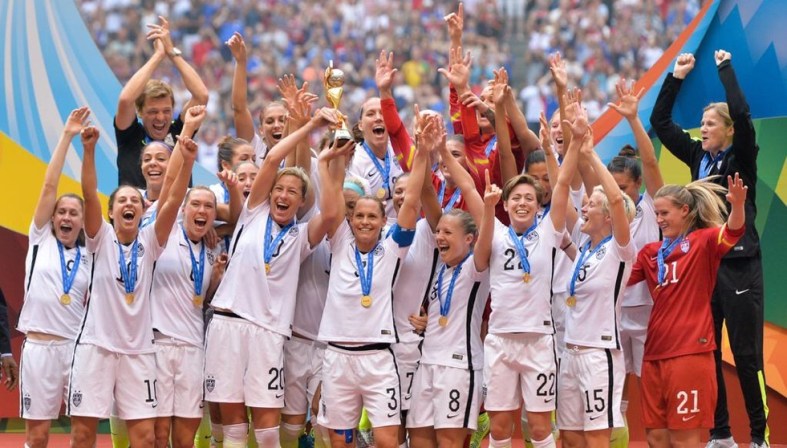
There have been many conversations recently about the wage gap between men and women@work. One of the most egregious discrepancies occurs on the global stage of world cup soccer. Earlier this month, five members of the U.S. Women’s National Team filed a wage discrimination action against the U.S. Soccer Federation. Carli Lloyd, co-captain of the team outlined her position in an essay, ‘Why I’m Fighting for Equal Pay’.

“I’ve worn a U.S. Soccer uniform for 12 years and have done so proudly. I’ve had some of the greatest moments of my life — winning two Olympic gold medals and the 2015 Women’s World Cup — wearing that uniform. So when I joined four teammates in filing a wage-discrimination complaint against U.S. Soccer late last month, it had nothing to do with how much I love to play for my country.

IMG_2458.jpg

When we talk about the wage gap in today’s workplace, experts estimate women earn 79% of a man’s salary for the same job. For U.S. women’s soccer, it’s 17% for the top players and 21% for the rest. There is no overtime pay in a career that requires a player to be on the road for 260 days a year.

In a sport where the women’s team revenue will exceed $5million vs. a $1million deficit for the men’s team, the top five women’s annual salaries are $72K vs the men’s at $406K. Members of the women’s world cup team earn $15K to the men’s $69K. When the women won the world cup last year they earned a $75K bonus. If the men were to win, they would bring home $390K.

The fact that women are being mistreated financially is, sadly, not a breaking news story. It goes on in every field. We can’t right all the world’s wrongs, but we’re totally determined to right the unfairness in our field, not just for ourselves but for the young players coming up behind us and for our soccer sisters around the world.”

In a related story, New York Magazine writer, Dayna Evans reports on the ‘expectation gap’ in salary negotiations uncovered by job marketplace, Hired – ‘Study Finds That Women in Tech Ask for Lower Salaries Than Men Do’.

womenwhocode1

“After analyzing 100,000 interview requests and job offers over the last year, tech job marketplace Hired found that, on average, tech companies offer women 3% less than men for the same roles. Among the most interesting—and troubling—pieces of data is that men receive higher salaries 69% of the time than women for the same job titles at the same companies.

Some of that disparity could be attributable to women not setting their demands high enough. Because Hired’s marketplace lets job seekers specify the salaries they’re seeking, the report provides a glimpse into both expectations and final offers. In roles that are more male dominated, women often set their salary expectations lower than their male counterparts.

Overall, Hired’s data shows that the average woman on our platform sets her expected salary at $14k less per year than the average man on our platform. When we break the expectation gap down by role — comparing women and men in the same job category — we found as the ratio of men to women in the role increases, so does the gap.”

The death of Pritzker Prize winning architect, Zaha Hadid on March 31 prompted The New York Times to send an “informal online questionnaire” asking “female architects among its readers to talk candidly about their experiences in the profession: the progress they’ve made and the obstacles they still face on construction sites and in client meetings.”

“For a woman to go out alone in architecture is still very, very hard,” the architect Zaha Hadid said. “It’s still a man’s world.” Ms. Hadid often stated that she did not want to serve as a symbol of progress for women in her profession. But, inevitably, she did. A study on diversity in the profession released this year by the American Institute of Architects found that “women strongly believe that there is not gender equity in the industry”; that women and minorities say they are less likely to be promoted to more senior positions; and that gender and race are obstacles to equal pay for comparable positions. Since Ms. Hadid won the Pritzker Prize in 2004, the percentage of female architects in the United States has barely grown, increasing to 25.7 percent from 24 percent, according the Bureau of Labor Statistics.”

The article is a series of snapshots of successful architects@work, encountering obstacles in a still white-male dominated field. One example from Yen Ha, Principal of Front Studio Architects in New York.

13archwomen-span-master675

“We absolutely face obstacles. Every single day. It’s still largely a white, male-dominated field, and seeing a woman at the job site or in a big meeting with developers is not that common. Every single day I have to remind someone that I am, in fact, an architect. And sometimes not just an architect, but the architect. I’m not white, wearing black, funky glasses, tall or male. I’m none of the preconceptions of what an architect might be, and that means that every time I introduce myself as an architect, I have to push through the initial assumptions. Every new job site means a contractor who will assume I am the assistant, decorator or intern. It usually isn’t until the third meeting that the project team looks to me for the answers to the architectural problems.”

In 1991 there was a vacancy on the U.S. Supreme Court. Then President George H.W. Bush nominated U.S. Circuit Court of Appeals Justice Clarence Thomas to fill the vacancy. This past weekend, HBO aired ‘Confirmation’, the story of former colleague Anita Hill testifying before the Senate Judiciary Committee that Thomas had sexually harassed her.

Unknown.jpeg

‘The Real Story Behind HBO’s ‘Confirmation’ From The NPR Reporter Who Broke The Story’ provides a Q & A with NPR correspondent, Nina Totenberg.

“I’d been hearing all summer long that there were women who said they were harassed by Clarence Thomas when he was at the EEOC and when he was at the Education Department,” Totenberg said. “But I could never really prove it. And then I heard about this woman, Anita Hill.”

That’s when everything changed.

You don’t recognize this now, but sexual harassment was a dirty little secret that most women had but they didn’t talk about. They were embarrassed by it; it was a hindrance and not a help in any way. Now suddenly, it gets popped into the open. … But all of those silent, female experiences materialized in the … phones exploding on Capitol Hill.”

Thomas was confirmed by a vote of 52-48. The legacy of Hill’s action was a dramatic increase in the number of sexual harassment claims filed with the EEOC.

“NPR received the prestigious George Foster Peabody Award for its gavel-to-gavel coverage — anchored by Totenberg — of both the original hearings and the inquiry into Anita Hill’s allegations, and for Totenberg’s reports and exclusive interview with Hill.”

Totenberg received individual accolades as well, but there was a downside.

“I was pilloried during this. I had one of the great stories of any reporter’s life. I had worked very hard to get it. And the cost was enormous in terms of negative publicity and people trashing me a lot and senators yelling at me. At one point I had a driver at Nightline who went around the corner [and] stopped and he said to me … “Lady, you better get a gun.”

The final story this week is ’50 Years in a Cab: A Long, Winding Trip for One Driver, and His City’, from Elisabetta Povoledo.

Rome_airal_picture.jpg

“From his front-seat perch, Alberto Tomassi, a Roman cabdriver for 50 years, has been both eavesdropper and confessor. He has played impromptu tour guide, thwarted muggings and rushed countless clients to the emergency room.

Expertly navigating Rome’s narrow, potholed streets — many conceived centuries before the internal combustion engine — he has developed the unflappable calm of a Zen monk.

“If you can get through the first 15 years without getting really angry, you can do it forever,” Mr. Tomassi said. “I just take things as they come.”

“You don’t get rich doing this job, but it’s honest work,” he said. “You can raise a family, put your kids through school.”

His only disappointment this year was in not being recognized for his service.

“…no party, no gold watch, no tribute — so he decided to place a round silver sticker emblazoned with “50 years of taxi” on the rear window of his cab.”


The week@work: Inequality on stage, Apple@40, ‘job crafting’ & odd interview questions

As the economy continues to improve, and include workers who had given up, playwrights are staging works that reflect the continued struggle and inequity in the workplace. This week@work we celebrate Apple@40, take a look at ‘job crafting’ as a way to reimagine work and pose a few interview questions.

Nelson D. Schwartz and Neil Irwin reported ‘Jobs and Wages Notching Gains Long In Coming’ for the New York Times.

“Companies have been hiring in recent months at a pace not seen before in this century. Wages are rising faster than inflation. Joblessness is hovering near the low levels last reached in 2007 before the economy’s downturn.

And perhaps most significantly, the army of unemployed people who gave up and dropped out of the job market is not only looking for work, but actually finding it.

“Wages and participation are where the rubber meets the road,” said Michael Gapen, chief United States economist at Barclays. “We will take our cue about the overall strength of the economy based on that.”

At the same time, the chasm widens between the average worker, still trying to recover with modest wage gains, and the quantum leaps in compensation for the wealthy.

It’s this divergence that is reflected in several theater productions, under the heading ‘Haves and have-nots: Putting America’s financial inequality on the stage’. The Economist article reviews ‘The Humans’, ‘Hungry’, ‘Hold On To Me Darling’, ‘The Way West’, ‘Dry Powder’, and ‘Red Speedo’ to illustrate how the economy and work are inspiring a generation of playwrights.

“There is something familiar about the Blakes, the American family at the centre of “The Humans”, a new play by Stephen Karam that is now on Broadway. Anyone who has navigated the emotional minefield of a family meal will recognise the affectionate way they bicker, their barbs softened with tenderness. But something else about this family will also resonate with a growing group of Americans: each member is struggling financially.

This conversation resembles countless others across the country, as Americans try to make sense of an economy in which working hard is no longer enough to afford a comfortable life. Parents who assumed that their children would surpass their own accomplishments are now startled to find so many of them sweating over rent and saddled with college debt. What does it take to get ahead? Why does the system create so few haves and so many have- nots?”

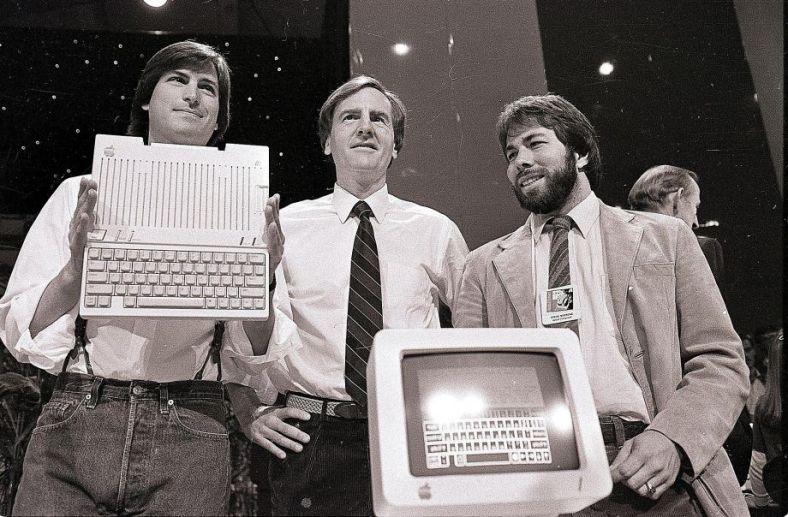
This past week marked the 40th anniversary of Apple. In his commencement speech to the Stanford class of 2005, co-founder Steve Jobs recalled the journey from start-up to his firing by the Board of Directors.

920x1240.jpg

“I was lucky — I found what I loved to do early in life. Woz and I started Apple in my parents’ garage when I was 20. We worked hard, and in 10 years Apple had grown from just the two of us in a garage into a $2 billion company with over 4,000 employees. We had just released our finest creation — the Macintosh — a year earlier, and I had just turned 30. And then I got fired. How can you get fired from a company you started? Well, as Apple grew we hired someone who I thought was very talented to run the company with me, and for the first year or so things went well. But then our visions of the future began to diverge and eventually we had a falling out. When we did, our Board of Directors sided with him. So at 30 I was out. And very publicly out. What had been the focus of my entire adult life was gone, and it was devastating.

We know the rest of the story. Jobs returned to Apple in 1997. David Pierce and Michael Calore identify ‘Fifteen Products That Defined Apple’s First 40 Years’.

iPhone-SE-gaming.jpg

#1 the iPhone

“If you want to understand the iPhone’s importance to Apple, just look at its earnings. But it’s not just that: Without it, our phones might still look like BlackBerries. We might never have learned to pinch to zoom. We might all carry point-and-shoots. It’s almost impossible to overstate the revolution the iPhone started in 2007, which has touched and connected billions of people around the world.”

hiddenbrain_deepbluereverse2_sq-d4dc2bc0fb94c4fa0074fb7ab2e1b681e6245d7a-s400-c85

If you prefer to digest ideas via podcast, add NPR’s Hidden Brain to your subscription list. Last week’s installment featured host Shankar Vedanta in conversation with Yale’s Amy Wrzesniewski on finding meaning in our work.

“Why do you work? Are you just in it for the money or do you do it for a greater purpose? Popular wisdom says your answer depends on what your job is. But psychologist Amy Wrzesniewski at Yale University finds it may have more to do with how we think about our work. Across groups such as secretaries and custodians and computer programmers, Wrzesniewski finds people about equally split in whether they say they have a “job,” a “career” or a “calling.” 

According to Wrzesniewski’s research “people who see work as a calling are more satisfied, engaged, and better performers”. These are folks who “go beyond notice” to craft the boundaries of their job to make work more meaningful.

The last story from this week@work is about interview questions. File it under the query, ‘What was the oddest question you were asked in an interview?’, from recruiting site, glassdoor.com.

Here’s a sample:

“What would the name of your debut album be?” (Urban Outfitters)

“What would you do if you found a penguin in your freezer?” (Trader Joe’s)

And here’s one that we should all be prepared to answer.

“If you were a brand, what would be your motto?” (BCG)

Think about it, and have a great week@work.


How many people have a job @graduation?

On college campuses across the country it’s ‘conversion’ time; next level marketing to the chosen to turn them into the enrolled. How do you differentiate between alternatives? If you take the commodity approach, it’s all about guaranteed employment. Here’s the thing – there are no guarantees.

It’s reasonable to consider post-grad employment when you’re investing a significant amount of money in a college degree. But that’s what it is, an investment, not a purchase. For the student, ‘attending’ college is not a passive act, it’s a full-time commitment. The ROI is a direct result of the effort, not dollars expended.

Former Cornell University president and current AAU president, Hunter Rawlings weighed in on the value of college debate last spring.

“A college education, then, if it is a commodity, is no car. The courses the student decides to take (and not take), the amount of work the student does, the intellectual curiosity the student exhibits, her participation in class, his focus and determination — all contribute far more to her educational “outcome” than the college’s overall curriculum, much less its amenities and social life. Yet most public discussion of higher ed today pretends that students simply receive their education from colleges the way a person walks out of Best Buy with a television.”  

When you ask the question ‘How many students are employed at graduation?’ you’re asking about the resale value of the car.

No one in today’s job market is guaranteed work. Any individual who believes their institutional pedigree will stand alone to open career doors is delusional.

The level of student engagement in internships, research, community service and extra-curricular activities, combined with faculty, staff and alumni connections, are far better predictors of post-grad success than destination survey statistics.

The question to ask is ‘What are the resources available to assist students seeking work?’ The ‘support’ assets are the constant in a volatile job market. Access to this ‘capital’ is the true measure of a university’s commitment to post-grad employment.


The week@work: terror on the way to work, a factory fire anniversary, values-based leadership@Starbucks, a millennial workplace, & a new job benefit


How do you share work thoughts when so many were killed and injured on their way to work on Tuesday morning? Apparently, we go on. I have to agree with the sentiment expressed by writer Pamela Druckerman in today’s New York Times ‘Je Suis Sick of This’.

“To Europeans, Brussels was supposed to be a dull place that you didn’t have to think much about until you had to change planes there. There’s a parlor game in which you stump people by asking them to name 10 famous Belgians. “Brussels, the anti-fanatic attacked by the fanatics,” French journalist Laurent Joffrin wrote in Wednesday’s Libération. “Brussels, a cousin whom one is content to know is there.”

Right after an attack it’s easy to say that everything feels different. People are horrified. Parents keep their kids home from school. Newspapers run headlines like “Europe at War.” There is the sad, familiar search for a slogan: This time, I prefer the Belgian frites arranged to make a rude gesture resembling a finger, and the banner reading, “Je suis sick of this” followed by an expletive.”

We don’t stop working. Maybe we are a bit more vigilant, the slogan ‘If you see something, say something’, temporarily gets more attention.

Journalist Druckerman continued, “Despite the inevitable false positives, it’s hard not to be on guard. I’m constantly making a series of mundane existential calculations: Is it worth it to risk going to a movie? Should I let my kids ride the metro to soccer practice? Daily life has a chiaroscuro quality: One minute you’re riding a bus and enjoying a view of the river; the next you’re wondering about the fellow with an unusually large backpack.”

There were other stories this week@work.

Friday was the 105th anniversary of the Triangle Shirtwaist Factory fire. It resonates with workers today because it was a story of immigrant workers, and led to changes in U.S. factory regulations and safety.

triangle fire.jpeg

Joseph Berger summarized the events in a 2011 article.

“A block east of Washington Square, not far from the neighborhood’s boutiques and chic restaurants, was the site of one of the nation’s worst industrial disasters. Many New Yorkers might be unaware of this.

Some labor advocates are trying hard to change that. They have organized an effort to build a memorial to the infamous Triangle Shirtwaist Factory fire of 1911, in which 146 workers died. Most of them were young immigrant women from Eastern Europe and Italy, and more than 50 jumped to their deaths from the factory’s ninth floor.

Two years ago, Tom Marshall posed the question, “Can disasters make life better for future generations?”  He went on to draw a parallel between the Triangle Shirtwaist factory fire and the 2013 garment factory collapse in Dhaka, Bangladesh.

“In both cases, inspectors visited and filed critical safety reports, but scores of people still died while making clothes for others. The American disaster is now hailed as a turning point that led to safer workplaces and broad support for a minimum standard of workers’ rights, while the Bangladeshi disaster’s impact is less certain.”

This week@work Starbucks chairman and CEO, Howard Schultz spoke at the annual shareholders meeting, and expanded on a conversation begun two years ago on the role and responsibility of a for-profit corporation. “What is the role and responsibility of all of us, as citizens?”

K9sMR38U-1650-1650

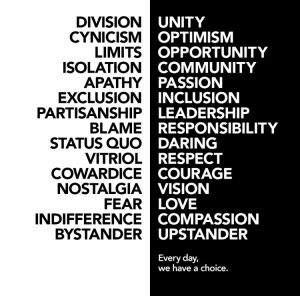
“Viewing the American Dream as a “reservoir” that is replenished with the values, work ethic and integrity of the American people, Schultz said, “Sadly, our reservoir is running dry, depleted by cynicism, despair, division, exclusion, fear and indifference.”

He suggested citizens fill the reservoir of the American Dream back up, “not with cynicism, but with optimism. Not with despair, but with possibility. Not with division, but with unity. Not with exclusion, but with inclusion. Not with fear, but with compassion. Not with indifference, but with love.”

“It’s not about the choice we make every four years,” Schultz said. “This is about the choices we make every day.”

One of the ‘most read’ articles last week, ‘What Happens When Millennials Run the Workplace?’, provided one more illustration that work issues are people issues, and it really doesn’t matter how you generationally identify.

“Joel Pavelski, 27, isn’t the first person who has lied to his boss to scam some time off work.

But inventing a friend’s funeral, when in fact he was building a treehouse — then blogging and tweeting about it to be sure everyone at the office noticed? That feels new.

Such was a recent management challenge at Mic, a five-year-old website in New York that is vying to become a leading news source created by and for millennials.”

The workplace is changing and the 80 million millennials @work will make a significant impact on work/life and the global economy. As a group, the 40 million with college degrees enter the workforce taxed with student loans that are the equivalent of a mortgage. Fidelity Investments announced a new employee benefit last week to address student loan repayment.  Tara Siegel Bernard provided the details.

“Fidelity will apply up to $2,000 annually to the principal of its employees’ student debts.

Fidelity is one of the more prominent employers to announce the student loan repayment benefit in recent months, a policy that seems likely to gain traction. The benefit helps address what some employers describe as a challenge attracting and retaining younger workers, many of whom can’t see beyond the burden of their student debt. Most employers that are offering the new perk also cap their costs at, say, $10,000 total per employee.”

At the end of a difficult week, spring wishes and Happy Easter!

IMG_4148


The week@work – leadership, lawyers, student loans & the economy

What makes a great leader or a great lawyer? What’s the best strategy to retire student debt? This week@work surveys articles that provide some answers, and as the economy continues to strengthen, offers some practical advice on career advancement.

Joshua Rothman wrote ‘Shut Up and Sit Down: Why the leadership industry rules’ for The New Yorker. He gives us a quick tutorial on the history of leadership, why we value the concept, but are so often disappointed in the people. He alludes to the current presidential contest, and then focuses on change in both our expectations of leaders, and the roles they play in contemporary organizations.Print

“In recent years, technological and economic changes like social media and globalization have made leaders less powerful.

Leaders used to be titanic and individual; now they’re faceless guiders of processes. Once, only the people in charge could lead; now anyone can lead “emergently.” The focus has shifted from the small number of people who have been designated as leaders to the background systems that produce and select leaders in the first place.

Leaders, moreover, used to command; now they suggest. Conceptually, at least, leadership and power have been decoupled.

To some extent, leaders are storytellers; really, though, they are characters in stories. They play leading roles, but in dramas they can’t predict and don’t always understand. Because the serialized drama of history is bigger than any one character’s arc, leaders can’t guarantee our ultimate narrative satisfaction. Because events, on the whole, are more protean than people, leaders grow less satisfying with time, as the stories they’re ready to tell diverge from the stories we want to hear. And, because our desire for a coherent vision of the world is bottomless, our hunger for leadership is insatiable, too. Leaders make the world more sensible, but never sensible enough.”

The New York Times profiled two women who chose law as their profession and took divergent, pioneering paths to achieve success. What makes a good lawyer? Meet Kimberley Chongyong Motley and Damaris Hernandez.

David Jolly profiled Ms. Motley, who has been practicing her profession in Afghanistan for close to eight years and was recently the subject of an award winning documentary, ‘Motley’s Law’.

image.adapt.990.high.kimberley_motley_05feb2016_portrait.1454770287607“Ms. Motley, 40, a Marquette University Law School graduate, had never before traveled overseas when she enrolled in a Justice Department program to train Afghan lawyers and flew to one of the world’s more dangerous places.


After her nine-month assignment, she did not return home to Milwaukee, instead hanging out her own shingle in Kabul. She studied Shariah, the Islamic code that lies beneath the fragile new Afghan Constitution, and she established herself as the only foreign litigator in one of the world’s most conservative and male-dominated cultures.

Ms. Motley says she makes a point of closely studying the cultures of both Afghanistan and the courtroom. “I’m a sort of legal archaeologist,” she said. “I try to uncover laws that have not been used, and then use them for the benefit of my clients.”

Damaris Hernandez was recently promoted to partner at the firm Cravath, Swaine & Moore, becoming the first Latina to reach that position. Elizabeth Olson tells her story as a first generation college student, who advanced in her career with the support of a unique scholarship at NYU.

Hernandez web.jpg

That achievement is an acknowledgment of her talent and hard work. But the story of her route to the top also reveals how much more complex the journey is for minorities and women than for the white men who overwhelmingly dominate the firms. Skill is only one of the keys. Being able to navigate unspoken rules is at least as important.

“When I was the only one of color or the only woman in the room, I had the confidence to believe in my ability,” said Ms. Hernández, 36, describing the advantages of the program to her. “When you are the first, you need someone to have your back.”

Over the last decade and a half, she and 100 others who attended the New York University School of Law received that support from a scholarship program that paid their full tuition and also gave them access to a network of luminaries including federal judges, law firm partners and even Supreme Court justices.”

If you are seeking ways to reduce your student loan obligation, NPR’s Yuki Noguchi offers ‘Strategies For When You’re Starting Out Saddled With Student Debt’. It’s not just about individual liability, but also the long term impact on career choice and economic growth.

“Experts say studies show rising student debt is limiting peoples’ career options. They decide against graduate school. Or feel they can’t afford lower-paying public service jobs or the risk of starting a new business. That’s a problem, because new companies create new jobs.”

University Park campus of the University of Southern California

This past week the University of  Southern California announced a tuition increase that will bring the annual bill to over $51,000. Financing college involves loans as part of the  package. Having a repayment strategy is critical to long term career success.

“Chris Costello, CEO of Blooom, a personal finance advice firm targeting lower-net-worth people, advises his firm’s clients to tackle student debt with this strategy.

First, if your employer matches contributions to a retirement plan, such as a 401(k) or 403(b), max out on the matching contributions.

After maxing out on the matching contributions, pay off the debt with the lowest balance.

Check to see if you can qualify for loan forgiveness, refinancing or debt consolidation.

Do not incur new debts: in other words, live below your means.”

Chico Harlan of The Washington Post reported on the latest figures released by the U.S. Labor Department on Friday.

“U.S. employers continued their rapid hiring in February, new government data showed Friday, a sign of the nation’s economic durability during a tumultuous global slowdown.

The U.S. added 242,000 jobs as the unemployment rate held at 4.9 percent, the lowest mark during the seven-year recovery from the Great Recession.

That pace, consistent with gains over the last year, indicates Americans are returning rapidly to the labor force, helped by steady consumer spending that is bolstering demand and prompting employers to expand their workforces. In data released Friday by the Department of Labor, sluggish wages provided the only disappointing note — a signal that labor market still has room to improve.”

Two other articles of interest this week:

’15 things successful 20-somethings do in their spare time’ by Jacquelyn Smith and Rachel Gillett for Business Insider

‘How to Advance In Your Career Without Becoming A Workaholic’ by Lisa Evans for Fast Company


The Saturday Read ‘Worklife: Rethinking the office for an always-on economy’

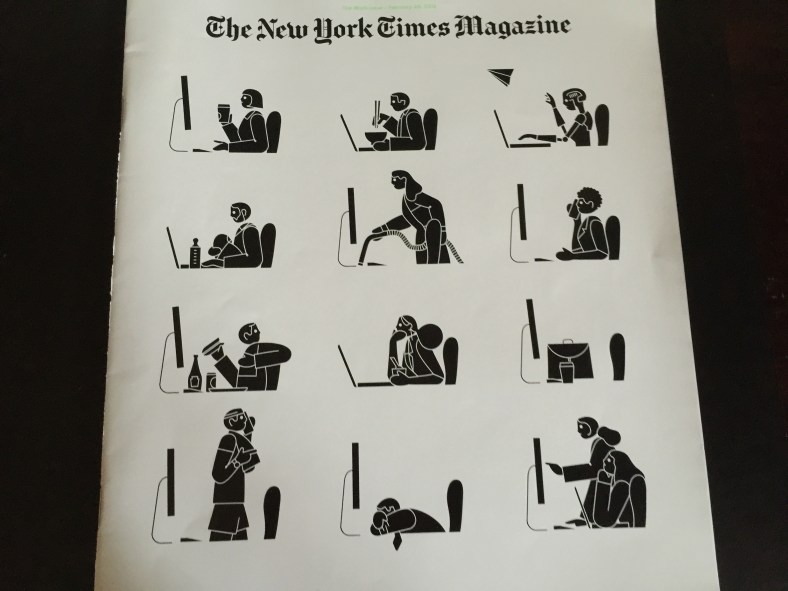
The Saturday Read this week is a compilation of articles that appeared in the February 28, 2016 ‘work issue’ of The New York Times Magazine.

A group of journalists and writers contributed coverage on a variety of work/life topics, adding new perspectives from groundbreaking research, demonstrating that, regardless of profession, it’s all about the culture. And the culture is in need of change.

Organization culture determines who succeeds, fails, and communicates ‘hints’ through recruiting practices, and the daily process of getting things done; meetings, teamwork and office space.

“We do often work at home. But we also work at work, before going home to work more. The office has persisted, becoming even bigger, weirder, stranger: a symbol of its outsize presence in our lives.”

The ‘work issue’ is an interesting survey of some of the most pressing issues @work today. The sampling of the content below is meant to serve as an introduction, with a recommendation to take the time to read the edition in its entirety.

NYT staff writer, Susan Dominus challenges us to think about balance beyond policies by ‘Rethinking the Work-Life Equation’, reporting on the research of Phyllis Moen of the University of Minnesota and Erin Kelly of M.I.T.

“Workers in the experimental group were told they could work wherever, and whenever, they chose so long as projects were completed on time and goals were met; the new emphasis would be on results rather than on the number of hours spent in the office. Managers were trained to be supportive of their employees’ personal issues and were formally encouraged to open up about their own priorities outside work — an ill parent, or a child wanting her mom to watch her soccer games. Managers were given iPods that buzzed twice a day to remind them to think about the various ways they could support their employees as they managed their jobs and home lives.

The research found that employees in the experimental group met their goals as reliably as those in the control group, and they were, in short, much happier: They were sleeping better, were healthier and experienced less stress. Other studies examining the same workplace found that the effects even cascaded down to employees’ children, who reported less volatility around their own daily stresses; adolescents saw the quality of their sleep improve. A year out, and then three years out, employees in the experimental group reported less interest in leaving the organization than those in the control group.

…sometimes there is little more than tradition holding organizations back from making meaningful changes that bring tremendous peace of mind to their employees.”

Five years ago, Google decided to determine what makes a ‘perfect team’. Pulitzer prize winning New York Times reporter Charles Duhigg reports on the results in an excerpt from his new book, ‘Smarter Faster Better: The Secrets of Being Productive in Life and Business’.

“For Project Aristotle, research on psychological safety pointed to particular norms that are vital to success. There were other behaviors that seemed important as well — like making sure teams had clear goals and creating a culture of dependability. But Google’s data indicated that psychological safety, more than anything else, was critical to making a team work.

However, establishing psychological safety is, by its very nature, somewhat messy and difficult to implement. You can tell people to take turns during a conversation and to listen to one another more. You can instruct employees to be sensitive to how their colleagues feel and to notice when someone seems upset. But the kinds of people who work at Google are often the ones who became software engineers because they wanted to avoid talking about feelings in the first place.

What Project Aristotle has taught people within Google is that no one wants to put on a ‘‘work face’’ when they get to the office. No one wants to leave part of their personality and inner life at home. But to be fully present at work, to feel ‘‘psychologically safe,’’ we must know that we can be free enough, sometimes, to share the things that scare us without fear of recriminations. We must be able to talk about what is messy or sad, to have hard conversations with colleagues who are driving us crazy. We can’t be focused just on efficiency. Rather, when we start the morning by collaborating with a team of engineers and then send emails to our marketing colleagues and then jump on a conference call, we want to know that those people really hear us. We want to know that work is more than just labor.”

Nikil Saval, who wrote about the evolution of the office in ‘Cubed: The Secret History of the Workplace’, writes about new experiments with office space, ‘Labor/atories’

“The sudden efflorescence of the tech industry in the late ’90s took us from the desert of cubicles to the milk-and-honey offices of today. Many of the dot-commers had graduated from (or, very often, dropped out of) cozy university campuses to toil in big corporations. Starting their own companies, they recreated the effortless drift between work and play that characterized their college lives. The cubicle walls came down, and in the wide, open warehouse and loft spaces they occupied, exceptionally long workdays would be punctuated by frenzied Mario Kart races or fierce Ping-Pong battles. Creating a playful office became one of the standard ways of attracting skilled employees in a competitive environment: The hope was that a talented engineer wouldn’t leave a tech behemoth for the dinky start-up next door that didn’t have a gym and a resistance pool. Thus has the ‘‘fun office’’ spread throughout the world.”

Each of the articles provides a ‘take away’ to apply @work. If you’re a leader, you’ll rethink your approach as you begin to understand what your competitors are doing to recruit and retain employees. As a manager, you’ll learn ways to improve the daily routine of meetings, but more important, reinforce behavior that will encourage employees to be productive. For the rest of us, a window has been opened to view alternative approaches to work and workplace. What will you do on Monday to turn policy into practice?


The week@work – A vacancy on the Supreme Court, the power of creative cross training, deciding to ‘jump ship’ and targeting teachers

The headline story of the week@work came with the late Saturday evening announcement of the death of U.S. Supreme Court Justice Antonin Scalia. The theme of transition was echoed in other stories this week, on creative cross-training and deciding when to make your next career move. If you are a teacher, you may be considering both, as educational reform efforts seem to be targeting those leading the classroom vs. students.

A few hours before the Republican candidates were to take the stage in their on-going interview process for the job of U.S. president, news broke that conservative Supreme Court Justice Antonin Scalia had died. Within seconds, it seemed, politicians were redefining the rules on the naming of a successor. In terms of job openings, it’s one of the most coveted appointments in government. The vacancy in the judicial branch will be added to the open position of President and 469 seats in Congress on November 8. It’s enough to overwhelm your average Human Resources manager. Oh, wait, we are the human resources manager here. Time to start paying attention to resumes and experience.

Most of us hope to find meaning in our work, and make some impact on our community with our efforts. For Justice Scalia, his impact was described by Jeffrey Toobin for The New Yorker.

“The loss of Justice Antonin Scalia is immensely significant on two levels. First, Scalia himself ranks among the most influential Justices in American history, alongside such figures as John Marshall, Oliver Wendell Holmes, Jr., and William Brennan. Second, Scalia was the linchpin of the Supreme Court’s five-justice conservative majority. His departure gives President Obama—or a Democratic successor—the opportunity to reshape the ideological balance among the Justices.

When Scalia joined the court, in 1986, the leading school of constitutional interpretation was the “living Constitution”—the claim that the meaning of the document evolves with changes in American society. Scalia brought with him the concept of “originalism”—that the Constitution should be interpreted as its eighteenth-century framers understood it. In practical terms, originalism gives constitutional sanction to conservative politics.

In interpreting laws, he was the leading spokesperson for “textualism,” the idea that, when interpreting laws, courts should look not to legislative history, or congressional “intent,” but rather only to the words of the law itself. While originalism remains controversial within the legal community, textualism won support from nearly all his colleagues (all except Stephen Breyer). This means that the Justices will limit the reach of laws to their precise terms, expanding the court’s power over Congress.”

Srinivas Rao writes about ‘The Power of Creative Cross Training: How Experimentation Creates Possibility’.

Although he is describing the careers of creative professionals, his suggestions to immerse  yourself in tangential activities to broaden your thinking and portfolio, has broad application across career disciplines.

“For most creative professionals, we have a tendency to live within the limitations of our labels: copywriter, web designer, filmmaker, illustrator, and author. Those are the things we do and we get paid for.

The point of creative cross training is to immerse yourself for a short period of time in an art form that is not your primary one. For a writer that could mean designing or drawing something. For a visual artist, that could mean learning to write code.”

An entrepreneur doesn’t have the luxury of labels, and must continually cross train to develop a suite of skills in marketing, finance, customer relations and communication. If you have the mindset of an entrepreneur, creative cross training will become your mandatory daily ritual to stay competitive irrespective of profession.

Creative cross training allows you to take ownership of your career and be prepared for changes @work. Paul Sullivan explored the risks for folks who have ‘jumped ship’, leaving  a stable career to pursue a passion.

“…a Gallup Poll in October found that when American workers make a career change, they almost always do so by leaving their employer instead of taking a new job within the company. Some 93 percent said they took a new role elsewhere. The survey found this was true whether the job change occurred 30 years ago or within the last year.

…consider the tale of DeJuan Stroud, a former Wall Street broker and compliance officer…he gave up his well-paid job and put their modest savings at risk to turn a hobby — floral design, which he had learned from his grandmother growing up in Alabama — into a business.

Now, two decades later, Mr. Stroud is one of the most sought-after floral and event designers in New York City.

His is a success story. But there are big risks in following a similar path — giving up a regular salary and losing your savings for one; throwing away the security of a career is another. For those who go forward, the payoff may be more psychic than monetary, and they need to feel comfortable that the chance of a more modest lifestyle is worth it.”

For some reason, its become ok in our society to devalue the folks who inspire, encourage and transfer knowledge to each generation. Well, it’s not ok and David Denby urges us to ‘Stop Humiliating Teachers’.

“A necessary commonplace: Almost everyone we know has been turned around, or at least seriously shaken, by a teacher—in college, maybe, but often in high school, often by a man or a woman who drove home a point or two about physics, literature, or ethics, and looked at us sternly and said, in effect, You could be more than what you are. At their best, teachers are everyday gods, standing at the entryway to the world. If they are fair and good, they are possibly the most morally impressive adults that their students will ever know. For a while, they are the law, they are knowledge, they are justice.

Our view of American public education in general has been warped by our knowledge of these failing kids in inner-city and rural schools. In particular, the system as a whole has been described by “reformers” as approaching breakdown. But this is nonsense. There are actually many good schools in the United States—in cities, in suburbs, in rural areas. Pathologizing the system as a whole, reformers insist on drastic reorganization, on drastic methods of teacher accountability. In the past dozen or so years, we’ve seen the efforts, often led by billionaires and hedge-fund managers and supported by elected officials, to infuse K-12 education with models and methods derived from the business world—for instance, the drive to privatize education as much as possible with charter schools, which receive public money but are independently run and often financed by entrepreneurs. This drive is accompanied by a stream of venom aimed at unions, as if they were the problem in American education. (Most charter schools hire non-union teachers.) In the real world, however, highly unionized areas of the country, such as the Northeast, produce students with scores higher than the national average in standardized tests; the Deep South, where union teachers are more scarce, produces scores that are lower. So unions alone can hardly be the problem.”

Many recent college graduates, and career changers consider teaching as a career. In reality, our society values the profession at 70% of what peers in other professions earn.  Teachers may not be motivated by money, but that doesn’t allow the rest of us to abdicate our responsibility. It’s time to place a higher premium on those who significantly influence our future.

Two additional articles of interest to consider this week@work:

‘Women in Company Leadership Tied to Stronger Profits, Study Says’ by Daniel Victor “Having women in the highest corporate offices is correlated with increased profitability, according to a new study of nearly 22,000 publicly traded companies in 91 countries.”

‘Why do my co-workers keep confusing me with other people? Because I’m Asian.’ by Iris Kuo   “All my life I’ve been mistaken for other people of my race. It’s a degrading and thoughtless error that boils away my identity and simplifies me as one thing: “that Asian.”


The week@work – Super Bowl@50, Facebook@12 and unemployment@4.9%

This week@work the center of the media universe shifted from Iowa to New Hampshire, and Silicon Valley where, separated by about 12 miles on Highway 101, Levi Stadium in Santa Clara will host the 50th Super Bowl game, and Facebook celebrated it’s twelfth birthday at corporate HQ in Menlo Park. And, in the U.S. the unemployment rate dropped to 4.9%, the lowest since 2008.

In the lead up to the big game there were hundreds of stories about those who choose football as a career, from the high school senior announcing a college choice to the veteran player rewarded with membership in the Football Hall of Fame.

The typical NFL player takes their first step in their career at the annual February ritual, ‘National Signing Day’. It’s the day high school football players sign a ‘Letter of Intent’ to accept an offer of admission and commit to play football at the collegiate level. This year, Tom Brady and Derek Jeter were on hand in Ann Arbor, Michigan to participate in ‘The Signing of the Stars’ “a flamboyant national signing day pep rally streamed live on Wednesday by The Players’ Tribune — the website founded by Jeter, a Michigan native — and intended to build the hype around this year’s class of prospective Wolverines football players.”

Time will tell if the top college recruit, Rashan Gary, from Paramus Catholic High School in New Jersey will advance beyond his playing days at Michigan.

On the other end of the football career spectrum is recognition as an inductee into the NFL Hall of Fame. The class of 2016 includes former Oakland Raiders quarterback, Ken Stabler who let his team to their first Super Bowl victory after the 1976 season.

“While generally a cause for celebration, Saturday’s announcement of the class of 2016 for the Pro Football Hall of Fame carried a somber tone as Ken Stabler, a Super Bowl-winning quarterback for the Oakland Raiders, was elected days after it was publicly revealed that he had had Stage 3 chronic traumatic encephalopathy, or C.T.E., a degenerative brain disease, before his death in July.

Stabler, known as the Snake, who won a Most Valuable Player Award for the 1974 season and led the Raiders to the team’s first Super Bowl victory after the 1976 season, was previously a finalist for election three times, but this year, as a senior candidate, he was elected alongside Dick Stanfel, a star offensive lineman in the 1950s. The modern-era electees were Brett Favre, Marvin Harrison, Kevin Greene, Orlando Pace and Tony Dungy, as well as Edward J. DeBartolo Jr., who owned the San Francisco 49ers for all five of their Super Bowl wins and was elected as a contributor.”

On Wednesday, journalist, John Branch’s profile of Stabler, and his life after football with chronic traumatic encephalopathy (C.T.E.) was published in The New York Times.

“After retiring from football, Stabler worked as a broadcast analyst for the N.F.L. and for the University of Alabama, where he had played quarterback under Coach Bear Bryant. His damaged knees became such a problem in the past 10 years that he rarely ventured out.

“His vision of what a leader is, what a strong person is, is someone who did not show signs of weakness,” said Alexa Stabler, 29, the second of Stabler’s three grown daughters. “Because it would affect the people he relied on and the people he cared about, whether that was his family or his teammates.”

When Stabler was 31, a 1977 Sports Illustrated feature story detailed his penchant for honky-tonks and marinas, usually with a drink in one hand and a pretty woman in the other…He pondered what he might do after football.

“My lifestyle is too rough — too much booze and babes and cigarettes — to be a high school coach,” Stabler said. “I’d hardly be a shining example to the young athletes of the future.”

His family hopes that the most powerful lesson he provides is the one delivered after he was gone.

In between signing day and induction into the Football Hall of Fame, if you’re impossibly lucky, is a chance to compete in the national championship of professional football, the Super Bowl.

The annual spectacle, held this year in the vortex of Silicon Valley has exposed the growing economic divide, “gentrification, sky-high housing prices and the technology industry’s influence on local government, even the nation’s biggest party has become a battleground.”

“The cost of hosting the Super Bowl — estimated at about $5 million for the city — has unleashed a storm of anger among residents already resentful of the influx of expensive restaurants, high-end stores and rich, young tech workers who have snapped up apartments in historically low-income neighborhoods. To tidy up for the tourists, the city’s large homeless population has been swept out of view, which some people here see as evidence that this city, long a seat of leftist activism, has sold itself to corporate interests.

“In San Francisco, we’re supposed to be the bastion of crazy liberals,” Ms. Leitner said. “Instead of raising wages for teachers so they can afford to live here, why are we spending money on a party for people who work for the N.F.L.?”

Fast Company writer, Michael Grothaus marked the birthday celebration on Thursday at Facebook.

“It’s a bit crazy when you think about it, but Facebook is 12 years old today. On February 4, 2004, Mark Zuckerberg launched his fledgling social media site at Harvard. And the rest, as they say, is history. Twelve years on, Facebook has become the largest social media company ever. It influences myriad aspects of our lives and recently passed a billion active users each day.

It’s also kind of doing what candy makers and online retailers have tried to do in the past by deeming February 4th as an unofficial holiday that it hopes catches on: Friend’s Day.”

A look back to the 2004 Harvard Crimson article about ‘thefacebook.com’ may be the best  argument for why venture capitalists should be reading their alma mater’s student newspaper.

“Thousands of students across the country use it. Major corporations are falling over themselves to buy it.

But nearly a semester after creating thefacebook.com, a social networking website launched on Feb. 4, Mark E. Zuckerberg ’06 doesn’t seem to have let things go to his head.

Wearing a yellow t-shirt, blue jeans, and open-toe Adidas sandals, Zuckerberg sits on a ragged couch in the middle of a messy Kirkland House common room, surrounded by strewn clothes and half-closed boxes.

Amidst this squalor, he smiles.

“I’m just like a little kid. I get bored easily and computers excite me. Those are the two driving factors here.”

Thefacebook.com allows university students to create personal profiles listing their interests, contact info, relationship status, classes and more.

It started locally at Harvard. It now has almost 160,000 members from across the country.”

Twelve years later, Thomas Friedman considers the question, ‘Social Media: Destroyer or Creator?’

“Over the last few years we’ve been treated to a number of “Facebook revolutions,” from the Arab Spring to Occupy Wall Street to the squares of Istanbul, Kiev and Hong Kong, all fueled by social media. But once the smoke cleared, most of these revolutions failed to build any sustainable new political order, in part because as so many voices got amplified, consensus-building became impossible.

Question: Does it turn out that social media is better at breaking things than at making things?

Recently, an important voice answered this question with a big “ yes.” That voice was Wael Ghonim, the Egyptian Google employee whose anonymous Facebook page helped to launch the Tahrir Square revolution in early 2011 that toppled President Hosni Mubarak — but then failed to give birth to a true democratic alternative.

“Five years ago,” concluded Ghonim, “I said, ‘If you want to liberate society, all you need is the Internet.’ Today I believe if we want to liberate society, we first need to liberate the Internet.”

Beyond the Super Bowl and Facebook, the economy continues to improve. The jobless rate is under 5% and wages are rising.

“It’s not that the new data blew the lid off expectations or pointed to some radical acceleration in job growth in the opening weeks of 2016. Quite the contrary. The nation added 151,000 jobs in January, which was below analysts’ expectations and well below the revised 262,000 jobs added in December. That looks an awful lot like “reversion to the mean,” and it wouldn’t be surprising if final revisions show a slower pace of job growth across the two months.

But while economists and financial markets have traditionally placed the greatest weight on that payroll number as the key indicator of whether economic growth is speeding up or slowing down, we’re entering a phase where some other components of the jobs report are more important.”

Two additional articles of interest this week profile the executive who created the culture at Netflix and a BBC photo essay on the career dreams of the children who have fled Syria.

‘The Woman Who Created Netflix’s Enviable Company Culture’  Vivian Giang for Fast Company – “The woman behind “Netflix Culture: Freedom & Responsibility” was the company’s chief talent officer at the time, Patty McCord…Instead of listing the company’s core values like every other company was doing, McCord decide to write down the things the company valued, what mattered to them, what they expected in their people.”

‘When I grow up I want to be…’ (BBC) “Despite their current predicament, children who have fled the conflict in Syria and are now living in neighbouring countries dream of what the future holds for them, and the International Rescue Committee (IRC) sent photographer Meredith Hutchison to find out.”

To end this week@work, let me introduce you to Rama, age 13, and her dream of becoming a doctor, as a reminder to honor your dreams.

_88034777_a80f7902-6be1-4991-913e-aed456838390.jpg“Walking down the street as a young girl in Syria or Jordan, I encountered many people suffering – sick or injured – and I always wanted to have the power and skills to help them.
“Now, as a great physician in my community, I have that ability. Easing someone’s pain in the most rewarding aspect of my job. To be able to give them relief is the most rewarding aspect of my job. To be able to give them relief and make them smile – this is what I love most.”


The week@work – It’s still 3 minutes to midnight, an engineer’s regret, a world run by millennials and the myth of the ‘best jobs’ lists

This week@work began with the announcement that the ‘Doomsday Clock’ has remained at 3 minutes to midnight, and ended with a remembrance day for NASA astronauts lost. Millennials will soon assume a larger role in global leadership and may move the hands of that clock backward, and ‘astronaut’ does not appear on either list released last week, ranking top jobs for 2016.

“Martyl Langsdorf’s “Doomsday Clock,” which first graced the cover of the Bulletin’s print edition in 1947, has served for 69 years to focus the world’s attention on the most pressing global threats. The time on the Clock reflects whether we are more or less safe than last year, and compares the current situation to years further in the past; the decision on where to set the Clock’s hands is an attempt to reconcile the achievements and breakdowns in security efforts, broadly defined, that occur each and every year.

Last year, the Science and Security Board moved the Doomsday Clock forward to three minutes to midnight, noting: ‘The probability of global catastrophe is very high, and the actions needed to reduce the risks of disaster must be taken very soon.’ That probability has not been reduced. The Clock ticks. Global danger looms. Wise leaders should act—immediately.” Bulletin of the Atomic Scientists, 2016

While many hold personal memories of where we were on January 28, 1986, those closest to the program provide a cautionary tale on leadership, communication and the value of trusting the voice of your employees.

As NASA observed a ‘Day of Remembrance’, NPR correspondent, Howard Berkes, returned to Bringham City, Utah to interview Bob Ebling, ’30 Years After Explosion, Challenger Engineer Still Blames Himself’.

“Thirty years ago, as the nation mourned the loss of seven astronauts on the space shuttle Challenger, Bob Ebeling was steeped in his own deep grief.

The night before the launch, Ebeling and four other engineers at NASA contractor Morton Thiokol had tried to stop the launch. Their managers and NASA overruled them.

That night, he told his wife, Darlene, “It’s going to blow up.”

When Challenger exploded 73 seconds after liftoff, Ebeling and his colleagues sat stunned in a conference room at Thiokol’s headquarters outside Brigham City, Utah. They watched the spacecraft explode on a giant television screen and they knew exactly what had happened.”

The Economist contemplated a new global order when the millennials take charge, ‘When the young get older: their time will come’.

“Where some see a generation in crisis, others think the young are adapting quite well to the challenges of a changing world. They flit from job to job not because they are fickle but because job security is a thing of the past. They demand flexible hours and work-life balance because they know they don’t have to be in the office to be productive. They spend six hours a day online because that is how they work, and also how they relax. Their enthusiasm for new ideas (and lack of spare cash) has kickstarted money-saving technologies from Uber to WhatsApp. They take longer to settle down and have children, but so what? They will also be working far later in life than their parents did.

In every generation, the young are the first to take to the streets to demand reform. Sometimes their fury leads nowhere, but autocrats still fear it. That is why China’s government rolled tanks over the Tiananmen Square protesters, and why it censors social media today. Young Africans, for their part, may not put up indefinitely with gerontocrats such as 91-year-old Robert Mugabe of Zimbabwe and 82-year-old Paul Biya of Cameroon.

In democracies, young people will some day realise that signing online petitions is no substitute for voting (just as their elders started voting when they acquired grey hairs and mortgages and sent their children to government schools). When the young show up at polling stations, democratic governments will heed their views. And when the millennials start calling the shots more widely in society, they will do so for a long time. For thanks to steady advances in medical technology, they will remain healthy and able to work for longer than any previous generation. Indeed, if scientists’ efforts to crack the “ageing code” in human genes bear fruit, many of them will live past 120.”

Where are the jobs? That’s the question the experts try to answer each year, identifying the best jobs and best places to work.

U.S. News and World Report announced their 2016 Best Jobs Rankings and glassdoor.com ranked the 25 Best Jobs in America. Orthodontist, dentist, computer systems analyst, nurse anesthetist and physician assistant led the U.S. News Top 100. The glassdooor.com list’s top five included data scientist, tax manager, solutions architect, engagement manager and mobile developer.

It’s always good to have a snapshot of market driven job titles, but it doesn’t help if your ‘dream job’ doesn’t make the list, or even exist. The myth of these lists lie in the impermanence of work. The top jobs this year may vanish from the list next year. It’s about the work you want to do, and the job title you imagine or may create.

Three additional stories this week were reported by journalists at The New York Times: an analysis of the success of Iowa’s economic development, commentary on the career of a veteran NFL quarterback who found joy in his sport but will now have the long off season to consider lessons from a loss, and advice on how to raise a creative child.

‘In Iowa, Jobs Are Plentiful but Workers Are Not’ Patricia Cohen

“At 3.4 percent, Iowa’s unemployment rate is among the lowest in the country. With major metropolitan areas — crowded with hard-hat construction sites — painting an alluring picture of steady economic progress, business leaders here retain a sunny optimism that is rarely heard from the presidential candidates.

But now that Iowa has achieved a tightening labor market that is the envy of most other states, many companies are confronted with a different set of challenges pushing them to rethink everything from recruiting to economic development.”

‘Carson Palmer’s Memorable Season Ends With a Forgettable Night’  William C. Rhoden

“I’ll look back at this season at some point, but not tonight,” Palmer said. “This is the only game that’s on my mind, not the other 16, 17.”

Despite Sunday’s disaster, this was a season in which Palmer reclaimed some of the joy that the business of football and the grind of the sport had taken away.”

‘How to Raise a Creative Child. Step One: Back Off’  Adam Grant

“Child prodigies rarely become adult geniuses who change the world…What holds them back is that they don’t learn to be original. They strive to earn the approval of their parents and the admiration of their teachers. But as they perform in Carnegie Hall and become chess champions, something unexpected happens: Practice makes perfect, but it doesn’t make new.”