The mysteries of networking #4 ‘missed opportunities’

Many of us consider networking a ‘dark art’ that requires a magical ‘insiders’ key to gain access to the influential. What we miss is the daily opportunity to connect, as we ride the bus, the train or stand in a long TSA line at the airport. Wisdom can present itself in all shapes and sizes if you open yourself to conversation.

This past week, consultant, Whitney Johnson shared a recent experience via a post on LinkedIn,  ‘An airline cancelled my flight and put me in a van. Along the way, I got lots of lessons on how *not* to network.’

After offering a fellow traveller, a member of the Class of 2016, a ride home after a diverted flight, she realized her passenger had no clue how to network.

“As I was giving him a lift home, I learned a lot about him: his name, where he grew up, where he goes to school, his major, what his parents do for a living, his own career aspirations when he graduates in a few months. We even discovered that we have an acquaintance in common. Meanwhile, I made a few mentions of my children, such as my 19 year-old son is living in Brazil, my husband teaches at a local university. Conversation starters.

I’ll confess I felt a little invisible—and exasperated. I find it easy to ask people about themselves. I genuinely enjoy doing it. It’s one of my strengths, and we’re often exasperated with people who aren’t likewise adept at the things that we do well.

But here’s the real take-away from this chance encounter: this young man is looking for a job when he graduates in a month… I could have potentially helped him, if he’d just shown a little of the moxie that would have motivated me to recommend him.”

This is not just about a ‘newbie’ to the job search process, it’s a story that recurs daily. Just walk through an airport departure area and observe the diversity of folks and contrast that with the homogeneity of technical disconnection. Each individual, existing in the ‘comfort cocoon’ of their temporary piece of real estate, happily texting colleagues and friends, totally ignorant of the ‘chance’ professional encounter in the adjoining seat.

There’s no magic in networking. The magic is in the conversation, perhaps leading to a relationship. All of us harbor ideas and dreams. What are they, if not shared?

This afternoon, seize the moment, and start a conversation with a stranger, or maybe the acquaintance you pass in the hall every day. Listen, share, and you may be on your way to mastering the ‘not so mysterious’ art of networking.

The week@work – Millennial myths, millennials@home and relocation stagnation

Apparently, Americans are less geographically mobile today than at any point since 1948. Interesting fact to contemplate as 38 million of us return from our adventures over the holiday weekend. It probably doesn’t help that for the first time, young adults between the ages of 18 and 34 are more likely to live at home, with their parents. Experts, not just parents, are voicing concerns about how this relocation stagnation is destroying what economists refer to as ‘dynamism’ in the job market.

This week@work we take a look back at the week’s stories of millennial myths and our dwindling pioneer spirit.

In April we reached a generational tipping point, when the number of folks between the ages of 18 and 34, aka millennials, overtook Americans between 51 and 69, the baby boomers, by 75.4 million to 74.9 million. And, as every move of the post WWII generation was observed and chronicled, so have we had this new majority under the microscope. It has been quite a lucrative vocation for the thousands of corporate consultants who advise executives on recruitment and retention.

130904259.jpg

But what if they got it wrong? Farad Manjoo thinks the “collectively homogenous cliche” portrayed in the media is a far cry from reality and believes it’s time to break away from the stereotypes. Thank-you.

“If your management or marketing theories involve collapsing all millennials into a catchall anthropological category — as if you’re dealing with space aliens or some newly discovered aboriginal tribe that’s suddenly invaded modernity — you’re doing it wrong.

Kim Parker, director of social trends research at the Pew Research Center, said demographers have noted large differences in millennials: Compared to older cohorts, they tend to be more socially liberal when it comes to issues like gay marriage and marijuana use, they marry later in life, and they are less enamored of traditional religious and political institutions. Looking at these shifts over time “is a useful construct when you’re trying to analyze a whole population,” Ms. Parker said.

But these broad trends leave lots of room for individual differences that matter in the real world, and that are often papered over when we talk about millennials as a monolithic collective.

Considering that millennials are the most diverse generation — spanning many racial, ethnic and income categories — intragenerational differences are bound to play an important role when you’re talking about individual people. Though both are “millennials,” a young immigrant working three sharing-economy gigs is likely to look at the world very differently from a trust-fund baby who’s tending his Tumblr in Brooklyn. Yet only one of these stereotypes tends to make it into media accounts of millennials.”

The busy folks at Pew Research released additional millennial data this week, “For First Time in Modern Era, Living With Parents Edges Out Other Living Arrangements for 18- to 34-Year-Olds”.

gettyimages-556631959_wide-cc80d12838d4eee05e43c4d54f2386d9de9581b7-s1400-c85.jpg

“It’s worth noting that the overall share of young adults living with their parents was not at a record high in 2014. This arrangement peaked around 1940, when about 35% of the nation’s 18- to 34-year-olds lived with mom and/or dad (compared with 32% in 2014). What has changed, instead, is the relative share adopting different ways of living in early adulthood, with the decline of romantic coupling pushing living at home to the top of a much less uniform list of living arrangements.”

Gillian B. White examined ‘The False Stereotypes About Millennials Who Live at Home’ for The Atlantic.

“…the Millennials who are most likely to wind up living with their relatives are those who come from already marginalized groups that are plagued with low employment, low incomes, and low prospects for moving up the economic ladder. Millennials who live at home are also more likely to be minorities, more likely to be unemployed, and less likely to have a college degree. Living at home is particularly understandable for those who started school and took out loans, but didn’t finish their bachelor’s degree. These Millennials shoulder the burden of student-loan debt without the added benefits of increased job prospects, which can make living with a parent the most viable option.

And while there may be comedic fodder in the idea of adult children trying to share space with their parents, staying at home for many Millennials and their family isn’t all that funny. For parents who are struggling to make ends meet, an extra mouth to feed or the inability to downsize to a smaller place can be truly burdensome. For many Millennials, moving out, even if they want to, could lead them to make financial decisions that would put them in an even more precarious place, and that’s precisely the opposite of what they, or the economy, need.”

Why will we travel 2,500 miles from home to attend our ‘first choice’ college, and yet resist relocation to a new urban environment for a job? Why do we spend a semester abroad in an internship or academic program and fail to accept a job offer fifty miles from home?

Has our pioneering spirit disappeared in the noise of descending helicopter parents, or are there more serious institutional prohibitions to career adventure?

american-pioneers.jpg

American Enterprise Institute president, and conservative author, Arthur C. Brooks offered advice on how to get America moving again, painting a grim picture of our current adventure deficit.

“Through census data, we know that Americans are less geographically mobile today than at any point since 1948. Other scholarship suggests that the decline stretches back further. This might help explain why our country is having such a hard time getting out of its national funk.

Mobility is more than just a metaphor for getting ahead. In America, it has been a solution to economic and social barriers. If you descended from immigrants, I’m betting your ancestors didn’t come to this country for the fine cuisine. More likely they came in search of the opportunity to work hard and get ahead.

Even for those already here, migration has long been seen as a key to self-improvement. As Horace Greeley so famously advised in 1865: “Go west, young man, and grow up with the country.”

Patricia Cohen followed up with a more in-depth review, ‘A Dearth of Pioneers’.

“Staying put can mean that workers are not moving to jobs where they would be more productive. At the same time, many are forgoing the raises and ascents on the career ladder that often come with a job switch. Fewer openings can also have a ripple effect, shrinking the bargaining power of workers in general, making it tougher to ask for a bump up in pay.

The declining churn in the labor market may surprise those who assumed that the era of lifelong employment capped by a gold watch had given way to serial job-hopping. But the reality is more complicated, said Abigail Wozniak, an economist at the University of Notre Dame and one of the authors of a new report on the subject. While it is true that fewer people have very long tenures at a single company, she said, that trend has been swamped by a countervailing one: People are not moving as much out of what used to be entry-level and temporary jobs.

One of the more intriguing findings was the role of declining social trust and what is known as social capital — the web of family, friends and professional contacts. For example, the proportion of people who agree with the statement, “Most people can be trusted,” has been shrinking for more than three decades. Researchers found that states with larger declines in social trust also had larger declines in labor market fluidity. The lack of trust may increase the cost of job-hunting and make both employees and employers more risk-averse.

As social trust diminishes, people may feel more comfortable sticking closer to home where the faces are familiar even if job opportunities are scarcer, researchers suggested.”


‘Mind the gap’ – the advantages of ‘full disclosure’ on your resume

The twenty-first century resume doesn’t follow the format suggested by experts in the past. The CV of the ‘gig economy worker’ offers a mosaic of diverse experiences, but it also includes gaps – periods of time not working. A recent study shows the competitive advantage goes to the candidate who ‘minds the gap’ and candidly discloses these career ‘sabbaticals’.

The golden rule of job search is to present yourself as who you are: not your social media presence, not through the biased lens of family and friends, and definitely not ‘shape shifted’ to match a particular job description.

Finding a job is about finding a ‘fit’, discovering a close match between your talent, values and aspirations. If an employer is dismissive of your qualifications because of breaks, you have met ‘the canary in the coal mine’, so take the hint and move on to a place where the value of those  gaps is understood.

Patricia Cohen examined the issue as it relates to family leave. Do you explain a child care gap in your resume?

“For women hoping to return to the workplace after caring for their children, the advice is often “don’t ask, don’t tell.” Many women who described themselves as stay-at-home mothers can attest to receiving denigrating nods and hasty rebuffs. Researchers have repeatedly found ample evidence of discrimination against mothers in the hiring process and the workplace.

But women may be better off explaining their decision to stay home to a potential employer upfront, said Joni Hersch, a professor of law and economics at Vanderbilt Law School, and co-author of a new study on the subject, “Something to Talk About: Information Exchange Under Employment Law.” Employers, afraid of running afoul of anti-discrimination laws, don’t bring up the subject, she said, and female applicants, picking up on those cues, often don’t offer information, leaving hirers to guess at the reasons behind a hiatus.

But, Professor Hersch said, “women who conceal personal information dramatically lower their hiring prospects.”

What’s the ‘take-away’ here?

Reliance on your resume as a single point of introduction to an employer is not your best job search strategy – it never has been.

The best job search strategy is a lifelong management of relationships. Maintaining professional connections, through career success and career breaks establishes your professional credibility. There is no substitute for a career advocate who ‘gets you’ and sees the complete picture of your career plan, warts and all. Someone who can advise you as you develop your script, tell your story and mind the gaps.


The week@work – new overtime rules, sharing the wealth of the ‘gig economy’ and college grads’ skills gap

This week@work President Obama announced changes in labor rules that will extend overtime benefits to 4.2 million Americans, Massachusetts Senator Elizabeth Warren advocated for the rights of ‘gig economy’ workers and a new report indicates a continuing deficiency in recent grads’ communications skills.

Christine Mai-Duc reported on the revisions to overtime regulations that will go into effect on December 1.

“The proposed changes would more than double the salary threshold for overtime eligibility to $970 a week in 2016. That means employees earning a yearly salary of $50,440 or less automatically would be eligible for overtime pay.

Currently, the threshold is $455 a week, meaning a salaried worker making more than $23,660 a year does not automatically qualify for overtime pay under federal standards.

Labor Secretary Thomas Perez told reporters that too many managers are falling behind and getting caught in the “middle-class squeeze.”

Proponents of the change say the salary threshold, designed to exempt highly paid white-collar workers, hasn’t seen meaningful change for more than 40 years. In 1975, more than 60% of salaried workers were eligible for overtime. Today, less than 8% of full-time salaried workers are covered by those regulations, according to the White House Domestic Policy Council.

“In effect, we have seen inflation repeal the regulations that went into effect decades ago,” said Harley Shaiken, a labor economist and professor at UC Berkeley.”

The man at the head of the Department of Labor, Secretary Thomas Perez, shared his approach to worker advocacy in an interview with David Gelles for The New York Times.


“It’s a day job intended to help other people with day jobs. He wants companies to take better care of their employees, even if it costs them in the short term. It’s not a message many C.E.O.s want to hear, but Mr. Perez believes it is his duty to spread the word.

Mr. Perez’s courting of chief executives also stems from a recognition that his department alone can’t fix the problems bedeviling American workers. Thorny issues like wage stagnation, stingy vacation time, shoddy manufacturing and environmental degradation are so complex, so entrenched, that no one government agency can tackle them (not to mention the diminished influence of organized labor).

He is talking about “conscious capitalism” and “inclusive capitalism.” He is singling out “high road” employers. He is promoting B Corps, companies that adhere to lofty social and environmental standards. In doing so, he hopes he can persuade less enlightened corporations to change.

The employers who do best are employers who reject these false choices,” Mr. Perez said. “It’s not a zero-sum world where you either take care of your workers or you take care of your shareholders. You can do good and do well, too.

We’re building a movement,” he said. “It’s undeniably a work in progress, but there’s a fundamental desire to see capitalism to do something different.”

On Thursday, Senator Elizabeth Warren addressed the annual conference of Washington D.C. think tank, New America. Her remarks, ‘Strengthening the Basic Bargain for Workers in the Modern Economy’, detailed the reality of the changing workplace and proposed steps to create an income safety net and ensure portability of benefits for all workers.

Warren takes part in the Washington Ideas Forum in Washington

“The problems facing gig workers are much like the problems facing millions of other workers. An outdated employee benefits model makes it all but impossible for temporary workers, contract workers, part-time workers and workers in industries like retail or construction who switch jobs frequently to build any economic security.

Just as this country did a hundred years ago, it’s time to rethink the basic bargain between workers and companies. As greater wealth is generated by new technology, how can we ensure that the workers who support this economy can share in that wealth?

I believe we start with one simple principle: all workers–no matter when they work, where they work, who they work for, whether they pick tomatoes or build rocket ships–all workers should have some basic protections and be able to build some economic security for themselves and their families. No worker should fall through the cracks.”

Lydia Dishman summarized a report released last week by compensations specialists, Payscale, citing a ‘skills gap’ between managers and employers. And, wait for it…there’s a generational twist.

IMGP1317.jpg

Some of the skills hiring managers find lacking or absent are unexpected. Critical thinking, problem solving, attention to detail, and writing proficiency top the list of skills managers find missing from job seekers’ personal tool kits. On the flip side, managers didn’t find graduates wanting for know-how in search engine optimization marketing, foreign languages, and coding.

Overall, hiring managers found soft skills such as communication, leadership, ownership, and teamwork were missing in this new crop of workers.

“Graduates need strong communication and problem-solving skills if they want to interview well and succeed in the workplace, because effective writing, speaking, and critical thinking enables you to accomplish business goals and get ahead,” Dan Schawbel, research director at Future Workplace, said in a statement. “No working day will be complete without writing an email or tackling a new challenge, so the sooner you develop these skills, the more employable you will become,” Schawbel adds.

It’s important to note here that age matters in this report. Fifty-five percent of managers who are millennials themselves believed graduates are prepared to enter the workforce versus 47% of gen Xers and 48% of boomers.”

The week@work – An astronaut in Greenland, a McDonald’s worker in Edinburgh, Facebook’s identity crisis, and how to design a happier life

This week@work, a former astronaut and climate scientist, and a McDonald’s employee in Edinburgh challenged expectations and stereotypes, journalists questioned Facebook’s content algorithm, and a leading happiness scholar shared his formula.

In January, Piers J. Sellers, Deputy Director of the Sciences and Exploration Directorate and Acting Director of the Earth Sciences Division at NASA/GSFC wrote an opinion for The New York Times Sunday Review, ‘Cancer and Climate Change’.

“I’m a climate scientist who has just been told I have Stage 4 pancreatic cancer.

This diagnosis puts me in an interesting position. I’ve spent much of my professional life thinking about the science of climate change, which is best viewed through a multidecadal lens. At some level I was sure that, even at my present age of 60, I would live to see the most critical part of the problem, and its possible solutions, play out in my lifetime. Now that my personal horizon has been steeply foreshortened, I was forced to decide how to spend my remaining time. Was continuing to think about climate change worth the bother?

1024px-Piers_Sellers_spacewalk.jpg

Journalist and author, Jon Gertner continued the story this week with ‘An Astronaut Finds Himself in Greenland’ for The New Yorker.

“Piers Sellers landed in Greenland on a frigid Monday morning in April, and as he stepped off the plane at Thule Air Base he regarded the surrounding snow-covered hills with delight…Sellers was visiting the country for the first time. “I didn’t even see this from space, since the farthest north the shuttle goes is fifty-one degrees latitude,” he said. “We’re at seventy-six degrees now, right? Fantastic.” Sellers’s plan was to rendezvous with NASA researchers at Thule (pronounced “TOO-lee”) and accompany them on Operation IceBridge, an annual mission to collect data on the diminishing ice in the Arctic Ocean and on the Greenland ice sheet. “These guys at IceBridge are always saying, ‘Oh, you should come along, see where the rubber meets the road,’ and I say that I’m too busy, with too much piled on my desk,” Sellers explained. “But, given my current situation, of all the things that we’re doing in the field, this one is probably the most critical right now.”

After the diagnosis, he briefly considered living his final year or so—assuming his doctors’ expectations prove correct—as a rich man might, in a tropical, hedonistic splurge. “I thought of myself sitting for weeks on a beach,” he said. “What would I do? I’d be thinking about climate.”

So Sellers went back to his desk job at Goddard, where he oversees the work of about sixteen hundred people, and considered how he could fit a few modest adventures between his office duties and chemotherapy sessions. Soon it occurred to him to go to the Arctic, which is warming faster than any other part of the world.

The second story this week comes via Mashable and writer Davina Merchant‘s coverage of the Facebook post of McDonald’s employee, Mike Waite. Bravo for debunking stereotypes!

Unknown.png

“Today I have had enough of the judgemental criticism. Let me be clear. YES I work at Mcdonalds and do it nearly 50 hours a week. Why? Not because I have no aspiration, motivation or intelligence…but for the opposite…because in a few months time like a great number of people I work with I will be going back into higher education. McDonalds has this reputation which is quite unfounded in the recent age, every person I work with has a story and every person is working their ass off in what can be a very tough job for their own reasons…be it they are in school, uni, have family, have kids, saving…etc. The one thing McDonalds is is a job which is extremely (extremely) flexible, has opportunities for growth and can allow you to do what you want to do. There are people becoming pilots, lawyers, designers, architects, and people who are at a point in their life that they will do whatever it takes to look after their family. I work with people I would aspire to be like, who have strengths in areas I wish I had, who have overcome situations I never could and who have the determination to not fade away on handouts but rather step up and work for their living unlike a huge number of people in this country. In the past I have known and worked with very rich folks in very high end jobs, and a few of them could never match the resilience and work ethic of some of the current lads/lassies. After the ending of a big part of my life McD’s is not only letting me save up for University, but setting me up with flexible work I can continue over the next years to come. Not only that but I intend on eventually progressing into the management side of things, something which ties in directly to my degree and will enhance my future job prospects.”

Beyond brilliant posts to its site, Facebook was in the news this week when Gizmodo reported that content on the platform was being ‘subjectively’ curated.

14LfacebookWeb-mediumThreeByTwo210.jpg

David Uberti reported ‘Facebook wants you to think it’s just a platform. It’s not.’ for the Columbia Journalism Review.

“As prominently argued by Emily Bell, director of Columbia’s Tow Center for Digital Journalism, Facebook is increasingly shaping the contours of the public square, and citizens and news organizations have little choice but to go along for the ride. The power shift raises the all-important question of how information travels in free societies—and what we know about it.

“This is an unregulated field. There is no transparency into the internal working of these systems,” Bell said in a University of Cambridge speech earlier this year. “We are handing the controls of important parts of our public and private lives to a very small number of people, who are unelected and unaccountable.”

News organizations once had a more central role in setting the terms of public debate, balancing money-making aspects of publishing with more civically minded accountability journalism. They also generally followed widely accepted journalistic standards. Social networks have assumed much of the same power, Bell and others have argued, though they typically use more opaque processes and have a greater focus on those profitable slices of publishing. That’s not to say this new construct is necessarily worse, but it is foreign. And Facebook has little incentive to open up about its methodology.”

Fast Company’s Elizabeth Segran introduced us to London School of Economics professor and happiness scholar, Paul Dolan in ‘How To Intentionally Design A Happier Life’.

37398b0

“After decades of studying happiness, Dolan has developed a happiness formula. He says that happy people pay attention to the everyday experiences that give them pleasure and purpose, then organize their lives so that they are doing more of those things. It sounds obvious, right? Sure, but the problem is that we spend so much of our lives on autopilot instead of consciously focusing on doing things that make us happy. “We are creatures of habit and we automate processes very quickly,” Dolan says. “We do a lot of what we do because we’ve always done it, not because it is good for us or because we enjoy it.” The good news, however, is that Dolan offers two tangible ways for us create more happy moments in our lives. The first is creating a mental habit of paying attention to what makes us happy and the second is designing our lives so it is easier to do those things.”

Two additional stories of interest this week@work:

‘It’s a Tough Job Market for the Young Without College Degrees’  by Patricia Cohen for The New York Times

“Only 10 percent of 17- to 24-year-olds have a college or advanced degree, according to a new study by the Economic Policy Institute, although many more of them will eventually graduate.

And for young high school graduates, the unemployment rate is disturbingly high: 17.8 percent. Add in those who are underemployed, either because they would like a full-time job but can only find part-time work, or they are so discouraged that they’ve given up actively searching, and the share jumps to more than 33 percent.”

‘The Miserable French Workplace’ by Pamela Druckerman opinion for The New York Times

“While many other European countries have revamped their workplace rules, France has barely budged. The new labor bill — weakened after long negotiations — wouldn’t alter the bifurcated system, in which workers either get a permanent contract called a “contrat à durée indéterminée,” known as a C.D.I., or a short-term contract that can be renewed only once or twice. Almost all new jobs have the latter.

(French workers) believe that a job is a basic right — guaranteed in the preamble to their Constitution — and that making it easier to fire people is an affront to that. Without a C.D.I., you’re considered naked before the indifferent forces of capitalism.

No matter what the government does, the workplace is becoming less secure.”

To close this week@work, let’s return to Piers Sellers’ January 2016 NYT opinion piece.

“As for me, I’ve no complaints. I’m very grateful for the experiences I’ve had on this planet. As an astronaut I spacewalked 220 miles above the Earth. Floating alongside the International Space Station, I watched hurricanes cartwheel across oceans, the Amazon snake its way to the sea through a brilliant green carpet of forest, and gigantic nighttime thunderstorms flash and flare for hundreds of miles along the Equator. From this God’s-eye-view, I saw how fragile and infinitely precious the Earth is. I’m hopeful for its future.

And so, I’m going to work tomorrow.”

Ping pong tables & bean bag chairs

In a volatile job market, do the sales of office furnishings signify a shift in the career aspirations of workers?

An article in this morning’s Wall Street Journal suggested that a decline in the sales of ping pong tables is a harbinger of a downturn in Silicon Valley. A New York Times article in April described advertising agencies casting aside a stodgy image with the installation of bean bag chairs and other furnishings emblematic of a start-up culture.

Recruiting and retention is about the work. Ping pong tables and bean bag chairs don’t create a culture, people do. When a competitor offers a better fit between an individual and an assignment, the bright shiny things become insignificant.

As Silicon Valley firms are selling off their inventory, New York Ad Agencies are stocking up, trying to emulate a culture that may be in decline and missing the point – the work is no longer attractive.

“People no longer have that innate desire and that instinctive desire to be in our business,” said Jay Haines, a founder of Grace Blue, a search firm that works with the advertising industry.”

That’s the story. Folks are moving on to the next new thing – meaningful work. Ping pong tables and bean bag chairs are relics of the establishment.


What do you do? Crafting an answer of identity @work

It’s the icebreaker question, ‘What do you do?’ It seems like a simple question, but it’s often difficult to explain our life’s work to strangers. Our workplace is defined by acronyms, our comfort zone is among our peers who share a common language.

It was the dilemma writer Elizabeth McCracken expressed in a 2014 tweet.

“21 years into a publishing career & I still have no idea what to say when someone says, “A writer? Have I heard of anything you’ve written?”

Maybe it’s not just the question, but the response we get when we attempt an answer. It’s the incorrect assumptions folks hold when they have a passing familiarity with a career.

Lincoln Michel used the query to imagine ‘If Strangers Talked to Everybody Like They Talk to Writers’.

“There is something unique about the way people talk to writers. Strangers seem very willing to offer career advice — “self-publishing is where the money is!” — literary advice — “People love vampires!” — or to oddly ask you to guess what work they’ve read in their life and if any of yours is among it. It got me thinking about what it would be like it people talked about other professions in this way.”

“Huh. A chef. Do people still eat food?”

“An accountant? Wow, I haven’t even looked at a number since high school.”

“Software programmer? Like, for actual computers sold in stores or just as a hobby?”

It’s not just writers. Most of us have embarked on career paths that carry with them a variety of inaccurate stereotypes.

Is it possible to craft an answer that informs, clarifies and avoids unsolicited advice?

Yes, and it’s storytelling without revealing the ending.

First, decide what you want to share about your work. Then imagine you are describing what you do to aliens. Finally, think function, product, audience and benefit.

Let’s go back to the writer, who may want to keep their work confidential, and avoid unsolicited feedback.

Authors are familiar with providing ‘soundbite’ summaries of their work to ‘sell’ a book proposal, and can employ the same technique to describe their work. For example: “I’m a writer and I recently completed a memoir that will be released in the fall. My next project is a profile for a weekly magazine which involves travel to Austin, Texas next week. Have you been to Austin? Can you suggest any good restaurants in the area?”

This sample response answers the question without divulging confidences, describes the work in familiar terms and redirects the conversation to connect on another, recognizable topic, food.

Who knew writers accumulate frequent flyer miles, get stuck in long TSA lines and patronize fashionable restaurants?

In crafting your response, consider your audience. How likely are they to be aware of your work? This is not about ‘dumbing down’ an answer, but about connecting through shared language and experience.


The week@work: Inequality on stage, Apple@40, ‘job crafting’ & odd interview questions

As the economy continues to improve, and include workers who had given up, playwrights are staging works that reflect the continued struggle and inequity in the workplace. This week@work we celebrate Apple@40, take a look at ‘job crafting’ as a way to reimagine work and pose a few interview questions.

Nelson D. Schwartz and Neil Irwin reported ‘Jobs and Wages Notching Gains Long In Coming’ for the New York Times.

“Companies have been hiring in recent months at a pace not seen before in this century. Wages are rising faster than inflation. Joblessness is hovering near the low levels last reached in 2007 before the economy’s downturn.

And perhaps most significantly, the army of unemployed people who gave up and dropped out of the job market is not only looking for work, but actually finding it.

“Wages and participation are where the rubber meets the road,” said Michael Gapen, chief United States economist at Barclays. “We will take our cue about the overall strength of the economy based on that.”

At the same time, the chasm widens between the average worker, still trying to recover with modest wage gains, and the quantum leaps in compensation for the wealthy.

It’s this divergence that is reflected in several theater productions, under the heading ‘Haves and have-nots: Putting America’s financial inequality on the stage’. The Economist article reviews ‘The Humans’, ‘Hungry’, ‘Hold On To Me Darling’, ‘The Way West’, ‘Dry Powder’, and ‘Red Speedo’ to illustrate how the economy and work are inspiring a generation of playwrights.

“There is something familiar about the Blakes, the American family at the centre of “The Humans”, a new play by Stephen Karam that is now on Broadway. Anyone who has navigated the emotional minefield of a family meal will recognise the affectionate way they bicker, their barbs softened with tenderness. But something else about this family will also resonate with a growing group of Americans: each member is struggling financially.

This conversation resembles countless others across the country, as Americans try to make sense of an economy in which working hard is no longer enough to afford a comfortable life. Parents who assumed that their children would surpass their own accomplishments are now startled to find so many of them sweating over rent and saddled with college debt. What does it take to get ahead? Why does the system create so few haves and so many have- nots?”

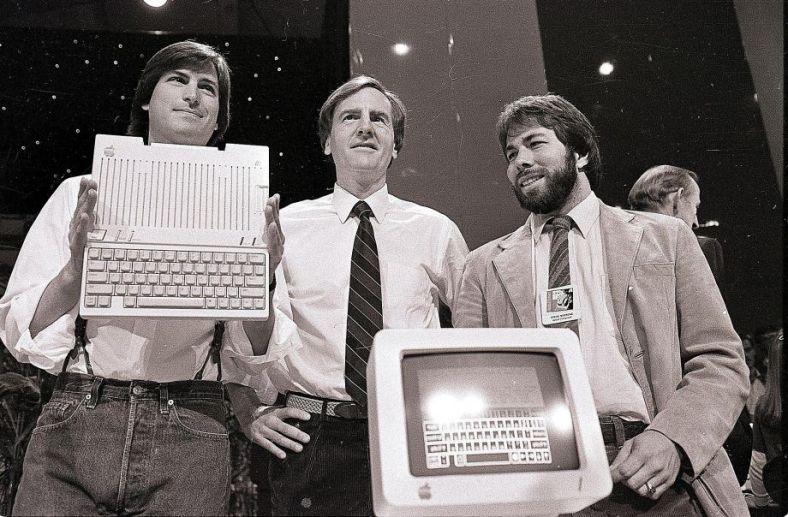
This past week marked the 40th anniversary of Apple. In his commencement speech to the Stanford class of 2005, co-founder Steve Jobs recalled the journey from start-up to his firing by the Board of Directors.

920x1240.jpg

“I was lucky — I found what I loved to do early in life. Woz and I started Apple in my parents’ garage when I was 20. We worked hard, and in 10 years Apple had grown from just the two of us in a garage into a $2 billion company with over 4,000 employees. We had just released our finest creation — the Macintosh — a year earlier, and I had just turned 30. And then I got fired. How can you get fired from a company you started? Well, as Apple grew we hired someone who I thought was very talented to run the company with me, and for the first year or so things went well. But then our visions of the future began to diverge and eventually we had a falling out. When we did, our Board of Directors sided with him. So at 30 I was out. And very publicly out. What had been the focus of my entire adult life was gone, and it was devastating.

We know the rest of the story. Jobs returned to Apple in 1997. David Pierce and Michael Calore identify ‘Fifteen Products That Defined Apple’s First 40 Years’.

iPhone-SE-gaming.jpg

#1 the iPhone

“If you want to understand the iPhone’s importance to Apple, just look at its earnings. But it’s not just that: Without it, our phones might still look like BlackBerries. We might never have learned to pinch to zoom. We might all carry point-and-shoots. It’s almost impossible to overstate the revolution the iPhone started in 2007, which has touched and connected billions of people around the world.”

hiddenbrain_deepbluereverse2_sq-d4dc2bc0fb94c4fa0074fb7ab2e1b681e6245d7a-s400-c85

If you prefer to digest ideas via podcast, add NPR’s Hidden Brain to your subscription list. Last week’s installment featured host Shankar Vedanta in conversation with Yale’s Amy Wrzesniewski on finding meaning in our work.

“Why do you work? Are you just in it for the money or do you do it for a greater purpose? Popular wisdom says your answer depends on what your job is. But psychologist Amy Wrzesniewski at Yale University finds it may have more to do with how we think about our work. Across groups such as secretaries and custodians and computer programmers, Wrzesniewski finds people about equally split in whether they say they have a “job,” a “career” or a “calling.” 

According to Wrzesniewski’s research “people who see work as a calling are more satisfied, engaged, and better performers”. These are folks who “go beyond notice” to craft the boundaries of their job to make work more meaningful.

The last story from this week@work is about interview questions. File it under the query, ‘What was the oddest question you were asked in an interview?’, from recruiting site, glassdoor.com.

Here’s a sample:

“What would the name of your debut album be?” (Urban Outfitters)

“What would you do if you found a penguin in your freezer?” (Trader Joe’s)

And here’s one that we should all be prepared to answer.

“If you were a brand, what would be your motto?” (BCG)

Think about it, and have a great week@work.


How many people have a job @graduation?

On college campuses across the country it’s ‘conversion’ time; next level marketing to the chosen to turn them into the enrolled. How do you differentiate between alternatives? If you take the commodity approach, it’s all about guaranteed employment. Here’s the thing – there are no guarantees.

It’s reasonable to consider post-grad employment when you’re investing a significant amount of money in a college degree. But that’s what it is, an investment, not a purchase. For the student, ‘attending’ college is not a passive act, it’s a full-time commitment. The ROI is a direct result of the effort, not dollars expended.

Former Cornell University president and current AAU president, Hunter Rawlings weighed in on the value of college debate last spring.

“A college education, then, if it is a commodity, is no car. The courses the student decides to take (and not take), the amount of work the student does, the intellectual curiosity the student exhibits, her participation in class, his focus and determination — all contribute far more to her educational “outcome” than the college’s overall curriculum, much less its amenities and social life. Yet most public discussion of higher ed today pretends that students simply receive their education from colleges the way a person walks out of Best Buy with a television.”  

When you ask the question ‘How many students are employed at graduation?’ you’re asking about the resale value of the car.

No one in today’s job market is guaranteed work. Any individual who believes their institutional pedigree will stand alone to open career doors is delusional.

The level of student engagement in internships, research, community service and extra-curricular activities, combined with faculty, staff and alumni connections, are far better predictors of post-grad success than destination survey statistics.

The question to ask is ‘What are the resources available to assist students seeking work?’ The ‘support’ assets are the constant in a volatile job market. Access to this ‘capital’ is the true measure of a university’s commitment to post-grad employment.


Beyond competence; resilience is the new competitive advantage

When we talk about failure, we have to talk about resilience. It’s the companion piece that measures our ability to become successful again after something bad happens. It’s not the mistake we value, it’s the recovery.

it’s what J.K. Rowling was talking about when she addressed the Harvard Class of 2008.

060508_COM_JC_425.jpg

“The knowledge that you have emerged wiser and stronger from setbacks means that you are, ever after, secure in your ability to survive. You will never truly know yourself, or the strength of your relationships, until both have been tested by adversity. Such knowledge is a true gift, for all that it is painfully won, and it has been worth more than any qualification I ever earned.”

In a recent interview , U.S. transportation secretary, Anthony Foxx, prioritized resilience over all other qualities he seeks in a potential candidate.

“What I’m trying to understand is whether the person, if things get really tough, is going to stay in there or fall apart. I’d rather hire somebody who’s maybe not a genius, but they will dig in on any assignment. I’d rather have resilience than almost any other quality. Competence is obviously critical, but a lot of people who are really smart actually end up walking away from some pretty tough assignments because they’re worried about whether they can do them or not.”

How do you demonstrate this new competence to a potential employer? How do you offer examples of your own ‘phoenix rising out of the ashes’ moment?

Andrea Ovans provides some hints in her article ‘What Resilience Means and Why It Matters’. Her survey of recent research on the topic broadens the definition of resilience to include adapting well to change, and pushing through in adversity.

“Resilient people possess three characteristics — a staunch acceptance of reality; a deep belief, often buttressed by strongly held values, that life is meaningful; and an uncanny ability to improvise. You can bounce back from hardship with just one or two of these qualities, but you will only be truly resilient with all three. These three characteristics hold true for resilient organizations as well.…Resilient people and companies face reality with staunchness, make meaning of hardship instead of crying out in despair, and improvise solutions from thin air. Others do not.”

It’s about confidence, ownership, continuous learning and an ability to adapt to a continually changing reality.

Resilience is not new. Robert Waterman, Judith Waterman and Betsy Collard were offering advice to workers and organizations over twenty years ago.

“By a career-resilient workforce, we mean a group of employees who not only are dedicated to the idea of continuous learning but also stand ready to reinvent themselves to keep pace with change; who take responsibility for their own career management; and, last but not least, who are committed to the company’s success. For each individual, this means staying knowledgeable about market trends and understanding the skills and behaviors the company will need down the road. It means being aware of one’s own skills—of one’s strengths and weaknesses—and having a plan for enhancing one’s performance and long-term employability. It means having the willingness and ability to respond quickly and flexibly to changing business needs. And it means moving on when a win-win relationship is no longer possible.”

What is new? Resilience is now a core competence, not an option. When an interviewer asks about a time you failed, respond with a narrative of strength and grit, and seize your competitive advantage.