The Saturday Read ‘Wild Man: Patagonia’s conflicted philosopher-king’ by Nick Paumgarten

The Saturday Read this week is journalist Nick Paumgarten‘s profile of the “tiny terror”, Yvon Chouinard, founder of the outdoor clothing and gear company, Patagonia.

If you are not familiar with Patagonia, “Our Reason for Being” provides a concise tutorial.

“Patagonia grew out of a small company that made tools for climbers. Alpinism remains at the heart of a worldwide business that still makes clothes for climbing – as well as for skiing, snowboarding, surfing, fly fishing, paddling and trail running. These are all silent sports. None require a motor; none deliver the cheers of a crowd. In each sport, reward comes in the form of hard-won grace and moments of connection between us and nature.

Our values reflect those of a business started by a band of climbers and surfers, and the minimalist style they promoted. The approach we take towards product design demonstrates a bias for simplicity and utility.

For us at Patagonia, a love of wild and beautiful places demands participation in the fight to save them, and to help reverse the steep decline in the overall environmental health of our planet. We donate our time, services and at least 1% of our sales to hundreds of grassroots environmental groups all over the world who work to help reverse the tide.”

“Wild Man” is the story of how Chouinard’s career evolved over time, rooted in love and respect for nature. It’s an entrepreneur’s journey, with cameo appearances by familiar names: journalist Tom Brokaw, The North Face founder, Doug Tompkins, Royal Robbins and Tom Frost.

Nick Paumgarten’s first connection to Patagonia came in 1992 when he “had a job answering phones at Patagonia’s mail-order office, in Bozeman, Montana…As far as qualifications, I was another city kid, but I’d been out in nature a bit and was, in descending order of aptitude, a skier, whitewater kayaker, backpacker, mountain biker, and fly-rod flailer. I had come of age poring over the Patagonia catalogue, with its action shots and exotic locales, and I already had Yvon Chouinard right up there with Jack Kerouac and Jimi Hendrix on my list of great Americans. Plus, I liked the idea of getting good gear at a discount.”

When Paumgarten decides to leave the job early, he gets his first inkling of Patagonia’s corporate culture.

“I quit the job before I was supposed to, in order to go on a ski trip. Of the two women who’d hired me, one was angry and the other understanding. Their reaction embodied an intrinsic schizophrenia at Patagonia. Chouinard had always encouraged his employees to cut work and go surfing when the swell came in. But it was also a company trying to claw its way out of a hole.”

Patagonia survived the economic challenges of the early nineties with layoffs and loans “from a friend and from some Argentines who wanted to get their money out of the country.”

“It was hard,” Chouinard said. “I realized we were just growing for the sake of growing, which is bullshit.”

“The company, he worried, was straying from its hard-core origins. “I was faced with the prospect of owning a billion-dollar company, with thousands of employees making ‘outdoorlike’ clothing for posers,” he said early in 1991, in a speech to the employees, in which he outlined his misgivings and his new resolutions. These subsequently appeared in the Patagonia catalogue, as a manifesto, under the heading “The Next Hundred Years.”

This ‘long read’ is a primer for the aspiring entrepreneur. It’s a vivid narrative of the progression of one man’s career from childhood dreams of being a fur trapper, to climber, private detective, surfer and blacksmith; proving there are no straight career paths. Its also a lesson in failure, resilience and a realization over time that success can be a double- edged sword.

“Eco-conscious fun-hoggery, as an ethos, a culture, a life style, and an industry, spans the world, and even rules some corners of it. Chouinard is its best-known avatar and entrepreneur, its principal originator and philosopher-king, and is as responsible as anyone for guiding it from the primitive tin-can and hobnail aesthetic of the mid-twentieth century to the slackline and dome-tent attitude of today. He has made it more comfortable, and more glamorous, to be outside, in harsh conditions. His influence is way out of proportion to his revenue footprint. He has mixed feelings about all this—some apprehension about the world he has made. He celebrates the spread of an ecological consciousness but laments the disappearance of danger and novelty, and the way that the wilderness has become a hobby, or even a vocation. He disdains ski areas (“They’re golf courses”), the idea of professional climbing (“I just don’t like the whole paid-climber thing”), and the proliferation of extreme sports as programming and marketing (“Red Bull’s in the snuff-film business”).”

Malinda Chouinard, Yvon’s wife and business partner, was a pioneer in ‘on-site daycare’ and in 2012 her efforts resulted in Patagonia becoming “the first California business to become a B Corp.”

“Malinda is principally responsible for making the company a notably humane place to work. Many there cite the advantage of having day care on site. In 1985, Malinda created (and has since put aside a vast patchwork of space for) what became known as the Great Pacific Child Development Center, to which I didn’t give much consideration, until I got a tour. A staff of twenty-eight oversees some eighty kids, on sprawling grounds of more than twelve thousand square feet, roughly half of it outdoors, among the fruit trees. A recent baby boom had led to another expansion, which displaced the H.R. department to a trailer. “We’ve raised fifteen hundred kids so far,” Chouinard told me. “None of them have been in prison—that I know of, anyway.”

Chouinard’s management style?

“I’m just the owner.” He called his executive style “management by absence.” He used to read business books and study various executive styles and corporate structures, here and abroad, but he prefers to take his lessons from nature—from ant colonies, for example. “There’s no management,” he said. “Every ant just does his job. They communicate and figure it out. It’s like a Navy seal team. The whole team has to agree on what the mission is.” It’s also true, however, that Chouinard’s occasionally whimsical notions send the ants scurrying. Absent or not, he’s still the big ant.”

There are multiple gems of wisdom interspersed throughout the profile. When asked “if the prospect of death bothered him”, he shared his secret to a good life.

“Nah, I’ve always considered death to be a part of life,” he said. “Tell you the secret to a good life: always be the oldest one in the room.”


Photo credit: Patagonia annual report

What are you going to do with those energy reserves you stored this summer?

As the sun sets on summer 2016, use the upcoming Labor Day weekend as a catalyst to recalibrate you career trajectory.

Why Labor Day? Timing is everything. This weekend marks a transition between seasons and a sense of ‘starting over’ as a new school year begins.

When you arrive @work on Tuesday morning your plans will collide with the competing interests of colleagues returning to work, equally energized and motivated. If you have a plan, and a schedule of activities already on your calendar you will be in a position to maintain the momentum, moving you closer to your ‘dream’.

Start with two questions:

What do I still want to accomplish?

What is one thing I can do move forward?

Your answer to the first question asserts your priorities, and the second sets the first item on your agenda.

When thinking about priorities, consider feedback you have received from managers, colleagues, mentors and friends. What skills need fine tuning? Is there additional expertise you need to acquire to advance in your current position or transition to a new workplace? Who can help you achieve your goals? Is it time for additional training or an advanced degree?

The ‘still want to accomplish’ question hits at the fundamental essence of who you are, who you want to become, and the legacy you want to leave behind. It has a workplace component, but also addresses work/life balance, and your role as a contributing member of your community.

The next step is to schedule a meeting to set your priorities in motion: coffee with a mentor to review your career direction, an information interview to establish a new professional connection, a visit to a local non-profit, or a meeting with an academic advisor to explore educational options.

Your priorities dictate your agenda.

Before the weekend comes to an end, take a few minutes to review your calendar and block out time for ‘summer energy reserves expenditures’. Send at least one email requesting a meeting and try to find time each week to sit down with folks who can expand your career horizons.

Effectively managing your work/life is an ongoing energy expense. It will keep you moving forward, recalibrating as needed.


The week@work – Grad students win right to unionize, the changing conversation about the economy, why America’s leaders fail and the story of Luke’s Lobster

Academia was in the headlines this week@work with the Tuesday announcement from the National Labor Relations Board, voting 3-1 to overturn a 2004 ruling allowing graduate students to form collective bargaining units. A Pew Research Center survey detected a shift in election season conversation from the economy (2012) to keeping the U.S. safe from terrorism. What conversation? The system isn’t working, and it may be we don’t have leaders who view their ‘calling’ as a ‘vocation’. And finally, a career transition story – from investment banker to ‘lobsterpreneur’ for this last week of summer.

images.jpeg

‘Ruling Pushes Door to Grad-Student Unions ‘Wide Open’ Peter Schmidt for The Chronicle of Higher Education

“Many more private universities can expect to see their graduate employees move to form unions in the wake of Tuesday’s National Labor Relations Board decision on such an effort at Columbia University.

The federal labor board’s 3-to-1 ruling resoundingly overturned a 2004 decision involving Brown University. In the Brown ruling, the board asserted that graduate employees should not be allowed to form unions because their doing so would intrude into the educational process.

In Tuesday’s decision, the majority held that such a belief “is unsupported by legal authority, by empirical evidence, or by the board’s actual experience.” It not only rejected the Brown precedent, but also overturned a 1974 ruling that had declared research assistants at Stanford University ineligible to unionize based on a belief that such research is part of the educational process.

The board’s decision in the Columbia case says graduate students employed by a private university are as eligible as any other type of worker to form collective-bargaining units under the National Labor Relations Act.”

In a letter to the Columbia University community, Provost John H. Coatsworth reiterated the long-held view of university administrators.

“Columbia and many of our peer universities have challenged this position. Nearly all of the students at Columbia affected by this decision are graduate students. We believe that the daily activities and the advisor-advisee relationships involved in the scholarly training of graduate students define an experience that is different from that of the typical workplace. Being a graduate student can take many years of intense research, teaching and study. But unlike university employees, graduate students who serve as teaching or research assistants come to this institution first and foremost to acquire through that work the knowledge and expertise that are essential to their becoming future scholars and teachers.”

The world of academia is changing, and with it the profile of the teaching community. As more adjunct faculty assume the classroom role, it may be harder to differentiate the job description of part-time faculty from that of grad assistant.

To be continued…

New-York-Stock-Exchange-1.jpg

‘Since 2012, The Economy Has Changed — And So Has The Conversation’ Marilyn Geewax for NPR

“Ah, 2012. You seem so long ago.

Back then, the economy was the star of the presidential election season, with more than 9 in 10 voters ranking it as Issue No. 1.

Voters worried about scarce jobs, expensive gasoline and a huge federal deficit.

Candidates proposed detailed solutions…

This year, the political conversation is very different, with much of the focus on non-economic issues: Republican Donald Trump’s temperament and Democrat Hillary Clinton’s trustworthiness.

And a Pew Research Center survey showed that the issue voters want to hear about most in a presidential debate is “keeping the US safe from terrorism.”

Of course, economic issues remain extremely important, but they are different from 2012. This year, the hottest money topics involve income inequality, trade deals and immigrants.”

Why are we focused on temperament and trustworthiness while the ‘big problems’ that effect our daily lives are ignored? David Brooks thinks it’s about career vs. calling, and he may be right.

Washington,_D.C._-_2007_aerial_view.jpg

‘Why America’s Leadership Fails’ David Brooks for The New York Times

“Over the past few decades, thousands of good people have gone into public service, but they have found themselves enmeshed in a system that drains them of their sense of vocation.

Let’s start with a refresher on the difference between a vocation and a career. A career is something you choose; a vocation is something you are called to.

A person choosing a career asks, How can I get the best job or win the most elections? A person summoned by a vocation asks, How can my existing abilities be put in service of the greatest common good?

A career is a job you do as long as the benefits outweigh the costs; a vocation involves falling in love with something, having a conviction about it and making it part of your personal identity.

A vocation involves promises to some ideal, it reveals itself in a sense of enjoyment as you undertake its tasks and it can’t be easily quit when setbacks and humiliations occur. As others have noted, it involves a double negative — you can’t not do this thing.

I do think there’s often an arc to vocation. People start with something outside themselves. Then, in the scramble to get established, the ambition of self takes over. But then at some point people realize the essential falseness of all that and they try to reconnect with their original animating ideals.

And so I think it possible to imagine a revival of vocation.”

The last story this week@work is an ‘end of summer’ career transition feature.

417562_10150602911837473_423900675_n.jpg

‘A Restaurant’s Sales Pitch: Know Your Lobster’  Janet Morrissey for The New York Times

“It was a steamy summer day in New York in 2009 when Luke Holden, an investment banker, had a craving for a lobster roll. Not just any lobster roll, though. He longed for the “fresh off the docks” taste he enjoyed growing up in Cape Elizabeth, Me.

After an exhaustive search on New York’s streets, he came up dissatisfied and disappointed.

“Every lobster was served over a white tablecloth, extremely expensive, drowning in mayo and diluted with celery,” he said. “I wondered why all the great chefs in this city had screwed this up so badly.”

So that year, Mr. Holden decided to open an authentic Maine lobster shack in Manhattan. To replicate that fresh taste that he remembered, he would need to oversee, track and, where possible, own every step in the process.

Today, he owns 19 Luke’s Lobster restaurants, two food trucks and a lobster tail cart in the United States, and five shacks in Japan.”

If you only  read one of these this week, spend some time with David Brooks…and reconnect with your “original animating ideals” and begin a “revival of vocation”. 

Your first day @work is not that different from your first day @college

Late last month, The New York Times shared advice for incoming college freshman from 25 upperclassmen and recent grads. As I read the article, I noted a parallel in the seven topics offered for new students, and folks in their first months @work – from the first internship through every career transition.

“Freshman year is a chance to redefine yourself, to challenge assumptions, to lay the foundation for the rest of your life.”

The first day of work is also a chance to redefine yourself, challenge assumptions and begin to lay the foundation of your career.

Let’s examine the list of seven, and test their application to the workplace.

“Extend yourself”  You are the ‘newbie’ @work. You’re not expected to have all the answers on day one. Ask questions.  Explore the world beyond your cubicle. Find ‘community spaces’ where folks gather, and mingle.

“Do the work”  In college, this is basically showing up for class, @work it’s consistently engaging in projects. Don’t wait to be asked. Offer to participate in assignments that will stretch your talents.

“Understand the system and work it”  Every workplace has its unique culture, values and traditions. If you did your research before you started your new job, you should have an inkling of what to expect. Once you are on payroll, take some time to observe how folks communicate, how priorities are set, where the budget dollars are allocated, and who is making the decisions. Align yourself with the energized vs. the disgruntled.

“Be yourself”  Hopefully you selected a workplace that is a ‘fit’ with your values and talents. If the recruitment process was straightforward, being the ‘authentic’ you will contribute to your success.

You will change as part of a new work community, just as you evolved throughout your college years in an environment that fostered success, creativity, and diversity.  Check in periodically with friends outside your workplace to ensure you’re growing vs. losing your essential essence.

“Tend to yourself”, “Your grade in one class does not define you”  These tidbits of advice applied to work fall into the categories of work/life balance and recovering from failure. It’s very easy to be consumed by the work in the beginning. You’re learning new concepts, meeting new people, struggling to make deadlines, and communicating in a new workplace language. If you’re not spending time outside of work socializing, contributing to your community or maintaining a fitness routine; your work will eventually suffer.

When you do make a mistake, your career isn’t over. The upper strata of success is populated with folks who have recovered from both minor and major workplace calamity.

“Develop people skills”  Without solid communication skills, every day at work will be a challenge. Our work culture has traditionally rewarded the extrovert, but new research has shown the introvert is an equal partner in the success of any organization.

In college you may have been able to get an ‘A’ as an individual, rarely leaving your room, thinking great thoughts and rarely interacting with the campus community. @work you have to deal with people. You may be the most brilliant innovator, but at some point you have to explain your product to a client.

All of us can improve our communication skills and it’s to an organization’s advantage to support you in this effort. Find out if there are skill development programs available through your employer or professional association. Be proactive on this one.

 “Don’t get stuck” Life doesn’t always go according to plan. Entering college you may have thought you would be the next Bill Gates, when a Freshman Seminar introduced you to the wonderful world of philosophy. Tangents open up @work as well. Entering an organization for the first time, you cannot imagine the variety of opportunities that are available. You may be in a meeting with a client and realize the work his/her organization is doing is a better fit for you skills. Be open when an alternative is presented. There is no perfect career path, just one that is unique to you.

One more – always share what you learn with colleagues. Knowledge is power. Shared information can be transformative.

The week@work: Olympics close: memories remain, the power of vulnerability, workplace lessons from the cineplex, and Seattle’s millennials @work

This week@work the world’s best athletes headed to the airport and the rest of us, mere mortals, returned to our workplace. A CEO discussed the benefits of embracing vulnerability and a movie critic found workplace advice at the multiplex. In Seattle, the most recent additions to the workforce ‘gig’ their way to dream jobs.

As the Olympics came to a close on Sunday evening, there were three stories that continued to resonate from the ‘workplace’ of track and field.

‘That girl is the Olympic spirit’: After colliding, runners help each other cross finish line’ Marissa Payne for the Washington Post

Cp_KizoXgAA1MbY.jpg

For track and field athletes, the Olympics offers the biggest prize of their careers. A gold medal is a tangible symbol of years of hard work and dedication. But on Tuesday, long-distance runners Nikki Hamblin of New Zealand and Abbey D’Agostino of the United States proved hardware doesn’t always trump heart.

After the two collided on the track during the 5,000-meter race, resulting in a bad leg injury for D’Agostino, the two urged each other on and both eventually were able to finish the race, albeit seemingly sacrificing their chances at a finals berth along the way.

“Everyone wants to win and everyone wants a medal. But as disappointing as this experience is for myself and for Abbey, there’s so much more to this than a medal,” Hamblin told reporters after the race.”

‘This Great-Grandmother Coaches an Olympic Champion. Now Let Her By.’ Karen Crouse for The New York Times

634.jpg

“The great-grandmother who could pass as Barbara Bush’s kid sister waded through the stands at Olympic Stadium on Sunday night, trying to get close enough to congratulate the South African runner Wayde van Niekerk, who had just captured the gold medal in the 400 meters and broken one of the oldest world records in men’s track and field.

This is Botha’s first Olympics. She competed — without distinction, she said — in the sprints and the long jump when she was young and began coaching in 1968 while living in her native Namibia, then a territory under the rule of South Africa. Her first athletes were her son and daughter, but when they reached a certain level, she passed them off to other coaches, she said, “because I feel that’s not always a good thing as a parent to coach your own children.”

The woman who didn’t believe it prudent to coach her own children has earned the trust of her athletes by treating them as family.

“She doesn’t see us as athletes or as people; she sees us as her children,” said van Niekerk, who asked Botha in late 2012 if he could train under her at the University of the Free State, where she has been the head track and field coach since 1990.

Van Niekerk won the race from Lane 8, considered a disadvantageous position. Botha said it didn’t bother her that he was in an outside lane. “Because every lane is the same distance,” she said.”

Rio+Olympics+Athletic_Spof+(4).jpg

Can Ashton Eaton Save the Decathlon?  Mary Pilon for The New Yorker

“Ten years ago, Tate Metcalf, a high-school track coach in Bend, Oregon, was trying to find a college that would give one of his athletes a scholarship. Ashton Eaton was a talented sprinter with a fierce long jump, but Metcalf received mostly lukewarm responses. His coach felt that Eaton would have the best shot at getting into a Division I college if he competed in one of track and field’s multi-event disciplines, like the heptathlon or the decathlon. Metcalf knew it would make Eaton, who was raised by a single mother and had never had any private coaching, one of the first people in his family to go to college. So he suggested it. “Sure,” Eaton replied, as Metcalf recently recalled. Then Eaton said, “What’s the decathlon?”

Eaton, who is twenty-eight, is now the defending Olympic gold medallist and world-record holder in the event. “He’s the face of track and field,” Metcalf said, sitting underneath a giant banner of Eaton draped over Hayward Field, in Eugene, Oregon, at the Olympic trials earlier this summer. “But nobody knows it because he’s a decathlete.” It’s true: though he has a gleaming smile, press-perfect interview skills, and historic talent, Eaton has remained virtually unknown relative to his Olympic-champion counterparts and even some of his decathlete predecessors. The one place he’s remained indisputably famous is Eugene: here, his face graces billboards and bus signs; the local minor-league baseball team recently distributed Ashton Eaton bobblehead dolls as part of a tribute night to him. “I haven’t seen them yet,” Eaton told me. “It’s a little weird.”

The decathlon hasn’t always been a path to athletic obscurity. Many consider the winner of the event, which can trace its origins to ancient Greece, the “world’s greatest athlete.”

On Thursday evening, after two days of competition in ten events, Olympian Ashton Eaton repeated as gold medalist in the decathlon. He continues to hold the title of ‘the world’s greatest athlete’.

One of the best series in journalism is Adam Bryant‘s weekly column in The New York Times, ‘The Corner Office’. Bryant poses five or six questions to a selected CEO, and their responses appear in the Sunday Business Section. This past week, Christa Quarles of Open Table shared ‘early leadership lessons’.

287803.jpeg

“The importance of embracing vulnerability. Early on, especially when I worked on Wall Street, God forbid that you declare any granular weakness, because people would pounce on it.

But the paradox of owning what you know and what you don’t know is that you actually seem more powerful as you expose more vulnerability. I’ve become more comfortable with exposing my vulnerability and not being afraid to go there.

When I give criticism now, I’ll talk about how I failed in a similar situation. I try to humanize the criticism in a way that says this is about an action, it’s not about you as a person. I want to make you better. If somebody feels like they’re in a safe place and they can hear the message, they’re more likely to change.”

Theater critic A.O. Scott may seem an unlikely source of management wisdom. This week he suggests ‘Even Superheroes Punch the Clock’.

suicide-squad-14.jpg

“This summer, your local multiplex is home to an extended business seminar. There are sessions on crisis-management and how to deal with office romances (“Star Trek Beyond”); on office rivalries and mission-statement drafting (“Captain America: Civil War”); on start-ups (“Ghostbusters”) and I.T. disasters (“Jason Bourne”). Every action movie is a workplace sitcom in disguise.

What is “Suicide Squad”? A bad movie, to be sure — and yes, I’m aware of opinions to the contrary (thanks, Twitter) — but also a movie about difficult personnel issues….The central problem of “Suicide Squad” is one that bedevils department heads and midlevel employees in every corner of the modern economy: team building.”

The last story this week is journalist Kirk Johnson‘s profile, ‘Debt. Terror. Politics. To Seattle Millennials, the Future Looks Scary.’

“Part of Jillian Boshart’s life plays out in tidy, ordered lines of JavaScript computer code, and part in a flamboyant whirl of corsets and crinoline. She’s a tech student by day, an enthusiastic burlesque artist and producer by night. “Code-mode” and “show-mode,” she calls those different guises.

This year she won a coveted spot here at a nonprofit tech school for women, whose recent graduates have found jobs with starting salaries averaging more than $90,000 a year. Seattle, where she came after college in Utah to study musical theater, is booming with culture and youthful energy.

But again and again, life has taught Ms. Boshart, and others in her generation, that control can be elusive.

Even for someone who seems to have drawn one of her generation’s winning hands, it feels like a daunting time to be coming of age in America.

“I don’t just expect things to unfold, or think, ‘Well, now I’ve got it made,’ because there’s always a turn just ahead of you and you don’t know what’s around that corner,” she said.”

A final thought this week @work – When we find that ‘dream job’, in an uncertain global economy, we realize there is more to what we do than the compensation: money or medals. The Olympics is our quadrennial reminder to honor our values. Thanks to @abbey_dags and @NikkiHamblin.


Photo credits: ‘Fireworks explode during the Rio 2016 closing ceremony’   Robert Gauthier Los Angeles Times, ‘Abbey D’Agostino and Nikki Hamblin’ @NCAA, ‘Ashton Eaton’ Matt Slocum for AP, ‘Ans Botha and Wayde van Niekerk’ Twitter, ‘Suicide Squad’ courtesy of Warner Bros.

‘The Ageing Athlete’ a poem by Neil Weiss

As the Games of the XXXI Olympiad come to an end, a ‘Friday Poem’ to consider life after sport…and other career transitions.

The Aging Athlete

You’re through – no walking up and down,

you think of speed and dig your heels,

testing this soil and that for a start,

but it’s no go…Practicing for leaps,

you start forward but exhaust the push

and end up with a damaging rush,

arms hanging, hands twitching at your sides,

chin bobbing on your chest: no pride

that once sustained you as you leapt

the next hurdle, hair up then down,

the wind in your ears, the crowd beside

itself, shouting, Come on! Come on!

and you smashed the tape with your chest

and sank into the arms of many lovers.

Neil Weiss      Poetry Magazine, August 1956

1955-08.jpg

Photo Credit: Getty Images/USA TODAY Sports 8/15/16

The week@work or on vacation-what leadership looks like, what leadership reads & ‘wasting time’ on the Internet

This week@work, desks and cubicles are vacant as colleagues are catching a few last days of escape away from work. Among those still @work: a journalist shared a relic of presidential transition to remind us what leadership looks like, the White House tweeted the President’s vacation reading choices, Olympians continue to compete in Rio, and we may not be wasting time on the internet.

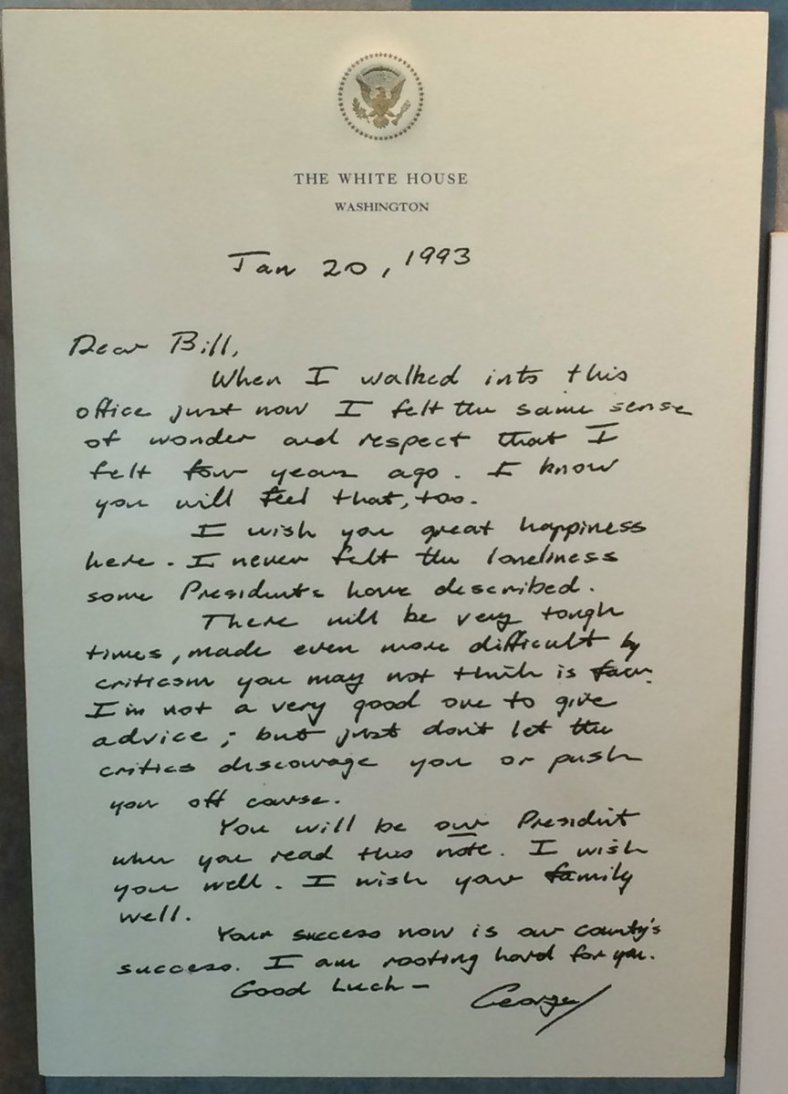
There’s been a copy of a letter circulating recently on the Internet. It arrived in my Twitter account this week via journalist Joyce Karam. It’s a handwritten note written on Inauguration Day, 1993 by departing President George H.W. Bush to his successor, President Bill Clinton.

bush to clinton.jpg

Imagine arriving at your new job on Monday morning and finding a handwritten note from your predecessor, wishing you great happiness @work. “Your success is now our success”.

What if you wrote a letter to the person taking over your desk on Monday morning? Could you convey a “sense of wonder and respect” for your workplace and your work?

Think about it. This is what leadership looks like.

While we are on the topic of U.S. Presidents, current President Obama is on vacation with family, friends and five ‘summer reads’ including Oprah’s recent Book Club selection and one of Bill Gates’ favorites.

readinglist2016_1200.jpeg

(A quick aside here on the Olympics. The photo at the top of the page captures the vacant volleyball nets this morning in Manhattan Beach, California. It’s the place where two U.S. Olympians, Kerry Walsh Jennings and April Ross went to work to get ready for Rio.)

Back to work, and reading, and surfing the Internet.

Kenneth Goldsmith, artist, professor and first poet laureate of the Museum of Modern Art, urged LA Times readers to ‘Go ahead: Waste time on the Internet’ with his OpEd this weekend.

“The notion that the Internet is bad for you seems premised on the idea that the Internet is one thing — a monolith. In reality it’s a befuddling mix of the stupid and the sublime, a shattered, contradictory, and fragmented medium. Internet detractors seem to miss this simple fact, which is why so many of their criticisms disintegrate under observation.”

He recently discussed his University of Pennsylvania course and new book ‘Wasting Time on the Internet’ with Quentin Hardy of The New York Times. Drawing on his personal observations of students and family, he imagined what an educated person will look like in the 21st century.

We still read great books, and there is a place for great universities. But an educated person in the future will be a curious person who collects better artifacts. The ability to call up and use facts is the new education. How to tap them, how to use them.

I’ve got a 10-year-old and 17-year-old. They’re thinking differently from me. They stay connected all the time, and they’re smart, they play baseball, they read, they spend time online. They’re not robots. Basic human qualities haven’t changed. I can find Plato in online life. When I read Samuel Pepys’s diary I see Facebook posts. We just find new ways to express things.

Go ahead, take a break this week@work. Stream the last week of the Olympics, read a great book, and follow the tangents of Internet exploration.

What I did this summer…

What happened to summer? Is it me, or does time go by more quickly after July 4? Before your experiences of the past few months are lost in the excitement of fall work assignments, take some time to reflect on what you learned.

Did you travel, study, volunteer or all of the above? Did your curiosity lead you to interviews with folks outside your career field? What did you learn about yourself?

Catalog your experience including the skills you acquired or any challenges you overcame. Some of these will fall naturally into a resume, but others will provide the content for future professional conversations.

How did you grow as an individual or as a professional? Can you identify ways to link your summer experience to your current work?

Sanity and survival compel us to try to separate work from the rest of our lives. But when we return to work after vacation, maintaining the separation can be a barrier to creativity.

Refreshing the view allows us to be open to new opportunities.

Develop a narrative that tells your story of the summer – a story that incorporates all the elements of the ‘new and improved’ you. Keep it simple. Focus on experience that adds value to your ‘brand @work’.

A conversation poolside that sparked an idea for a new product. An article/book that offered an alternative approach to problem-solving. A civic engagement project that spurred ideas to motivate your team. A faculty member or classmate who provided a connection to a potential new client.

Or, did the chance to step away and just daydream provide new insight into your next career?


The week@work – a historic moment in Philadelphia, a ‘profile in courage’, the culture @Fox & @Bridgewater Associates & an adventure ends

It was a week of firsts: a solar powered aircraft completed the first circumnavigation of the globe and the Democratic National Convention nominated the first woman as a candidate of a major party for U.S. president. The corporate culture of Fox News and hedge fund, Bridgewater Associates continued to be scrutinized. And one man, took the stage in Philadelphia for seven minutes, proving we can all make a difference.

On Thursday evening Hillary Clinton, former U.S. Senator from New York and former Secretary of State, accepted the nomination of the Democratic Party as their candidate for President of the United States.

“And so, my friends, it is with humility, determination, and boundless confidence in America’s promise that I accept your nomination for president of the United States.”

images.jpeg

For 50.8% of the American people, a career milestone was achieved; ninety-six years after the ratification of the 19th amendment granting the right of suffrage to women.

University of New Hampshire professor of history and author, Ellen Fitzpatrick reflected on the moment and it’s ironies. When a woman finally checks all the ‘pay your dues’ boxes, in any career field, doubts about their motivation and abilities linger.

“One of the most powerful ironies in a political season full of perversities is a paradox that now defines Hillary Clinton’s campaign: The first female presidential candidate to overcome the obstacles that sank every single woman before her now confronts criticism for overcoming those very same difficulties.

Time and again, Americans have deemed men worthy of the White House if they could succeed on the national political stage, raise sufficient money, rally the support of party leaders, appeal to voters and point to domestic and foreign policy experience. That these assets are suddenly negatives, at the very moment that a woman finally achieved them, is curious, to say the least.”

Curious, but not surprising.

On Saturday The Los Angeles Times responded to readers who took exception to coverage of the historic moment with a front page photo of former President Bill Clinton.

“Like other newspapers, The Times illustrated its main story Wednesday on Hillary Clinton’s historic nomination for president with a photo — of her husband.

Of course, Bill Clinton is no ordinary spouse of a candidate (and neither was Hillary Clinton when her husband was president). Still, many readers detected a whiff of sexism in The Times’ decision to feature a large photo of the former president basking the adulation of the Democratic National Convention crowd when it was the former secretary of State who received her party’s nomination for president.”

Like other newspapers? Apparently imitation is the new competitive advantage.

Three reader comments were included; my favorite from Janet Kinosian of Santa Ana – “I’m sure the Suffragettes would not have been surprised, though I am.”

One of the most memorable moments of the convention in Philadelphia occurred when the parents of Capt. Humayun Khan, who was killed in Iraq four months after arriving in 2004, stepped to the podium.

Annabelle Timsit chronicled ‘Seven Minutes That Shook the Convention’ for Politico Magazine.

Khizr Khan.jpeg

“He walked onto the convention stage Thursday night with his wife beside him, the Constitution to guide him and the pride of a father who knows he has a story to tell.

“Tonight,” said Khizr M. Khan, “we are honored to stand here as the parents of Capt. Humayun Khan, and as patriotic American Muslims with undivided loyalty to our country.”

That was the beginning of a 7-minute speech that became an instant sensation—eloquent, emotional and notably original, coming as it did at the end of four days of highly processed political cliche. Khan, a 66-year-old immigration lawyer from Charlottesville, told the story of his son’s death in combat in Iraq, but he turned that elegy into a viral rebuke of Donald Trump: “You have sacrificed nothing!”

In 1957, before his presidential candidacy, President John F. Kennedy wrote the Pulitzer Prize winning book, ‘Profiles in Courage’.

“In the preface to ‘Profiles in Courage’, Senator Kennedy discusses the “problems of political courage in the face of constituent pressures, and the light shed on those problems by the lives of past statesmen.’’ He describes the three types of pressure faced by senators as pressure to be liked, pressure to be re-elected, and pressure of the constituency and interest groups…the book is about his admiration of the courage shown by elected leaders in the face of adverse factions like their electorates, popular opinion and political action committees that pull these elected men in different directions.”

Khizr M. Khan is not an elected official, but he is a citizen. And on Thursday evening his remarks filled a leadership void, demonstrating courage “in the face of adverse factions and popular opinion” – a contemporary ‘profile in courage’.

Each week The New York Times publishes the ‘Traffic Report’, a list of the most-read business articles on nytimes.com for the previous week. Three of the top four stories this week centered on corporate cultures that enabled sexual harassment of employees at Fox News and Bridgewater Associates.

Jim Rutenberg, Emily Steel and John Koblin covered the number one story, ‘At Fox News, Kisses, Innuendo, Propositions and Fears of Reprisal’.

“The investigation by Fox News’s parent company, 21st Century Fox, focused narrowly on Mr. Ailes. But in interviews with The New York Times, current and former employees described instances of harassment and intimidation that went beyond Mr. Ailes and suggested a broader problem in the workplace.

The Times spoke with about a dozen women who said they had experienced some form of sexual harassment or intimidation at Fox News or the Fox Business Network, and half a dozen more who said they had witnessed it. Two of them cited Mr. Ailes and the rest cited other supervisors. With the exception of Ms. Bakhtiar, they all spoke on the condition of anonymity, citing embarrassment and fear of retribution. Most continue to work in television and worry that speaking out could damage their careers.

They told of strikingly similar experiences at Fox News. Several said that inappropriate comments about a woman’s appearance and sex life were frequent. Managers tried to set up their employees on dates with superiors.”

And while a spokesperson for the parent company 21st Century Fox detailed the corporate sexual harassment policy and reporting procedures, Michael Grynbaum and Emily Steel noted ‘A Stony Silence at Fox News After Ailes’s Departure’.

“The Fox News skybox here turns into a hive of activity as the network’s star anchors analyze the Democratic National Convention for millions of viewers.

When the cameras blink off, however, the banter has been replaced by something rarely heard in the television news business: silence.

Megyn Kelly and her co-hosts, including Bret Baier and Brit Hume, have not been speaking during commercial breaks, according to two people with direct knowledge of the anchors’ interactions, who described the on-set atmosphere at Fox News as icy. During ads, the hosts are often absorbed with their smartphones.

…employees say there is a continuing split inside the network, with one camp of old-guard Fox News loyalists — some of whom owe their careers to Mr. Ailes — upset at his ouster. Some are resentful toward Ms. Kelly for cooperating with lawyers brought in by the network’s parent company, 21st Century Fox, to investigate Mr. Ailes’s behavior.” 

Alexandra Stevenson and Matthew Goldstein reported on the culture at the hedge fund, Bridgewater Associates – ‘At World’s Largest Hedge Fund, Sex, Fear and Video Surveillance’.

“Hedge funds tend to be a highly secretive bunch, yet even within their universe Bridgewater stands out. The allegations, as well as interviews with seven former employees or people who have done work for the firm and a filing by the National Labor Relations Board, open a window into the inner workings of a $154 billion company that, despite its mammoth size, remains obscure. The firm is governed by “Principles” — more than 200 of them — set out in a little white book of Mr. Dalio’s musings on life and business that some on Wall Street have likened to a religious text.

In his complaint, Christopher Tarui, a 34-year-old adviser to large institutional investors in Bridgewater, contends that his male supervisor sexually harassed him for about a year by propositioning him for sex and talking about sex during work trips.”

Sexual Harassment remains a significant workplace issue. The popularity of articles covering high profile incidents reflect the reality of workers looking for guidance beyond mandatory training sessions, trying to navigate the workplace to achieve success based on merit.

For the last story, a question, what is the definition of adventure? The pilots of the Solar Impulse 2 told CNBC “that having both elating moments and setbacks made the solar-powered flight the “definition of adventure.”

Samantha Masunaga reported for The Los Angeles Times on the journey’s end of Solar Impule 2. On Monday, pilots Bertrand Piccard and Andre Borschberg guided their craft into the airport where their experimental flight began.

rtw_solar_impulse_2_landing_in_abu_dhabi_finishing_the_round-the-world_journey_2016_07_26-1.jpg

“After 16 months and a 17-leg journey, a solar-powered plane finally completed its around-the-world flight attempt Monday evening when it touched down in Abu Dhabi, United Arab Emirates.

The plane, called Solar Impulse 2, landed at Al Bateen Executive Airport a few minutes after 5 p.m. Pacific time, marking the first around-the-world solar flight.

Inside the plane, pilot Bertrand Piccard shouted, “We made it.”

In a week@work of firsts, I echo the sentiment. We made it.


Photo Credit – Solar Impulse 2: Jean Revillard / REZO/Solar Impulse

The Friday Poem ‘To the Indifferent Women’ by Charlotte Anna Perkins Gilman

Last night a woman accepted the nomination of a major political party for the first time in the history of the United States. The next president will preside over the commemoration of the centennial of the 19th amendment, which extended suffrage – the right to vote, to women.

To mark history, the Friday Poem this week is ‘To the Indifferent Women’ and was first published in 1911. Charlotte Anna Perkins Gilman called herself a humanist. She was a poet, author, magazine editor and feminist in a lifetime that began with the civil war and ended in the great depression.

Although the words were set to paper over a century ago, the message resonates today.

“We all may have our homes in joy and peace
When woman’s life, in its rich power of love
Is joined with man’s to care for all the world.”

To The Indifferent Women

A Sestina

You who are happy in a thousand homes,
Or overworked therein, to a dumb peace;
Whose souls are wholly centered in the life
Of that small group you personally love;
Who told you that you need not know or care
About the sin and sorrow of the world?

Do you believe the sorrow of the world
Does not concern you in your little homes? —
That you are licensed to avoid the care
And toil for human progress, human peace,
And the enlargement of our power of love
Until it covers every field of life?

The one first duty of all human life
Is to promote the progress of the world
In righteousness, in wisdom, truth and love;
And you ignore it, hidden in your homes,
Content to keep them in uncertain peace,
Content to leave all else without your care.

Yet you are mothers! And a mother’s care
Is the first step toward friendly human life.
Life where all nations in untroubled peace
Unite to raise the standard of the world
And make the happiness we seek in homes
Spread everywhere in strong and fruitful love.

You are content to keep that mighty love
In its first steps forever; the crude care
Of animals for mate and young and homes,
Instead of pouring it abroad in life,
Its mighty current feeding all the world
Till every human child can grow in peace.

You cannot keep your small domestic peace
Your little pool of undeveloped love,
While the neglected, starved, unmothered world
Struggles and fights for lack of mother’s care,
And its tempestuous, bitter, broken life
Beats in upon you in your selfish homes.

We all may have our homes in joy and peace
When woman’s life, in its rich power of love
Is joined with man’s to care for all the world.

Charlotte Anna Perkins Gilman  ‘Suffrage Songs and Voices’ 1911

41pY0+cnJWL._SX331_BO1,204,203,200_

Convention photo credit: Marcus Yam for The Los Angeles Times