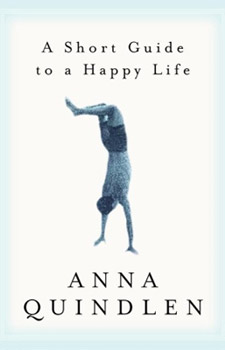
The Saturday Read ‘A Short Guide to a Happy Life’ by Anna Quindlen

Do you remember who spoke at your graduation ceremony? The Saturday Read this week is for all of you who forgot, but would welcome a bit of ‘life advice’ in this season of ‘Pomp and Circumstance’.

In 1999, author Anna Quindlen was invited to deliver the commencement address at Villanova University. And then this happened:

“Pulitzer Prize-winning columnist and author Anna Quindlen has withdrawn as the commencement speaker at Villanova University this Sunday because of what she said were objections by a “vocal minority” to her support of abortion rights.

Quindlen, who was also to have received an honorary doctorate of humane letters, said in an interview yesterday that she did not want to “ruin the day or cast a shadow” on the graduation ceremony.”

A graduate student requested a copy of the prepared text and posted it on the Internet. (This was before Facebook, Twitter et al.) The post went viral, and the resulting essay was published in 2000 as ‘A Short Guide to a Happy Life’.

Seventeen years later her words still resonate. In the opening paragraphs she signals her values, and offers a hint at why she withdrew.

“My work is human nature. Real life is really all I know…Don’t ever confuse the two, your life and your work…The second is only part of the first.”

Real life collided with an opportunity to address Villanova’s Class of 1999, the alma mater of several of her family members. Fortunately her publisher provided an avenue for Ms. Quindlen to share her personal life experience with a broader audience, to encourage ownership and balance.

“When you leave college, there are thousands of people out there with the same degree you have; when you get a job, there will be thousands of people doing what you want to do for a living.”

“But you are the only person alive who has sole custody of your life. Your particular life. Your entire life. Not just the life at your desk, or your life on the bus, or in the car, or at the computer. Not just the life of your mind, but the life of your heart. Not just your bank account, but your soul.”

“People don’t talk about the soul very much anymore. It’s so much easier to write a resume than to craft a spirit.”

Some may disagree that a resume is easy to write, especially a recent grad who has spent the past months engaged in the job search. A resume is limited to a list of accomplishments, full of key words designed to cut through the barrier of digital applicant screening. It’s the values expressed in that experience that define who you are, your spirit.

The recurring theme of ‘Short Guide’ challenges the reader to question commonly held definitions of success.

“You cannot be really first-rate at your work if your work is all you are.”

“So I suppose the best piece of advice I could give anyone is pretty simple: get a life. A real life, not a manic pursuit of the next promotion, the bigger paycheck, the larger house.”

“Get a life in which you are not alone. Find people you love, and who love you. And remember that love is not leisure, it is work.”

‘A Short Guide to a Happy Life’ is a compact book to be kept close for a periodic reread. It’s a reminder to all, at every career stage, that “Life is made up of moments, small pieces of glittering mica in a long stretch of gray cement.”

One of those moments is revealed in the recollection of a conversation with a homeless man on the boardwalk in Coney Island, New York.

“And he stared out at the ocean and said, “Look at the view, young lady. Look at the view.”

Commencement is the beginning of a life of learning, sometimes from the most unexpected of teachers. Enjoy the Saturday Read, and don’t forget to enjoy the view.




The Saturday Read – It’s Independent Bookstore Day!

Today is Independent Bookstore Day. Instead of recommending a book this week, I recommend you find your local independent bookstore (not Barnes and Noble) and spend an hour browsing their selection.

One of my favorites – Pages in Manhattan Beach, CA.

IMG_4376.jpg

Just what does IBD celebrate?

“Independent bookstores are not just stores, they’re community centers and local anchors run by passionate readers. They are entire universes of ideas that contain the possibility of real serendipity. They are lively performance spaces and quiet places where aimless perusal is a day well spent.

Indie bookstores, whether dusty and labyrinthine or clean and well-lighted, are not just stores, they are solutions. They hold the key to your love life, your career, and your passions. Walking the aisles of a good bookstore means stumbling upon a novel from India that expands your heart. It’s encountering an art book that changes the direction of your life. It’s the joy of having a perfect stranger steer you toward the perfect book.

In a world of tweets and algorithms and pageless digital downloads, bookstores are not a dying anachronism. They are living, breathing organisms that continue to grow and expand. In fact, there are more of them this year than there were last year. And they are at your service.”

Today, day five of #OnTheRoad, I will be visiting Main Street Books in Davidson, N.C.IMG_3337.jpg

Enjoy selecting your Saturday Read!

On the road again…

I will be crossing the U.S. by car from west to east this week. Follow on Twitter @EileenKohan or @workthoughts. In the interim, some thoughts from Tim Kreider, ‘The Busy Trap’.

“If you live in America in the 21st century you’ve probably had to listen to a lot of people tell you how busy they are…They’re busy because of their own ambition or drive or anxiety, because they’re addicted to busyness and dread what they might have to face in its absence…

But I would suggest that an ideal human life lies somewhere between my own defiant indolence and the rest of the world’s frenetic hustle. My role is just to be a bad influence, the kid standing outside the classroom window making faces at you at your desk, urging you to just this once make some excuse and get out of there, come outside and play… I did make a conscious decision, a long time ago, to choose time over money, since I’ve always understood that the best investment of my limited time on earth was to spend it with people I love… Life is too short to be busy.”

Uncovering genius in the aftermath of a mistake

There are countless stories of product development errors that resulted in brilliant inventions: penicillin, Post-it notes, Coca-Cola, and the color mauve. What about human error; when a group of high school seniors is offered admission to college by mistake? Can an administrative blunder result in undiscovered genius?

I’ve been thinking about those students who received letters of admission from Vassar, UCLA and the University of Ulster in the spring of 2012, only to learn later that they hadn’t made the cut. What happened to those students who planned to attend college as members of Class of 2016 at these schools?

I’m sure there is a grad student in search of a thesis topic, who will one day interview the admitted/rejected cohort and determine the long-term impact on success. I guarantee a significant number of these students used the experience to excel at an alternate institution.

What if these schools had honored their offer of admission?

Let’s imagine a freshman class at Vassar College that included the 76 students who had been sent a letter of admission by mistake.

I can hear the opposition preparing for debate.

In some instances, this would be impractical if the numbers of mistakenly accepted students exceeded the capacity of classroom and living space. There’s probably an argument that admitting a ‘second tier’ roster would impact national rankings.

At the top of the higher education pyramid, selectivity is the guiding principle. It’s no different at the most competitive corporations. Employers want folks who have the highest GPA, and go to war with one another over the same pool of candidates.

This is what they both miss; students who could thrive in a challenging academic environment, and employees who would contribute over the long term rather than continually fend off offers to join the competition.

Alexander W. Astin, professor emeritus at UCLA and author of a new book, ‘Are You Smart Enough? How Colleges’ Obsession With Smartness Shortchanges Students’ describes the focus on ‘acquiring’ vs.’developing’ students.

“When the entire system of higher education gives favored status to the smartest students, even average students are denied equal opportunities,” he writes. “If colleges were instead to be judged on what they added to each student’s talents and capacities, then applicants at every level of academic preparation might be equally valued.”

The next time the admission office makes a mistake; I hope they take a minute to consider the alternative.

It’s the undiscovered genius among the rejected that are the true ‘opportunity cost’.


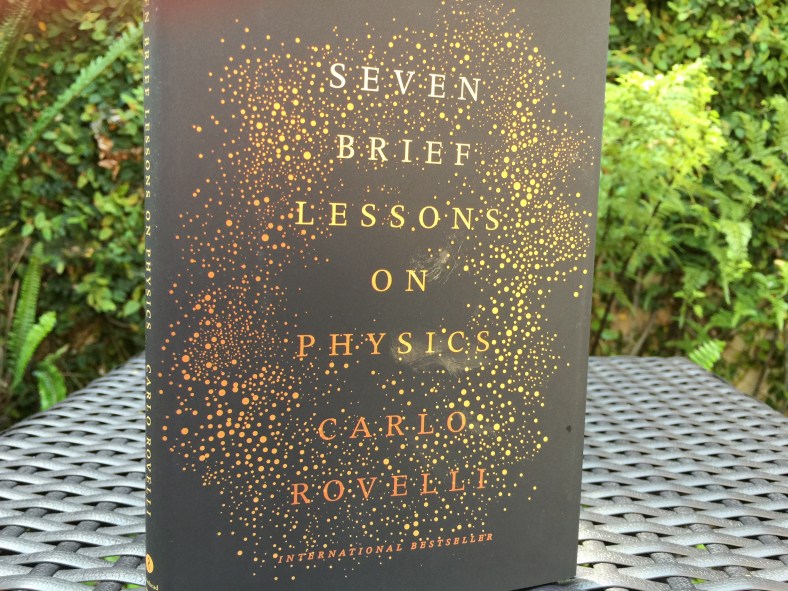
The Saturday Read ‘Seven Brief Lessons On Physics’ by Carlo Rovelli

It was the ‘chirp’ heard around the world. In February scientists announced the discovery of gravitational waves formed by two black holes colliding, confirming the century old predictions of Albert Einstein.

If you’re not a physicist or a physics major, you may have only a passing familiarity with the terms used in the previous sentence. And yet, we just experienced, in a ‘galaxy far far away’, what the New York Times science reporter Dennis Overbye described as a moment “destined to take its place among the great sound bites of science, ranking with Alexander Graham Bell’s “Mr. Watson — come here” and Sputnik’s first beeps from orbit.” 

The Saturday Read this week is ‘Seven Brief Lessons on Physics’ by physicist Carlo Rovelli of Aix-Marseille University and the Intitut Universitaire de France. Spend some time with this exquisite book and become a bit more fluent in the language of physics.

“These lessons were written for those who know little or nothing about modern science. Together they provide a rapid overview of the most fascinating aspects of the great revolution that has occurred in physics in the twentieth and twenty-first centuries, and of the questions and mysteries that this revolution has opened up. Because science shows us how to better understand the world, but it also reveals to us just how vast is the extent of what is still not known.”

Beginning with Einstein’s ‘beautiful theory’ of relativity, Rovelli follows the science beyond gravity to quantum mechanics and quantum gravity.

Is your hair is hurting? Hang in there.

“Physics opens windows through which we see far into the distance. What we see does not cease to astonish us. We realize that we are full of prejudices and that our intuitive image of the world is partial, parochial, inadequate. Earth is not flat; it is not stationary. The world continues to change before our eyes as we gradually see it more extensively and more clearly.”

Are we still talking about science? The magic of Rovelli’s prose is its simplicity in conveying painfully complex theories.

We learn the value of ‘wasting’ time.

“In his youth Albert Einstein spent a year loafing aimlessly. You don’t get anywhere by not ‘wasting’ time – something, unfortunately, that the parents of teenagers tend frequently to forget.”

And that we live in “A world of happenings, not of things.”

Rovelli describes concepts visually.

“…before experiments, measurements, mathematics, and rigorous deductions, science is about all about visions. Science begins with a vision. Scientific thought is fed by the capacity to ‘see’ things differently than they have been previously seen.”

And reminds us that “Genius hesitates.”

The essays originally appeared as a series for the culture section of  Il Sole 24 Ore, the Italian newspaper. Released last month in the U.S., the book is ranked third on the New York Times combined print & e-book nonfiction list.

Why read ‘Seven Brief Lessons on Physics’? Because it will take you on an adventure beyond your comfort zone in the time it takes you to commute to work.

“We are made of the same stardust of which all things are made, and when we are immersed in suffering or when we are experiencing intense joy, we are nothing other than what we can’t help but be: a part of our world.”


Beyond competence; resilience is the new competitive advantage

When we talk about failure, we have to talk about resilience. It’s the companion piece that measures our ability to become successful again after something bad happens. It’s not the mistake we value, it’s the recovery.

it’s what J.K. Rowling was talking about when she addressed the Harvard Class of 2008.

060508_COM_JC_425.jpg

“The knowledge that you have emerged wiser and stronger from setbacks means that you are, ever after, secure in your ability to survive. You will never truly know yourself, or the strength of your relationships, until both have been tested by adversity. Such knowledge is a true gift, for all that it is painfully won, and it has been worth more than any qualification I ever earned.”

In a recent interview , U.S. transportation secretary, Anthony Foxx, prioritized resilience over all other qualities he seeks in a potential candidate.

“What I’m trying to understand is whether the person, if things get really tough, is going to stay in there or fall apart. I’d rather hire somebody who’s maybe not a genius, but they will dig in on any assignment. I’d rather have resilience than almost any other quality. Competence is obviously critical, but a lot of people who are really smart actually end up walking away from some pretty tough assignments because they’re worried about whether they can do them or not.”

How do you demonstrate this new competence to a potential employer? How do you offer examples of your own ‘phoenix rising out of the ashes’ moment?

Andrea Ovans provides some hints in her article ‘What Resilience Means and Why It Matters’. Her survey of recent research on the topic broadens the definition of resilience to include adapting well to change, and pushing through in adversity.

“Resilient people possess three characteristics — a staunch acceptance of reality; a deep belief, often buttressed by strongly held values, that life is meaningful; and an uncanny ability to improvise. You can bounce back from hardship with just one or two of these qualities, but you will only be truly resilient with all three. These three characteristics hold true for resilient organizations as well.…Resilient people and companies face reality with staunchness, make meaning of hardship instead of crying out in despair, and improvise solutions from thin air. Others do not.”

It’s about confidence, ownership, continuous learning and an ability to adapt to a continually changing reality.

Resilience is not new. Robert Waterman, Judith Waterman and Betsy Collard were offering advice to workers and organizations over twenty years ago.

“By a career-resilient workforce, we mean a group of employees who not only are dedicated to the idea of continuous learning but also stand ready to reinvent themselves to keep pace with change; who take responsibility for their own career management; and, last but not least, who are committed to the company’s success. For each individual, this means staying knowledgeable about market trends and understanding the skills and behaviors the company will need down the road. It means being aware of one’s own skills—of one’s strengths and weaknesses—and having a plan for enhancing one’s performance and long-term employability. It means having the willingness and ability to respond quickly and flexibly to changing business needs. And it means moving on when a win-win relationship is no longer possible.”

What is new? Resilience is now a core competence, not an option. When an interviewer asks about a time you failed, respond with a narrative of strength and grit, and seize your competitive advantage.


The Saturday Read ‘A Sense of Where You Are’ by John McPhee

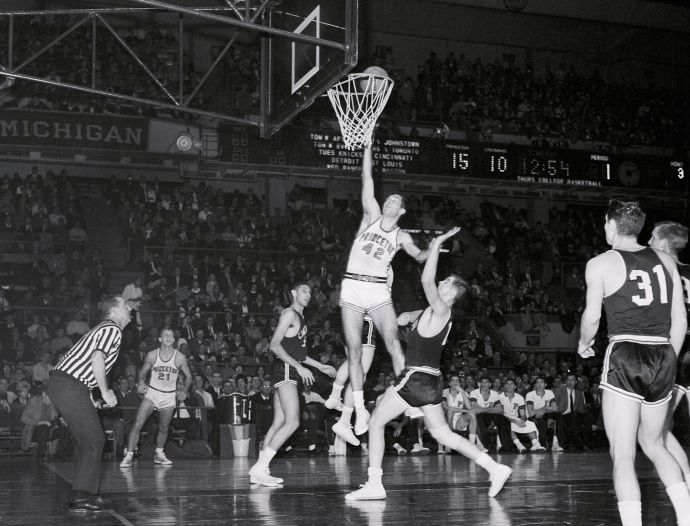
In 1964 Bill Bradley was a senior at Princeton University, and a star player on the basketball team. John McPhee was just beginning his career as a writer. In a moment to make networking history, McPhee’s dad, the athletic department physician, suggested John visit campus and profile the Ivy League phenom.

The Saturday Read this week is ‘A Sense of Where You Are’, the original New Yorker article, published in the January 23, 1965 issue.

images.jpeg

As the NCAA tournament narrows the field from 64 to 16 this weekend, let John McPhee be  your ‘throwback Saturday’ guide to Princeton University in the fall of 1964.

“The basketball locker room in the gymnasium at Princeton has no blackboard, no water fountain, and, in fact, no lockers. Up on the main floor, things go along in the same vein. Collapsible grandstands pull out of the walls and crowd up to the edge of the court. Jolly alumni sometimes wander in just before a game begins, sit down on the players’ bench, and are permitted to stay there. The players themselves are a little slow getting started each year, because if they try to do some practicing on their own during the autumn they find the gymnasium full of graduate students who know their rights and won’t move over. When a fellow does get some action, it can be dangerous. The gym is so poorly designed that a scrimmaging player can be knocked down one of two flights of concrete stairs. It hardly seems possible, but at the moment this scandalous milieu includes William Warren Bradley, who is the best amateur basketball player in the United States and among the best players, amateur or professional, in the history of the sport.”

McPhee introduces us to Bradley, his work ethic, and a time when basketball competition provided “a real period of relief from the academic load”.

Stay with me, fellow time traveller. This is not fiction. This is the future Pulitzer Prize winner, and pioneer of creative non-fiction, John McPhee, painting a picture of college life and basketball in the early 1960s.

In September of his senior year, Bradley competed on the U.S. Olympic basketball team in Tokyo, defeating Russia for the gold medal. In December, he was elected a Rhodes Scholar. He opted out of an opportunity to play for the NY Knicks to study at Oxford.

“Bradley says that when he was seventeen he came to realize that life was much longer than a few winters of basketball. He is quite serious in his application to the game, but he has wider interests and, particularly, bigger ambitions.”

Last year Marc Tracy revisited McPhee, the profile that began his career at The New Yorker, and Bradley’s last NCAA tournament.

“Fifty years earlier, McPhee had good reason to be at the Palestra for a basketball game, and for looking more than simply interested. He was covering an N.C.A.A. tournament game between Princeton and Penn State. Princeton won and then, at College Park, Md., defeated North Carolina State (whose zone press had just handled Duke) and Providence to advance to the Final Four in Portland, Ore. There, it lost to Michigan and, in the consolation game, devastated Wichita State, 118-82.”

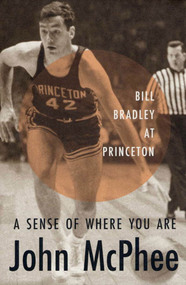
The profile, which was later expanded into a book of the same title, provides a tutorial on basketball, and the life of one true ‘student-athlete’, as he balances his academics, sport, and community involvement.

9780374526894.jpg

About that title:

“I asked him what he called his over-the-shoulder shot. He said that he had never heard a name for it, but that he had seen Oscar Robertson, of the Cincinnati Royals, and Jerry West, of the Los Angeles Lakers, do it, and had worked it out for himself. He went on to say that it is a much simpler shot than it appears to be, and, to illustrate, he tossed a ball over his shoulder and into the basket while he was talking and looking me in the eye. I retrieved the ball and handed it back to him. “When you have played basketball for a while, you don’t need to look at the basket when you are in close like this,” he said, throwing it over his shoulder again and right through the hoop. “You develop a sense of where you are.”

In 1964 his classmates predicted Bradley might run for governor in his home state of Missouri, and one day run for president.

With Bradley off to Oxford, McPhee closed his profile with this sentence.

“And like Hank Luisetti, of Stanford, who never played professional basketball, he will have the almost unique distinction of taking only the name of his college with him into the chronicles of the sport.”

That was not the end of the story.

Bradley returned after earning a masters degree at Oxford to play ten seasons with the NY Knicks, and was inducted into the Basketball Hall of Fame in 1983. He served as the U.S. Senator from New Jersey (not Missouri) from 1979-1997. And he ran for president in 2000.

In the 2015, NY Times article,“Bradley explained what the book’s title means to him”.

“You have a sense of where you are in life,” he said. “You don’t get carried away. You know who you are. You understand the environment, the context in which you’re living, and you make decisions based upon the centeredness.”

He added, “You’re also always working on who you are.”


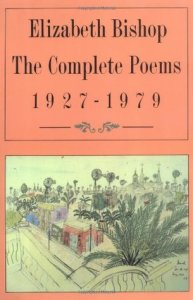
‘One Art’ a poem by Elizabeth Bishop

This week a candidate competing in the Republican presidential primary suspended his campaign. Another continues to label his opponents ‘losers’. In the noise of our success driven culture we have lost respect for the fine art of losing. The Friday Poem this week is from American poet, Elizabeth Bishop, who reminds us that we all “Lose something every day.” 

Being a loser is not a bad thing, it’s a human thing.

One Art

The art of losing isn’t hard to master;
so many things seem filled with the intent
to be lost that their loss is no disaster.

Lose something every day. Accept the fluster
of lost door keys, the hour badly spent.
The art of losing isn’t hard to master.

Then practice losing farther, losing faster:
places, and names, and where it was you meant
to travel. None of these will bring disaster.

I lost my mother’s watch. And look! my last, or
next-to-last, of three loved houses went.
The art of losing isn’t hard to master.

I lost two cities, lovely ones. And, vaster,
some realms I owned, two rivers, a continent.
I miss them, but it wasn’t a disaster.

—Even losing you (the joking voice, a gesture
I love) I shan’t have lied. It’s evident
the art of losing’s not too hard to master
though it may look like (Write it!) like disaster.

Elizabeth Bishop   ‘The Complete Poems 1926-1979’

420278

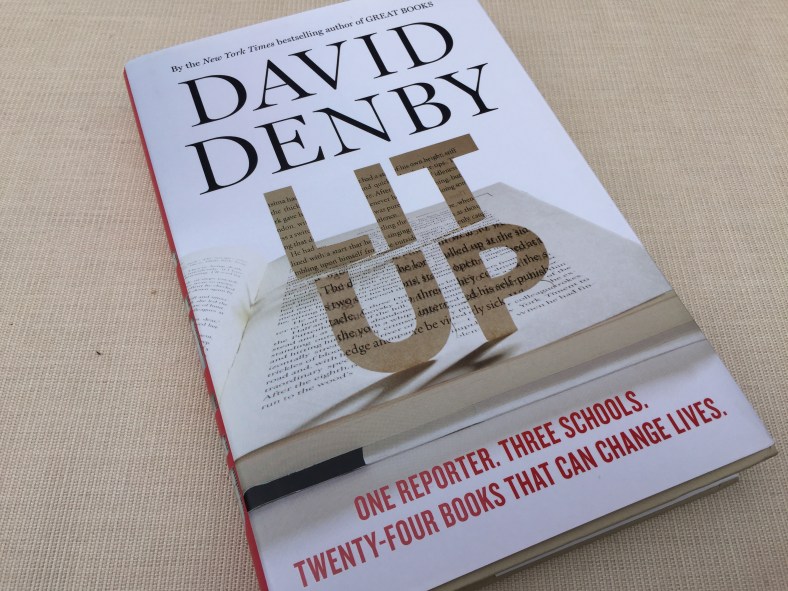
The Saturday Read ‘LIT UP: One Reporter, Three Schools. Twenty-Four Books That Can Change Lives.’ by David Denby

If you believe that the humanities are as critical as STEM skills in the 21st century workplace, take a trip back to high school with David Denby and this week’s Saturday Read, ‘LIT UP’: One Reporter. Three Schools. Twenty-Four Books That Can Change Lives.

We have this basic disconnect in our workplace today that is pitting generalists against specialists. The consequences are trickling down into our public education system.

If you’re a parent considering where to invest in your child’s college education, you’re probably looking at ‘vocational’ programs that ‘guarantee’ a job at graduation. If you’re that same parent, but now in the role of organization executive, you realize your recruiting efforts must consider ‘cultural contribution’; potential in addition to skill set. If you’re a student, you hear ‘STEM good, humanities bad; or worse, a waste of time’.

Writing in The New Yorker in February, Mr. Denby addressed the challenge in advocating for the humanities in today’s skill driven education/employer complex. He cited recent state government efforts to offer ‘bonus premiums’ in financial aid to students enrolled in STEM degree programs by cutting funding to students in the humanities.

“Lifetime readers know that reading literature can be transformative, but they can’t prove it. If they tried, they would have to buck the metric prejudice, the American notion that assertions unsupported with statistics are virtually meaningless. What they know about literature and its effects is literally and spiritually immeasurable. They would have to buck common marketplace wisdom, too: in an economy demanding “skill sets”—defined narrowly as technical and business skills—that deep-reading stuff won’t get you anywhere.” 

In ‘LIT UP’ David Denby is searching for the magic that transforms a young reader into a lifetime reader. “How do you establish reading pleasure in busy screen-loving teenagers – and in particular, pleasure in reading serious work? Is it still possible to raise teenagers who can’t live without reading something good? Or is that idea absurd? And could the struggle to create such hunger have any effect on the character of boys and girls?”

He chooses to go back to school for the 2011-12 academic year at Beacon, a New York City magnet high school, at the time located on West 61st St, observing teacher Sean Leon‘s tenth grade English class.

“School was the place to find out. And students in the tenth grade, I thought, were the right kids to look at. Recent work by neuroscientists has established that adolescence, as well as early childhood, is a period of tremendous “neuroplasticity”. At that age, the brain still has a genuine capacity to change.”

The book is structured by months, and reading selections. Mr. Leon introduces each book with inventive assignments, questions and at one point, a ‘digital fast’. Mr. Denby provides thumbnail plot sketches to shake the cobwebs from our ‘required reading’ memories. And we meet the students, by pseudonym, in their reactions to the literature.

At one point, the author gives the students a questionnaire to find out what books they read on their own, and their favorite authors. He finds three ‘real readers’ in a class of 32. “…unfairly or not, I was sorry that among Mr. Leon’s students there were no mad enthusiasms, no crazy loves, no compulsive reading of every book by a single author…”

In writing the book, he was encouraged by colleagues to create a scalable review, contrary to his initial approach, resisting quantification, and observing “a single place where literary education seemed to be working.” 

He realized that you can’t clone Beacon’s Sean Leon. He wanted other teachers to learn from Leon’s methods, but realized additional perspectives would add to his narrative.

“Typicality and comprehensiveness remained impossible to achieve, but variety was not. I delayed finishing the book, and, in the academic year 2013-14, I visited tenth-grade English classes in two other public schools – shuttling up many times during the year to James Hillhouse High School, an inner-city school in New Haven with a largely poor African American population; and five times in the spring to a school in a wealthy New York suburb, Mamaroneck, a “bedroom town” in the language of the fifties, where people sent their kids to good schools.”

Mr. Denby’s appendix includes the reading lists for each of the schools he visited and a ‘where are they now?’ college destination roster of the Beacon English Class of 2014. “There is, of course, no ideal reading list, no perfect syllabus, no perfect classroom manner, but only strategies that work or don’t work. In a reading crisis, we are pragmatists as well as idealists.”

“Teenagers, distracted, busy, self-obsessed, are not easy to engage – not by their teachers or by their parents. To keep them in the game, the teachers I watched experimented, altered the routine, changing the physical dimensions of the class. They kept the kids off balance in order to put them back in balance. They demanded more of students than the students expected to give.”

This is a book for parents, parents who are business leaders; teachers and the politicians who minimize their value; and students. We’re in a reading crisis and we need folks who have emotional intelligence, who can think, judge, make decisions and create a vision for an enterprise within a global world view.

“Teachers are the most maligned and ignored professionals in American life. In the humanities, the good ones are as central to our emotional and moral life as priests, ministers, rabbis, and imams. The good ones are not sheepish or silent in defense of literature and history and the rest. They can’t be; the children’s lives are right before them. In high-school English, if the teachers are shrewd and willing to take a few risks, they will try to reach the students where they live emotionally. They will engage, for instance, with “naïve” existential questions (what do I live for?) and also adolescent fascination with “dark” moods and the fear of being engulfed by adult society. Shakespeare, Mary Shelley, Poe, Hawthorne, Twain, Stevenson, Orwell, Vonnegut, and many others wrote about such things. And if teachers can make books important to kids—and forge the necessary link to pleasure and need—those kids may turn off the screens. At least for a few vital hours.”

“Know something about something…”

What is this thing; lifelong learning? David Brooks called it the ‘question-driven life’, and the late diplomat Richard Holbrooke delivered one of the best defining quotes: “Know something about something. Don’t just present your wonderful self to the world. Constantly amass knowledge and offer it around.” 

Lifelong learning = Curiosity

Recently, in a response to a consultant survey, Michael Dell, the chief executive of Dell, Inc. identified curiosity as the one attribute a leader will need to succeed in the future.

Journalist and questionologist, Warren Berger reports ‘Why Curious People Are Headed To the C-Suite’ for the Harvard Business Review.

“Dell was responding to a 2015 PwC survey of more than a thousand CEOs, a number of whom cited “curiosity” and “open-mindedness” as leadership traits that are becoming increasingly critical in challenging times. Another of the respondents, McCormick & Company CEO Alan D. Wilson, noted that business leaders who “are always expanding their perspective and what they know—and have that natural curiosity—are the people that are going to be successful.

“These days, a leader’s primary occupation must be to discover the future,” Panera Bread CEO Ron Shaich told me. It’s “a continual search,” Shaich says, requiring that today’s leader keep exploring new ideas—including ideas from other industries or even from outside the business world.”

OK, you’re not the head of a multi-national corporation, but you have questions, and not just about the technical aspects of work. It’s the human stuff that’s a bit more difficult to unbundle.

There have been continuing education and extension programs catering to adult learning for a hundred years. Most are connected to an academic institution and offer ‘lite’ versions of curricula taught to college students.

In the summer of 2008, ‘philosopher of life’ Alain deBotton founded ‘The School of Life’ in London a few blocks walk from the Russell Square Underground Station. Since then it has evolved into the new model for lifelong learning, employing non-traditional faculty to deliver programing focused on “developing emotional intelligence through the help of culture. We address such issues as how to find fulfilling work, how to master the art of relationships, how to understand one’s past, how to achieve calm and how better to understand, and where necessary change, the world.”

In the Marchmont Street location, and recently opened global sites, professionals come together to learn, share and evolve in a safe space of respectful interaction. This past weekend, SOL offered a ‘pop-up’ sampling of programs in Los Angeles. I attended three of the five sessions led by philosopher and trust consultant, Brennan Jacoby.

On a beautiful California Saturday morning, a diverse group of students arrived at the Design Matters Gallery to begin a day of three, 90 minute sessions. The content informed, inspired and provoked lively discussion.

The School of Life model works because talented faculty deliver contemporary topics, using an instructional technique that allows for the right balance of introspection, sharing and networking. Sessions seemed to end too soon, with attendees lingering to continue conversations.

For the Los Angeles weekend the topics included: How to Find A Job You Love, How to Be Creative, How to Think Like an Entrepreneur, How to be Confident and How to Have Better Conversations.

The School of Life is a catalyst for the question-driven life. If you’ve decided your ‘wonderful self’ is not quite perfect yet, and you’re “ready to amass knowledge and offer it around”, set you lifelong learning GPS on London, or visit the website to begin your quest.